
UPDATED with more details: The streets of Los Angeles are calmer today after a weekend of ICE raids, protests, police actions and Donald Trump‘s federalization of the California National Guard over the objections of Gov. Gavin Newsom. However, as Newsom sues Trump over his “illegal order,” the White House has escalated the stakes with U.S. Marines now set to arrive in the City of Angels.
Amid a mounting legal clash between the federal government and the state of California, President Donald Trump suggested his border czar Tom Homan should arrest Gov. Gavin Newsom.
“I would do it … I think it would be a great thing,” Trump said June 9 when asked if Homan should arrest the governor, who has challenged the administration’s mobilization of National Guard troops to crack down on violent protests against immigration raids in Los Angeles. The president also attacked Newsom as “grossly incompetent.”
Newsom was aghast: “The President of the United States just called for the arrest of a sitting Governor. This is a day I hoped I would never see in America,” he said on X.
“The authority that the president cites to only allow for the deployment of the National Guard by the president when there’s an invasion by a foreign nation, which there’s not, when there’s a rebellion to overturn leadership of the United States of America, which there’s not, or when the regular forces of the federal government cannot execute the law, which is also not present,” Bonta said.
The lawsuit also argues that the state’s governor is the commander in chief of the Guard and must consent to its federalization. Newsom has not done so, and has “strenuously objected” to it, the state’s top prosecutor said.
Yesterday I discovered one of my great grandfathers founded a Turnverein Hall on Bush Street in San Francisco. This hall was a place one could go hear music and practice gymnastics. The Seamens Friendly Union met here, and the Vigilance Committee. Plays were performed, and debates held. This is the radical root of San Francisco that I have traced to the Longshoreman’s Hall and the first Acid Tests. The Turner hall offered music and other entertainment as an alternative to gambling and prostitution. My father was a Merchant Marine and would be pleased to know the first institution for furthering sailor rights met in the Bush hall.
“All seamen are invited to attend at the Turn Verein Hall on Bush Street between Stockton and Powell Streets on Thursday Evening, January 11 at 7 1/2 o’clock to form a Seamens Society for the Pacific Coast.”
The Vigilance Committee combatted corruption and violence. These were idealists that lay the groundwork for a city famous for it cultural revolutions.
The 1856 committee was also much larger than the committee of 1851, claiming 6,000 in its ranks. The committee worked very closely with the formal government of San Francisco. The president of the Vigilance Committee, William T. Coleman, was a close friend of Governor J. Neely Johnson and the two men met on several occasions working towards the shared goal of stabilizing the town.[11] Another important figure at this time who would later come to make a name for himself in the Civil War is William T. Sherman. Sherman was running a bank when Governor Johnson requested he become the commander of the San Francisco branch of the state militia in order to curb the activities of the Committee. Sherman accepted the position two days before the murder of King by Casey.[12]
The California Fusileers
Posted on May 7, 2021 by Royal Rosamond Press
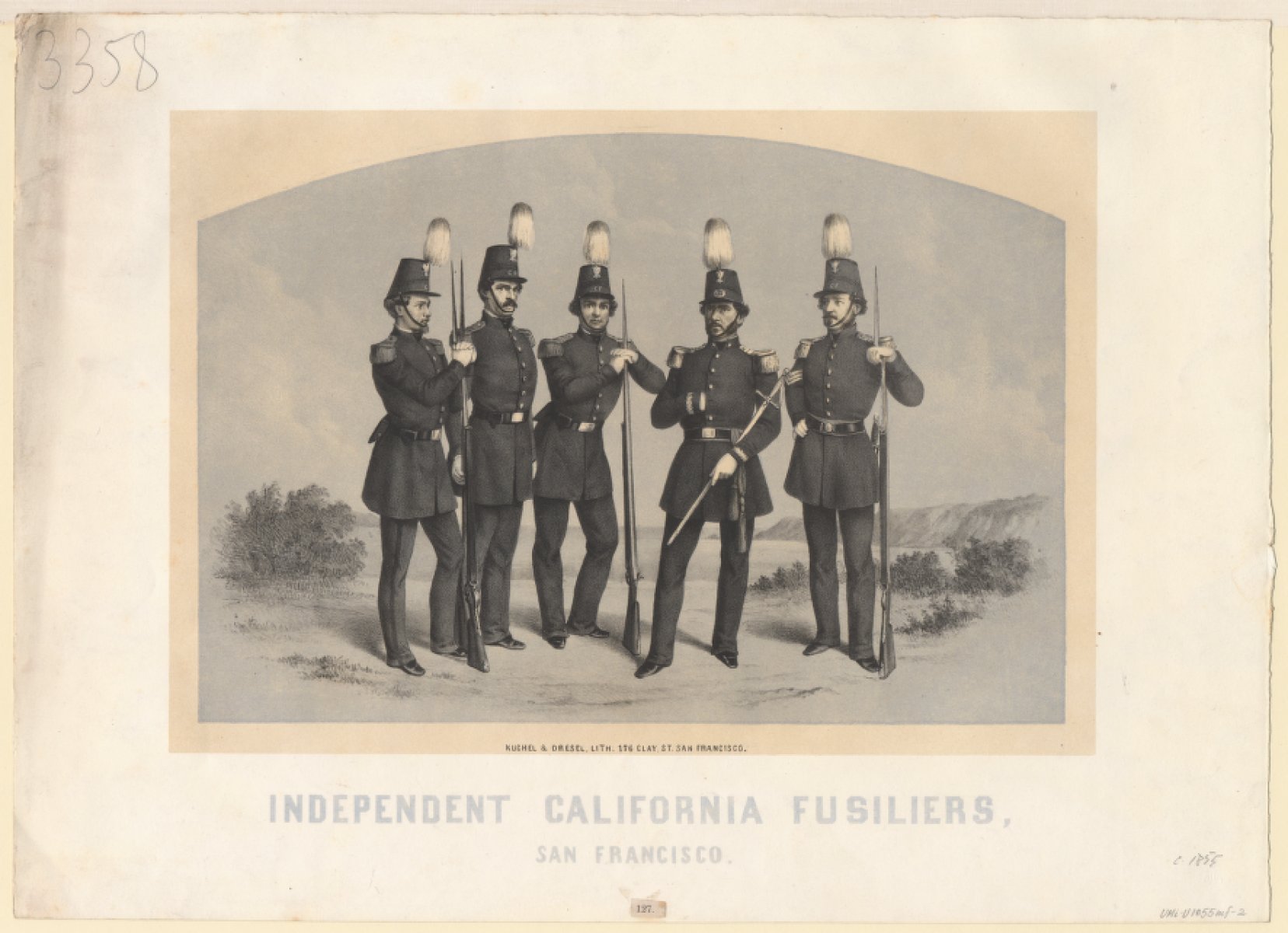
My ancestors were wealthy Prussians. Were they investors in Prussia’s attempt to purchase California, that did not happen possibly due to the Revolutions of 1848? Did some Germans realize California could be had by a intensive migration? The six million dollars could be used to buy portable homes, and other necessities. The chances Count Cipriani purchased a portable home from Carl Janke, is high. Unless he brought one in his wagon train.
The Jankes were members of the California Fusiliers. Did they have any contact with my kin, John Fremont, who was talked out of founding a new nation in the West during the Civil War. Consider the Manifest Destiny propaganda of his father-in-law and John Astor, who paid Washington Irving to author a propaganda novel that clamed the right of Americans to take the Oregon Territory – from BRITISH ROYALS. Astor launched a financial conquest of China – that could be the model for China today! If they take over Central America, will they manufacture Chinese cocaine after exterminating the criminal cartel and all gangs south of the border? Texans would be – pleased as punch! As long as China does not take away their right not to wear masks – or their guns! What about – their God? China could get its powerful think tank to invent a Cocaine Jesus for anti-Democratic cult followers, who will honor the day the Democrats cheated them our of their birth right with fake elections. To the Chinese, we look like members of a superstitious Cargo Cult, we easy pickens when it comes to….Divide and Conquer. Our tribal system is open to covert bribes, pitting one tribe against another tribe.
John Presco ‘Author of The Royal Janitor’
California Fusileers (militarymuseum.org)
On November 29, 1858, M.C. Blake, County Judge of San Francisco County, appointed Major Isaac Rowell to enroll members in a volunteer military company to be known as the California Fusileers. The name fusileer (or fusilier) originally applied to a soldier armed with a fusil. In the British Army the designation Fusiliers is still retained by ten regiments distinguished from the other regiments of the line only by wearing a kind of busby and other peculiarities in costume.
Accordingly on December 9, 1858, Major Rowell presided at the meeting and superintended the election of officers of this new organization. F. G. E. Tittel was elected Captain and Peter Lesser, First Lieutenant. The company was composed almost entirely of German citizens of San Francisco and was a well drilled unit.
Their first recorded appearance in public was in connection with the elaborate military reception tendered to General Winfield Scott on October 18, 1859. Governor Weller and other dignitaries attended the reception and tendered their respect to the famous hero of the Mexican Campaign. (1)
The path of the California Fusileers proved to be rough and rather stormy for in the latter part of 1863, a bitter feud between Captain Tittel and Colonel West, commanding the First Regiment of Infantry, culminated in the refusal of Colonel West to deliver uniforms to Company E, California Fusileers as long as Captain Tittel was in command. When Captain Tittel was promoted to Colonel of the Sixth Infantry Regiment, First Lieutenant John Obeneimer made a new demand to Colonel West for their uniforms.
The Colonel again refused to deliver the uniforms until the company should show that their bona fide active members were sufficient to comply with the law, and that the officers evinced a disposition to do their duty and obey proper orders and regulations. In reply to this letter, the Lieutenant urged the Colonel to prefer charges against him if he had been negligent in duty or disobeyed orders. The Lieutenant was a “fighter” evidently, for he not only contradicted the Colonel but he took the matter up with Brigadier-General Ellis, who then ordered.an inspection of the company by Major Hill on December 10, 1863. The inspection showed their arms and equipirient in good and serviceable order, their books well kept but in German language, the discipline of the company good and their drill passable. Thirty-seven members were in old and badly worn uniforms, and seven without any uniforms. These uniforms belonged to the old company and were private property.
The records do not reveal the outcome of the strife, but it is assumed that the unit received their uniforms for soon after the passing of the Inspection, the California Fusileers were transferred to the Sixth Infantry Regiment, Second Brigade as Company A. The Colonel of this Regiment was the California Fusileers’ first Captain (F. C. E. Tittel) and no doubt the new assignment ended the ill-feeling between Colonel West and the California Fusileers.
With the conclusion of the Civil War the need for a large militia force was lessened and the Legislature passed a law reducing the number of the militia. This law provided for the organization of a Board of Organization and Location. The duty of this Board was to select companies that were to be mustered out, their selection being decided according to local requirements, ability.to concentrate on short notice, and the ability to meet the standards required regarding efficiency and enrollment of individual companies. It is assumed the California Fusileers was mustered out because of their location in relation to military need, since a large number of companies were mustered out in San Francisco for that reason. Their mustering out occurred on July 23, 1866.
The Armory Hall at Sacramento and Montgomery Streets, home of the California Fusiliers.
The Prussian Kingdom of Jerusalem and California
Posted on December 22, 2020 by Royal Rosamond Press
Trump is talking about implementing Marshall Law. I believe he has been considering doing this in California for a couple of years. He has sent his idiotic advance guard in the form of The Newt and The Hucklehead.
FLASH! Trump’s ‘Patriot Prayer’ group attacked the Oregon State House and two reporters. This is coming from THE President. Never before in history have we had a leader who encourages civil disobedience – and attacks on the press! I am writing a James Bond novel to get my politics and message across – as well as weaken Putin.. A year ago I had Victoria Bond and Miriam Christling become lovers to counter the anti-gay bashing in Russia. San Francisco led the world in Gary Rights. Ian Fleming is kin to all the Gettys. Governor Newsom is being attacked by the religious-right. This is – REVENGE! Are the Trumpites reading my blog?
My grandfather the author was a friend of Dashiell Hammet and taught Erl Stanley Gardener to write. He camped on the Channel Islands with Black Mask writers. My spy novel ‘The Royal Janitor’ should be a SF landmark, a part of the Starter Sourdough.
I showed up dressed as the Anti-Christ at a armed 3% rally in Eugene Oregon that clashed with a Gay Rights rally. This militia promised Biblical stuff – too!
John ‘The Seer’
(1) Patriot Prayer Is Dragging Antifa Into An Unwinnable PR War (HBO) – YouTube
The Black Mask – Writes Again! | Rosamond Press
Two journalists, Brian Hayes of the Salem Statesman-Journal and Sergio Olmos of OPB, said they were assaulted by protesters Monday afternoon.
OSP has identified Jeremy Roberts, 40, as the man who attacked the reporters. Roberts has not been located by officers yet.
Covid US: Anti-lockdown protesters hit Oregon State Capitol building | Daily Mail Online

The Royal Janitor
by
John G. Precsco
Copyright 2020
While Starfish salivated over the target rifle that Admiral William Augustus Lee used when he won his first gold medal, Victoria took in the old map that was hung on the back of the display. She had seen it before. In her work at the Royal College of Arms, she had seen many old maps that were provided as evidence of a royal or Baronic lineage. Claims to land – played a huge role in owning a title and cote of arms!
Pressing her nose to the glass, Victoria was now nine years old. When she read the name Charles Preuss, she went into a deep trance. She had looked at a dozen copies of this map filed in the College to back up claims for large chunks of California. Taking out her cellphone, she googled John Fremont. Preuss went on…
First Portable Houses In San Francisco
Posted on June 25, 2024 by Royal Rosamond Press

Charles Ferdinand Janke
Three of the portable houses Carl Janke brought around the Cape, ended up in the City of San Francisco. This makes my great, great, grandfather – A PIONEER BUILDER OF SAN FRANCISCO! Why wasn’t I told this by The Belmont Historical Society when I first made contact with them? Why wasn’t I made aware there is another JANKE LINE of my blood relatives? Why are there so many Frenchman meeting in the Turn Verin Hall Janke built? I demand the City of Belmond fund my study!
I have been struggling to understand why it is, when anything good happens to me, friends and family, diminish it, even try to destroy it. What is…..it? Mark Gall did nothing to help me.
I doubt Cipriani dissembled his home, shipped it to the East Coast, then put it in wagons heading West. This would have cost his a fortune. How many wagons would be needed? Did Carl Janke have a unsold portable house already there in Belmont? Was it two story, the premier house – that perhaps Carl wanted for himself? How come there is no discretion of the Janke dwelling? Is it possible Ralston bought the Janke house, and built his manor around it? There exist a floorplan showing the original house. I have to locate it. Cipriani write about the five thousand SCREWS it took to assemble his house that was a Western Wonder! Where did it come from? I suspect Hamburg. My kindred, Jessie Benton, lived in a pre-fab that may have been purchased from Janke.
John Presco
New York was a major source. It was estimated that 5000 houses had been sent from NY to SF, or were under contract, by fall of 1849. Boston, Maine, and Philadelphia were suppliers too. There was a wooden cottage from Hamburg, Germany, in 42 packages. From Le Havre, France, came a “maison demontee” valued at 800 francs. China was another source. A two-room house from China sheltered Jessie Benton Fremont (wife of John C. Fremont) in Happy Valley, summer of 1849. The house was made of sliding panels, like furniture and without nails, and often a Chinese carpenter or two was included in the package, to assemble it.
Because there were many Frenchmen in the committee Coleman called for all the French speakers to assemble in the middle of the room and also divide into companies of a hundred men, and from each company select officers who spoke their own language.
Elizabeth D. Johnson
Birth Place: Germany
Pioneer Father:Carl August Janki
Birth Place: Germany
Date of Arrival in California: Sept. 12, 1850
Pioneer Mother: Anna Dorthea Peterson
Birth Place: Germany
Date of Arrival in California: Sept. 12, 1850
Death: Father: Belmont 1881; Mother: Belmont 1881
Remarks: My father was the first to bring portable houses to the city. I believe two were erected where Sherman & Clays Music store now stands (Sutter & Kearney). One on Montgomery Street on part of the lot now occupied by the D.O Mills building and two on Folsom Street near First All were covered with slate roofs. My two brothers were the flag of the Old Fusilier Guard. A building company called California Fusiliers (German) of which Colonel Little was the captain. My father also built and managed the first Turn Verein Hall situated on Bush Street near Powell. The hall was dedicated Christmas Eve and all the people of note in the city attended the exercises.
Mrs. Johnson passed away Jan. 20, 1829.
I insist the History Department of Stanford assist me in gathering all the information there is on Carl Janke and Family so it can be studied.. I will post in increments. Two of the portable houses that Janke brought around the Cape were erected in San Francisco. Carl built a Turnverein Hall in the city my father was born.
John Presco
john-presco@rosamondpress.com
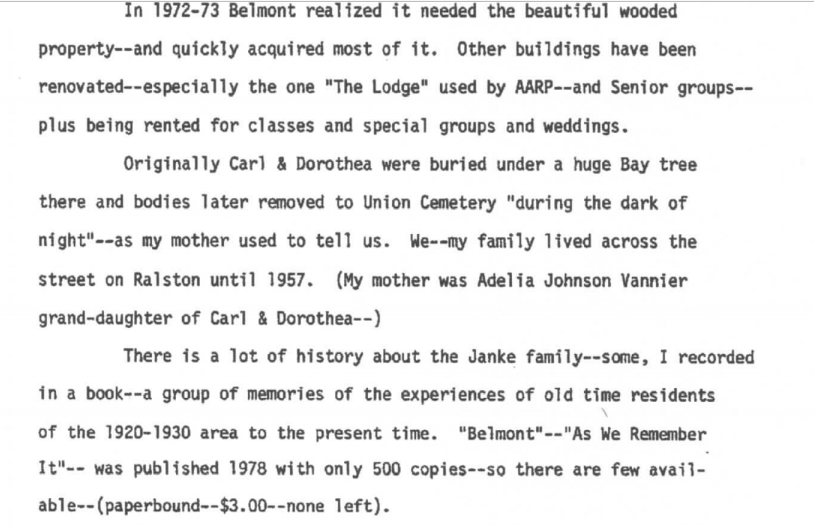
Page 56 – Her Side of the Story (californiapioneers.org)
Elizabeth D. Johnson
Overview
This two-story villa, created by an Italian artistocrat, Leonetto Cipriani, active in the Italian Risorgimento, was one of the first extensive country estates on the San Francisco Peninsula. Cipriani served as San Francisco Consul of the Kingdom of Sardinia between 1852 and 1855, residing in this house between about 1852 and 1862.
Building History
The first, large residence on this Belmont property was erected by Count Leonetto Cipriani (1812-1888), a Corsican by birth whose family had developed successful businesses in Tuscany. Cipriani was dispatched by King Victor Emmanuel II (1820-1878) to become the first Consul of the Kingdom of Sardinia to San Francisco in 1852. Cipriani purchased property in the Cañada del Diablo in what would become Belmont, CA, and proceeded to erect a prefabricated timber dwelling, built before large amounts of lumber had become available in the region.
The San Francisco Examiner related some of the history of his house in an article of 1880: “The first neighbor that occupied the [Belmont] valley was the celebrated Italian General, Cipriani, who had distinguished himself under Charles Albert, the predecessor of Victor Emmanuel, in the wars waged for the unity and liberty of Italy, and who, coming to America, had married an accomplished young lady, the daughter of one the first families of Baltimore. For Cipriani’s eminent services, his country had made him a General and a Senator. Cipriani bought the forty acres which now constitute the grounds of the [Ralston-] Sharon mansion, and erected a picturesque little residence on that mansion’s present site. Cipriani lived alternately between peaceful California vale and war-tossed Italy. In 1862, General Cipriani sold to W.C. Ralston the property, and Mr. Ralston was at first contented with building additions to the house, but, being in this way unable to entirely satisfy his architectural yearnings, in 1868, the then structure was entirely razed, and the present residence partially built and subsequently added to.”(See “Wedded,” San Francisco Examiner, 12/24/1880, p. 1.)
Banker William C. Ralston owner of great wealth deriving from Nevada’s Comstock Silver Lode, purchased the house and acreage from Cipriani in 1862, just after most of Italy was unified on 03/17/1861. Ralston added onto the small house but decided to erect a large one from scratch in 1868.
Cipriani, returned to Italy and participated at the highest levels in the Italian Risorgimento led by Giuseppe Garibaldi (1807-1882). He retired to his Corsican birthplace of Ortinoli di Centuri in the early 1880s, where he died in 1888.
Building Notes
Ralston Hall was listed on the National Register of Historic Buildings: Survey number HABS CA-1674; Building/structure dates: c. 1855 initial construction; National Register Number: 66000234; c. 1865-1870;
Demolition
The Cipriani Villa was razed by William C. Ralston in 1868.
Prefabs in the Gold Rush
Historical Essay
by Paul Fisher
Today when most people think of prefab housing, they think of Airstreams or “doublewides” or edgy buildings from avant-garde magazines. In the early 20th century they were an ideal of future civilization for modernists like the Bauhaus. But they were fully operational in the mid-19th century, with a definite presence in the raw, rough new city of San Francisco. Thousands rushed in but there was almost no infrastructure or housing stock for them. Tents and shanties were popular by default. Some slept on wagon beds or under overturned boats. There were no local construction trades or suppliers of building materials. To fill this void, entrepreneurs resorted to “packaged” houses mostly from from the Eastern US.
New York was a major source. It was estimated that 5000 houses had been sent from NY to SF, or were under contract, by fall of 1849. Boston, Maine, and Philadelphia were suppliers too. There was a wooden cottage from Hamburg, Germany, in 42 packages. From Le Havre, France, came a “maison demontee” valued at 800 francs. China was another source. A two-room house from China sheltered Jessie Benton Fremont (wife of John C. Fremont) in Happy Valley, summer of 1849. The house was made of sliding panels, like furniture and without nails, and often a Chinese carpenter or two was included in the package, to assemble it. Iron structures were sent west too. Their attraction was that they were strong and non-combustible, very appealing to a town that had already caught fire several times in such a short period. But they could have a large solar heat gain, so were favored for commercial rather than for residential use, and in a wildfire the iron would melt. All these buildings had to be shipped around Cape Horn, and so transportation was a major cost factor. Toward the end of the prefab boom, mid-1850s, when supply was catching up with demand, the fabricators sometimes barely broke even, or took a loss. Some shippers, rather than send the houses back to the East Coast, would send them on to Hawaii and sell at a discount. Three photographs show examples of prefabs.

Photo: OpenSFHistory.org, wnp71.0521
The first photograph is one of the earliest views of San Francisco, part of a panorama looking north from Rincon Hill, which in those days really was a hill. In the foreground is Happy Valley, formerly a tent city, located around 3rd and Howard. Identical prefab residences are conspicuously scattered all over, like little Monopoly houses.

Photo: Photo, Library of Congress, HABS CAL, 48-BENI, 12
A second photograph shows a charming prefab Carpenter Gothic cottage from late 1849. It actually exists in Benicia, known as the Frisbie-Walsh house, but it had two other clones, one in San Francisco, known as the Burritt house (no longer extant). The other clone still exists however, in Sonoma, known as Lachrymae Montis, residence of General Mariano G. Vallejo. John Frisbie was Vallejo’s son-in-law. Burritt is the famous “Maltese Falcon” alley on Nob Hill. The City of Benicia was named after the wife of M. G. Vallejo, just as the City of Vallejo was named after Vallejo himself. Lot of history here!

Photo: San Francisco History Center, San Francisco Public Library
The third photograph is the prefab Stanyan house, 2006 Bush Street, one of the 3 or 4 oldest existing houses in SF, from 1854. It is City Landmark No. 66, occupied by the family for over 110 years. It came from Boston and is very simple and modest, like most pre-Victorian structures.
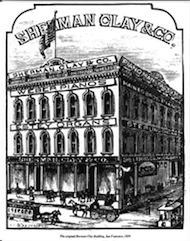
When Sherman Clay, a San Francisco establishment since Leander Sherman opened the first store on Kearny Street in 1870, announced closing its stores, pianists and even mere piano owners expressed regret. A piano teacher in Pleasanton said:
Sherman Clay’s sale has been going for a while already. It’s very sad, because it has done a lot for our Tri-Valley community and local MTAC branches — offering very good concerts; inviting well-known musicians and music teachers for lectures. I had a very good business going with them, referring my students to their Walnut Creek store to purchase piano. Very sad, it feels like I am loosing a good friend.
California Militia and National Guard Unit HistoriesCalifornia Fusileers (or Fusiliers)Official or Other Names:
- California Fusileers, Company E, First Infantry Regiment, Second Brigade, California Militia;
- After 1864 California Fusileers, Company A, 6th German Infantry Regiment, 2nd Brigade, California Militia (after 1866, National Guard of California
Location: San Francisco, San Francisco CountyArmory: Initially the Turn-Verein Hall on Bush Street. Later, Armory Hall on the corner of Sacramento and Kearny Streets.Organized: September 3, 1856
Mustered In: December 9, 1858Mustered Out: July 23, 1868 Commanding Officers F. G. E. Tittel, Captain; Elected December 9, 1858; Commissioned January 14, 1859
Peter Lesser, First Lieutenant; Elected December 9, 1858; Commissioned January 14, 1859
F. G. E. Tittel, Captain, Re-elected December 9, 1861John Obeneimer, First Lieutenant; Elected December 9, 1861, Commissioned February 6, 1862
John Obeneimer, Captain; Elected March 17, 1864; Commissioned April 9, 1864
Rudolph Meiners, First Lieutenant; Elected March 17, 1864; Commissioned April 9, 1864
John Obeneimer; Captain; Re-elected December 9, 1864Jacob Zech, First Lieutenant; Elected December 9, 1864; Commissioned December 16, 1864
John Obeneimer, Captain; Re-elected December 9, 1865Christian Bohn, First Lieutenant; Elected December 9, 1865; Commissioned January 3, 1866 Unit papers on file at the California State Archives: a. Organization Papers 2 documents (1858)
b. Bonds 3 documents (1860-1862)
c. Correspondence (Unclassified letters) 17 documents (1855-1864)
d. Election Returns 6 documents (1859-1865)
e. Exempt Certificates, Applications for none
f. Muster Rolls, Monthly returns 10 documents (1858-1866)
g. Oaths Qualifications 3 documents (1864)
h. Orders none
i. Receipts, invoices 3 documents (1861-1864)
j. Requisitions 3 documents (1859-1861)
k. Resignations 1 document (1861)
l. Target Practice Reports none
m. Other none
History
On November 29, 1858, M.C. Blake, County Judge of San Francisco County, appointed Major Isaac Rowell to enroll members in a volunteer military company to be known as the California Fusileers. The name fusileer (or fusilier) originally applied to a soldier armed with a fusil. In the British Army the designation Fusiliers is still retained by ten regiments distinguished from the other regiments of the line only by wearing a kind of busby and other peculiarities in costume.
Accordingly on December 9, 1858, Major Rowell presided at the meeting and superintended the election of officers of this new organization. F. G. E. Tittel was elected Captain and Peter Lesser, First Lieutenant. The company was composed almost entirely of German citizens of San Francisco and was a well drilled unit.
Their first recorded appearance in public was in connection with the elaborate military reception tendered to General Winfield Scott on October 18, 1859. Governor Weller and other dignitaries attended the reception and tendered their respect to the famous hero of the Mexican Campaign. (1)
The path of the California Fusileers proved to be rough and rather stormy for in the latter part of 1863, a bitter feud between Captain Tittel and Colonel West, commanding the First Regiment of Infantry, culminated in the refusal of Colonel West to deliver uniforms to Company E, California Fusileers as long as Captain Tittel was in command. When Captain Tittel was promoted to Colonel of the Sixth Infantry Regiment, First Lieutenant John Obeneimer made a new demand to Colonel West for their uniforms.
The Colonel again refused to deliver the uniforms until the company should show that their bona fide active members were sufficient to comply with the law, and that the officers evinced a disposition to do their duty and obey proper orders and regulations. In reply to this letter, the Lieutenant urged the Colonel to prefer charges against him if he had been negligent in duty or disobeyed orders. The Lieutenant was a “fighter” evidently, for he not only contradicted the Colonel but he took the matter up with Brigadier-General Ellis, who then ordered.an inspection of the company by Major Hill on December 10, 1863. The inspection showed their arms and equipirient in good and serviceable order, their books well kept but in German language, the discipline of the company good and their drill passable. Thirty-seven members were in old and badly worn uniforms, and seven without any uniforms. These uniforms belonged to the old company and were private property.
The records do not reveal the outcome of the strife, but it is assumed that the unit received their uniforms for soon after the passing of the Inspection, the California Fusileers were transferred to the Sixth Infantry Regiment, Second Brigade as Company A. The Colonel of this Regiment was the California Fusileers’ first Captain (F. C. E. Tittel) and no doubt the new assignment ended the ill-feeling between Colonel West and the California Fusileers.
With the conclusion of the Civil War the need for a large militia force was lessened and the Legislature passed a law reducing the number of the militia. This law provided for the organization of a Board of Organization and Location. The duty of this Board was to select companies that were to be mustered out, their selection being decided according to local requirements, ability.to concentrate on short notice, and the ability to meet the standards required regarding efficiency and enrollment of individual companies. It is assumed the California Fusileers was mustered out because of their location in relation to military need, since a large number of companies were mustered out in San Francisco for that reason. Their mustering out occurred on July 23, 1866.
The Armory Hall at Sacramento and Montgomery Streets, home of the California Fusiliers.
The organization of the Committee of Vigilance
april 15, 2012 by john putnam leave a comment
The new Committee of Vigilance enrolled about fifteen hundred people that first day in 1856. Meanwhile a larger meeting hall was secured at Turn Verein Hall on Bush Street and in that hall later that evening the committee met again and signed another five hundred or so men. After some discussion, William Coleman proposed dividing into companies of a hundred men in Roman style and forming them into regiments of ten companies each. Since this met with a general consent men were organized according to their number, from one to one hundred and so on until there were fifteen regiments. They were to select the best men, from a military standpoint, from each company to lead them.
Military units of the Committee of Vigilance, 1856
Because there were many Frenchmen in the committee Coleman called for all the French speakers to assemble in the middle of the room and also divide into companies of a hundred men, and from each company select officers who spoke their own language. And then, because their numbers were somewhat less than a regiment, they were to form into a French Legion. This all met with hearty approval. The companies, regiments and legion were quickly organized, the officers selected and approved by the executive committee and within the relatively short time of twelve to fifteen hours the 1856 Committee of Vigilance was in nearly complete working order.
Resolutions of the Committee of Vigilance
april 10, 2012 by john putnam leave a comment
The work of enrollment for the 1856 Committee of Vigilance went rapidly. Most of the first to join had been members of the 1851 committee and knew how that organization worked. They proceeded to elect a president, eight vice-presidents, a secretary, a treasurer and a sergeant-at-arms. William Coleman, the president, suggested an executive committee that would have general direction of the whole association, much like the original committee of thirty had in 1851. Twenty-six men were duly elected to the body. Nine more were chosen for an examining committee. A chief of police and twenty-five policemen were also appointed.
Committee of Vigilance medallion
As soon as the organization was in effect, matters of utmost importance were considered. First suitable quarters for the meetings must be found, and full power should be given to the executive committee to act on all matters and report to the general body. Further it was resolved that the committee should, as soon as the executive committee directs, visit the county jail and take from it Charles Cora and James Casey then give them a fair trial before the entire committee and deliver to them what punishment justice required.
It was also resolved that the executive committee should, after careful investigation, report to the general body the names of all who were notoriously, undeniably and criminally obnoxious to the lives, peace and prosperity of the citizens so that they would be persuaded to leave the state or face more decisive action by the committee to relieve the community of their presence. All resolutions seem to have been enacted unanimously and so the general scope and purpose of the organization was clearly understood and defined from the beginning.
Historical Landmark
Description:
This redwood structure was completed in 1868 by William Chapman Ralston, San Francisco financier. Incorporating Count Cipriani’s earlier villa, this enlarged mansion with its mirrored ballroom became the symbol of the extravagance of California s Silver Age. It anticipated features later incorporated into Ralston’s Palace Hotel in San Francisco.
After Ralston’s death, the estate passed to his former business partner, United States Senator from Nevada William Sharon, whose family lived in the house. Sharon’s daughter Flora’s wedding to Englishman Sir Thomas George Fermor-Hesketh, 7th Baronet, of Rufford was one of the last elaborate social events of the time, taking place in the mansion’s ballroom. After Senator Sharon’s death in 1885, the mansion became Radcliffe Hall, a girls’ finishing school. From 1900 to 1922, it was the Gardner Sanitarium.
Cipriani period (1853–1864)[edit]
Originally, the mansion was built for Count Leonetto Cipriani in 1853. The original house was a “two-story Italian Villa-style house, featuring asymmetrical massing, Italianate cave brackets, lacy bargeboards, and a tower”.[7] Some of the original house remains in the east wing. In 1864, Cipriani sold the building to William Chapman Ralston.[7][8]
Ralston Hall was built by William Chapman Ralston (1826–75), a prominent San Francisco businessman and founder of the Bank of California. In 1864, Ralston bought an existing, twostory villa called Cañada del Diablo about 25 miles south of San Francisco as his country estate
It is believed that Ralston hired John Painter Gaynor, later the architect for the Palace Hotel, to design accommodations for up to 120 guests. As a result, the mansion resembled a hotel with extensive High Victorian architectural interiors; grand entertainment spaces on the main floor; European Renaissance designed pilasters, moldings, columns, interior arches, staircases, and furnishings; a remodeled ballroom, reception hall, and dining room; state-of-the-art ventilation
The mansion’s interior “steamboat Gothic” construction and design may have been chosen to reflect Ralston’s early days on the Ohio and Mississippi Rivers. There were doors that swung both in and out, glazed glass door panels handsomely etched with flower designs, and intricately carved ventilator covers — all features found on Mississippi river boats. Ralston called his estate “Belmont.” Besides the mansion, the estate included a stone carriage house, barns, a bowling alley, greenhouses, servants’ quarters, and a gymnasium with Turkish baths. Built to be self sufficient, the estate would eventually include its own gas plant to supply lighting to its 27 chandeliers and to the neighboring small town. The property also had its own reservoir, constructed in 1870. Instead of the wide expanses of lawn seen today, the property had ascending terraces planted with heliotrope, oleander, crape-myrtle, camellias, laurel, and lilac. None of these accessory buildings, structures, features, or landscapes are subjects of this report.
Our German Heritage
Posted on November 18, 2021 by Royal Rosamond Press


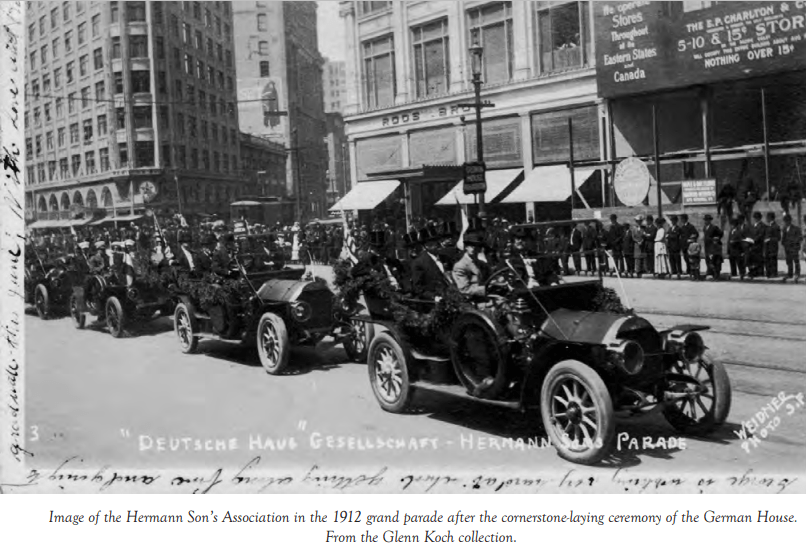
Yesterday I found a book that says my great great grandfather, Carl Janke was a Forty-niner who built homes all over the Bay Area. This history was oppressed because Christians did not like the German Forty-Eighters who backed my kin, John Fremont, the co-founder of the Rebpilcian Party, and its first Presidential Candidate. Recording this history is the most important thing I can do.
John Presco
Click to access Argonaut-2020-Vol-31-No-1.pdf
My Vigilant German Kindred
Posted on August 17, 2019 by Royal Rosamond Press

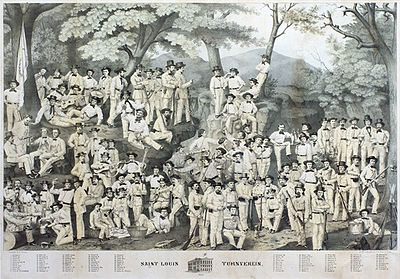
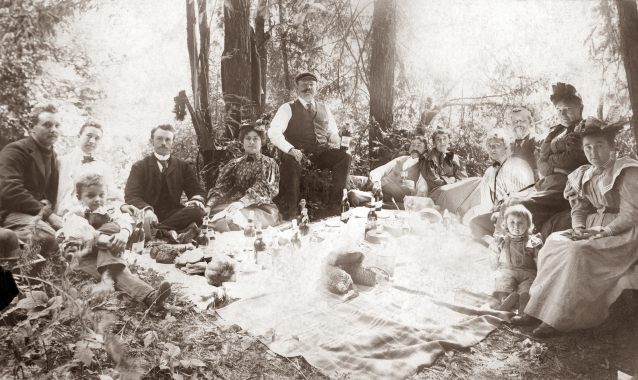
In the photograph of my German grandfathers taken in the Oakland Hills, we see a rifle hung in a tree. Carl Janke owned a German Theme park south of San Francisco where sharpshooter contests were held. I suspect my German People helped form the Vigilante Committees of California with the help of the Turnverein. I believe they helped found the Jewish Turnverein of Berlin, who were instrumental in founding the Nation of Israel.
This rifle is the symbol of the Emancipation of the slaves. The treacherous Confederacy murdered thousands in order to keep Americans in chains. When the Germans lost their battle against the Papal forces of the Habsburgs, they came to America on many ships. When they came down the gangplank, waiting for them were countrymen, who gave them a rifle and a uniform. They were now Freedom Fighters in the Union Army – and they marched against Lee’s army of traitors. Eventually we defeated him. Lee is my kin. We look alike. There are 240,000 million Americans of German descent.
To the polls! Sweep this Champion Liar – and his Neo-Confederate Goon Squad – into the sea! Remember General Sherman! Write your Senator and demand Moscow Mitch stand before the American People once a week, and give a complete report of the united effort to put down Fuzzyball Putin, and his Demon Squad of Hackers, named in the Mueller report.
Neo-Confederate Traitors of our time, went to Bob Jones University in order to learn evangelical propaganda so they could counter the movement of Martin Luther King. These traitors now control our Senate, that is using the contrived abortion mission to divide our nation. As a Republican Candidate for the Office of the President of the United State of America, it is my objective to sweep the evangelical trailer-trash out of the Republican Party co-founded by my kindred, John Fremont, and his wife Jessie Benton Fremont.
On this day, I found the New Jessie Scouts, a vigilant squad of loyal women whose job it is to protect all women who are being harassed by Treacherous Patriot pretenders, and Trump’s Pussy Squad of Practiced Perverts and Liars. How dare Trump suggest his evangelical worshippers want their Messiah to hold office for a third term. This is treason, preached by fake men of god!
How long would the Black Holocaust have gone on if Lee and his Traitors won the Civil War? How many teenage slaves would have been backed against a wall and had their pussys grabbed, and then forced to bare the child of their owner so it could be sold? Thank God for these good Germans, these Saviors!
Lock him up!
John Presco
Presidential Republican Candidate
TURNVEREIN SHARPSHOOTERS
The Home Guard Willing to Shed Its Blood but Only at Los Angeles The contemplated home guard of sharpshooters connected with the Turnverein Germania Is making but slow progress In getting organized. A minority of intending members met last night but failed to do anything. A score or so were willing to sign the roll to be forwarded to the adjutant general, but several others held back, not from lack of patriotism or want of sympathy with the United States, but for fear that In the event of the state’s accepting their services as an Independent company they might be called upon to do duty or fight away from home. These men hay* ties here which preclude their leaving their families or interests and they are unwilling to sign any papers which might turn out to be no obligation to leave Los Angeles and march to the front. They want to be strictly what the name Implies—home guard. As one man put it tersely, “I am for this country, willing to defend It here and shed my blood right in Los Angeles for the Stars and Stripes, but I’ll be goll-darned if I want to have it run out of my body at Milpitas or Sausalito.” At the next meeting, however, it is expected that so many will sign the roll that the sharpshooters will be able to organize.
Los Angeles 1898
A popular Union commander and native German, Major General Franz Sigel was the highest ranking German-American officer in the Union Army, with many Germans enlisting to “fight mit Sigel.” Sigel was a political appointment of President Abraham Lincoln, who hoped that Sigel’s immense popularity would help deliver the votes of the increasingly important German segment of the population[citation needed]. He was a member of the Forty-Eighters, a political movement of the revolutions in German states that led to thousands of Germans emigrating to the United States. These included such future Civil War officers as Maj. Gen. Carl Schurz, Brig. Gen. August Willich, Louis Blenker, Max Weber and Alexander Schimmelfennig.
Schurz was part of the socio-political movement in America known as the Turners, who contributed to getting Lincoln elected as President. The Turners provided the bodyguard at Lincoln’s inauguration on March 4, 1861, and also at Lincoln’s funeral in April 1865.

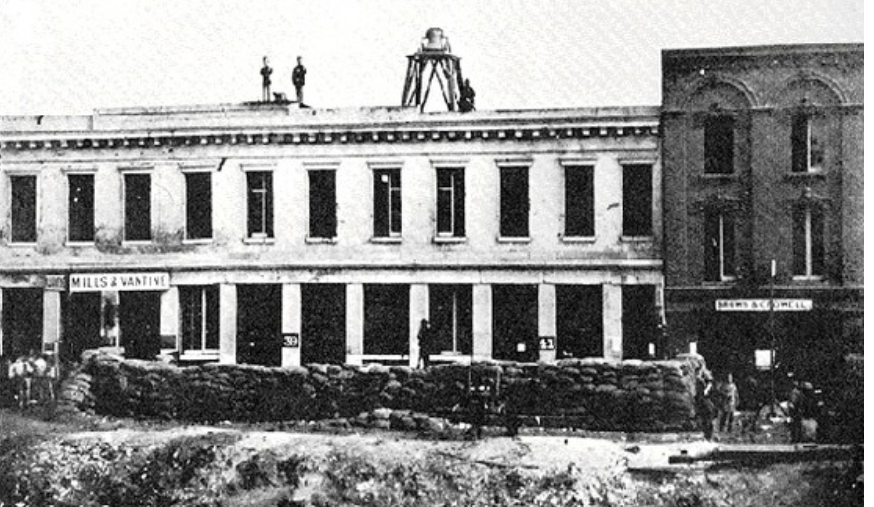


Yesterday I discovered one of my great grandfathers founded a Turnverein Hall on Bush Street in San Francisco. This hall was a place one could go hear music and practice gymnastics. The Seamens Friendly Union met here, and the Vigilance Committee. Plays were performed, and debates held. This is the radical root of San Francisco that I have traced to the Longshoreman’s Hall and the first Acid Tests. The Turner hall offered music and other entertainment as an alternative to gambling and prostitution. My father was a Merchant Marine and would be pleased to know the first institution for furthering sailor rights met in the Bush hall.
“All seamen are invited to attend at the Turn Verein Hall on Bush Street between Stockton and Powell Streets on Thursday Evening, January 11 at 7 1/2 o’clock to form a Seamens Society for the Pacific Coast.”
The Vigilance Committee combatted corruption and violence. These were idealists that lay the groundwork for a city famous for it cultural revolutions.
“Flaunting their rebellious spirit, the gymnasts of Vormärz wore their hair long and sported large black hats decorated with a rooster feather”

Above are my grandparents having picnic in the Oakland Hills. There is a sharpshooters rifle hanging in the tree. Janke had marksman contests Belmont Park. Many Turnverein were Socialists and Marxists.
Jon Presco
Israeli National-Socialists
Posted on September 18, 2011by Royal Rosamond Press


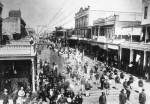

Israel was founded by Socialists who got a foothold in Palestine via the Maccabi Sports Clubs that sprang from the German Turnverien, or, Turn Verein, Turner Societies, founded by Freiderich Jahn a Prussian, who is considered by some to be the Father of National-Sociialism, or, the Nazis.I suspect my kin, Carl Janke, was a Turnverein and established a Turner Society in Belmont that later merged with the Oddfellows. William Ralston, whose home was in Belmont, provided the funds to spread the Oddfellows throughout Europe, beginning in Germany, where Jews and Gentiles met in Turnverien clubs, worked out together, talked business, and promoted the idea that their children should marry. Then the Germans wanted the Jews out, and they formed their own Turnverein clubs that became the Maccabi gymnasts who began to colonize Palastine.
After world war one there was a prejudice against Germans, and Turnverein was changed to Tanforan, the alleged kin of a Mexican Spaniard.
From Fairmont to Belmont
Posted on March 5, 2021 by Royal Rosamond Press
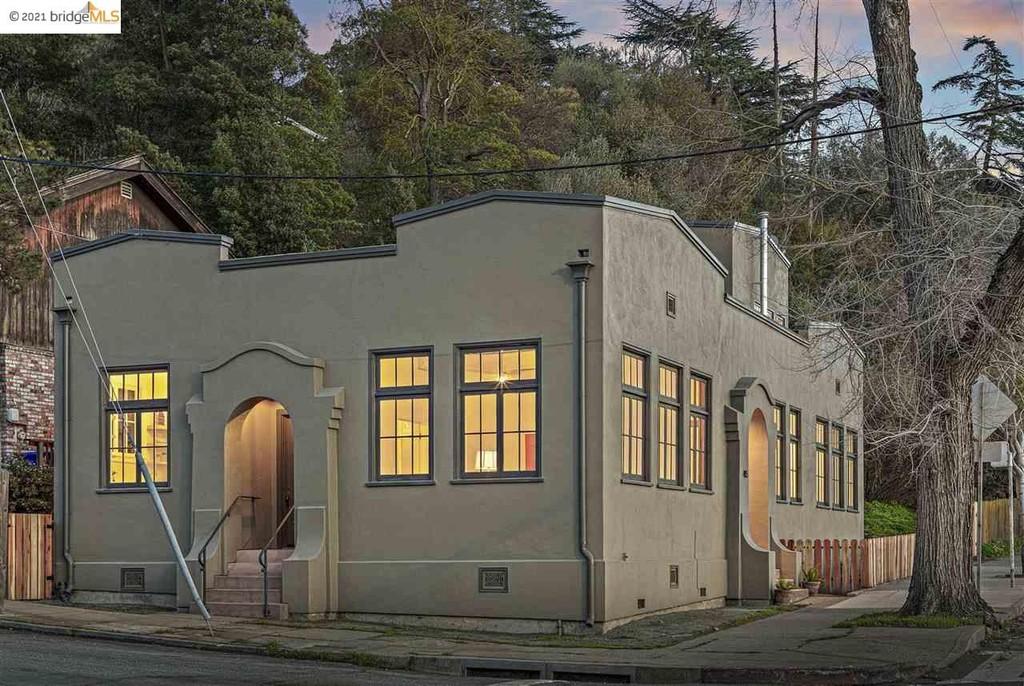
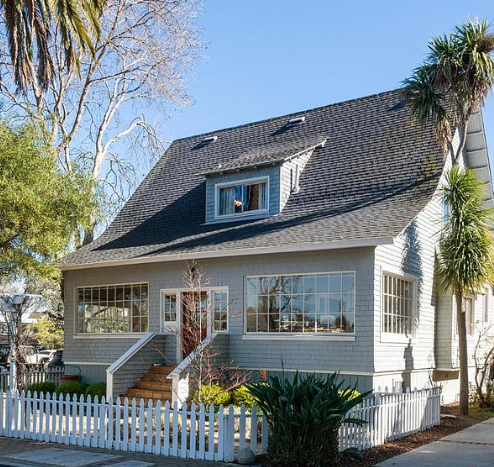

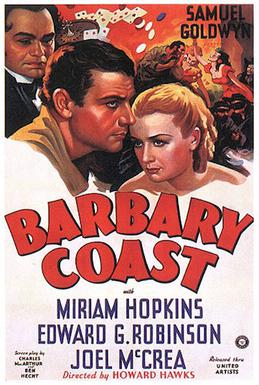



1 / 9
I am now going to put forth a proposal for a film titled
From Fairmont to Belmont
It will be about the history of Bohemianism in Oregon, California, and NewYork. The movie ‘The Barbary Coast’ is from The Bozone. It is the model for my life. It is Victor Hugo Presco marrying Melba Charlotte Broderick the granddaughter of Augustus Janke of Belmont whose father built Belmont, and helped rebuild this famous Bohemian Capitol after the 1906 earthquake. My father’s mother is name after Charlottenburg Palace. The Stuttmeister lived on a street they made, at No.1 Berlin Way. They developed about fifty homes in the town of Fruit Vale, that like Fairmont, was swallowed up. Berlin Way is on my birth certificate. But, what is still blowing my mind, is where Wensel Anton Braskewitz-Prescowitz came from. He was born in Bohemia.
This is why I was anxious to find a backer to buy the old telephone exchange in Crockett. I wanted to live in a gallery-museum. Rosemary told me Victor Hugo gambled in the Barbary Coast of San Francisco. I found an address on Mission Street. Victor Hugo (named after the famous author) worked on Eddy Street. This Raymond Chandler and Norbert Davis. You can’t get any sleazier than this.
There was a sign over a street in San Francisco called ‘The International Settlement’. What went on there far surpasses the Tell-all permission given to Stacey Pierrot and her bevvy of ghost writers (by Robert Buck) one who says Ron Schwary “optioned” the story of our “Rosamond”. Is this true? How do I find out? Maybe Belmont will swing wide their golden gates for Julie Lynch who invented the testimony of Christine’s kindergarten teacher. Does this constitute stalking – and child abuse?
The International Settlement must rise again from the ashes of the plague, or, we are dead! I inherited the Bohemian Blueprint. That no one will fund me – spells DOOM!
“Rosebud!”
Rose Mont
John Presco
Copyright 2021
Victor Hugo Presco a Bohemian | Rosamond Press
The Royal Crockett Gallery | Rosamond Press
La Belle de San Francisco | Rosamond Press
THE BUILDING
Facts and Features
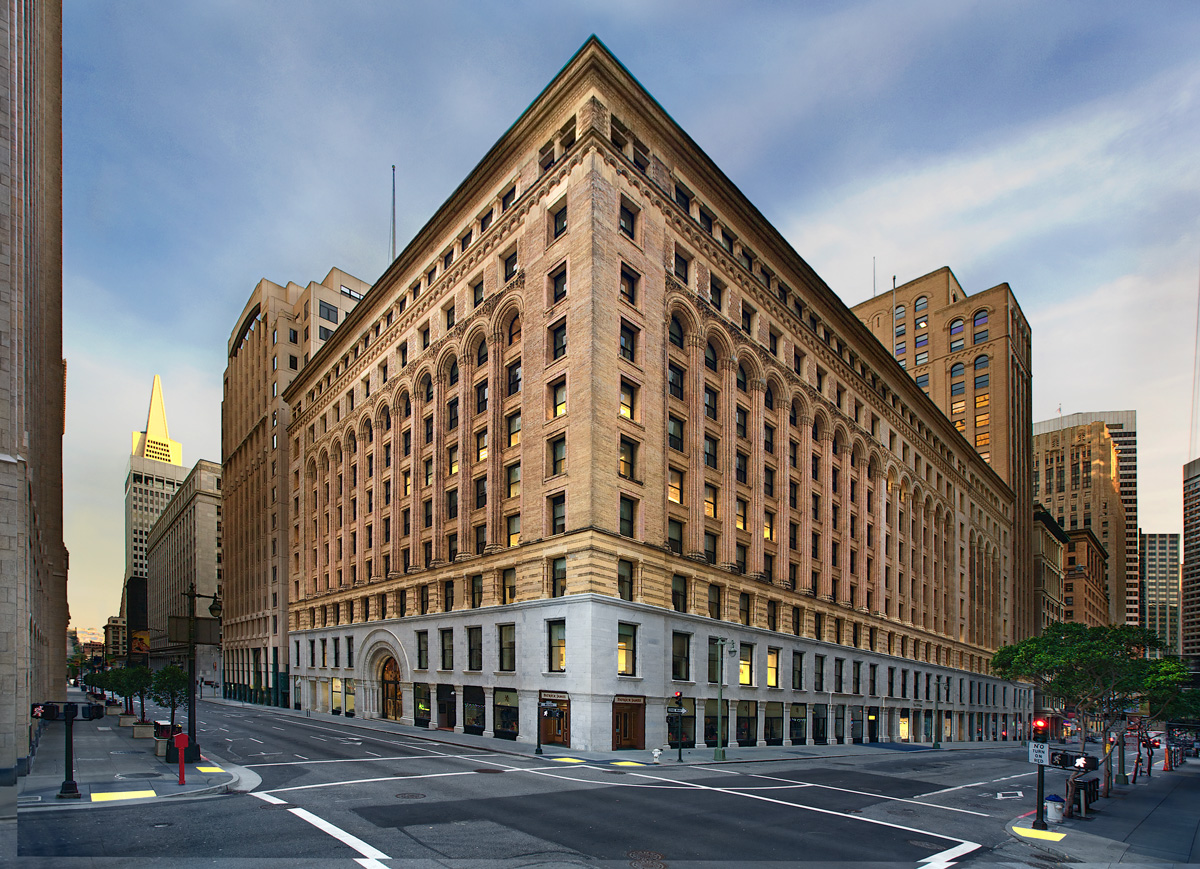
The Mills Building is a San Francisco landmark with singular historical, architectural and aesthetic interest. The Building was commissioned by Darius Ogden Mills, one of San Francisco’s early tycoons. In 1840 Mills started the National Gold Bank of D.O. Mills & Company, the first bank west of the Rocky Mountains and helped to finance the construction of the Southern Pacific Railroad. His bank later merged with the California National Bank and upon moving to San Francisco in 1864, Mills helped form and became president of the Bank of California.
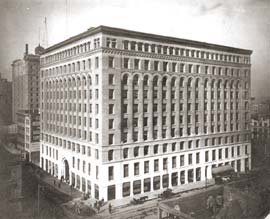
In 1864, Mills moved to San Francisco and commissioned his building in 1891. He chose what was, in its time, a revolutionary style of architecture. Burnham and Root of Chicago designed the 154-foot, steel frame skyscraper. The Mills Building is San Francisco’s only remaining example of this Chicago School of architecture, outlasting the old Chronicle Building at Market and Kearny, which has been entirely modified, and the Crocker Building at Post and Kearny, which was torn down in 1967.
The Mills Building survived the 1906 earthquake, although its interior was virtually gutted by the ensuing fire. Architect Willis Polk oversaw the building’s restoration in 1907, adhering to its original design. Additions made in 1914 and 1918 also maintained the building’s stylistic integrity. The last addition, the 22-story Mills Tower, was completed in 1932.The first two stories of The Mills Building are constructed of white Inyo marble from Keeler, California. The Building’s most distinctive feature is its Montgomery Street entrance arch, which typifies the Richardson-Romanesque style. Its carved acanthus leaf and egg-and-dart molding frames four pairs of marble Corinthian columns.
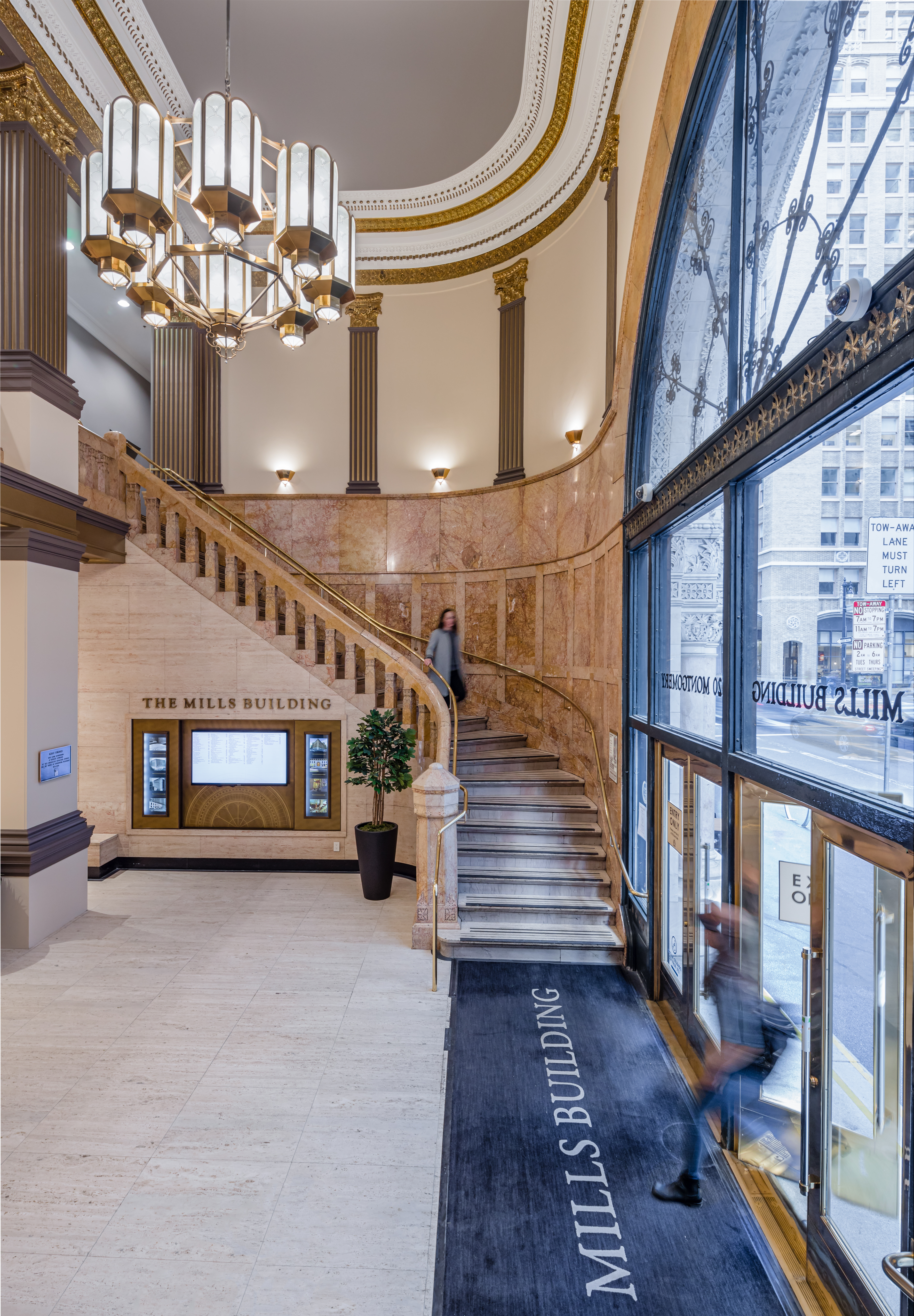
Only minor restoration after the 1906 earthquake and fire were needed for the curved staircases in the Montgomery Street lobby. The staircase is still made with the original Jaune Fleuri marble. The lobby interior also features black Belgian marble and lavish Roman travertine with an inlaid marble floor pattern which was added during a renovation of both lobbies in 1988.
The Bank of California was opened in San Francisco, California, on July 4, 1864, by William Chapman Ralston and Darius Ogden Mills. It was the first commercial bank in the Western United States, and considered instrumental in developing the American Old West.[1][2][3]
History[edit]

The ancestor of the bank was the banking firm of Garrison, Morgan, Fretz & Ralston, established in San Francisco in January 1856 by a group that included Ralston, Cornelius K. Garrison and R.S. Fretz.[4] Ralston established the Bank of California in 1864 when he sold shares to 22 of the state’s leading businessmen for $100 a share. The bank opened on July 4, 1864, with Darius Ogden Mills as president and Ralston as cashier; Louis McLane was on the board of directors. A branch was opened in Gold Hill, Nevada, near Virginia City, on September 4, 1864.[5] William Sharon was the bank’s longtime Nevada agent.
Built of stone quarried on nearby Angel Island in San Francisco Bay, the Bank of California Building at the northwest corner of California and Sansome streets in San Francisco was said to be “one of the handsomest structures on the coast…”[6]

The Bank of California financed a number of mining operations of the Comstock Lode, and repossessed some mines when their owners defaulted, and ultimately generated enormous profits as a result.[7] However, Ralston sometimes lent money to mine owners in circumstances that would inevitably lead to default and repossession. At the height of their power, Ralston and his “Ring” (as his associates were known) were able to exert monopolistic influence over sections of commerce and industry in San Francisco and in Virginia City.[8]
In July 1869, Ralston averted a run on the bank by exchanging nearly $1 million worth of gold bars for an equivalent value in gold coin from the United States Sub-Treasury in San Francisco. The transfer was carried out in the middle of the night by two of Ralston’s associates, Asbury Harpending and Maurice Dore. When the bank opened in the morning, the sight of tray after tray of gold coin at the tellers’ windows quashed any thought by depositors of mounting a run on the bank.[9]
Mills retired as president of the Bank of California in October 1873 and was succeeded by Ralston, who kept Mills on the board of directors for the prestige of his name.[10]
.jpg)
At a time of volatile trading of Nevada mining stocks, a run on the Bank of California occurred on Thursday, August 26, 1875. The bank failed, and Ralston was ruined.[8] The next morning, he executed a deed of trust, turning over everything he owned to Sharon, and the deed was notarized. Ralston then admitted irregularities in banking practices to the board of directors, and was ousted as president. He walked to the North Beach to get away from the angry crowds and went to the Neptune Bath House, where he was accustomed to swim in the ocean on summer days. He swam out as far as he could go, and did not return. When his body was recovered, it was found he had died of a stroke.[11]
Proposal To Notre Dame de Namur
Posted on June 18, 2023 by Royal Rosamond Press
Brotherhood of the Swan
Posted on March 11, 2018by Royal Rosamond Press
Charles Ferdinand Janke
Posted on October 13, 2023 by Royal Rosamond Press
William August Janke, native of Hamburg, Germany, born Dec. 25,
1842, died Nov. 22, 1902, son of Carl August & Dorette Catherine
Janke.

In October 12, 2023 I discovered how Charles Ferdinand Janke died. He was taking part in a Republican’ celebration when his horse collided with a team of horses. Belmont Historians, and alleged family neighbors do not record this?
There is a prophecy in these Belmont posts. Israel started shelling Lebanon. It sounds like
JUDGEMENT DAY
John Presco ‘Nazarite Judge’
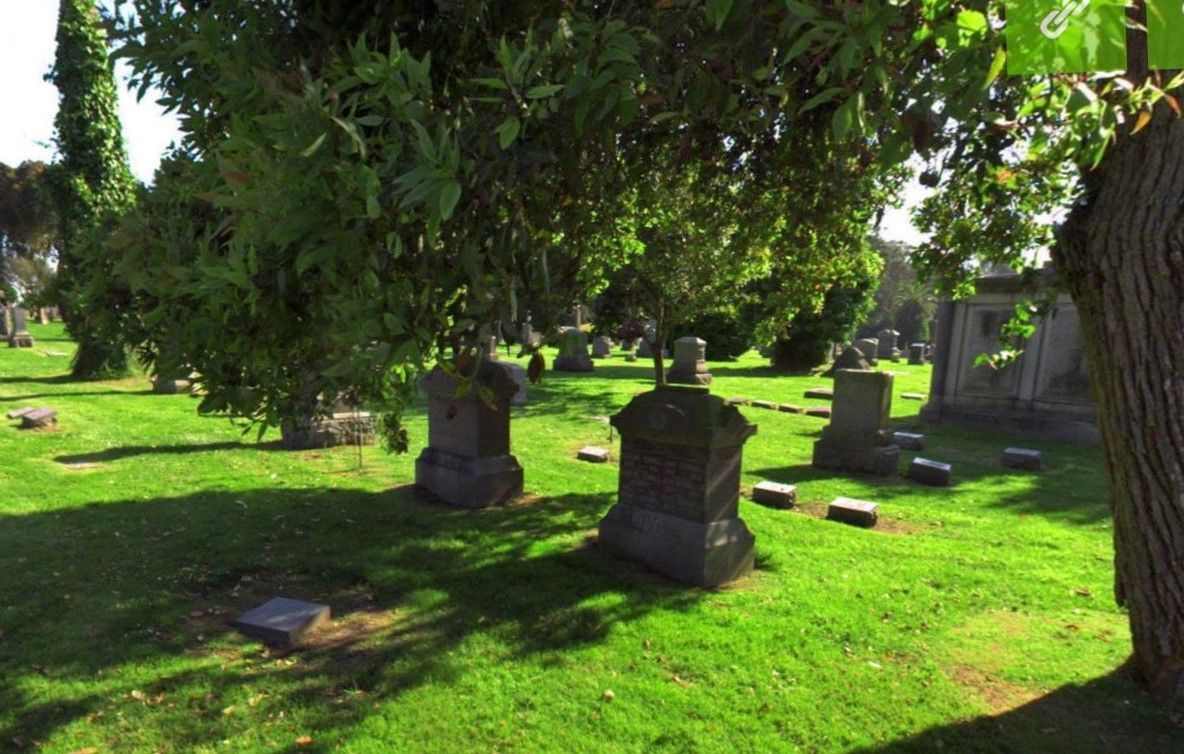
San Francisco Evening Bulletin, No. 12, 1888, p.1, col.4, Pacific Coast Items. “Charles F. Janke of Belmont, who was wounded in a collision while on horseback with a double team during the Republican procession at Redwood on the 3d inst., died yesterday. He had been a resident of Belmont for twenty-five years.”
San Francisco Evening Bulletin, Nov. 12, 1888, p.3. “JANKE—In Redwood City, November 11, C. F. Janke, a native of Germany, aged 49 years, 5 months and 2 days.” (Calculated birth date.)
.
Daily Alta California, Volume 42, Number 14175, 24 June 1888
STUTTMEISTER-JANKE.
One of the most enjoyable weddings of the past week took place at
Belmont, Wednesday morning last, the contracting parties being Miss
Augusta Janke, daughter of Mr. and Mrs. August Janke of Belmont,
and Dr. Wm. Stuttmeister of San Francisco. The house was
handsomely decorated with a rich profusion of ferns and flowers, and
at the appointed hour was filled with the relatives and intimate friends
of the contracting parties. At 11 o’clock the wedding march was played
and the bridal party entered the parlor. The bride was attended by Miss
Alice Stuttmeister, a sister of the groom, and Miss Minnie Janke, a
sister of the bride, as bridesmaids, and Dr. Muldownado and Wm.
Janke, a cousin of the bride, were groomsmen. The Rev. A. L. Brewer
of San Mateo performed the beautiful and impressive ceremony under
an arch composed of flowers and greens very prettily arranged, after
which the guests pressed forward and offered their congratulations.
The bride was attired in a very pretty and becoming costume of the
crushed strawberry shade, and wore a corsage bouquet of orange
blossoms. She carried a handsome bouquet of white flowers. After the
guests had paid their compliments the bride and groom led the way to
the dining-room, where the wedding dinner was served and the health
of the newly married pair was pledged. The feast over, the guests
joined in the dance, and the hours sped right merrily, interspersed with
music singing and recitations, until the bride and groom took their
departure amid a shower of rice and good wishes. Many beautiful
presents were received. Dr. and Mrs. Stuttmeister left Thursday
morning for Santa Cruz and Monterey, where they will spend the
honeymoon. On their return they will make their home in Belmont.
1911: Dr. Willian O. Stuttmeister was practicing dentistry in Redwood
City, CA. (Reference: University of California, Directory of Graduates,
1864-1910, page 133).
Records from Tombstones in Laurel Hill Cemetery, 1853-1927 – Janke
– Stuttmeister
Mina Maria Janke, daughter of William A, & Cornelia Janke, born
February 2, 1869, died March 1902.
William August Janke, native of Hamburg, Germany, born Dec. 25,
1842, died Nov. 22, 1902, son of Carl August & Dorette Catherine
Janke.
Frederick William R. Stuttmeister, native of Berlin, Germany, born
1612, died January 29, 1877.
Mrs. Matilda Stuttmeister, wife of Frederick W.R. Stuttmeister, born
1829, died March 17, 1875, native of New York.
Victor Rudolph Stuttmeister, son of Frederick W.R. & Matilda
Stuttmeister, born May 29, 1846, died Jan. 19, 1893, native of New
York.
Brief Life History of Elizabeth Dorothy
When Elizabeth Dorothy Janke was born on 14 November 1844, in Hamburg, Germany, her father, Carl August Janke, was 24 and her mother, Dorothea, was 24. She had at least 1 son and 6 daughters with Amassa Parker Johnson. She lived in Belmont, San Mateo, California, United States in 1880 and San Francisco, San Francisco, California, United States in 1900. She died on 20 January 1929, in San Francisco, California, United States, at the age of 84, and was buried in Colma, San Mateo, California, United States.
Brief Life History of Amassa Parker
When Amassa Parker Johnson was born on 9 July 1836, in Delhi, Delaware, New York, United States, his father, Elias Johnson, was 44 and his mother, Phebe Finney, was 42. He had at least 1 son and 6 daughters with Elizabeth Dorothy Janke. He lived in Delhi, Delhi, Delaware, New York, United States for about 5 years and Belmont, San Mateo, California, United States for about 50 years. He died on 1 January 1931, in San Mateo, California, United States, at the age of 94, and was buried in Cypress Lawn Memorial Park, Colma, San Mateo, California, United States.
The California Brigade
Posted on June 26, 2024 by Royal Rosamond Press
Because it was prohibitive to send troops from California to the South during the Civil War. some units back East created California Brigades.
John
The California Brigade
In West Philadelphia Born and Raised
Daniel Landsman
When the Civil War broke out, residents of the west coast wanted to have a presence in the eastern theater. However, with nearly 3,000 miles separating the state of California and the Army of the Potomac and no railroad connecting the west coast to the east, sending a brigade of infantrymen across the wild country would be an ambitious goal. Instead, a group of Californians asked Oregon Senator Edward Baker to head east and raise a brigade in the name of California.
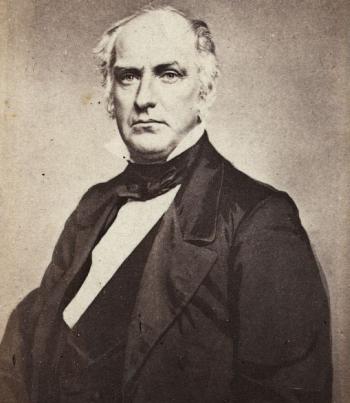
In April 1861, Baker was commissioned by Abraham Lincoln to raise a California brigade in Philadelphia. The first regiment Baker organized, the 1st California, consisted of Philadelphians and was placed under immediate charge of Colonel Isaac Wistar, who had been a ranger in California during the 1850s. By October Baker’s brigade had grown to its full size, consisting of the 1st, 2nd, 3rd, and 5th California Infantry.
The 3rd California had another name at the time of conception. Known as the Philadelphia Fire Zouaves, the men of the 3rd California were easily recognizable by their uniforms, which were inspired by the Zouaves of the French army. Dressed in light blue pants cut wide with red stripes and a cut away jacket with a row of bright blue buttons, the Philadelphia Fire Zouaves drew considerable attention as they marched through the streets of Philadelphia.
The California Brigade saw their first glimpse of battle at the Battle of Ball’s Bluff. The result of miscommunication and faulty intelligence, the Battle of Ball’s Bluff was a small skirmish with large political ramifications. On the morning of October 21, 1861, Union troops under Charles Devens crossed the Potomac River and engaged Confederates under the command of Nathan “Shanks” Evans.
In the afternoon, the Federals attempted to retreat across the river, but there were only three small boats available and the attempt to retreat resulted in a terrific bottleneck. Brig. Gen. Charles P. Stone sent Senator Baker to the field, bringing his California Brigade along with him. Baker sent his Philadelphians to determine the location of the Confederate right flank, which sparked a firefight between the 1st California and 8th Virginia. During this battle, Senator Baker, the California Brigade’s creator and commander, was killed. Following the death of Senator Baker, the state of Pennsylvania reclaimed the California Brigade.
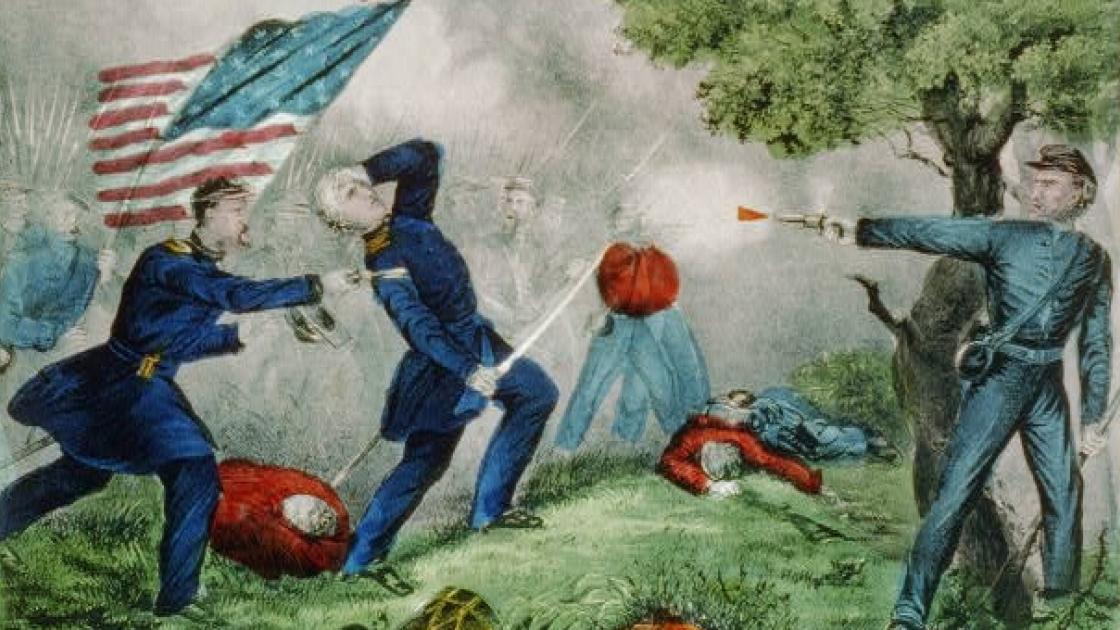
The California Brigade remained extremely active in the Army of the Potomac’s actions in the eastern theater.
They were engaged in the Peninsula Campaign, during which General Joseph Hooker commended the 2nd California for their successful bayonet charge during the Battle of Glendale. Following the Seven Days Battles, where they fought in the Battle of Savage Station and Allen Farm, the Brigade suffered heavy losses during the Battle of Antietam. During the attack near the West Woods, the California Brigade lost 545 men in as little as 10 minutes.
Several months later at the Battle of Chancellorsville, the California Brigade along with the rest of their corps remained at camp to serve as a decoy while the rest of the army marched. The California Brigade was then called into action on May 3rd and supported Maj. Gen. John Sedgwick’s attack on the Confederate rear guard near Fredericksburg.
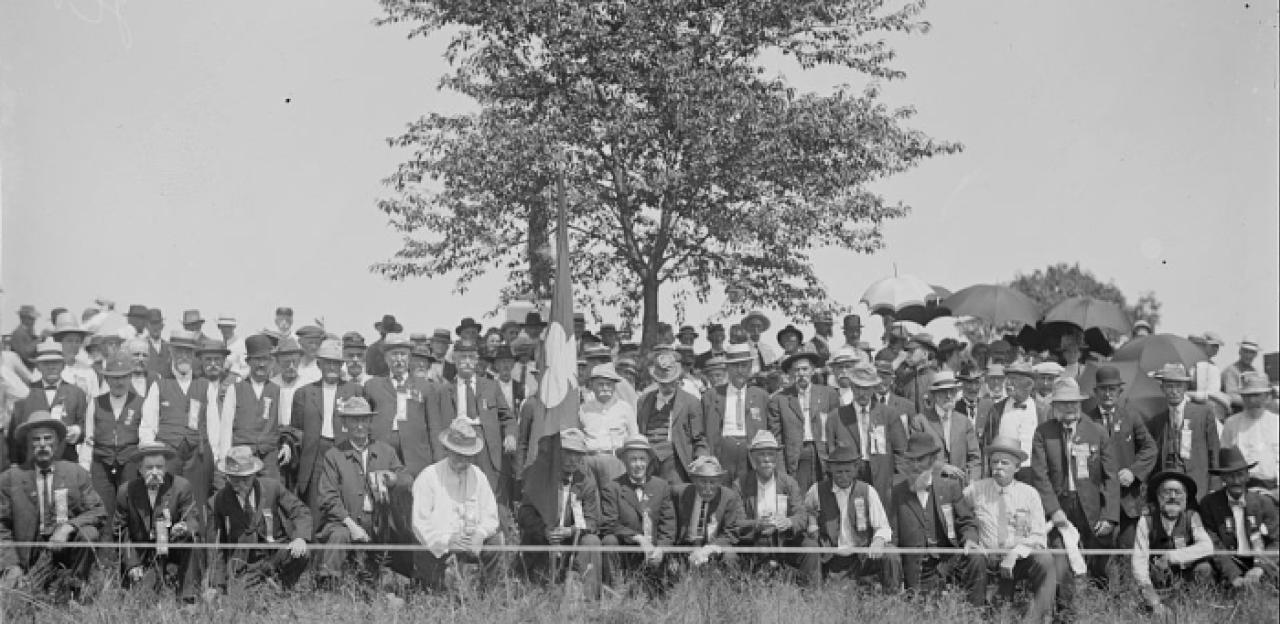
Placed under the command of Brig. Gen. Alexander Webb, the California Brigade earned recognition for their efforts during the Battle of Gettysburg. The California Brigade took their position at Cemetery Ridge at 6:30 in the morning on July 2nd, and held the ridge near the Angle for the remainder of the battle.
At 6:30 P.M. on July 2nd, they were involved in the Union defense of Maj. Gen. Richard Anderson’s attack against Cemetery Ridge. During this attack, Brig. Gen. Ambrose Wright’s brigade temporarily captured the southern end of the ridge, but was quickly driven back by the California Brigade.
On July 3rd, the California Brigade was charged with defending the same position at the Angle during Pickett’s Charge. The Confederate effort against the Angle was greater than any other part of the line. Described as “an advance of an acre of men”, the charging Confederates proved to be too great a force for the 71st Pennsylvania, formerly the 1st California, as they retreated upon seeing the great Rebel approach.
Despite the 71st Pennsylvania’s retreat, the 69th and 72nd Pennsylvania, formerly 2nd and 3rd California, held their position and proved to be instrumental in the defense of the Angle. As nearby batteries began to fall to Armistead’s brigade, the defense of the Angle was left in the hands of the infantry, and the 69th Pennsylvania was the only nearby regiment holding the Angle.
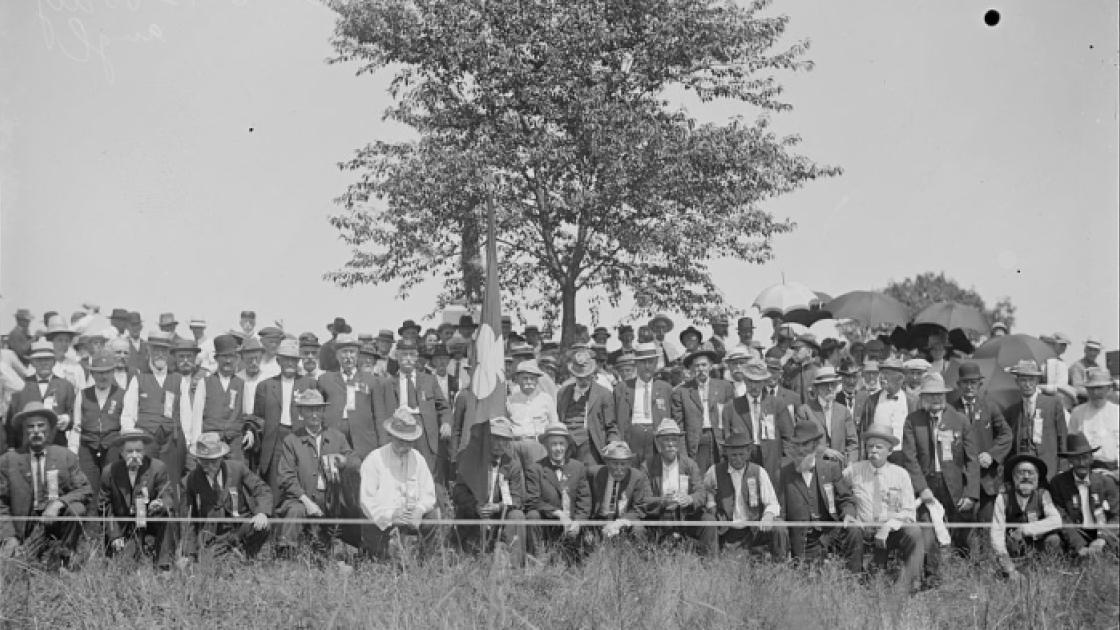
As the Confederates continued their approach, the 69th unleashed a heavy fire upon the Confederate advance. Having stockpiled weapons, many of the soldiers of the 69th had six to eight loaded rifles leaning against the wall, ready to be fired. Eighty yards east of the Angle stood the 72nd Pennsylvania, which had just been moved forward from its reserve position. The 72nd Pennsylvania assisted the 69th with a heavy line of fire, and the two regiments of the California Brigade effectively blocked further advance from Armistead’s Brigade.
While the California Brigade had gained recognition and fame for its actions during Pickett’s Charge, their last battle as a unit, the Battle of Cold Harbor, was one marked with failure due to the actions of their new commander, Joshua Owen. On the morning of June 3, 1864, as the rest of the Second Division were in line, Brig. Gen. John Gibbon found Owen and the rest of the California Brigade still asleep in their tents.
Furious with Owen, Gibbon sent the California Brigade to the front of the line. Owen’s blunders continued through the battle. Gen. Gibbon’s orders for Owen were to march his troops in column through Col. Thomas A. Smyth’s line and assist in Smyth’s attack against the Confederate line. However, Owen decided to march his line further southwest through nearby woods, emerging on Smyth’s left after the Union forces had already broken the Confederate line. Owen’s decision to disobey orders and traverse through the woods placed them at the line too late to be of any assistance and the California Brigade was pushed back by three North Carolina regiments.
Following the failures of Cold Harbor, the Brigade was broken up and the 71st, 72nd and 106th were discharged.
Belmont Historian Destroys Black History
Posted on March 1, 2021 by Royal Rosamond Press
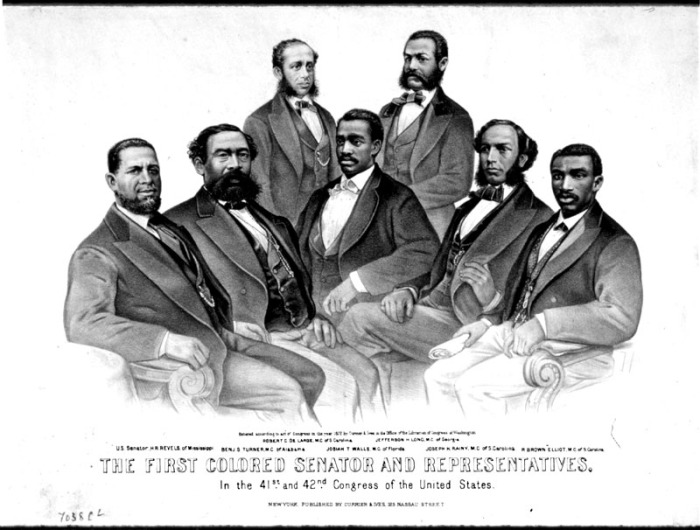


These posts were taken down from the Belmont Historic Society by one or more alleged volunteers. Cynthia Karpa McCarthy takes all the blame in order to get me to rage at her via personal e-mail, and, or, she wants to be THEIR champion so she can write a new book employing my family who founded Belmont, and were German Turnverein. They read these posts- and winced! I was their worst nightmare – alas come home to roost. I believe Cynthia came across my blog, Royal Rosamond Press, in her studies. THEY conspired on how to take care of me – and remove my posts. No one extended his/her welcoming hand to a senior – who owns the same DNA Carl Janke & Sons own! My Rosamond Ancestors were Patriots in South Carolina, and ARE the Good ol Boys! They would not dream of treating anyone like a Carpetbagger – today! I now rename Belmont….BELABAMA!
The Rosamond American Authors | Rosamond Press
The Philosopher Detective | Rosamond Press
Rename Franklin Street – Harry Lane | Rosamond Press
Black History ended yesterday. The New Dawn of the Turnverein – began yesterday when The Golden Chump declared himself The Divine Healer of the Treacherous Republican Party co-founded by my kin, John Fremont, Jessie Benton, and the Forty-Eighters, of which my Stuttmeister Ancestors belonged, and the Janke family. William Janke founded a Turnverein Hall on Bush Street in San Francisco. There was a Turnverein in Redwood City. I will be sending this outrage to the German Consulate. Are they aware that John Fremont was the first to emancipate black slaves -while surrounded by a foreign bodyguard, some of them German Socialists – who put Lincoln in the White House?
Frémont Emancipation – Wikipedia
Here are some of my posts that were removed removed.
John Presco
President: Royal Rosamond Press
Kennedy Brothers at Defremery Park
Posted on February 25, 2021 by Royal Rosamond Press
My friend Ed Howard posted on seeing a film about the Black Panthers. I have been posting on the Belmont Historical Society. We chatted about applying for a grant from the Buck Foundation yesterday after I told him I talked to three people in charge of honoring the last wishes of Berle Buck – who is still keen on maintaining her good reputation – in the tradition of Estate Planning. Robert Buck set up the foundation with his law expertise. I am repairing the devastating attack on the legacy of my late sister, Christine Rosamond Benton, who is a great asset to the City of Belmont. They want this creative history to boost their plans for downtown, and any arts projects. I told them about the Benton artists.
Belmont Historical Society, Belmont, CA | Facebook
John Presco
On June 1, 1968, I was driving my 1949 Ford down Adeline when I saw a crowd in Defremery Park. I saw a white man on truck talking to a crowd of black people. Up front were about twenty Black Panthers shouting and pumping their fists. I had pulled over, and now got out of my car and walked to the edge of the crowd. I could not believe I was hearing the voice of Robert Kennedy. In doing research on this speech I discovered John F. Kennedy spoke here on November 2, 1960. I am sure Bobby was making a statement, that he intends to walk in his brothers footsteps which is tragic for Bobby was murdered on June 5th. I had seen John drive through Oakland on his way up Telegraph. There was a light around his head. His younger brother had that same light.
Jackie Jensen And William Stuttmeister | Rosamond Press
La California | Rosamond Press
Christine Rosamond – Wikipedia
Meet Snitty Cynthia Karpa McCarthy | Rosamond Press
Sedwick and Elizabeth Freeman | Rosamond Press
Edith Sedgewick Kin To Henry Brevoort | Rosamond Press
Sharon-Hesketh Family of Piedmont | Rosamond Press
Black Turnverein
Posted on July 17, 2020 by Royal Rosamond Press


Yesterday, I admitted I have gotten out of shape due to COVID-19. Today I founded the Black Turnverein Channel that hopefully will be broadcast across America. Many black athletes will not be taking the field in our Nation’s colleges. I moved to Springfield fourteen years ago and bonded with some of the black Oregon Ducks. For awhile there was a group of blacks who met near the playground to do exercise. I joined them. I was seventy years – young!
With the coming of Black Live’s Matter, the whole world is looking at major issues that can, and will change the course of world history. It was traditional for Turnverein Clubs to hold debates of all kinds. These German immigrants go involved in our Democracy and served in the Union Army and helped defeat the Confederate Conspiracy – which is still alive! With my discovery my kin, John Fremont, formed the Radical Democracy Party in order to get Abraham Lincoln to drop out of the rice, opens up a huge field of topics in regards to how thoroughly black slaves were oppressed in the United States.
I would like to see the Black Panthers found a Black Turnverein in Oakland California. There is talk about armed Black Militias. My kin, Carl Janke, founded a Turnverein in Belmont and San Francisco where a armed Vigilante Committee may have been preparing to fight the Confederacy – as well as maintaining Law and Order. These issue are up! This history has returned.
I am for seeing armed black groups – if they take advantage of the Turnverein history. I would love to see the Black Panthers marching down Broadway and parading at Merritt College – after the coronavirus is no longer a threat. Being of sound body and mind was the motive of the Turnverein that admitted Jews who went on of the create Muscular Judaism, and, founded the New Israel. Are we to see Jews doing the goosestep in Los Angeles where live the largest Jewish population outside Israel? I have roots in Reformed Judaism.
I highly suggest BLM contact Ursula Von Der Leyen who went to Stanford. Tell her you want to set up a cultural exchange with Germany. Blacks should learn German. English is the language of the slave masters. I would start classical music clubs and learn the goose step that many nations south of the Trump Wall have adopted. I would recognize Cuba, who were taught to goose step by the Russians – who learned it from my Prussian kin. The Germans were for the cultural advancement of the black slaves – they were determined to set free! Germany did take part in the slave trade and there is reparation conversation about the genocide of Africans. Perhaps Germans will donate violins and other instrument to black students – who may not go back to school. The Black Turnverein channel can teach children to play and speak German. Why Trump and the Republicans snub Germany, is to say:
“The enemy of my enemy – is my friend!”
Fremont’s Foreign Fighters
Posted on February 26, 2017 by Royal Rosamond Press
Viva La Bama!
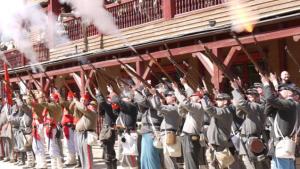

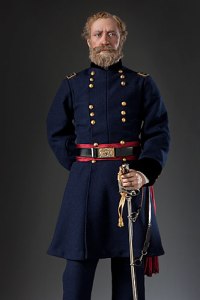

The Fremont family spent much time in Europe. I believe Elizabeth Fremont burned the reason why. John and Jessie had a bodyguard made up of foreigners. They feared a foreign invasion, and Lincoln was aware of this;
“President knew we were on the eve of England, France and Spain recognizing the South: they were anxious for a pretext to do so; England on account of her cotton interests, and France because the Emperor dislikes us.”
Above is a photo of Germans reenacting Civil War battles. This is because 200,000 Germans fought in this bloody war. Many of them were Turners. My Prussian and German ancestors were Turners in the Bay Area and had to know what role they would play before my kindred in South Carolina went to war with the Union.
I suspect Carl Janke was part of an effort to make California a colony of the German Unification, if…
View original post 2,950 more words
 Rosamond Press


Leave a comment