
George Walker mural in Springfield Oregon
The Gideon Computer
by
John Presco
My novel ‘The Gideon Computer’ was born up in the pool room at the Springfield Oakland, and stopped by to say hello to my childhood friend, Nancy Van Brasch. She was the first girl I kissed. We went to McChesney Junior High on 13th. Street in Oakland. Gertrude Stein lived a half mile down 13th. that led to the Oakland Estuary, where Jack London docked his oyster boat. It was here he found a large plank from a dock, and paddled it to Belmont where he got a job doing laundry in a Sanitarium. Did Ken Kesey study Jack when he went to the University of Oregon? I tried to save the cottage that Oregon’s ,most fampus author, lile I treid to save KORE that braodcast the Christian revelations of Herbert Arsmtrong. Did he figire out Mary took the Vow of the Nazatire because jer was closed, as wasthe womb of her her mother, Anna, who had many gandchildren by Mary and Joseph. How then did Virginity play a huge role n the founding of the Catholic Church, where priests and nune are requite to be virgins?
It is 9:16 AM on November 9. 2025 and I, John Presco, have decided to run for Governor of Oregon. Alas, I own spiritual permission. About a dozen men and women instroduced themselves to me. I was with Meher Baba, and we were were looking in Eygene for a new lawn near a new building to pitch a tent. I am going to try to raise a billion dollars. Im going to ask Billionaire philanthropist and Jeff Bezos’ ex-wife, MacKenzie Scott, to fund my Think Tank, wherein I will compile the alternative realies that were bonr in Oregon and California.
I suspect there was some conflict between Nancy and Chuch over the BRANDING of Nancy’s Yogurt. I own the history of Nancy, who married Jerry Hamren, who also passed away, as did Sue Kesey. I have been communicating with George Walker on Facebook about the threat by POTUS to invade Oregon with Federal troops. Nancy bide me to write the History of the Hippies because I could recall so much.
Almost every Facebook post abpout the death of Chuck Kesey mentioned “Nancy’s Yogurt” that may be the purest BRAND name in America – if not the world! This BRAND has it’s roots in the Adelsverein in Texas. Nancy’s Yogurt may have come from Europe on a sailing ship. The Van Brasch family were onboard. Chuck should have been honored – by real history. He knew the bookcase in his brother’s mural – belonged to Ken Babbs. When I wrote about it, I was put in the Springfield Enemy’s List, This case…..is
HISTORIC ARTIFICIAL INT\RLLIGRNCE
….that was the theme of The Gideon Computer!
OMG! I just realized these bools represent the books that once belong to Bill and Monica!, science fiction characters based on the lover of Peter Shapiro and Myself. The three of us lived with
THE LOADING ZONE
…..in 1967
Welcome to…
THE DOWNLOADING ZONE
To be continued
Born and raised in California, Texas and Iowa, Nancy’s was the third generation in a lineage of health food enthusiasts. In 1966, Nancy moved to Haight Ashbury in San Francisco to attend college (and just in time for the Summer of Love, 1967). In 1969 she met Ken Kesey, counterculture leader and author of “One Flew Over the Cuckoo’s Nest,” and was invited to take care of Ken’s Eugene, Oregon farm while he was in London recording stories with the Beatles. When Nancy heard that Ken’s brother, Chuck, had a little creamery in Springfield, Oregon and was looking for a bookkeeper, she applied and soon found herself sharing her knowledge of making yogurt. This was just when live cultures were becoming a topic around the farm.
Using Nancy’s grandmother’s yogurt recipe, Nancy and Chuck began experimenting using acidophilus in a sour cream-like yogurt. What they ended up with was traditional, creamy, full-bodied, tangy yogurt that is now known as Nancy’s Yogurt.
Nancy’s career at Springfield Creamery has supported the growth of her own family, including her husband, Jerry, and two daughters, Emily and Meredith. “The neat thing about this creamery is that it’s not just work,”she says. “I’m the bookkeeper and the historian. I do research on new cultures, new ingredients; I taste every batch of yogurt we make. We are each deep banks of knowledge about many things, and what makes it so enjoyable is that we all fill in for each other in so many ways. It’s a culture of sharing.” Thankfully Nancy is sharing some of her favorite Summer of Love dishes with us this month…we hope they become your favorites, too!
The surname Van Brasch is associated with individuals whose German ancestors were part of the 19th-century Adelsverein colonization movement that led to the founding of New Braunfels, Texas.
Carl, Prince of Solms-Braunfels, was the first Commissioner-General for the Adelsverein (The Society of Noblemen) and established the colony of New Braunfels in 1845. While the Prince himself returned to Germany, the colony flourished, populated by a significant wave of German immigrants.
Individuals with the Van Brasch surname have been noted as descendants of these original German settlers in Texas. The name is part of the historical German heritage of the region, which is well-documented in institutions like the Sophienburg Museum and Archives in New Braunfels.
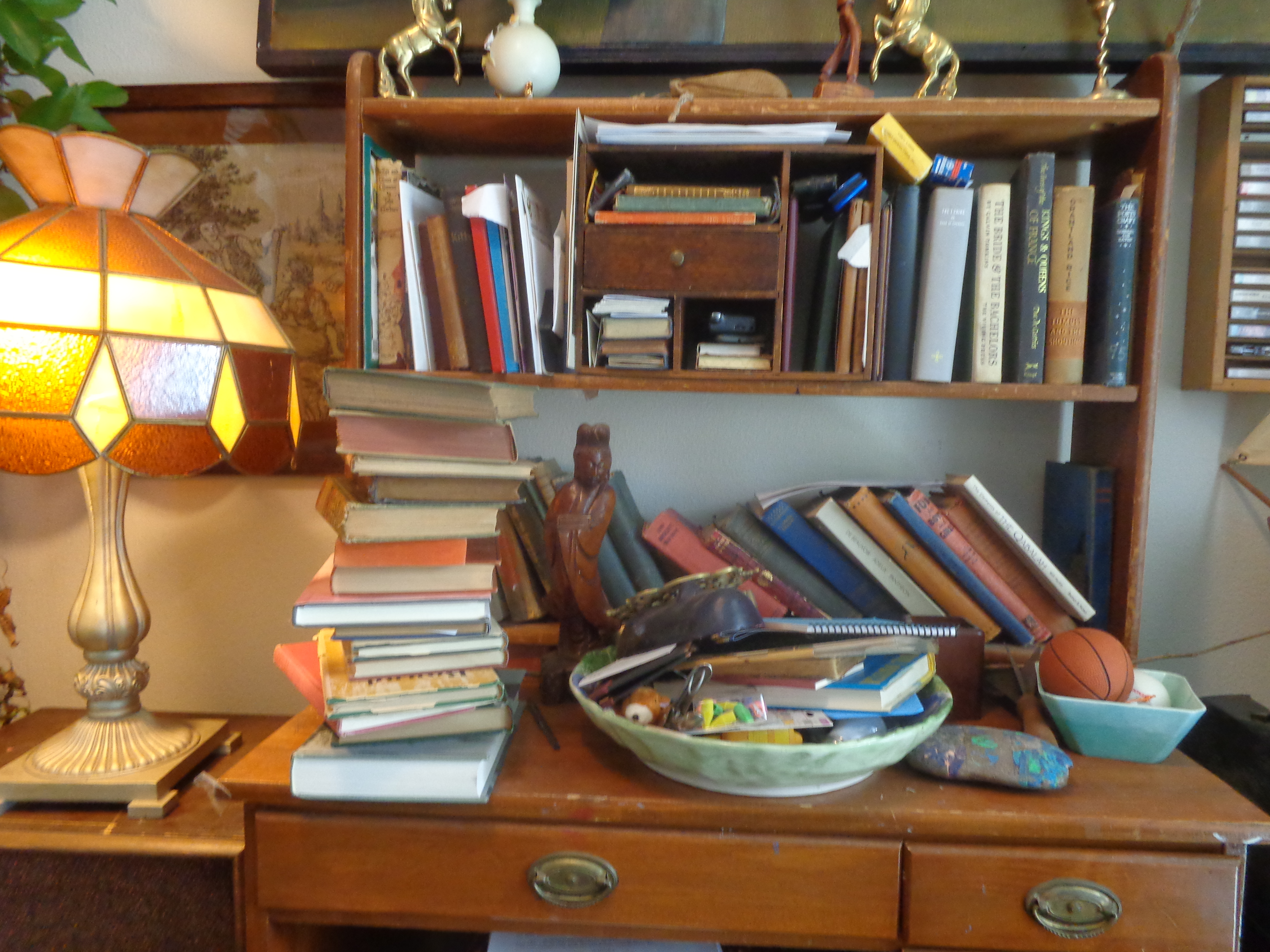
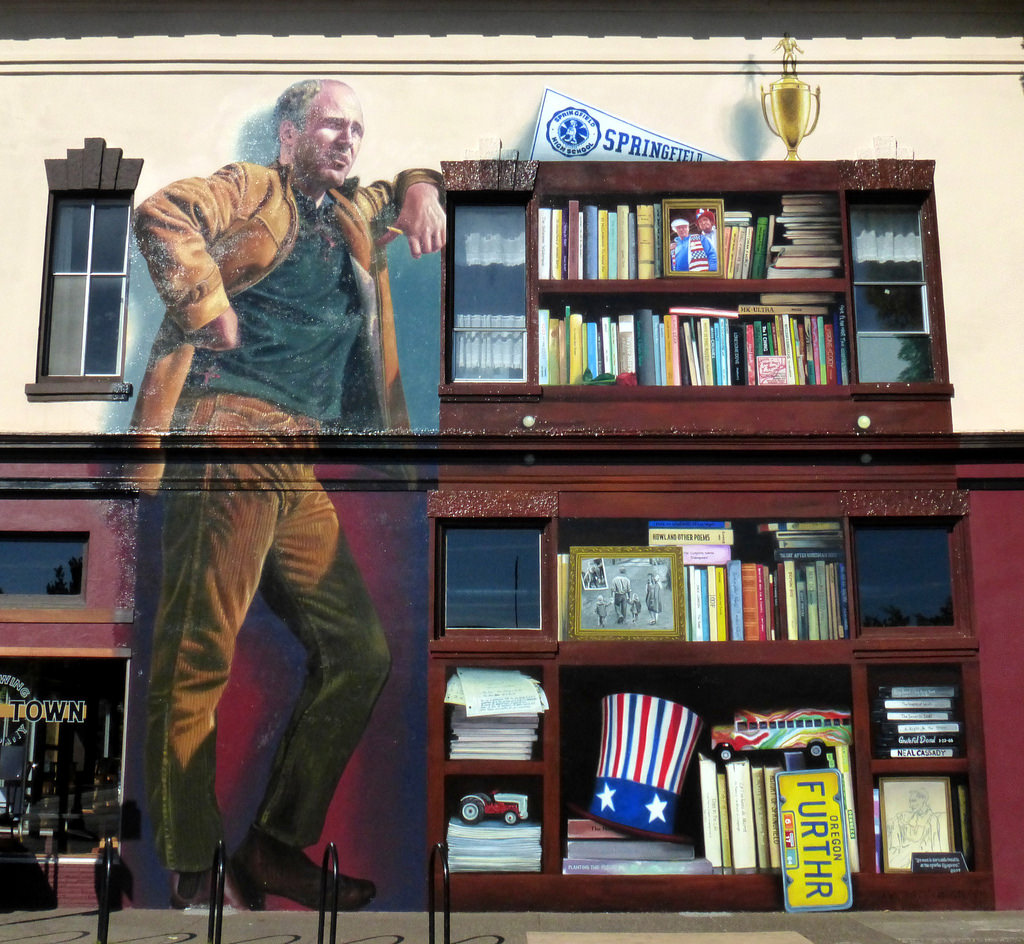
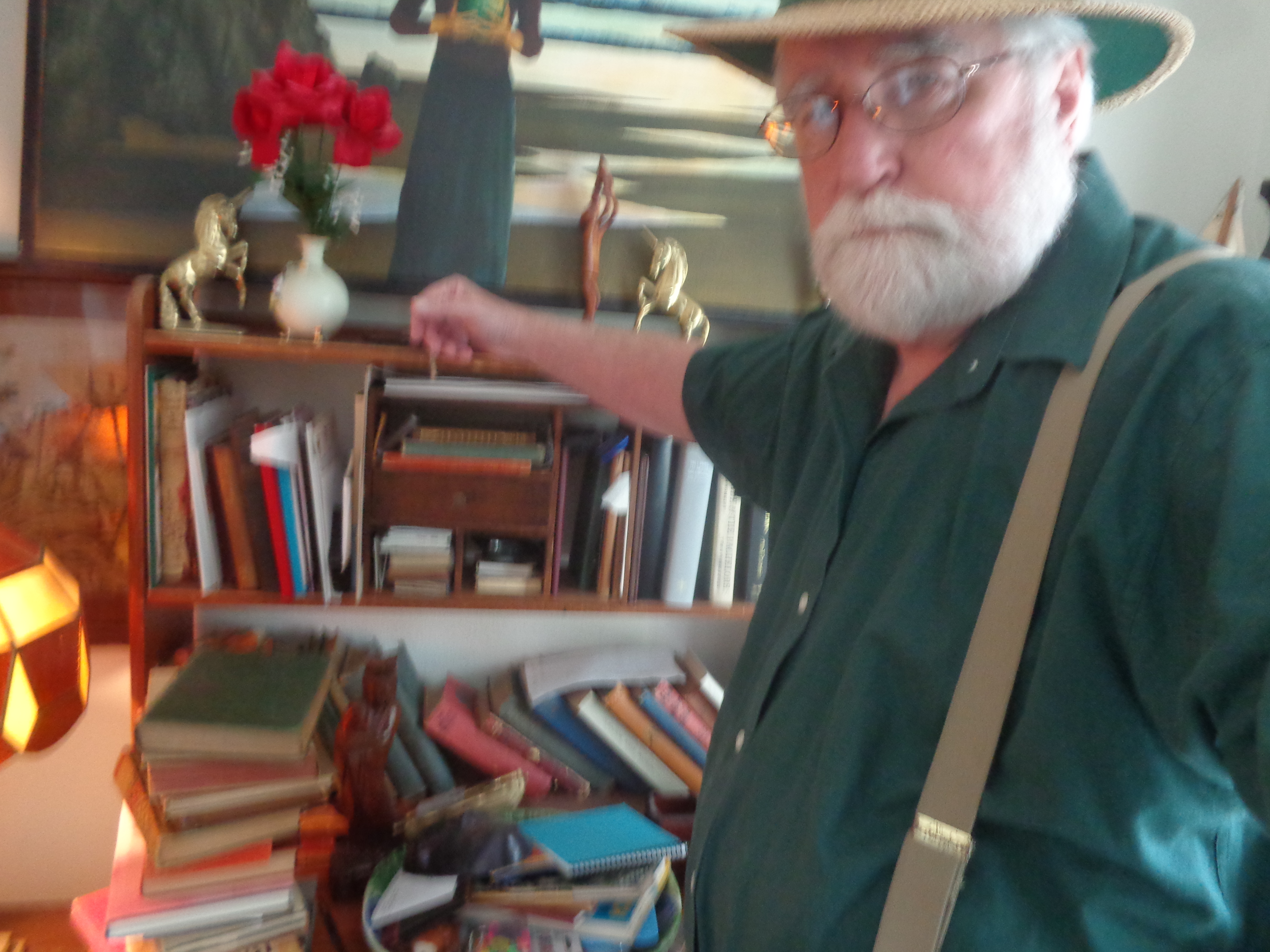
This morning I realized my bookcase erected in 2010 is similar to the one in the Ken Kesey Mural in downtown Springfield.
I am alive. Ken is dead. I decided to go into as much detail as I can about dying on a huge dose of LSD. Dying, and seeing God. This is what will come out of my bookcase.
With Nancy’s help, I found one of thee artists who painted the Creamery mural. I used to visit Nancy there when I came into town. I went with Sue and Chuck Kesey, with a group of Pranksters to the top of Mount Pisgah. I rode with Ken on Further in the Eugene parade. On one of my visits to the Creamery, Nancy encouraged me to write the history of the hippies because I could recall so much. I began ‘The Gideon Computer’ which was about the last hippie – of the future. Much of my book came true. This blog would not exist without Nancy. I never dreamed I would be a writer.
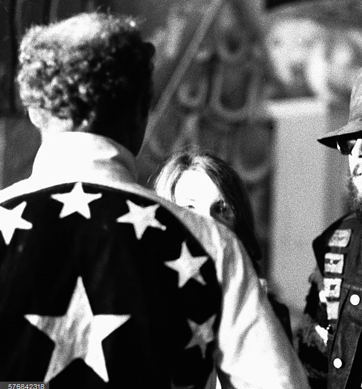
I took that pic of Ken Babbs and Nancy in front of the mural.
John Presco 007


A Bookcase, Pennent, and Trophy
Mural Connected to Hog Farm


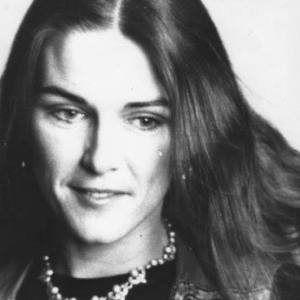
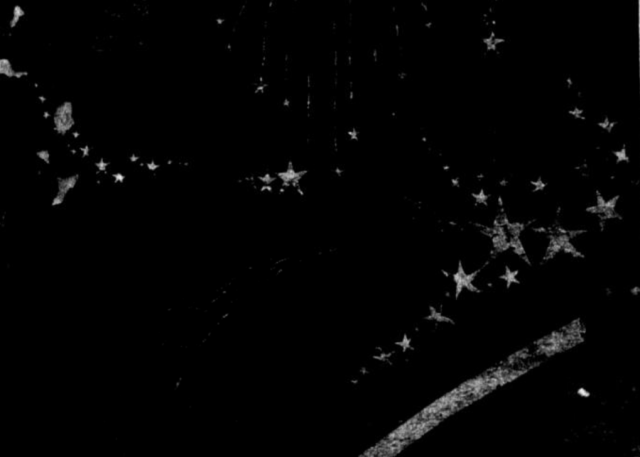
Here is Erin Sullivan who painted most of the starry objects in the Creamery Mural. She told me she was a friend of the authors of the book ‘Holy Blood, Holy Grail’, and she felt compelled to read ‘The Da Vinci Code’ after the lawsuit. I had not yet found Erin when I wrote this on this post;
Erin was a member of the Hog Farm and a good friend of Wavy Gravy. Homer Simpson was recruited as the Axis Mundi. Consider Robert Anton Wilson’s ‘The Cosmic Trigger’. Like it or not, we are all hurtling in space. And the mothers that born us want to be proud of all their children. For sure they don’t want us to fall in with the wrong crowd, a bunch of oddballs. Now, the bookcase makes perfect artistic sense. Do you agree?”
Wow! What a Cosmic Trigger Coincidence! Erin posted this post on this Facebook and said it was an example of her ‘Retrograde of Venus’. I am changing it, but have the original. Here is what Erin wrote me – that floored me!
“Boy, could I tell you about Dan Brown . . . I am published by Penguin/Tarcher . . . I was the editor for Arkana Contemporary Astrology, Penguin UK . . . . And, he ripped off my authors and friends, Michael Baigent and Rich Leigh who are the authors of Holy Grail, etc.
Rich Leigh who are the authors of Holy Grail, etc. When they lost the lawsuit, Rich died of a heart attack four months later . . . Michael has since died 4 years ago from cancer . . . , When I was forced to read DaVinci, by the tine I got to page 38, I thought it was Rich Leigh under a boring pseudonym . . . AND, it is also straight out of my book on Retrograde Planets, in the VENUS chapter!!!!””
Erin asked me if I had seen the mural her and Laura Foster painted. I told her I saw it in 1986, when I went to visit my childhood friend, Nancy Hamren, who worked there. We talked about the commune we lived in with the Zorthian sisters, whose father was a famous muralist who was inspired by my kindred, Thomas Hart Benton – who was the mentor of Jackson Pollock! Erin was thrilled to be placed amongst these stars of the Art World, as will Laura be when I find her.

Solms-Braunfels was a partition of Solms, ruled by the House of Solms, and was raised to a Principality of the Holy Roman Empire in 1742. The county of Solms-Braunfels was partitioned between: itself and Solms-Ottenstein in 1325; itself and Solms-Lich in 1409; and itself, Solms-Greifenstein and Solms-Hungen in 1592.
Frederick William (1696–1761) was created a Prince of the Holy Roman Empire in 1742, with his younger offspring also bearing the title prince and princess, styled Serene Highness. The Principality of Solms-Braunfels was mediatised to Austria, Hesse-Darmstadt, Prussia and Württemberg in 1806.
For the first time, Catholic sisters return land to a Tribal nation
“This return represents more than the restoration of land — it is the restoration of balance, dignity, and our sacred connection to the places our ancestors once walked.”

Gender, climate and sustainability reporter

PublishedNovember 7, 2025, 9:56 a.m. PT
On a sunny afternoon on the shores of Trout Lake in northern Wisconsin, a Catholic sister and a Tribal president sat together at a table and made history.
Two years ago, the Franciscan Sisters of Perpetual Adoration, a Catholic congregation, had approached the Lac Du Flambeau Band of Lake Superior Chippewa, a part of the Ojibwe Nation, and the original caretakers of the land, with an unheard of proposition: Would they like a piece of their land back?
The question took the tribe by surprise, said Araia Breedlove, their public relations director. They had never had a private property owner offer up a piece of land, much less Catholic sisters. But after ironing out the details, the two parties were able to close the deal last Friday.
Billionaire philanthropist and Jeff Bezos’ ex-wife, MacKenzie Scott, has donated $80 million to Howard University, marking one of the largest single donations in the school’s 158-year history and continuing her recent surge of major contributions to diversity and equity causes. The donation, announced over the weekend by Howard University, comes as Scott – estimated to be worth $35.6 billion, as per The Wall Street Journal – has been on what observers are calling a philanthropic roll, making several multimillion-dollar gifts to DEI and disaster relief causes in recent weeks.
Amazon CEO Andy Jassy Says The Recent Layoffs Of 14,000 People Was About ‘Culture’ And Not Financially- Or AI-Driven

share
Amazon CEO Andy Jassy addressed the company’s recent layoffs during its quarterly earnings call on Oct. 30, saying the decision to cut 14,000 corporate positions was based on cultural factors rather than financial or AI-related reasons, Fortune reports.
“The announcement that we made a few days ago was not really financially driven, and it’s not even really AI-driven, not right now at least,” he said during the call. “It’s culture.”
In August of 1970, at the height of the Vietnam War, President Richard Nixon was slated to come to Portland, and so were thousands of antiwar protesters. Oregon was preparing for violent protests in the streets of Portland. That’s when the idea of Vortex 1 was born.
/
Drugs, sex, rock ‘n’ roll and Republican politics converged in an Oregon forest in the summer of 1970 to pull off an unlikely scheme. It was a tense time in America. Protests across the nation were ending in bloodshed, including in downtown Portland.
In an unlikely partnership, Oregon’s Republican governor teamed up with a group of self-described hippies to throw a drug-fueled rock festival in the woods. Oregon Vortex 1: A Biodegradable Festival of Life served as a distraction from a potentially volatile situation in Portland. Fifty years later, another group attempted to honor the spirit of Vortex before it was cut short by a pandemic nobody saw coming. Now, in a climate with uncanny similarities to the one in 1970, the story of Vortex 1 lives on as an example of community in a time of division.
Amazon upheaval: With morale shaken, Jassy looks for next big play after mass layoffs
Published Wed, Nov 5 20257:30 AM ESTUpdated Wed, Nov 5 202510:26 AM EST

Annie Palmer@in/annierpalmer/@annierpalmer
ShareShare Article via FacebookShare Article via TwitterShare Article via LinkedInShare Article via Email
Key Points
- Amazon CEO Andy Jassy’s overhaul of the company’s corporate culture deepened last week with the announcement of 14,000 layoffs.
- The next big wave of job cuts is expected to start in January, after the holiday rush and Amazon’s annual re:Invent cloud conference, CNBC has learned.
- Before the company’s earnings beat last week, Amazon’s stock had badly underperformed its tech peers this year.
In this article
Follow your favorite stocksCREATE FREE ACCOUNT

Amazon CEO Andy Jassy speaks during the GeekWire Summit in Seattle on Oct. 5, 2021.
David Ryder | Bloomberg | Getty Images
Amazon CEO Andy Jassy sat on a stage in a Seattle conference center in September, looking out at an audience of thousands of sellers who’d traveled from around the world to the company’s hometown.
He used the moment to lay out a vision for how he wants Amazon to operate like the “world’s largest startup,” getting rid of bureaucracy in order to move faster and stay competitive.
“We’re working hard to try to flatten our organization and have fewer layers because in the very earliest days of Amazon, it’s been true for many years, we had very high ownership at every level of the organization, including on the frontline,” Jassy said at the event.
Jassy, who took the helm from founder Jeff Bezos in 2021, has embarked on a major overhaul of Amazon’s corporate culture in recent years, including a hard pivot back to in-office work, with Covid largely in the rearview mirror, and a push for employees to do more with less.
The starkest example came last week, when Amazon announced it would lay off about 14,000 corporate employees and said more cuts are expected soon.
During Amazon’s earnings call on Thursday, Jassy used a familiar line when asked about the reductions.
“As a leadership team, we are committed to operating like the world’s largest startup,” Jassy said. “And that means removing layers.”
The next big wave of cuts is expected to start in January, CNBC has learned, after the holiday rush and Amazon’s annual re:Invent cloud conference, which is held in early December.
Amazon’s stores and human resources division, known as people experience and technology, are among the units that will be impacted, according to two people familiar with the matter who asked not to be named because the details are confidential.
In total, it’s expected to add up to the largest round of corporate layoffs in Amazon’s 31-year history, CNBC previously reported. Amazon has been trimming head count across the company since late 2022, resulting in more than 27,000 job cuts. Reductions have continued of late, though at a smaller scale.
Layoffs have been announced at companies across the tech, retail, auto and shipping industries in recent months, with executives citing myriad reasons, from artificial intelligence and tariffs to shifting business priorities and broader cost-cutting efforts. Meta, Google, Intel and others have also sought to reduce management layers or organizational bloat in hopes of boosting efficiency.
Before Amazon’s better-than-expected third-quarter earnings report late last week, Wall Street was taking a skeptical eye toward the company. The stock was very narrowly up for the year, badly trailing the broader market and Amazon’s megacap peers. However, a 14% jump over two trading days put the stock solidly in the green and lifted it to a record close Monday.
But as Jassy tries to reshape the company, plenty of hurdles remain, including rising costs, heightened cloud competition, delays at Alexa and what some employees describe as flagging morale.
While Amazon’s core e-commerce unit remains healthy, Amazon and other retailers have been navigating the uncertainty of President Donald Trump’s shifting tariff policies, which threaten to increase costs and dampen consumer demand.
Amazon Web Services, the dominant cloud infrastructure provider, has come under pressure from rivals Microsoft and Google, which are growing faster. AWS is also battling a perception that it’s a laggard in signing key artificial intelligence infrastructure deals. Amazon’s $38 billion cloud agreement with OpenAI, announced Monday, could help ease some of those concerns.
watch now
VIDEO01:41
OpenAI strikes 7-year deal with Amazon to scale ChatGPT
Meanwhile, Amazon’s 11-year-old Alexa service, an early leader in the voice assistant market, was slow to bring to market an enhanced version, with competition building from generative AI companies, namely OpenAI.
Amazon released Alexa+ in February. But it’s unclear how well the upgraded Alexa, as well as companion devices that debuted in September, will fare against rivals and whether consumers will rush to buy them over the holidays.
Jassy has been searching for Amazon’s next opportunity, or “pillar,” for growth after e-commerce, cloud and its Prime membership program. The company has made big bets on satellite internet, health care, grocery, entertainment and self-driving vehicles, but with varying degrees of success.
Widespread cuts
The layoffs hit nearly all of Amazon’s business units, from logistics, AWS, retail and grocery stores to Prime Video, advertising and gaming, according to people familiar with the matter and employee posts on LinkedIn.
Jassy told investors last week that the cuts weren’t triggered by financial strain or AI replacing workers. He said he’s responding to a “culture” issue inside the company, spurred in part by a multiyear hiring spree that left it with “a lot more layers” and slower decision-making.
Current and former staffers, most of whom asked not to be named in order to speak candidly on the subject, told CNBC that several years of persistent cost cutting and layoffs have damaged morale, while pressure has simultaneously been building to innovate faster, especially around AI.
Amazon declined to comment.
Jassy outlined his plan to flatten Amazon’s structure in September 2024, at the same time that he instructed staffers to return to five days a week in the office. He set a goal for each major organization inside Amazon to increase the ratio of individual contributors to managers by at least 15% by the end of the first quarter of 2025.
He also established a “no bureaucracy email alias” for employees to flag unnecessary processes or rules. In September of this year, Jassy said that led to about 455 changes inside the company.
Jassy’s cost cuts haven’t just been around layoffs. He’s shuttered several of Amazon’s physical store chains and axed some of its more unprofitable or unproven bets, including a roving sidewalk robot, telehealth service, health and fitness wearable, and a virtual tours initiative.
An employee in Amazon’s cloud unit said in an interview that efforts to slash management layers and reduce costs have made staffers feel like they’re under an “incredible amount of pressure” and “burdened with more work” than before. The potential for more layoffs next year has created further anxiety, the person added.

watch now
VIDEO05:23
Is AI behind recent job cuts? Here’s what to know
A staffer in Amazon’s customer support division who was laid off last week after 15 years at the company described how the push to flatten organizations meant “they remove people but not the work.” The person said senior leadership appears “extremely disconnected from the workers.”
In the memo announcing the latest layoffs, human resources chief Beth Galetti used the phrase “staying nimble” in the headline.
It quickly became a meme on internal Slack channels and in Reddit threads. One image posted on Slack shows Keanu Reeves in “The Matrix,” labeled with the word “employees,” attempting to dodge a bullet labeled “Staying nimble, getting stronger, reducing layers, shifting resources.”
Another meme shows a cat with the animatronic bear from “Five Nights at Freddy’s,” a popular horror video game, lurking behind it and labeled with the title of the memo, “Staying nimble and continuing to strengthen our organizations.”
That’s not to say the changes are universally opposed. An AWS employee told CNBC that some organizations became too bloated and that fewer layers would help speed up decision-making. A former manager in Amazon’s retail business said the company overhired in recent years, creating too many layers of management.
AI doubts
Then there’s the impact of AI.
In June, Jassy said efficiency gains from using AI internally would shrink Amazon’s corporate staff in the coming years. The company is already reining in the growth of its white-collar workforce.
At the same time, Amazon is racing to keep up with the other hyperscalers by aggressively investing in AI infrastructure. In its earnings report last week, the company said it plans to boost capital expenditures this year to $125 billion, up from an earlier estimate of $118 billion. CFO Brian Olsavsky said that number will likely increase in 2026.
Amazon has also pushed corporate employees to use AI in their work and regularly experiment with internal tools. The company monitors AI adoption by employees, and some staffers were counseled to use the services more to speed up their work, or were informed that their usage could be factored into performance evaluations, according to three people familiar with the matter.
Workers are asking for clarity.
Amazon Employees for Climate Justice, an internal advocacy group, published an open letter on its website last week calling on Amazon executives to establish a “more responsible rollout of AI” and urging staffers to co-sign it.
“We’re the workers who develop, train and use AI, so we have a responsibility to intervene,” AECJ wrote.
While Jassy is making the case that AI agents will transform work for the better and make jobs “even more exciting and fun” than they currently are, AECJ members suggest they may be planting the seeds of their own demise.
“Amazon is forcing us to use AI while investing in a future where it’s easier to discard us,” they wrote.
Preston Arquette, who was laid off from Amazon’s e-commerce platform team last week, said he’s not “anti-AI” but he questioned whether the technology has led to tangible results inside the company.
“In my role, I didn’t see the kind of efficiencies or improvements that would make you think all these layoffs are necessary,” Arquette said in a text message.
WATCH: How Amazon built its biggest AI data center in a year
Prince Carl of Solms: A Visionary Leader in Texas Colonization
By: Glen E. Lich and Günter Moltmann
Published: 1952
Updated: March 19, 2019
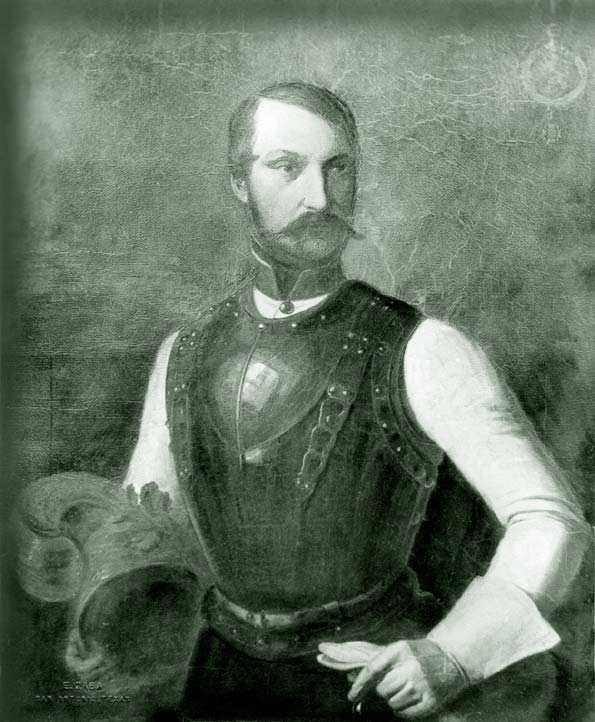

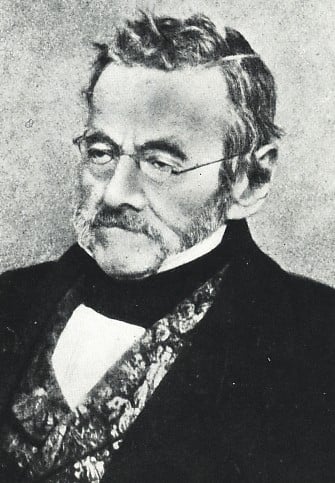
Solms-Braunfels, Prince Carl Of (1812–1875).Friedrich Wilhelm Carl Ludwig Georg Alfred Alexander, Prince of Solms, Lord of Braunfels, Grafenstein, Münzenberg, Wildenfels, and Sonnenwalde, the first commissioner-general of the Adelsverein and imperial field marshal, was born at Neustrelitz on July 27, 1812, the youngest son of Prince Friedrich Wilhelm of Solms-Braunfels and Princess Friederike of Mecklenburg-Strelitz. Prince Carl’s illustrious connections included Prince Frederick of Prussia, Queen Victoria, Czar Alexander I of Russia, King Leopold I of Belgium, and Prince Albert of Saxe-Coburg-Gotha. Not only well connected, but also handsome, highly spirited, and romantic, the trilingual Carl was educated both as soldier and courtier. Because of his connections, he secured prestigious military assignments, awards, and knightships, even though in 1839 he was sentenced by a Prussian court martial to four months in prison as a result of having absented himself from his command without leave. An early morganatic marriage, which had commenced in secret in 1834, dimmed his prospects after it became known, until, under duress from all sides, Carl consented in 1841 to the putting away of his wife, pensioned as the Baroness Luise “von Schönau,” and his three children by that marriage. That same year Carl became a captain of cavalry in the imperial army of Austria, progressing though prominent assignments in the Balkans, Bohemia, and the Rhineland. While stationed at the imperial garrison at Biebrich, he read Charles Sealsfield’s novel about Texas (see POSTL, CARL ANTON), William Kennedy‘s geography of Texas, and G. A. Scherpf’s guide to immigrants to Texas. As one of the twenty-five members of the Adelsverein, organized initially in 1842 and reorganized in 1844, Carl worked tirelessly to promote the growth, finances, administration, and political acceptance of the society. He lobbied his many relatives, traveled incognito through France and Belgium to the Isle of Wight, where he may have met with Prince Albert, and, along with other members, secured the covert support of England, France, and Belgium for the Texas colonial project, which was at once philanthropic, mercantile, and political.


In 1844 Carl was appointed commissioner-general for the first colony that the society proposed to establish in Texas. Provisioned with two cannons, table linens, and twelve place settings, he traveled to London, where his assistant’s diary suggests there was a royal audience, then to the United States, and westward down the Ohio and Mississippi to the Republic of Texas, where they arrived in Galveston on July 1, 1844. A series of letters, subsequently turned into formal reports, trace the route and detail Carl’s growing comprehension of North American culture, commerce, and geopolitics. Seeing himself at the head of a migration of German artisans and peasants to what one of his colleagues called “the new Fatherland on the other side of the ocean,” the visionary Carl wrote, “The eyes of all Germany, no, the eyes of all Europe are fixed on us and our undertaking: German princes, counts, and noblemen…are bringing new crowns to old glory while at the same time insuring immeasurable riches for their children and grandchildren.” In preparation to receive the German settlers and to protect them from what he considered the bad influences of the Anglo-American frontier, Carl purchased land on Matagorda Bay for the establishment of a port of debarkation named Carlshafen, or Indianola. He also traveled extensively throughout Texas and advised the Adelsverein, which already owned the right to settle Germans in the remote Fisher-Miller Land Grant, to buy even larger expanses reaching southward from the Llano River to Corpus Christi Bay and westward to the Rio Grande. Further, he communicated to Texas officials the threat of possible war with Britain, France, Russia, and Mexico should annexation occur. After the arrival in December 1844 of the society’s first settlers, some of whom he left at Indianola, or Carlshafen, the prince led the first wagon train into the interior of Texas. Near Victoria, he left the immigrants and proceeded to San Antonio in order to conclude the purchase from Juan Martín Veramendi and Raphael C. Garza of a fertile, well-watered tract on the Guadalupe and Comal rivers. The immigrant train reached this tract on Good Friday, March 21, 1845, and founded the settlement of New Braunfels, named for the Solms ancestral castle on the Lahn River, southwest of Wetzlar. Before Prince Carl left New Braunfels for Germany on May 15, 1845, he saw the work on the Zinkenburg, a stockade on a bluff on the east bank of Comal Creek, almost completed and work well underway on the Sophienburg, a fort on the Vereinsberg, a hill overlooking the old residential section of New Braunfels.
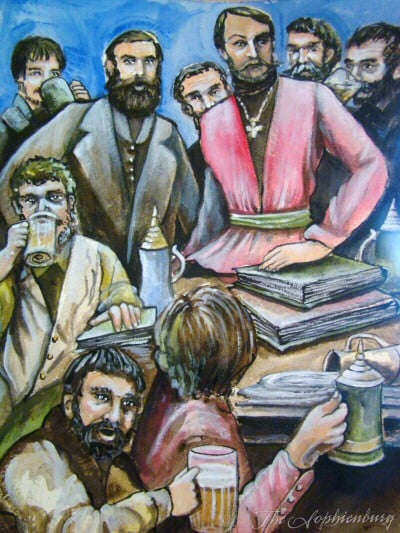
After he returned to Germany, Carl resumed his military service, from which he had been given a year’s leave, and on December 3, 1845 at Bendorf, he married Sophie, the widowed princess of Salm-Salm and the daughter of the reigning prince of Löwenstein-Wertheim-Rochefort. In 1846 he published Texas, a clear and succinct geography and guide to Texas. During this time Carl also wrote a fifty-nine-page memoir, transmitted to Queen Victoria in 1846, in which he explained that Europe and the westering United States were on a collision course to dominate world trade. America would likely win this race, Carl told the queen, if the United States reached the Pacific. He offered containment through colonization, the establishment of a powerful monarchy in Mexico, and the emancipation of the slaves as England’s surest policy. Carl remained active in his support of the Adelsverein, in which his family had heavily invested. In 1847, for example, he helped to recruit the Forty, an idealistic fraternity of students that eventually settled in the Fisher-Miller Land Grant.
His checkered military career continued. He left the Austrian army and became a colonel in the cavalry of the Grand Duchy of Hesse in 1846. An attempt to rejoin the Prussian army failed. In 1850 the Austrian army accepted him again, and by 1859 he had become a brigadier with command of dragoons on Lake Constance. In 1866, having also drawn Hanover into the conflict, he took part in the unsuccessful war of Austria against Prussia. As commander of an imperial corps, Carl failed, was recalled and reprimanded, but acquitted by court martial. He retired as a field marshal in 1868 to his residence at the estate of Rheingrafenstein near Kreuznach on the Nahe River. Prince Carl died seven years later, on November 13, 1875, at the age of sixty-three, at Rheingrafenstein. He was interred in the city cemetery of Bad Kreuznach. Sophie died the next year. They were the parents of five children, four of whom survived them. Characterized by one of his German contemporaries in Texas as a “Texan Don Quixote” and by an eminent German historian as the last knight of the Middle Ages, Carl is a complex character, more romantic and individualistic than practical and accommodating. His two fixed passions, for which he was acknowledged to have had an expert eye, were fine horses and ruined castles-to which, in the early 1840s, he added empire-building.
TSHA is a proud affiliate of University of Texas at Austin
Is history important to you?
Chester William and Ethel Hander Geue, eds., A New Land Beckoned: German Immigration to Texas, 1844–1847 (Waco: Texian Press, 1966; enlarged ed. 1972). Theodore Gish, “Carl, Prince of Solms-Braunfels, First Commissioner-General of the Adelsverein in Texas: Myth, History, and Fiction,” Yearbook of German-American Studies 16 (1981). Glen E. Lich, “Archives of the German Adelsverein, Beinecke Rare Book and Manuscript Library, Yale University,” Southwestern Historical Quarterly 91 (January 1988). Glen E. Lich, The German Texans (San Antonio: University of Texas Institute of Texan Cultures, 1981). Glen E. Lich and Dona B. Reeves, eds., German Culture in Texas (Boston: Twayne, 1980). Wolf Heino Struck, Die Auswanderung aus dem Herzogtum Nassau, 1806–1866 (Wiesbaden: Steiner, 1966).


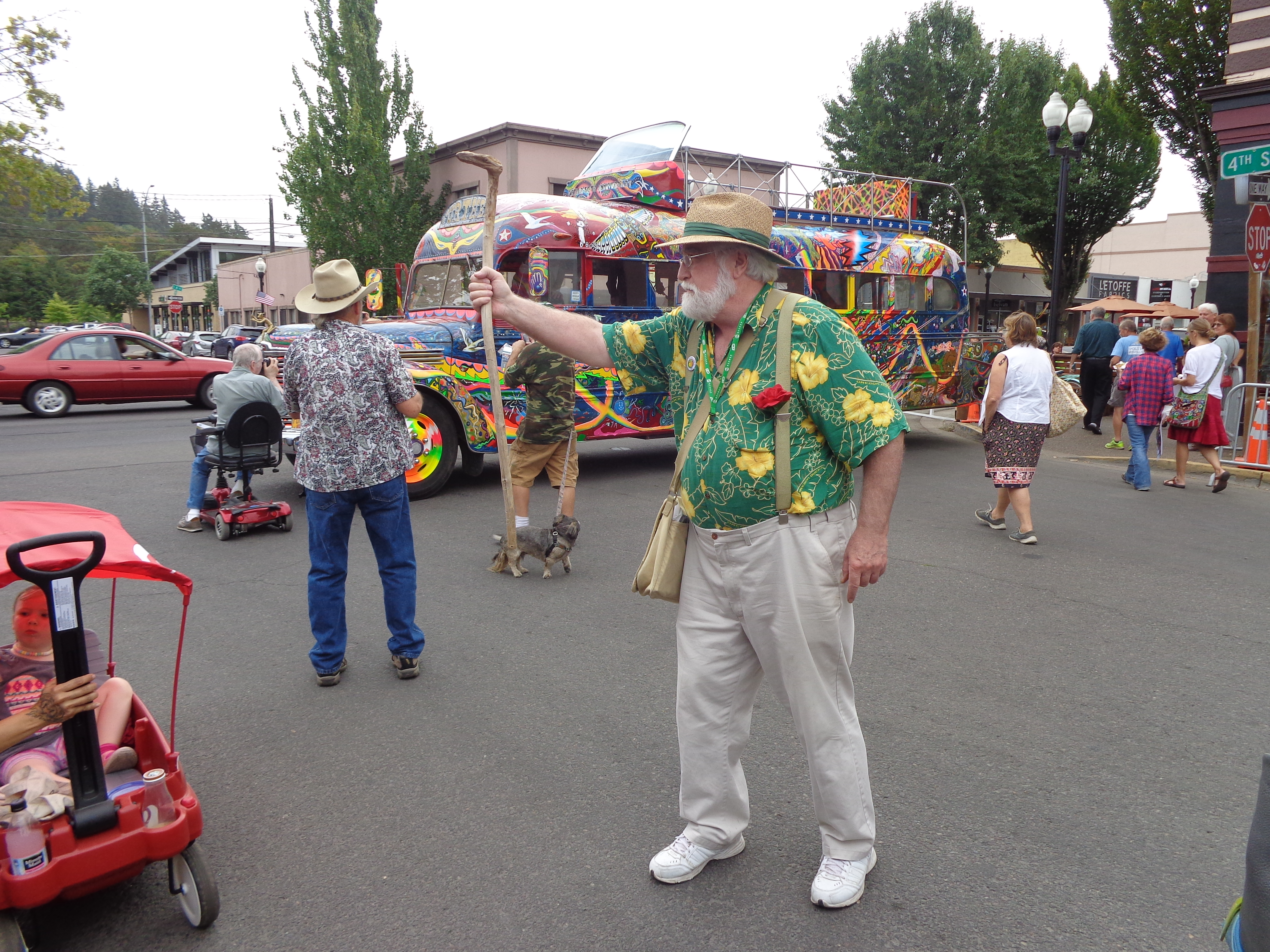
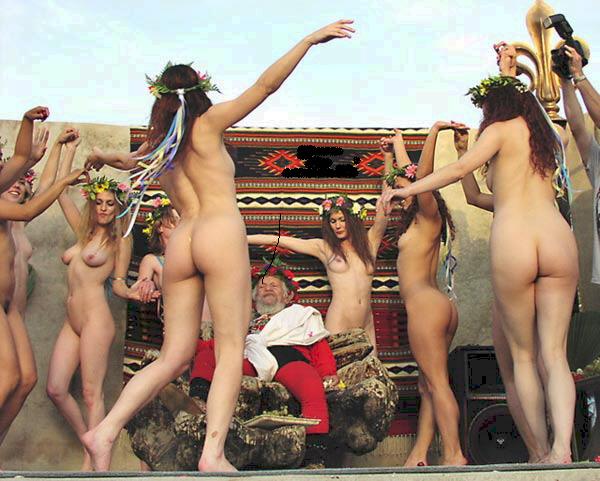
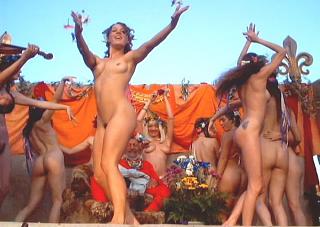
Another mural has been destroyed. This is a……..SIGN!
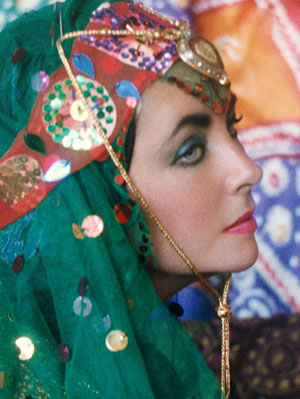
Look closely and you will see an old man with a white beard surrounded by dancing naked women. This is Jiryl Zorthian who was titled ‘The Last Bohemian’. However, this title goes to Elizabeth Rosemond Taylor who died seven years after Zorthian. I might be ‘The Last Bohemian.
Jon
https://nypost.com/2018/08/04/my-mural-was-destroyed-by-new-high-line-art-gallery/
Jordan Betten installed “Lady Luck,” an 8-by-20-foot mural which depicts a sweeping female figure flying across a sky-blue background, on a squat two-story building across from the elevated park trail in 2013.
The only thing between the mural and the High Line was an empty lot on West 27th Street.
But in April, contractors for Related Companies, which is developing a number of new art galleries in the neighborhood, removed a large chunk of Betten’s mural without notice, he contends.
https://www.laweekly.com/arts/the-last-bohemian-rip-2137664
Stephanie Kesey – Art Dictator
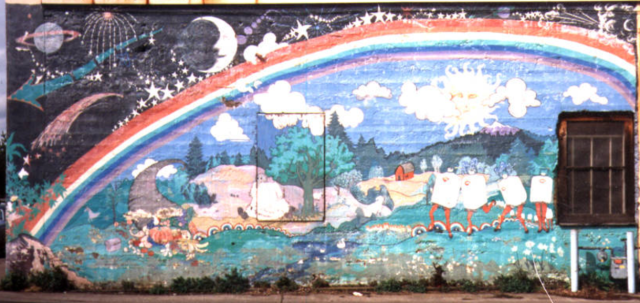
Stephanie Kesey married Zane Kesey, the son of Ken Kesey. I didn’t know Steph was a artist until after she “blocked” (unfriended me on facebook) after I failed to heed HER ORDER, that came too late, because, I already made me some fine connections, one of them to my friend, Stefan Eins, whose work has hung in MOMA. Stefan made graffiti art a true art form. The Creamery mural was seen as graffiti that the locals wanted – gone! There was a marijuana plant growing in a milk can at the end of the rainbow. The artist was a member of the Hog Farm, and is a supporter of Winnarainbow, as is the Bill Graham foundation.
https://en.wikipedia.org/wiki/Fashion_Moda
“STOP trying to connect such mundane coincidences.”
Folk Festival at Zorthian Ranch
Garth Sues the Gettys
I helped pass this law that Garth took advantage of. He and Christine did not know we are kin to them and Liz Taylor.
John Presco
“The capacity of some people to give back to the community is truly awe- inspiring, and as far as San Francisco is concerned, the Gettys are in a world all their own.
As if the local standard bearers of high society had not done enough in the areas of philanthropy, culture, music or family planning, now the Gettys have ventured forth in a new and unexpected arena: art education.
Their first project is to remind us that when you decide to “upgrade” an artist’s work, you may want to call the artist before getting in touch with your inner Monet. And it’s better, and cheaper, if your cubist leanings don’t involve someone else’s cube.
Recovering The Lost Magical Mural
Years ago I suggested Nazarite Queen Helena of Abiabene was the Sleeping Beauty Princess, Rosamond. I have found the remnant of the Nazarite church she founded in Iraq. The Church of the East has its roots in Adiabeni a place associated with the Magi – who followed a star! I followed this question; “What is in a name?”
“The Brothers Grimm included a variant, Briar Rose, in their collection (1812). It truncates the story as Perrault and Basile told it to the ending now generally known: the arrival of the prince concludes the tale. Some translations of the Grimm tale give the princess the name Rosamond.”
https://rosamondpress.com/2011/10/03/rosamond-threads/
Erin Sullivan, who painted most of the starry objects in the Creamery Mural, told me she was a friend of the authors of the book ‘Holy Blood, Holy Grail’, and she felt compelled to read ‘The Da Vinci Code’ after the lawsuit. I had not yet found Erin when I wrote this on this post;
https://rosamondpress.com/2015/08/29/a-bookcase-pennent-and-trophy/
“Where’s Ken’s copy of ‘The Da Vinci Code’? Before Ken, Homer Simpson was recruited as the Axis Mundi. Consider Robert Anton Wilson’s ‘The Cosmic Trigger’. Like it or not, we are all hurtling in space. And the mothers that born us want to be proud of all their children. For sure they don’t want us to fall in with the wrong crowd, a bunch of oddballs. Now, the bookcase makes perfect artistic sense. Do you agree?”
Wow! What a Cosmic Trigger Coincidence! Erin posted this post on this Facebook and said it was an example of her ‘Retrograde of Venus’. I am changing it, but have the original. Here is what Erin wrote me – that floored me!
“Boy, could I tell you about Dan Brown . . . I am published by Penguin/Tarcher . . . I was the editor for Arkana Contemporary Astrology, Penguin UK . . . . And, he ripped off my authors and friends, Michael Baigent and Rich Leigh who are the authors of Holy Grail, etc.
Rich Leigh who are the authors of Holy Grail, etc. When they lost the lawsuit, Rich died of a heart attack four months later . . . Michael has since died 4 years ago from cancer . . . , When I was forced to read DaVinci, by the tine I got to page 38, I thought it was Rich Leigh under a boring pseudonym . . . AND, it is also straight out of my book on Retrograde Planets, in the VENUS chapter!!!!””
Erin asked me if I had seen the mural her and Laura Foster painted. I told her I saw it in 1986, when I went to visit my childhood friend, Nancy Hamren, who worked there. We talked about the commune we lived in with the Zorthian sisters, whose father was a famous muralist who was inspired by my kindred, Thomas Hart Benton – who was the mentor of Jackson Pollock! Erin was thrilled to be placed amongst these stars of the Art World, as will Laura be when I find her.
Here is my sister. This site and these images of beautiful Rosamond women, came to be owned by a hostile outsider who tried to get me to sign a legal document that would forbid me to write about Christine – and my family!
On my visit, Nancy suggested I author the history of the hippies because I could recall so much. A year later I began ‘The Gideon Computer’. In 1989, began a theological novel ‘The Lion of God’ where I say Mary Magdalene was the real Messiah of the Jews, and thus was called Jesus, which means “Savior”. Because John was the “savior” of the Jews, and a son of a Rabbi, he would be married. In my book her marries Mary Magdalene. A parchment is saying Jesus was married.
Tale of Two Murals
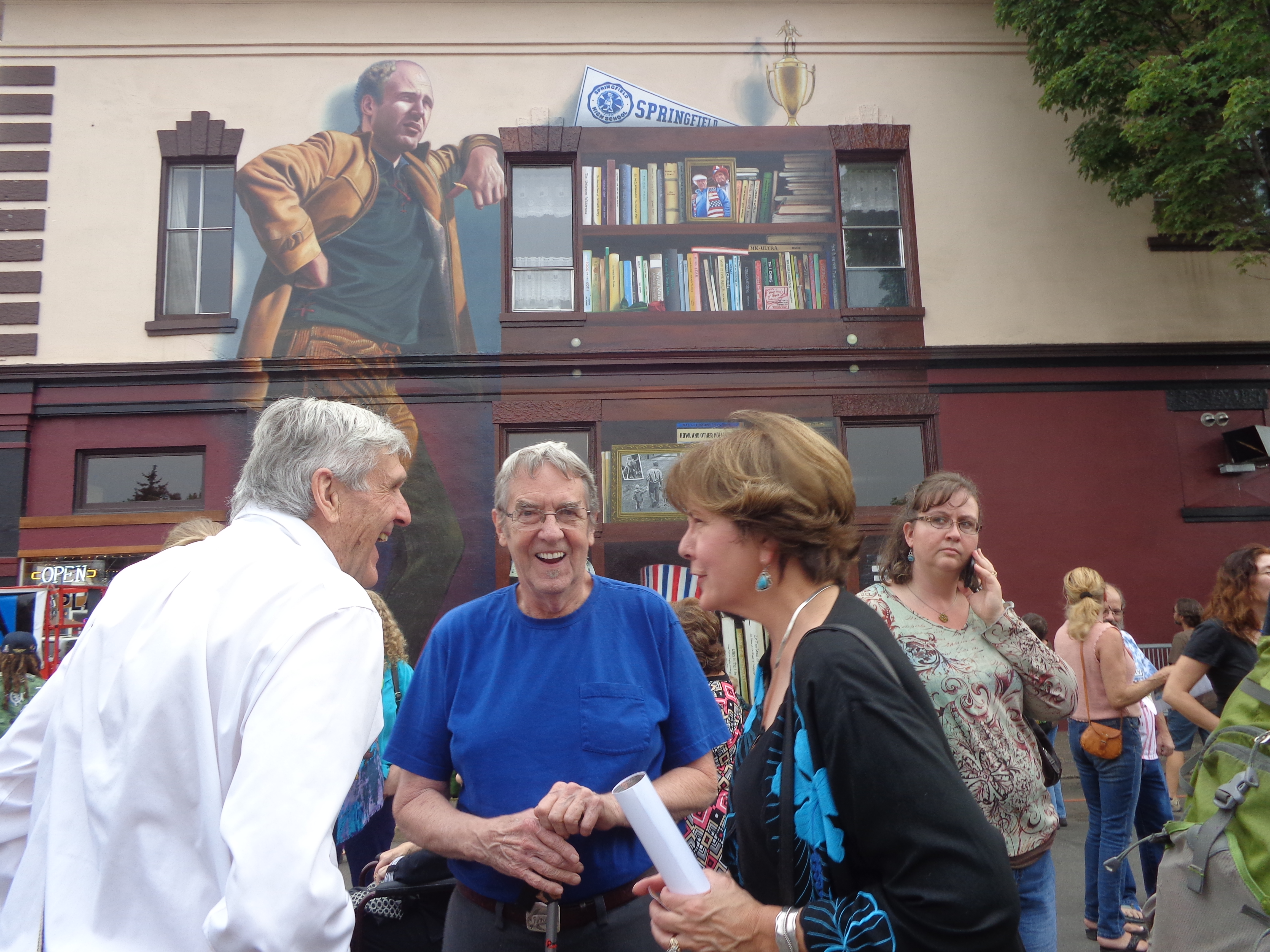
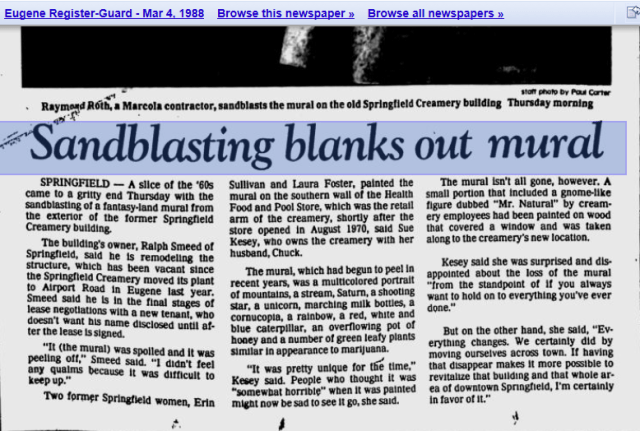
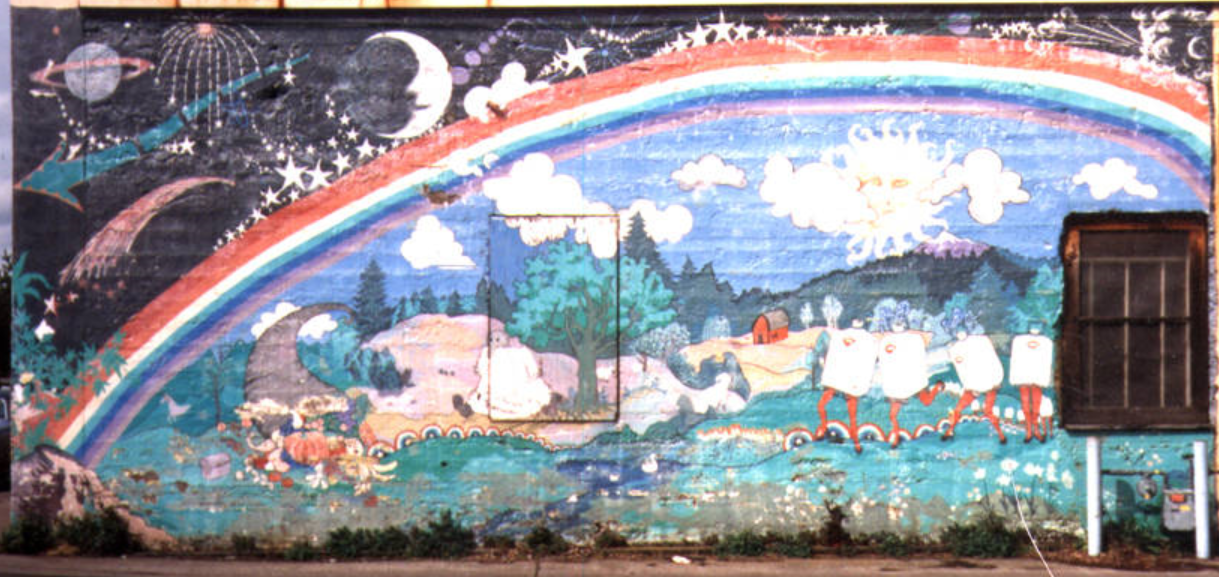
There once were two Kesey Murals in Springfield. My friend Nancy described the first one and got one of names of the artists, right, so I was able to restore the lost description of the mural that was painted on the outside wall of the The Creamery that Chuck told me the town leaders hated.
“It was the only mural for a hundred miles around, and, it had to go!” Said the husband of Sue Kesey, and brother-in-law of Ken.
“There was a caldron with marijuana plants!” Nancy, of yogurt fame, added.
“Wasn’t there a Unicorn?” asked I.
The unasked question at the unveiling (as far as I know) is………
How did Ken get so big? It’s like ‘The Attack of the Fifty Foot Author’.
A Bookcase, Pennent, and Trophy
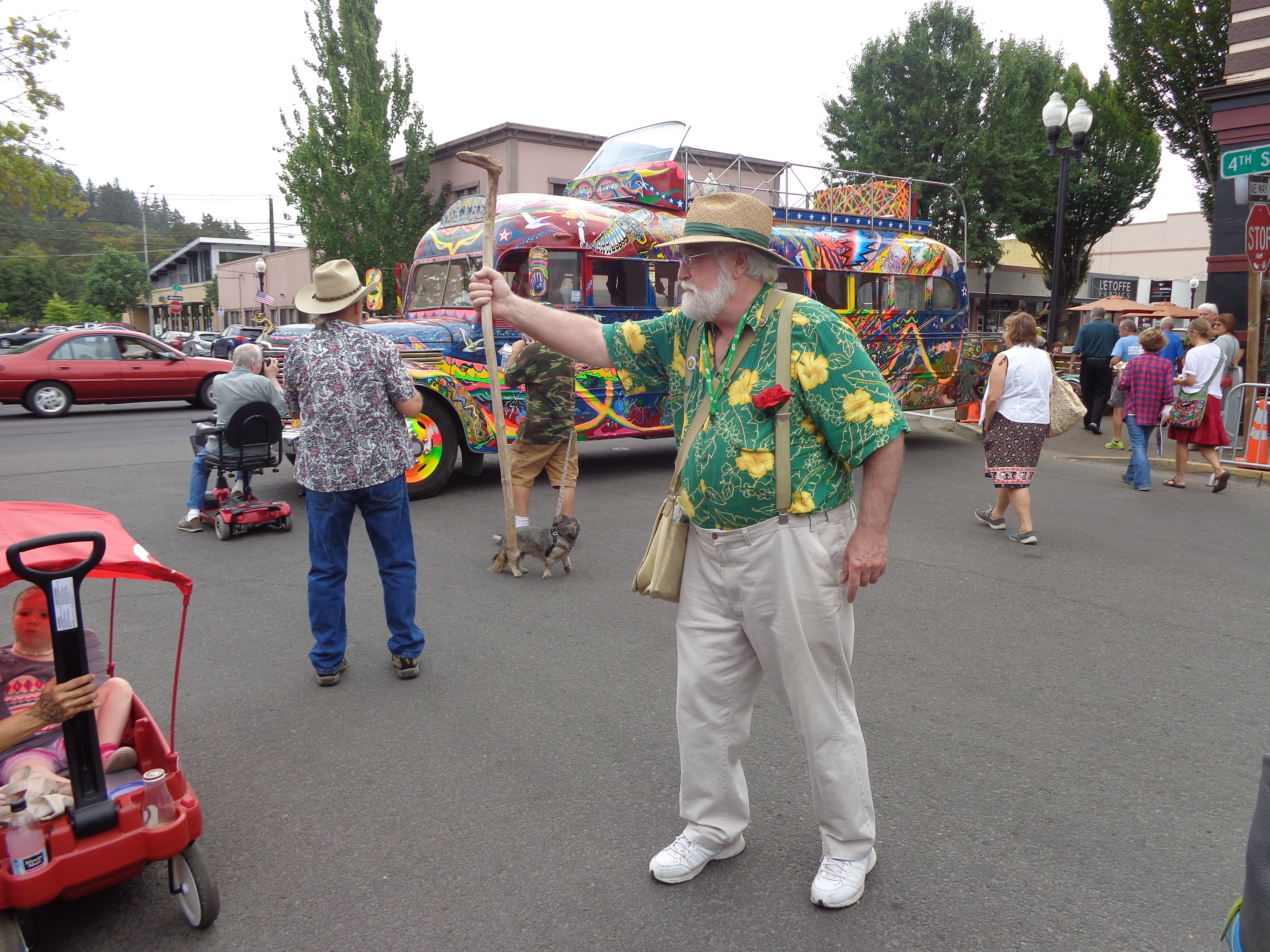
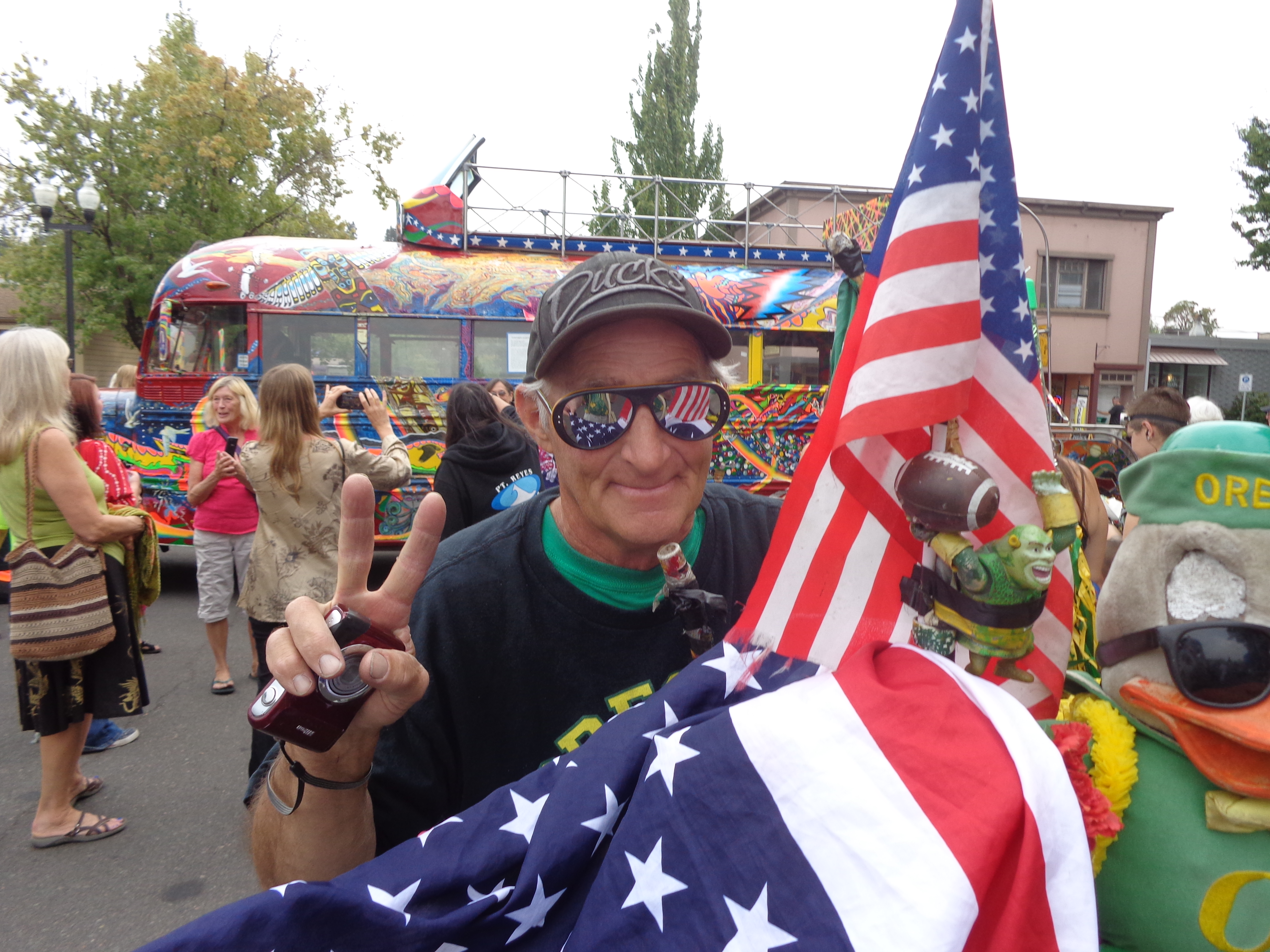
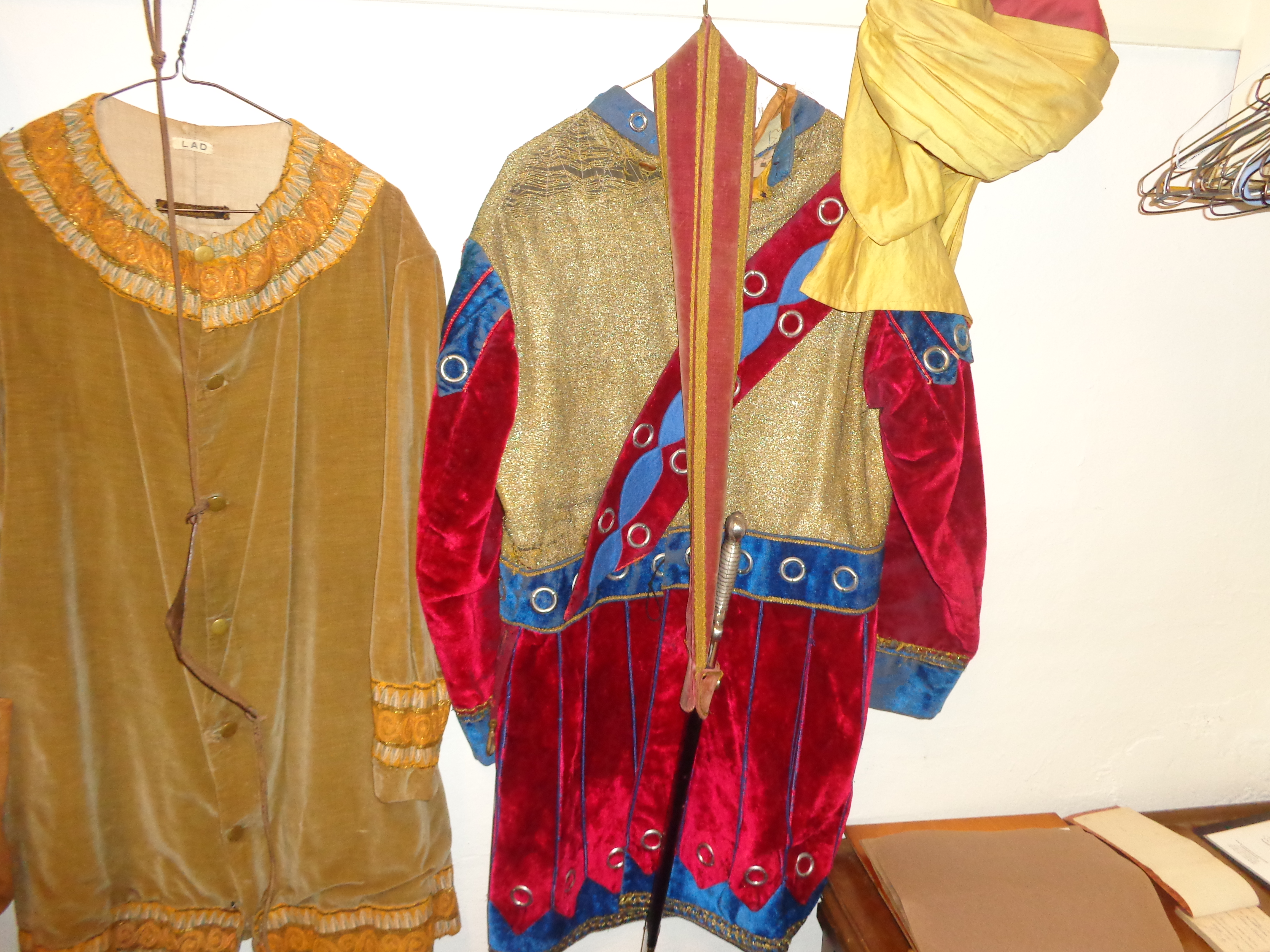

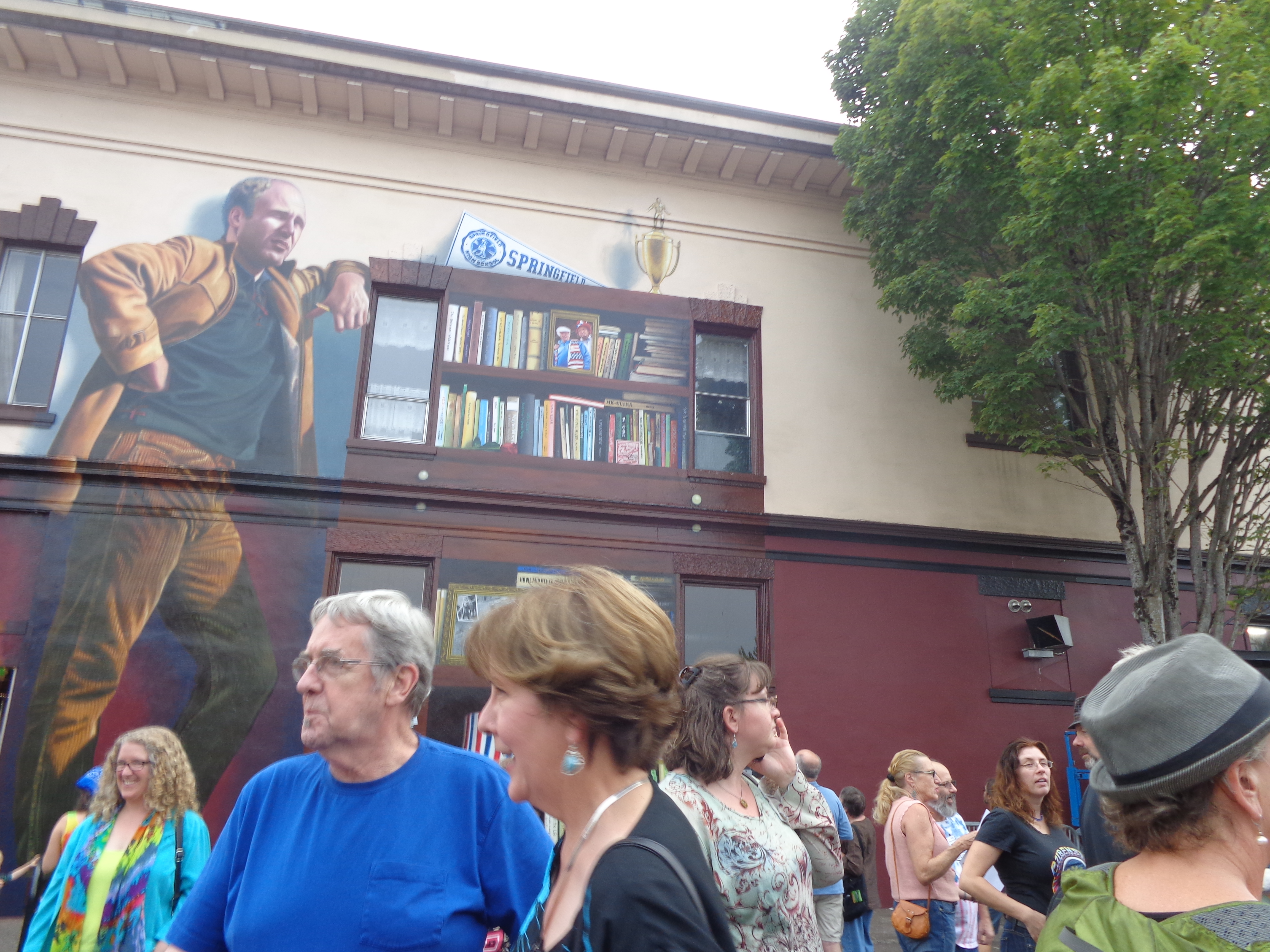

There are reasons why many people want to see Ken Kesey’s mural in downtown Springfield, work. I will post on the Mayor’s speech later on. What had to be sought was permission to render this mural on a building owned by the Oddfellows. They were mentioned in what can be described as a political speech. Most everything is political these days. For sure no one that mattered was for ‘Cosmic Ken’. To render a giant mural with Saturn and a shooting star above Magi Kesey’s head, is a No-No! There can be no beatitude smile on his face while he hand-feeds a Unicorn that has just come across the Rainbow Bridge. This would not pass muster. Everyone is going to scream…..
“DRUGS!”
Even though these thing were used to sell dairy and yogurt products, stuff that is good for you, let us put these magical things in books, and put these books in a bookcase, that almost renders Ken’s mural, a still life. The revolution will not be televised. There will be no army of happy milk cans marching down the yellow-brick road to see the Wizard who promoted a mind-altering chemical. If folks want to see this kind of stuff they can go see the Kesey movie when it plays at the Gateway theatre, located a mile away. Will it be in 3-D? Will the audience put on tie-dyed glasses?
What I am extremely interested in is becoming a Lobbyist, because I want to see the 17% percent tax on marijuana go to Creative Bohemian ideas. That cauldron at the end of the Rainbow Nancy talked about, will soon be filled with
“GOLD!”
Many will come running to stake their claim. We are looking at a New Gold Rush!
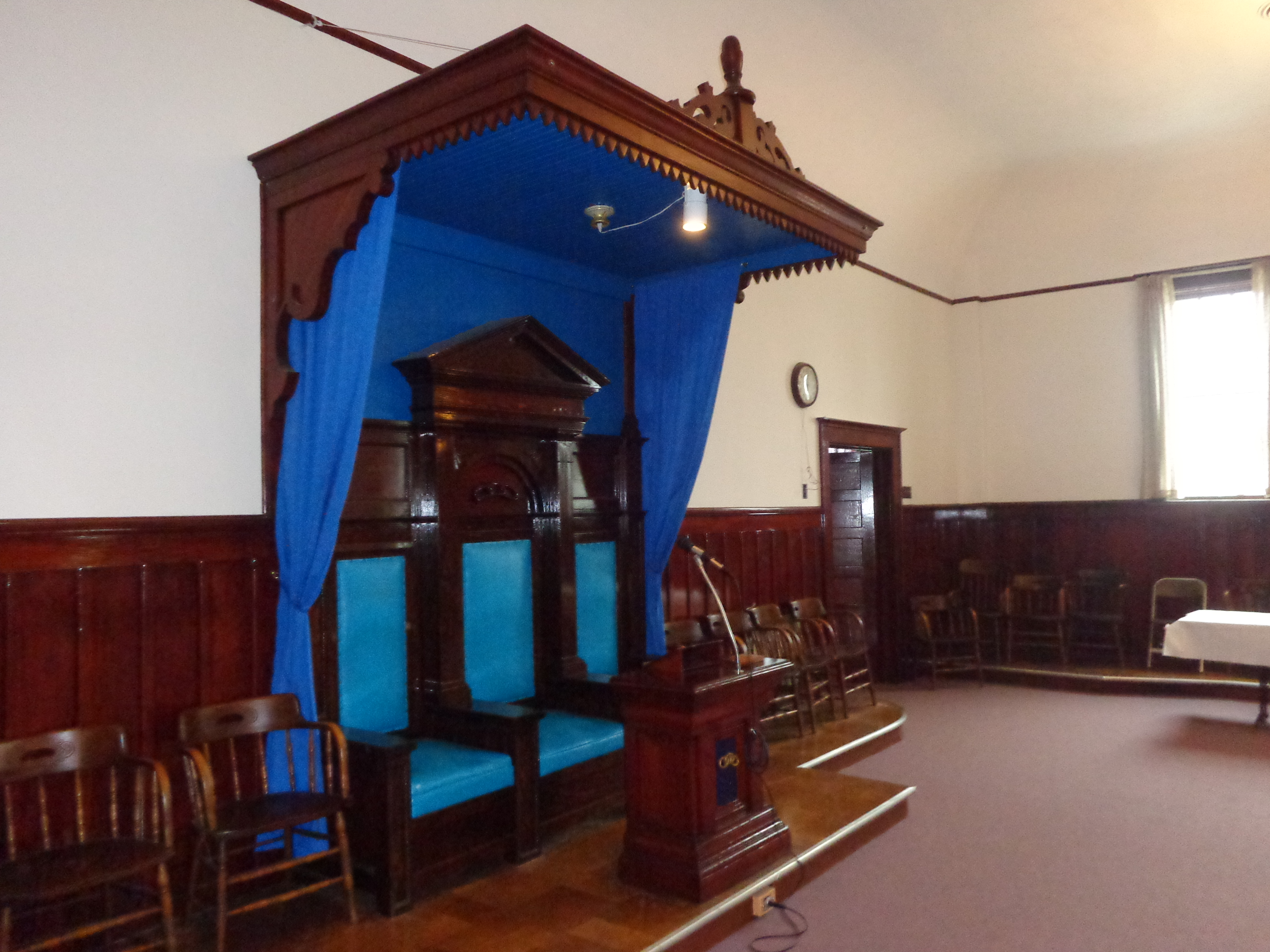
When I read the folks who rendered the Simpson Family on the side of the Emerald Art Association, were going to do a mural of Ken Kesey, I went downtown to investigate from a skeptics point of view. I wore a funny hat, Merlin’s hat, that was full of stars and crescent moon. I brought objects with me in order to perform an Augur’s ritual. Four days later I could not believe my good fortune when Brenda invited me to come upstairs and see the Oddfellow Hall that was open to the public for the unveiling. I was going to get more than a peek behind te Curtain of Oz.
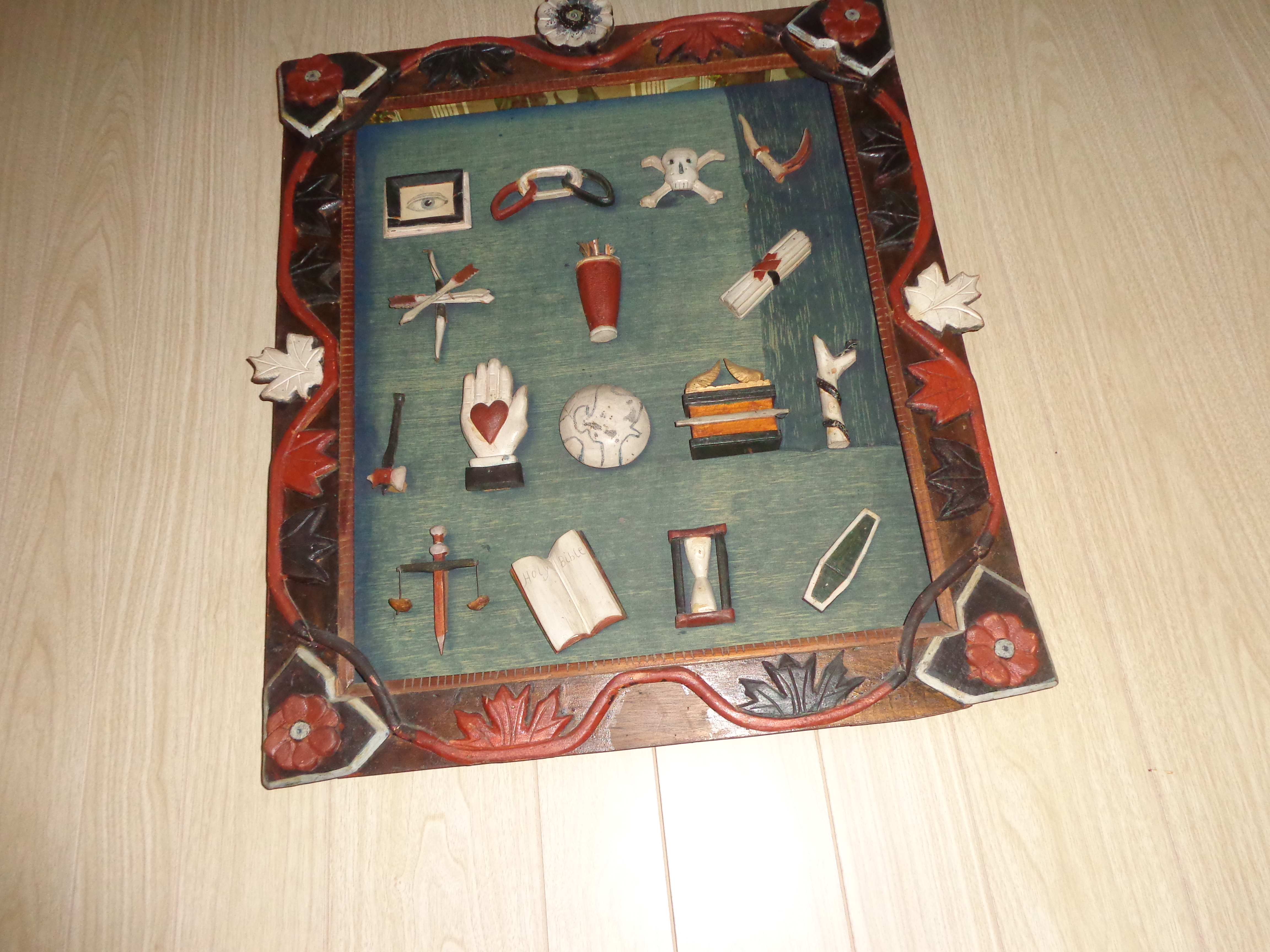
The first thing I see is a table full of magical and odd hats. I debated about bringing my Merlin hat. There were costumes. In another room there were strange three-dimensional objects in a frame. Did the Oddfellow look down on me while I performed an intuitive ceremony? Did they declare;
“He’s the Chosen One! Let us lure him up here at the unveiling!”
e
Capturing Beauty
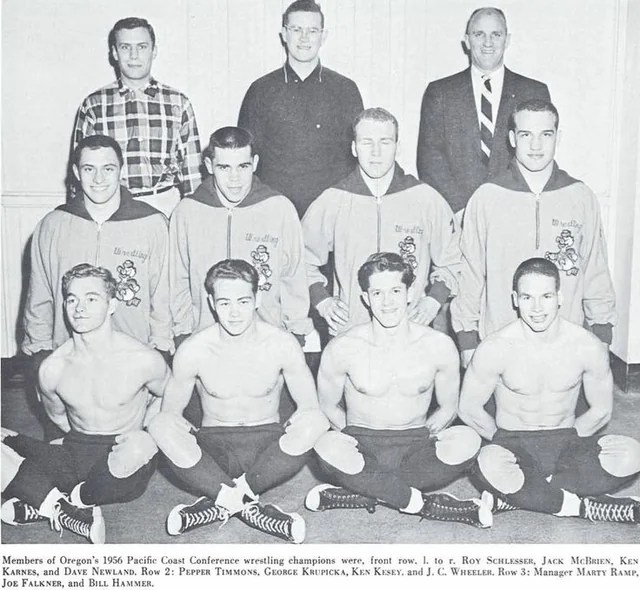
Above is a group photo of Duck wrestlers. One of them is Ken Kesey. All are wearing Duck Gear with a image of the Oregon Ducks. How could the million dollar promoters of Duck Tie-Dye, with Oregon Duck football game miss this? Ken attended the UofO on a football scholarship. John Madden also played football for the Ducks.
Ken was an aspiring author, and became a published writer. He would support all my writing endeavors, that includes owning and operating a alternatives newspaper.
John Presco
President: Royal Rosamond Press
While attending the University of Oregon School of Journalism and Communication in neighboring Eugene in 1956, Kesey eloped with his high-school sweetheart, Oregon State College student Norma “Faye” Haxby, whom he had met in seventh grade.[2] According to Kesey, “Without Faye, I would have been swept overboard by notoriety and weird, dope-fueled ideas and flower-child girls with beamy eyes and bulbous breasts.”[10] Married until his death, they had three children: Jed, Zane and Shannon.[11] Additionally, with Faye’s approval, Kesey fathered a daughter, Sunshine Kesey, with fellow Merry Prankster Carolyn “Mountain Girl” Adams. Born in 1966, Sunshine was raised by Adams and her stepfather, Jerry Garcia.[12]
Kesey had a football scholarship for his first year, but switched to the University of Oregon wrestling team as a better fit for his build. After posting a .885 winning percentage in the 1956–57 season, he received the Fred Low Scholarship for outstanding Northwest wrestler. In 1957, Kesey was second in his weight class at the Pacific Coast intercollegiate competition.[1][13][14] He remains in the top 10 of Oregon Wrestling’s all-time winning percentage.[15][16]
A member of Beta Theta Pi throughout his studies, Kesey graduated from the University of Oregon with a BA in speech and communication in 1957. Increasingly disengaged by the playwriting and screenwriting courses that comprised much of his major, he began to take literature classes in the second half of his collegiate career with James B. Hall, a cosmopolitan alumnus of the Iowa Writers’ Workshop who had previously taught at Cornell University and later served as provost of College V at the University of California, Santa Cruz.[17] Hall took on Kesey as his protégé and cultivated his interest in literary fiction, introducing Kesey (whose reading interests were hitherto confined to science fiction) to the works of Ernest Hemingway and other paragons of literary modernism.[18] After the last of several brief summer sojourns as a struggling actor in Los Angeles, Kesey published his first short story (“First Sunday of September”) in the Northwest Review and successfully applied to the highly selective Woodrow Wilson National Fellowship for the 1958–59 academic year.
The Truth Behind Oregon’s Tie-Dye Uniforms, Grateful Dead Connection
The No. 6 Oregon Ducks have caught the attention of the country with their uniforms once again, as the Ducks recently released new “Grateful Ducks” jerseys with tie-dye accents, inspired by the Grateful Dead. Fans might be wondering where connection exists between the popular band and the Ducks, and it lies in famous author and Oregon alumni Ken Kesey.
Charlie Viehl | Oct 21, 2025

Oregon Ducks uniforms nike phil knight Grateful Dead Dante Moore tie-dye Autzen Stadium Wisconsin Badgers Jerry Garcia Dan Lanning recruiting nil / oregon football twitter/x
In this story:
Oregon Ducks discuss what they learned from their loss
The No. 6 Oregon Ducks have caught the attention of the country with their uniforms once again, as the Ducks recently released new “Grateful Ducks” jerseys with tie-dye accents, inspired by the Grateful Dead. Fans might be wondering where connection exists between the popular band and the Ducks, and it lies in famous author and Oregon alumni Ken Kesey.
Kesey, author of One Flew Over the Cuckoo’s Nest, graduated from Oregon in 1957. Kesey got to know the Grateful Dead before they became the world-famous artists as the band traveled across the country with Kesey, performing at “Acid Tests.”
Before the Ducks’ matchup with the Wisconsin Badgers on Saturday, the University of Oregon released a video explaining the rel between Kesey, the Grateful Dead, and the city of Eugene.
Because of the band’s connection to Kesey, the Grateful Dead eventually performed in on Oregon’s campus over 20 times with 10 concerts inside of Autzen Stadium.

Oregon Ducks uniforms nike phil knight Grateful Dead Dante Moore tie-dye Autzen Stadium Wisconsin Badgers Jerry Garcia Dan Lanning recruiting nil / Oregon Ducks Football
“The 1960s. As the nation tested limits, two University of Oregon visionaries were already thinking beyond them, Bill Bowerman and Ken Kesey. One was redefining sport. The other, how people saw the world. Bill Bowerman, a track coach with a soldier’s discipline and a scientist’s curiosity, was tearing apart running shoes in Eugene, searching for ways to make athletes faster. Together with former Oregon track runner Phil Knight, they set out to reinvent the running shoe, a partnership that later became Nike,” the narrator in Oregon’s video reads..
“Around that time, Ken Kesey, a UO alum and author of One Flew Over the Cuckoo’s Nest and Sometimes a Great Notion was leading a different kind of experiment. Accompanied by the Grateful Dead, Kesey helped create gatherings that reimagined how people experience art, community, and consciousness, sparking a movement at the end of the ‘60s that would define the decade.”
Oregon news and research writer Ed Dorsch compiled a timeline that explains the events of the Grateful Dead alongside Nike and the success of Oregon’s athletics.
MORE: AP Top 25 Poll Chaos After Ranked Upsets For Miami, Ole Miss, Texas Tech
MORE: Biggest Winners, Losers From Oregon’s Resounding Win Against Rutgers
MORE: Oregon’s Dan Lanning Gives Positive Injury Update on Kenyon Sadiq After Rutgers Win
In 1972, “the Grateful Dead perform a benefit concert for Springfield Creamery, the makers of Nancy’s Yogurt. The Creamery, owned by Ken Kesey’s younger brother Chuck and his wife Sue, was in financial trouble. The Sunshine Daydream Concert, as it came to be known, was held on the current site of the Oregon Country Fair in Veneta, Oregon,” wrote Dorsch.
“The concert also marked the beginning of a lasting bond between the Kesey family, the Grateful Dead, and the Eugene community,” Dorsch continued.
Oregon Ducks uniforms inspired by the Grateful Dead / GoDucks / X
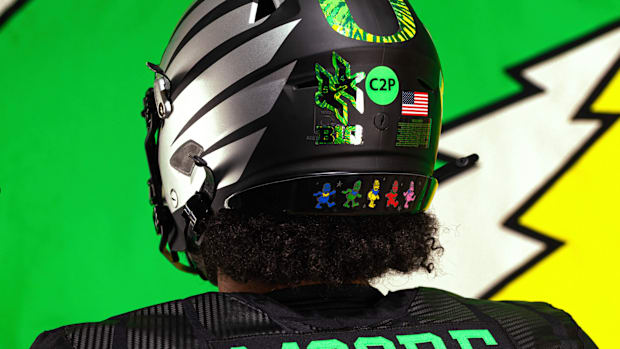
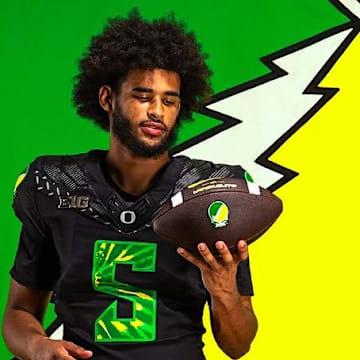
Oregon unveiled the “Grateful Ducks” uniforms on Sunday, as a tie-dye green and yellow pattern is accented on the jersey numbers. The shoulder patches feature the Grateful Dead’s iconic skull logo with the crack repurposed into a Nike swoosh.
The Ducks’ helmets will also have a special decal of dancing ducks on the back, an ode to the rainbow dancing bears that have become associated with the band.
The partnership between Oregon, Nike, and the Grateful Dead is one of the latest initiatives enjoyed by the football program. Earlier in the year, the Ducks wore “Shoe Duck” uniforms as a tribute to the founding of Nike by Knight and Bowerman.
Merchandise available to purchase has been made available to fans, and the jerseys are also set to go on sale before the game.

The Duck Store’s John Chambers shows off some of the new apparel featuring The Grateful Dead, er Duck, on sale now. / Chris Pietsch/The Register-Guard / USA TODAY NETWORK via Imagn Images
Published Oct 20, 2025|Modified Oct 21, 2025
Charlie Viehl is the deputy editor for the Oregon Ducks, Colorado Buffaloes, and USC Trojans on SI. He has written hundreds of articles for SI and has covered events like the Big Ten Championship and College Football Playoff Quarterfinals at the Rose Bowl. While pursuing a career in sports journalism, he is also a lifelong musician, holding a degree in Music and Philosophy from Boston College. A native of Pasadena, California, he covered sports across Los Angeles while at Loyola High School and edited the Gabelli Presidential Scholars Program’s magazine at BC. He is excited to bring his passion for storytelling and sports to fans of college athletics.
vs

Football
Nike’s NIL Deals with Oregon Stars Dante Moore, Dakorien Moore Are Different
Football
Oregon Ducks Can’t-Miss Tie Dye Uniforms Are Recruiting Magnet

Dominic DiSaia ’97
Bill Walton
May the Spirit of Bill Walton Reign Over Oregon Basketball
Darren Perkins June 4, 2024 Editorials
OK, let’s get it out of the way.
Yes; his quirky, rambling, meandering and obscure commentary during basketball telecasts could be extremely frustrating — evoking reactions ranging from cute to cursing, endearing to eye-rolling, joy to “you’ve gotta be joking,” and from a sense of comradery to cursing. And, for some, simply anger.
But, for many of us, doesn’t that sound a hell of a lot like the state we love?
So, in a sense, Bill Walton was Oregon.
I pulled Mr. FishDuck from his fun where he learned how a Fanatics Sportsbook NC Promo Code will help you maximize your potential earnings if you are adding stakes to any game. He had a number of memories about Walton, being a lifelong Oregon resident.
During telecasts Walton had an odd habit of randomly referencing his 1977 championship Portland Trailblazers teammates. Maurice Lucas, Lionel Hollins, Johnny Davis and Larry Steele to name a few. I would assume the vast majority of the viewing audience had no idea who those players were. He was talking to a minority of us Oregon sports junkies almost as an inside joke, to which I would find myself in exasperation, responding, “Bill! Nobody knows who Dave Twardzik is!!”
And that encapsulated my general feelings toward Walton. I loved him and liked his color commentary, but sometimes he could drive me crazy.
Walton was an old hippie. He loved the Grateful Dead, riding his bike, nature, and Oregon: the state that adopted him after he brought its only professional sports championship in 1977. Walton came from Southern California, but Oregon was in his DNA. He had the good sense of putting others ahead of himself over the “me first” glamour of his native Los Angeles. This way of life served him well on the basketball court as he was one of the best passers and most unselfish players the game had ever known.
The 1977 final pitted the Trailblazers against the Philadelphia Seventy-Sixers. As an egoless entity, the Blazers epitomized “team.” They played like graceful figure skaters on the hardwood where passing, off-the-ball cuts, and basketball IQ were emphasized over scoring and individual accolades. Coach Jack Ramsey would famously run practices where the ball would not touch the floor as the elegant sound of squeaking sneakers rang like Mozart in the ears of basketball purists.
In contrast, the Sixers were a motley crew of outlaws (think Jailblazers) with immense flash and talent led by the Michael Jordan of the 70s, Julius “Dr J” Irving. The Sixers were favored and had more individual talent than the Blazers, but wherein the sum of the whole was greater than that of the individual parts for the Blazers, the opposite was true of the Sixers.
In today’s era of NIL and transfers it is difficult to put together a true team as the “me first” mentality rules the day. Because of this, Dana Altman has had a difficult time putting together a true “team” the past few seasons, as the Ducks have always been at their best when they fielded a team as opposed to a group of self-directed individuals. The Luke’s (Jackson and Ridnour) under coach Ernie Kent, the 2017 Final Four team, and the Payton Pritchard era were all about team-first.
Altman is known for getting his teams to play their best toward the end of the season. Only a true team can grow together throughout the season and continually improve. At 65, and with an outstanding sophomore floor general leading the way in Jackson Shelstad, it feels as if Altman has at least one more great run of “team basketball” left in him at Oregon.
As long as he can get them to play Bill Walton basketball.
Oregon, the humble, quirky little state tucked away in the Pacific Northwest not known for its flashiness (minus uniforms) but rather for a collection of underdogs and misfits like Ken Kesey, Steve Prefontaine, and Phil Knight who rise to do great things. And that is what Oregonians relish the most.
Whether you loved or disliked Walton’s public persona, it was easy to recognize his joy, kindness, self-deprecation, and giving nature. At the very least, and above all else, you could see that Walton was a good person.
R.I.P. big man, and the piece of Oregon that passed away with you.
Darren Perkins
Spokane, WA
Top photo credit: From X

Natalie Liebhaber, the FishDuck.com Volunteer Editor for this article, works in technology in SLC, Utah.
Here.


Here is the testimonial of Alessandra Hart who co-founded BEAF:
“A small group of our friends decided to create the Berkeley Experimental Arts Foundation and we rented a space on College Avenue in Berkeley which we made into a theater, calling it Open Theater & Gallery. Pop Art was just coming in, Andy Warhol was experimenting with it on the East Coast. We opened with a pop art exhibit and a theater piece my husband, Roland Jacopetti, wrote.”
The Loading Zone played at the event these artists and filmmakers put on at the Open Theatre. Here is the missing link between artists and Psychedelic Music that was an intended to be a sideshow to a multimedia happening aimed at expanding your mind, with, or without LSD. We are talking about ART, that would soon be pushed aside, put on the back-burner while The People got it, that they were Art Pieces, living sculptures on a new and very fluid stage. The Muse was everywhere, and in, everyone. No one wanted to look at art anymore and grove on the artist, his or her………..TRIP! Five hundred people were now living galleries with ten million paintings flashing inside their minds every second. There were light shows, but, who gave a rat’s ass? Artists were being – humored!
Psychedelic Filmmaker, Ben Van Meter, is accused on the Village Voice of being on a – ego trip! Huh? I love seeing that world I took part in through the eyes of a fellow artist. We exist in real life, and not up on that Music Stage that keeps cranking out musical notes like bubbles in hope the players can get lucky and strike it rich.
Two days ago Peter Shapiro called me. We talked about the time he put on a happening in the backyard on Miles. He and Tim O’Connor wanted to celebrate my marriage to Mary Ann Tharaldsen. Peter invited Swami X to bless us, even conduct a second Hippie Wedding, but, he was a no-show.
Instead we got our Jewish neighbor, who we placed on a platform in between the Japanese arch I built in the center of an octagonal garden.
Peter told all his friends to bring a loaf of cheap whitebread as an offering to the Swami. Many brought flowers and placed them around Swami Swartz who did a great job doing a Swami-Rabbi with Vaudville Jesus routine. When we lined up to get our share of the loaves and a blessing, Swami Swartz bid us to kneel, hold out our hand, and then slap five pieces of Wonderbread into our palms.
In the background we had five beautiful young women doing Tai Chi in their white outfits. Their shadows were cast upon the doors of the old garage while multicolor dots of wonder opened new levels of wedded bliss and awareness.
When Stefen Eins came to the rescue of the Queen of the Wends, a creative hand was stretched across America. Chris was backstage for all the Zone’s events. For several months Stefan and I have talked about doing a Broadway Musical based upon the music of Love, and an aging Woodstock Nation. But, with the discoveries I have made in the last several days, we are looking at THE GENESIS of Psychedelic Rock Be-ins that connect to Warhol’s Factory and filmmakers.
What is truly astounding, Alessandra Hart, read from Revelations during these Mind Alterations. Consider the apocalyptic art of my ex-wife who was married to Thomas Pynchon, whose movie is due out in December. Pynchon is a One Man Band who might want to consider giving proceeds from ‘Inherent Vice’ to Bruce Baille so he can preserve this important film history.
Jon Presco
“I also borrowed a white noise machine, which was supposed to help you meditate and get into other brain wave patterns. We also had taped layers of music, playing simultaneously, and added voice readings from the Book of Revelations from the Bible. It was a multimedia event. We called it “Revelations.”
The Open Theater in Berkeley is most famous for debuting Big Brother and The Holding Company, and for being one of the incubators of the Trips Festival, which we have covered elsewhere. Indeed, another blogger discovered a listing in the Oakland Tribune Theater section that listed one of (if not the) first advertisements for “Psychedelic Music” at the Open Theater. Following the lead of this blogger, I reviewed the Theater Sections of The Oakland Tribune for 1965 and 1966, and managed to piece together the brief, but interesting history of the organization. I apologize in advance for any serious Theater scholars who have stumbled across this, as my focus is more on the musical side of the venture.
The Oakland Tribune first mentions the Open Theater on July 21, 1965. Founders Ben and Rain Jacopetti had formed a group called the Berkeley Experimental Arts Foundation “for the presentation and study of new art forms and trends”. After opening on September 30, 1965, the Open Theater began presenting shows every weekend, and sometimes on weekdays as well. The first listing above (under the heading Little Theaters, from the Sunday, November 7, 1965 Tribune) was typical of their Fall 1965 offerings. There was new theater on Fridays and Saturdays, and on Sunday they had “Sunday Meeting,” a spontaneous meeting. Sometimes music was advertised, as presented by either Ian Underwood or The Jazz Mice, Underwood’s trio.
It was the Sunday Happenings that seemed to be one of the precursors to The Trips Festival. According to Charles Perry’s 1984 book Haight Ashbury: A History, there was apparently multi-media performances, with lights and nudity (too much nudity for San Francisco’s Broadway), music by Underwood and others, an Art Gallery featuring contemporary art, and so on. The bass player for the Jazz Mice was artist Tom Glass, known also as Ned Lamont, and a painting of a huge comic book-style painting of his graced the lobby.
In January, the open theater begins to shift somewhat more towards music. The second (split-up) entry is from the Sunday, January 9, 1966 edition of Oakland Tribune. The Sunday night happening is followed by an apparently musical performance by Day Wellington and The Poor Losers. The next weekend is January 14 and 15, when The Loading Zone and Big Brother make their debuts, in evenings of “rock and roll and theatrical improvisation”.
The weekend of January 21-22-23 was the Trips Festival, in which the Open Theater participated. They surely contributed some multi-media, and Ian Underwood’s Jazz Mice played the first night. On the Saturday night (January 22), Underwood and others presented an avant garde musical performance. The last day of the Trips Festival, however, the Open Theater has its Sunday Meeting as usual, although perhaps some of the regular participants may have been a little worse for wear.
The last clipping is from the Sunday January 23 edition of the Tribune, noting the Happening, and also upcoming musical events. They are
Thursday January 27, 1966
Ramon Charles McDarmaid and Don Buchla, Movies by Bruce Baille
Don Buchla had constructed the Thunder Machine for Ken Kesey’s Pranksters, a sort of electronic percussion device.
Friday, January 28, 1966
Performances by Congress of Wonders and Ned’s Mob, introducing new material.
Congress of Wonders were a comedy trio, also regulars at the Open Theater, who did hip comedy and performance art (they later released a few albums). Ned’s Mob are unknown to me.
Saturday, January 29, 1966
Rock and Roll dance featuring The Loading Zone
This would have been The Loading Zone’s third performance, to our knowledge, the first two having been two weeks earlier at the Open Theater (Jan 14) and then at the Trips Festival (either Jan 21 or 22). The Loading Zone was based in Oakland.
The Open Theater continued to present performances through early March. They presented a John Cage piece on February 4 and 5 (reviewed by the Tribune) and a few other shows. Ian Underwood was now mentioned as the Musical Director, and per the March 12, 1966 Tribune it appears that Ben and Rain Jacopetti had left, and the Open Theater was under new management. However, by the end of March the Open Theater had closed. Ian Underwood said the Theater group was looking for a different space, but it was not to be.
http://www.chickenonaunicycle.com/Loading%20Zone.htm
http://berkeleyfolk.blogspot.com/2009/09/2976-college-avenue-open-theater.html
Alessandra Hart testimonial
But I’ll begin by telling you about myself and my experiences and evolution, starting from ’65 – ’66.
I was in an artists’ crowd. I was in my mid-20’s and we had a child. The Beatles were already a big thing and everyone’s hair was getting long, our clothes were casual and mostly we wore jeans.
I had created a kind of light show that was participatory and people came to our attic to experience it and “have their minds blown” – a kind of opening up that expanded one’s consciousness. We used light show techniques with an overhead projector, slide projectors, moving film, and I had convinced a Palo Alto scientist to lend me a new contraption they were experimenting with, a strobe light that flashed in a sequence that appears to stop action in movement if other lights are low or off. It turns out that if it synchronizes with certain brain patterns, it can stimulate an epileptic seizure, but that wasn’t known at the time.
I also borrowed a white noise machine, which was supposed to help you meditate and get into other brain wave patterns. We also had taped layers of music, playing simultaneously, and added voice readings from the Book of Revelations from the Bible. It was a multimedia event. We called it “Revelations.”
A small group of our friends decided to create the Berkeley Experimental Arts Foundation and we rented a space on College Avenue in Berkeley which we made into a theater, calling it Open Theater & Gallery. Pop Art was just coming in, Andy Warhol was experimenting with it on the East Coast. We opened with a pop art exhibit and a theater piece my husband, Roland Jacopetti, wrote: “The Hard Con, the Soft Con, and the Unvarnished Shuck” a kind of spoof on how we felt the older culture had “conned” the people.
This period of time was when the first bumper stickers that said “Question Authority” started to appear. We questioned EVERYTHING! We wanted to know the truth: the truth inside the truth! Not what we’ve been told but what we can experience directly and KNOW to be true!
Out there the scientists were getting ready to travel to the moon! They were taking care of the exploration of outer space – we were interested in “inner space.”
Soon other friends who were experimenting in their own fashions and we decided to “take our show on the road” so to speak. Bill Graham, was like an “impresario”. He brought you Woodstock later on. He was the manager of a small pantomime group called The Mime Troupe. Our Open Theater and the Mime Troupe were accustomed to small audiences of maybe 10 or 12 people, just to give you a sense of scale of the popularity of little theater at that time. Ben Van Meter was an experimental or “underground” film maker and was also working with overhead projections and light shows that happened in somebody’s garage. Stewart Brand later created the Whole Earth Catalog. He had a show he called “America Needs Indians.” Ramon Sender had an experimental music center he called the Tape Music Center.
Chet Helms was finding himself, but he had begun to work with other musicians and he arranged for his group, the Family Dog (which I think is where Janis Joplin started out, I’m not sure), Grace Slick and the Jefferson Airplane, and the early group who evolved into The Grateful Dead to play rock ‘n roll. We were going to perform our “Revelations”. Somebody got a big trampoline and the Olympic athlete, later novelist and spiritual author Dan Milman performed on it with the strobe light trained on him. Stewart knew Ken Kesey, author of One Flew Over the Cuckoo’s Nest, a popular novel at the moment. Ken showed up with his busload of Merry Pranksters who had been on the road with something they called The Acid Test.
Together we rented the Longshoreman’s Hall, a large hall in the San Francisco port area, and planned a big multi-dimensional, multi-media three-day event we called The Trips Festival. A “trip” was anything that surprised you, opened your mind, or brought you unexpected delight or illumination. It was set for January of 1966. As it turned out, it was a bigger “trip” than any of us could have imagined.
Just before the event while we were getting the last things in place, maybe half an hour before ticket sales were to begin, Bill Graham who was taking care of the money, went outside to see that everything was right there. He came back in, wildly waving his arms, eyes big, and he said, “They’re lined up around the building out there, waiting to get in!” None of us had experienced crowds like that before, and we were more than a little wide-eyed. Thousands of people attended in those three days.
Unknown to me, Ken Kesey had spiked the punch with his “Acid Test” formula and many people had taken the test. It very quickly became apparent that while all our theatrical “trips” were certainly interesting enough, that the music was the thing that actually held the energy. It could provide the people a means of self-expression and the possibility to work out their various energies in a positive mode, while still interacting with other people. It was the unifying element; essential. Bill Graham understood this so immediately that before the three days were over, he had gone out to find a big hall to rent on a regular basis. He tied up the Fillmore which became THE place to hear this kind of music. Later the Avalon Ballroom also opened. The Rock scene was born!
The Trips Festival was the first time any of these people had come together in a place where they realized there were others like them who were interested in the exploration of the same kinds of things. The alienated and small cliques of friends were suddenly part of a culture that could create change! Everyone was filled with excitement and possibility.
In time this event became credited with opening the gateway to the 60’s, to the Rock and Roll era, to the San Francisco counter-culture scene. In 2008, last fall, there was a documentary that premiered at the Mill Valley Film Festival called simply “The Trips Festival”. It includes original footage of film taken in ’66 at the Trips Festival and interviews with people who were responsible for creating it. There’s a short image of me looking very hip, a black and white photo from the time. Women were kept in the background in those days. We’d never allow it now, but the film kept to that custom. It’s an hour-long regular DVD and can be purchased from its maker through the website of the same title.
Springfield Augurs Ken Kesey


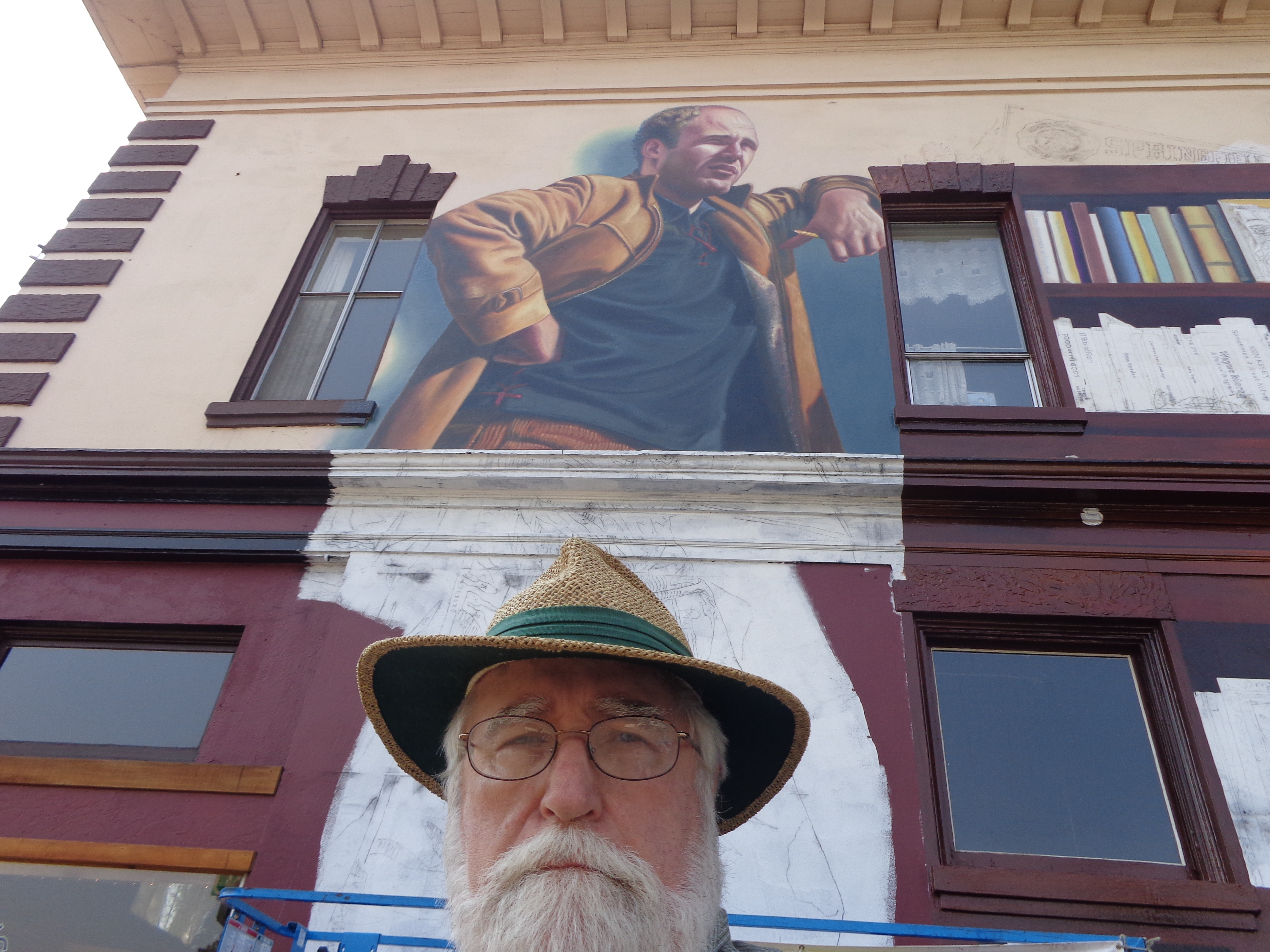

I am beginning to believe Springfield got it right! I went and looked at the un-finished mural of Ken Kesey. This is a much better job of Branding then the Homer Simpson Mural. It has a literary and historic theme. There are titles of books that Ken perhaps read and mentioned? ‘Grapes of Wrath’ is one.
When I moved to Springfield Oregon eight years ago, I ran into Virginia Hambley’s boyfriend at a city hall meeting. Afterwards Michael took me for a mini-tour downtown. We stopped in front of the Emerald Art Association that was closed. I came back the next day and talked to the director Cheyrl Liontino. I had a vision. I told her I saw Springfield surpassing Eugene in the Arts and it becoming a Mecca for European artists. As I headed out the door, Liontino held out her arms and blocked the door. I became a member of the EAA located on Main Street a block away from Odd Fellows Lodge building that is hosting the image of Ken ‘The King of the Bohemians’.
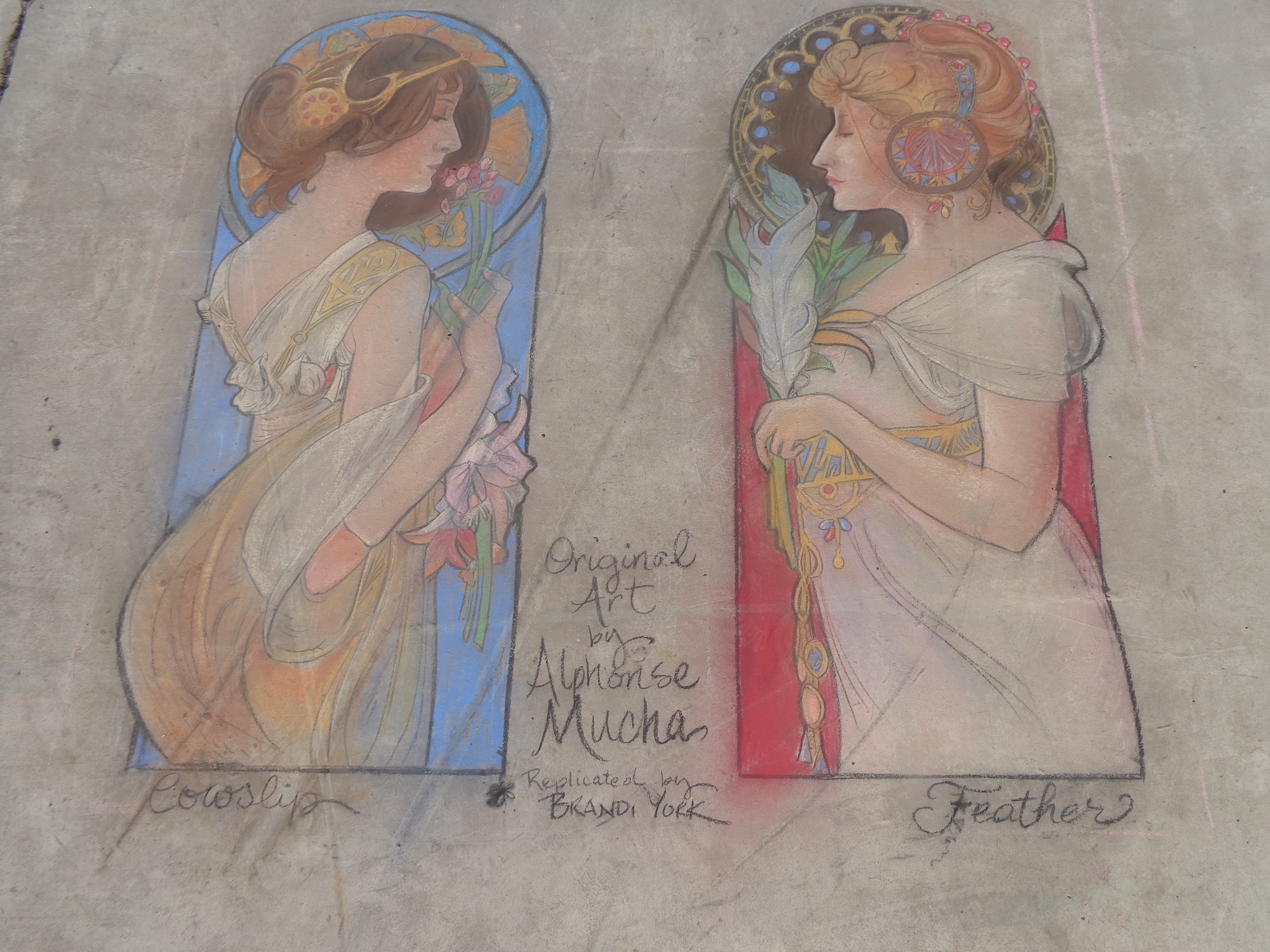
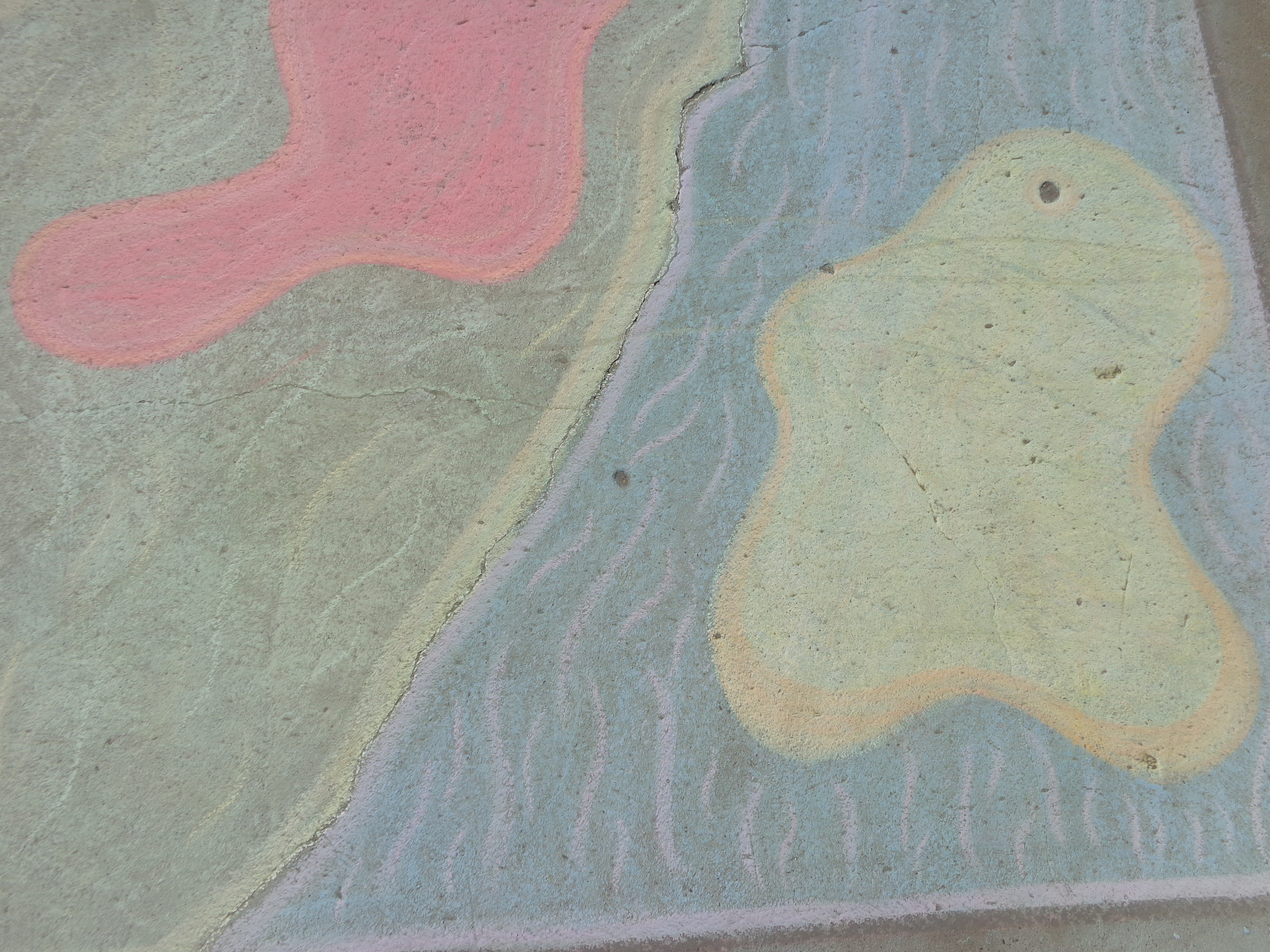
I went back to look at the finished chalk art and beheld a tribute to Alphonse Mucha the Bohemian Czech artist who inspired me when I rendered my painting of Rena Easton. I asked for and received a photo of her profile.
When I first mew of Stefan Eins, I suggested he talk to Austrian officials about the large canvas we have that might belong to the Austrian People. I ran into a member of my city government and we talked about the Kesey mural. I told her I would do a report and submit it to the City Council after I attend the unveiling on Friday. I am going to catalogue the murals of Springfield. The first one may have been on the side of the first Springfield Creamery building where I visited my childhood friend, Nancy Hamren. In 1987 Nancy got me on the bus, and an invite to the Dead and Dylan concert at Autzen Stadium. I hiked up Mt. Pisgah with Sue and Chuck Kesey. Nancy and I went to Ken’s reading of his book he co-wrote with students. Nancy and I lived in a commune with the Zorthian sisters whose father was influenced by the famous muralist, Thomas Hart Benton. This statement brings all the creative elements together, and puts them on the wall that is now the compass point of a cultural milestone for Springfield.
“Benton fits the familiar mold of Jack London, John Steinbeck, Ernest Hemingway–the roughneck artist, the temperamental genius disguised as a Joe. But beneath the denim and swagger, there lurks something else: a soul, Benton said, ‘impregnated with a deep sense of the value of life, of the beauty of the basic human emotions and the sadness of the drama of human striving.’ -Verlyn Klinkenborg, Smithsonian, April 1989, p. 100.
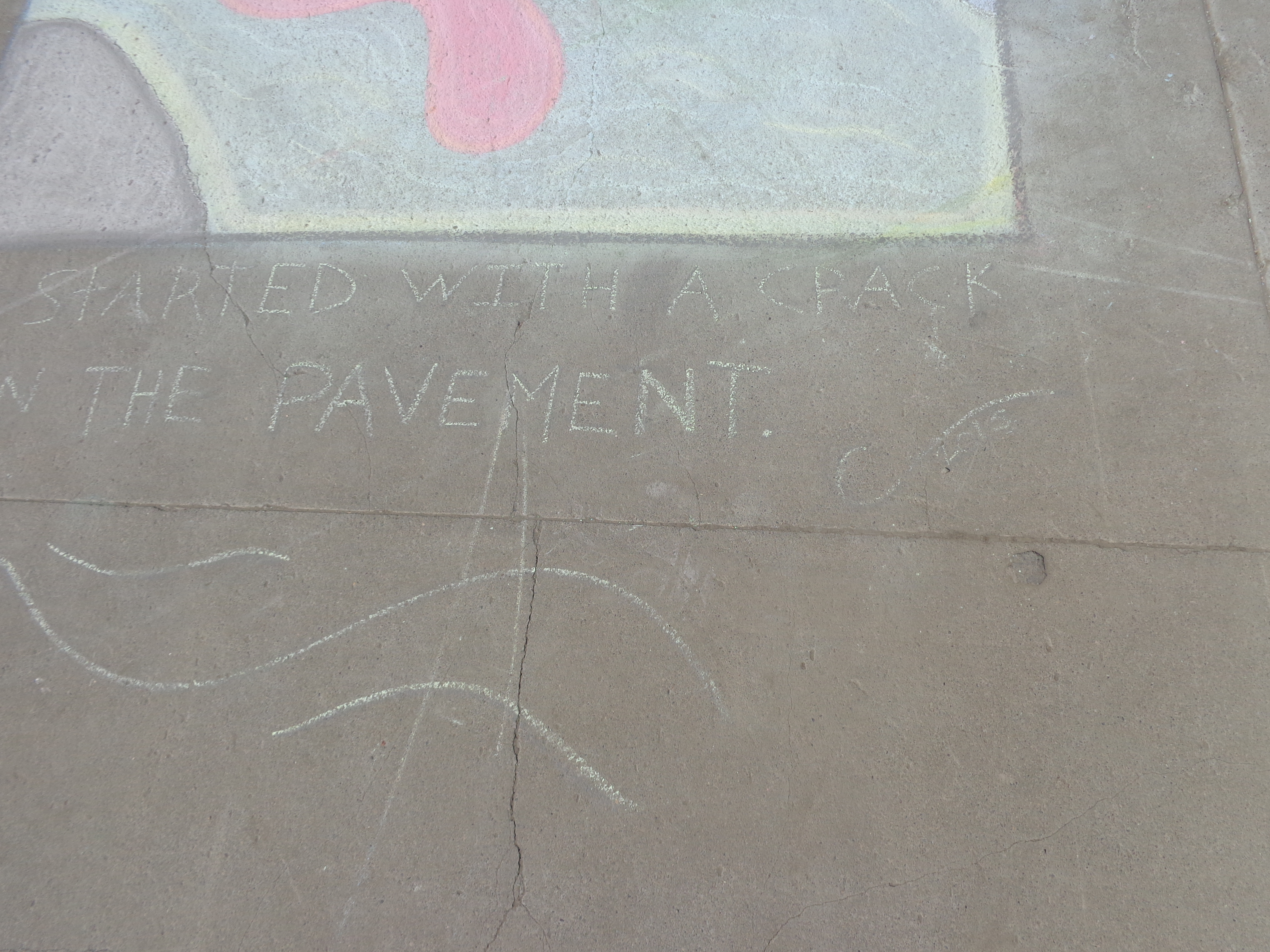
As a Master of the New Augury, I found the auspices of this mural, to, augur well. One of the chalk entries was titled ‘It Started With A Crack In The Pavement’. What can I say?
Jon Presco




Looked, viewed etc. at ‘Tale of Two Cities’ – amazing……Thank you for having put it together!!!
Stefan
A hour ago I got off the phone with Stefen Eins who Christine said I conjured up and brought into her life when she really needed a friend. He told me his people are Bohemians who lived in the Czech Republic. I told him my grandfather, Wensel Anton Braskewitz (Prescowitz) was born there
What the chalk line is, is CONJURING. It may represent the coming together of the artistic ideas of two Bohemian Artists, they meeting on the edge of the two-dimensional cage that most framed artwork is, or isn’t in some rare cases. This is one of those rarities. With the suggestion of color, I experienced an optical illusion where I saw this plot covered in faint pastel colors, yellow, blue, green. My mind was filling in the blank area. It took some effort to stop my hallucinating and see what was really there. What I would eventually see, is that this work transcends, teleporting, telephoning, telescoping, and, teledesign, a word I just made up. It could be delayed-telepathy where the message has been sent, after the means to receive the message has been launched.
“Then he had the Japanese and Chinese artists living there. They built their beautiful little Japanese paper houses up through the woods. What beautiful country! It looks like a mess now, but it was beautiful then — a natural and wild landscape — and the Japanese had carefully created a meandering little stream, Japanese style, beautifully arranged with gardens and little rockeries near the poet’s. You know their expertness in creating beauty. They’d made this beautiful place where they had their barbecues. At that time the poet’s barbecues were always run by his Japanese friends. We’d have raw fish and soy sauce — really delicious. Then, always the particular barbecue for which the poet was famous — he had beautifully peeled willow switches on which were arranged rounds of onions and meat — which you held over the fire until cooked to your taste.
Then we’d go up to a little art colony scattered throughout the woods in their beautiful paper houses. These houses were well made, beautifully constructed, but all the doors and windows except the frames were made of paper. We’d go in, take our shoes off and sit down and we’d watch the artists work, or they’d display work to show us. Some were Chinese, most of them were Japanese.
In 1848 William Makepeace Thackeray used the word bohemianism in his novel Vanity Fair. In 1862, the Westminster Review described a Bohemian as “simply an artist or littérateur who, consciously or unconsciously, secedes from conventionality in life and in art”. During the 1860s the term was associated in particular with the pre-Raphaelite movement, the group of artists and aesthetes of which Dante Gabriel Rossetti was the most prominent:[2]
As the 1860s progressed, Rossetti would become the grand prince of bohemianism as his deviations from normal standards became more audacious. And as he became this epitome of the unconventional, his egocentric demands necessarily required his close friends to remodel their own lives around him. His bohemianism was like a web in which others became trapped – none more so than William and Jane Morris.[3]
Above is a very large painting at the University of Oregon museum, titled ‘The Last Audience of the Habsburgs’ whom all descend from Jeanne de Rougemont. This painting was discovered rolled up in a bank vault here in Eugene Oregon. It had been smuggled out of Austria when Hitler put a bounty on Empress Zita’s head. The Empress receives war orphans ushered into her presence by a famous Austrian women’s Liberationist.
Zita and her family were smuggled to America with the help of
Aristides de Sousa Mendes, whose kin owned the “Jews land” in South Carolina my kindred purchased. The Mendes are Sephardic Jews kin to King David. The Habsburgs held the title ‘King of Bohemia and Hungary, and fought a war with Louis Kosseth who was a good friend of Jessie Benton.
Kossuth was a Freemason, as was Alphonse Mucha whose huge canvases were also smuggled out Nazi Germany that had claimed Austria and the Czech Republic. Drew’s great grandfather, Colonel Thomas Hart Benton, the nephew of the Senator of the same name, saved Albert Pike’s library during the Civil War.
“Among his many other accomplishments, Mucha was also the restorer of Czech Freemasonry.[12]”
I will now research if Kossuth and Mucha knew each other. The Hungarian Freemasons made up Jessie’s and John’s bodyguard.
The Habsburgs were great Patrons of the Art. The Fremont’s held a salon at Black Point where Mark Twain sent the night. Here is a Masonic artistic Legacy that has come down to my niece, Drew Benton, the daughter of the Getty Museum muralist, and cousin of the artist Thomas Hart Benton, the mentor of Jackson Pollack.
So much for Rosemary calling her four children “Bohunks” and chortling.
“He who laughs last – laughs best!”
Did you know Marie Antoniette was a Habsburg? I own a Habsburg lip. I now understand what the Seer meant, when she saw people coming into my being and “take! Take! Take!” I powerless to stop them for reasons unknown. Well, it appears much of my family history is a Masonic Secret – many partake of – but me, until, recently!
Mucha’s canvases look likes scenes out of Star Wars, they as big as a movie screen! Now, what does my kindred Carrie Fisher got, in regards to the screenplay about Christine Rosamond Benton – and her Artistic Legacy!
All’s well, that ends well!
Jon Presco
Copyright 2012
http://nancys-yogurt.myshopify.com/
http://www.nancysyogurt.com/index.php/springfield-creamery
http://www.nancysyogurt.com/index.php/springfield-creamery/our-history
http://www.nancysyogurt.com/index.php/springfieldcreamery/nancy
http://www.oregonlive.com/O/index.ssf/2010/03/sometimes_a_great_yogurt_nancy.html
The year was 1970 and next door to the creamery, the Keseys opened the Health Food and Pool Store. A mural outside depicted a fun-filled utopia, complete with a rainbow, a man in the moon, a smiling sun and dancing milk jugs. Inside, not far from the pool table, bulk foods, whole grains, herbs, candles and, of course, Nancy’s Yogurt, filled the shelves.
Chuck Kesey smiles slyly and his eyes glint as he describes the store as “a real culture shock to Springfield.”
Healy, the fellow who bought the bakery next door, remembers that the place lit up whenever Ken Kesey, who died in 2001, rolled up in his Cadillac. He and a few of the Merry Pranksters, as those in his entourage were known, would hop out, shoot pool and raise the sort of high-energy ruckus that fueled their radical reputation.
That reputation and the impact Ken Kesey had on 1970s youth culture gave Nancy’s Yogurt a nudge, or, as Gilbert Rosborne puts it, “The Kesey name gave it hippie star power.”.
Rosborne was a University of Oregon graduate student who delivered Rolling Stone magazine in Portland and Seattle. He recalls sitting outside the creamery chatting with Chuck Kesey when he wondered aloud: Why not drive a truckload of Nancy’s Yogurt to that long-hair haven, the San Francisco Bay Area, and try to sell it?
He needed a partner and asked a Mill Valley, Calif., acquaintance — a guy as sharp at auto mechanics as he was with a harmonica — to join him. Rosborne and his new partner, Huey Lewis, called their venture Natural Foods Express.
They bought old delivery trucks and Lewis tuned them until they purred. The two men took turns driving the long slog between Springfield and the Bay Area, Lewis blowing tunes on the harmonica as they traveled. And the Bay Area devoured Nancy’s Yogurt.
“Rock’n’roll, natural foods, pot. We were gonna create a whole new world,” says Rosborne, who lives north of San Francisco, in a Larkspur, Calif., home he and Lewis once co-owned.
The men dissolved their business partnership around the time Lewis’ band, Huey Lewis and the News, hit it big in the 1980s.
These days, Rosborne delivers wine for a living, but he still fills his fridge with Nancy’s Yogurt.”The main thing I got out of it,” he says, “was good digestion.”
Nancy Van Brasch Hamren brought her grandmother’s recipe to Springfield Creamery in the late ’60s when she started as bookkeeper. She still works in 2010 as office manager.
Nancy Van Brasch Hamren had a recipe. Her health-conscious grandmother made yogurt, and so did she during the months she lived on Ken Kesey’s farm near Eugene.
Hamren, a lanky, soft-spoken Californian, ran in circles simply psychedelic with history. She lived in San Francisco’s Haight-Ashbury district from 1966 to 1968, the bookends to 1967’s Summer of Love. Her boyfriend’s sister was married to Jerry Garcia, the Grateful Dead’s shaggy-haired lead guitarist. And they all knew Ken Kesey — from his books, “One Flew Over the Cuckoo’s Nest” and “Sometimes a Great Notion,” and from the infamous, drug-juiced parties known as Acid Tests, which he hosted and promoted.
When Ken Kesey traveled to Britain to work with the Beatles in 1969, Hamren and her boyfriend moved to Oregon to look after his farm. When Kesey and his family returned, she needed a new pad and a job. Down at the creamery, his brother, Chuck, needed a bookkeeper. He and Sue hired Hamren, and they started talking yogurt.
The time was right. The place, too.
Eugene and Springfield brimmed with hippie bakeries, granola makers, co-ops and natural-food stores. College kids and others living there moved beyond white bread long before the mainstream pondered crafting diets around fresh, local, organic food
In 1972, when the company was struggling, Chuck Kesey asked his friends in the Grateful Dead if they would play a benefit concert. Hand-drawn posters advertised the event for $3 in advance or $3.50 at the gate. The creamery turned Nancy’s Honey Yogurt labels into concert tickets. On August 27, more than 20,000 free-spirited Deadheads rocked the sweltering afternoon away in Veneta, west of Eugene. The creamery raised from $12,000 to $13,000, enough to stay in business.
http://www.rexfoundation.org/2014/09/01/historic-springfield-creamery-t-shirt-supports-rex/
Now immortalized for posterity as Sunshine Daydream, the Grateful Dead’s August 27, 1972 concert in Veneta was one for the history books on many fronts — especially because it kept the Springfield Creamery alive.
So we’re delighted that the Creamery is celebrating this epic event with a classic T-shirt, celebrating the day A Rock Band Saved A Yogurt Company, with the proceeds going to Rex. (Order yours here!)
Explains Sheryl Kesey Thompson, “The T-Shirt evolved out of a longtime desire to offer a ‘give back’ to the Grateful Dead of some type, as we honor and remember the fork in the road that the ’72 concert had for the Creamery. We also looked for something to offer when folks, intrigued by the Nancy’s/GD connection, asked, ‘Do you have a copy of that Nancy’s label/ticket from the Sunshine Daydream Show?’ or ‘Can I get a copy of the poster?’” They didn’t, but last year’s Sunshine Daydream release led to creative thinking, and voila.
 Rosamond Press


Leave a comment