The Royal Janitor
Here are my very prophetic Grail Posts. The search for the Holy Grail – is on! Trump and his Apocalypse Gang – have lost! No one saw Jesus here on earth. No one beheld an image of Jesus – in the sky!
I need to find the day the granddaughter of James Bond was born. I believe it is April 16, 2018.
I AM JOHN


The Royal Janitor
by
Jon Presco
Copyright 2018
Jean-Baptiste Rougemont rarely worked late, and never at this hour. As the father clock rang midnight in the hall outside his office at the College of Arms, Jean raised his bushy white eyebrows when he saw, and now heard the ornate brass doorknob being turned.
Holding his breath, he saw the profile of the most beautiful young woman he had ever beheld in this stuffy old place, and, he could just make out the words she was muttering.
“All winter long……”
Looking up she let out a yelp, like a young fox caught in a trap in the winter snow. Jean gasped when he saw how pale and blue her eyes were, that tried to dart back into the hall after beholding this old wizard of a man, whose eyes were just as pale, just as blue that they startled the college janitor, who came to dust the book cases, and run a wax over the oaken library table.
“Wait! Come here!” Jean commanded, which he did not mean to do, but, he wanted to make sure she obeyed, because, she might be a mirage, or something of this nature, and once the door is shut, the twine is severed, and she is gone forever.
What is your name? Open your eyes!”
“I have no name. I don’t want you to see my eyes!” the creature replied.
“Why won’t your tell me? Please. Look at me. I won’t hurt you!”
“I was raised by wolves, with pale blue eyes. They taught me to keep my eyes lowered in the presence of the alpha wolf. And you are the alpha wolf of this place. Are you not?”
“I suspose so. I am the head of the College of Arms. My name is……”
“I know your name. I dust your desk six day a week. I know your grandchild is going to La Rosey, and, he is all you have in the world.”
“Please. Just your name, and I will leave your to your work. I was just about to leave!”
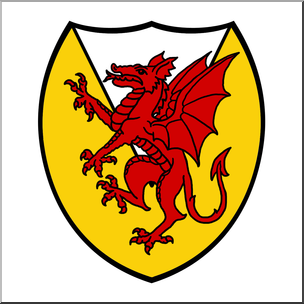
The wolfen child came to stand next to Jean, and held out her arm. On her forearm was a crest containing a red dragon. Jean’s mouth fell open, and before he could speak, she opened her eyes, and her angelic mouth;
“I am the Rouge Dragon!”

“Oh my God! Lift back your hair. I want to see your ears!” Jean commanded once more, he struggling to catch his breath.
“Do you want to see if I have wolf ears?” she asked with a musical quality in her voice. She was being whimsical.
“No! I would……….!” Jean stammered.
“I know who you think I am, but I am not he. My name is Victoria, Theresa, Bond, the granddaughter of Teresa Bond, the wife of James………….Bond. And, now you know!”
“But, how can this be?”
“God loves a story my mother used to say, and………
“If anyone asks, you were raised by wolves!”
“Oh my! You are not supposed to exist. Why are your revealing yourself?
“I want to go to La Rosey. I want to be an artist. I want to be – refined, like my grandmother. She went to La Rosey. She drove a sports car, a Jaguar. I want to own a Jaguar. My dusting days have come to an end.

I have never read a Ian Flemming novel. My God……It’s all here! I have been led down the path of the Rouge Dragon for twenty years. I just posted on the coat of arms of the Quinotar and the city of the Franks. I watched parts of this Bond movie, and it is a stinker. How do you do a movie on coats of arms – back in 1969? After Dan Brown, it’s a piece of cake!
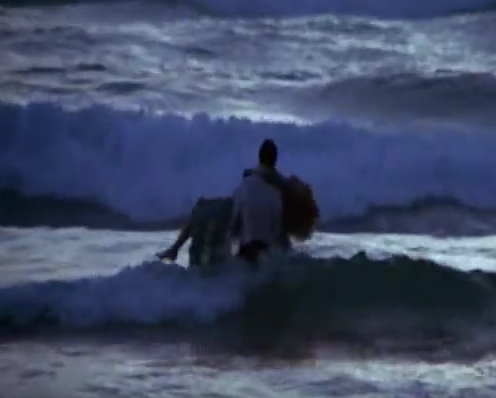
Bond sees the love of his life trying to drown herself in the sea! What? What! She has a child, but it dies. This child was sired by another man, but, I changed the plot! I resurrected the Bond bloodline!

The name Hilary Bray was that of an old-Etonian with whom Fleming worked at the stock broking firm Rowe & Pitman,[16] whilst Sable Basilisk was based on “Rouge Dragon” in the College of Arms. Rouge Dragon was the title of heraldic researcher Robin de la Lanne-Mirrlees who asked Fleming not to use the title in the book; in a play on words, Fleming used Mirrlees’s address, a flat in Basil Street, and combined it with a dragon-like creature, a basilisk, to come up with the name.[17] Mirrlees had Spanish antecedents, generally born without earlobes and Fleming used this physical attribute for Blofeld.[16] Mirrlees also discovered that the line of the Bonds of Peckham bears the family motto “The World is Not Enough”, which Fleming appropriated for Bond’s own family.[12]
On Her Majesty’s Secret Service (novel)

First edition cover, published by Jonathan Cape
|
|
| Author | Ian Fleming |
|---|---|
| Cover artist | Richard Chopping (Jonathan Cape ed.) |
| Country | United Kingdom |
| Language | English |
| Series | James Bond |
| Genre | Spy fiction |
| Publisher | Jonathan Cape |
|
Publication date
|
1 April 1963 |
| Media type | Print (hardback & paperback) |
| Preceded by | The Spy Who Loved Me |
| Followed by | You Only Live Twice |
On Her Majesty’s Secret Service is the tenth novel in Ian Fleming‘s James Bond series, first published in the UK by Jonathan Cape on 1 April 1963. The initial and secondary print runs sold out, with over 60,000 books sold in the first month. Fleming wrote the book in Jamaica whilst the first film in the Eon Productions series of films, Dr. No, was being filmed nearby.
On Her Majesty’s Secret Service is the second book in what is known as the “Blofeld trilogy”, which begins with Thunderball and concluded with You Only Live Twice. The story centres on Bond’s ongoing search to find Ernst Stavro Blofeld after the Thunderball incident; through contact with the College of Arms in London Bond finds Blofeld based in Switzerland. After meeting him and discovering his latest plans, Bond attacks the centre where he is based, although Blofeld escapes in the confusion. Bond meets and falls in love with Contessa Teresa “Tracy” di Vicenzo during the story. The pair marry at the end of the story but Blofeld kills Bond’s wife, hours after the ceremony.
Fleming made a number of revelations about Bond’s character within the book, including showing an emotional side that was not present in the previous stories. In common with Fleming’s other Bond stories, he used the names and places of people he knew or had heard of and Blofeld’s research station on Piz Gloria was based on Schloss Mittersill, which the Nazis had turned into a research establishment examining the Asiatic races.
On Her Majesty’s Secret Service received broadly good reviews in the British and American press. The novel was adapted to run as a three-part story in Playboy in 1963 and then as a daily comic strip in the Daily Express newspaper in 1964–1965. In 1969 the novel was adapted as the sixth film in the Eon Productions James Bond film series and was the only film to star George Lazenby as Bond. In 2014 On Her Majesty’s Secret Service was adapted as a play on BBC Radio, starring Toby Stephens.
Contents
[hide]
Plot[edit]
For more than a year, James Bond, British Secret Service operative 007, has been involved in “Operation Bedlam”: trailing the private criminal organisation SPECTRE and its leader, Ernst Stavro Blofeld. The organisation had hijacked two nuclear devices and subsequently blackmailed the western world, as described in Thunderball. Convinced SPECTRE no longer exists, Bond is frustrated by MI6’s insistence that he continue the search and his inability to find Blofeld. He composes a letter of resignation for his superior, M.
Whilst composing his letter, Bond encounters a beautiful, suicidal young woman named Contessa Teresa “Tracy” di Vicenzo first on the road and subsequently at the gambling table, where he saves her from a coup de deshonneur by paying the gambling debt she is unable to cover. The following day Bond follows her and interrupts her attempted suicide, but they are captured by professional henchmen. They are taken to the offices of Marc-Ange Draco, head of the Unione Corse, the biggest European crime syndicate. Tracy is the daughter and only child of Draco who believes the only way to save his daughter from further suicide attempts is for Bond to marry her. To facilitate this, he offers Bond a dowry of £1 million (£20 million in 2018 pounds[1]); Bond refuses the offer, but agrees to continue romancing Tracy while her mental health improves.

The College of Arms building in London.
Afterwards Draco uses his contacts to inform Bond that Blofeld is somewhere in Switzerland. Bond returns to England to be given another lead: the College of Arms in London has discovered that Blofeld has assumed the title and name Comte Balthazar de Bleuville and wants formal confirmation of the title and has asked the College to declare him the reigning count.
On a visit to the College of Arms, Bond finds that the family motto of Sir Thomas Bond is “The World Is Not Enough”, and that he might be (though unlikely) Bond’s ancestor. On the pretext that a genetically-inherited minor physical abnormality (a lack of earlobes) needs a personal confirmation, Bond impersonates a College of Arms representative, Sir Hilary Bray, to visit Blofeld’s lair atop Piz Gloria, a fictional mountain top in the Engadin, somewhere between Samedan and Pontresina,[note 1] where he finally meets Blofeld. Blofeld has undergone plastic surgery partly to remove his earlobes, but also to disguise himself from the police and security services who are tracking him down.
Bond learns Blofeld has been curing a group of young British and Irish women of their livestock and food allergies. In truth, Blofeld and his aide, Irma Bunt, have been brainwashing them into carrying biological warfare agents back to Britain and Ireland in order to destroy the agricultural economy, upon which post-World War II Britain depends. Believing himself discovered, Bond escapes by ski from Piz Gloria, chased by SPECTRE operatives, a number of whom he kills in the process. Afterward, in a state of total exhaustion, he encounters Tracy. She is in the town at the base of the mountain after being told by her father that Bond may be in the vicinity. Bond is too weak to take on Blofeld’s henchmen alone and she helps him escape to the airport. Smitten by the resourceful, headstrong woman, he proposes marriage and she accepts. Bond then returns to England and works on the plan to capture Blofeld.
Helped by Draco’s Union Corse, Bond mounts an air assault against the clinic and Blofeld. Whilst the clinic is destroyed, Blofeld escapes down a bobsled run and although Bond gives chase Blofeld escapes. Bond flies to Germany where he marries Tracy. The two of them drive off on honeymoon and, a few hours later, Blofeld and Bunt drive past, machine gunning them: Tracy is killed in the attack.
Characters and themes[edit]
On Her Majesty’s Secret Service contains what the author of “continuation” Bond novels Raymond Benson calls “major revelations” about Bond and his character.[2] These start with Bond’s showing an emotional side, visiting the grave of Casino Royale‘s Vesper Lynd, which he did every year.[2] The emotional side continues with Bond asking Tracy to marry him.[3] The character of Tracy is not as well defined as some other female leads in the Bond canon, but Benson points out that it may be the enigmatic quality that Bond falls in love with.[4] Benson also notes that Fleming gives relatively little information about the character, only how Bond reacts to her.[4]
Academic Christoph Lindner identifies the character of Marc-Ange Draco as an example of those characters who have morals closer to those of the traditional villains, but who act on the side of good in support of Bond; others of this type include Darko Kerim (From Russia, with Love), Tiger Tanaka (You Only Live Twice) and Enrico Colombo (“Risico“).[5] Fellow academic Jeremy Black noted the connection between Draco and World War II; Draco wears the King’s medal for resistance fighters. The war reference is a method used by Fleming to differentiate good from evil and raises a question about “the distinction between criminality and legality”, according to Black.[6]
Background[edit]
On Her Majesty’s Secret Service was written in Jamaica at Fleming’s Goldeneye estate in January and February 1962,[7] whilst the first Bond film, Dr. No was being filmed nearby.[8] The first draft of the novel was 196 pages long and called The Belles of Hell.[9] Fleming later changed the title after being told of a nineteenth-century sailing novel called On Her Majesty’s Secret Service, seen by Fleming’s friend Nicholas Henderson in Portobello Road Market.[10]

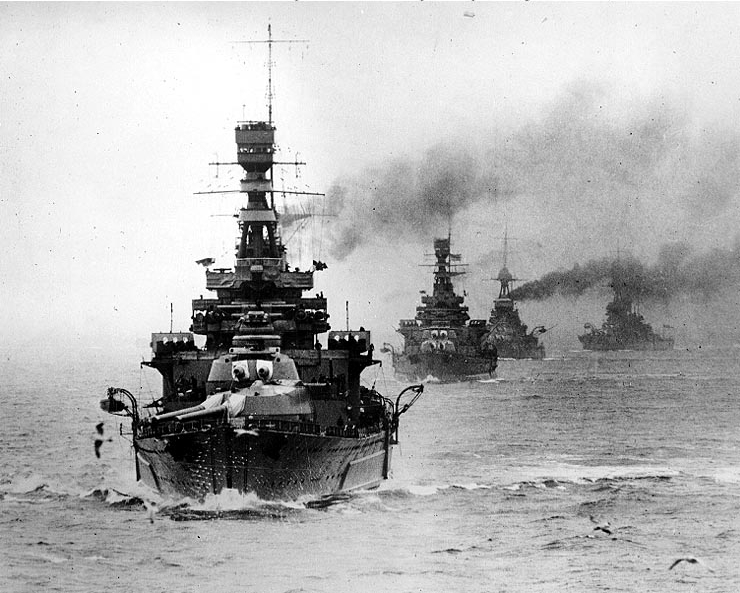
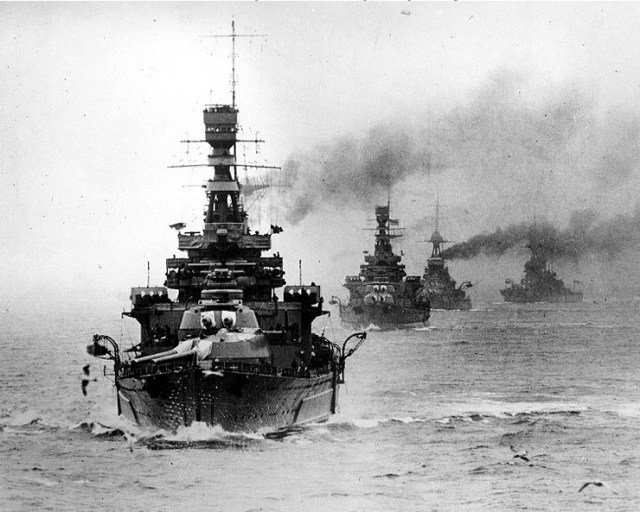
HMS Repulse on manoeuvres in the 1920s
As with all his Bond books, Fleming used events or names from his life in his writing. In the 1930s, Fleming often visited Kitzbühel in Austria to ski; he once deliberately set off down a slope that had been closed because of the danger of an avalanche. The snow cracked behind him and an avalanche came down, catching him at its end: Fleming remembered the incident and it was used for Bond’s escape from Piz Gloria.[11] Fleming would occasionally stay at the sports club of Schloss Mittersill in the Austrian Alps; in 1940 the Nazis closed down the club and turned it into a research establishment examining the Asiatic races. It was this pseudo-scientific research centre that inspired Blofeld’s own centre of Piz Gloria.[12]
The connection between M and the inspiration for his character, Rear Admiral John Godfrey, was made apparent with Bond visiting Quarterdeck, M’s home. He rings the ship’s-bell for HMS Repulse, M’s last command: it was Godfrey’s ship too.[13] Godfrey was Fleming’s superior officer in Naval Intelligence Division during the war[14] and was known for his bellicose and irascible temperament.[15] During their Christmas lunch, M tells Bond of an old naval acquaintance, a Chief Gunnery Officer named McLachlan. This was actually an old colleague of both Godfrey and Fleming’s in the NID, Donald McLachlan.[8]
The name Hilary Bray was that of an old-Etonian with whom Fleming worked at the stock broking firm Rowe & Pitman,[16] whilst Sable Basilisk was based on “Rouge Dragon” in the College of Arms. Rouge Dragon was the title of heraldic researcher Robin de la Lanne-Mirrlees who asked Fleming not to use the title in the book; in a play on words, Fleming used Mirrlees’s address, a flat in Basil Street, and combined it with a dragon-like creature, a basilisk, to come up with the name.[17] Mirrlees had Spanish antecedents, generally born without earlobes and Fleming used this physical attribute for Blofeld.[16] Mirrlees also discovered that the line of the Bonds of Peckham bears the family motto “The World is Not Enough”, which Fleming appropriated for Bond’s own family.[12]
Fleming also used historical references for some of his names and Marc-Ange Draco’s name is based upon that of El Draco, the Spanish nickname for Sir Francis Drake,[16] a fact also used by J. K. Rowling for the naming of her character Draco Malfoy.[18] For Tracy’s background, Fleming used that of Muriel Wright, a married wartime lover of Fleming’s, who died in an air-raid[19] and Bond’s grief for the loss of his wife is an echo of Fleming’s at the loss of Wright.[20] Fleming did make mistakes in the novel, however, such as Bond ordering a half-bottle of Pol Roger Champagne: Fleming’s friend Patrick Leigh Fermor pointed out that Pol Roger was the only champagne at the time not to be produced in half-bottles.[21]
On Her Majesty’s Secret Service is the second book in what is called “the Blofeld trilogy”, sitting between Thunderball, where SPECTRE is introduced and You Only Live Twice, where Blofeld is finally killed by Bond.[22] Although Blofeld is present in Thunderball, he directs operations from a distance and as such he and Bond never meet and On Her Majesty’s Secret Service constitutes his and Bond’s first meeting.[2]
Release and reception[edit]
On Her Majesty’s Secret Service was published on 1 April 1963 in the UK as a hardcover edition by publishers Jonathan Cape;[23] it was 288 pages long and cost 16 shillings.[24] A limited edition of 250 copies were also printed that were numbered and signed by Fleming.[23] Artist Richard Chopping once again undertook the cover art for the first edition.[23] There were 42,000 advance orders for the hardback first edition[25] and Cape did an immediate second impression of 15,000 copies, selling over 60,000 by the end of April 1963.[26] By the end of 1963 it had sold in excess of 75,000 copies.[27]
The novel was published in America in August by the New American Library,[23] after Fleming changed publishers from Viking Press after The Spy Who Loved Me.[28] The book was 299 pages long and cost $4.50[29] and it topped The New York Times Best Seller list for over six months.[23]
Reviews[edit]
Writing in The Guardian, critic Anthony Berkeley Cox, writing under the name Francis Iles, noted that the two minor grammatical errors he spotted were “likely to spoil no one’s enjoyment”[30] of the novel as he considered that On Her Majesty’s Secret Service was “not only up to Mr. Fleming’s usual level, but perhaps even a bit above it.”[30] Writing in The Guardian‘s sister paper, The Observer Maurice Richardson pondered if there had been “a deliberate moral reformation”[31] of Bond. However, he notes Bond still has his harder side when needed. Richardson also thought that “in reforming Bond Mr. Fleming has reformed his own story-telling which had been getting very loose”.[31] Overall he thought that “O.H.M.S.S. is certainly the best Bond for several books. It is better plotted and retains its insane grip until the end”.[31]
Raymond Mortimer, writing for The Sunday Times, said that “James Bond is what every man would like to be, and what every woman would like between her sheets”;[12] meanwhile the critic for The Times considered that after The Spy Who Loved Me, “On Her Majesty’s Secret Service constitutes a substantial, if not quite a complete, recovery.”[24] In the view of the reviewer, it was enough of a recovery for them to point out that “it is time, perhaps, to forget the much exaggerated things which have been said about sex, sadism and snobbery, and return to the simple, indisputable fact that Mr. Fleming is a most compelling story-teller.”[24] Marghanita Laski, writing in The Times Literary Supplement thought that “the new James Bond we’ve been meeting of late [is] somehow gentler, more sentimental, less dirty.”[32] However, she considered that “it really is time to stop treating Ian Fleming as a Significant Portent, and to accept him as a good, if rather vulgar thriller-writer, well suited to his times and to us his readers.”[32]
The New York Herald Tribune thought On Her Majesty’s Secret Service to be “solid Fleming”,[12] while the Houston Chronicle considered the novel to be “Fleming at his urbanely murderous best, a notable chapter in the saga of James Bond”.[12] Gene Brackley, writing in the Boston Globe wrote that Bond “needs all the quality he can muster to escape alive”[33] from Blofeld’s clutches in the book and this gives rise to “two of the wildest chase scenes in the good guys-bad guys literature”.[33] Regarding the fantastic nature of the plots, Brackley considered that “Fleming’s accounts of the half-world of the Secret Service have the ring of authenticity”[33] because of his previous role with the NID.
Writing for The Washington Post, Jerry Doolittle thought that Bond is “still irresistible to women, still handsome in a menacing way, still charming. He has nerves of steel and thews of whipcord”,[29] even if “he’s starting to look a little older.”[29] Doolittle was fulsome in his praise for the novel, saying “Fleming’s new book will not disappoint his millions of fans”.[29] Writing in The New York Times, Anthony Boucher—described by a Fleming biographer, John Pearson as “throughout an avid anti-Bond and an anti-Fleming man”[34]—was again damning, although even he admitted that “you can’t argue with success”.[35] However, he went on to say that “simply pro forma, I must set down my opinion that this is a silly and tedious novel.”[35] Boucher went on to bemoan that although On Her Majesty’s Secret Service was better than The Spy Who Loved Me, “it is still a lazy and inadequate story”,[35] going on to say that “my complaint is not that the adventures of James Bond are bad literature … but that they aren’t good bad literature”.[35] Boucher finished his review lamenting that “they just aren’t writing bad books like they used to.”[35]
The opposite point of view was taken by Robert Kirsch, writing in the Los Angeles Times, who considered Fleming’s work to be a significant point in fiction, saying that the Bond novels “are harbingers of a change in emphasis in fiction which is important.”[36] The importance, Kirsch claimed, sprung from “a revolution in taste, a return to qualities in fiction which all but submerged in the 20th-century vogue of realism and naturalism”[36] and the importance was such that they were “comparable … only to the phenomenon of Conan Doyle’s Sherlock Holmes stories”.[36] Kirsch also believed that “with Fleming, … we do not merely accept the willing suspension of disbelief, we yearn for it, we hunger for it.”[36] The critic for Time magazine referred to previous criticism of Fleming and thought that “in Fleming’s latest Bond bombshell, there are disquieting signs that he took the critics to heart”[37] when they complained about “the consumer snobbery of his caddish hero”.[37] The critic mourned that even worse was to follow, however, when “Bond is threatened with what, for an international cad, would clearly be a fate worse than death: matrimony”.[37] However, eventually a “deus ex machina (the machine, reassuringly, is a lethal red Maserati) … saves James Bond from his better self.”[3
s
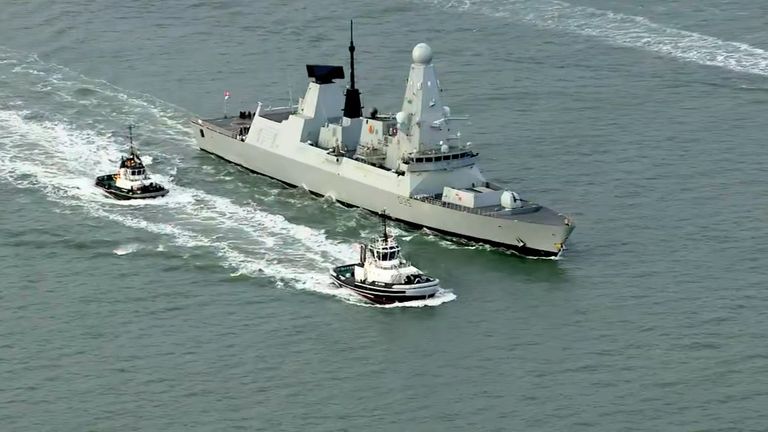
What HMS Dragon can do – and why it took so long to leave the UK
Sky News takes a closer look at the warship the UK has deployed to protect RAF Akrotiri from Iranian projectiles

Foreign news reporter @MikeRDrummond
Wednesday 11 March 2026 03:53, UK
1:31
Will Royal Navy destroyer make a difference?
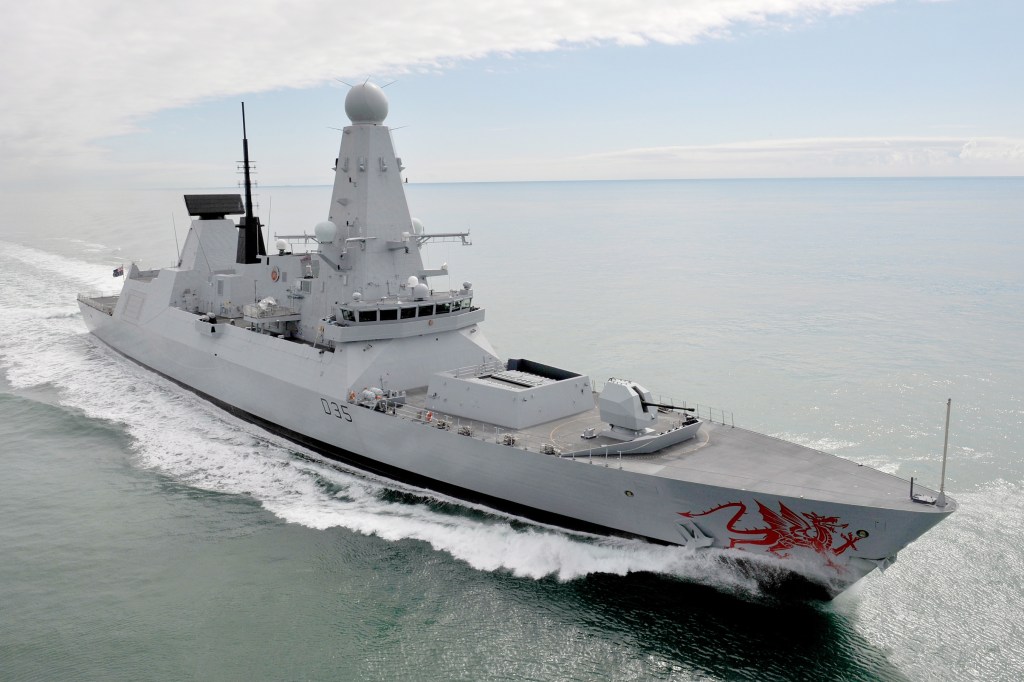
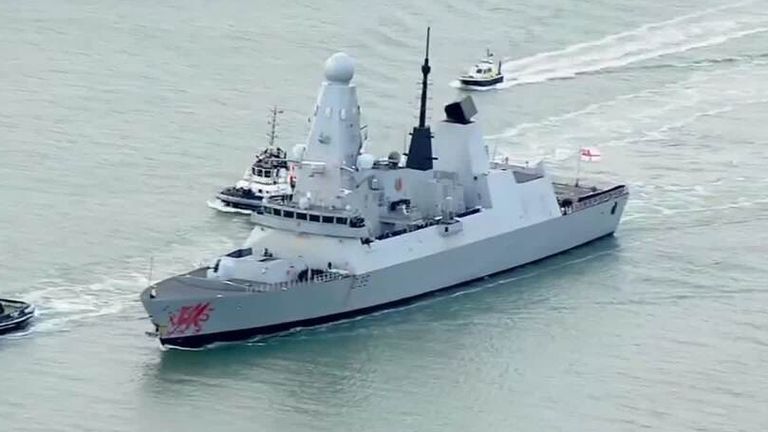
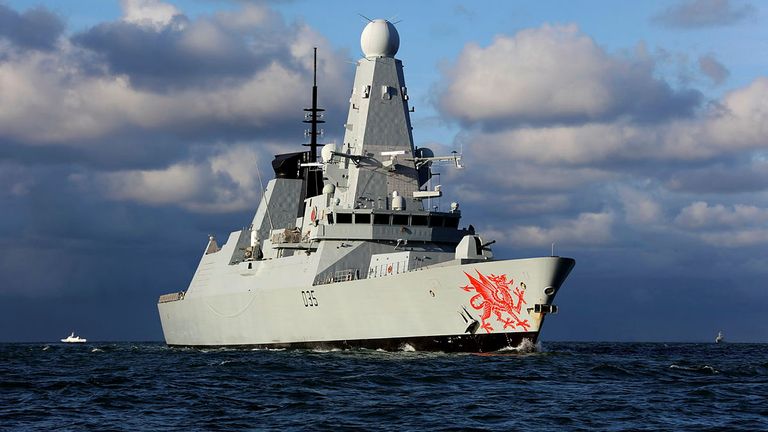
A red dragon emblazoned on her prow, HMS Dragon has set sail for Cyprus to help safeguard the British military base there – finally.
One of the most advanced warships in the world, the Type 45 destroyer is capable of shooting down the types of drones and ballistic missiles being launched by Iran.
Sponsored link
Scarlett Johansson and Colin Jost’s Mansion in $Oregon$ Is Absolutely IncredibleTwist Digital

But despite its many capabilities – some of which are world-leading – the days of delay in dispatching her to the Middle East reflect systemic issues in the Royal Navy.
1:46
Watch: HMS Dragon departs for Eastern Mediterranean
This has once again raised questions about the UK’s military preparedness and its ability to respond to threats when they emerge.
It will take up to a week for HMS Dragon to reach Cyprus now that she’s left Portsmouth Harbour.
Her journey will take her along the English Channel, around Spain and then into the Mediterranean through the Strait of Gibraltar.
With the US and Israel’s war on Iran changing every day, the situation when HMS Dragon arrives may be completely different. The war may even be over.
Despite this, HMS Dragon’s commanding officer has said his crew is ready for action.
“We are trained for this, we are ready for this, we have the equipment and people, we have the support of the British people and, most importantly, our families and friends,” said Commander Iain Giffin.
HMS Dragon’s deployment comes after RAF Akrotiri – one of two major British bases on the island – was hit by a drone in the early hours of 2 March.
Officials would not specify where the drone had come from, but said assessments showed it was a Shahed type and had not been launched from Iran.
Later, two drones heading towards the RAF base were intercepted.
Launched in 2008 and commissioned into the Royal Navy in 2012, HMS Dragon is the fourth ship in the Type 45 (Daring) class of destroyers.
She follows a string of UK warships to bear the name – the first HMS Dragon was a 38-gun frigate launched in 1647.

“It’s a fairly modern stealth warship,” defence analyst Tom Sharpe from the RUSI thinktank told Sky News podcast This Is Why.
“Everything’s on a slope, it’s not a regular shape, and there aren’t many uncovered bits and pieces outside.
“This is to try and keep the ship stealthy.”
The ship measures just over 152 metres in length and weighs between 8,000-8,500 tons.
“Its primary reason for existing is to throw an air defence bubble over whatever it is you want,” Mr Sharpe said.
“Once the SAMPSON radar has detected and seen the threat, that then talks to the command system.
“The command system will then spin up the ship’s primary weapon system, which is the Sea Viper missile.”

Also known by the rather longer title Principal Anti-Air Missile System (PAAMS), the Sea Viper system can track, target and destroy a variety of threats simultaneously.
It was put on display in the Red Sea in 2024, when sister ship HMS Diamond shot down seven drones launched by Iranian-backed Houthi fighters.
“It was doing exactly the job for which it was designed,” military analyst Professor Michael Clarke said.
“When Sea Viper is fired, it seems to explode out of the deck, vertically upwards, before it sets course towards whatever target it’s taking on.
“And it doesn’t miss.”

The problem is the cost.
“Against a ballistic missile, it’s worth it because the ballistic missile does a lot of damage,” Prof Clarke says.
“Against a drone it isn’t worth it and you’d want to bring that down in other ways.”
While a Sea Viper missile may cost more than £1m – and HMS Dragon is limited in how many she can carry – drones can cost far, far less.
The navy’s Wildcat helicopters, some of which are already in Cyprus, can also be used to take down drones with air-to-air Martlet missiles at a much lower cost.
HMS Dragon’s flight deck and hangar can accommodate a Wildcat or Merlin helicopter.
Ground-based, short-range air defences have also been deployed to the region.

While Sea Viper missiles are effective, HMS Dragon can only carry so many at a time.
The nearest place to restock? Gibraltar. More than 2,000 miles away.
It’s possible this could be eased by the deployment of the RFA Lyme Bay support ship, which can carry stocks of ammunition among other tasks.
In a pinch, the missiles might be able to be flown in, but it’s not a sure thing, Prof Clarke says.
He added: “It’s concerning that we never have enough ammunition for anything.
“We are very low on war stocks in general.”
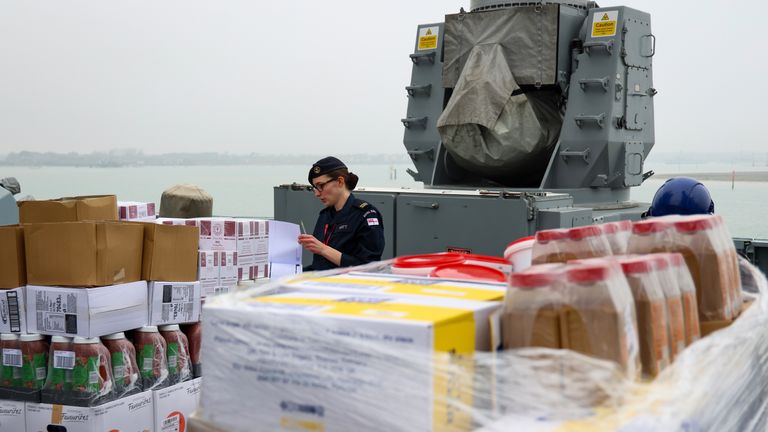
There’s also the matter of how long it took HMS Dragon to even leave port in the UK, let alone arrive at Cyprus.
“It’s a 30-year problem,” Mr Sharpe says.
“It feels increasingly to me through our carrier operations, particularly when the Houthis were active last year, we as a political class have forgotten how navies work.
“The system has sort of bogged down to a point where we end up where we are. The requirement to get a Type 45 ready for sea and out of the door was blatantly obvious.”
In an interview with UK defence secretary John Healey, Sky’s Alistair Bunkall asked him when the option to deploy a Royal Navy destroyer first hit his desk.
He suggested he’d had options for weeks and did not disagree when asked if it was his decision to delay.
But afterwards, defence sources said the Royal Navy only gave him the option on 3 March.
After HMS Dragon departed Portsmouth on Tuesday, Mr Healey said the work to prepare her would normally have taken six weeks and was “completed in just six days”.
Meanwhile, last week there were reports that efforts to make HMS Dragon ready for sail took longer than necessary because a new MoD contract with private firm Serco ditched round-the-clock staffing in favour of a 9-5 workday.
“This is a microcosm of the whole of the whole problem,” Prof Clarke said.
“We’re not ready for real operations most of the time, because our numbers are very, very low.
“You have the barely minimum numbers, there’s no redundancy built in, there is no allowance for spares or attrition or anything like that.”
And while HMS Dragon and her able crew set sail for Cyprus, at least three of her sister Type 45 ships are undergoing maintenance, and there are questions over one of the other two.
9/28/2021
“I am the Rouge Dragon!”

When I decided to write a James Bond Book, I did research. I looked for a way for Victoria Rosemond Bond to be kin to James. I found it, via the Red Dragon. No one had an idea the latest Bond movie was heading for the rocks due to the coronavirus. At first, I was only wanting to write a book. Then I found a video of Lara Roozemond toying with a gun. I was rudely cast out of a Bond Facebook group that talked about ‘No Time To Die’. I wanted to concentrate on ‘Why We Fight’ not on ‘How We Make Money’. I can say I got little, if no support for my projects.
John Presco
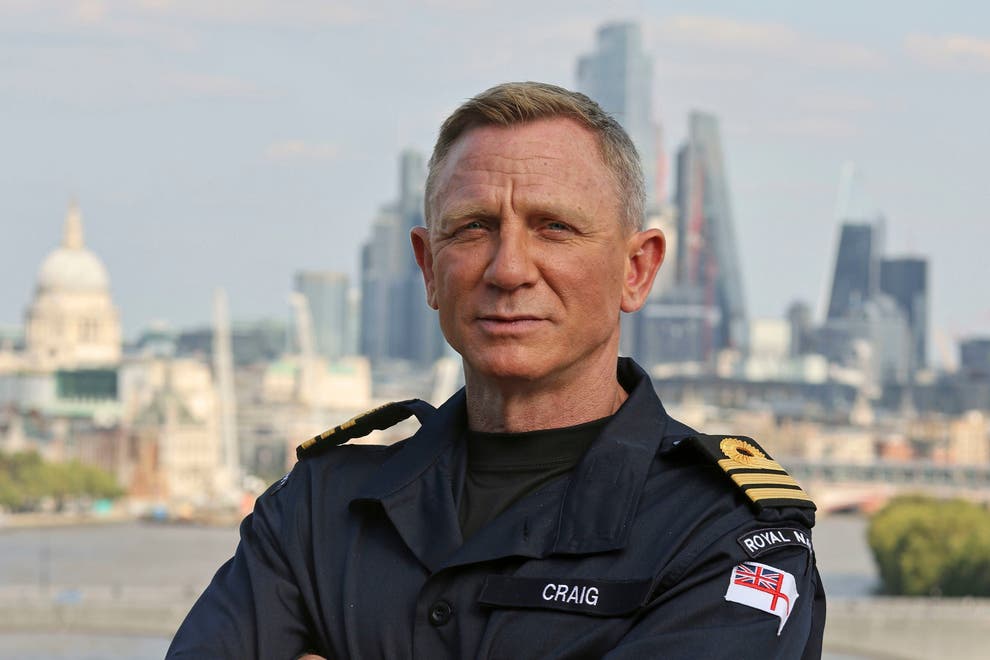
James Bond star Daniel Craig was made an honorary officer of the United Kingdom’s Royal Navy on Thursday — matching his onscreen 007 persona, who holds the rank of commander.”I am delighted to welcome honorary Commander Daniel Craig to the Royal Navy,” First Sea Lord Admiral Sir Tony Radakin, the head of the Royal Navy, said in a news statement.”Daniel Craig is well known for being Commander Bond for the last 15 years — a naval officer who keeps Britain safe through missions across the globe. That’s what the real Royal Navy does every day, using technology and skill the same way as Bond himself.”
Craig wants to use his new military status — commander is the seventh-highest rank in the Royal Navy — as a way to help UK military families, according to the statement.
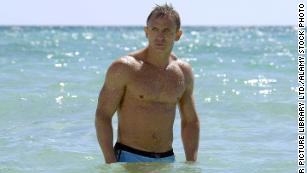
How Daniel Craig’s body became his James Bond signatureCraig is about to star as the British super spy for the fifth time in “No Time to Die,” which the UK military is also using to highlight some of its newest hardware.
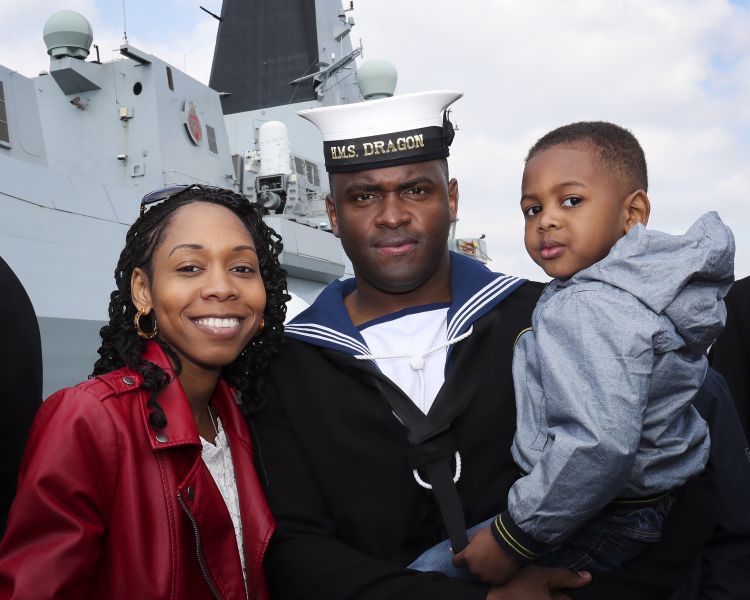
HMS Dragon, a new Type 45 air defense destroyer, appears in the movie, the Defense Ministry said. The Royal Navy’s website calls the 8,000-ton, 152-meter (500 feet) warship one of the most advanced in the world.

The Royal Janitor
by
Jon Presco
Copyright 2018
Jean-Baptiste Rougemont rarely worked late, and never at this hour. As the father clock rang midnight in the hall outside his office at the College of Arms, Jean raised his bushy white eyebrows when he saw, and now heard the ornate brass doorknob being turned.
Holding his breath, he saw the profile of the most beautiful young woman he had ever beheld in this stuffy old place, and, he could just make out the words she was muttering.
“All winter long……”
Looking up she let out a yelp, like a young fox caught in a trap in the winter snow. Jean gasped when he saw how pale and blue her eyes were, that tried to dart back into the hall after beholding this old wizard of a man, whose eyes were just as pale, just as blue that they startled the college janitor, who came to dust the book cases, and run a wax over the oaken library table.
“Wait! Come here!” Jean commanded, which he did not mean to do, but, he wanted to make sure she obeyed, because, she might be a mirage, or something of this nature, and once the door is shut, the twine is severed, and she is gone forever.
What is your name? Open your eyes!”
“I have no name. I don’t want you to see my eyes!” the creature replied.
“Why won’t your tell me? Please. Look at me. I won’t hurt you!”
“I was raised by wolves, with pale blue eyes. They taught me to keep my eyes lowered in the presence of the alpha wolf. And you are the alpha wolf of this place. Are you not?”
“I suspose so. I am the head of the College of Arms. My name is……”
“I know your name. I dust your desk six day a week. I know your grandchild is going to La Rosey, and, he is all you have in the world.”
“Please. Just your name, and I will leave your to your work. I was just about to leave!”
The wolfen child came to stand next to Jean, and held out her arm. On her forearm was a crest containing a red dragon. Jean’s mouth fell open, and before he could speak, she opened her eyes, and her angelic mouth;
“I am the Rouge Dragon!”

“Oh my God! Lift back your hair. I want to see your ears!” Jean commanded once more, he struggling to catch his breath.
“Do you want to see if I have wolf ears?” she asked with a musical quality in her voice. She was being whimsical.
“No! I would……….!” Jean stammered.
“I know who you think I am, but I am not he. My name is Victoria, Theresa, Bond, the granddaughter of Teresa Bond, the wife of James………….Bond. And, now you know!”
“But, how can this be?”
“God loves a story my mother used to say, and………
“If anyone asks, you were raised by wolves!”
“Oh my! You are not supposed to exist. Why are your revealing yourself?
“I want to go to La Rosey. I want to be an artist. I want to be – refined, like my grandmother. She went to La Rosey. She drove a sports car, a Jaguar. I want to own a Jaguar. My dusting days have come to an end.

I have never read a Ian Flemming novel. My God……It’s all here! I have been led down the path of the Rouge Dragon for twenty years. I just posted on the coat of arms of the Quinotar and the city of the Franks. I watched parts of this Bond movie, and it is a stinker. How do you do a movie on coats of arms – back in 1969? After Dan Brown, it’s a piece of cake!
Bond sees the love of his life trying to drown herself in the sea! What? What! She has a child, but it dies. This child was sired by another man, but, I changed the plot! I resurrected the Bond bloodline!


The name Hilary Bray was that of an old-Etonian with whom Fleming worked at the stock broking firm Rowe & Pitman,[16] whilst Sable Basilisk was based on “Rouge Dragon” in the College of Arms. Rouge Dragon was the title of heraldic researcher Robin de la Lanne-Mirrlees who asked Fleming not to use the title in the book; in a play on words, Fleming used Mirrlees’s address, a flat in Basil Street, and combined it with a dragon-like creature, a basilisk, to come up with the name.[17] Mirrlees had Spanish antecedents, generally born without earlobes and Fleming used this physical attribute for Blofeld.[16] Mirrlees also discovered that the line of the Bonds of Peckham bears the family
Teresa Rozemond Bond La Draco
Posted on April 16, 2018 by Royal Rosamond Press


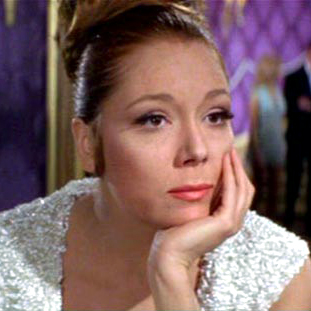

I am blown away. I just found Jame’s Bond’s wife, Tracy Bond, played by one of my favorite actresses, Diana Rigg. For two hours this morning I looked at Lara Rozemond as a possible main character of my Flemming revival ‘The Royal Janitor’. I was not happy with Serena being an older woman. I would lose most of my audience. I looked at some videos of Lara, and captured these shots. Then I saw her, Emma Peel, the besutiful star in ‘The Avengers. I wanted to send Lara another message saying I am certain she is my kin, and related to Elizabeth Rosemond Taylor. I wanted her to look at these blue eyes. Then, I thought I better not give the impression I am stalking her. I did not want to make promises I could not keep.
Emma and Lara have baby faces. I have a rule to run by what is old, past the young, who never heard, nor saw ‘The Avengers’. I went googling! I am blown away! This is like the story of Cinderella and the Glass Slipper. She is kin to me a Liz – in a fictional manner! She is kin to Sir Caspar John – in a fictional manner. I left out the opening scene I envisioned two weeks ago – because I was not inspired! Thank you Great Muses!
Lara has taken acting lessons. She needs more lessons. She is too aware of the camera. Relax, and let the camera become aware of you. Take martial arts. Take a video camera and got read your poems in public. Be as dramatic as your poems. Get to the core of your anger. Be your dragon! I will develop your character from the model you give me. You are Denim and Silk – reborn! This is Kismet!
Jon Presco
Teresa “Tracy” Bond (born Teresa “Tracy” Draco, and also known as the Contessa Teresa di Vicenzo) is a fictional character and the main Bond girl in the 1963 James Bond novel On Her Majesty’s Secret Service, and its 1969 film adaptation. She is the only Bond girl to actually marry 007. In the film version, Tracy is played by actress Diana Rigg.
‘The Royal Janitor’
by
Jon Presco
Copyright 2018
Serena Victoria Eastman could not get to Osborne House fast enough. When she got behind the wheel of her 1961 Jaguar she named ‘Grey Cloud’ the young women who picked her up at the airport tried not to show that she had been warned. She was two shades a pale grey when they arrived at the palace built for Victoria and Albert. She tried to keep up on unsteady legs. The blood was returning to her hands now that she unloosened her grip. As they made their way into the basement she realized she had an experience better than sex. She was a virgin. All her blood veins were alive with an energy she did not know existed. She felt adventurous, and nauseous. She knew she would never be the same.
At the stainless steel door, Sabrina stopped, pointed up, and asked;
“What does that say?”
It says……….”I can tell that you are quite left-leaning.”
“Why is it there?” Sabrina asked.
“To remind us to never underestimate anyone. And, never think for a second a whacked-out poet-artist and Bohemian type, is not a true patriot.”
Contents
[hide]
Biography[edit]
Born Teresa Draco in 1943, she is the only child of Marc-Ange Draco, the head of the Union Corse, a powerful Corsican crime syndicate – not quite as large as SPECTRE, but with substantially larger “legal” operations, including Draco Construction. Teresa goes by “Tracy” because she feels “Teresa” does not suit her (as she introduced herself to Bond, “Teresa is a saint; I’m known as Tracy”).
Tracy’s mother died in 1955; her father then sent her to a boarding school in Switzerland. Deprived of a stable home life, Tracy joined the “international fast set”, committing “one scandal after another”; when Draco cut off her allowance, Tracy committed “a greater folly” out of spite. She later married Italian Count Giulio di Vicenzo who, during their marriage, got hold of a large portion of her money before eventually leaving her; he subsequently died while driving a Maserati in the company of one of his mistresses. During this marriage, Tracy had a child, who later died of spinal meningitis.

Mr. and Mrs. Bond.
Desperate with grief for her child, Tracy attempted suicide by walking into the sea in Portugal, only to be saved by James Bond.[1]
When her father meets Bond, he pleads with Bond to continue to see her, claiming that their relationship had changed her for the better. Bond initially refuses, but he changes his mind when Marc-Ange offers his resources for anything Bond desires. Since the events of Thunderball and the demise of SPECTRE, Bond had been hunting for Ernst Stavro Blofeld, and at one point was willing to retire from MI6 because he felt the hunt was folly and that his services and abilities could be used better. Using Draco’s resources, however, Bond is able to track Blofeld to Switzerland. In return, Bond continues to see Tracy and eventually falls in love with her. Tragedy strikes on their wedding day, however, when Blofeld and his henchwoman Irma Bunt shoot at Bond and Tracy in a drive-by shooting. Tracy is shot in the head and killed.
In the film, Tracy drives a red 1969 model Mercury Cougar XR-7 convertible.[2]
Legacy[edit]
In Fleming’s novels, Bond is a broken man after Tracy’s death. In You Only Live Twice, he has begun drinking heavily, which has affected his work; M is forced to acknowledge that he is no longer fit for service. However he decides to give Bond one last chance and assigns him to an intelligence-related diplomatic affair in Japan. This in turn leads to a duel to the death with Blofeld in the climax of the novel, and Bond is finally awarded his revenge. In the aftermath, however, he is left with amnesia.
In the films, James Bond is tracking Blofeld in the pre-title credits sequence of Diamonds Are Forever. The film does not explain why nor does it mention Tracy. Originally, it had been planned that On Her Majesty’s Secret Service would end with Bond and Tracy driving away from their wedding. The scenes where she was shot were filmed at the same time with the intention that they would form the pre-title sequence of Diamonds Are Forever. This was rendered inviable when George Lazenby left the role.
Subsequent films reference the fact that Bond was previously married, but only fleetingly:
- In The Spy Who Loved Me, when Bond meets Anya Amasova in the Mujaba Club bar, in Cairo, she recites a few facts about his life to prove that she had researched him. She mentions facts about his career and his relationships, noting that he had “…many lady friends, but married only once. Wife killed…” at which point Bond immediately cuts her off, snapping “All right. You’ve made your point.” Anya comments that he’s surprisingly sensitive, to which Bond responds, “About certain things, yes.”

The tombstone of James Bond’s wife, Teresa, which Bond visits in For Your Eyes Only. Shown at a James Bond convention in 1992.
- In For Your Eyes Only, in the pre-titles sequence, Bond lays flowers at Tracy’s grave (in an English churchyard) before boarding a helicopter. An uncredited man in a wheelchair who strokes a white cat (implied to be Ernst Stavro Blofeld) has booby-trapped the helicopter. Bond lifts the man’s wheelchair with one of the helicopter’s skids and drops him (wheelchair and all) down a tall industrial chimney. The headstone clearly reads: “TERESA BOND, 1943–1969, Beloved Wife of JAMES BOND, We have all the time in the World” – referring to the final words in On Her Majesty’s Secret Service and the Louis Armstrong song. Also, the headstone shows Tracy died in 1969, the same year On Her Majesty’s Secret Service was released.
- In Licence to Kill, after Felix Leiter‘s wedding, Felix’s new wife Della throws her garter at Bond, teasing him, “the one who catches this is the next one who…” Bond looks visibly pained; when Della asks Felix about it, Felix makes a short, sad reference to Bond once having been married, “but that was a long time ago.”
- In GoldenEye, Alec Trevelyan tells Bond, “I might as well ask you if all those vodka martinis ever silence the screams of all the men you’ve killed… or if you find forgiveness in the arms of all those willing women for all the dead ones you failed to protect.”
- In The World is Not Enough, Elektra King asks Bond if he’s “ever lost a loved one.” Bond pauses and brushes off the question.
The Creative Royal Fleet Sets Sail
Posted on April 16, 2018 by Royal Rosamond Press

Here are the vessels that Sir Caspar John served upon. He was born into a artistic family. I would like see the College of Defence Studies founded by the Artist, Sir Winston Churchill, expanded to include Creative People in Britain and the U.S. As a rule artists, writers, and musicians do not take slaves, gas people, and loot other people’s art. Hitler did all three. He was a bad artist who cost the world many lives, and a trillion dollars to put him down. We took back the art he stole and put it in sacred public places. I support Theresa May’s strike against Assad, who gassed his own people.
Below are the warships that Sir Ian Easton served on.
Jon Presco


China’s interpretation of the law of the sea within what it claims to be its own waters has long clashed with that of maritime powers and the majority of members of the international community. The United States regularly asserts maritime rights and freedoms under its “freedom of navigation” program, much to Beijing’s chagrin.
Author

Lynn Kuok
Former Brookings Expert
Senior Research Fellow – University of Cambridge
But as other maritime powers join the United States in taking steps to defend maritime rights—a British Royal Navy warship makes its way through the South China Sea this month—it is in China’s interests to learn from the Soviet example. As the Soviet navy transitioned from a “reactive coastal fleet” to a “proactive, expansionist, blue-water navy,” the Soviet attitude towards the law of the sea changed. It moved from one that sought to limit maritime freedoms to one that joined hands with naval powers, including its Cold War foe, the United States, to push for protection of such freedoms. A similar shift would help boost China’s international reputation, as well as protect and advance its interests across the globe.
Maritime powers join hands
British Defense Secretary Gavin Williamson confirmed last month that a Royal Navy warship would sail through the South China Sea in March on its way back from Australia to the United Kingdom to assert navigation rights in waters Beijing claims. The HMS Sutherland left Sydney for the South China Sea on March 15, undertaking training with the Australian navy in the meantime. It is not clear what rights, exactly, the United Kingdom will assert—Williamson declined to say whether it would exercise rights to innocent passage within 12-nautical miles of disputed land territories or wider freedoms outside of territorial seas.
What is clear, however, is that in taking steps to assert rights vested under the United Nations Convention on the Law of the Sea (UNCLOS) in the South China Sea, the United Kingdom joins other maritime powers in guarding against their erosion. In June 2016, the French minister of defense underscored his country’s commitment to the principles of freedom of navigation and overflight and the navy’s intention to continue to pass through the waters of the region several times a year. In the first half of 2016, French navy vessels deployed to the region three times.
U.S. Freedom of Navigation program
The United States, for its part, regularly asserts maritime rights vested under UNCLOS under its “freedom of navigation” program. The program’s name is a bit of a misnomer since it protects more than the right to navigate from point A to point B. It defends a whole basket of rights and freedoms, including the right of warships to exercise innocent passage within territorial seas without prior notification or authorization, and the freedom to conduct military activities, including surveillance and reconnaissance, outside of territorial seas. The U.S. freedom of navigation program also pushes back against excessive maritime claims that limit rights and freedoms of warships and warplanes. In the past year, U.S. forces under the freedom of navigation program challenged China’s claims to a territorial sea from offshore features not entitled to one under UNCLOS.
Given its wide scope, it is more accurate to describe the program as a “freedoms of the seas” or “excessive maritime claims” program. More accurate terminology would make it more difficult for China to sidestep real disagreements over legitimate rights and freedoms under UNCLOS. Beijing suggests that the United States and others invent concerns over “freedom of navigation,” but its argument only has superficial validity if we take “freedom of navigation” in its narrowest sense. Still, the term “freedom of navigation” operations, or “FONOPS,” has stuck. From October 1, 2016, to September 30, 2017, the United States conducted freedom of navigation operations to challenge the excessive maritime claims of 22 countries around the world.
Capturing Beauty – The Sea Lord
Posted on March 16, 2018 by Royal Rosamond Press





With Great Britain leading a united force against Putin. I can come to the end of our amazing story, that Rena did not know about. She is the Muse of the Ages.
Caspar John is in my rosy family tree. He was a Sea Lord, and half-brother of Poppet Pol (John) There is no doubt that Rena’s late husband, Commander Sir Ian Easton, and John, knew each other. Tabitha Getty is Caspar’s second-niece. She was a Bohemian fashion model, and step-mother of John Paul, who was abducted. John is the subject of a movie and television series titled ‘Trust’. Why are these knighted men marrying beautiful American women? May I dare wonder?
Rena was the muse of my late, Christine Rosamond, and I. This is the love story of our time. The children born at the end of the World War were given a special mission. Rena and I were destined to meet – and part – so our spirits can rescue Britain from her enemies. Britannia rules the waves! Like Phoenix Birds…………..We will rise from the ashes?
“We now come to the History of Jon.
Jon, Jôn, Jhon, Jan, are all the same name, though the pronunciation varies, as the seamen like to shorten everything to be able to make it easier to call. Jon—that is, “Given”—was a sea-king, born at Alberga.”
King Henry the second claims he descends from Trojans. I have compared Rena to Helen of Troy – and the goddess, Britannia! I began a painting of her as Fair Rosamond, who captured Henry’s heart. This King of England placed her in a Labyrinth. I can not yet reveal what the movie ‘The Shape of Water’ revealed to me. It has much to do with Pharamond, the King of Franks.
I am going to contact Boyle and send him a movie script ‘Capturing Beauty’. If he won’t produce it, I will send it to de Toro.
Everyone wants to overlook the truth that I rescued Rena in the City of Venice, by the sea. At the premiure of OUR MOVIE, we will unite. When she comes down the isle, the audience will stand as one, and sing: for the world is saved by many means, but, it is the love the artist has for his muse, that forever gets our special attention. This is what we come back for, again, and again.
The Muses, still with freedom found,
Shall to thy happy coasts repair.
Blest isle! with matchless beauty crowned,
And manly hearts to guard the fair.
Jon Presco
President: Royal Rosamond Press
Copyright 2017


In the medieval romances, the lance with which Saint George slew the dragon was called Ascalon after the Levantine city of Ashkelon, today in Israel. The name Ascalon was used by Winston Churchill for his personal aircraft during World War II, according to records at Bletchley Park.[citation needed] In Sweden, the princess rescued by Saint George is held to represent the kingdom of Sweden, while the dragon represents an invading army.[citation needed] Several sculptures of Saint George battling the dragon can be found in Stockholm, the earliest inside Storkyrkan (“The Great Church”) in the Old Town. Iconography of the horseman with spear overcoming evil was widespread throughout the Christian period.[33]


http://dandyinaspic.blogspot.com/2012/12/talitha-getty-icon-of-1960s.html
Talitha Getty (18 October 1940 – 14 July 1971) was an actress and model of Dutch extraction, born in the former Dutch East Indies, who was regarded as a style icon of the late 1960s. She lived much of her adult life in Britain and, in her final years, was closely associated with the Moroccan city of Marrakesh. Her husband was the oil heir and subsequent philanthropist John Paul Getty, Jr.

Talitha Getty, 1970In 1968, Talitha gave birth to her son, whom she named Tara Gabriel Gramophone Galaxy Getty (not surprisingly, as a grown-up, Tara would remove ‘Gramophone Galaxy’ from his name). Although the baby temporarily brought a little bit of stability into their hectic lifestyles, they still struggled to control their drug addictions. Their relationship started deteriorating , too. In 1971 Paul had an affair, and Talitha left their Rome apartament and went to London. In London she started her own affair – with a shady French aristocrat Count Jean De Breteuil. De Breteuil stayed at Keith Richards’ house in Chayne Walk and was a self-proclaimed ‘drug dealer to rock stars’. After some time, Talitha decided to go back to Rome to fix her marriage (around the same time, Count De Breteuil went to Paris with Marianne Faithful, where he sold a lethal dose of heroin to Jim Morrison). On 14 July 1971, Talitha died in Rome of heroin overdose. The exact circumstances of her death are unknown. She was taken to a private clinic, where initial verdict was ‘death from a barbiturate overdose’. It wasn’t until six months later, when it was reaveled that the drug in question was heroin (Count De Breteuil’s stuff, most likely).Guilt stricken Paul Getty, thinking in paranoid state, that he might be arrested in connection with Talitha’s death, fled Rome and came to London. Several dark years followed. He never completely recovered from Talitha’s death and he succumbed deeper into his heroin addiction. In 1973, another tragedy happened. Paul’s son from his first marriage – 17 year-old John Paul Getty III was kidnapped in Calabria. Kidnappers demanded $17 million ransom. Because Paul’s trust fund was not enough to cover such sum, he turned to help to his father, J.P. Getty Sr., who refused saying: I have fourteen other grandchildren. If I pay a penny now, I will have fourteen kidnapped grandchildren. But when kidnappers cut off young Paul’s ear, and posted it to an Italian newspaper, He agreed to lend Paul II money with a 4% interest. Paul III was eventually freed (just like his father, he was a drug addict. In 1981 he took an overdose, which resulted in stroke, which left him paralysed from a neck down and nearly blind at the age of 25. He died in 2008).Paul Getty II started overcoming his addiction in early 1980’s, thanks to a lenghty and expensive (£500 per day for approximately 500 days) period in London Clinic. After inheriting his father’s money in 1976, he started making a slow transformation from a drug addicted jet-setter to a prolific philantropist. He shared his $3 billion fortune with poor and needy. His donations included £50 million to National Gallery, £20 million to British Film Institute and £5 million to St. Paul’s Cathedral. He purchase Canova’s Three Graces for National Galleries of Scotland for £1 million. During miners’ strike in 1984 (even though he was a lifelong Conservative supporter) he was helping financially miners’ families. He set up Paul Getty Jr. Charitable Trust which he claimed supported ‘unpopular’ causes – rehabilitation for young offenders, assistance to victims of domestic abuse, preserving dilapidated buildings, etc. Countless little businesses around the country benefited from Getty’s generosity. For his charitable work, he had been rewarded KBE (Knight Commander of the British Empire) in 1987, although he could not use a title ‘Sir’ because of his American citizenship – which he eventually renounced when he was granted British citizenship in 1997.Paul Getty Jr. died in 2003, aged 70 – a respactable, slightly eccentric English gentleman,a philantropist, friend of many Conservative politicians – a very far journey from young American Playboy of 1960’s, who, along with his’ beautiful and damned’ wife, led a life of pleasures. And tragedies.
Talitha Dina Pol was born in Java, then part of the Dutch East Indies (now Indonesia), daughter of the artists Willem Jilts Pol (nl) (1905–88) and Arnoldine Adriana “Adine” Mees (1908–1948).[1]
Her father subsequently married Poppet John (1912–97), daughter of the painter Augustus John (1878–1961), a pivotal figure in the world of Bohemian culture and fashion. She was thus the step-granddaughter of both Augustus John and his muse and second wife, Dorothy “Dorelia” McNeil (1881–1969), who was a fashion icon in the early years of the 20th century. By Ian Fleming‘s widowed mother, Evelyn Ste Croix Fleming née Rose, Augustus John had a daughter and Talitha’s aunt, Amaryllis Fleming (1925–1999), who became a noted cellist.
Pol spent her early years, during the Second World War, with her mother in a Japanese prison camp. Her father was interned in a separate camp and her parents went their own ways after the war, Pol moving to Britain with her mother, who died in 1948 in The Hague.[2]
Pol studied at the Royal Academy of Dramatic Art (RADA) in London. Writer and journalist Jonathan Meades, who was at RADA several years later, recalled that, after first coming to London in 1964, he saw Pol with her stepmother at Seal House, Holland Park (home of Poppet John’s sister, Vivien). Meades thought her “the most beautiful young woman I had ever seen … I gaped, unable to dissemble my amazement”.[3] In 1988, a former Labour Member of the British Parliament Woodrow, Lord Wyatt recalled, with reference to the “success with women” of Anthony, Lord Lambton, former Conservative Government Minister, that
…there was that Talitha Pol who was very pretty and had a little starlet job in Yugoslavia; and he went and stayed at the hotel and sent her huge bunches of flowers about every two hours and showered her with presents.[4]
Another to come under Pol’s spell was the dancer Rudolf Nureyev, who first met her at a party in 1965. According to Nureyev’s biographer, Julie Kavanagh, the two were in thrall to each other, to the extent that Nureyev “had never felt so erotically stirred by a woman” and told several friends that he wished to marry Pol.[5] In the event, Nureyev was unable to attend a dinner party given by Claus von Bülow, at which he and Pol were to have been seated next to each other, and so von Bülow invited instead John Paul Getty, son of his employer, the oil tycoon Paul Getty. Pol and Getty Jr forged a relationship that led to their marriage in 1966.
Marriage to John Paul Getty[edit]
Pol became the second wife of John Paul Getty, Jr. on 10 December 1966. She was married in a white miniskirt, trimmed with mink.[6] The Gettys became part of Swinging London‘s fashionable scene, becoming friends with, among others, singers Mick Jagger of the Rolling Stones and his girl-friend Marianne Faithfull. Faithfull has recounted her apprehension, through “ingrained agoraphobia“, about an invitation to spend five weeks with the Gettys in Morocco (“but for Mick this is an essential part of his life”) and how, after splitting from Jagger, she took up with Talitha Getty’s lover, Count Jean de Breteuil, a young French aristocrat (1949–1971). Breteuil supplied drugs to musicians such as Jim Morrison of The Doors, Keith Richards, and Marianne Faithfull, who wrote that Breteuil “saw himself as dealer to the stars”[7][8][9] and has claimed that he delivered the drugs that accidentally killed Morrison[10] less than two weeks before Talitha’s own death in 1971. For his part, Richards recalled that John Paul and Talitha Getty “had the best and finest opium“.[11]
Print designer Celia Birtwell, who married designer Ossie Clark, recalled Talitha Getty as one of a number of “beautiful people” who crossed her threshold in the late 1960s, while couturier Yves Saint Laurent likened the Gettys to the title of a 1922 novel by F Scott Fitzgerald as “beautiful and damned”.[12] Among other glamorous figures of the Sixties, the fashion designer Michael Rainey, who founded the Hung on You boutique in Chelsea, and his wife Jane Ormsby-Gore, daughter of British ambassador David Ormsby-Gore to the United States during the Kennedy era, “hung out” with the Gettys in Marrakesh between their moving from Gozo to the Welsh Marches.[13]
John Paul Getty, who has been described as “a swinging playboy who drove fast cars, drank heavily, experimented with drugs and squired raunchy starlets”,[14] eschewed the family business, Getty Oil, during this period, much to the chagrin of his father. However, in later years, he became a philanthropist and, as a U.S. citizen, received an honorary British knighthood in 1986. His luxury yacht, built in 1927 and renovated in 1994, was the MY Talitha G.
In July 1968, the Gettys had a son, Tara Gabriel Gramophone Galaxy,[15] who became a noted ecological conservationist in Africa, dropped his third and fourth forenames, and took Irish citizenship in 1999. He and his wife Jessica (a chalet maid he met in Verbier) had three children, including a daughter named Talitha.[16]
Marrakesh photo[edit]
Talitha Getty is probably best remembered for an iconic photograph taken on a roof-top in Marrakesh, Morocco in January 1969 by Patrick Lichfield.[17] With her hooded husband in the background, this image, part of the collection of the National Portrait Gallery in London, portrayed her in a crouching pose, wearing a multi-coloured kaftan, white harem pants and white and cream boots.
The look seemed stylishly to typify the hippie fashion of the time and became a model over the years for what, more recently, has been referred to variously as “hippie chic“, “boho-chic” and “Talitha Getty chic”.[18]
Film career[edit]
As an actress, Pol appeared in several films, including Village of Daughters (1962) (as a daughter, Gioia Spartaco); an Edgar Wallace mystery, We Shall See (1964) (as Jirina); The System (1964) (as Helga); Return from the Ashes (1965) (as Claudine, alongside Maximilian Schell, Ingrid Thulin and Samantha Eggar); and Barbarella (1968), a sexually charged science-fiction fantasy starring Jane Fonda, in which she had the minor uncredited role of a girl smoking a pipe.
Death[edit]
Talitha Getty is rumored to have died of a heroin overdose in Rome, Italy on 14 July 1971; however, her death certificate listed the cause as cardiac arrest, and high levels of alcohol and barbiturates were found in her blood (source: source: 1930-, Pearson, John, (1995). Painfully rich : the outrageous fortune and misfortunes of the heirs of J. Paul Getty (1st ed ed.). New York: St. Martin’s Press. ISBN 0312135793). Ostensibly, she was in Rome to patch up her marriage.[16] She died within the same twelve-month period as Jimi Hendrix, Janis Joplin, Edie Sedgwick and, as noted, Jim Morrison, other cultural icons of the 1960s. Her friend Brian Jones of the Rolling Stones, with whom she had spent time in Marrakesh, had predeceased Hendrix by a little over a year. [19]
Admiral of the Fleet Sir Caspar John GCB (22 March 1903 – 11 July 1984) was a senior Royal Navy officer who served as First Sea Lord from 1960 to 1963. He was a pioneer in the Fleet Air Arm and fought in the Second World War in a cruiser taking part in the Atlantic convoys, participating in the Norwegian campaign and transporting arms around the Cape of Good Hope to Egypt for use in the western desert campaign. His war service continued as Director-General of Naval Aircraft Production, as naval air attaché at the British embassy in Washington D.C. and then as Commanding Officer of two aircraft carriers. He went on to serve as First Sea Lord and Chief of the Naval Staff in the early 1960s. In that capacity he was primarily concerned with plans for the building of the new CVA-01 aircraft-carriers.
Born the second of the five sons of the artist Augustus John (1878–1961) and his first wife, Ida John (née Nettleship),[1] John was raised with his siblings in an undisciplined manner, frequently dressing as ragamuffins, to such an extent that his maternal grandmother attempted to secure and raise them herself.[2] At the age of nine, he went with his brothers to Dane Court preparatory school in Parkstone, Dorset.[3] There he won the prize for the best gentleman in the school and a copy of Jane’s Fighting Ships, and it was this, together with a wish to seek a more orderly existence, that inspired him to join the Royal Navy.[1] His father strenuously objected, but his stepmother help persuade him to support his son.[4] In 1916 he entered the Royal Naval College, Osborne on the Isle of Wight, at the age of thirteen.[5] He transferred to the Royal Naval College, Dartmouth in 1917 and passed out eighty-third of a hundred in 1920.[6] John is remembered at Dartmouth by the naming of the college’s theatre and lecture hall, the Caspar John Hall.[7]
Early years in the Royal Navy[edit]
Promoted to midshipman on 15 January 1921, John was posted to battleship HMS Centurion in the Mediterranean Fleet in February 1921 and then to the flagship of that fleet, HMS Iron Duke, in April 1922.[8] He transferred to the destroyer HMS Spear in August 1922 and took part in operations during the Chanak Crisis later that year.[8] He was promoted to sub-lieutenant on 30 January 1924.[9] It was at this time that the future of naval aviation was being debated; the issue caught his imagination and during his qualifying exams at the RAF Flying Training School at Netheravon in 1925 (he gained first class certificates in gunnery and torpedo), he applied to train as a pilot in the Fleet Air Arm, then under the dual administration of the navy and Royal Air Force.[8] Promoted to lieutenant on 30 August 1925, he gained his ‘wings’ in 1926 and from then on committed himself to the Fleet Air Arm,[8] being attached to the Royal Air Force for a period of four years as a flying officer.[10] In April 1926 he was posted to RAF Leuchars in Scotland.[8]

An Avro Avian, the aircraft type in which John took part in three King’s Cup Races
In December 1926, John joined the aircraft carrier HMS Hermes for flying duties on the China station during the conflict between the communists and Chiang Kai-shek‘s nationalist armies.[6] On returning from China he bought his own aeroplane, an open cockpit Avro Avian and took part in three Royal Aero Club King’s Cup Races.[8] He was posted to the aircraft carrier HMS Furious in the Atlantic Fleet in April 1930, the battleship HMS Malaya in the Atlantic Fleet in January 1931 and then the cruiser HMS Exeter in the Home Fleet in December 1931.[8]
Promoted to lieutenant commander on 30 August 1933,[11] John joined the battlecruiser HMS Renown in October 1933 and transferred to the aircraft carrier HMS Courageous as Staff Officer (Operations) for the Home Fleet in August 1934.[8] During the Second Italo-Abyssinian War, he spent much of 1936 based in the western desert outside Alexandria.[6] Promoted to commander on 31 December 1936,[12] he was appointed to the Admiralty’s naval air division, where he was involved in discussions about the transfer of the Fleet Air Arm to the sole control of the Navy.[8] He was posted to the cruiser HMS York on the America and West Indies Station as Second-in-Command in June 1939.[13]
John served in the Second World War initially with HMS York, taking part in the Atlantic convoys, participating in the Norwegian campaign and transporting arms around the Cape of Good Hope to Egypt for use in the western desert campaign.[13] He was mentioned in despatches on 11 March 1941.[14] Promoted to captain on 30 June 1941, he became Director-General of Naval Aircraft Production at the Ministry of Aircraft Production in summer 1941 and then naval air attaché at the British embassy in Washington D.C. from March 1943.[13] There he arranged the training of British pilots in Canada and the USA and met the Russian aircraft designer Igor Sikorsky, with whom he discussed the introduction of helicopters for the Royal Navy after the War.[6] He was given command of the aircraft-carrier HMS Pretoria Castle in August 1944 and of the brand-new light carrier HMS Ocean in June 1945.[13]

The aircraft-carrier HMS Pretoria Castle which John commanded towards the end of the Second World War
Post-war career[edit]
After attending the Imperial Defence College in 1947, John was given command of the Royal Naval Air Station Lossiemouth in January 1948.[13] He then returned to the Admiralty, first as Deputy Chief of Naval Air Equipment and then as Director of Air Organization and Training.[13] He was appointed a Naval Aide-de-Camp to the King on 7 July 1950[15] and promoted to rear admiral on 8 January 1951[16] on appointment as Commander of the Third Aircraft Carrier Squadron, later renamed the Heavy Squadron, Home Fleet.[13] Appointed a Companion of the Order of the Bath in the 1952 Birthday Honours,[17] he was posted to the Ministry of Supply as Deputy Controller of Aircraft that year and, having been promoted to vice admiral on 30 March 1954,[18] he became Flag Officer (Air) Home at Lee-on-Solent in June 1955.[13] He was advanced to Knight Commander of the Order of the Bath in the 1956 Birthday Honours,[19] promoted to full admiral on 10 January 1957, and became Vice Chief of the Naval Staff in May 1957.[13]
John became First Sea Lord and Chief of the Naval Staff in May 1960.[20] He was advanced to Knight Grand Cross of the Order of the Bath in the 1960 Birthday Honours.[21] As First Sea Lord he was primarily concerned with plans for the building of the CVA-01 aircraft-carriers (which were eventually cancelled in 1966).[20] He was promoted to Admiral of the Fleet on 23 May 1962[22] and retired in August 1963.[20]
Easton joined the Royal Navy in 1931 and qualified as a pilot at the start of World War II in which he saw active service on aircraft carriers.[1] On 4 January 1941, flying a Fairey Fulmar of 803 Squadron from HMS Formidable during a raid on Dakar he force landed, with his aircrewman Naval Airman James Burkey and was taken prisoner and held by the Vichy French at a camp near Timbuktu until released in November 1942.[2] He was appointed Assistant Director of the Tactical and Weapons Policy Division at the Admiralty in 1960 and was seconded to the Royal Australian Navy as Captain of HMAS Watson in 1962.[1] He went on to be Naval Assistant to the Naval Member of the Templer Committee on Rationalisation of Air Power in 1965, Director of Naval Tactical and Weapons Policy Division at the Admiralty in 1966 and Captain of the aircraft carrier HMS Triumph in 1968.[1] After that he was made Assistant Chief of Naval Staff (Policy) in 1969, Flag Officer for the Admiralty Interview Board in 1971 and Head of British Defence Staff and Senior Defence Attaché in Washington, D.C. in 1973.[1] He last posting was as Commandant of the Royal College of Defence Studies in 1976: he commissioned armourial bearings for the College which were presented during a visit by the Queen in November 1977.[3] He retired in 1978.[1
Poppet (Elizabeth Anne) Pol (born John)
- Collection:MyHeritage Family Trees
- Site name:Houwelingen, van Web Site
- Site manager:Mary van Houwelingen
- Birth:1912
- Death:1997
- Parents:Augustus John, Dorothy (Dorelia) Mcneill
- Siblings:…rd Sir John, Unknown, Unknown, Gwyneth Johnstone, Vivien White (geboren John), Amaryllis Marie-louise Fleming, <Private> Vere Cole, De
- Husband:Willem Jilts Pol
- Ex-husband:Derek Ainslie Jackson
Immediate Family
- Willem Jilt Polhusband
 Derek Ainslie Jacksonex-husband
 Dorothy Johnmother
 Augustus Johnfather
 Vivien Whitesister
 Talitha Dina Gettystepdaughter
- Ida Margaret Johnstepmother
 Sir Caspar Johnhalf brother
- Edwin Johnhalf brother
- Lady Ottoline Cavendish-Bentinckfather’s ex-partner
- Evelyn Beatrice Saint Croix Rosefather’s ex-partner
 Amaryllis Marie-Louise Fleminghalf sister
About Poppet John
Elizabeth Anne (“Poppet”) John: born Alderney, Dorset 9 March 1912; married 1930 Derek Jackson (marriage dissolved 1935), 1942 Villiers Bergne (marriage dissolved 1945), 1952 Willem Pol (died 1988; one stepdaughter); died London 22 October 1997.
Poppet always seemed faintly glamorous to the younger members of the John family; she was the aunt who lived in the South of France, mixed with grand people and loved a cocktail party. She had an exotically named stepdaughter, Talitha, and a charming husband, a Dutch painter who was always known by his surname, Pol. At their best they were a delightful, animated couple, who none the less suffered devastating turns of fate.
John and -The Gypsy Lore Society
Posted on December 26, 2015by Royal Rosamond Press

Lyric Fantasy circa 1913-4 Augustus John OM 1878-1961 Bequeathed by Mrs Reine Pitman 1972 http://www.tate.org.uk/art/work/T01540
Yesterday I discovered Augustus John was the inspiration for ‘The Horse’s Mouth’ which was Bill Arnold’s favorite movie. Bill was the love of Christine Rosamond Benton’s life, and it was her desire to marry him one day. Then he was killed by a train the night of my eighteenth birthday. Exactly how and why this gifted artist and writer left the planet, remains a mystery, as does Christine’s death. What we know for certain, is Bill, Christine, and myself, were gifted artists. When my sister took up art, I was her role model. She wanted us to paint together, and be famous together.
He is said to have been the model for the bohemian painter depicted in Joyce Cary‘s novel The Horse’s Mouth, which was later made into a 1958 film of the same name with Alec Guinness in the lead role.
Do you recall this video where Michael and I talk about the Horse’s Mouth connection?
What’s going on? Are we back on the trail?
In the mural ‘Lyric Fantasy’ John’s employs members of his family, including a muse or two. Dorothy McNeill may be the center of attention. Here is Rena as Eurydice. Why is she half naked before the beautiful man playing the lyre?
I heard from no member of my family yesterday. For some reason, they all thought they were Art Experts, and when I disagreed, they fought me. My muses fought me! As a Art Historian, there is nothing I can do – but put them in my Literary Mural – just to render them stationary and well-behaved! I am not going to live forever and am compelled to leave behind a enduring legacy. Nothing has been easy. John managed to do it all. He got his muse and wife in bed with him, and, other women. He sired a hundred children between rendering masterpieces. John was surrounded by people. Like Elizabeth Rosemond Taylor, and her good friend, Baron Rosenberg Rede, Augustus let everyone play. For him art was a group endeavor. The Gypsy Life is about adults playing and dancing together. Hippies did associate with his work.

John was known as a colourful personality who adopted an individualistic and bohemian lifestyle. Intrigued by gypsy culture and the Romany language, he spent periods traveling with gypsy caravans over Wales, Ireland, and Dorset. He based much of his work on these experiences, such as the painting Encampment on Dartmoor (1906). John was more modern in his approach to landscape painting, as seen in the bright palette and loose brushwork of paintings such as Llyn Trewereyn (1911–12) and The Little Railway, Martigues (1928).


beinecke
After World War I, John’s creative vitality declined even as his reputation continued to grow. He painted portraits of many of the leading European personalities—politicians, society ladies, and literary figures—in a slick and somewhat superficial style, occasionally recapturing his former boldness and integrity of form. His most significant portraits include those of novelist James Joyce, playwright George Bernard Shaw, cellist Guilhermina Suggia, and poets Dylan Thomas and William Butler Yeats. John’s sister, Gwen John, was also a highly regarded artist who worked with the painter James McNeill Whistler and the sculptor Auguste Rodin.
This is one of four murals commissioned in 1909 to decorate the hall of the house in Chelsea of Hugh Lane, a private dealer in old master paintings. John designed the composition using his own family and friends as models, including at the right his wife Ida, who had recently died. It was painted from a full size drawing. John then painted out a figure at the centre, and suggested alterations to compensate. Hugh Lane died in 1915, and his paintings were never finished.
Lyric Fantasy was not displayed, nor given its title, until 1940. John devoted his early career to these decorative murals, which he based on drawings and colour sketches.
During her years in Paris she met many of the leading artistic personalities of her time, including Matisse, Picasso, Brâncuși, and Rainer Maria Rilke,[20] but the new developments in the art of her time had little effect on her, and she worked in solitude.[21] In 1910 she found living quarters in Meudon, a suburb of Paris where she would remain for the rest of her life. As her affair with Rodin drew to a close, Gwen John sought comfort in Catholicism, and around 1913 she was received into the Church.[22] Her notebooks of the period include meditations and prayers; she wrote of her desire to be “God’s little artist”[23] and to “become a saint.”[22] In an often-quoted letter of ca. 1912, she wrote: “As to whether I have anything worth expressing that is apart from the question. I may never have anything to express, except this desire for a more interior life”.[24]
http://jackiemallon.com/2014/07/29/painted-women/
In 1972 Redé had his portrait painted by the fashionable painter Anthony Christian. In 1975 the Hôtel Lambert was purchased by Baron Guy de Rothschild, whose wife, Marie-Hélène de Rothschild was a close friend of Redé, who inherited her beloved dachshund “Whiskey”; the Rothschilds henceforth used it as their Paris residence.
The Gypsy Lore Society was founded in Great Britain in 1888 to unite persons interested in the history and lore of Gypsies and rovers and to establish closer contacts among scholars studying aspects of such cultures. David MacRitchie was one of its founders and he worked with Francis Hindes Groome until 1892 to produce its quarterly journal. From 1892, the organisation was dormant until its revival in 1907, when MacRitchie became its president.
Another early member of the society was Sir Richard Burton, who wrote from Trieste in 1888:
| “ | We [The Gypsy Lore Society] must advance slowly and depend for success upon our work pleasing the public. Of course, all of us must do our best to secure new members, and byThe Two Jamaican Girls (ca. 1937)Augustus John poses for the American press on board a ship.Early in 1900, he married his first wife, Ida Nettleship (1877–1907); the couple had five children. After her death in 1907, his mistress Dorothy “Dorelia” McNeill, a Bohemian style icon, became his partner and later became his second wife, with whom he had two children. One of his sons (by his first wife) was the prominent British Admiral and First Sea Lord Sir Caspar John. His daughter Vivien John (1915–1994) was a notable painter.[24]By Ian Fleming‘s widowed mother, Evelyn Ste Croix Fleming née Rose, he had a daughter, Amaryllis Fleming (1925–1999), who became a noted cellist. Another of his sons, by Mavis de Vere Cole, is the television director Tristan de Vere Cole noted for his contributions to TV series from the Sixties to the Eighties. His son Romilly (1906–1986) was in the RAF, briefly a civil servant, then a poet, author and an amateur physicist. Poppet (1912–1997), John’s daughter by his second wife, married the Dutch painter Willem Jilts Pol (1905–1988) whose daughter Talitha (1940–1971), a fashion icon of 1960s London, married John Paul Getty, was famously photographed in Marrakesh by Patrick Lichfield, and, after a brief hedonistic life, died of a drug overdose. His daughter Gwyneth Johnstone (1915–2010), by musician Nora Brownsword, was an artist.[25]Augustus John’s promiscuity gave rise to rumours that he had fathered as many as 100 children over the course of his life.[26http://www.geni.com/people/Augustus-John/6000000011071262498Christmas I hope that we shall find ourselves on the right road. Mr. Pincherle writes to me hopefully about his practical studies of Gypsy life in Trieste. As regards Orientalism in England generally I simply despair of it. Every year the study is more wanted and we do less. It is the same with anthropology, so cultivated in France, so stolidly neglected in England. I am perfectly ashamed of our wretched “Institution” in Hanover Square when compared with the palace in Paris. However, this must come to an end some day.[page needed] | ” |
Since 1989 it has been headquartered in the United States. Its goals include promotion of the study of Roma, Gypsies and Travelers. Gypsy Lore Society publications include journal ROMANI STUDIES continuing Journal of the Gypsy Lore Society and Newsletter of the Gypsy Lore Society. The biannual journal, Romani Studies, concerned with disseminating accurate information aimed at increasing understanding of these cultures in their diverse forms. The Journal of the Gypsy Lore Society appeared in four series, starting in July 1888. The Society’s archives are held at the University of Liverpool.
Among the Gypsy and Traveler cultures represented include those traditionally known as Roma, Sinti, Calé, Romnichels, Ludar, Irish Travellers, Scottish Travellers and others.
The Society also sponsors programs and conferences. The Society has established the Victor Weybright Archives of Gypsy Studies, specializing in recent scholarly work on Gypsy, Traveler and related studies, for the benefit of researchers and students.
Current president of the Gypsy Lore Society is Elena Marushiakova.
Talitha Pol married John Paul Getty, Her father was Willem Jilts Pol, a painter who subsequently married Poppet John daughter of the painter. Tlaitha is related to Peter and Ian Fleming, and my kin, Elizabeth Rosemond Taylor, who descends from the Dutch families of Rover and Rosemondt. We are looking at a modern-day Dutch Bohemian Renaissance!
Ian Fleming’s novels generated more money from his books made into movies than Dan Brown, and was a real spy working with real codes.
Note how Garth Benton’s mural blends with Talitha’s shoot at the Getty mansion, where this photo of the world famous artist ‘Rosamond’ was taken.
Talitha was a Libra, a Bohemian Venus and lover to famous Rock Stars. She was a wild Bohemian woman, and is in my Family Tree.


(c) BRIDGEMAN; Supplied by The Public Catalogue Foundation
Dorothy (Dorelia) McNeill (19 December 1881- 23 July 1969) was best known as a model for the Welsh artists Gwen John and Augustus John, was the common-law wife of the latter, and has been credited for inspiring “his first unequivocally personal work”.[1] In her time she was regarded by some as an exemplar of bohemian fashion.[2]
Dorothy McNeill was born in Camberwell, the daughter of a clerk and the fourth of seven children.[3] While attending the Westminster School of Art in 1903 she met Gwen John, who in turn introduced her to her brother Augustus. That year Gwen and McNeill traveled together on foot through France, following the Garonne River.[4] During a stay in Toulouse Gwen John painted several oils of McNeill, including Dorelia in a Black Dress,[5] before the two proceeded to Paris, where they briefly shared quarters in 1904.[6] McNeill left for Bruges with a Belgian artist, and was pursued by Augustus, with whom she returned to England. She lived in a ménage à trois with Augustus John and his wife Ida Nettleship, sometimes as part of a Gypsy caravan that would grow to include John’s children by both women.[7] The arrangement lasted until Nettleship’s death in 1907, when McNeill became the principal female figure in the John household.[3][8] Later she had an affair, at Augustus’ encouragement, with the painter Henry Lamb.[3]
McNeill is often described as quiet and enigmatic.[4][9] In Gwen John’s work she appears detached and simply dressed; in Augustus John’s art she at times served more exotic purposes, wearing scarves and long dresses,[10] but was also the subject of domestic scenes, including those which show her with Augustus’ first wife and their children.[9][11] It is said that she “made a significant contribution to the ‘bohemian utopianism’ of the artist’s most intensely creative period, c. 1903-1914.”[9] Eventually she had two sons and two daughters with Augustus. She lived with him until his death in 1961.[3] Her step-granddaughter was the 1960s bohemian fashion icon Talitha Getty.
Known for “a compelling stare when he looked at a woman,” Augustus John’s quest for the next enigmatic face was a compulsion he made no apologies for. It was a congenital weakness. A coquettish voice emanating from a plumply pretty face sustained his imagination at least for the duration of a portrait–as long as the coquettish voice knew to silence itself. He didn’t like talkative women.
Mistresses and wives overlapped in the same household. Sometimes his women shacked up with each other when the mystery had faded for him and a new intimacy had bloomed between them. He needed to consummate every passion for it to be meaningful to his work. To that end he would send his chosen one heartfelt letters, chase her to Paris, beseech and promise until she succumbed. They always succumbed. He was a roguish long-haired six-footer wearing dramatic Victorian coats and sporting an untamed beard.
Before he ever put brush to canvas, his vision often propelled him to style his muses in costumes. He looked to women for clues to the world and his existence in it. But he didn’t care for intellectual women. Although some of the letters written by Ida, his simple, long-suffering first wife, to her friend are the loveliest to read:
“You know I was very near the laudanum bottle–somehow it seemed the next thing. Like when you’re tired, you see an armchair and sit down on it. Now you ‘know all’, I feel a sort of support–it is funny. Others know, but no one has given me the support in the right place as you have. One held up an arm, another a leg, one told me I wasn’t tired and there was nothing the matter…With you I have something to sit on!”
http://jackiemallon.com/2014/07/29/painted-women/
Share this:
One response to ““I am the Rouge Dragon!””
Royal Rosamond PressOctober 21, 2021 at 2:08 pmEditReblogged this on Rosamond Press and commented:Jean-Baptiste Rougemont asks;What is your name? Open your eyes!”“I have no name. I don’t want you to see my eyes!” the creature replied.“Why won’t your tell me? Please. Look at me. I won’t hurt you!”“I was raised by wolves, with pale blue eyes. They taught me to keep my eyes lowered in the presence of the alpha wolf. And you are the alpha wolf of this place. Are you not?”“I suspose so. I am the head of the College of Arms. My name is……”“I know your name. I dust your desk six day a week. I know your grandchild is going to La Rosey, and, he is all you have in the world.”
 Rosamond Press


Leave a comment