

This extremely rare photo of the first west coast Black Mask get-together on January 11, 1936 captures possibly the only meeting of several of these authors.
Capturing Beauty
On this day, the day I discovered my nephew has a shit-load of information he is…….TRYING TO CONTROL…..I John Gregory ‘Son of Presco’ found the….
NEW BLACK MASK SOCIETY
I believe my grandmother figured out her grandson, Mark Presco, was hurting me – and Christine! This is why she had me come and live with her on Greenwood in Westwood.
I my last posts, and in personal messages, I offered Cian a partnership in the families Creatiive Legacy, His responce was not to call me hen he said he would – again! Why is he so furious? I would love to see us put in straght jackets, and chairs facing each other, while a panel too notes as we hurled hurting words at one another.
OMG!
It just occcured to me…..Mark Presco left all his money to me! This is why all my relatives hid, including Cian. If this is trie, and they conspire to not let me know, them this constitutes…
CONSPORACY!
OMG!
I bet you Mark Presco loved the idea our ancestor were…..
KNIGHT TEMPLARS!
OMG!
Here is how Hammett’s The Maltese Falcon begins! Is Mark alive, kept in a cellar in a basement in Sunnyvale?
OMG! Did Hammett and other Black Mask authors form a
NEW KNIGHT TEMPLAR SOCIETY THART MET ON THE CHANNEL ISLANDS?
OMG1 If I amd dead, then Cian gets……
ALL MY INFORMATION! Mark loves my genealogies that connect us to famous people – and royals!
I DEMAND A DEATH CIRTIFICATE BE PRODUCED! AND A WILL! I HEREBY CLAIM THE ESTATE OF MARK BRODERICK PRESCO!
“You brother hates you and has no respect for you.”
Did he love my….”TEMPLAR CRAP – though?
Did he have a change of heart after facing his mortality, and surmising our family are money hungry pigs – and I wasn’t? Not telling me my relatives are dead – is par for the ourse?
John Butler was close with Raymond Chandler
P.S. I just sent Cian this message:
John Presco 3:37 PM
Did Mark Presco ask to see me before he died, and, was I in his will? I want that death certificate – and you don’t. That was the chess move I saw. Mark had every reason to love and respect me – in the end – because we both love white women and white genealogies , and white history. I hereby claim my Brother’s Estate.
John Presco 12/14/25
https://rosamondpress.com/2025/12/14/the-new-black-mask-society/
John K. Butler
kevinburtonsmith Uncategorized October 18, 2022
(1908-64)
Author JOHN K. BUTLER is best-known, at least in our little neck of the woods, for the numerous stories he pounded out for such pulps as Black Mask, Detective Fiction Weekly, Double Detective and especially Dime Detective.
A native Californian, Butler was born in Auburn, up near San Francisco. In the latetwenties he migrated to Southern California and found work at Universal Studios as a reader and editor, just as the industry was moving to sound. By the thirities he had started writing for the pulps. His best known series character, of course, was Steve Midnight, the trouble-prone hack for the Red Owl Cab Company of Los Angeles, who appeared in nine stories in Dime Detective, but he was also responsible for the adventures of police detective Rex Lonergan and undercover cop Tricky Enright. His forté, however, seemed to be tough, competent sleuths with unlikely professions, such as Midnight, or hard-boiled phone company inspector Rod Case. Butler even penned at least one story about Sandy Taylor of the Harbor Police. The plots, of course, are often absurd but no more so than most pulp fiction of the time, but Butler had a way of humanizing his characters without beating us over the head with them, and he was capable of memorably stylish touches.
He became involved with the SoCal-based community of writers for the pulps, and managed to be included, pleased as punch, in the infamous Black Mask Boys photo. He was a neighbour of Raymond Chandler’s, and considered him a friend.
But unlike many of that gang, Butler never managed a novel—instead, by the forties, with the pulp market drying up, he turned to Hollywood, becoming one of the most prolific writers of B-pictures, eventually cranking out over fifty screenplays, mostly for Republic Pictures, more than half of them westerns, and many of them featuring Roy Rogers. Okay, so they weren’t all gems, but among his screen credits are such classics—or at least alternative classics–as Ambush at Cimarron Pass, Drums Along the River, My Pal Trigger,The Vampire’s Ghost and–get this–Post Office Investigator, about a hard-boiled, um, post office inspector. A nitrate print of it survives in the UCLA Film and Television Archives but is not listed for preservation.
In the fifties, Butler switched gears again, moving on to television, once more favouring westerns, although he also wrote for shows like The New Adventures of Charlie Chan, The Adventures of Dr. Fu Manchu and 77 Sunset Strip.
Butler was also a bit of a wingnut, dressing up in cowboy drag and galloping through Griffith Park on his horse Prince. You might even say he died in the saddle — he broke his back during a ride in 1964.


SHORT STORIES
- “Murder Alley” (April 1, 1935, Dime Detective; Rex Lonergan)
- “The Corpse Parade” (June 1, 1935, Dime Detective; Rex Lonergan)
- “Fog Over Frisco” (July 1, 1935, Dime Detective; Rex Lonergan)
- “The Stairway to Hell” (November 1, 1935, Dime Detective; Rex Lonergan)
- “‘G’ Heat” (November 1935, Black Mask)
- “Guns for a Lady” (March 1936, Black Mask)
- “Seven Years Dead” (January 1936, Dime Detective; Tricky Enright)
- “Dark Return” (May 1936, Black Mask; Mark Dana)
- “Blood on the Buddha” (May 1936, Dime Detective; Rex Lonergan)
- “Parole for the Dead” (August 1936, Dime Detective; Rex Lonergan)
- “You Can’t Bribe Bullets” (August 1936, Black Mask)
- “The Mad Dogs of Frisco” (October 1936, Dime Detective; Rex Lonergan)
- “No Rest for Soldiers” (October 1936, Black Mask)
- “The Lady in the Grave” (October 31, 1936, Detective Fiction Weekly)
- “Federal Bullets” (November 1936, The Feds)
- “Celluloid Doom” (December 1936, Ten Detective Aces)
- “The Mirror Maze” (February 1937, Ten Detective Aces)
- “The Walking Dead” (February 1937, Dime Detective; Rex Lonergan)
- “Reunion on River Street” (March 6, 1937, Argosy)
- “The Blood Barrier” (March 1937, Ten Detective Aces)
- “Death on the Hook” (March 1937, Headquarters Detective; Sandy Taylor)
- “Gallows Ghost” (April 1937, Dime Detective; Tricky Enright)
- “I Killed a Guy” (April 1937, Black Mask)
- “The Parole Pawn” (May 1937, Ten Detective Aces)
- “A Coffin for Two” (July 1937, Dime Detective; Rex Lonergan)
- “Death in the Dust” (September 4, 1937, Detective Fiction Weekly)
- “A Ticket to Tokyo” (September 18, 1937, Detective Fiction Weekly)
- “A Street in Singapore” (September 25, 1937, Argosy)
- “The Secret of the Wax Lady” (September 1937, Dime Detective; Tricky Enright)
- “Sierra Gold” (November 20, 1937, Argosy)
- “Death Rides the Wires” (November 20, 1937, Detective Fiction Weekly)
- “The Pied Piper of Frisco” (November 1937, Dime Detective Magazine; Rex Lonergan)
- “Legend of Boulder Gap (1937)
- “The Black Widow” (January 1938, Double Detective)
- “Defender of the Doomed” (May 7, 1938, Detective Fiction Weekly)
- “Why Shoot a Corpse?” (May 1938, Dime Detective; Tricky Enright)
- “Over the Wall” (August 1938, Double Detective)
- “Hard to Kill” (November 1938, Double Detective)
- “Big Mike’s Christmas Carol” (December 24, 1938, Detective Fiction Weekly)
- “The Last Hideout” (January 1939, Double Detective)
- “County Cleanup” (February 1939, Dime Detective; Tricky Enright)
- “Murder in Mexico” (April 1939, Double Detective)
- “The Headless Man in Hangar 3” (July 1939, Double Detective)
- “The Man from San Quentin” (August 1939, Double Detective)
- “The Man Who Liked Ice” (October 1939, Double Detective)
- “Country Cop” (November 4, 1939, Detective Fiction Weekly)
- “The Policeman Writes a Ticket” (December 1939, Double Detective)
- “The Doctor Buries His Dead” (December 1939, Dime Detective; Stan Denhart, M.D.)
- “I Died Last April” (January 1940, Double Detective)
- “The Lady and the Snakes” (March 1940, Double Detective)
- “The Autumn Kill” (May 25 1940, Detective Fiction Weekly)
- “The Dead Ride Free” (May 1940, Dime Detective; Steve Midnight)
- “The Man from Alcatraz” (July 1940, Dime Detective; Steve Midnight)
- “Cop from Yesterday” (September 28, 1940, Detective Fiction Weekly)
- “Hacker’s Holiday” (October 1940, Dime Detective; Steve Midnight)
- “Brass Knuckles” (October 19, 1940, Detective Fiction Weekly)
- “The Saint in Silver” (January 1941, Dime Detective; also The Hardboiled Dicks; Steve Midnight)
- “Don’t Make It Murder” (February 1941, Black Mask)
- “The Killer was a Gentleman” (March 1941, Dime Detective; Steve Midnight)
- “We Sell Murder” (Summer 1941, Exciting Murder)
- “Dead Man’s Alibi” “July 1941, Dime Detective; Steve Midnight)
- “Death Has My Number” (August 1941, Black Mask; Rod Case)
- “Blitz Kill” (September 1941, G-Men Detective)
- “The Hearse from Red Owl” (September 1941, Dime Detective; Steve Midnight)
- “Murder for Nickels” (December 1941, Black Mask; Rod Case)
- “Death and Taxis” (January 1942, Dime Detective; Steve Midnight)
- “Cops Have Nine Lives” (February 1942, Street & Smith’s Detective Story Magazine)
- “Funeral — C.O.D.” (February 1942, Detective Tales)
- “The Mark of the Monterey Kid” (February 1942, Western Tales)
- “The Corpse That Couldn’t Keep Cool” (March 1942, Dime Detective; Steve Midnight)
- “Never Work at Night” (March 1942, Black Mask; Rod Case)
- “Death Goes Dancing” (May 1942, Street & Smith’s Detective Story Magazine)
- “The Pen is Not for Punks” (Fall 1942, The Masked Detective)
- “Dead Letter” (September 1942, Black Mask; Rod Case)
- “The Last Man to Hang” (October 1942, Detective Tales)
- “Legend of Boulder Gap” (February 1950, Max Brand’s Western Magazine)
- “The Man Who Knew Cochise” (December 1952, Western Story Magazine)
- “So-Long, Tombstone!” (June 1953, Western Story Magazine)
- “A Man with a Gun” (June 1955, Best Western)
COLLECTIONS
- At the Stroke of Midnight (1998; Steve Midnight) | Buy this book
- The Complete Cases of Steve Midnight (2016; Steve Midnight) | Buy the book
- The Complete Cases of Steve Midnight, Vol. 2 (2021; ; Steve Midnight) | Buy the book
FURTHER INVESTIGATION
- The Real Black Mask Boys
John K. Butler captured on film, along with a few of his partners in crime!
Respectfully submitted by Kevin Burton Smith. Sorry for the crappy photo—his appearance in the legendary snap of the Black Mask Boys, was all I could find.
includes the need for the ultimate villain. Mark Presco worked in the aerospace industry, and built a robot in his garage. He was the brother-in-law of Mary Ann Tharaldsen, who was the lover of Thomas Pynchon.

Enter – The Mark – Of Cain
Posted on August 9, 2013 by Royal Rosamond Press


I title my brother Mr. D as in Death. He made top-secret killing toys for Hughes Aircraft. He designed the computer system for the Space Shuttle. He was part of America’s aerospace program and put men in Space. He bid me to go find a place in Oregon, and build the Presco End of the World Bunker as a video from work played in the background showing tank gas warfare.
“We are men building killer toys, and one day we are going to use them!”
Mark lurked in the background beginning the day our sister drowned. He controlled much of the family artistic legacy. He is the other Phantom of the Rosy Opera – the Evil One. He helped lure my sixteen year old daughter away from me with promises of stardom. Heather is a singer. He did not tell me my father was dead, my mother was dying, and my daughter was going to have a child. He excommunicated me for not apologising to our aunt Lillian after I called her a “cunt” – after she admitted to me she gave interviews to the rival biographer – after I recorded five hours of our conversation.
Mark wanted me to put some of his evil, racist blog in my book. I refused.
Michael Dundon told me about the time Mark dropped LSD with his sister Vicki, and her husband, Jin Dundon.
He walked about carrying a large rock. He said nothing.
“He was looking for me, his brother – Able! We had unfinished business.”
“Am I my brother’s keeper?”
Mark built a robot in his garage, he in want of some kind of slave who would work for free. He had the same Top Secret clearance as the President. How high was Ian Easton’s clearance – in America?
D also stands for Darth Vader, who Mark looks like – unmasked! Not my father – but my brother!
“Hmm! Hmm! Hmm!” Says Lena. “How that peckerwood loved to hate folks – especially women – while hiding behind one of dem Rosamomd masks!”
Every good hero flick, has to have a real bad villain. So do Soap Operas. I wonder if Rena owns the guts to come to my rescue?
Hmm! If you place that Corinthian helmet on Rena, she will turn into – Dorothy Vader – she once the Creative Muse, now captured and turned into a beautiful weapon of mass destruction.
My brother was supported by our Tax Dollars. He was given a million or to make Scary Doomsday Devices that were never used. What a waste of Tax Payer’s money. Is my brother a Parasite on Society, or, a Deadly Extortionist? Why not – both!
The last time I saw my large painting I did of Rena as the High Priestess, was in Mark’s garage.
Like I said, the gods on high love a good story!
P.S. Mark was seen as the Sane One, and I the Insane One, because it was too scary to behold the truth. I am the Presco Family Scapegoat.
http://mbpresco.blogspot.com/2008/08/problem-with-womens-movement.html
P.S.S. I provided my reader with Dark and Hateful Music to read Mark’s blogs by. Enjoy! If this music makes you feel like dancing, or, doing the goosestep, how can I stop you?
Jon
https://rosamondpress.wordpress.com/2012/08/14/mark-presco-on-human-parasites/
https://rosamondpress.wordpress.com/2012/03/08/mark-presco-racist-hater-of-women/
https://rosamondpress.wordpress.com/2013/08/09/capturing-britannia/
My brother bases his racial superiority on the idea white folks are rugged individualists whose core ambition is to amass wealth they reluctantly share with no one, because having money makes white people unique. One need only look at Nazi films to see Mark Presco is full of shit.
Being a individualist made you an enemy of the Nazi Race. Good Germans did not stand out, march to a different drummer. As for White Money Earning Power, you could go look for a job – after you kick the crap out of the Commies!
As for sex in the military – bend over!
A Good Killing Nazi was expected to get his wife or girlfriend pregnant while on leave, his children becoming a ward of the state that needed more soldiers, whose duty is to obey orders and have no will or mind or their own.
Mark identifies tribal people as the breeders of parasites. This is why the right-wingers label hippies parastites. When you are not in love with the Almighty Dollar and White Power, one tends to share in a tribal manner, sit around a fire playing guitars, or, beating on a drum.
Australia-France Spat Takes Ugly Turn With Leaked Text Messages, Warning to World Leaders (msn.com)
Family tree of Stan RICE – Geneastar
Mark Presco My Moriarty | Rosamond Press
Mark Presco My Moriarty
Posted on January 22, 2021 by Royal Rosamond Press
My brother believes he owns a Big Brain. He knows, stuff, but is not original. He uses his mental gifts to depict himself as superior – even a god! He loathes the truth we shared the same womb, and came out of the same Mommy Uterus. Michael’ Dundon told me Mark had visions while on LSD. He asked me to include some of his racist rants in my autobiography. I refused. Several years later he read the rough draft of Tom Snyder’s evil biography of our sister. With the attack on our Capitol by Mark’s Orc Goons, the focus of my life story will fall upon these two brothers who are opposites.
John Presco
Professor Moriarty – Wikipedia
Pynchon, Oswald, Aerospace Cases
Posted on August 15, 2014 by Royal Rosamond Press


Sometimes information comes to me in dreams. I get huge downloads of information while I sleep. Last night, I was on the Papal and Pynchon Trail at the same time. (Why me?) I was led to a woman’s name. I told Pynchon we have to stop playing games because the Pope has called for a Holy Crusade against ISIS, and I need to blog on this. Tom gave me her name, that I could not quite make out. I tried to focus in and get it. This caused me to wake up…..with this conscious thought;
“Lee Harvard Oswald worked for Boeing, for NASA. So did Mary Ann, and….
“In the early 1960s, Phyllis was a Spanish teacher in Seattle, married to Fred Gebauer, a mechanical engineer doing work at Boeing he couldn’t discuss. At a party celebrating a mutual friend’s new piano, the two met Pynchon, a technical writer working for another part of Boeing.”
Then it hit me, how similar Thomas Pynchon is to Lee Harvey Oswald. They have been on a parelel path living a double life. These INFAMOUS LONERS are famous for their SECRETS, their covert activity. Some of the best detective minds have failed to discover WHO Lee was. Consider all the cult-like literary guesses about these two men, that if stacked up, would reach to the ceiling!
Has Tom made the Oswald connection? I had read about the Reily Coffee Company a year ago when I blogged extensively about the Kennedy assassination that some blame on the failed Bay of Pigs CIA operation. I googled ‘Oswald’ and ‘Aerospace’ and found this article and this name
“I then noticed that Alfred Claude, who hired Oswald for Reily, had also gone to work for the Chrysler Aerospace Division.”
Your CIA boss would be a real pig for information. Was Tom working on an assignment for the CIA? Did Mary Ann Thararldsen get him a job working for the CIA at Boeing? What were these eggheads doing in Mexico? What was Oswald doing in Mexico? Tom had to know folks around him could not talk about what they did for money and country. The Mailman has been corrupted. No one gets close the truth.
As I came fully awake, I thought about my mother’s job at Rucker, a company that made hydrolics for the Space Industry in Emeryville California. Rosemary would tell her children she helps some of the brightest minds in the country get their act together. They were eggheads. CIA material.
“Your mother helps put men in space.”
Once a year Rosemary would throw an office party. She was in charge of entertainment. There was a Jazz band that practiced at our home. My mother had these Space Men dress like Can-Can Girls. My father hated all the attention she was getting. Then she met Big Bones Remmer in the Key Club, a legal gambling joint in Emeryville.
Rosemary Rosamond, the ex-mother-in-law of Mary Ann Tharaldsen, scored the second highest score in the history of WAVES (Navy) when they gave her a IQ test. She was put to work spying on the Russians in Seattle where they intercepted radio chatter and deciphered it.
My brother worked on the Space Shuttles at Hughes Aircraft. He told me he had same TOP SECURITY clearance as the President. He designed War Toys. Mark’s wife was Sue Lyon’s good friend. My brother would drive Sue to Santa Monica College. Sue starred in the movie ‘Lolita’.
My reclusive brother disappeared himself. In 1987 he showed me a video of his top secret work. They were making tanks impervious to gas warfare. He said;
“We are like boys with new toys. We will play with them one day. This is why I want you to find some land in Oregon and build our family a bunker.”
In Boris Kachka’s article on Pynchon, he speaks of the dislusionment Tom suffered after being admitted into a inner circle at Boeing. He speaks of a “death-wish” he acquired there. Mary Ann was a part of that circle. Consider the “death-wish” in her apocalyptic paintings. Lee Harvey Oswald seems to have the same world-view, he not able to find himself after being introduced to the ‘World of Spooks’. No one is who they say they are! This is key!
Pynchon wrote the Minuteman Field Service News when he worked at Boeing that made the Minuteman ICBM missile. Did he want to own more math so he could actually build a missle, and get paid more money? He carried around fireworks and rockets that he would set-off. How many bright college kid’s brain and identities were buried in those secret silos hidden the cornfields of Kansas? During the Cuban Missle Crisis Rosemary told her kids;
“We were considering invading Russia at the end of the war.”
Rosemary also announced;
“I know who killed Kennedy.”
“Who?” her four children asked.
“I can’t tell you.”
Investigate British Aerospace
Posted on August 30, 2013 by Royal Rosamond Press


Write your Representative and demand an investigation of British Aerospace. Remove all U.S. funding and publish a list of American Investors. Let’s put some faces on public view of the British Allies that won’t be backing up our President.
Let’s put the faces of the children who were killed by chemical weapons alongside the brave British Warrior with all those cotes of arms and titles that suggest they are brave knights.
Time for the spirit of my Patriotic Kindred to step forth and shout……….
“Fuck the British!”
Jon Presco
Here is a Lord asking why Britain needs a military. Why does the U.S.
There have been allegations that the Al Yamamah contracts were a result of bribes (“douceurs”) to members of the Saudi royal family and government officials. Some allegations suggested that the former Prime Minister’s son Mark Thatcher may have been involved; he has strongly denied receiving payments or exploiting his mother’s connections in his business dealings
British Aerospace plc (BAe) was a British aircraft, munitions and defence-systems manufacturer. Its head office was in the Warwick House in the Farnborough Aerospace Centre in Farnborough, Hampshire.[1] In 1999 it purchased Marconi Electronic Systems, the defence electronics and naval shipbuilding subsidiary of the General Electric Company plc, to form BAE Systems.
P.I.L.G.R.I.M.$. by Charles Savoie
Posted on August 30, 2013 by Royal Rosamond Press


It’s the people with money against the rest of us. The Queen of England is the dollar sign. It is her scepter. When she taps you with it, you are elevated into a upper money class. This is where Rena Christensen went when she married Sir Ian Easton. She must have had a clue from her older sisters.
Did our American Beauty attend a horse race in one of them ten gallon hats the Queen’s Beauties are bid to wear? That’s the Farishs at the Kentucky Derby with their Queen.
If you own the feeling someone close to you is looking down their nose at you – they probably are. The Queen is ‘The Beast of Temptation in the Wilderness’.
Jon Presco
The New Black Mask
kevinburtonsmith Uncategorized May 27, 2025
A Review and Tribute by Mark Coggins
Edited by J. Kingston Pierce


Many fans of hard-boiled fiction are aware of the importance of Black Mask, the pulp magazine that flourished in the 1920s and 30s and launched the careers of Dashiell Hammett, Raymond Chandler and Erle Stanley Gardner. What fewer mystery readers may know is that it was revived for a all-too-brief period in the mid-1980s as a quarterly trade paperback called The New Black Mask (NBM).
The editors of The New Black Mask, Matthew J. Bruccoli and Richard Layman, were up for the assignment. Bruccoli was best known for his research on F. Scott Fitzgerald, but he had credentials nearly as strong in the field of detective fiction, having compiled Raymond Chandler: A Check List (1968) and a number of other bibliographical works on Chandler. Layman is the author of six books about Hammett, including Shadow Man, the best Hammett biography — and is editor of Selected Letters of Dashiell Hammett. (In 2005, he also commemorated the 75th anniversary of The Maltese Falcon‘s publication with a speech about Hammett and his best-known novel at the Library of Congress.)
The resulting product reflected their expertise. Published by Harcourt Brace Jovanovich for a scant eight issues, The New Black Mask featured some of the best fiction from contemporary hard-boiled practitioners as well as intriguing “rarities” from past masters. I’ve always been a big fan of NBM and felt it never got the circulation or the recognition it deserved. So, I’ll try in my small way to rectify that situation by taking you on a guided tour.
And, as a special extra, my first published story, “There’s No Such Thing as Private Eyes,” which first appeared in New Black Mask No. 4, is available to read here.
* * * * *
TheNew Black Mask Quarterly
Volume One
1985
The cover story of the first edition of NBM is an excerpt from Robert B. Parker‘s novel Promised Land (1976), which features the scene in which private eye Spenser’s therapist girlfriend, Susan Silverman, and his strong-arm sidekick Hawk first meet. Even more interesting is the accompanying interview with Parker. In it, when asked to identify what he brought to the hard-boiled tradition that differentiated his writing from that of Hemingway, Chandler, and Hammett, he responds with one word: love. Parker continues, “If I have changed the form, whatever that form quite is, I think it’s because of the degree to which I use it as a vehicle to write about love, which certainly not many hard-boiled private detective writers do.”
The second offering in this paperback is the initial installment of a four-part serialization of a heretofore unpublished Jim Thompson novel, The Rip-Off. As a sheltered 28-year-old reading my first Jim Thompson prose in 1985, I have a vivid memory of being very impressed that he’d somehow managed to have not one but two characters (male and female) pissing into a sink in the first chapter.
Next up is “Backfire,” an original story for a screenplay that Raymond Chandler wrote on spec in 1946 or 1947. Alas, no one hired Chandler to turn the story into a shooting script, and its only prior appearance in print was in a collector’s edition published in 1984. The tone of the piece is surprisingly casual, almost as if Chandler is sitting right next to you in a bar, telling a story. It begins, “George comes home from the wars (I’m as sick of this as you are, I’m just spitballing) to find, say, his wife has been killed in an auto accident on a dark road in a fog at night, at a bad turn.”
Following that we have “A Case of Chivas Regal,” a short story by George V. Higgins, author of the seminal, dialogue-driven novel, The Friends of Eddie Coyle. “A Case” shows off more of Higgins’ facility with dialogue. It finds Pandy Feeney, a court officer, relating why he cannot speak at the memorial service for a recently deceased judge.
As we move into the paperback a bit further, we find a curious story titled “Remember Mrs. Fritz!” by George Sims, a UK author in the rare book trade whom I’d never heard of before. Apparently he wrote a number of books, at least one of which was included in a list of the 100 best mystery and crime books. “Mrs. Fritz!” is essentially the story of a stalker and his prey, told in epistolary form from the perspective of the stalker. What struck me rereading it in 2007 is how well it would translate into a story about Internet stalking, something I explored in my novel Candy from Strangers (2006).
“Trouble in Paradise,” a story by one of my favorite P.I. authors from the 1980s, Arthur Lyons, falls next in the contents. Lyons’ Los Angeles gumshoe, Jacob Asch, investigates the scuba-diving death of the son of a wealthy commodities brokerage firm owner. Although he had eight novels to his credit at the time it was written, “Trouble” was the first Asch short story Lyons had written.
Loren D. Estleman follows with an Amos Walker story titled “Bloody July,” which incorporates elements of Detroit’s Prohibition past in what I think is the best piece in this issue of NBM. In 1985, Amos is still smoking a lot of Winstons, but it’s the slugs from a Thompson submachine gun that he really needs to watch out for.
The second-to-last story here is a short piece called “Say a Prayer for the Guy” from writer Nelson Algren of The Man with the Golden Arm fame. In it, Algren gives a character sketch of a poker player, and doesn’t provide him with a line of dialogue until the very end of the tale, but nonetheless manages to leave the reader with a very clear impression of the man.
The final story in the issue is by William F. Nolan and is called “The Pulpcon Kill.” Although Nolan is perhaps most famous for his book (and movie) Logan’s Run, he is also a student of hard-boiled fiction and Black Mask writers. In a story that features reincarnation, he manages to include Mickey Spillane, Carroll John Daly, and Dashiell Hammett as characters. Daly and Hammett were dead, so Nolan didn’t need their approval, but Spillane was still alive so would have had to have given his. However, there is mention of Spillane’s famous light beer commercials in “The Pulpcon Kill,” so maybe he was compensated by “commercial placement.”
* * * * *
The New Black Mask Quarterly
Volume Two
1985
The second issue, also published in 1985, is nearly as star-studded as the first. The cover story is an excerpt from Elmore Leonard‘s 1983 novel, LaBrava, wherein former Secret Service agent Joe LaBrava and South Miami Beach old-timer Maurice Zola hop in Zola’s old-model Mercedes and drive north to rescue a lady in distress in Delray Beach.
In commentary that follows the excerpt, Leonard says that the chapter contains the first two and half pages he wrote of the novel — on Christmas Eve in 1982 during a lull in holiday preparations. As he explains, “The best time to begin writing a novel is when you least expect to. Otherwise you can prepare forever… to the point that the act of beginning becomes a major event, if not a psychological hang-up.”
There’s also an interview in this issue, preceding the LaBrava excerpt. In it, Leonard discusses some of his other work habits. One that drew my attention is that — in contrast to other big-name writers I know — it seems he does read reviews and sometimes takes the feedback to heart. In particular, after an Associated Press reviewer contended that he hadn’t made enough of the city of Detroit in a previous novel, he worked to draw more of his story setting — whatever it might be — into his books. That certainly shows in his descriptions of Miami and its environs in the LaBrava excerpt.
The next piece in this second NBM is a teleplay titled “George Smiley Goes Home,” by John le Carre, featuring his MI-5 spymaster, George Smiley. This was the teleplay’s first publication in the United States, and it was written to set up the character of Smiley for a 1977 BBC program about Le Carre. It succeeds admirably. We see both the domesticated (possibly henpecked) man who picks up the family laundry himself and the quick-thinking Machiavelli who deftly parries an attempt on his own life.
In the trey spot we have another novel excerpt, this time a chapter from Come Morning (1986), by Joe Gores. The excerpt (and the novel as a whole) are a bit of a change-up for Gores: a description of a well-planned and executed heist à la Mission: Impossible. I think the piece is very well written, and seems to leverage Gores’ TV screenplay-writing experience. The Mystery Writers of America must have agreed, since its members nominated Come Morning for an Edgar Award in 1987. (It ultimately lost the prize, though, to A Dark-Adapted Eye by Barbara Vine.)
A Dan Fortune story called “A Reason to Die,” by the now late, great Dennis Lynds (aka Michael Collins), follows. I attended a tribute to Lynds at the 2007 Left Coast Crime in Seattle, which included a panel that featured his (thriller-writing) wife, Gayle Lynds, and a number of other distinguished authors. One of them mentioned that Dennis Lynds sometimes regretted his decision to hobble private eye Fortune with his distinguishing physical characteristic: a missing arm. Apparently, Lynds struggled to accurately convey physical movements that were possible for a one-armed man or, on occasion, accidentally moved Fortune’s remaining arm to the wrong side.
But in “A Reason to Die” none of that matters, because Fortune’s job is not a physical one and Lynds never even makes mention of the missing arm. What he does do is have a lot of fun with a college professor character who is working to make it big as a fiction writer, but is getting nowhere fast. (Can anyone relate?) However, the story really concerns the murder of a young married woman who is driven to prostitution for mysterious reasons. Fortune solves the mystery and the murder, but no one, including his client — the dead woman’s mother — is particularly happy that he has.
Next up is the second installment of The Rip-Off, the Jim Thompson novel whose serialization began in the premiere issue of NBM. The scene of the wheelchair-bound man on a runaway ride has been played to good comedic effect in a number of movies, including The Naked Gun. (Extra points if you can name the actor who played the man in the wheelchair, Detective Nordberg, in Gun.) But Thompson’s first-person description of a similar journey is pretty terrifying.
After Rip-Off, an English writer named H.R.F. Keating serves up a short story titled “And We in Dreams.” This is the story of a decidedly henpecked man who “dreams up” a computer-fraud caper to pay for the retirement home in Scotland that his wife has always wanted. The characterizations are excellent and there’s a nice ironic twist at the end, but being in the software business (even back in 1985), I did have to chuckle at the technical descriptions of how this fictional fraud is managed.
In my novel, Runoff, I faced a similar challenge in describing how the security on e-voting machines might be defeated to rig elections. The trick in writing about this sort of thing is to be accurate and convey enough information to motivate the story, without giving so much detail that it bogs the narrative down or is impossible for the lay reader to understand. I spent a lot of hours on rewrites of Runoff, trying to strike that balance.
If the “Dreams” piece was a bit cozy for a revival of Black Mask, Michael Avallone more than makes up for it in the hard-boiled story that follows, “A Bullet for Big Nick.” Avallone out-Spillanes Spillane in what, in my opinion, is the weakest offering in this issue, but I’m glad the story was included because it’s a great excuse to talk about Avallone. Master of the TV tie-in novel, Avallone wrote books for such shows as The Man from U.N.C.L.E., The Girl from U.N.C.L.E., Hawaii Five-O, Mission: Impossible, Mannix, and even The Partridge Family! He completed more than 1,000 works in his lifetime and was apparently possessed of a such a big ego that, when putting together a top-10 list of P.I. novels, he included two of his own.
The second-to-last story in this issue is “Trace of Spice,” by Peter Lovesey of Sergeant Cribb fame. In it, a mystery-fiction critic is invited to a party where all the other guests are authors about whose work he’s written bad reviews. It slowly dawns upon the reviewer that he may be in jeopardy. I found this story strangely satisfying, but I can’t for the life of me say why. Perhaps the only thing that could possibly have made it better is if the reviewer had been given name of Mr. Kirkus …
The final story in NBM, “Dead End for Delia,” is by veteran writer William Campbell Gault, to whom Ross Macdonald dedicated The Blue Hammer (1976) with the note, “To Bill Gault, who knows that writing well is the best revenge.” Gault’s story is the tough, no-nonsense tale of a police sergeant who quits the force in order to investigate the murder of his estranged wife, who’s found beaten to death outside a dance hall. It originally appeared in the November 1950 issue of Black Mask Detective and shows off this “old-school” writer’s strengths to good effect.
* * * * *
The New Black Mask
Volume Three
1985
In The New Black Mask No. 3, the word “Quarterly” — as in The New Black Mask Quarterly — was dropped from the nameplate. Since this was the third but final issue of the magazine to be published in 1985, the editors perhaps realized they weren’t on pace to make a quarterly publication and did away with the designation.
Donald E. Westlake grabs the cover with an excerpt from his 1987 novel, Good Behavior, which finds professional thief John Dortmunder cooking up a scheme with his hand-picked henchmen in the back of the O.J. Bar & Grill. Their mission: to break into a building full of jade, jewels, ivory, and other precious goods — and, oh by the way, they must also rescue a nun who’s being held captive there by her father.
To accompany the Good Behavior excerpt, Westlake gives NBM one of the few extended interviews I’ve seen with him. When asked for his opinion about other hard-boiled American writers, Westlake says, “Chandler is just a little too baroque for me. Every sentence has three syllables too many. Hammett, I think, is terrific. His use of language and his use of emotion — he’s sparing with both, and it’s very well done. Cain, too.”
On the difference between television and the film industry, Westlake remarks: “It’s the Peter Principlerun rampant. You’re dealing with a network. The people in the offices are dumb; they’re just dumb. I could do a paragraph on it, but it would wind up with dumb. In the movies, you’ve got lively, intelligent, hard-driving people, because they tend to be entrepreneurs. Whereas in the networks they tend to be employees, and they’re interested in protecting themselves.”
The next story in this third issue of the magazine is one I quite like. Titled “A Pity About the Girl,” it relates the tale of two middle-aged men who fought on the side of the Allies during World War II, and then meet again in later life. By the time of their second meeting, they are engaged in professions that, well, I can only say that they’re quite different. The writing in “Pity” reminded me a lot of Len Deighton, but the author is actually another Englishman, Michael Gilbert. Apart from being a prolific and underrated wordsmith — who perhaps never achieved the reputation he should have, because he dabbled in so many genres — Gilbert also once served as Raymond Chandler‘s London solicitor. Thanks to Google Book Search (about which I have very mixed feelings), we can now view a page from Tom Hiney‘s 1997 biography of Chandler, on which Gilbert is mentioned, and peruse a portion of a letter Chandler wrote to Gilbert.
Clark Howard bats next with a story called “Breaking Even.” In it, jaded veteran reporter Dewey Taylor visits New Rome, Alabama, to cover the sensationalistic ice-pick murder of a local businessman, but finds himself in an unusual position after a jailhouse visit with the accused, Jack Strawn. Strawn confesses to a prior homicide, of which he was previously acquitted; yet he adamantly denies being involved in the current killing, and enlists Taylor’s help to win release.
Howard himself is quite the genre veteran. He’s written 16 novels, two short-story collections, and more than 200 uncollected short stories. He’s collected an Edgar Award, a Derringer, and many other commendations and prize nominations. He comes from some pretty hard-boiled stock, too. I read on Rara-Avis that his grandfather was a cousin of early 20th-century American criminal Kate “Ma” Barker and his father was a partner of Machine Gun Kelly!
Linda Barnes‘ story “Lucky Penny” follows in the line-up and represents a number of firsts. It is the first story by a woman to appear in New Black Mask; it is also the story that first introduced Barnes’ 6-foot-1 redheaded Boston private eye, Carlotta Carlyle, who has since appeared in 11 novels (including Heart of the World, 2006). And, although it had been sold several times before, this was the first time “Lucky Penny” had actually made it to print; the magazines that purchased it before had all folded before Barnes’ tale could be published. It would go on to be nominated for several commendations, and it won the American Mystery Award for Best Short Story —which might explain why Barnes decided to make Carlotta her go-to gal.
In “Lucky Penny,” resourceful, cab-driving Carlotta gets held up by a fare; and although she eventually recovers much of the money that was taken, she feels honor-bound to investigate the crime, because of the unusual circumstances surrounding it. As Carlotta digs further into the case, she discovers that much more than the price of a few cab rides is at stake.
“Isak Romun” is the pen name used by Gordon Bennett for his story “The Grabber,” which appears next in this issue. As the title suggests, “The Grabber” is about a serial rapist, but we are told in the first paragraph that he has been dispatched by police bullets after scratching the number six three times across the wall of the room in which he was holed up. What follows from there is an investigation by another newspaperman protagonist, its resolution hinging on the interpretation of the numbers scratched on the wall and information the scribbler collects during an interview with a putative victim.
The title of the yarn in this magazine’s “super hit six” position is “Death Makes a Comeback,” but its author, James O’Keefe, isn’t making a comeback — this is his debut story in print. It is also the first story by a previously unpublished author to appear in the New Black Mask. The editor’s introduction mentions that Mr. O’Keefe was encouraged to submit his tale after a favorable response from his writers’ group, which included Detroit detective novelist Loren D. Estleman. As O’Keefe’s entry in this bibliography of short fiction shows, he went on to publish other stories. In “Death Makes a Comeback,” a father/son police detective team catches a serial murderer with a little help from psychiatrist Dr. Whitney Larsen.
Jim Thompson comes up next in the lineup with NBM‘s third installment of his serialized novel, The Rip-Off. In this latest segment, our hero, Britt Rainstar, manages to get himself further entangled with two women while still being married to a third. As in the first part of this yarn, Thompson also manages to work in a scene where a character pisses into the sink. I’m beginning to get the idea that this Thompson fella writes about some pretty warped stuff.
The final story in NBM No. 3 is an excellent one by John Ball of Virgil Tibbs fame, called “Appointment with the Governor.” It involves a clemency meeting with an unnamed governor in an unnamed state, during which details about the identity of the governor and the petitioners amp up the tension — and challenge the reader’s expectations.
* * * * *
The New Black Mask
Volume Four
1986
In the fourth issue of The New Black Mask, Detroit detective novelist Loren D. Estleman, who also had a story in the first NBM, makes a return appearance, this time to nab the cover with his original Amos Walker story, “Blond and Blue.” That issue was published in 1986, but in correspondence years later, Estleman told me he was never very happy with the artist’s portrayal of Walker (the gentlemen in the illustration with his coat pulled down around his shoulders), feeling that his protagonist came off looking more like game-show host (and The Snoop Sisters co-star) Bert Convy than a tough-guy private investigator. He could well have a point.
“Blond and Blue” tells the story of a kidnapped boy who ends up being a pawn in a battle between his estranged parents, the feds, and the mob. Walker (who by 1986 had appeared in only six novels, most recently Every Brilliant Eye) is in fine form, eschewing his Smith & Wesson for a well-aimed Oldsmobile in the final showdown scene.
In the Estleman interview accompanying this tale, he talks about submitting his first short fiction to Argosy magazine when he was just 15, and compares the art of short-story writing with making love in an elevator! Regarding the basics of fiction-writing, Estleman said: “You have to know where you’re going from the beginning. You have to nail your character down in a couple of lines and move on from there.” And when asked about his reading of other authors’ work, he remarked: “I read a great deal, and I make it a practice not to read writers who do not themselves read. We read for the same reason a baseball player looks at a videotape of another player in action. Certainly a pitcher does it to see how his opponent works and to see if he can better it.”
Following Estleman’s yarn comes “The Sins of the Fathers,” by returning author George V. Higgins. Higgins once again says it all with dialogue, conveying a character sketch of a corrupt, blackmailing police lieutenant in the course of one long conversation between two of his underlings at a shooting range. Higgins bookends his opening line — “I am telling you right now … that you would not believe, that no sane person would believe, what I go through with this guy” — with the perfect line at the close, and nicely motivates it with what comes in between.
Prolific veteran Edward D. Hoch spins the next yarn, “The Other Eye,” which offers one of the relatively rare appearances of his California private eye, Al Darlan. I say relatively rare, because Hoch wrote more than 900 short stories, and Darlan did not show up nearly as often as do his other series characters, Nick Velvet and Captain Leopold. In “The Other Eye” Darlan lets an eager would-be investigator buy his way into his one-man firm, but soon has cause to regret it.
Not many people can say, “Goddamn [James] Ellroy … he’s always calling me up. He wants to be friends; I don’t need friends,” and mean it, but apparently the author who follows next in this lineup, Joseph L. Koenig, can — and did. As Sarah Weinman once explained, Koenig is something of a cipher: he wrote true-crime articles for 15 years prior to the publication of his story “The Scoop” in NBM, then went on to write four crime novels — scoring an Edgar Award nomination and a movie-option deal in the process — before simply disappearing. In “The Scoop,” he describes how one newsman learns that pressing his First Amendment rights to the limit can be hazardous to a person’s health.
I’m going to skip over the fifth story in this issue for a moment and proceed to the sixth, instead: “Pincushion,” by David Bowman. “Pincushion” was his first publication, but he’s gone on to write two novels, a biography of the Talking Heads, and numerous stories in Salon.
“Pincushion” is my favorite story in this issue. It’s a warped, noirish tale of private eye Foy Laneer‘s quest to determine whether his client’s husband is “doing the thing” with an exotic dancer whose act involves impaling herself with needles. If you were to throw David Lynch‘s Blue Velvet, some random Twilight Zone episodes, and Cormac McCarthy‘s No Country for Old Men into a blender and hit puree, you might come up with something that approximates this one.
“Psychodrama,” by Mike Handley, is the next-to-last story in the magazine. Handley has other short fiction to his credit, and in “Psychodrama” he provides the fictionalized account of a real-life Oakland, California, holdup that occurred in August 1983.
Capping off this edition is the fourth and concluding installment of Jim Thompson‘s The Rip-Off. Our hero, Britt Rainstar, has his hands full dodging the fists, bodies, switchblades, and balustrades that are thrown at him in a climatic, penultimate scene; but in the closing act, he’s back to his old tricks with the ladies.
* * * * *
Now let’s get back to that short story I skipped over previously, the fifth one you come to, when flipping through this particular issue. It’s called “There’s No Such Thing as Private Eyes,” and represents my very first appearance in print. The tale also introduces my series character, San Francisco private eye August Riordan.
In “Eyes,” August lives in another city (Phoenix, Arizona), but he still drives the same 1968 Galaxie 500, and he is still the same “smart-ass with a foolish heart,” as described in the jacket text for his fourth appearance, Runoff.
I wrote it in the late ’70s for a creative-writing class at Stanford University taught by Ron Hansen (The Assassination of Jesse James by the Coward Robert Ford, Hitler’s Niece). This was shortly after I’d learned about Raymond Chandler and his distinctive writing style in another class, that one taught by Tobias Wolff (This Boy’s Life). I was all of 19 years old when I typed out the original draft on my Smith-Corona portable, and although the story went through a number of revisions, at the direction of both Hansen and NBM co-editor Richard Layman, it must be acknowledged — particularly when it comes to the plot and character motivations — that it still reads like a 19-year-old wrote it.
All that said — and if an author may be forgiven for commenting on his own work — in rereading “Eyes” again, I did find that it contained a few “Chandlerisms,” or instances of the traditional private-eye voice that made smile. Here’s a sampling:
From the story’s opening: “Delbert Evans was cheap: cheap with his time, cheap with his money. Cheap with everything. It didn’t do you any good to tell him, though, because he liked being that way.”
Describing the love interest: “She wore a cream pantsuit over a figure that would make an accountant snap all his pencils.”
August checks the back of his head after being knocked out: “[I] found a matted patch of bloody hair on a bump big enough to convince me that my head was reproducing by fission.”
Calling on the maid of a suspect: “The Roman Empire rose and fell in the time it took someone to answer the door … She smiled at me and tilted her hips at an insolent angle. She looked about as hard to get as the time of day.”
Prowling a hallway to the chief suspect’s apartment: “I … stepped out into a hallway that was as quiet as a sneak thief in the duchess’s bedroom.”
After getting clobbered over the head yet again: “Points of light blazed like welding sparks in front of my eyes. The floor reached up to grab me.”
And perhaps the best (and shortest) sentence I have ever written: “Things happened,” as the prelude to a description of the story’s big gun battle.
I am an inveterate pack rat. So I still have the original manuscript with Hansen’s comments, as well as a copy of the version I submitted to Layman, which contains his handwritten editorial remarks. I also have much of the correspondence between Layman, myself, and various representatives of the publisher. For the social historian interested in the process of writing and selling a short story to a major publisher in the mid-1980s, here is a little tour.
In the last page of the original manuscript containing Hansen’s summary recommendations, he’s very generous with his praise and you can see that he is encouraging me to submit the story for publication, though he’s concerned that the theme of the piece — that private eyes, as written about during the early and mid-20th century by Dashiell Hammett and Chandler, could not exist in today’s world — is not fully explored. I confess I couldn’t bring myself to make August recognize that he was a complete anachronism, because I was too much in love with the Hammett-Chandler world. August does quit doing private investigations at the end of “Eyes,” but reverses that decision in time to appear in his next adventure, The Immortal Game, which also began life as a short story that I submitted to The New Black Mask. Unfortunately — or fortunately, depending on how you view it — NBM ceased operations before it could be published; and after letting the story languish in a drawer for a number of years, I pulled it out to expand into novel form. By then, August had become a bit less anachronistic, a bit more mature — and a bit more self-aware.
I still have the letter from Layman I received after sending my story “over the transom” to the editors. As you might expect, I was thrilled to bits to receive the acceptance. Check out the amount I was paid for the story: $750. More than 20 years later, that is still considered a generous amount for a short story. And some wonder why short fiction is dying…
As for the “enclosed marked typescript” mentioned in Layman’s letter, I agreed with 99 percent of the changes he wanted, and when I did call him to discuss the work, it was a fairly efficient conversation. For example, the sentence he marked as “too strained” originally read, “The gun barked in my hand and three pills found found [sic] their way into his gut.” During the call, Layman told me that he didn’t like the use of the word “pills” because that was too reminiscent of Hammett and 1930s detective fiction argot. He also thought “barked” was hackneyed and that it was unnecessary to say “in my hand.” We agreed to replace “pills” with “slugs,” and I suggested “jolted” as a substitute for “barked.” I noted those changes down while we talked.
I eventually signed for the story, and noted that the representative for the publisher is none other than Peter Jovanovich of Harcourt Brace Jovanovich.
Some time after “There’s No Such Thing as Private Eyes” was accepted and the contract executed, I received another call from Richard Layman, telling me that I had been selected to have my photo on the back cover (only five of the authors in any one issue were selected). Again, I was thrilled and perhaps more than a little dumbstruck. I asked Layman what sort of photo he needed. His laconic response was straight out of the P.I. tradition, “Preferably one with your clothes on.”
* * * * *
The New Black Mask
Volume Five
1986
The fifth issue of The New Black Mask came out in 1986, but features a previously unpublished cover story that was written more than 50 years before: Dashiell Hammett‘s original treatment for the 1936 movie After the Thin Man. More on this great Hammett “rarity” in a moment, but coming before “After the Thin Man” in the issue is an interview and story by William Haggard, a now-deceased British spy/thriller writer.
Haggard’s interview has as much to do with what Wikipedia charitably calls his “idiosyncratic points of view” on politics, international relations, and England’s place in the world as it does with his writing. Someone less generous might call those opinions jingoistic or possibly even xenophobic. Sample quotes are in order. On who’s who in the world, Haggard says: “I much prefer Turks to Greeks. I don’t like Greeks … So far as the Indian martial races are concerned, I have great admiration for them … But apart from them, the rest of India is a four-letter word … [The Swiss and French are] infinitely bribable. The French are merely a nuisance. They’ve never forgiven the Anglo-Saxons for saving them. I don’t like Germans, but I greatly admire them.” And when asked about Britain’s class system, the author remarks: “[I] uphold it strongly, but I’m not a snob. I know which class I was born to.”
Haggard’s story is titled “Timeo Danaos,” the first part of the Latin expression timeo Danaos et dona ferentes, which translates as, “I fear the Greeks even when they bring gifts.” Set in Cyprus around the time of the 1974 Turkish invasion, it’s the tale of a Dutch woman married to an upper-class Englishman, who gets into trouble with the Greek authorities on the island. The husband finally rides in to save her, executing an unlikely stratagem, and Haggard has the opportunity to run down the Greeks a bit more. In commentary after the story, he takes a parting shot. “At the first sign of real trouble,” Haggard pronounces, “Greece will let both Britain and the United States down, as I privately fear that France will too.”
If you’re getting the sense that I was surprised Haggard and his story were included in this issue, you’re right. But the real treasure in NBM No. 5 is the first installment of Hammett’s “After the Thin Man.” It continues the adventures of the characters Nick and Nora Charles, who Hammett introduced in his 1933 novel The Thin Man. But getting Hammett to produce this film treatment was evidently not an easy undertaking. To quote from the introduction to the story:After the success of the movie The Thin Man in 1934, a wire was sent from the Culver City office of MGM to the New York office requesting that Hammett be hired to write a sequel … Hammett arrived in Culver City on October 29, 1934, rented a six-bedroom penthouse at the Beverly Wilshire Hotel, and proceeded to astonish Hollywood regulars with his profligacy … He drank the nights away in the company of a variety of female partners and then complained about being harassed by starlets … [A]t the end of his ten-week contract, he had only a thirty-four page plot summary to show.
Although Hammett was a slow and unreliable worker, studio executives liked what they saw in the plot summary. They hired him to flesh out the story to 115 pages of typescript, and then Hammett friends Albert Hackett and Frances Goodrich translated it into screenplay format.
In the first part of the story, published in NBM No. 5, Nick and Nora return from New York City to San Francisco to find a welcome-home New Year’s Eve party in progress at their house. That party is interrupted, however, when the body of the former gardener for Nora’s family is found on their doorstep. The discovery of that corpse and the later disappearance of the husband of Nora’s cousin, Selma, conspire to pull Nick into another investigation. The stakes are raised even higher when the husband is shot to death by a person or persons unknown and Selma is found holding a gun.
Although this isn’t Hammett’s traditional hard-boiled fare, I enjoyed the piece quite a bit, particularly the deadpan humor he sprinkles in. For example, when a police detective named Abrams asks Nick why he didn’t tell Selma and her family about the gardener’s death, Nick replies, “This is my wife’s family. They’d think I did it.” And when Nick and Nora leave the family home, Nick asks Harold, the chauffeur, “Where’s a good place to get the stink of respectability out of our noses?” Harold reels off the names of several joints, ending with the statement, “None of them three ain’t apt to be cluttered up with schoolteachers.”
The tale that follows “After the Thin Man” is a highly inventive one by an author with whom I was not previously acquainted. The piece is call “Action at Vicksburg,” and its author is Irvin Faust. I may not be alone in my unfamiliarity with Faust. Herb Gold, in his 1985 New York Times review of Faust’s book The Year of the Hot Jock and Other Stories, poses the question, “Why are other urban wits famous and why is Irvin Faust not?” His answer is that Faust tends to go his own way, and after reading “Action” I can understand what Gold means.
The yarn’s narrator is a Japanese tourist who observes a drug deal gone bad at Grant’s Tomb, in Manhattan’s Morningside Heights neighborhood, while he’s snapping photographs and engaging in an internal narrative that makes mistaken assumptions from afar about the motivations and the conversation between buyer and seller. These assumptions stem from an incompletely digested study of American history and culture — particularly black culture — and tend to be hilarious. For example, this is what Mr. Ito, the tourist, says to one of the men at the end of the story to distract him from firing another bullet into the man who lies wounded by a tree: “Well, twirl my turban, man alive, can this be Mister Five by Five.”
A Time reviewer said of Faust’s characters, “[They] are consumed by a world of mass-produced trivia and popular mythology … They generate authentic obsessions about the inauthentic.” That just about nails Mr. Ito.
The next story in this edition is a fun one called “Shopping Cart Howard,” by first-time author James Lee Snyder. I can’t find any references to other publications by Snyder, so this may have been his one and only. Like other NBM fiction, “Shopping Cart” features a private eye, but the story is told from the perspective of the individual that gumshoe has been hired to find: Howard, a homeless person in New Orleans. Snyder provides a great characterization of Howard and has a little fun with the conventions of P.I. tales, all at the same time.
“Rain in Pinton County,” by Robert Sampson, follows and it is the first and only New Black Mask work to win an Edgar — the 1987 one for short fiction, to be specific. Although he has published a number of other short stories, Sampson is perhaps best known for writing Yesterday’s Faces, a five-volume study of pulp magazines. In “Rain,” Sampson gives us the tale of Ed Ralston, “Special Assistant to the Sheriff” of Pinton County, and his quest to avenge the death of his sister. It’s a noirish yarn with a slam-bang ending that plants a heavy, ironic thumb on the scales of justice.
British author George Sims, who also had a story in the first NBM, comes next in the line-up with a very well-written story called “Family Butcher,” involving a well-respected butcher in a picture-postcard village in England’s Hambleden Valley, who discovers that his younger wife is cheating on him. His solution to his predicament suggests a second, sardonic meaning to the title of the story and also proves the wisdom of the aphorism “look before you leap.”
The penultimate tale in this issue is one from a heavy hitter — James Ellroy — featuring a character he made famous in a book that was still “in progress” in 1986: The Black Dahlia. The character is Lee Blanchard, the “fire” half of the “fire and ice” Black Dahlia detective team of Blanchard and Bleichert. The story is set in Los Angeles in 1945, right after World War II ends, and is titled “High Darktown,” which is a reference to an upper-middle-class black neighborhood in L.A. In “Darktown,” Blanchard has to track down a paroled convict named Wallace Simpkins, who had earlier “voodoo-hexed” Blanchard, after he (Blanchard) sent him to prison for “clouting markets and juke joints on West Adams.” The chase takes Blanchard into the aforementioned neighborhood, where he’s in for an appointment with fists, .45s, a tommy-gun, and a shiv.
Chet Williamson contributes the final story in NBM No. 5, “Some Jobs Are Simple.” I think he actually should have titled it “Inside Job,” but you’ll have to read the story to understand why. It’s the shifty, hard-hitting tale of a young wife who cooks up a scheme to get a little extra money by staging a jewelry robbery in her own house. However, things don’t end exactly the way she sketches them out to the “Joe” she hires to do the job.
* * * * *
The New Black Mask
Volume Six
1986
In the sixth issue of The New Black Mask, Dashiell Hammett takes the cover again with the second installment of his original treatment for the 1936 movie After the Thin Man. But before Hammett steps onto center stage, Belgian writer Georges Simenon has a short interview and a story titled “The Man Behind the Looking Glass.” Best known for his Inspector Maigret books, Simenon wrote in French and says in the interview that he aims for as simple a style as possible with “a minimum of adjectives and adverbs, a minimum of abstract words which have a different resonance for each reader.” Likewise, he asks that his translators “safeguard his simplicity,” but adds that sometimes that’s difficult, “as for instance in Italian.”
“The Man Behind the Looking Glass” was written in 1943, but was published in English for the first time here. The title refers to a character named Emile, who is the actual brains behind the well-regarded Agency O, putatively run by the much more famous detective Joseph Torrence, former inspector of Paris’ Criminal Division. From his post “behind the looking glass,” Emile pulls all the strings in investigations, while the stodgy, phlegmatic Torrence provides a respectable public face to the world. Like Sherlock Holmes in the short story “A Scandal in Bohemia,” Emile matches wits here with a female adversary possessed of skills equal to or better than his own, and achieves only a partial victory.
Next up is the second half of “After the Thin Man.” Hammett continues to put Nick and Nora through their paces, once more employing the wry humor he used to good effect in the first part of this tale. When Nora complains that a police detective failed to chase after a suspect whom she had pointed out, the detective says to Nick, “[I]t sounded kind of screwy to me at first … I didn’t know she was your wife then.” Deadpans Nick, “You can never tell where you’re going to find one of my wives.”
Later, Nick and Nora visit a crime scene, only to find police Lieutenant Abrams’ men killing time doing a crossword puzzle at the kitchen table. As they make their way through the apartment house, Hammett’s wedded snoops discover a rug upstairs that Nick wants rolled up for mysterious, not-yet-explained reasons. Abrams calls down to his men to do the heavy lifting:“Hey, Francis — you and that other cutie who was trying to find a three-letter word for ape, come up here.”
Nora, in a hoarse whisper, asks, “What is it, Nick?”
Nick. “Do I know? Men are dying all around and you ask me riddles.”
In a famous essay on the mystery story, Raymond Chandler wrote that Hammett “gave murder back to the kind of people who do it for a reason, not just to provide a corpse.” My only complaint about “After the Thin Man” is that the author cedes this yarn to the people who commit it “with handwrought dueling pistols, curare and tropical fish” for improbable reasons. In fact, Hammett’s ending was changed in the movie version of the story to make it more plausible, although the guilty party remained the same: a character played by (a then young) Jimmy Stewart.
Jeffry Scott — a pseudonym employed by (white) British writer Shaun Usher — does an impressive job of putting across an adventure told from the point of view of an urban African American in the story that follows Hammett’s, “A Friend to the Limit.” Norm, the narrator, is the “friend to the limit” who pulls a white father and son’s chestnuts out of the fire when they blunder into the inner-city murder of a prostitute.
The next author in this issue’s line-up is R.D. Brown, who in addition to teaching English for 25 years at Western Washington University — where there is a memorial scholarship named after him — also wrote mystery stories. One of his novels, Hazzard, was nominated for a Best Paperback Original Edgar in 1987. His story, “Frisbee in the Middle,” gives us a private eye named Frisbee and his gal Friday, Glendora (“prettier than a red pickup”), who match wits with a mobster and a bodyguard capable of removing knobs from the office doors of private eyes. Frisbee does most of the legwork, while Glendora contributes the brain work and thus the day is saved.
The next tale here is a short, edgy one by Austin, Texas, writer Carolyn Banks called “Mean to My Father.” Told from the perspective of a young girl, it explains why, after the girl’s best friend is stabbed 13 times, she is no longer quite so nice to her sire.
Dennis Lynds (aka Michael Collins), who also had a story in the second NBM, gets the “super hit six” spot with his yarn “Killer’s Mind.” It’s an interesting mix of the traditional puzzle story with a noirish spiral of deceit and betrayal à la Double Indemnity. The person at the center of it all? A young, attractive, success-hungry femme fatale, natch. Two successful architects vie for her affections, but neither she nor her suitors get quite the just desserts the reader expects at the outset of this escapade.
The final story in this (relatively slim) issue is by mystery man Harold Walls. We are told in the introduction to “It Was a Hard Fall” that Walls is a pseudonym for a writer who describes himself as a “dyspeptic misanthrope with no real desire to reveal my identity or my motive in writing fiction to the world at large.” I’ve not been able to find any other references to Walls, so apparently he wasn’t merely paying lip service to his misanthropic inclinations.
“Hard Fall” is the story of Marblehead Dexter Simpkins, an inner-city black man who was “six-feet-four of prime fullbacking scholarship meat” before he got caught one night, after he left high school, in the company of the under-aged daughter of a prominent white businessman. By the third page of this yarn, Marblehead gets his ass put “in the can for two to ten on a charge of rape statutorily” — and that is only the beginning of problems that multiply fact-ta-torially.
* * * * *
The New Black Mask
Volume Seven
1986
In 1986, Ed McBain celebrated the 30th anniversary of the publication of his first 87th Precinct novel, was elected a Grand Master by the Mystery Writers of America, and captured the cover spot in the seventh issue of The New Black Mask with an excerpt from his 39th 87th Precinct book, Poison. The excerpt is a chapter titled “Honesty,” and it describes an interview that police detective Hal Willis has with Marilyn Hollis, an attractive, flirty murder suspect who offers him a drink and ends up getting more information from him than he from her.
In the interview that accompanies this excerpt, McBain (aka Evan Hunter, aka Salvatore Lombino) talks about how he got started with the famous police-procedural series: “Erle Stanley Gardner… was getting old, and Pocket Books was looking for a replacement, to be blunt about it, and [the editor] asked me if I had any ideas for a series character.” The interview ends on a somewhat bitter note, especially in light of McBain’s death in 2005. When asked about any involvement in the (then popular) Hill Street Blues TV program, he responds, “No, they did not come to me. It continues to amaze me that anyone developing a police series, a series with a conglomerate hero in a mythical city, had never heard of the 87th Precinct. My only consolation is that Hill Street Blues will be off the air one day, and I’ll still be here writing my novels.”
The next story is “Busman’s Holiday” by Josh Pachter, and is quite a treat — as much for the story as for the back story behind it. Pachter is primarily known as a short-story writer and “Busman” is a story that sneaks up on you. It head-fakes you into thinking it is a rather mundane recounting of a businessman’s two-week vacation, and then ends up being something quite different. The back story is also a surprise. Apparently, the piece Pachter originally sold to the editors was a parody of McBain‘s 87th Precinct novels, but the publisher decided at the last minute that parodies were not appropriate for NBM. The editors bought “Busman” instead, and as Pachter exalts, “I somehow got billed above Joyce Carol Oates and Tony Hillerman on the back cover of this book. Eat your heart out, Oatesy! And bite me, Hillermeister!”
Speaking of “Oatesy,” what follows “Busman” is a Joyce Carol Oates piece with the ponderous title of “Little Moses/The Society for the Reclamation and Restoration of E. Auguste Napoleon Bonaparte.” Excerpted from her 1998 novel, My Heart Laid Bare, which the introduction says is “planned for publication in 1988 or 1980,” “Little Moses” gives us two well-written episodes in the scam-ridden career of con man Abraham Licht and his adopted black son, Elisha. In the first, Licht travels the rural backroads of early 20th-century America selling and reselling Elisha into slavery for $600 cash. In the second, Licht concocts a scheme to peddle shares in a legal defense fund for the recovery of the inheritance of Emanuel Auguste Napoleon Bonaparte, Napoleon I’s last-born (illegitimate) child. After raising more than $1 million dollars by convincing American “heirs” of Emanuel Auguste that they will receive a slice of the nearly $200-million inheritance that is moldering in the vaults of the Bank of Paris, Licht deems it wise to shut down the scheme before anyone tumbles to his fraud, with a clever stunt that plays upon the “heirs’” racism and fears of mixed blood in their own ancestry.
“The Hillermeister,” as Josh Pachter calls him, is next. (But note that he declined to use that sobriquet when he signed my copy of NBM No. 7, preferring a simple Tony Hillerman.) His story, “Chee’s Witch,” involves the younger of his two series characters, Navajo Tribal policeman Joe Leaphorn and Jim Chee. In “Witch,” Chee butts heads with a Caucasian FBI agent sent to pick up a witness under protection for a car-theft investigation. Chee decides that what the agent doesn’t know may hurt that agent as well as the federal government’s case, but won’t bother Chee or the people on the reservation who’ve been reporting incidents of witchcraft.
The fifth story in this edition is “The Blue Book of Crime,” by Jerome Charyn, author of 37 books, including three memoirs about growing up in New York City and several detective novels. In a way, this story combines elements of both the memoirs and the detective novels, concerning as it does the friendship of two boys growing up in New York who are caught with goods stolen from a department store — even though they’ve made a point to study the “Blue Book” (a primer put out by the FBI) in order to allude capture. It’s a clever coming-of-age tale about betrayal, karma, and frustrated dreams — with a generous bit of nostalgia for the golden age of Hollywood thrown in.
Peter Heyrman follows with a noirish yarn called “One for the Money.” Written in an no-nonsense style, it features tantalizing femme fatale Deborah Usher, who hires Key West, Florida, charter boat skipper Mark Kane for a trip that involves more than fishing for marlin. (Can you say “cocaine,” children?) Kane finds out what it’s like to have his hands full when his first mate comes down with an appendicitis, the boat runs into a squall line with 30-knot winds and high seas, and Ms. Usher’s “representative” on the trip breaks free from the chair he’s been tied down in and goes after Kane with a sap.
“The Death of the Tenth Man” comes next in this issue’s lineup, and it is Steve Oren‘s first publication. The title refers to the minyan (a quorum of 10 Jewish males over the age of 13) that must be present to perform a Kaddish — a public prayer that is often used as a memorial for the dead. In “Tenth Man,” the Kaddish is being performed for the father of Mike, the narrator, and getting a minyan together proves especially difficult when one of the chosen males is found dead in the basement of the synagogue with a knife through his heart. Because of the advanced age of the other people present, and the fact that Mike is a Vietnam veteran, suspicion quickly falls on him in this creative variant of a traditional locked-room mystery.
Irish writer Maurade Glennon serves up “Murder, though it has no tongue” in the following story, which reminded me a bit of the Stephen King novel Misery. The protagonist, Jay Simpson, wakes up in a Mexican hospital, paralyzed and mute from a stroke with his wife whispering in his ear, “I’m going to kill you.” She’s as good as her word, feeding Simpson doctored blood-pressure medicine to induce a second stroke. Simpson’s only hope is to find a way to alert his doctor before her fiendish plan succeeds.
Isak Romun (aka Gordon Bennett), who also had a story in issue three, bats ninth with “Capriccio.” Told once again from the point of view of newspaperman Oscar Monahan, this yarn deals with the hurt feelings and murderous impulses that can surface when the work of a temperamental artist is changed by another — in this case the work of a composer as altered by a conductor. Although Romun says that the “story resulted from the author’s thoughts, while attending a concert, about the different performances of the same composition,” you can’t help but wonder if Romun was really inspired by the actions of an editor.
Clark Dimond, who seems to have contributed perhaps even more to the field of music as to mystery, provides the penultimate story in the issue, “You Can’t Fire Me for Doing My Job.” While “extremism in the defense of liberty” may not be a vice, This one proves that extremism in the defense of copper tubing on a construction site may just qualify.
The final author in this issue, Ron Goulart, has a background as a historian of pulp fiction and hard-boiled detective characters. He puts that knowledge to good use with a tongue-in-check send-up of a quintessential pulp plot, wherein the main character suffers amnesia and his unremembered past comes back to haunt him. In “Hollywood Detective,” the main character in question is a writer who wakes up with no memory and a copy of an obscure detective novel in his pocket. Because of his admiration for the author, he is inspired to try his hand at writing private eye fiction himself. He succeeds in grand style, but is always haunted by the desire to find and meet the person responsible for the book in his pocket. It’s a fun story, and in a weird way, it reminded me of William Hjortsberg‘s Falling Angel, due to the narrator’s lack of self-knowledge.
* * * * *
The New Black Mask
Volume Eight
1987
1987 was the year the eighth and final issue of The New Black Mask made its appearance in print. It is a strong close, including as it does a number of stories from both well-established and rising stars of the mystery genre.
From the well-established category, Travis McGee creator John D. MacDonald grabs the cover with his story “Night Ride.” It’s the tale of a middle-aged salesman who leaves a late-night poker game drunk and a thousand bucks down, and manages to dig himself even deeper on the ride home when he hits a homeless man. He gambles further when he attempts to cover up that accident.
I once took a creative-writing class during which the instructor passed out two Xeroxed excerpts from published novels, with the authors’ names and the titles obscured. I happened to be able to identify both: one was a scene from Cormac McCarthy‘s Blood Meridian (1985) and the other was a chapter from a Travis McGee novel. The instructor had us read the selections and then led us in a discussion their individual merits, revealing at the end that he considered the first to be one of the best examples of published fiction (McCarthy’s Meridian) and the second to be one of the worst (MacDonald’s McGee novel).
I like MacDonald and think the instructor did him an injustice. Certainly MacDonald acquits himself well with “Ride.” It provides the story’s protagonist with a strong characterization, making his actions in the final third of this tale feel entirely consistent with what we learn about him in the preceding two thirds. There’s one curious failure of “continuity,” however, in the cover illustration associated with MacDonald’s story. The plot of “Ride” turns on the fact that one headlight of the salesman’s car is busted during the accident, yet both are shown blazing on the front of this issue.
James Ellroy, who in 1987 can be said to have been on the verge of superstardom, provides the second story in this edition, and his second piece for NBM overall, a barn-burner called “Dial Axminster 6-400.” As with the yarn he provided for the fifth issue, it features a character from The Black Dahlia: Lee Blanchard, the “fire” half of the “fire and ice” Black Dahlia detective team of Blanchard and Bucky Bleichert. In “Axminster 6-400,” Blanchard and his hot-rod-loving partner find that an assignment to transport an Okie prisoner from the Ventura County Sheriff’s Department turns from a chance to misappropriate the prisoner’s 1936 Auburn Speedster into a series of deadly high-speed chases and gun battles involving the prisoner’s accomplices, Ventura County deputies, and the feds. The highlight here is the thrill-ride on a Rube Goldberg hot-rod that Blanchard’s partner calls “Li’l Assdragger.”
Veteran writer John Lutz bats next with his story “Flotsam and Jetsam.” In it, private eye Alo “Nudge” Nudger helps the owner of the Dunker Delite doughnut shop, located below his office, determine why former crewman from his old U.S. Navy ship keep winding up in the gutter with their heads bashed in. Nudge has to get past ingestible doughnuts, fumigating cigars, and flying ashtrays, but he ultimately gets his man.
The fourth story here is contributed by first-time author Martin J. Miller Jr. Miller has experience in private investigations and he puts it to good use in “Telex,” a sort of “P.I. procedural” yarn about bank fraud, featuring a four-person private eye firm called Quad Investigations. The fraud in question involves the theft by computer of nearly $6 million from a large Los Angeles bank. Quad discovers the identity of the person responsible — the former head of “data processing” (now, there’s a 1980s term for you) — but determines that he’s covered his tracks too well to bring charges. Instead, they contrive to get the money back from his Cayman Islands account in the same way that he stole it. The story concludes as more of an Ocean’s Eleven-type caper.
One thing I’ve always admired about Chicago writer Sara Paretsky is how she has her female P.I., V.I. Warshawski, hang tough in realistic hard-boiled plots. Unfortunately, V.I.’s role in “Skin Deep” — the next story in NBM No. 8 — is a bit more soft-boiled and Agatha Christie-ish than what we’ve come to expect from Paretsky (who by 1987 had only four novels under her belt, all of them Warshawski books). This tale involves the poisoning of a spa client through a toxic agent mixed into the skin cream applied to his face, and the resolution of the mystery has V.I. drawing (upon) her Italian language skills rather than the gat in her purse.
Another master — make that Grand Master —of P.I. fiction holds the “super hit six” position: Bill Pronzini. Although Pronzini is best known for his Nameless series, “Stacked Deck,” his story in this edition, reminded me more of a Parker yarn by Richard Stark (aka Donald E. Westlake). It features a Parker-like character named Deighan, who pulls off the strong-arm heist of a high-stakes poker game in Tahoe. The wrinkle in this well-written yarn is that Deighan’s true motives are not obvious and very unlikely to be shared by Parker.
William Doxey, a University of West Georgia English professor who retired after 35 years in the saddle, is up next with his story “Family Business.” In “Business,” all P.I. Jack Bleekman wants to do is get his house painted before the next rainstorm, but Kimberly, an attractive 19-year-old with $500, convinces him that he has enough time to tell her parents to stop looking for her. It seems she’s found a well-paying job as a dancer and is happy to be living in Atlanta and not a small town in Tennessee. Funny thing — when Bleekman visits the parents at a nearby Travelodge, it turns out that the girl who gave him the money wasn’t their daughter after all. He teams up with the bruiser of a father, finds the real Kimberly, and gets his house painted to boot.
As you might guess from its title, the following tale by Sol Newman, “‘Ead All About It,” employs (more than) a bit of patois. Although Mark Twain pulled it off nicely in Adventures of Huckleberry Finn, I’ve never been a big fan of patois, and it made “‘Ead All About It” a bit hard for me to parse. Set in New York in the early 1900s, “‘Ead” tells the story of a pair of star-crossed lovers, Julius and Rosala, and Julius’ older brother Finkie, who “could fix anything: ballgames, prizefights, horse races, tennis even.” When Finkie tries to involve the lovers in one of his scams as a way to fund their honeymoon, physician Julius slips his harness, Rosala proves less than faithful, and newspaper headlines result.
Edward D. Hoch, who also had a story in the fourth issue, returns with “Spy for Sale” as the ninth story in this last issue. “Spy” seems to be a rather atypical tale for Hoch, featuring as it does non-series characters and dealing with high technology, specifically picture-taking satellite technology. When civilian photo analyst Frasier gets an offer he can’t refuse to pass on photos of the Mediterranean and Persian Gulf regions to his firm’s “outside sales” guy, Jack Sergeant, and he finds that Miss Raymond, the office administrative assistant, is more than willing to hop into the sack with him, it seems like he’s got it made. But then the U.S. Defense Department starts making inquiries about inappropriate use of the technology, Sergeant gets greedy, and Miss Raymond shows she has a surprise or two up the sleeve of her negligee.
“Looking for Lauren,” by Joseph Lisowski, is next in the line-up. The guy who’s doing the looking here is a bookkeeper and wanna-be P.I. by the name of Wilcox. Pushing 60, Wilcox is overweight and he lives only for eating and his daily trip to the post office, where he hopes someday someone will respond to his classified ad for discreet inquiries. He just about has a heart attack when someone does: Sarah Wright, who is missing her sister Lauren with whom she lives. Wilcox swings into action, eating cheeseburgers at the local college snack bar, ribs at the Blue River Rib Company, steak and eggs at a Waffle House, cream puffs at the Dunkin’ Donuts, and spaghetti at Joe’s Inn — all while breaking wind and occasionally throwing up into the tank (not the bowl) of the toilet at the morgue. When Lauren ends up dead and Wilcox actually discovers who killed her (perhaps because he boned up on investigative techniques by reading Ross Macdonald‘s The Zebra-Striped Hearse at the library), he’s as surprised as anyone. The only problem is dealing with the consequences. It’s an amusing ride with a quirky parody of the prototypical P.I. Lisowski went on to publish Looking for Lauren as a novel in 1998.
Although second-time offender Peter Lovesey has the 11th story here, I was surprised to realize that his name isn’t on the front or the back cover. The story is “Murder in Store” and it has to do with the death of a department store Santa, which is reported to the store clerk protagonist by one of his young customers with the following line of dialogue: “I think Santa’s snuffed it, miss.” The “miss” in question is Pauline Fothergill, and with the help of the young customer, she fingers the murderer in relatively short order.
The penultimate tale here is penned by another repeat performer, Carolyn Banks, whose previous New Black Mask story appeared in Issue 6. Titled, “Shhh, Shhh, It’s Christmas,” Ms. Banks explains in the introduction that she intends the story as an “experiment in voice.” When the female narrator learns that the couple next door is getting a divorce and that her husband has been having an affair with the other man’s wife, will the reader be fooled by the homey and matter-of-fact voice? As Ms. Banks asks, “Is it really true that it ain’t what you say; it’s how you say it?”
Credit for the last story in this issue, and the last story ever to be published under The New Black Mask banner, goes to Robert Sampson, who also had an (Edgar Award-winning) story in number five. This one is titled “To Florida” and it involves a character, Jerry Teller, who only Jim Thompson could love. Teller decides it’s time to visit the Sunshine State after a run-in with his landlord, who comes calling for the rent. All the landlord gets is dead, and Teller takes off with his wallet, his car, and the apartment’s window-mounted air conditioner, hauling his vapid girlfriend along for the ride. When he drops the air conditioner in the lap of a used-appliance dealer who refuses to buy it, it becomes clear that Teller is more likely going to hell than Florida.
* * * * *
Thus ends my guided tour of The New Black Mask. A close reading of the copyright page in the eighth issue gives a hint of the reason for this magazine’s imminent discontinuance. A notice, missing from the seven prior issues, appears near the bottom of that page: “The title and design ‘Black Mask’ is used in accordance with an arrangement with Keith Deutsch.”
NBM co-editor Richard Layman told me later that copyright issues and the fact that the larger trade paperback format was not popular with bookstores were the two primary reasons the editors stopped producing The New Black Mask. But they weren’t quite finished. They morphed the publication into A Matter of Crime and switched to mass-market paperback format. The transition also seemed to signal a shift from hard-boiled to more traditional mysteries, but the publication only survived for four issues.
Farewell, New Black Mask. We hardly knew ye.
FURTHER INVESTIGATION
- August Riordan by Mark Coggins
Our site’s profile. - My Scrapbook: Raymond Chandler’s Typewriter
Mark Coggins got it! - Mark Coggins
The official site for the author, done by computer whiz Mark himself, with plenty of interactive links, and some great photos. There are also several excerpts from the books.
Report respectfully submitted by Mark Coggins, creator of the August Riordan P.I. series. This essay was first serialized in the Rap Sheet and edited by J. Kingston Pierce, and later updated by the author and published on his own site. Used with permission.
Templar Shroud of Fontenotte


Here are images of Knight Templars who might have seen The Holy Shroud of Turin. I am calling for a New Reformation that will ground its roots at Fontenotte. We need a United Religion designed to stand its ground and take on New World Enemies.
John Presco
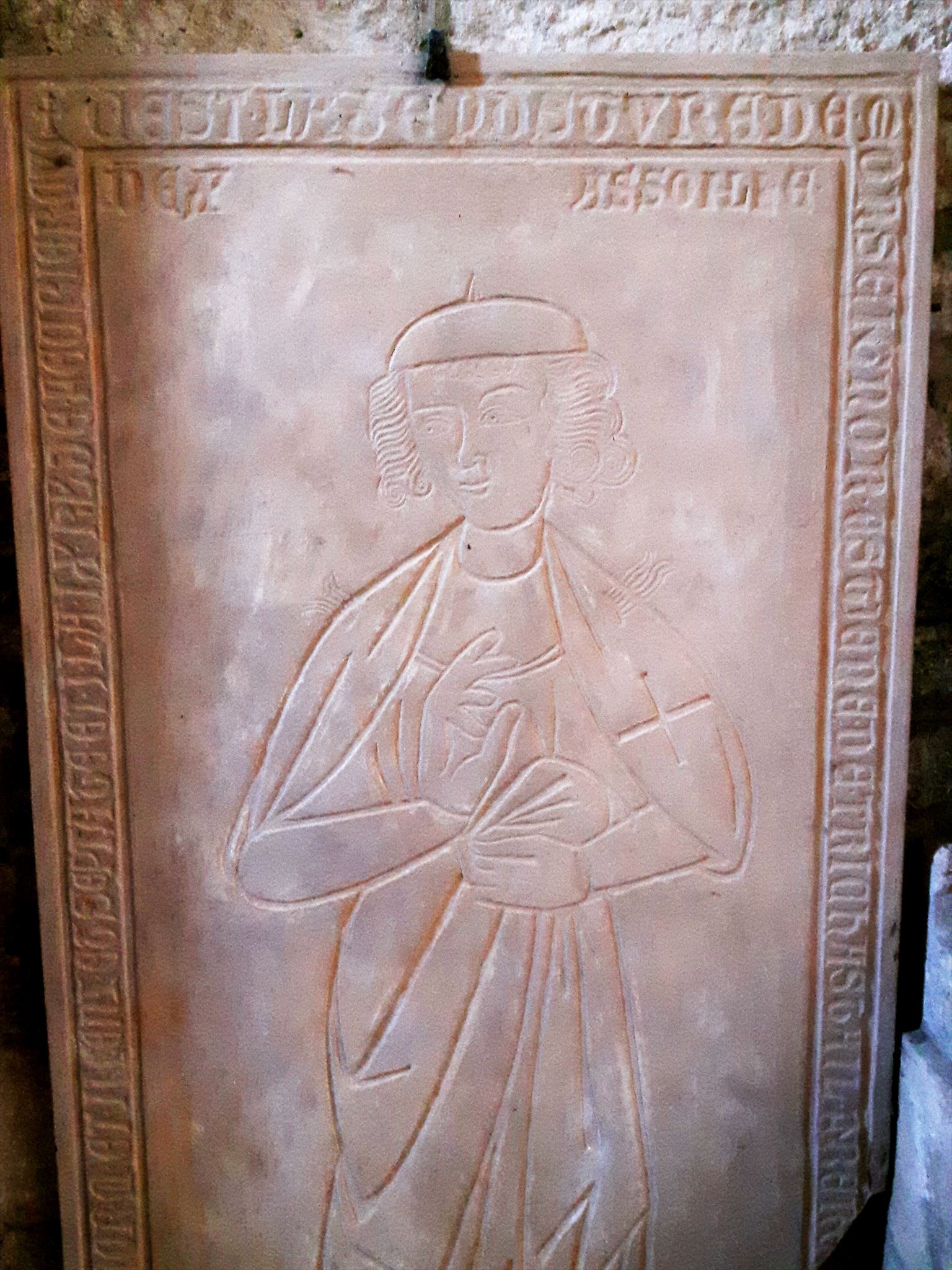
In this church, near the western gateway, you will first find the tombstone of Etienne de Til-Châtel , lord of Pichanges and Chapelain of the Templar Commandery of Fontenotte, buried in 1271.
He is the fifth son of Gui II of Til-Châtel (1180-1241) and Guillemette of Bourbonne, Lady of Coublant.
On the tombstone we can read:
“Who gist or cymetere are brothers of the Chevalerie Dou Temple of Fontenottes near Trichasteaul. “
This funerary stone is a molding of the original stone found in the Chapel of the Sheepfold, at the Rente Saint Joseph on the heights of Dijon.
(see GC6GQQK: TTBERG On the trail of the Knights Templar – La Bergerie)
Thanks to the engraving of this stone, we know the dress of a Chaplain of the Order for a ritual.

On the other side of the door is the nephew of Etienne, Guy III of Til-Châtel , Knight Templar, Lord of Til-Châtel and Pichanges, Gonfalonnier of Franche-Comté, and Archdeacon of Tonnerois in the church of Langres.
On the tombstone we can read:
“Cigit.messires.Gui.sires.de.Trichatel.qui.trespassa.lan.grace … of.mois.doctouvre.priez.for.lame.li. “
This tomb with its green traces of moss is the subject of an old tradition: the original stone would be that of St. Margaret, and as it is often wet because of its porosity, it is said that the saint cries.


Rougemont Family Templars Worshipped at Fontenotte and owned the Shroud of Turin.
The First Preceptor of La Fontenotte
My mother’s maiden name has been traced to Rougemont who appear to have ties to the Windsors, thus much of the royalty of Europe. I am sharing this discovery with Robert Sinclair, and Ben Toney, who may be related to the Robert de Ros who lived in Belvoir castle that belonged to the House of Toney.
Because the world is going mad, and in order to strengthen Britain and recreated a European Union co-founded by Denis de Rougemont, I revive the order of Knight Templars, whom the Sinclairs are now tied via Anges de Toney.
Alexandre, and Francois de Rougemont are buried with Knight Templars as Til-Chatel. Gui 1er de Rougemont married Etinnette de Ruffey. Here are the Seigneur de Til-Chatel. Guy 2 de Rougemont Thibaut V de Rougemont 1306-1333 Guillaume de Rougemont Humbert de Rougemont married Alix Neufchatel Aymon 2 (Aimon) de Rougemont married Guillemette de Ray daughter of Othon de La Roche, owner of the Shroud of Turin. Thibaut V1 de Rougemont father of Catherine de Rougemont who married Jean de Neufchatel the son of Margarita de Castro e Souza from who the Windsors descend.
The fifth son of Guy II of Rougemont and Guillemette de Coublant,
Etienne de Rougemont was lord of Pichanges. In December 1265, having
recalled the donations made to the temple by Aimon IV and Guy II, he
gave to the Templars, with the agreement of his elder brother, Jean,
Lord of Rougemont, the right of pasturage on his lands of Pichanges
and Spoy. He died in 1271 and was buried before the altar in the
chapel of Fontenotte and conferring his Templar rank of Preceptor
(priest-templar).
After the death of Etienne, Jean de Til-Chatel had to confirm in 1274
the rights of the Templars over Fontenotte. In 1278 his younger
brother, Guy, who had been curate of Til-Chatel in 1242 then
archdeacon of Le Tonnerois in the church of Langres, succeeded him at
the head of the lordship of Pichanges.
In May, 1274, Jean de Rougemont, Marshal of Burgundy legally
recorded “for the repose of his soul and that of his elder brother,
Etienne de Rougemont, who lies in the cemetery of the said Temple,
and of the souls of his forebears”, granted to Henri de Dole,
Commander of the House of Fontenotte:”
I have found a Hughes/Hue de Rougemont who a “grand maître du
Temple”in two accounts, and the maître du Temple of Burgundy in
another.This Hugues appears to be related to Humbert de Villersexel
who wasthe Lord of Rougemont and Til-Chatel. Is this the Hughes that
preceeded Bernard de Tramelay/Dramelay? Did this Hugues come after
Bernard. In the Fromond/Dramelay genealogy we find a line of De La
Roches, and thus the Rougemonts are kin to another Templar Grand
Master, Amaury de La Roche.
Jon Presco
Copyright 2016
http://rougeknights.blogspot.com/
Today I found the Templar Chapel of Fontenotte where the Rougemont
family of Knights Templar worshipped.
http://www.petit-patrimoine.com/fiche-petit-patrimoine.php?















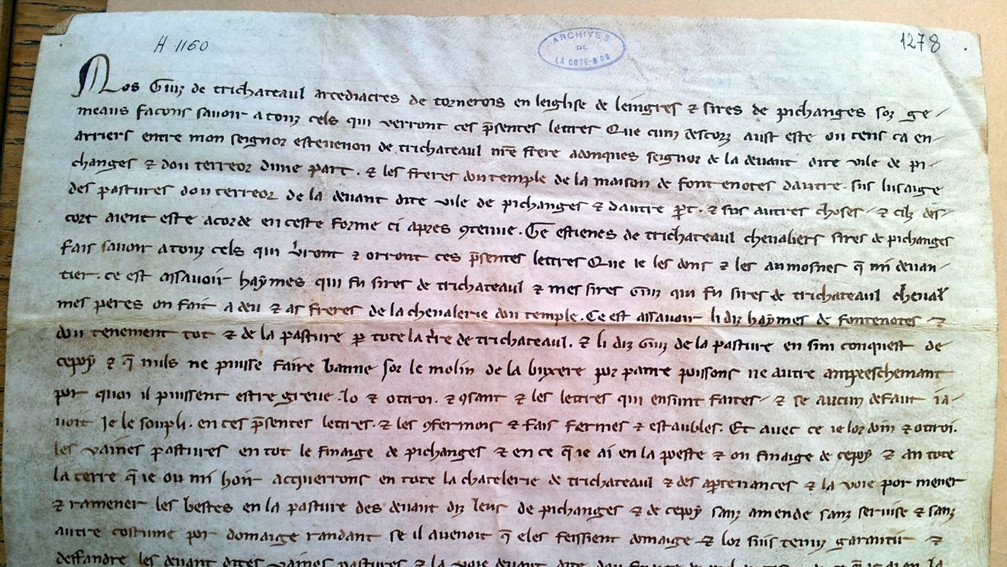

Hugues III donated his land of Fontenotte to the Knights Templar, to ensure the repose of his soul.
These built a commandery including this chapel dedicated to St Petronilla and St Peregrine.
When the order of the Temple was abolished in 1311, the estate of Fontenotte was administered by farmers until the Revolution and sold as a national property.
Became farm, managed by its owners until 1971, (Latour family) buildings and land were sold separately.
In 1960 thanks to Abbot Henri Latour the chapel was saved, dismounted stone by stone, after a journey of about forty kilometers, everything was reassembled in the walls of the sheepfold, on the heights of Dijon.
The chapel back to the place called “La Bergerie” is accessible from Dijon, taking the Avenue Eiffel, out of Dijon and continue on the D 108 G, the chapel is on the left, signposting “Bergerie”, very easy access. From Corcelles-les-Monts, take the D 108 G direction Dijon and continue to the entrance of this city, the chapel visible is on the right just before entering Dijon (chemin de la Rente St Joseph).
Le marchand de vin / époque gallo-romaine IIe-IIIe sièclesProvenance : Til-Châtel / Musée archéologique de Dijon
origin
The village, located on the way Agrippa between Langres (Andemantuno) and Chalon (Cabillione) is mentioned on the map of Peutinger in the year 230 CE under the name of Filena on the river Tille.
Historians consider that it was probably a locality of great importance, at least strategic, Dijon (Divio) is not mentioned.
Father Vignier who had consulted the texts of Claudian wrote during the 17th century that there existed during the Roman occupation a location called La Motte Ronde, located in the bottom of the village constituting a Castrum along the way Agrippa, which allowed to monitor both the river and the road.
It was bounded by Aval Street, Coupé Street and the alley of the Reculée.
The excavations that were carried out in this perimeter allowed to update many vestiges, statues, funerary steles and coins dating from the time of the Roman occupation.
At the time, a channel 2 meters wide by 1.5 deep to navigate flat-bottomed boats, connected the bridge on the Tille to a place called Ogne, located between Til-Châtel and Lux where excavations in the 1980s to 1992 confirmed the existence of a group of buildings occupying a site of approximately 9 hectares which could be, according to René Goguey who led the excavations, a set of warehouses linked to the river navigation where were gathered the grains from the Bassigny destined to the food of Rome.
Later, around the year 264 stands the martyrdom of Saint Florent patron of the village church. The Abbé Roussel tells that the invaders from northern Europe, commanded by Chrocus, after having ravaged Langres and massacred Saint Didier bishop of that city, stopped at Tilae Castrum (Castrum ad Tillam) as the village was then called .
They met there a Christian named Florent, son of the governor of Castrum whom they made prisoner and with whom they wanted to make abjure his faith. At his refusal they decapitated him with a plow. Her head rolled in the river Tille where, carried by the current, she was dragged to Barbe Island on the Saone near Lyons where she was kept in the church of Saint-Martin. As for Florent, his relics exposed in the church are at the origin of many miracles. Ogne and Castrum were destroyed during an invasion after the year 400.
Around 407, the kingdom of Burgundy was created by Gondicaire, barbarian Christian leader from across the Rhine that ended the Roman occupation.
We do not know what is happening in the village until the year 801. At that time it was dependent on the bishop of Langres Betto, who that year, concedes the church of Tilicastro and his income to the Augustinians of Saint Etienne de Dijon. Since that date, the name of the village is written according to the mood of the scribes and the language used, Latin or French, Tylicastrum, Trichastel, Trichâteau, Trichâtel, Tilchastel, Tréchâteau, and finally Til-Châtel in 1860, after being called Mont-sur-Tille during the revolutionary period.
The Lords
Reporting to the bishop of Langres, they originated from an Audon I of Til-Châtel, son of Garnier Count of Troyes attested in 918 by his signature in an act of the Duke of Burgundy Richard.
This family, which carried as a coat of arms a key in pal, also paid tribute to the dukes of Burgundy. She held a high rank among the lords of the duchy and county of Burgundy. Its members who contracted prestigious alliances followed one another from father to son until the year 1299 when Isabelle de Rochefort, daughter of Gaucher de Rochefort lord of Puiset in Beauce, widow of Guy III of Til-Châtel Gonfalonier of the County of Burgundy, became lady of Til-Chatel. She remarried with Humbert de Rougemont around 1306 and married her daughter Jeanne whom she had with Guy III of Til-Châtel to Thiébaud de Rougemont son of a first marriage of his new husband. The lordship then passes into this family until the end of the 15th century when the last of the Rougemont, having no children, ceded the seigneury to Antoine de Baissey from a family of Montsaugeonnais who immediately paid tribute to the bishop of Langres. At the same time, Isabelle de Til-Châtel, Guy III’s half-sister, married Guillaume de Grancey, to whom she brought Gemeaux, Pichanges and Selongey dowries, reducing the possessions of the Til-Châtel family, which , lost a significant part of its luster.
In 1618, having no descendants, the last of the Baissey left the land of Til-Châtel to his uterine brother Erard du Châtelet who called her marquisate and gave it to her son Antoine. Put in decree for settlement of its debts it was acquired in 1663 by the baron of Housset, in turn put in decree in 1685. It was then bought by his widow Marie d’Aguesseau which in 1703 made gift to her niece Catherine d Aguesseau married to Charles Marie de Saulx, Count of Tavannes whose descendants possessed Til-Chatel until the revolution.
The village
It consists of several parts:
– The town
situated in the upper part of the village bounded by the Rue de la Charme in the east, the Barrière in the south, the Bourg and the Derrière lane to the west and by the Côte au nord. Inside the village there was the church and priory now disappeared, the Rue des Pieds Ferret and the Rue du Château which led to the fortress built at the top of the hill dominating the village and the valleys of the Tille and the Ignon. At the time of its splendor, it contained two large belt ditches with double drawbridges and several towers. Today only remains the door of this castle transformed into a dwelling. The rue aux Apports linked the village to the Agrippa way and to the village which had gradually been built on the edge of it.
– The village
stretched along the edge of the way Agrippa where from the 12th century was built the Notre-Dame chapel around which a House-Dieu hospital and its dependencies had come to settle. Sold as a national good in the revolutionary period, these buildings remain and we can see part of the Place du Tertre and rue de l’Hôpital. Other more recent constructions remain, notably of Renaissance period. Going down the Aval street you pass the reach on which various mills existed and we reached the site of the former Castrum that was mentioned above. Beyond the river at the exit of the village the site of the Maladrerie where the lepers were received and treated remains, but there are no visible remains. The village today has more than 800 inhabitants, it has spread towards Langres in the north, the Forge in the northeast, Lux in the east and Marcilly in the west.
– The Saint-Florent church
Located near the castle on the spur overlooking the village, we saw above that it was mentioned in the year 801 in a charter of Betto, bishop of Langres who conceded the benefits to the abbey of Saint Etienne de Dijon . During the following centuries, it received numerous donations and was enlarged in the eleventh and twelfth centuries, access to the church which included only a short nave being done by the southern portal decorated with a tympanum representing a Christ in majesty surrounded by four angels bearing the mark of the sculptor Pierre de Dijon.
Towards the end of the 12th century, the nave was enlarged, giving this Romanesque church its present appearance. The large west portal surmounted by a semi circular archivolt developing 5 rollers whose ends rest on each side on as many rolls crowning fine round columns, all different.
This arcade surrounds a tympanum representing Christ seated, treading under foot the symbol of sin and surrounded by animals symbolizing the four evangelists.
During this work on May 15, 1146, the workers discovered a stone coffin containing a skeleton.
According to the legend, one of them, named Remy, who manipulated without respect this body fell backwards and remained paralyzed, his comrades had the idea to take him to the altar of Saint Florent where the mason, having confessed his fault was cured. The crowd shouted to the miracle and a child exclaimed “Honoratus”, this name was given to the holy contained in the tomb which was placed in the southern part of the transept. Subsequently several miracles occurred and Honoré designated as the second patron of the church.
A carved and painted wooden frame recalls its legend.
Over the centuries, many repairs or consolidation work was done in the church. During the nineteenth century it was in poor condition and at the request of Viollet-le-Duc a major restoration campaign was undertaken in the years 1868-1869. It was led by his son Maurice Uradou who put the church in its current state and saved the essentials, including the general architecture and the remarkable capitals.
We will not describe it here. Note, however, that besides the reliquaries of the patron saints, it contains a god of pity carved wood of the eleventh century, a wooden calvary of the seventeenth century, a triptych painted on wood offered by Jehan Morelet signed by T. Claudon, many funerary slabs including that of Gui III Til-Châtel dated 1240, baptismal fonts of the twelfth century octagonal and several fragments of murals that would have been made from the fifteenth to the seventeenth century.
– Fontenotte
Located on the way Agrippa 2 km towards Dijon, this area, ancient Roman villa had several sources, one of which was connected site of Ogne by a pipe whose remains were found during the excavations carried out on this site .
In 1170, Aimon IV or Amé, lord of Til-Châtel, leaving for the crusade gave the Templars Fontenotte and all its territory to ensure the rest of his soul.
A Templar commandery, dependent on that of Bure was then built.
It was built around a central courtyard with various residential buildings, shed, barn, stables building square, tower, a chapel dedicated to St. Petronilla and a fence wall.
It benefited throughout the centuries of numerous donations and when the suppression of the order of the Temple in 1311 was attributed to the order of Malta. From then on, the estate of Fontenotte was administered by farmers until the Revolution.
At that time, the estate was sold as a national asset.
It became an agricultural operation and was administered by its owners, either directly or as a tenant, until 1971. At that date it was sold, the buildings and lands being sold separately.
In the 1960s, the chapel was dismantled by the priest Henri Latour, then pastor of Saint-Pierre in Dijon, son of the owner and back in the grounds of the field of Sheep in Corcelles les Monts.
A casting of the tombstone of Etienne de Til-Châtel was made, it is visible in the church Saint-Florent.
On the Trace of the Knights Templar, here we are at the Commanderie de Fontenotte.

Close to Til-Châtel, on the road from Dijon to Langres, still stands an old Templar farm called “Fontenotte”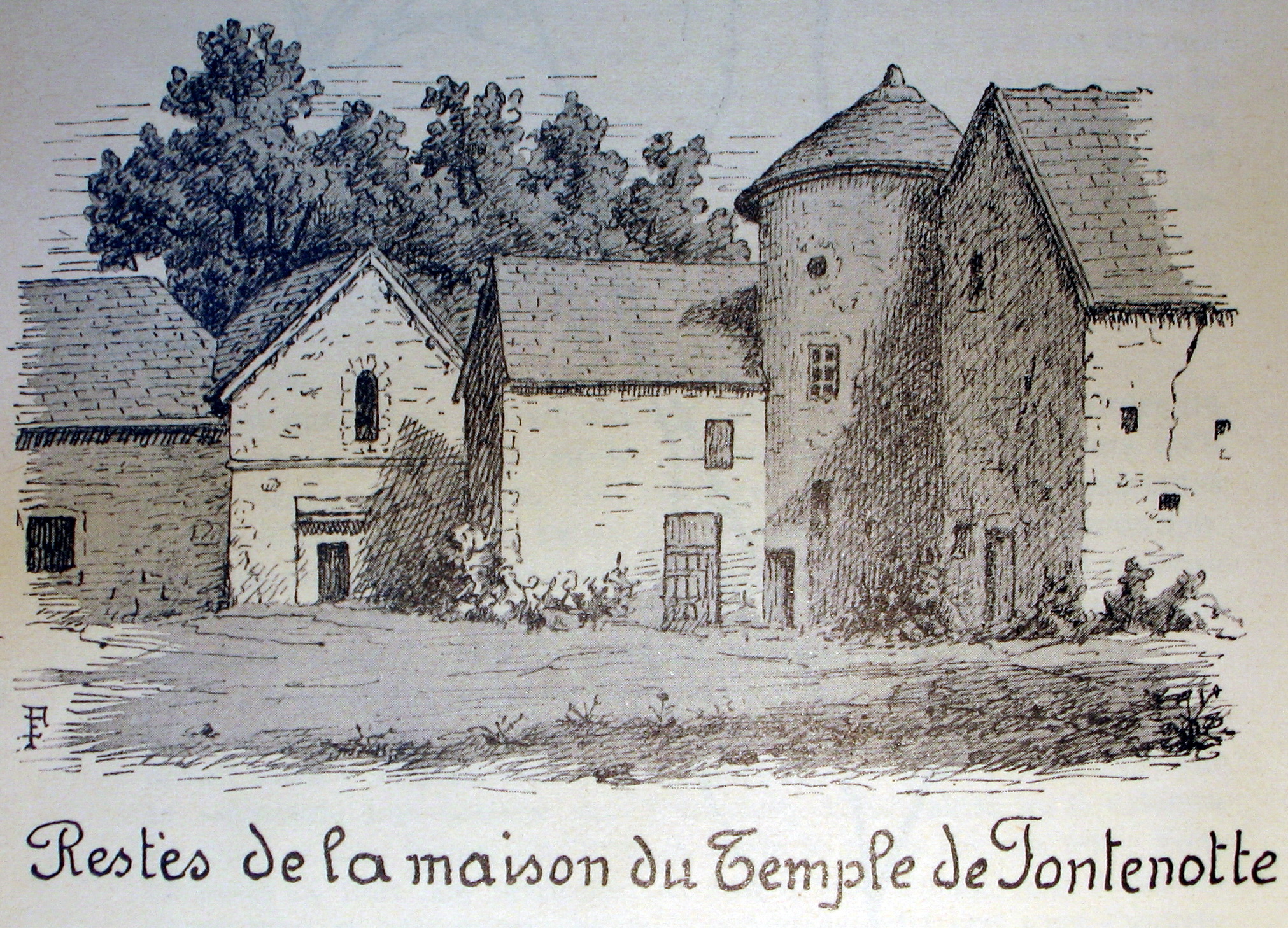
Before leaving for a crusade in the Holy Land, where he accompanied the Duke of Burgundy Hugues III, Aimon IV or Amé, lord of Til-Châtel, donated Fontenotte’s farm to the knights of the Temple “for the repose of his soul”.
The Templars thus receive around 1170 the enjoyment of a vast domain,
“The use on all his land so much in wood as in water and pasture”, that they affiliate with the commandery of Bure.
The monk-soldiers also obtain grazing rights to Pichanges and Spoy from a certain Etienne, lord of Pichanges, fifth son of Gui II of Til-Chatel and Guillemette de Coublant, Chapelain of the Commandery, he is, at his death in 1271, buried in the chapel of Fontenotte.
Three years later, Jean, his older brother, confirms some donations he makes to the Templar establishment and more particularly to Henri de Dole, commander: woods near the commandery, and still grazing rights on the whole finage Spoy.
It will be understood, the Templars accumulate in Fontenotte an important agricultural and forest area from which they derive the benefits and various tithes spread over Til-Châtel, Spoy and Pichanges, of course, but also Lux, Gemeaux, and Saint-Julien, to the gates of the ducal capital.
The other descendants then confirmed the donation, as here in 1278: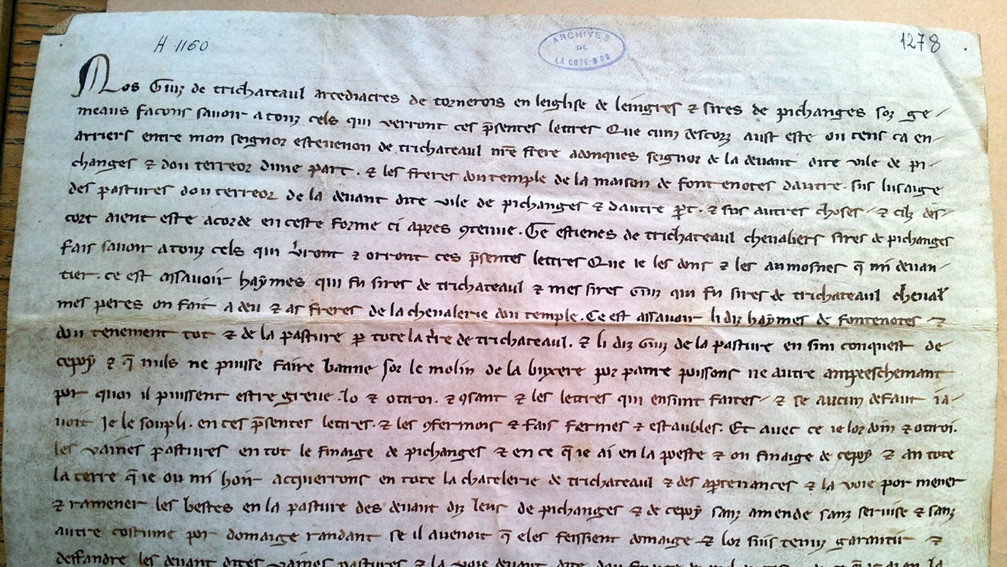
We can read on this document:
«Our Guiz de Trichatel archdeacon of Tonnerois in the church of Langres and lords of Pichanges. . .
let everyone know what will read. . .
my fathers made to God and brothers of the chivalry of the Temple. . . “
Fontenotte was built around a central courtyard with various residential buildings, hangar, barn, stables building square, tower, a chapel dedicated to St. Petronilla and St. Peregrine, and a fence wall.
The building currently used as a barn is large and elevated and appears to have been a clumsy house.
The chapel opens on a house at right angle. with a round stair tower in the inner corner.
In the 1960s, the chapel was dismantled and reassembled stone by stone identical to the Rente Saint Joseph on the heights of Dijon, the field of the Sheepfold, Corcelles road. (see GC6GQQK: TTBERG On the trail of the Knights Templar – La Bergerie)
Fontenotte takes its name from the many sources that come close to it; sources which, as indicated by the remains of the aqueduct which were discovered, fed the old town of Ogne disappeared, and now feed the village of Lux.
Until the beginning of the 20th century, the mothers of Til-Châtel, Gemeaux, Lux came to Fontenotte to evoke Saint Petronille for their feverish children. They spread the nappies of the sick child on the water. If they ran to the bottom the poor mother knew that her mourning clothes had to be prepared.
The Gonfaloniere was the holder of a highly prestigious communal office in medieval and Renaissance Italy, notably in Florence and the Papal States. The name derives from gonfalone, the term used for the banners of such communes.
In Florence, the office was known as Gonfaloniere of Justice and was held by one of the nine citizens selected by the drawing lots every two months, who formed the city’s government, or Signoria. In the papal states, it was known as Gonfaloniere of the Church or Papal Gonfaloniere. Other central and northern Italian communes, from Spoleto to the County of Savoy, elected or appointed gonfalonieri. The Bentivoglio family of Bologna aspired to this office during the sixteenth century. However, by the year 1622, when Artemisia Gentileschi painted a portrait of Pietro Gentile as a gonfaloniere of Bologna, with the gonfalone in the background, the office had merely symbolic value.
Jean Gonfalonier of the Burgundy County of ROUGEMONT, Chevalier, co-founder of Rougemont, lord of Til-Châtel and Rougemont, De Rougemont
Print Family TreeFamily Tree Print
Sosa : 2,905,724Sosa: 2,905,724
- Deceased after 1411 Deceased after 1411
ParentsParents
- Guillaume de ROUGEMONT ou Guy 1er de Rougemont , chevalier, Sire/seigneur de Rougemont et de Til-Châtel, sire de Ruffey , De Rougemont, Deceased about 1375Guillaume de ROUGEMONT or Guy 1st of Rougemont, knight, Sire / lord of Rougemont and Til-Châtel, sire of Ruffey, De Rougemont , Deceased about 1375
Married toMarried to - Etiennette de RUFFEY-sur-L’OIGNON ,dame de Ruffey-sur-l’Ognon, De Ruffey, Deceased about 1390Etiennette of RUFFEY-sur-L’OIGNON, lady of Ruffey-sur-l’Ognon, De Ruffey , Deceased about 1390
Spouses, children , grandchildrenand great-grandchildrenSpouses, Children , Grandchildren and Great-Grandchildren
- Married to Jeanne de VIENNE,(Jeannette Bourguignon), dame de Til-Châtel, De Vienne(Parents : Married to Jeanne de VIENNE, (Jeannette Bourguignon), lady of Til-Châtel, De Vienne(Parents:Henri de VIENNE, seigneur de Mirebel et de Charnay, De Vienne†1371/ &Henri de VIENNE, lord of Mirebel and Charnay, De Vienne † 1371 / &Marguerite de BAUFFREMONT, De Bauffremont ) withMarguerite de BAUFFREMONT, of Bauffremont ) with
 Guy II de ROUGEMONT ,seigneur de Rougemont et de Til-Châtel, seigneur de Ruffey-sur-l’Ognon ,seigneur de Maillot et de Vauvry, (“noble et puissant seigneur monsieur Guys de Rougemont et de Ruffy”) De Rougemont†1420/married toJeanne de MONTAGU, (“noble et puissante dame Jehanne de Montaigu”) De Montagu†1426 withGuy II de ROUGEMONT, lord of Rougemont and Til-Châtel, lord of Ruffey-sur-l’Ognon, lord of Maillot and Vauvry, (“noble and powerful lord Mr. Guys of Rougemont and Ruffy”) De Rougemont† 1420 /married toJeanne de MONTAGU, (“noble and powerful lady Jehanne de Montaigu”) De Montagu† 1426 with
- l
Share this:
Royal Rosamond Press
Leave a comment
Write a comment…

Comment
This site uses Akismet to reduce spam. Learn how your comment data is processed.
d
Cian O. 10:39 AMGood morning Uncle. I am well thank you- View Cian’s profileCian O. 10:41 AMI see you are still kicking. Hope you are well and enjoying it. Per Mark I do not know where or how he is doing. If you do find out please let me know. I will do the same.
- Aug 21, 2024John Presco sent the following messages at 7:37 AMView John’s profileJohn Presco 7:37 AMDrew Benton took her life on July 23rd. I am her only relative who responded, who called the police and mortuary. I was going to pay for cremation and have her ashes sent to me. But, God blocked me. Half measures availed us not. I’m going to write a letter to Stanford and have them do a complete study of our family that descends from the family of Carl Janke, the founder of Belmont, who was dug out of his grave in the middle of the night and put in a common grave in Redwood city. Stanford wants to buy land in Belmont that used to belong to – us!
- View John’s profileJohn Presco 7:41 AMYou got on it, the truth your got no nourishment from your father. He got none from his father, who got none from his father. And so it goes. You have broken the chain. I salute you!
https://rosamondpress.com/2024/08/21/garth-benton-blames-me-for-bills-suicide/Garth Benton Blames Me For Bill’s Suiciderosamondpress.com - Aug 23, 2024Cian O. sent the following messages at 1:00 PMView Cian’s profileCian O. 1:00 PMJohn: You got on it, the truth your got no nourishment from your father. He got none from his father, who got none from his father. And so it goes. You have broken the chain. I salute you! https://rosamondpress.com/2024/08/21/garth-benton-blames-me-for-bills-suicide/…see moreThank you uncle. It means a lot to me that you would say this. I know this, and I am sorry that you did not get the nourishment you needed, and I know my father did not. Both of you were never taught love, how to be a father. Grandma had her issues too. I do not blame him, you, etc. I know and forgive. In truth, I also could have been a better son. I had wanted to reconcile, but I may never get the chance. When you contacted me, I was at the Grand Canyon with the family. The last time I was there, it was when I was with my father. It is the best memories I have with him. It became clear to me I wanted to pass on what Mark gave me in this regard. He taught me about nature, and how to do the handy things in life. There is little I cannot fix. As I never know if we will reconcile, I did so at the Grand Canyon. I prayed, This is the place I have the best connection with my father. I prayed, and reconciled with him there. looking upon the canyon at the sunset. A burden was lifted. I was able to pass on what he taught me on that trip. I remembered so many details.
I am sorry to hear about Drew. I have spoken to Shannon from time to time, she was not well, in and out, if you know what I mean. Let me know if I can help. I am not clear on the current status.
With love - View Cian’s profileCian O. 1:04 PMBTW I think it was a trip that you contacted me while I was going through that process. That was not an accident.
- Sep 7, 2024John Presco sent the following messages at 8:04 AMView John’s profileJohn Presco 8:04 AM
- 👏
- 👍
- 😊
Your offer to help as a member of Our Family, is very timely. I am poised to pay $1,870 dollars to cremate your cousin. I got a credit card a Selco. I filled out Drew’s death certificate on Sept. 5. When I wrote her parents names, I felt like God. As a genealogist I have gone to those filled in empty spaces and – taken names! “The Lord giveth, and He taketh away.”
Garth and Christine created Drew. Rosemary and Vic, created me. October 8th. is my natal birthday. My sober birthday is April 7th. Christine died a sober sister. And this may be all I come away with, in the end, so despairing is the burden my parents put upon me, that is is unfit for human literature?
For seventy years I have awoken, put my feet on the floor, and put on my Magicians Hat. We grow weary of having to run – the show! I’m glad to be witness to you – letting it go! I have pondered long why Mark did not make more magic in his life and share it freely. I conclude his need to do well, while everyone around him, fails, set him up – for failure! He couldn’t let it go – this need.
So, allow me to record one last magical image. There we be, the three of us, standing on the edge of the abyss, beholding an outstanding sunset, and, sharing the glory of God’s Creation.
I need your help. I need to go to Belmont and look at our history on the History Room. Faux historians have banished me. Our great grandfather was dug up from under a Bay tree in the middle of the night, and thrown in a mass grave in Redwood City. If you can take a day off from work, I would love to be with you in the Stuttmeister crypt in Colma, then go to Belmont, then, stand over the grave of our ancestors at the Union Cemetery. I will put some of Drew’s ashes here. We are looking at a month from now.
Best regards to our Family
Uncle John - c
 Rosamond Press
Leave a comment