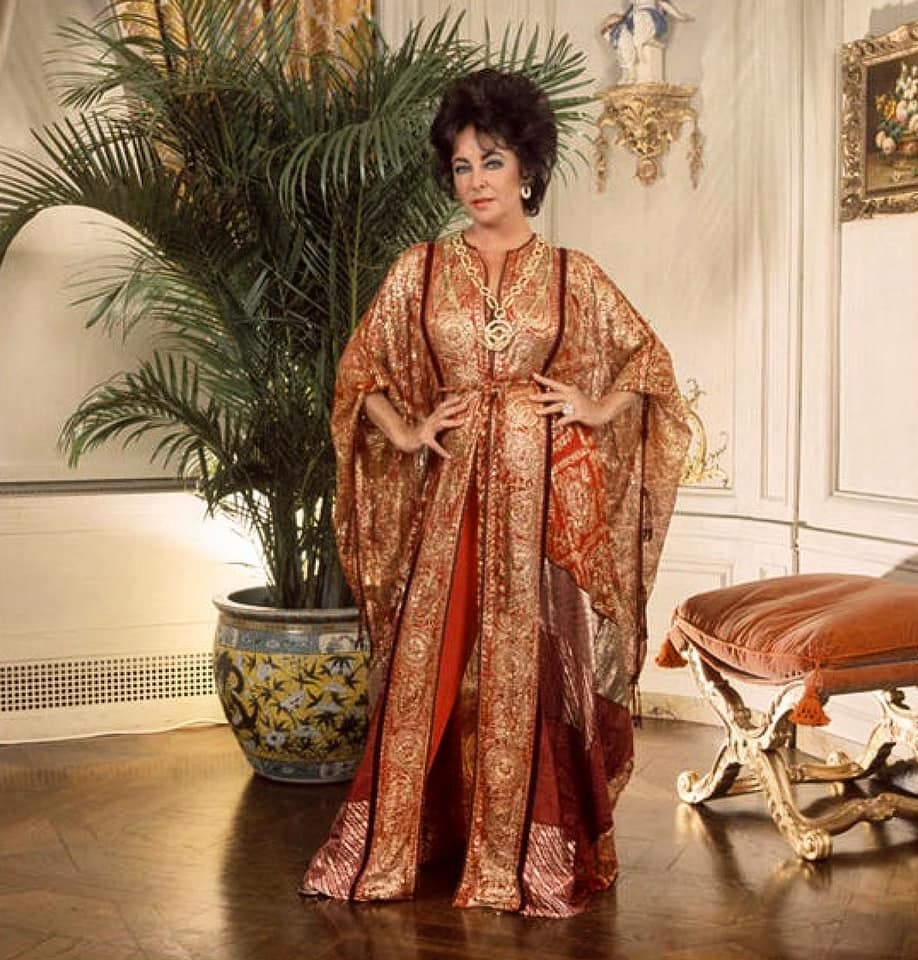
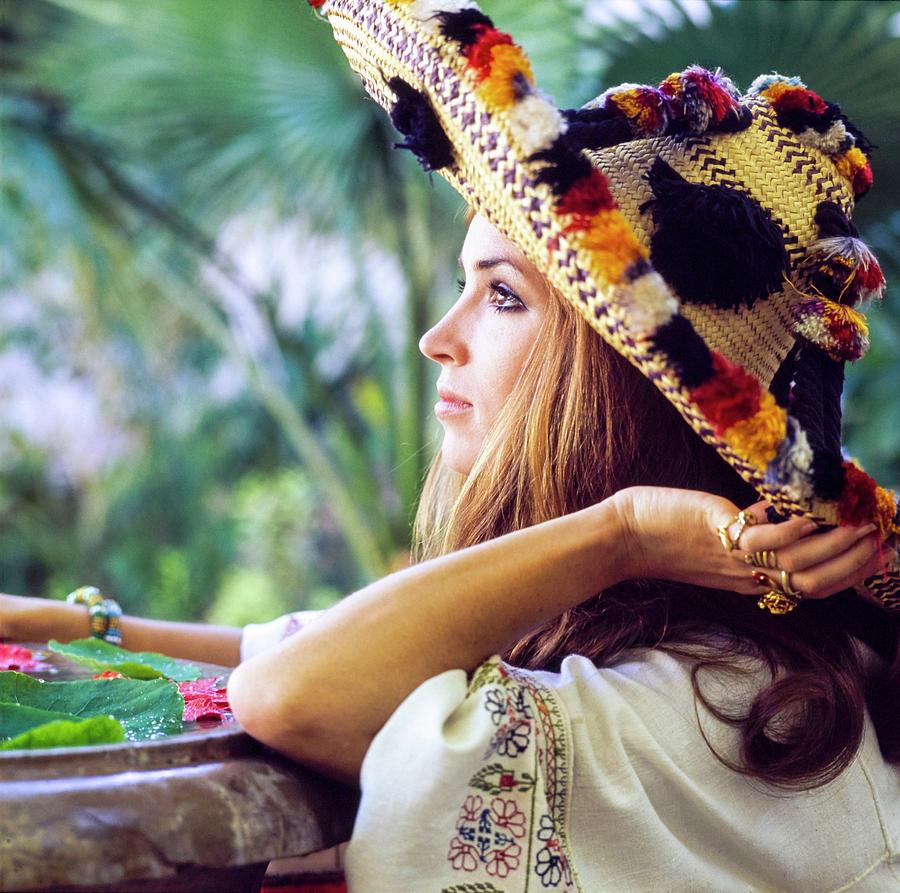
On this day, January 3, 2025, I John Presco connect my cousin, Elizabeth Rosemond Taylor, with J.R. Tolkien, and the Bohemians of Augustus John, who was a friend of her family. Abpve is a image of the fasjhion model, Talitha Getty, who is related to John. She had tragic death due to drug addiction. I was hoping to save Drew Rosamond Benton to replace Talitha.
Today I save these two women, by creating the character for my book. Dorelia John is a model for…
Rosamonda of Toxandria
Rosamunda Took traced her roots back the Thrain who came from the island of Toxandria that is located in Holland. Silt from the rivers filled in the area around this island. This made the Thrain open to many enemies. The enemy that took over Toxandria was a Wolf Tribe. The smaller Thrain fled over the sea. Some became wives of the Wolf Men. Because Rosamunda was four inches taller than other Hobbits, it was alleged her ancestors came from Toxandria – and beyond. Rosamunda met a highwayman who called himself Wolf Rosamond.
To be continued.
I base part of Rosamunda on my friend, Nancy Hamren, because they both came to own an ancient formula for yogurt.
No one has assisted me in putting together my story. Nor have I had any conversations about it. I have been keeping it on the back burner.
JP
EXTRA! I just woke from my Old Man Nap and saw several lines of clothing that stem from the line of Rosamunda Toxandria, and Ada Nettleship John. I’m going to ask my friend Nancy to endorse a line of Deadhead Wear, I am going to have a Christine Rosamond Line…..Rosamond Drew! With so many Tolkein movies, I am sure fans would like to dress the part.
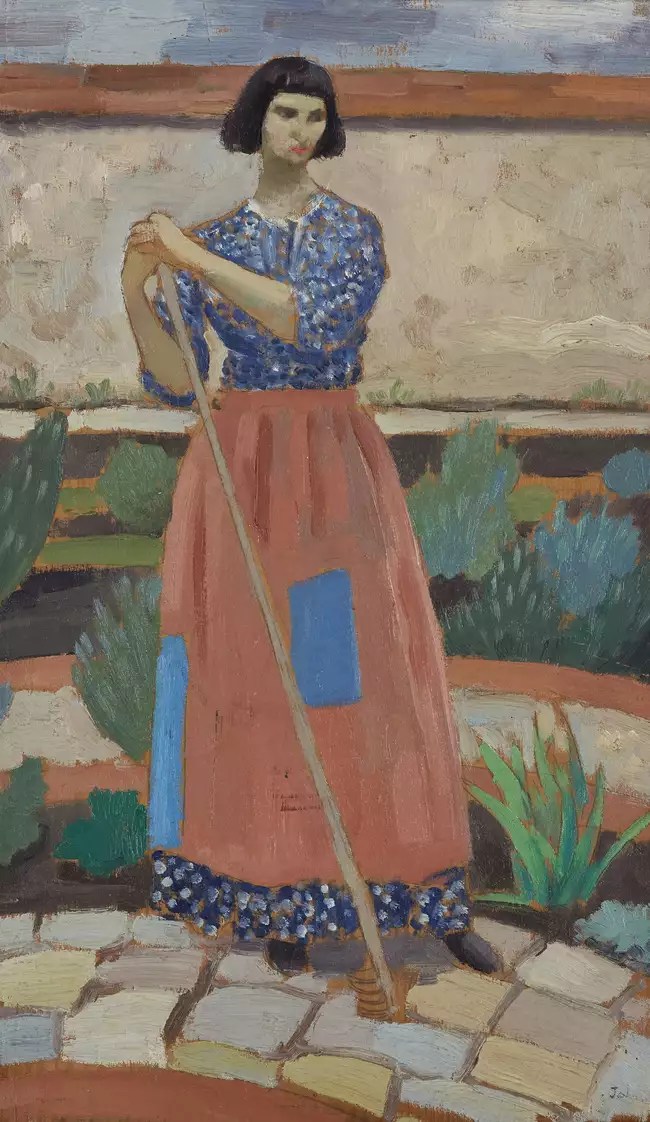
oil on board, signed lower right ‘John’, 50.8 x 30 cm(ARR)
Provenance:
Arthur Tooth & Sons Ltd, London, no. Z2414;
Exhibited:
Olympia, London ‘Augustus John’, 23rd – 28th February 1999, no.69;
Note:
This early work shows the artist’s common-law wife and most famous sitter, Dorelia McNeill. Dorelia first met Augustus through his sister, Gwen John, while studying art at Westminster School of Art in 1903, later travelling with her in France that same year. With Augustus she chartered a bohemian existence, travelling across Southern England, often living in a Gypsy caravan.
Dorelia is the subject for John’s most iconic early works, including ‘Woman Smiling, 1908-09’ (Tate Gallery) and ‘The Blue Pool, c.1911’ (Aberdeen Art Gallery and Museums Collection).
John began making quotidian figure studies of Dorelia often in domestic settings around 1910, and they were highly successful commercially, perhaps reflecting the public’s idealised desire for a more simple existence. This work demonstrates her easy confidence and charm, dressed in her homemade clothes that reflected the pairs’ interest in Romani culture. Similar works in public collections are Washing Day, circa 1915 (Tate) and ‘Dorelia in the Garden at Alderney Manor, Dorset’ (Yale Center for British Art).
Dorelia McNeill (born Dorothy McNeill; 19 December 1881 – 23 July 1969) was best known as a model for the Welsh artists Gwen John and Augustus John, was the common-law wife of the latter, and has been credited for inspiring “his first unequivocally personal work”.[1] In her time she was regarded by some as an exemplar of bohemian fashion.[2]
It has been suggested that Gwen John had romantic feelings for McNeill.[7] McNeill left for Bruges with a Belgian artist, and was pursued by Augustus, with whom she returned to England. She lived in a ménage à trois with Augustus John and his wife Ida Nettleship, sometimes as part of a Gypsy caravan that would grow to include John’s children by both women.[8] The arrangement lasted until Nettleship’s death in 1907, when McNeill became the principal female figure in the John household.[3][9] Later she had an affair, at Augustus’ encouragement, with the painter Henry Lamb.[3]
McNeill lived with Augustus until his death in 1961.[3] Her step-granddaughter was the 1960s bohemian fashion icon Talitha Getty.
Talitha Dina Getty (néePol; 18 October 1940 – 11 July 1971)[1] was a Dutch actress, socialite, and model who was regarded as a style icon of the late 1960s. She lived much of her adult life in Britain and, in her final years, was closely associated with the Moroccan city of Marrakesh. Her husband was the oil heir and subsequent philanthropist John Paul Getty Jr.
Talitha Dina Pol was born in Java, then part of the Dutch East Indies (now Indonesia), daughter of the artists Willem Jilts Pol [nl] (1905–1988) and Arnoldine Adriana “Adine” Mees (1908–1948).[2]
Her father subsequently married Poppet John (1912–1997), daughter of the painter Augustus John (1878–1961), a pivotal figure in the world of Bohemian culture and fashion. She was thus the step-granddaughter of both Augustus John and his muse and second wife, Dorothy “Dorelia” McNeil (1881–1969), who was a fashion icon in the early years of the 20th century. By Ian Fleming‘s widowed mother, Evelyn Ste Croix Fleming née Rose, Augustus John had a daughter, Talitha’s step-aunt, Amaryllis Fleming (1925–1999), who became a noted cellist.
Ada Nettleship, carte de visite, 1888 Reproduced by kind permission of Rebecca John
Ada is best known now for her theatrical costumes but whether the dress she was making was to be worn on the stage or in the street, she wanted to make beautiful clothes, ‘each dress..an individual production of real artistic value’. However, she was also committed to combining originality with suitability and was involved in the ‘Rational Dress’ movement, which advocated for everyday clothes that were lightweight and easier to move around in.
In May 1883, there was a large Rational Dress Exhibition in London and amongst the divided skirts and ‘outrageous’ costumes designed for cricketing and boating were Ada’s ‘artistically designed evening and walking dresses’. In the opinion of the St James Gazette, ‘it is more than conceivable that a young woman of good figure would appear to advantage’ [in one of Ada’s evening dresses] ‘without any stays at all.’
Bolger Family History
Bolger
In Ireland this name is an anglicised form of the Gaelic Ó Bolguidhir, meaning ‘a descendant of Bolgodhar’, a personal name composed of the elements bolg meaning ‘belly’ and odhar meaning ‘yellow’ or ‘sallow’. The name was most prevalent in south-east Leinster – especially in Wexford, Carlow and Kilkenny – and several members of the family were physicians to local Gaelic chiefs.
Brassell and Dermot Bolger, both of Ballywalter, were listed among the chief gentlemen of the Barony of Ballaghkeen in 1608 and the family name was well represented in King James II’s Irish army and, after the defeat of the Jacobites, in the Irish Brigade in France
In Sir William Petty’s ‘Census’ of 1659, the name Bolger (or a variant) is mentioned as the Principal Irish Name of households in the baronies of the following counties:
The tribal name Texandri, which may be related to the name of the region,[1] is mentioned as Texand(ri) by an inscription dated 100–225 AD, as Texuandri by Pliny (1st c. AD),[2] and perhaps as Texu<…> on an inscription from Romania dated 102–103 AD.[3]
The variant form Toxiandria is only attested once in a 9th-century manuscript of Ammianus Marcellinus‘ Res Gestae (ca. 390) to designate the region, and the variant Taxandria occurs five times in 9th-century sources, and also in later documents.[3] The inconsistencies in spelling may be explained by dittography (errors by copyists), or by the fact that the older form Texandria had fallen out of usage.[3][4]
The name Texandria is generally assumed to derive from the Proto-Germanic stem *tehswō(n)- (‘right [hand], south’; cf. Old Saxontesewa, Gothictaihswa, ‘right, south’) attached to the contrasting suffix *-dra-.[5][6][1]Texandria may thus be interpreted as the ‘land of the southerners’.[1]
Today, March 16th, is the day when EverQuest first launched in 1999, and 25 years later this elder statesman of our genre is still going strong. That means it’s time to celebrate with goodies and data, which are two of Bree’s favorite things (the third is probably chocolate).
My sister, Vicki Presco, got in early on EverQuest, and was a Supreme Goddess when she invited me to join and play with our niece, Drew Benton I came in as….Wolferose. I know Drew is sorely missed – there! The Land of Make Believe was tailormade for Drew, who Christine name after Andrew, she said. She wanted a boy, and got a verb?
produce (a picture or diagram) by making lines and marks, especially with a pen or pencil, on paper.
“he drew a map”
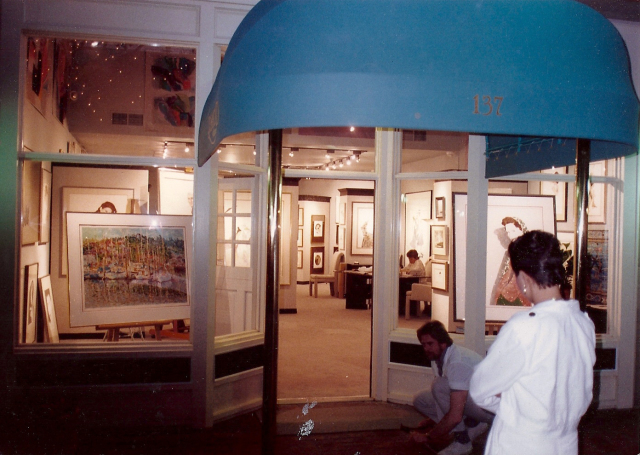
There are maps in EverQuest. J.R. Tolkien DREW maps. He created a woman who owned the name Rosamunda. He conjured her up. Above is a photo of the Rosamond Gallery in Carmel. That might be Shannon Rosamond standing in front, Drew’s half-sister.
“Every fine day Rosamunda walked the hills, seldom seeing another living creature other than sheep, or, very rarely, a doe or faun. She did not walk south to Hobbiton, however, except on errands or for an appointed visit. She had not forgotten her “understanding” with Bilbo. And Bilbo did not forget her, either. Regularly, he sent her gifts of wine or ham or fruit in season, as tokens of his neighborly regard. She appreciated the way he could show marks of particular notice, without making her feel the burden of obligation.”
It’s 9:25 A.M. August 10, 2024. I just called the Police Department in Bullhead City because Drew’s boyfriend begged a member of Drew’s family to do so. He couldn’t find – any of us! He never – knew us. But, he loved Drew Benton. On July 23, 2024 Damien posted a death notice on his Facebook. Total strangers to me – grieved – on cyberspace! The next day (I didn’t know) Drew was dead) I sent my estranged nephew, Cian, my post where I claim all of Belmont. I had not communicated with my nephew in twelve years. For several weeks I had been trying to find the courage to ask him if his father, Mark Presco, was dead. My older brother was supposed to take care of Drew after Vicki died. I got no reply – from Drew’s cousin, Cian.
{Casey Farrell can testify about me wanting to get in touch with Mark – after twenty-four years. He had to admit I could predict things. Christine had full acceptance I was a Seerm and is why she took up art. We were in touch, always.)
Yesterday I highly suggest the City of Belmont give me an appartment above the Iron Gate Restaurant. Too, late to be – civil to my family. Drew and I will haunt those two apartments – forever! Our Family Book – will take it all. My claim for it all – is ordained! The Magical Family is coming home to Belmont. For it is a truth that IF Carl and Dorothea did not exist – Drew would not exist! It is a fact that two members of the Belmont Historical society – did not want us to exist. Not once did they mention Drew’s famous mother, or, the names of the Jankes buried in our family crypt in Colma – that was not mentioned. They did not mention the coin I put in the crack of my ancestors final resting place. It was an AA Angel coin given to me by my Sister in AA, Joy Gall after I told her our Sister Christine Rosamond, drowned on her first sober birthday – after saving Drew. At eight years of age she watch her mother drown. Her account dies with Christine’s beloved daughter, who will be missed on EverQuest.
I understand the rich and famous are envied and hated. If only millions had the connections, they would all be millionaires. Billionaires – die alone! Surrounded by strangers born with real human empathy, like the empathy for King Kong, lying bloodied and dead in the mean street of New York. Because there are parasites in the world, I hereby claim all that is associated with the legacy of Christine Rosamond Benton. Drew and Shannon had no children. I have one child and two grandchildren. Rosamond did a painting of Cian that is very connected to Tolkien, and will be for a long time when my book is out.
Christine and I began to live a Fairytale life shortly after we moved to San Sebastian Avenue to West Los Angeles. I became good friends of Bryan McLean who became Christine’s lover. Bryan dated Lisa Minnelli in Junior High. Two hours ago I read about her father who directed the movie ‘The Sandpiper’ that was supposed to star Kim Novak, who had a special home overlooking the waves in Carmel.
My baby does not love me anymore. Yet – we dream. And, our dreams take us away, to foreign shores, where magic runs free, and is forever un-molested.
You are home, my dear niece! I have made a home for you!
When I read the following this morning, the book, and movie ‘Gone With The Wind’ came to mind.
“The couple had nine children; eight girls and but one son — Martin — who served with Lucas County boys in Company C of the 13th Iowa Infantry and died in service in 1862. When James Roseman died in 1887, there was nobody by the name of Roseman left in the county.”
Thanks to my kin, Charles M. Wright, I was able to find the Western branch of the Rosemond-Rosemond-Rosemond family that descends from James Roseman, Phillip Rosemond, and Moses Morton Rosemond. Add to this branch my grandfather Frank W. Rosamond, and his four daughters, June, Bertha, Rosemary, and Lillian, and the Western Rosamond family, is complete.
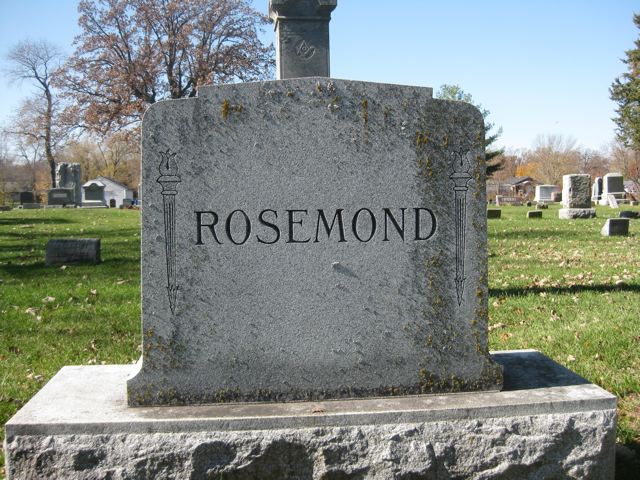
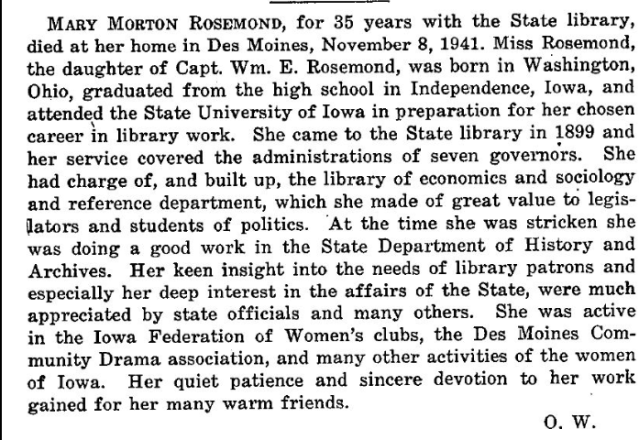
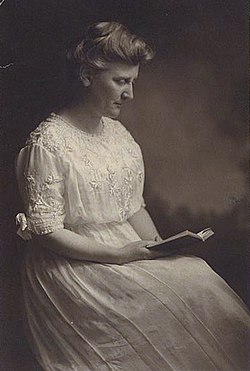
I have chosen Mary Morton Rosemond t ground all the Rosy families, because she is a trained Librarian and State Archivist. If she were alive, she would be doing what I and Jimmy Rosamond have been doing for many years. The Rosemond family is mentioned in several history books, none more tragic then the Record of Iowa Soldiers. Why did they let Martin join The War of the Rebellions? He was surrounded by eight beautiful sisters who loved him dearly. He got wound, and was discharged. He came home and died shortly of his wound. What a heartbreak to say goodbye. He was handsome, and, perhaps too effeminate? Did he, and others believe he would come home……….a man. A Rose Man?
There are some profound parallels between the history of The Gone With The Wind, and the Roseman family who were pioneers. They Came from Ireland, and went West. Their name is gone, but their DNA is all over Iowa, including the bloodline to the Wieneke of Iowa. Frank Weseley Rosamond married Mary Magdalene Wieneke, and thus another Mary M. Rosamond. What is in a name? Did Mary Rosemond ever dream one of her kin would become one of the most famous Movie Stars of all time? Then there is my sister’s famous works of art, she know all over the world for her images of beautiful women. Christine Rosamond Benton used her middle name to sign her work, thus giving this name new life. I suspect Mary Morton gathered all her Roses around her, and this monument, with, just the name.
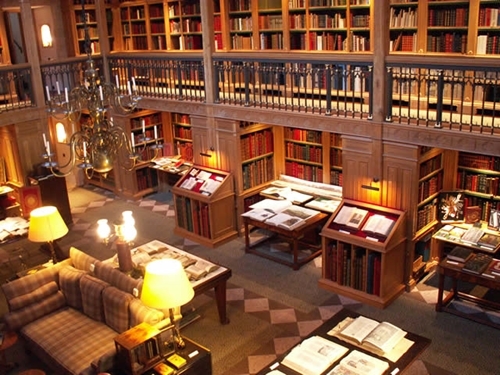
I am kin to Richard Burton who Ian Fleming wanted to play the first James Bond. Liz Taylor is kin to Fleming via Aeilene Getty. The Getty family have founded famous libraries, archives, and museums.
Here is The Crux of my stories. My idea for a Netfix series is based upon Herbert Armstrong who helped fund Radio London, that was managed by my late friend, Ben Toney. Koreville Radio will look like a scene straight from ‘The Horses Mouth. There will be sheep and Gypsy wagons around a reconstructed KORE set. There will be clothes drying on the barbed wire. When talking with Michael Powell about the Ken Kesey cottage, I brought up the movie ‘The Horse’s Mouth’ with Alec Guinness. This story is based upon my kin (via Liz Taylor) the artist Augustus John. Kesey was how old? Liz grew up in his home and her uncle sold his art.
I posted this weeks before Ben Toney died. I wanted him to get a glimpse of how he was going to be remembered. I had come to realize I was involved in a real James Bond assignment which is to save the alliance between and the United States. I threw Holland into the mix, to only learn two days ago the Dutch had their pirate ship.
The making of Bond 25 is – cursed! The muses hate this movie. Violence and murder is not the message God wants to give in regards to solving world problems. In the name of kindred, Ian Flaming – I take over this production and legacy! I pirate it. I board this wreck and raise a United Flag that contains a musical note and a harp!
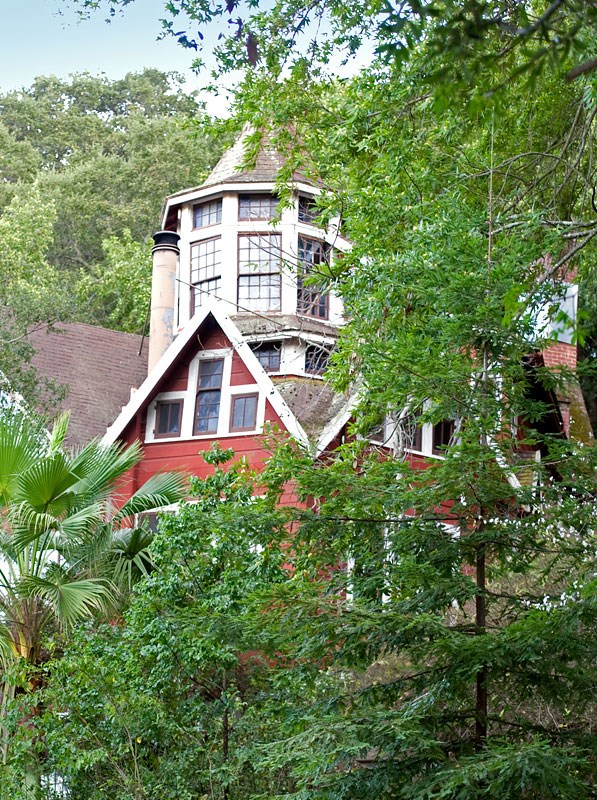
Brittan House on Dale Avenue. Nathanial Brittan Party House, 125 Dale Ave., San Carlos, California This is an image of a place or building that is listed on the National Register of Historic Places in the United States of America.
To: Governor Newsom
From: John Presco
President: Royal Rosamond Press
Dear Governor Newsom
For years I have been trying to get you and your circle of family and friends to promote The Sober Bohemian Way of Life, that was established by gifted White People. I have White Democrat Swing Voters in mind, a whole group of people – who hate what they see! They see a Flim-Flam Man offering our grandchildren Easy Flashy Money if they betray The Bohemian Cause and Lifestyle and vote for The Generous Game Show Host – who has Jesus on his side – making it easier to choose The Right Door and get THE GRAND PRIZE! Down with The Dealers of Bling! Blng!
“Come on down – and be saved!”
Thirty-six years ago I went to an our-patient program and became clean and sober. I was a young Bohemian and a original hippie. I began to collect the history of The Bohemians in two blogs. I did this in order to create a clean and sober alternative for millions, many who saw getting straight as a cop-out. How many joined The Trump Crusade? Think – SWING VOTES! Have Jenny talk about Talitha Getty, and how she tried to get sober, She went back to drugs – and died! Not everyone who wants sobriety, gets sobriety. The success rate for those who try, is low. Meanwhile every Republican can take credit for saving the un-born. I didn’t hear Trump and His Cult Followers come up with a solution for The Drug Epidemic that is destroying our cities!
I turned on the news this morning and leanrded Sheila Jackson Lee, died. She carries the name of two Confederate Generals. I am kin to John Fremont who was surrounded by Radical Forty-eighters, many of them from Germany. They spread their Liberal Message in the Turnverein Halls they made across America. They founded the Rebpilcian Party that had been taken over by Neo-Confederates. My Pioneer ancestor, Carl Janke, built a hall in San Francisco, and when it burned down, he replaced.
I sent you a letter about Mary White Ovington. You need to get on this. Have Jenny give a history lesson on T.V. starring these two Freedom Fighters – who fought for Liberty and Justice – for all. Here is The True Heritage WE NOW OWN, but, will not own AT ALL – if the Trumpire of The Evil Wizard, prevails. I am kin to Robert E. Lee – and Christopher Lee! Do I got THE MOVIE – for us!
Sheila Jackson Lee died on Friday amid her battle with pancreatic cancer. She was one of the longest serving members of Texas’ Congressional delegation. Credit: Eddie Gaspar/The Texas Tribune
WASHINGTON — Sheila Jackson Lee, a Houston Democrat who was one of the longest serving members of Texas’ Congressional delegation and a longtime advocate for progressive causes, died on Friday amid her battle with pancreatic cancer. She was 74.
In July 1968, the Gettys had a son, Tara Gabriel Galaxy Gramaphone Getty,[16] who became a noted ecological conservationist in Africa, dropped his third and fourth forenames, and took Irish citizenship in 1999. He and his wife Jessica (a chalet maid he met in Verbier) have three children, including a daughter named Talitha.[17]
By 1969, the dissolute lifestyle the Gettys were leading in Italy and Morocco had begun to wear on Talitha, who wished to pursue treatment for heroin and alcohol addiction and return to Britain. Both she and Paul were unfaithful to one another (Paul was having an affair with Victoria Holdsworth, whom he would go on to marry in 1994), and Paul showed no commitment to becoming sober. He agreed to a separation and purchased a house for his wife and son to live in on Cheyne Walk in London.[18] In early 1970 Talitha was sober and living an active social life in London.
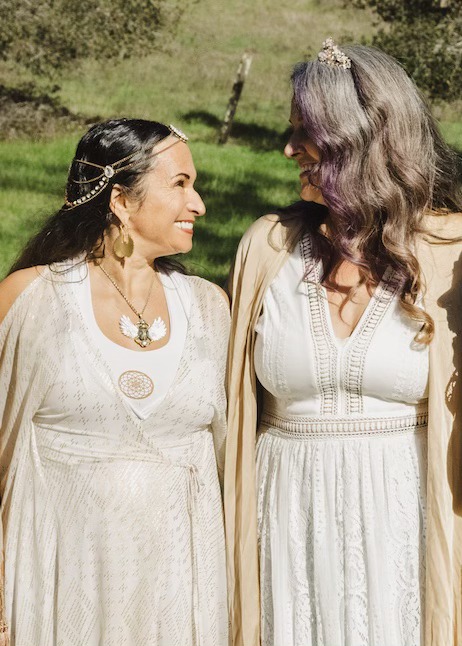
My daughter Heather Hanson (on the right) is kin to Doris Vannier, and all her kin that descend from Carl Janke. I have found our Lost Kingdom atop the…..Beautiful Mountain!
················
Dear Gavin Newsom;
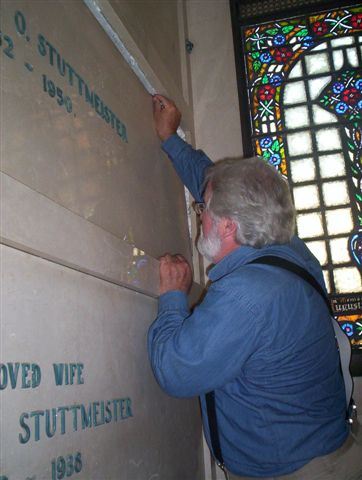
Five days ago I discovered Paul and Talitha Getty lived on Cheyne Walk in Chelsea. How did I miss this. I am certain Joaquin Miller had dinner on Cheyne Walk in the home of Dante Gabriel Rossetti. Joaquin carried my father’s mother on the trolley from Oakland to San Francisco. We owned a farm below The Hights, a Bohemian Mecca. William Stuttmeister developed property in the Laurel area of Oakland, and married Augustus Janke at Ralston Hall in Belmont. She died before William, and holds the place of honor in the Janke crypt in Colma. There are three generations of the Janke family in the a place I brought my daughter and newborn grandson. I found out before memorial day, that two more generations were dug up from their graves in Belmont and dumped in a hole in Redwood City. Add to this the digging up of the Oddfellows grave in San Francisco. I posted this defilement on Facebook, and I am getting much outrage and sympathy from the Common People. I have gotten nothing but silence from the higher ups, the elected officials, and folks who hand out grants – like candy – to just about anyone – but me! My therapist and I have been trying to figure out why I have been kept poor. The answer is, since I was thirteen most people I knew thought I would be a famous artist one day, and thus I WOULD HAVE GOBS OF MONEY. To test out if they are going to get any of my money – they undermine me in every conceivable and evil way.
Talitha’s father was an artist, who hung with the Bohemians of Holland. When she married into the WEALTHY Getty family, and the poor Bohemian folk took note. There were famous rich people who lived on Cheney Walk, many of them Rock Stars. They got the best drugs. Some paid with their lives. Talitha was one of them – even thought she worked hard to remain clean and sober. So did my famous sister, Christine Rosamond, who gave me credit for her success. I turned her on the Pre-Raphaelites. We are the only two artists in the Getty Family Tree. Elizabeth Rosemond Taylor grew up around artists, and lived in Augustus John’s house. I a done waiting for Justice and Funding! I am thirty-six years clean and sober. I have what Talitha and Paul wanted. Eugene Getty – died clean and sober! Christine drowned on her first sober birthday.
On this day, May 21,2023, I found the Rosemond Perfume Company For The Artis.. I demand a full investigation of all the Artists and Scholars who got Getty Money. Where are they – now that we got two wolves at the door. Donald Trump and his buddy Putin has turned the world upside down and create vicious and treacherous chaos.. I am the only Rebpilcian this is – because I modeled my memberships after John and Jessie Benton – who supported artists and writer.
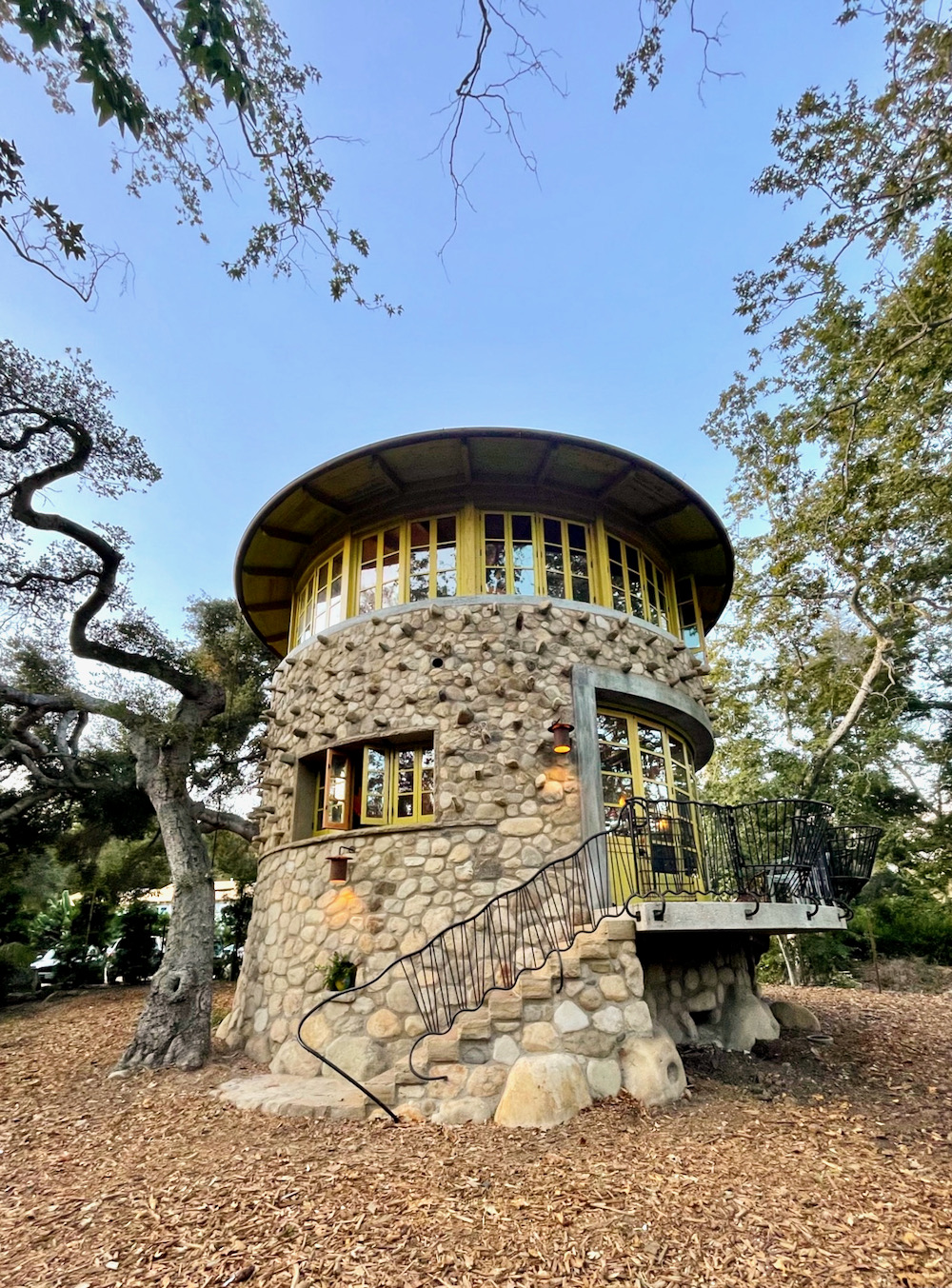
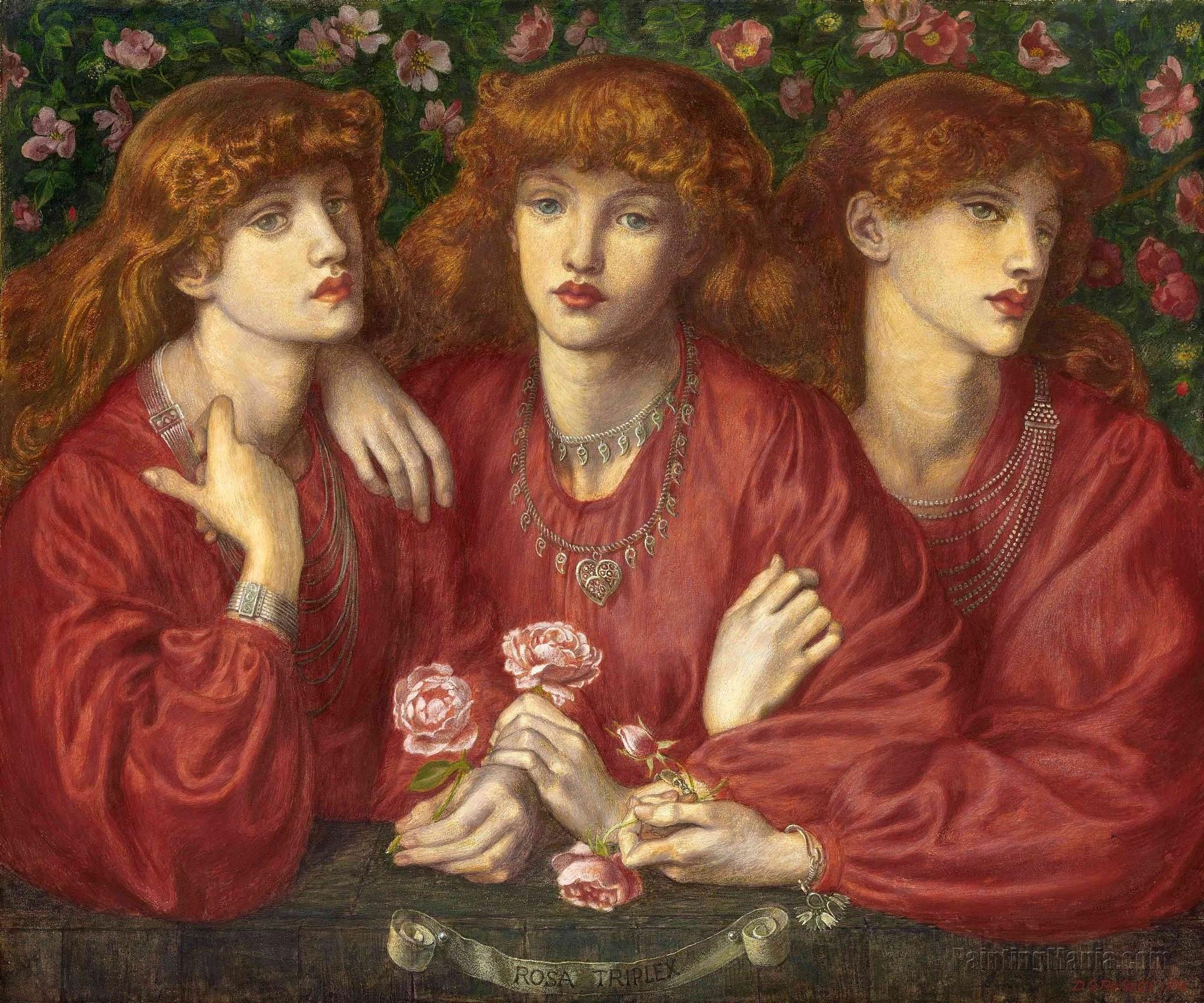
When I awoke yesterday, Mary Ovington White – was in the thoughts. She was inspired by Jack London and William Morris. Morris inspired J.R. Tolkien. I want the Tower of the Magician to be called Rosemond Tower, and the park around it to be named Rosemond Park. I want the three Jankes in that hole in Redwood City – interred in the bottom floor of the tower that will be the new Janke family crypt I’m going to employ the photo of Talitha above, to render my version of Fair Rosamond.. How about a Labyrinth around the Rosy Tower?
It occurs to me Royal Rosamond Press may be the only radial newspaper for the arts – because I get no funding. If I did I would be compelled to – tone it down – if I want more funding. The Christian-right has declared war on the National Endowment of the Arts – and I have struck back – many times. Beverley LaHaye led the Christian charge. Her late husband is Tim LaHaye a close compatriot of Gini Thomas the wife of Clarence, who said he would go after Gays, when he helped repeal of Roe vs, Wade. Alas we see VP Kamala Harris returning fire. She is close with you and the Gettys. Do you know Larry Chazen? I need help with my newspaper so I can finish my theological book that will weaken the claims of the right. I get threats. I need protection.
Relapsing is not a sin, nor relapsing and dying. It is time to raise Talitha out of the pit of shame. I relapsed after a year of sobriety when my marriage to Mary Ann Tharaldsen ended. She lived with Thomas Pynchon for several years. Her art needs to be saved. Sheis in the Getty family tree.
In thirty minutes Victoria and Miriam would be landing in Eugene Oregon. Our intelligence agents for BAD (the British Anglian Directive) were in shock and had been ever since the Librarian at Wormsley had shown Victoria the ancient genealogy of Shakespeare and the Bard’s Will that left everything to his grandson, Hart.
“There’s a Hart in my family tree!” The head of BAD exclaimed. I am kin to the Hart family of Connecticut, and possibly Sir Isaac Hull, a Captain of the U.S.S. Constitution.”
“Oh my!” the Librarian said, excitedly. “You are kin to Princess Diana Spencer, and all the Harts in America, via, Stephen Hart. And you are British, or course. This makes you a literary ambassador, a Hand Across the Water. You are kin to Senator Thomas Hart Benton, the first propirator of the Oregon Territory. How long have you been interested in Shakespeare?”
“Most of her life!” Starfish piped in. “And she’s really interested in American History! We are heading to Oregon where Tina Kotek just won the race for Governor.”
“How wonderful! You must look up John Presco who is kin to Alexander Webb, and thus the Arden family. He has used our reference library on several occasions. He is kin to all members of the Getty family via his second, Elizabeth Rosemond Taylor.”
“That’s your middle name!” Starfish – screeched!
“Oh my! It appears you are American Royalty! Did you know the Gettys are kin to Ian Fleming?”
“Who’s that?”
“You never heard of James Bond? They made ten movies about him.”
“We don’t watch movies!”
“Only the movie PI.”
“Do you read books?”
“No!”
“No books!”
“We spend allot of time on our smart phones.”
“Oh. Well…. perhaps you can look John up? He lives in Springfield. Did you know Sir Sam Mendes is directing a play about your kin, Hamnet? He already directed a play about your kin Liz Taylor. He made two James Bond movies. I can give him a call. He would be glad to meet a descendant of Shakespeare.”
“No. We are running late!”
“Got to go!”
“Stephen Hart was the progenitor of many descendants who now live in all fifty of the United States, as well as Canada, South America, Europe, and probably other parts of the world.
He was born about 1605 in England. By 1632, he had arrived in New England on the Lyon. Four years later he was among the original settlers of Hartford, Connecticut.”
When Eric Richardson ragged on Walt Disney, I knew about Mary Ovington being influenced by my Hero, William Morris, the Pre-Raphaelite. Tolkien was very inspired by William Morris, who ragged on Walt the “poor boob”. In 1969 I declared myself a New Pre-Raphaelite, and let my hair grow real long. The Evil Lord of Modor is stomping around Europe today, and no one has a clue how to stop him. I got more than a clue! How about Eric, and the NAACP?
Is there a movement in the Democratic Party to move white people to the curb, and let the Woman of Color parade, march by? We have to be on the same team, and may not know what our team looks like. We can do as many restarts as we need. We may end up with a fantastic new look!
ORIGINAL NAME Talitha Dina Pol BIRTH 18 Oct 1940 East Java, Indonesia DEATH11 Jul 1971 (aged 30) Rome, Città Metropolitana di Roma Capitale, Lazio, Italy BURIALDorpskerk Begraafplaats Wassenaar, Wassenaar Municipality, Zuid-Holland, Netherlands
Willem Jilts Pol ( Leek , 26 March 1905 – Ramatuelle , 15 August 1988 ) was a Dutch artist and art critic. His work includes woodcuts , paintings and drawings . As a critic, he was attached to the journal orientation.
In the thirties he lived in France , where he painted French and Italian landscapes. In Paris he met his first wife, the daughter bankers and painter Arnoldine Adriane Mees, with whom he Lived with in Wassenaar. Late thirties he went with her to the Dutch East Indies , where in 1940 on Java daughter Talitha was born. During the Second World War, Pol was interned in a Japanese POW camp while his wife and daughter were in another camp. After the war the family returned to the Netherlands where in 1948 his wife died as a result of the hardships in the Japanese camps.
After her death, Pol lived from 1948 until the fifties in England . There he married in 1952 Poppet John, daughter of the painter August John . The last decades of his life he lived with her in southern France where he died in 1988. He left behind an extensive oeuvre.
The William Jilts Pol work is always recognizable by the use of pastel colors and a quick but accurate lines. The typical “fifties” shape his work highly valued by many connoisseurs.
In my novel The Gideon Computer, I employ the move of the Oakland Raiders to Los Angeles as the – Beginning of The End. For some insane reason I have Bill’s German walk-on twin come back to life as John the Baptist. I walked out of the Catholic Church when I was eleven and knew very little about the Bible. This story was inspired by my ex-wife, Mary Ann Tharaldsen finding an old trunk in a attic that was owned by a German immigrant. There were Nazi postcards inside, I assume sent by a relative. Mary Ann had lived in Mexico with Thomas Pynchon. They lived for a short while on College Ave. in Oakland, thus, I put Pynchon and London in the same literary group.
With the Oakland A’s pulling out of the Howard Park deal, I believe the end of my life draws near. The Future I saw – has arrived.
I lived on a houseboat and sailboat here at the end of Adeline Street next to Schnitzer Steel. Adeline is the ramp that ended where Sea&Land was. The Sunshine Harbor got filled in. My girlfriend and I, along with another person who owned an old tugboat, were the only residents that lived in the industrial area. My history is important to this new development.
My grandmother raised Jackie Jensen and his brothers for a couple of years. Jackie played for the Oakland Oaks baseball team. I’m going to take my run for Governor of Oregon more seriously.
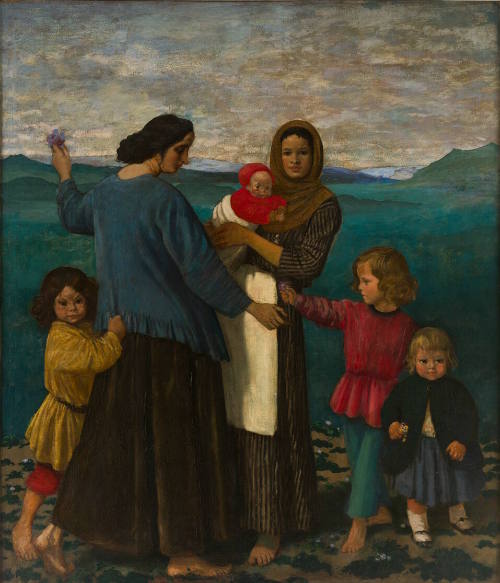
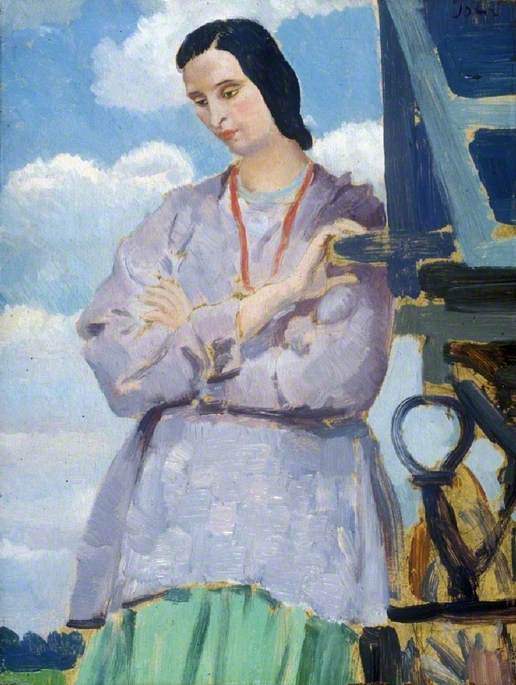
For a period after his marriage to Ida Nettleship, and especially after his wife’s death in 1907 Augustus John (1878–1961) led a bohemian lifestyle, travelling around the countryside in a caravan with his model Dorelia McNeill and children by Nettleship and McNeill. Attracted by the lifestyles of Romani peoples (he later became President of the Gypsy Lore Society), paintings from the period show Dorelia and other figures in an outdoor setting, and capture a travelling lifestyle. Developed in association with Grant Waters, Art Detective Group Leader: South East England, East England and the Midlands.
Head of Dorelia McNeill (1881–1969) c.1911 Augustus Edwin John (1878–1961) Oil over graphite on board H 40.1 x W 33.3 cm Amgueddfa Cymru – National Museum Wales
Study for ‘Lyric Fantasy’ c.1913 Augustus Edwin John (1878–1961) Oil on photograph on board H 71.5 x W 127.5 cm Amgueddfa Cymru – National Museum Wales
The ethnonymTexandri, reconstructed in early West Germanic dialects as *tehswandrōz, is generally assumed to derive from the Proto-Germanic stem *tehswō(n)- (‘right [hand], south’; cf. Old Saxontesewa, Gothictaihswa, ‘right, south’) attached to the contrasting suffix *-dra-.[5][6][7] The name can thus be interpreted as meaning ‘those of who live south/on the right bank [of the Meuse or Rhine river’],[8] and the region of Texandria as the ‘land of the southerners’.[7] Alternatively, J. Mansion has proposed in 1924 an alternative etymology from *texs-wandra-, formed with the West Germanic steù wandra-, which might be related to English wander and Dutch wandelen.[7] It has also been speculated that Texandri may be a Latinized form of the Gaulish tribal name Eburones, since eburos and taxus mean ‘yew’ in Gaulish and Latin, respectively.[8]
The region of Texandria, attested as Toxiandriam ca. 390 (pagus Texandrie in 709), and the city of Tessenderlo, attested as Tessenderlon in 1135,[note 2] are probably named after the tribe.[5][4][2]
The Texandri dwelled in a territory situated between the Scheldt and Rhine rivers, alongside other contemporary tribes like the Tungri.[1] Roman writer Pliny (1st c. AD) connected the Texandri to the river Scaldis (modern Scheldt) but the handwritten versions of the sentence a Scaldi incolunt <?> Texuandri are ambiguous.[4] The manuscripts variously have texero, exerni, extera, or externi, which could be interpreted as meaning ‘at the Scheldt river’, although some translations portray them as ‘beyond’ that river.[4][note 3]
Scholars generally assume that the territory of the Texandri mostly corresponded to the region of Texandria later mentioned by Ammianus ca. 390 AD.[4] In the 380s, the Salian Franks, after being defeated by Julian ca. 358, were given permission to settle apud Toxiandriam locum (‘at a place in Toxiandria’).[1] If depopulation had already begun in the area by the late-2nd century (reaching its peak in the late 3rd and 4th centuries), human occupation continued along the Meuse river during the period, and it is unlikely that the sandy areas of modern North Brabant were completely deserted when Frankish settlers recolonized the region from the 5th century onward.[7]
According to Bijsterveld and Toorians (2018), “it can be plausibly argued that those living there as well as the neighbouring population may well have kept the geographic reference to the Texuandri (or to the territory named after them) in use.”[7] In sources of the period 709–795, the pagus Texandrie appears to be concentrated around the basin of the river Dommel and its tributaries, between the towns of Alphen, Waalre and Overpelt. It was later extended from the 9th century onward as the result of a growing network of local alliances.[1]
In the 1st century AD, Pliny the Elder reported that the Texandri consisted of several smaller tribes with various names,[1] which could mean that they were born out of several smaller ethnic groups that merged into a larger group or joined together.[9]
From the military records found across the Roman Empire, it appears that the Texandri may have formed at least one administrative district or pagus which contributed troops to Roman armies, but it appears to be associated with more than one higher level district or civitas. One is the Civitas Tungrorum, the civitas of the Tungri, but there also seems to be an association with the civitas of the Nervii, to the west of the Tungri.[8] The modern town of Tongerloo, named after the Tungri, is very close to Tessenderlo, but actually further from the capital city of the Tungri, modern Tongeren. The relationship between the Tungri and Texandri is unclear. Prior to Pliny, the Texandri were not mentioned by Julius Caesar or Strabo in their reports of the region.
If the Texandri were not a new name for an older group, then the Texandri and indeed the Tungri, whose name also only appears for the first time in Roman times, may have been made up of Germanic immigrants from the east of the Rhine, settling Roman territory, as certainly happened closer to the Rhine – for example the Ubii to the east near Cologne, the Cugerni to the northeast near Xanten, and the Batavians and Canenefates directly to the north of the Texandri, in the Rhine-Meuse delta. Tacitus, however, does not mention the Texandri, but specifically mentions that the Tungri, unlike the Ubii, Batavians and Canenefates who he also discusses, had simply changed tribal name, having previously been known as the (cisrhenane) Germani, a grouping which had included the Eburones.[10][11]
Before the Roman takeover of this region, in Julius Caesar‘s commentary, the tribal boundaries in the area where the Texandri are later found are left unclear. He described it as thorny low forest and marshy lowlands, northwards of the main populations of the cisrhenane Germani and Nervii. Caesar mentions both these politically important tribes retreating into such northern estuarine areas when threatened, but more clearly connects those regions to the Menapii, who in Caesar’s time, as opposed to Strabo’s, stretched through the delta all the way to the Rhine. At one point Caesar specifically says that the cisrhenane Germani bordering the Menapii were the Eburones, who he describes as the biggest and most important tribe of the Germani.[12]
In one isolated passage, Caesar did apparently describe a tribe near the area of the later Texandri, the Ambivariti. He describes their position incidentally only, mentioning that a raiding group of Tencteri and Usipetes from east of the Rhine had crossed it at a point where Menapii lived on both sides of the river, and then crossed the Meuse (DutchMaas) in order to raid the Ambivariti. However, Caesar does not describe the associations of these people with any others.[13]
He was one of The Brotherhood, a group of the 1870s including John Butler Yeats and Edwin John Ellis. They were admirers of William Blake, on friendly terms with the Pre-Raphaelites or at least the Rossetti brothers, and part of the Bedford Park social and artistic group.[2] He created a group of what he called “Blake drawings” exploring the style of the poet-artist. He also made the Blake-influenced illustrations to Arthur O’Shaughnessy‘s poetry collection Epic of Women and other poems in 1870.[3]
Ada was creative, musical and good at drawing. In an interview she gave to Harper’s Bazaar in 1897 when she was 40, she is described as a woman of ‘intelligence, education and thought’ who in her youth had been a noted ‘art-embroiderer’ in the style of May Morris. Ada’s artistry and her early exposure to the importance of financial prudence formed the foundation for her successful career as a dressmaker.
In December 1875, just before Ada turned twenty, her father died. Four months later she married John Trivett Nettleship, known as Jack, a 35-year old painter and sculptor who specialised in portraying animals, often on a very large scale. Jack was from a well-educated, high-achieving family. Two of his brothers were Oxford college professors, the third was an eye-surgeon. Jack attended Heatherley School of Fine Art in Chelsea, where John Everett Millais, Edward Burne-Jones, Walter Crane and Frederic Leighton all trained, and then the Slade School of Fine Art. He also published a study on the poetry of Robert Browning, so sat easily in the worlds of art and literature and Ada’s marriage brought her into the heart of an artistic community.
In Tate Britain hangs a fantastic painting of the actress Ellen Terry as Lady Macbeth. In it she is wearing one of the many costumes designed for her by Alice Comyns Carr. However, it was another woman, Ada Nettleship, who made this dress, buying the ‘fine yarn’ in Bohemia, ‘a twist of soft green and blue tinsel’ and, together with her team, sewing on the shimmering wings of 1,000 beetles to create the final iridescent effect.
‘Sweet Nettle’, as Ellen Terry used to call her, has now faded into the historical background, one of the many DNB Ghosts. The entry in the Dictionary of National Biography for her artist husband says nothing about her life and work, despite the fact that for much of their marriage it was her business that brought in the cash, keeping him in canvas and paint and their family housed, clothed and fed. So let’s celebrate Ada’s life and work here.
Born in 1856, Ada was the daughter of a surgeon, James Hinton and his wife, Margaret, née Haddon. Both came from non-conformist families. James’s father was an ‘intellectual dissenting preacher’ and James was equally keen to challenge the social status quo, particularly in the area of domestic and social relations. He was a man of many ideas and supported polygamy but, as Edith Havelock Ellis wryly commented, could never ‘make clear..how a woman can be at once a free personality, a wage-earner, a wife and a mother, and at the same time remain for the world at large a healthy, romantic, joyful, capable and charming human being.’
It was easier for men, or at least or James. He eventually organised his household so that his wife and four children lived in Brighton and he visited at weekends, staying in London during the week where he was free to pursue numerous affairs. It was therefore Ada’s mother who provided both emotional and financial stability to Ada and her siblings, keeping a tight hand on the family purse strings.
Margaret came from a large family that valued girls’ education. Two of her sisters, Elizabeth and Caroline, ran a progressive boarding school in Dover attended by, among others, Henrietta Barnett. Caroline was also a philosophical writer, who published several books about her brother-in-law’s treatises. Another sister, Emily, was head of a school in Penge where Ada was later a pupil.
Ada was creative, musical and good at drawing. In an interview she gave to Harper’s Bazaar in 1897 when she was 40, she is described as a woman of ‘intelligence, education and thought’ who in her youth had been a noted ‘art-embroiderer’ in the style of May Morris. Ada’s artistry and her early exposure to the importance of financial prudence formed the foundation for her successful career as a dressmaker.
In December 1875, just before Ada turned twenty, her father died. Four months later she married John Trivett Nettleship, known as Jack, a 35-year old painter and sculptor who specialised in portraying animals, often on a very large scale. Jack was from a well-educated, high-achieving family. Two of his brothers were Oxford college professors, the third was an eye-surgeon. Jack attended Heatherley School of Fine Art in Chelsea, where John Everett Millais, Edward Burne-Jones, Walter Crane and Frederic Leighton all trained, and then the Slade School of Fine Art. He also published a study on the poetry of Robert Browning, so sat easily in the worlds of art and literature and Ada’s marriage brought her into the heart of an artistic community.
However, Jack’s profession meant income was unpredictable. In the Harper’s version of events, Ada was persuaded to expand into dress-making by a friend, but it is just as likely that it was her own idea, a practical way of adding to what Alice Comyns Carr later described as ‘a slender income.’ By 1881 she and Jack were living at 2 Melbury Terrace near Marylebone Station, one of the many streets to disappear as the station expanded. Ada was employing ten women and 2 girls in her dress-making business and was also mother to two young daughters, Ida, aged four and Ethel, two. She and Jack would have one more child in 1886, Ursula.
Ada Nettleship, carte de visite, 1888 Reproduced by kind permission of Rebecca John
Ada is best known now for her theatrical costumes but whether the dress she was making was to be worn on the stage or in the street, she wanted to make beautiful clothes, ‘each dress..an individual production of real artistic value’. However, she was also committed to combining originality with suitability and was involved in the ‘Rational Dress’ movement, which advocated for everyday clothes that were lightweight and easier to move around in.
In May 1883, there was a large Rational Dress Exhibition in London and amongst the divided skirts and ‘outrageous’ costumes designed for cricketing and boating were Ada’s ‘artistically designed evening and walking dresses’. In the opinion of the St James Gazette, ‘it is more than conceivable that a young woman of good figure would appear to advantage’ [in one of Ada’s evening dresses] ‘without any stays at all.’
This is probably how Ada got to know Constance Lloyd. Constance was an advocate for women’s rights and dressed in the aesthetic style, wearing higher-waisted and looser-fitting dresses. Both Constance and her future husband, Oscar Wilde, regularly spoke on the subject of dress and Constance later edited the Rational Dress Society’s Gazette.
Constance Lloyd by Louis Desanges (1882)
When Constance and Oscar were married on 29th May 1884, Constance was wearing a dress made by Ada, now aged 28. Oscar has been generally given the design credit though it is just as likely that the ideas came from Constance and that she visited Melbury Terrace to work them up with Ada.
Constance was reported to have a ‘happy, hopeful light’ in her eyes as she walked down the aisle in the result: an elaborate dress of ivory satin, ‘the bodice, cut square and somewhat low in front, was finished with a high Medici collar; the ample sleeves were puffed; the skirt, made plain, was gathered by a silver girdle..[and the dress was]…ornamented with clusters of myrtle leaves’.
Ada and Constance continued to collaborate on dresses that turned heads. It was with Constance that Ada first experimented with creating a sequinned effect using beetle wings, the technique she would later use to great effect on Ellen Terry’s stage costume. Perhaps it was the theatricality of these dresses and the publicity they garnered that brought Ada to the attention of Alice Comyns Carr (1850-1927).
Beetle wings (c) Zenzie Tinker Conservation LtdMrs. J. W. Comyns Carr by John Singer Sargent c. 1889 Speed Art Museum, Louisville, Kentucky Oil on canvas
Alice is another DNB ghost. She was from a smarter social circle than Ada, growing up in Genoa where her father was the British chaplain. Charles Kingsley, author of ‘The Water Babies’ was one of her godparents. Both Alice and her sister, Alma Strethell, a highly-regarded translator, feature in paintings by John Singer Sargent.
In 1873 Alice married the drama critic, Joseph Comyns Carr. In 1877, Joe turned his hand to gallery management as a director of the new Grosvenor Gallery, funded largely by Sir Coutts Lindsay, a member of the Coutts banking family and an artist in his own right. The Gallery was quickly favoured by the pre-Raphaelites. James McNeill Whistler exhibited here and it was also where Jack Nettleship showed his work.
Alice and Joe’s house in Blandford Square, a stone’s throw from Melbury Terrace, naturally became a meeting point for those with an aesthetic bent. Dinner party guests included the artists Edward Burne-Jones, Lawrence Alma-Tadema and John Singer Sargent, the writers Robert Browning and Henry James and composers Hubert Parry and Arthur Sullivan.
Alice’s first major costume design job was for a stage version of Far from the Madding Crowd in 1882, starring Ellen Terry’s younger sister, Marion. Alice already knew Ellen Terry well as Ellen had starred in a play, ‘Butterfly’, which Alice had translated from the original French. Alice soon started designing costumes for Ellen, eventually replacing Patience Harris (sister of Augustus Harris who would later take the English National Opera building off Richard D’Oyly Carte’s hands).
It is likely that Alice and Ada got to know one another through their husbands and in 1885, they teamed up, Alice recalling that she was ‘fortunate to secure the help of Mrs Nettleship, the wife of the well-known animal painter, an old friend of mine, and an extremely clever dressmaker who was anxious to find some means of adding to a slender income.’
The pair had an early high-profile success with the dresses Ellen Terry wore in The Amber Heart, in 1887, deemed to be a good enough reason in themselves to see the play. In August, The Queen went into rhapsodies about Mrs Nettleship’s ‘very original gowns’ and detailed her work on a high-profile wedding trousseau as well as elaborate court dresses of gold brocade. and outfits for Ellen Terry’s upcoming tour of America.
In 1888, the Nettleship family moved closer to the centre of town, setting up in a large house at 58-60 Wigmore Street, where Jack had a studio at the top of the house, the family lived on the next floor down and Ada’s dress-making business operated on the bottom floors. She rang a tight ship, dressing in a practical outfit of her own design made from a single piece of heavy black brocade so that she could move around easily. Women who trained under Ada included Elspeth Phelps, who went on to run her own business, and Sylvia du Maurier, who gave up dressmaking when she married Arthur Llewelyn Davies and had the five sons who were the inspiration for J.M. Barrie’s ‘Peter Pan’ stories.
Ada’s designs, which a few years earlier might have been deemed eccentric, were now instead seen as ‘refreshingly original, delightfully different’ according to the The Queen which rounded off a gushing article on 11th June 1892 concluding: ‘Mrs Nettleship is no slave to Fashion but is a devoted worshipper at the shrine of the beautiful.’
Letters from Ellen Terry to Ada between 1895 and 1901 suggest that if she was not a slave to Fashion, she was at times a slave to Ellen. In public Ada said that ‘actresses are as a rule very charming people to work for’ and Miss Terry was, of all her customers, ‘the sweetest-tempered…and the most easily-pleased’, but Ellen’s letters to Ada show that she could be demanding. This one is begging to be performed at Letters Live.
22 Bankstern Gardens Earls Court S.W. July 1895
Monday one-o-clock in the morning
Sweet Nettle, Would you have a little dress run up for tonight’s wear for Miss Gibson in the Corsicans? I have told Sarah to send you the dress which is to be copied, first thing in the morning – it is of dark shot silk and is much too funereal for the little lady (Miss Gibson) who wears it. This [a swatch of fabric was attached] would suit the situation much better (this is to be had at Russell & Allen’s).
(c) Victoria & Albert Museum
This – or something like it – only it must be a lighter colour. A white satin dress is already on the stage so that won’t do – and a transparent dress won’t travel for America – so a pale glace silk of some kind best trimmed with Tarlatan (can’t spell it) not Nett festooned at the bust & slightly round the bottom of skirt = Was at rehearsal till past 3 on Sat evening – Am half dead = I hope you liked yr ‘Party’ =
Yrs affect E.T.
I want a Cheap cloak for Wednesday. Looking like Ermine but really the innocent Bunny rabbit & unlined =
Ellen might have been cost conscious but when Ada and Alice worked with other collaborators on stage costumes for her, Henry Irving and the rest of the company, the budgets quickly increased. Edward Burne-Jones worked on designs for the costumes for King Arthur, which Ada later said generated the ‘biggest bill I had at the Lyceum, when one considers the number of dresses’, coming in at c. £75,000 (equivalent). Lawrence Alma-Tadema designed the dress Ellen wore in Cymbeline. Just the main body of the dress, with its twenty-five pieces of silk in graduating colours took Ada three weeks and in total the dress cost nearly £20,000 equivalent.
Dame Ellen Terry as Imogen in ‘Cymbeline’ Source: National Trust, Smallhythe PlaceDetail of the dress from the collection at Smallhythe Place (c) Rebecca John
By 1897, Ada was making ‘all Miss Terry’s official gowns and many of those which are unofficial.’ With Ellen being so busy, it was worth Ada employing a body-double so costumes could be fitted costumes exactly in Ellen’s absence. Ada was clear that securing a first-rate fitter was a critical part of a dress-maker’s success: ‘the fitter can do more to make or mar a business than even the principal herself.’ A good fitter could earn £500 a year in 1902, equivalent to c. £60,000 p.a.
This was just one of the many insights Ada gave into the world of dress-making in an article she wrote for the South Wales Daily News in January 1902 as part of a twelve-part series on ‘Woman’s Work’, which also featured articles by Margaret Bateson and Florence Fenwick Miller. She laid out the training needed, the initial capital required to survive for the first year or two (equivalent to £60-£120k per annum) and the annual profits one could expect (in the same range). She suggested pricing on a cost-plus basis, with a 50% mark up, though given the dresses were all custom-made, customer-specific pricing was always an option. Pricing was also seasonal – the price for a morning dress in season could be set 50% higher than out of season.
Ada reinforced the importance of connections: ‘the dressmaker who starts with plenty of rich and influential friends has the best chance, provided she has an efficient staff and manages well.’ Just as now ‘some customers..are treated to specially small prices on account of the connection they bring.’ (Indeed, Lily Langtry later boasted that she could always negotiate an 80% discount on her dresses.)
She also highlighted the same issue raised by the photographer Alice Hughes a year later: the risk of bad debts. Regular terms needed to be set for payment, accounts should be sent out quarterly and paid off in a timely fashion. Even then, trade protection societies offered credit checking facilities, where ‘for a fee of a guinea a year’ potential customers’ credit-worthiness could be checked and debts recovered. ‘There are many undesirable customers always ready to try a new dressmaker and it is sometimes hard in the beginning to refuse good orders but it is worse to contract bad debts’
Ada concluded that dressmaking was a ‘pleasant profession and one which a clever woman can take up with every chance of success’, but she also admitted that during the season ‘the strain is very severe’. A few months later the strain Ada started to feel was nothing to do with the season. Jack Nettleship died in August 1902 and at the age of 46 Ada was left responsible for the business and her younger daughters, Ethel and Ursula now aged 23 and 18 and both unmarried. One of the first things the three of them did was move to a smaller house at 28-30 Wigmore Street.
However, it was her eldest, married, daughter Ida, allegedly Ada’s favourite, who was to be the greatest source of worry and, ultimately, grief. Ida had enrolled at the the Slade School of Fine Art in 1892, when she was just 15, winning a scholarship to study for a further three years in 1895. She continued her training in Florence and later Paris where she attended classes taught by, among others, James McNeill Whistler.
Ida and her mother were clearly close. She wrote to her mother from Paris in the autumn of 1898 asking her to send her ‘some sort of evening dress, because there is perhaps going to be a dance at Whister’s studio.’ She also helped Ada with her costume research, writing to her:
“My darling Mother, Here are some ’54 fashions, & I am going to try for some evening dresses and mantles tomorrow. It is rather hard to get them for the particular dates especially ’55. There is a book called ‘Une siecle des Modes Feminines’,1794-1894. There are two prints each year – all pictures, no writing – coloured & good – price 2frs.50. If I cannot get anything better I will send it to you. What beautiful clothes they are. I can get a fine book for frs.10 with plates from ’53 and ’54. [..] Who is going to dress in that bountiful dress of 1854? Is it for a play?..”
Ada found time to send Ida a story she had written about a rain gatherer and sun gatherer, which both Ida and her friend, Gwen John, who was with her in Paris, were keen to illustrate. A family photograph taken in 1898 shows Ida sitting at the centre of the group, her mother and father both with a hand on her shoulder, her younger sisters to the sides.
This picture of family harmony was soon to be permanently altered by Ida’s relationship with the painter, Augustus John. They met in 1897 and Ida was soon in love. While her father was swayed by Augustus’s talent, Ada disapproved of his unkempt clothing and worried about his roving eye. Aware of her parents’ displeasure, they eventually married in a secret ceremony in January 1901, where artist friends including Augustus’s sister, Gwen, and Ambrose McEvoy acted as witnesses. Ada and Jack were presented with a fait accompli later that day and were less than thrilled but attended a wedding celebration nonetheless.
Ida’s marriage to Augustus lasted for six turbulent years. Within three months, she was pregnant and between January 1902 and March 1907, she gave birth to five sons.
The growing family was often on the move, from London, to Liverpool, back to London, out to Matching Green in Essex and finally over to France, living in numerous houses and occasionally a caravan.
Ida’s letters tell of the support her family gave her. Ada rushed up to Liverpool to be with her when her first child, David, was born and Ida wrote to her sister, Ursula, on 21st January 1902: ‘Mother & Gus are downstairs, & Mother is playing all the tunes she knows on the piano, It is so nice to hear.’
Back in Fitzroy Street in August 1903, she wrote to Gwen John that “my tribe came round as usual tonight, & assisted at the bathing etc. Gus lay on the bed – Ursula knelt by me – Mother loomed large on the other side of the bath, sitting on a wooden chair.” However, Ada’s dislike of her son-in-law was ever-present and the feeling was mutual: he described her as a ‘slow-moving dumpling’ with a temper that was ‘certain, but bad.’
From the late summer of 1904, the John household became even larger as Augustus and Ida started living in a ménage à trois with Dorelia McNeill, a beautiful young art student, and, soon, Dorelia’s children by Augustus. Ada refused to visit when Dorelia was in residence and her concerns increased when they all decided to de-camp to France in 1905. She did her best to persuade her daughter to leave Augustus and come back to London, even getting Ethel and Ursula to make their cases to Ida, but to no avail.
Ada must have had the same concerns as any mother watching her daughter make choices she thought were poor but her first-hand experience of family scandal would have made her particularly sensitive to the potential fallout of Ida’s unconventional living arrangements. In 1886, her brother, the mathematician Charles Howard Hinton had been at the heart of ‘an extraordinary bigamy case’. He had married Mary Ellen Boole, daughter of George Boole, whose name lives on in the concept of Boolean logic, in 1880. Three years later, Charles married a second woman under a false name who subsequently gave birth to twins. He continued to live with Mary Ellen and turned himself in to the police in October 1886 ‘as a matter of conscience to them both as they did not want to have a secret in the house.’ Ada was called as a witness when Charles was charged at Bow Street Police Court, the case was widely reported and Charles had to leave the country with Mary Ellen and their children, moving first to Japan and later the United States.
It is hardly surprising, then, that Ada viewed Ida’s increasingly bohemian lifestyle with alarm. Ethel Nettleship later said that her mother went ‘completely haywire’ as a result of and for the duration of Ida’s marriage. This might have been how it felt at home but Ada did a good job of keeping things together on the business front and she and Ida remained close. Ida sent her eldest son, David, to stay with his grandmother from time to time and on the rare occasions she came into funds, she entrusted them to her mother to make investment decisions for her.
However, these distractions at home might have been reason Ada decided to restructure her business. In June 1904 it was set up as a limited company with 8,000 preference shares and 10,000 ordinary shares. Ada retained half the ordinary shares and Percy Anderson (1851-1928), a painter and costume designer who worked closely with the D’Oyly Carte Company, took the other 50%. He committed to ‘do his best to place all orders for costumes with the new company’. Ada was compensated for all the assets and goodwill that transferred across into the new company and she remained in charge as a salaried employee. At that point, the business had a turnover equivalent to £1.5m and gross margins of 34%.













/https://static.texastribune.org/media/files/ba19bb21acb4df17e7948107e47e34f1/0923%20Harris%20Co%20EG%2030.JPG)







 Rosamond Press
Leave a comment