
Hugo in 1875

Savoy of California
“These events are dubbed “the second White Terror.” General Bourmont becomes Minister of War and later President of the Council“
On July 23, 2026, I discovered Victor Hugo wrote a novel about events where the illustrious Freench family of my missing fiance – was at the core of!
EUREKA!
Let us call my finding….
THE SECOND COMSTOCK MINE
I will be working MY MINE to the day….
I DROP DEAD
I have compared my encounters with SLEEPING BELLE to a Victor Hugo Novel. We arranged a meeting at The Wandering Goat where I asked her to be the co-author of my auto-biogrphy
CAPTURING BEAUTY
Because Belle spoke French very well, I wanted Virginia to be at our first modelling session. In an e-mail I tell Belle if she is nervous about modeling for me, alone, I could ask Virginia to be her chaperone. This will be the opening scene. I am rendering a naked cubist masterpiece of Belle, while Virginia and Belle discuss (in French)
Victor Hugo was spot on when he wrote
THE HUNCHBACK OF NOTRE DAME
I found this remark that will be the theme of my story.
The brother of Marie Antoinette, Joseph II, Holy Roman Emperor, said of her during his visit to France in 1777 that she was the only one in the royal family “to give birth to children, but is in all other aspects a complete idiot.“
Fernand LégerNude Model in the Studio (Le modèle nu dans l’atelier)
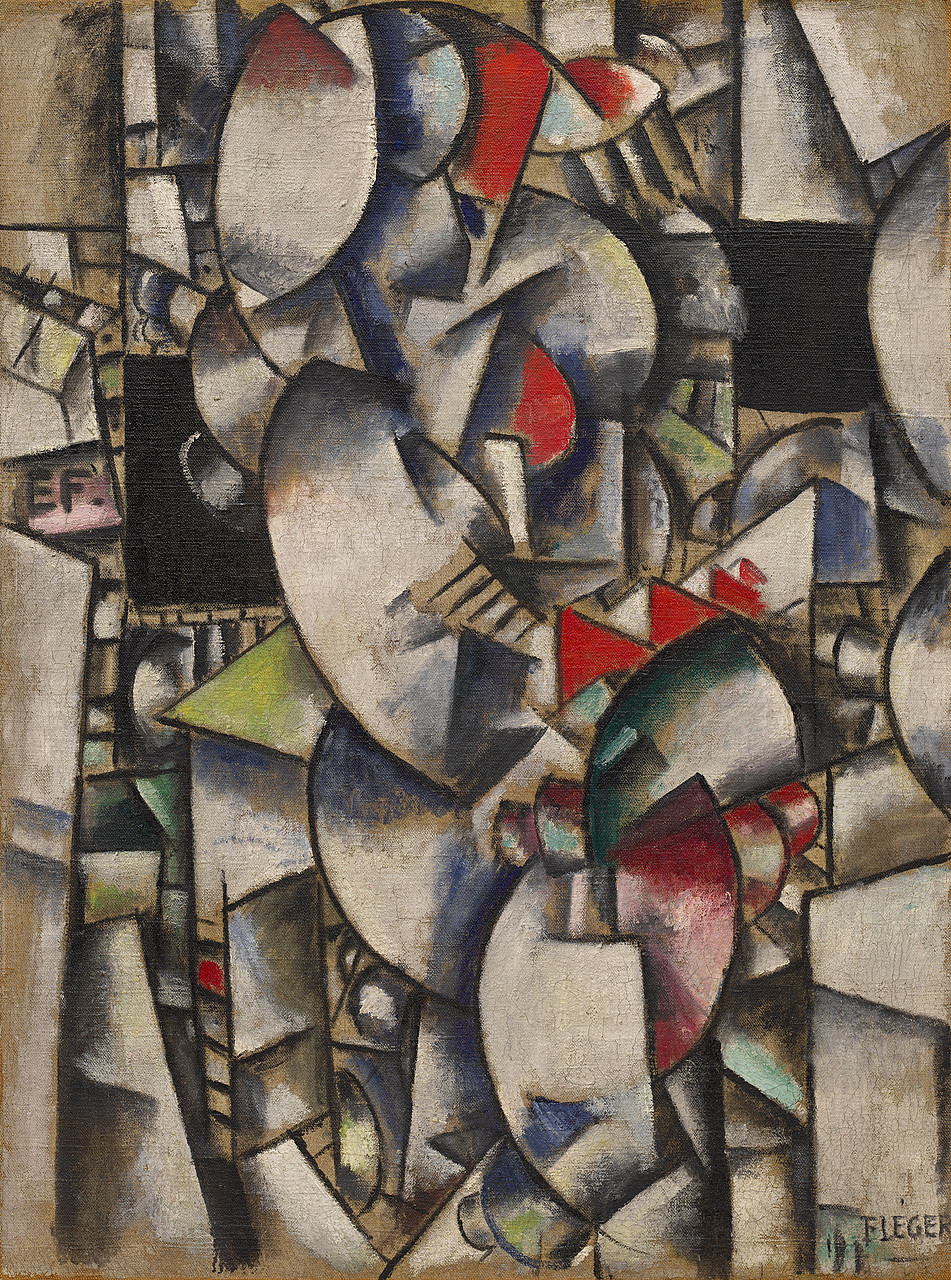
Art historian and critic Michel Seuphor proclaimed that 1912 was “perhaps the most beautiful date in the whole history of painting in France.” That year marked the culmination of Analytic Cubism in the work of Pablo Picasso and Georges Braque as well as the maturation of Fernand Léger’s idiosyncratic Cubist style, as manifested in his lively painting The Smokers. All three artists were inspired by Paul Cézanne in their quest for a means by which to accurately describe three-dimensional objects on a two-dimensional canvas. By breaking the represented figures or items into series of splintered planes and rendering them against—or within—a similarly faceted background, they created an entirely integrated space in which field and object interpenetrate one another. Of the three painters, Léger developed a vocabulary of more precisely delineated forms—his fragmented units are larger, arcs predominate, and color prevails.
Part VII: The New Monarchy
Under the regency of the Duchess of Berry, a new legitimist monarchy is established. Henri V, only 12 years old, is seen as a reconciliatory king, uniting the nation after years of turmoil. The duchess governs wisely, calming tensions between royalists and moderate liberals while consolidating the power of the Bourbons and purging both republicans and Orléanists. She imposes a new charter on the chambers, which quickly accept it, aware that the people of Paris and the provinces alike are weary of political struggles and long for peace after this swift but deadly civil war.
The legitimist army is integrated into the regular armed forces, and several former Orléanist leaders are pardoned or incorporated into the new administration to ensure a smooth transition. For example, Lafayette is forgiven due to his popularity and venerable age. However, some politicians who enabled the fall of Charles X, both republicans and Orléanists, are exiled or purged from the administration. This includes figures like Adolphe Thiers, François Guizot, and Laffite. These events are dubbed “the second White Terror.” General Bourmont becomes Minister of War and later President of the Council, while members of the Rochejaquelein, Charette and Catelineau familes are elevated to the rank of peers and marshals of France.
Ninety-Three (Quatrevingt-treize)[1] is the last novel by the French writer Victor Hugo. Published in 1874, three years after the bloody upheaval of the Paris Commune that resulted out of popular reaction to Napoleon III’s failure to win the Franco-Prussian War, the novel concerns the Revolt in the Vendée and Chouannerie – the counter-revolutionary uprisings in 1793 during the French Revolution. It is divided into three parts, but not chronologically; each part tells a different story, offering a different view of historical general events. The action mainly takes place in Brittany and in Paris.
Plot
The year is 1793. In the former Duchy of Brittany during the Royalist insurrection of the Chouannerie, a troop of “Blues” (soldiers of the French Revolutionary Army) encounter in the bocage Michelle Fléchard, a peasant woman, and her three young children, who are fleeing from the conflict. She explains that her husband and parents have been killed in the peasant revolt that started the insurrection. The troop’s commander, Sergeant Radoub, convinces them to look after the family.
Meanwhile, at sea, a group of “Whites” (Royalist emigres) are preparing to land the Marquis de Lantenac (a thinly fictionalized combination of real Chouannerie leaders Charles Armand Tuffin, marquis de la Rouërie and Vincent de Tinténiac), a Breton aristocrat and former officer in the French Royal Army whose command experience could transform the fortunes of the rebellion. While at sea, a sailor fails to properly secure his cannon, which rolls out of control and damages the ship. When the same sailor risks his life to secure the cannon and save their ship, Lantenac awards the man a medal for his bravery and then executes him (without trial) for failing in his duty.[2] Their corvette is spotted by ships of the Republic. Lantenac slips away in a boat with one supporter, Halmalo the brother of the executed sailor. The corvette distracts the Republican ships by provoking a naval battle the damaged ship cannot win. The corvette is destroyed, but Lantenac lands safely in Brittany and sends Halmalo ahead as a messenger.
Lantenac is hunted by the Blues, but is protected by a local beggar, to whom he gave alms in the past. He meets up with his supporters, and they immediately launch an attack on the Blues. Part of the troop with the family is captured. Lantenac orders them all to be shot, including Michelle. He takes the children with him as hostages. The beggar finds the bodies, and discovers that Michelle is still alive. He nurses her back to health.
Lantenac’s leadership and methods turn the Breton uprising into a major threat to the First French Republic. In Paris, Danton, Robespierre and Marat argue about the threat, while also sniping at each other. They promulgate a decree that all rebels and anyone who helps them will be executed. Cimourdain, a committed revolutionary and former Roman Catholic priest, is deputed to carry out their orders in Brittany. He is also told to keep an eye on Gauvain, the commander of the Republican troops there, who is related to Lantenac and thought to be too lenient to rebels. Unknown to the revolutionary leaders, Cimourdain was Gauvain’s childhood tutor, and thinks of him as a son.
Lantenac has taken control of Dol-de-Bretagne, in order to secure a landing place for British troops to be sent to support the Royalists. Gauvain launches a surprise attack and uses deception to dislodge and disperse them. Forced to retreat, Lantenac is constantly kept from reaching the coast by Gauvain. With British troops and supplies unavailable, Lantenac’s supporters melt away. Eventually he and a last few followers are trapped in his castle.
Meanwhile, Michelle has recovered and goes in search of her children. She wanders aimlessly, but eventually hears that they are being held hostage in Lantenac’s castle. At the castle Sergeant Radoub, fighting with the besiegers, spots the children. He persuades Gauvain to let him lead an assault. He manages to break through the defences and kill several rebels, but with Halmalo’s aid, Lantenac and a few survivors escape through a secret passage after setting fire to the building. As the fire takes hold, Michelle arrives, and sees that her children are trapped. Her hysterical cries of despair are heard by Lantenac. Struck with guilt, he returns to the castle through the passage and rescues the children, helped by Radoub. He then gives himself up.
Gauvain knows that Cimourdain will guillotine Lantenac after a show trial. He visits him in prison, where Lantenac expresses his vision of French culture ordered by social hierarchy, deference, and duty. Gauvain insists that humane values transcend tradition. To prove it, he allows Lantenac to escape and then gives himself up to the revolutionary tribunal that was convened to try him. Gauvain’s forgiveness and Lantenac’s courageous act at the siege both contrast with the execution of the sailor at the beginning of the novel. Gauvain is then tried for treason. The tribunal comprises Cimourdain, Radoub and Gauvain’s deputy, Guéchamp. Radoub votes to acquit, but the others vote to condemn Gauvain to be executed, with Cimourdain casting the deciding vote. Visited by Cimourdain in prison, Gauvain outlines his own vision of a future society with minimal government, no taxes, technological progress and sexual equality. The following morning he is executed by guillotine. At the same moment, Cimourdain shoots himself.
Writing and reception
While Hugo clearly favours the revolutionaries in several comments by the omniscient narrator[citation needed], neither side is depicted as opportunistic, mercenary or cynical. Republicans and Royalists are depicted as idealistic, high-minded, completely devoted to their antagonistic causes and ready to perform cruel and ruthless acts perceived as necessary in the ongoing titanic struggle. Hugo was criticised for portraying the Bretons as “savages” and as speaking “a dead language”[citation needed].
Joseph Stalin read Ninety-Three as a young seminarian in Georgia and the character of Cimourdain, a former priest, “made a deep impression” on him.[3]
Herbert Butterfield expressed admiration for Ninety-Three in his essay The Historical Novel (1924), describing the book as “a striking example of the epic of national freedom”.[4]
Ayn Rand greatly praised this book (and Hugo’s writing in general), acknowledged it as a source of inspiration,[5] and even wrote an introduction to one of its English-language editions[6] which was later reprinted with edits as an essay in The Romantic Manifesto.[7] Its influence can be especially discernible in the passages describing the Russian Civil War in Rand’s We the Living—where, uncharacteristically for this staunchly anti-Communist writer, “Reds” as well as “Whites” are recognized for the sincerity of their convictions and presented as courageous and heroic.
Maria Theresa of Savoy (French: Marie Thérèse de Savoie; 31 January 1756 – 2 June 1805) was a French princess by marriage to Charles Philippe, Count of Artois. Her husband was the grandson of Louis XV and younger brother of Louis XVI. 19 years after Maria Theresa’s death, he assumed the throne of France as King Charles X. Her son Louis Antoine, Duke of Angoulême, married Marie Antoinette‘s daughter Marie-Thérèse Charlotte.
Biography

Princess Maria Theresa of Savoy was born at the Royal Palace in Turin during the reign of her grandfather Charles Emmanuel III of Sardinia. The daughter of the heir apparent Victor Amadeus and his wife Maria Antonia Ferdinanda of Spain, she was the couple’s third daughter and fifth child of twelve children. She was raised with her sister Princess Maria Giuseppina, who was three years her senior and whom she would join later as a member of the Royal House of France.
Marriage
Her aunts, Maria Luisa of Savoy and Eleonora of Savoy, were once proposed as brides for Louis Stanislas’ father Louis.
Following a series of dynastic alliances, Maria Theresa was betrothed to the Count of Artois, the youngest grandson of the reigning Louis XV of France and his popular wife, Queen Marie Leszczyńska. Artois had previously been intended to marry Louise Adélaïde de Bourbon, the daughter of the Prince of Condé. However, the union never took place as her rank was much lower than Artois who, as a male-line descendant of a French monarch, was a grandson of France.
Her marriage was arranged as a part of a series of Franco-Savoyard dynastic marriages taking place in a time span of eight years: after the wedding between her cousin Princess Marie Thérèse Louise of Savoy-Carignano and Louis Alexandre, Prince of Lamballe, and the wedding between her elder sister Marie Joséphine of Savoy and Louis Stanislas, Count of Provence in 1771, Maria Teresa was married to the Count of Artois (future King Charles X of France) in 1773, and her eldest brother Prince Charles Emmanuel of Savoy (the future King of Sardinia) was married to her sister-in-law Princess Clotilde of France in 1775. Her eldest brother-in-law, Dauphin Louis Auguste (the future Louis XVI), was since three years prior married to Marie Antoinette.

Maria Theresa married the Count in a proxy ceremony at the Palazzina di caccia of Stupinigi before she crossed the bridge of Beauvoisin between Savoy and France, where she was turned over by her Italian retinue to her French entourage, after which her official marriage took place at the Palace of Versailles on 16 November 1773.
As her husband was the grandson of a king, the newly named Marie Thérèse held the rank of granddaughter of France, and was commonly referred to by the simple style Madame la comtesse d’Artois.
Countess of Artois

Maria Theresa was described as diminutive, somewhat ill-shaped, clumsy and with a long nose and was not regarded a beauty, but her complexion was generally admired; as a person, she was regarded as “not distinguished in any sense”, but nevertheless goodhearted.[1] Florimond Claude, Comte de Mercy-Argenteau, who corresponded with Holy Roman Empress Maria Theresa regarding Marie Antoinette, said that she was silent and interested in absolutely nothing.[2] The brother of Marie Antoinette, Joseph II, Holy Roman Emperor, said of her during his visit to France in 1777 that she was the only one in the royal family “to give birth to children, but is in all other aspects a complete idiot.”[3]
During her first years in France, the three royal couples; the Count and Countess of Provence, the Count and Countess of Artois, the Dauphin and Dauphine, as well as her cousin, the Princess of Lamballe, who was the favorite of Marie Antoinette, formed a circle of friends and acted in amateur theater plays together, before an audience only consisting of the Dauphin.[1] This intimate friendship, however, gradually deteriorated after the succession of Louis XVI to the throne in 1774.
Roughly a year after Maria Theresa’s arrival at Versailles, she became pregnant with her first child, Louis Antoine, Duke of Angoulême: He was the first child of the new royal generation, which was an important event, as there was at that point concern for the succession because the marriage of both the King as well as that of the first of his brothers, the Count of Provence, were childless, and the birth was reportedly stressful to Marie Antoinette, at the time anxious for the consummation of her marriage to take place and concerned for her lack of children.[4] After this birth, Marie Antoinette was harassed by the public for not having given birth herself. The next year Maria Theresa gave birth to a daughter, Sophie, who was known as Mademoiselle as the most senior unmarried princess at court. She died at the age of seven in 1783. Her second son, Charles Ferdinand, Duke of Berry, was born in 1778. Her last child, Marie Thérèse d’Artois, presumably named after her mother, died while the court was at Choisy-le-Roi at the age of just 6 months.
Prior to the meeting of the Estates General, every member of the Royal Family was publicly mocked by libelous verses, in which Maria Theresa was claimed to have given birth to an illegitimate child.[5]
Exile
Maria Theresa left France with her spouse after the Storming of the Bastille on 14 July 1789, which marked the beginning of the French Revolution, and took refuge in her homeland of Savoy. She left one week after her spouse with a retinue of thirty people, and since she had her possessions sold in connection to her trip, the couple’s official statement that they were to return in spring was doubted.[1]
When her spouse left Savoy in 1791, she stayed behind, and the couple lived separated for the rest of their lives. The Count of Artois refused to give her permission to stay with or visit him, even refusing her to attend the wedding of her son the Duke of Angoulême to Marie Thérèse of France in Mitau.[6] Soon after her husband’s departure, her two sons also left Savoy to serve in the Condé emigré army. Maria Theresa was described as desolate and deeply saddened after her husband and her sons had left her in Savoy, and reportedly contemplated becoming a nun.[7] She was persuaded not to enter a convent by her sister-in-law Clothilde, who appealed to her sense of duty to her children, and Maria Theresa later expressed gratitude toward Clothilde for this.[7] In 1792, she was joined in Turin by her sister Marie Josephine. Their presence in Savoy was politically sensitive, as it disturbed the relations between France and Savoy.
In April 1796, when Savoy was defeated by France under Napoleon Bonaparte during the Italian campaigns of the French Revolutionary Wars, Maria Theresa and her sister Marie Joséphine left Turin for Novara, in parallel with the departure of Marie Joséphine’s husband from Verona.[8] While her sister continued to Austria, Maria Therese accepted her father’s invitation to return to Turin after the peace between France and Savoy in May.[9]
In December 1798, when Piemonte was annexed by France, Maria Theresa left with her lady-in-waiting for Graz in Austria, where she was permitted to remain and where she died in 1805.[10] Because she died before her spouse became King of France, she remained Countess of Artois. She was buried in the Imperial Mausoleum near to Graz Cathedral.
The Chouannerie (French pronunciation: [ʃwanʁi] ⓘ; from the Chouan brothers, two of its leaders) was a royalist uprising or counter-revolution in twelve of the western départements of France, particularly in the provinces of Brittany and Maine, against the First Republic during the French Revolution. It played out in three phases and lasted from spring 1794 to 1800.[1] The revolt was comparable to the War in the Vendée, which took place in the Vendée region.
The uprising was provoked principally by the Civil Constitution of the Clergy (1790), which attempted to impose Caesaropapism upon the Catholic Church in France, and the mass conscription, or levée en masse (1793), which was decided by the National Convention. A first attempt at staging an uprising was carried out by the Association bretonne to defend the French monarchy and reinstate the devolved government, specific laws, and customs of Duchy of Brittany, which had all been repealed in 1789. The first confrontations broke out in 1792 and developed in stages into a peasant revolt, guerrilla warfare and finally full-scale battles. It ended only after Chouan leaders accepted the treaties of Montfaucon and Beauregard in 1800.[1]
Briefer peasant uprisings in other départements like in Aveyron and Lozère are also identified as “chouanneries”. Another petite chouannerie broke out in 1815, during the Hundred Days War, and a final one occurred in 1832.
Origins
In 1791, the adoption of the Civil Constitution of the Clergy loyalty to State requirements caused peasants around Vannes to rise to defend their bishop Sébastien-Michel Amelot from those of Lorient who wanted him to swear this oath of loyalty. In another incident, the following spring, in the area around Quimper, a justice of the peace led several parishes in an uprising in the name of King Louis XVI against the local authorities.[2]
In the summer of 1792, further incidents occurred in the districts of Carhaix (Finistère), Lannion, Pontrieux (Côtes-d’Armor), Craon, Château-Gontier and Laval, where peasants opposed a levy of volunteers for the army. At Saint-Ouën-des-Toits, in the department of Mayenne, Jean Cottereau (known as Jean Chouan) led the insurgents. His nickname probably came from his imitation of the call of the tawny owl (the chouette hulotte) for a recognition-signal.[2] A reward was put on his head, but he managed to reach England in March 1793. The Republican administration recognised him and his brother as the leaders of the revolt.[3]
Uprising

First phase 1794–1795
By January 1794, the Vendéans of the Vendée militaire [fr], following a setback of the Virée de Galerne, tried to resist the infernal columns of General Louis Marie Turreau. Groups of Chouans north of the Loire took up arms again in the areas crossed by the Vendeans. The Chouannerie was born on the borders of the Mayenne and of the Ille-et-Vilaine, near Fougères, Vitré and Laval.[4] The small groups, led by Jean Chouan, Aimé du Boisguy and Jean-Louis Treton [fr] (nicknamed Jambe d’Argent, i.e. “Silver Leg”), had Chouans and Vendeans who survived the Virée de Galerne, leaders who were compromised in the peasant uprisings of March 1793 and even deserters.[5] Condemned to live in almost total secrecy, the Chouans knew that capture by the Republicans would mean certain death. Most of them were motivated by a desire to avenge their relatives who had disappeared in the Virée de Galerne.[5]
Using guerrilla warfare tactics, Chouans in groups of a few score or a few hundred men ambushed military detachments, couriers and stagecoaches carrying government funds. They attacked Republican towns and executed informers, constitutional priests and republicans, and many administrators.
To oppose the Chouans, Republicans built strongholds or fortified towns, which were defended by local territorial guards. They were led by General Jean Antoine Rossignol, the chief commander of the Army of the Coasts of Brest. A law enacted on 23 March 1793 mandated that captured insurgents were to be executed by firing squad or by guillotine within 24 hours. Rossignol also assembled groups of fake Chouan outlaws to do as much as possible to discredit the real Chouans.

Murders were carried out throughout the whole war with a varying degree of intensity, for example, in the district of Fougères, 2,000 Chouans and a fluctuating number of Republicans, 219 people were assassinated or executed by Chouans and 300 by Republicans. This number did not include deaths during fights, summary executions on the battlefield or executions following the expeditive revolutionary due process of law.[6]
The Chouannerie spread quickly to Brittany and reached the Côtes-d’Armor, which was dominated by the Chevalier de Boishardy. On 15 March, it reached Morbihan, where Joseph de Fay and Béjarry, former officers of the Vendean army, assisted by Pierre Guillemot incited a peasant uprising aimed at Vannes. The insurgents were easily countered by the Republicans at the battle of Mangolérian [fr]. However, in Finistère and the west of Côtes-d’Armor, Basse-Cornouaille, Léon and Trégor did not take part in the uprising.
Georges Cadoudal and Pierre-Mathurin Mercier [fr], nicknamed la Vendée, rescued from the Battle of Savenay, moved to the Morbihan, where Boulainvilliers was appointed general-in-chief of the département. However, Boulainvilliers defected to Ille-et-Vilaine with money taken from the headquarters. Sébastien de La Haye de Silz succeeded him as general. Boulainvilliers foolishly returned a few months later in the Morbihan. He was captured and shot by Pierre Guillemot’s men.
Other départements, however, were not as united as the Morbihan. In the north of Anjou, Marie Paul de Scépeaux de Bois-Guignot was named commander for the north of Maine-et-Loire. His authority later extended to Loire-Atlantique, Mayenne and Sarthe. However, he commanded in name only since like in other départements, his authority as a Chouan chief only extended to his own canton. Joseph de Puisaye, a former officer who was compromised in the federalist revolts, realised the necessity of centralised command and attempted to assume the function of general-in-chief of the Chouans. Recognised by some chiefs, Puisaye embarked from Dinard to London on 11 September 1794 to meet the Comte d’Artois (the future King Charles X). Major-General Pierre Dezoteux de Cormatin, his second-in-command, assumed command in his absence.
Artois favoured absolute monarchy and distrusted Puisaye, who advocated parliamentary monarchy. However, after the intervention of British Prime Minister William Pitt the Younger, Puisaye was appointed general-in-chief of the Royal and Catholic Army of Brittany on 15 October 1794 with the rank of lieutenant general, thus entrusting him with the king’s authority. His power thus extended to all the insurgent areas north of the Loire, including the Maine and Anjou, where Scépeaux appointed him general-in-chief.

When Maximilien Robespierre fell on 28 July 1794, the Terror ended and the Convention nationale became more flexible and open to negotiation. The Agence royaliste de Paris asked the Chouans in the name of Louis, comte de Provence, to stop fighting. On 26 December, Brigadier General Jean Humbert and the Chouan chief Boishardy met to discuss peace options. Puisaye tried to organise a landing from London, and his lieutenant, Cormatin, assumed full command and negotiated the peace treaty of La Mabilais in April 1795. He was followed by a few local leaders.[7] Of the 121 leaders attending, only 21, including de Silz and Boishardy, signed the treaty.[8]
Second phase 1795–1796
Because neither side had negotiated in good faith, tension again increased following the death of Louis XVII on 8 June. The peace was broken on 26 August 1794 by General Lazare Hoche, who succeeded Jean Antoine Rossignol as head of the Army of the Coasts of Brest and ordered the arrest of those who had refused to sign the treaty of La Mabilais. Hoche thought that Cormatin was trying to outsmart him. Cormatin was imprisoned and would not be freed before 1802. Boishardy, who did not sign, was killed during the night of 17 to 18 June between Bréhand and Moncontour. Likewise, de Silz, who had taken up arms again, was attacked on 28 June at Grand-Champ by the troops of Adjutant-General Josnet. De Silz was killed in action, and his men retreated.
On 23 June 1795, a British fleet led by Commodore John Borlase Warren, landed 3,500 soldiers of the émigré army in Carnac. They joined 15,000 Chouans led by Vincent de Tinténiac, Paul Alexandre du Bois-Berthelot [fr] and Jacques Anne Joseph Le Prestre de Vauban, the great-grandnephew of Marshal Sébastien Le Prestre de Vauban. However, disagreements between the general of the émigrés Louis Charles d’Hervilly and the expedition leader Puisaye cost the Royalists precious time.
A counterattack by Hoche forced the Chouans back to the Quiberon peninsula. On 10 July, two columns of Chouan troops wearing English uniforms embarked on British ships from the peninsula and were landed behind Republican lines. However, the men from the first column, led by Lantivy du Rest and Jean Jan [fr], scattered. The second column, led by Vincent de Tinténiac and seconded by Georges Cadoudal, prepared to attack but received a message from the Agence royaliste de Paris requiring them to join a second British landing at Côtes-d’Armor. Tinténiac hesitated in the face of opposition from Cadoudal but obeyed the order. He was killed on his way there at Coëtlogon on 18 July. They reached the bay of Saint-Brieuc, but since the British fleet had joined them, they returned to the Morbihan and appointed Cadoudal as their general.
.jpg)
Un épisode de l’affaire de Quiberon (An Episode of the Quiberon affair), painting by Paul-Émile Boutigny, 19th century.
Meanwhile, in Quiberon, reinforcements of 2,000 men led by Charles de Virot de Sombreuil joined the émigrés. They attempted to attack on 16 July, but were crushed. Hoche launched a final assault on 20 July and routed the émigrés. Louis Charles d’Hervilly was fatally wounded, and Puisaye managed to board a British ship. The Republicans took more than 6,000 prisoners. 748 of them were shot by firing squad, including Sombreuil. The day before his execution, he wrote a letter to Commodore Warren denouncing the flight of the Chief General, Joseph de Puisaye.
That letter had an enormous impact on the Chouans. A council of officers in Morbihan sentenced Puisaye to death in absentia. He returned to Brittany in autumn 1795, where he was arrested by Pierre-Mathurin Mercier and brought before Cadoudal. Puisaye defended himself vigorously and found that he still had the support of the Count of Artois. Cadoual and Puisaye eventually reconciled.
Guerilla fighting resumed after the failure of the British royalist expedition and spread to Normandy, where Louis de Frotté, who had freshly landed in France in 1795, organised an uprising.

Puisaye had suffered a loss of reputation and blamed the Chouans of the Morbihan and their chiefs, who he claimed were hostile towards nobles and wanted to “establish equality under a white flag”. Puisaye left the Morbihan for the Ille-et-Vilaine, where the division chiefs were of the nobility, and joined the Mordelles division led by Jean-Joseph Ruault de La Tribonnière [fr]. He did not receive much more support than in the Morbihan, but he remained commander-in-chief because of the support of the Count of Artois. Puisaye wanted a Chouannerie led by nobles and founded the company of the chevaliers catholiques [fr]. Several émigrés joined France to fight with the Chouans, but numerous disputes broke out among them.
In January 1796, Puisaye joined the Fougères division, the most important one in Ille-et-Vilaine, and appointed as his chief Aimé Picquet du Boisguy, Chief General of the Ille-et-Vilaine and of the east of the Côtes-d’Armor. However, in practice, Boisguy controlled only the east of Ille-et-Vilaine, and Frotté and Scépeaux acknowledged Puisaye as General-in-Chief in name only.
To fight the Chouans, the Republican forces were organised in three armies. The Army of the Coasts of Brest, led by Lazare Hoche, was based alternately in Rennes or Vannes and controlled the Finistère, the Morbihan, the Côtes-d’Armor, the Ille-et-Vilaine and the Mayenne. The Army of the West, led by Jean Baptiste Camille Canclaux, was based in Nantes and controlled Loire-Atlantique, Maine-et-Loire, the Vendée and Deux-Sèvres. The Army of the Coasts of Cherbourg, led by Jean-Baptiste Annibal Aubert du Bayet, was based in Saint-Malo and controlled Manche, Orne, Calvados, Sarthe and part of Ille-et-Vilaine.
In December 1795, the Directoire named Hoche chief general of all the Republican forces based in the West and gave him full authority. The Armies of the West, of the Coasts of Brest and of the Coasts of Cherbourg were merged to form the Army of the Coasts of the Ocean.
Despite the Quiberon disaster, the Chouans had some victories in the coming months. Hoche however changed tactics in the beginning of 1796. He set up mobile columns, promised amnesty to Chouans who surrendered, guaranteed religious freedom and strove to discipline the army. Many Chouans and Vendeans were amenable to those measures and laid down their arms.
Hoche’s priority was to pacify the Vendée. Jean-Nicolas Stofflet was captured and shot by firing squad in Angers on 25 February 1796. François de Charette was hunted down, imprisoned and shot on 29 March 1796. His death marked the end of the War in the Vendée.
Since the Vendée was pacified, Hoche turned his attention to the Chouans. Faced by large Republican numbers, Chouan chiefs gradually surrendered. Scépeaux was the first to surrender, on 14 May.[9] Georges Cadoudal signed a peace treaty on 19 June.[10] Louis de Frotté refused to sign a peace treaty and embarked for England and left his lieutenants to sign it on 23 June. Aimé Picquet du Boisguy was the last to surrender, on 26 June.[11] Puisaye returned to England.
Third phase
The uprising lasted until the Republican victory in 1800.[1]
Leaders
| Part of a series on |
| Conservatism in France |
|---|
 |
| Ideologies |
| Principles |
| History |
| Intellectuals |
| Literature |
| Politicians |
| Commentators |
| Parties |
| Organisations |
| Media |
| Related topics |
 Conservatism portal Conservatism portal France portal France portal |
| vte |
The principal leaders of the insurrection were Georges Cadoudal, his brother Julian, Jean Cottereau, called Jean Chouan; Pierre Guillemot, known as the king of Bignan; Joseph de Puisaye, Louis-Charles de Sol de Grisolles, Auguste and Sébastien de La Haye de Silz, John-Louis Treton, nicknamed Jambe d’Argent; Tristan-Lhermitte, Michel Jacquet, known as Taillefer; Joseph-Juste Coquereau, Aimé du Boisguy, Boishardy, Pierre-Mathurin Mercier and Bonfils de Saint Loup.
In Brittany, the Chouans were supported by many nobles: Charles Armand Tuffin, marquis de la Rouërie, the Chevalier de Boishardy, Count Louis of Rosmorduc, the Picquet brothers of Boisguy, as well as by commoners (the brothers Cadoudal). In Lower Normandy, Count Louis de Frotté had a dominant role. One of the lieutenants in lower Maine was Guillaume Le Métayer, who was nicknamed Rochambeau.
In the Vendée, the nobility were not able to play their normal military role. There was never any properly-organised army and was mostly small elusive bands. The Chouan leaders were, above all, peasant farmers.
In contrast to the earlier War in the Vendée of 1793, the Chouannerie did not control any large population centres, the cities and many towns having remained Republican, but some districts were openly in revolt. There was also the Petite Vendée in the lower part of Maine, which was controlled by the Prince of Talmont.
The Chouannerie was very difficult to suppress since its fighting forces had not been beaten during the Vendée War. Also, it had many leaders, and its army units were small and dispersed.
In popular culture

This Chouannerie uprising was featured in the novel Les Chouans by Honoré de Balzac, Ninety-Three by Victor Hugo, and The Man in Grey, a collection of short stories about the Chouans by Baroness Orczy. The uprising is also the central action of the novel The Marquis of Carabas by Rafael Sabatini. It was also depicted in paintings and popular imagery.
In Breton literature, Lan Inisan published Emgann Kergidu (“The Battle of Kergidu”) in 1877, the first and only novel in the Breton language to be published as a book before the First World War. The novel is set during the 1793 uprising in Saint-Pol-de-Léon.[12]
Some of the popular songs collected in the 19th century in the insurrection zone were devoted to the celebration of persons and events relevant of the moments. For example : “Ar Re c’hlas” (The blue men = blue-uniformed), in the “Barzaz Breiz“, a song collection edited in 1839.
 Rosamond Press
Leave a comment