
I am going to write a letter to the University of California and see if they will host debates on Papal Armies at Notre Dame De Namur campus. The whole world was turned on it’s head, twice! The Trumpire of Red State Wrath (0f God) invaded Iran with no plan, and, no member of Trump’s staff got on Google and searches for a Papal Army – that opposed the Unification efforts of Count Leonetta Cipriani, the other co-founder of Belmont California. For doing battle with the Pope, the United States has been toppled from its lofty perch. The Republicans are already being trounced.
Top photo is of John Presco, the great, great, grandson of Carl Janke, co-founder of Belmont California.
John is being stalked by a pretender, a pale, pudgy, white salamander, creature.
John Presco
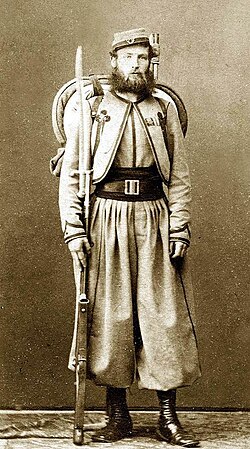
The Papal Zouaves (Italian: Zuavi Pontifici) were an infantry battalion (later regiment) dedicated to defending the Papal States. Named after the French zouave regiments, the Zuavi Pontifici were mainly young men, unmarried
The Battle of Mentana
One thousand five hundred Papal Zouaves assisted in the notable Franco-Papal victory at the Battle of Mentana, fought on 3 November 1867 between French-Papal troops and Italian volunteers led by Giuseppe Garibaldi.[11]
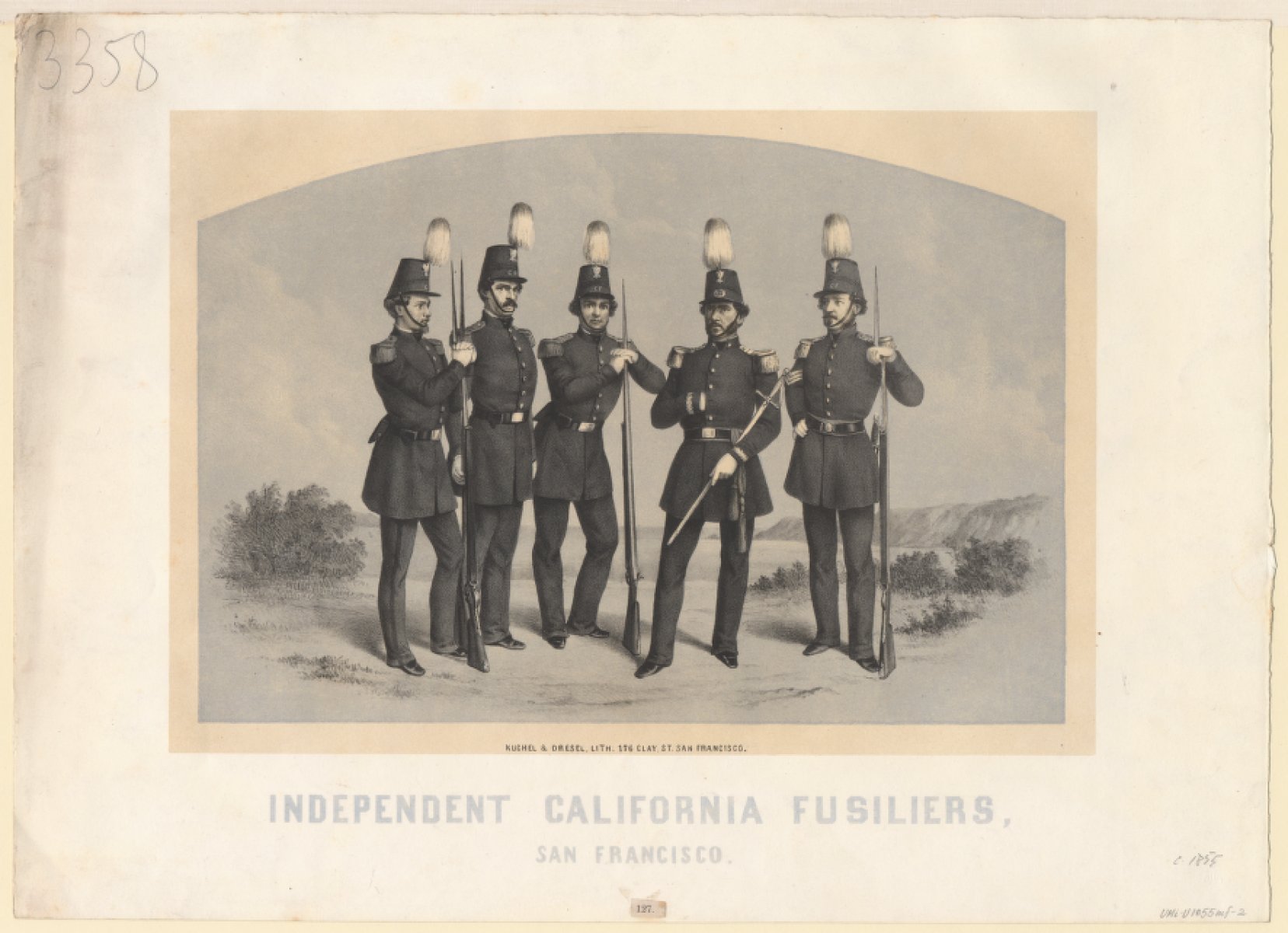
The California Fusileers
Posted on May 7, 2021 by Royal Rosamond Press
My ancestors were wealthy Prussians. Were they investors in Prussia’s attempt to purchase California, that did not happen possibly due to the Revolutions of 1848? Did some Germans realize California could be had by a intensive migration? The six million dollars could be used to buy portable homes, and other necessities. The chances Count Cipriani purchased a portable home from Carl Janke, is high. Unless he brought one in his wagon train.
The Jankes were members of the California Fusiliers. Did they have any contact with my kin, John Fremont, who was talked out of founding a new nation in the West during the Civil War. Consider the Manifest Destiny propaganda of his father-in-law and John Astor, who paid Washington Irving to author a propaganda novel that clamed the right of Americans to take the Oregon Territory – from BRITISH ROYALS. Astor launched a financial conquest of China – that could be the model for China today! If they take over Central America, will they manufacture Chinese cocaine after exterminating the criminal cartel and all gangs south of the border? Texans would be – pleased as punch! As long as China does not take away their right not to wear masks – or their guns! What about – their God? China could get its powerful think tank to invent a Cocaine Jesus for anti-Democratic cult followers, who will honor the day the Democrats cheated them our of their birth right with fake elections. To the Chinese, we look like members of a superstitious Cargo Cult, we easy pickens when it comes to….Divide and Conquer. Our tribal system is open to covert bribes, pitting one tribe against another tribe.
John Presco ‘Author of The Royal Janitor’
California Fusileers (militarymuseum.org)
On November 29, 1858, M.C. Blake, County Judge of San Francisco County, appointed Major Isaac Rowell to enroll members in a volunteer military company to be known as the California Fusileers. The name fusileer (or fusilier) originally applied to a soldier armed with a fusil. In the British Army the designation Fusiliers is still retained by ten regiments distinguished from the other regiments of the line only by wearing a kind of busby and other peculiarities in costume.
Accordingly on December 9, 1858, Major Rowell presided at the meeting and superintended the election of officers of this new organization. F. G. E. Tittel was elected Captain and Peter Lesser, First Lieutenant. The company was composed almost entirely of German citizens of San Francisco and was a well drilled unit.
Their first recorded appearance in public was in connection with the elaborate military reception tendered to General Winfield Scott on October 18, 1859. Governor Weller and other dignitaries attended the reception and tendered their respect to the famous hero of the Mexican Campaign. (1)
The path of the California Fusileers proved to be rough and rather stormy for in the latter part of 1863, a bitter feud between Captain Tittel and Colonel West, commanding the First Regiment of Infantry, culminated in the refusal of Colonel West to deliver uniforms to Company E, California Fusileers as long as Captain Tittel was in command. When Captain Tittel was promoted to Colonel of the Sixth Infantry Regiment, First Lieutenant John Obeneimer made a new demand to Colonel West for their uniforms.
The Colonel again refused to deliver the uniforms until the company should show that their bona fide active members were sufficient to comply with the law, and that the officers evinced a disposition to do their duty and obey proper orders and regulations. In reply to this letter, the Lieutenant urged the Colonel to prefer charges against him if he had been negligent in duty or disobeyed orders. The Lieutenant was a “fighter” evidently, for he not only contradicted the Colonel but he took the matter up with Brigadier-General Ellis, who then ordered.an inspection of the company by Major Hill on December 10, 1863. The inspection showed their arms and equipirient in good and serviceable order, their books well kept but in German language, the discipline of the company good and their drill passable. Thirty-seven members were in old and badly worn uniforms, and seven without any uniforms. These uniforms belonged to the old company and were private property.
The records do not reveal the outcome of the strife, but it is assumed that the unit received their uniforms for soon after the passing of the Inspection, the California Fusileers were transferred to the Sixth Infantry Regiment, Second Brigade as Company A. The Colonel of this Regiment was the California Fusileers’ first Captain (F. C. E. Tittel) and no doubt the new assignment ended the ill-feeling between Colonel West and the California Fusileers.
With the conclusion of the Civil War the need for a large militia force was lessened and the Legislature passed a law reducing the number of the militia. This law provided for the organization of a Board of Organization and Location. The duty of this Board was to select companies that were to be mustered out, their selection being decided according to local requirements, ability.to concentrate on short notice, and the ability to meet the standards required regarding efficiency and enrollment of individual companies. It is assumed the California Fusileers was mustered out because of their location in relation to military need, since a large number of companies were mustered out in San Francisco for that reason. Their mustering out occurred on July 23, 1866.
The Armory Hall at Sacramento and Montgomery Streets, home of the California Fusiliers.
The Prussian Kingdom of Jerusalem and California
Posted on December 22, 2020 by Royal Rosamond Press
Trump is talking about implementing Marshall Law. I believe he has been considering doing this in California for a couple of years. He has sent his idiotic advance guard in the form of The Newt and The Hucklehead.
FLASH! Trump’s ‘Patriot Prayer’ group attacked the Oregon State House and two reporters. This is coming from THE President. Never before in history have we had a leader who encourages civil disobedience – and attacks on the press! I am writing a James Bond novel to get my politics and message across – as well as weaken Putin.. A year ago I had Victoria Bond and Miriam Christling become lovers to counter the anti-gay bashing in Russia. San Francisco led the world in Gary Rights. Ian Fleming is kin to all the Gettys. Governor Newsom is being attacked by the religious-right. This is – REVENGE! Are the Trumpites reading my blog?
My grandfather the author was a friend of Dashiell Hammet and taught Erl Stanley Gardener to write. He camped on the Channel Islands with Black Mask writers. My spy novel ‘The Royal Janitor’ should be a SF landmark, a part of the Starter Sourdough.
I showed up dressed as the Anti-Christ at a armed 3% rally in Eugene Oregon that clashed with a Gay Rights rally. This militia promised Biblical stuff – too!
John ‘The Seer’
(1) Patriot Prayer Is Dragging Antifa Into An Unwinnable PR War (HBO) – YouTube
The Black Mask – Writes Again! | Rosamond Press
Two journalists, Brian Hayes of the Salem Statesman-Journal and Sergio Olmos of OPB, said they were assaulted by protesters Monday afternoon.
OSP has identified Jeremy Roberts, 40, as the man who attacked the reporters. Roberts has not been located by officers yet.
Covid US: Anti-lockdown protesters hit Oregon State Capitol building | Daily Mail Online

The Royal Janitor
by
John G. Precsco
Copyright 2020
While Starfish salivated over the target rifle that Admiral William Augustus Lee used when he won his first gold medal, Victoria took in the old map that was hung on the back of the display. She had seen it before. In her work at the Royal College of Arms, she had seen many old maps that were provided as evidence of a royal or Baronic lineage. Claims to land – played a huge role in owning a title and cote of arms!
Pressing her nose to the glass, Victoria was now nine years old. When she read the name Charles Preuss, she went into a deep trance. She had looked at a dozen copies of this map filed in the College to back up claims for large chunks of California. Taking out her cellphone, she googled John Fremont. Preuss went on…
First Portable Houses In San Francisco
Posted on June 25, 2024 by Royal Rosamond Press

Charles Ferdinand Janke
Three of the portable houses Carl Janke brought around the Cape, ended up in the City of San Francisco. This makes my great, great, grandfather – A PIONEER BUILDER OF SAN FRANCISCO! Why wasn’t I told this by The Belmont Historical Society when I first made contact with them? Why wasn’t I made aware there is another JANKE LINE of my blood relatives? Why are there so many Frenchman meeting in the Turn Verin Hall Janke built? I demand the City of Belmond fund my study!
I have been struggling to understand why it is, when anything good happens to me, friends and family, diminish it, even try to destroy it. What is…..it? Mark Gall did nothing to help me.
I doubt Cipriani dissembled his home, shipped it to the East Coast, then put it in wagons heading West. This would have cost his a fortune. How many wagons would be needed? Did Carl Janke have a unsold portable house already there in Belmont? Was it two story, the premier house – that perhaps Carl wanted for himself? How come there is no discretion of the Janke dwelling? Is it possible Ralston bought the Janke house, and built his manor around it? There exist a floorplan showing the original house. I have to locate it. Cipriani write about the five thousand SCREWS it took to assemble his house that was a Western Wonder! Where did it come from? I suspect Hamburg. My kindred, Jessie Benton, lived in a pre-fab that may have been purchased from Janke.
John Presco
New York was a major source. It was estimated that 5000 houses had been sent from NY to SF, or were under contract, by fall of 1849. Boston, Maine, and Philadelphia were suppliers too. There was a wooden cottage from Hamburg, Germany, in 42 packages. From Le Havre, France, came a “maison demontee” valued at 800 francs. China was another source. A two-room house from China sheltered Jessie Benton Fremont (wife of John C. Fremont) in Happy Valley, summer of 1849. The house was made of sliding panels, like furniture and without nails, and often a Chinese carpenter or two was included in the package, to assemble it.
Because there were many Frenchmen in the committee Coleman called for all the French speakers to assemble in the middle of the room and also divide into companies of a hundred men, and from each company select officers who spoke their own language.
Elizabeth D. Johnson
Birth Place: Germany
Pioneer Father:Carl August Janki
Birth Place: Germany
Date of Arrival in California: Sept. 12, 1850
Pioneer Mother: Anna Dorthea Peterson
Birth Place: Germany
Date of Arrival in California: Sept. 12, 1850
Death: Father: Belmont 1881; Mother: Belmont 1881
Remarks: My father was the first to bring portable houses to the city. I believe two were erected where Sherman & Clays Music store now stands (Sutter & Kearney). One on Montgomery Street on part of the lot now occupied by the D.O Mills building and two on Folsom Street near First All were covered with slate roofs. My two brothers were the flag of the Old Fusilier Guard. A building company called California Fusiliers (German) of which Colonel Little was the captain. My father also built and managed the first Turn Verein Hall situated on Bush Street near Powell. The hall was dedicated Christmas Eve and all the people of note in the city attended the exercises.
Mrs. Johnson passed away Jan. 20, 1829.
I insist the History Department of Stanford assist me in gathering all the information there is on Carl Janke and Family so it can be studied.. I will post in increments. Two of the portable houses that Janke brought around the Cape were erected in San Francisco. Carl built a Turnverein Hall in the city my father was born.
John Presco
john-presco@rosamondpress.com
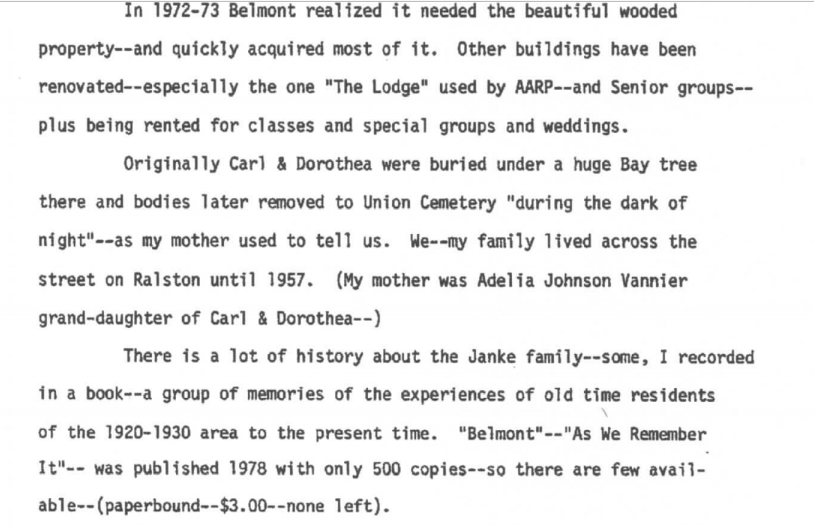
Page 56 – Her Side of the Story (californiapioneers.org)
Elizabeth D. Johnson
Overview
This two-story villa, created by an Italian artistocrat, Leonetto Cipriani, active in the Italian Risorgimento, was one of the first extensive country estates on the San Francisco Peninsula. Cipriani served as San Francisco Consul of the Kingdom of Sardinia between 1852 and 1855, residing in this house between about 1852 and 1862.
Building History
The first, large residence on this Belmont property was erected by Count Leonetto Cipriani (1812-1888), a Corsican by birth whose family had developed successful businesses in Tuscany. Cipriani was dispatched by King Victor Emmanuel II (1820-1878) to become the first Consul of the Kingdom of Sardinia to San Francisco in 1852. Cipriani purchased property in the Cañada del Diablo in what would become Belmont, CA, and proceeded to erect a prefabricated timber dwelling, built before large amounts of lumber had become available in the region.
The San Francisco Examiner related some of the history of his house in an article of 1880: “The first neighbor that occupied the [Belmont] valley was the celebrated Italian General, Cipriani, who had distinguished himself under Charles Albert, the predecessor of Victor Emmanuel, in the wars waged for the unity and liberty of Italy, and who, coming to America, had married an accomplished young lady, the daughter of one the first families of Baltimore. For Cipriani’s eminent services, his country had made him a General and a Senator. Cipriani bought the forty acres which now constitute the grounds of the [Ralston-] Sharon mansion, and erected a picturesque little residence on that mansion’s present site. Cipriani lived alternately between peaceful California vale and war-tossed Italy. In 1862, General Cipriani sold to W.C. Ralston the property, and Mr. Ralston was at first contented with building additions to the house, but, being in this way unable to entirely satisfy his architectural yearnings, in 1868, the then structure was entirely razed, and the present residence partially built and subsequently added to.”(See “Wedded,” San Francisco Examiner, 12/24/1880, p. 1.)
Origin
The Zouaves evolved out of a unit formed by Louis Juchault de Lamoricière on 23 May 1860, the ‘Company of Franco–Belgian Tirailleurs‘.[2][1] The company was quickly increased to an 8-company battalion by amalgamating the Tirailleurs with another volunteer unit, the ‘Crusaders of Cathelineau‘.[1]
On 1 January 1861 the unit was renamed the Papal Zouaves, after already proving themselves in 1860.[3][1] The name had been introduced by Xavier de Mérode.[4] The Almoner was Mgr. Edouard de Woelmont.[5]
Composition
The unit was commanded by the Swiss colonel Eugène Allet (1814–1878), from Leuk, who had previously served in the Pontifical Swiss Guard under Pope Gregory XVI.[6] All orders were given in French.[7]
From 1867 to 1868, the Papal Zouaves increased their strength from that of a single battalion to a four-battalion regiment, each battalion having six active and one depot company.[1]
Initially, the French and Belgian unit was mostly composed of young aristocrats and gentlemen.[1] Later on, the unit was truly international, and by May 1868 numbered 4,592 men.[8] A British volunteer, Joseph Powell, noted in his account of his service with the Papal Zouaves that at least three individuals of African descent and one person from China served in the Zouaves.[7]
| Ethnicity of the people | No. of people |
|---|---|
| Dutch | 1,910 |
| French | 1,301 |
| Belgians | 686 |
| Italians (Romans and Pontifical subjects) | 157 |
| Canadians | 135 |
| Irish | 101 |
| Germans (Prussians) | 87 |
| English | 50 |
| Spaniards | 32 |
| Germans (beyond Prussia) | 22 |
| Swiss | 19 |
| Americans | 14 |
| Italians (Neapolitans) | 14 |
| Italians (Modenese) | 12 |
| Poles | 12 |
| Scots | 10 |
| Austrians | 7 |
| Portuguese | 6 |
| Italians (Tuscans) | 6 |
| Maltese | 3 |
| Russians | 2 |
| South Sea Islands | 1 |
| India | 1 |
| Africa | 1 |
| Mexico | 1 |
| Peru | 1 |
| Circassia | 1 |
Between February 1868 and September 1870, the number of Canadian volunteers, mainly from the Francophone and majority Catholic province of Quebec, rose to seven contingents numbering some 500 men in total – with a contingent of 114 turning back to Canada because news had reached them of the surrender of the Papal States in September 1870.[9]
Operational history
Peacetime service
In addition to involvement in the suppression of brigandage between 1864 and 1868, the Papal Zouaves were employed in humanitarian relief when a cholera epidemic devastated Albano during early 1867. All members of two companies of the 1st Battalion were decorated by Pope Pius IX for their work in burying the dead and tending to the infected.[10]
The Battle of Mentana
One thousand five hundred Papal Zouaves assisted in the notable Franco-Papal victory at the Battle of Mentana, fought on 3 November 1867 between French-Papal troops and Italian volunteers led by Giuseppe Garibaldi.[11]
In his report to the Pope, the commander of the Papal forces, General Kanzler, praised the elan of the Zouaves, citing a determined bayonet charge as a particular example.[12]
The Zouaves suffered the brunt of the fighting, sustaining 81 casualties in the battle, including 24 killed (the Papal forces suffered only 30 dead in total) and 57 wounded.[13] The official French report of the battle prepared by the French commander, General de Failly, also cited the bravery of the Papal Zouaves.[14] The youngest victim, aged seventeen, was English Zouave Julian Watts-Russell.[15]
Last days of the Papal States
The Zouaves also played a role in the final engagements against the forces of the newly united Kingdom of Italy in September 1870, in which the Papal forces were outnumbered almost seven to one.[16] The Zouaves fought off enemy lancers on the 13th,[17] withdrew with Papal artillery under heavy fire on the 20th[18] and made preparations for a counterattack against the Italians before being told of the surrender at the Capture of Rome.[19]
Several Zouaves were executed or murdered by the Italian forces following the surrender, including a Belgian officer who refused to give up his sword.[16][20]
Aftermath

After being disbanded, veterans of the Papal Zouaves fought on in other units, for example, on the side of the Carlists in the Third Carlist War[21] and on the side of the French in the Franco-Prussian War.[22]
Franco-Prussian War
After the Capture of Rome by Victor Emmanuel in 1870, 760 French soldiers of the disbanded Papal Zouaves, led by Colonel de Charette, offered the French Government of National Defense their service.[22] They were renamed as Légion de Volontaires de l’Ouest (Legion of the Volunteers of the West)[1] and, by 7 October 1870, the contingent, composed of 64 officers, 1,620 men, 80 cavalry, 80 gunners, was organised into:[22]
- three 6-company battalions, plus three depot companies
- squadron of mounted éclaireurs
- mountain battery
While retaining their grey and red Papal uniforms, the Zouaves fought the Prussians and their other German allies outside Orléans, with 15 killed or wounded between 11 and 12 October 1870, and also engaged the enemy at Patay.[23] Expanded to two battalions totalling about 1,800 men,[24] the new force with its experienced core of former Papal Zouaves fought with distinction at the Battle of Loigny where the 2nd Battalion charged with the bayonet, losing 216 out of 300 men (18 officers and 198 men) while covering the retreating and shattered 16th Corps.[22] The Volontaires were armed with Chassepots and Remingtons.[22] The unit was disbanded after the entrance of Prussian troops into Paris.[citation needed]
Third Carlist War
Some Spanish Papal Zouaves fought on the Catalan Front as the Carlist Zouaves (Spanish: Zuavos Carlistas), commanded by Alfonso de Borbón, the brother of the Carlist King Carlos VII, who asked him to enter the Catalan front, naming him General in Chief of the Zouaves.[21] The Carlist Zouaves were also joined by many of the young aristocrats who previously fought side by side in Rome with the Infante Alfonso for the pontifical cause.[21]
Uniform
The Zouaves wore a similar style of uniform to that of the French Zouaves but in grey with red trim.[1] A grey and red kepi was normally substituted for the North African fez, while a black busby with white plume was worn for parade dress.[1]
- Medals of a Papal Zouave, blue original uniform in collections of the Royal Museum of the Armed Forces, Brussels
- John Surratt in Papal Zouave uniform in Nantes, France, c. 1866–1867
- Papal Zouaves (individuals in grey)
- Douwe and Matthijs Walta from Workum, two Dutch Zouaves serving under Pope Pius IX in 1870
- Jules Marie Deluen (1849–1918) in Papal Zouave uniform in Nantes, France
Monuments and mementos
There are a number of monuments to the Papal Zouaves, including a Dutch museum near the Oudenbosch Basilica,[25] the Mass chapel in Rome’s Capuchin Crypt and a monument in the Lateran.[26]
The names of the 507 Canadian Papal Zouaves are engraved in gold letters on marble slabs in Montreal’s Mary, Queen of the World.[27] Also in Montreal, a miniature silver ship was hung from the ceiling of Our Lady of Succor chapel by Papal Zouaves as an ex-voto to thank the Virgin Mary after they escaped a shipwreck.[28]
 Rosamond Press


Leave a comment