San Sebastian Avenue
Here is the draft for a post I composed a year ago. Here is the intro to the histroy book that Cymthia McCarthy pubished on
MARCH 31, 2014
Below are posts I cmposed in 2011. Everzything I author, is protecte by a special copyright give to Ministers. After my last post, there can be no dought I study relgions, and proidce amazing results.
One of the m ain reasons I contracted the Belmont Historic Society was to find if Carl Janke and his descents backed the Forty-Eighters, and thus .John Fremont, the co-founder of the Abolitionist Republican Party. I am related to John. Dis Cynthia and other members of the Belmont Historical Society FIND my posts when they were resasrching THEIR book? Did Lawhern know
ALL ABOUT ME AND MY NISTOTY WHEN I FIRST POSTED?
If so……..WHY DIDN’T THEY CALL ME AND GET MORE? Why didn’t the ask about my famous sister?
“Yesterday I discovered one of my great grandfathers founded a Turnverein Hall on Bush Street in San Francisco. This hall was a place one could go hear music and practice gymnastics. The Seamens Friendly Union met here, and the Vigilance Committee.”
Here are the e-mnails and post I made GINA aware of. I think she chooses o beiv I am brown-nosing after……
I DISCOVERED HER!
She is snubbing me. She, and The Scisty, will neer fotgive me for trying to destroy the reputatuinb of
DENSTER LOBSTERMAN
In my series ‘Belmont’ there will be a charcter named
ANITA BROWNSTEIN
Anita descends from Spanish Sperhadi Jews. Her mother was Hemingways muse. Then……
NAZI DIVE BOMBERS
droped a bomb omn the Browstein home. killing Anita. He daughter was taken prisoner, and beaem a famus torch singer in Berlin. She was tried as a collaboator ast the wars end.
John Ambrose
From:braskewitz@yahoo.com
To:ginaforbelmont@gmail.com
Fri, Feb 6 at 8:40 AM
Dear Councilperson;
My name is John Presco. I am the great, great, grandson of Carl Janke, a co-founder of Belmont. I found you early this morning. I suspect you are the miracle we have been waiting for. Here is my daughter, Heather Hanson. We had a falling out when she bonded with a man I did not approve of. It was mutual. Recently Heather formed a group that I thought should sing at the 100th. History Anniversary. I am giving you permission to contact her and give her an invitation..
Has it been ten years since the Belmont Historic Society and I had falling out over photos of my family having a picnic in Twin Pines Park?. Heather came into my life when she was sixteen. I told her’
“All’s well. that ends well!”
I see you on stage singing along.
I found an article on the Masque Ball held at Germania Hall. Carl Janke was dressed like King Carl 111, who may be the source of the name Carlmont.
Here is Heather in the Janke-Stuttmeister crypt in Colma. Dr. William, Stuttmeister was a dentists as was William Janke, his brother-in-law. They had a ofice in Redwood City.
Please let me know you got this message right away.
Sincerely
John Presco
458 201-
Belmont (Images of America) Paperback – Illustrated, March 31, 2014
by Cynthia Karpa McCarthy (Author)
5.0 5.0 out of 5 stars 8 ratings
Midway between San Francisco and San José, Belmont is where an Italian count reconstructed his villa transported from Italy, where a silver king created “the White House of the West,” and where the Warlocks, a fledgling 1960s rock band, honed the sound they would make famous under another name, the Grateful Dead. Spanish explorers called Belmont’s vales “la Cañada del Diablo,” or “the Devil’s Canyon,” either after the locally famous winds or because the native Ohlone believed the canyon to be inhabited by spirits. Belmont’s historic advantage of being on the bay side of the shortest route to the Pacific coast meant easier access to another type of spirits during Prohibition, fueling a minor red-light district across the tracks on Old County Road. A century or more ago, Belmont’s wooded hills attracted sanitariums and prep schools. Today, its woods and trails draw residents from more developed neighboring towns.
Belmont Legacy of Carl Janke
Posted on September 11, 2011 by Royal Rosamond Press
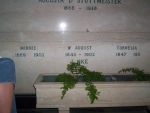


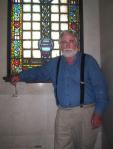
Months after my sister’s death I went to the Sacramento Library and looked at microfish about a legal battle between the heirs of Carl Janke’s estate in Belmont that appeared in the San Francisco Call. I lost the copy I made of that article that I am certain mentioned William O. Stuttmeister, and the sisters of Augusta Stuttmeister-Janke. Carl’s sons did not want Minni and Cornillia, to have anything, and one brother (or cousin) took their side, and was cut out. This has to be William, or W. JANKE. “The bride was attended by Miss Alice Stuttmeister, a sister of the groom, and Miss Minnie Janke, a sister of the bride, as bridesmaids, and Dr. Muldownado and Wm. Janke, a cousin of the bride, were groomsmen.” When Victor Presco turned twenty-one, the the Janke spinsters offered him a moving company in San Francesco. Apparently they saw him as the heir to the Stuttmiester legacy, and the Hope of a return to former glory because they had no children. How about their brother, William? Rosemary said this; “Your father was a made man.” Two days ago, in an e-mail, my cousin Daryl Bulkley confirmed my suspicions that ‘Stuttmeister’ was not the original name of the folks from Berlin. I suspect they were a branch of the Glucksburg family who became Calvinist Evangelicals, and perhaps Rosicrucians. In the top photo we see Minni and Corniallia Janke in the family vault that William Stuttmeister purchased for $10,000 dollars to put the reains of the Jankes and Stuttmeisters in after they were evicted from the Oddfellow cemetery. That William Ralston was a Oddfellow that put up a large sum of money to establish the Oddfellows in Germany – and perhaps elsewhere – makes me wonder about his alleged suicide by plunging into the bay. I am reading articles on the internet about the Oddfellows being the founders of the Welfare State in America, where being charitable to the poor, the infirmed, and the widows, was paramount. They also paid much attention to burying their dead, which suggests they believed in a different hereafter. As a theologian I have pointed out the strange raising of the dead in Matthew 27:53 at the very moment of Jesus’ alleged death.
I suspect Judas was given thirty pieces of silver to purchase Jesus’ tomb, and Jesus was about to practice the ancient Judaic ritual called of the RESUSCITATION, where the soul of the diseased enters the body of another. I believe this is why those who take the Nazarite Vow are bid to keep their distance from the dead. That the Oddfellows titled women as Rebekahs, suggests they are Rechabites, who have been associated with the Nazarites who composed the first Christian church called “The Church of God”. That Jesus came to be seen as God “the Father” is a usurption that began with Paul of Tarsus. That the fall of the Oddfellows in the Bay Area happened overnight, and all traces of their demise, all but disappeared, tells me there was a real Judas and purge. That Daryl pointed out in her research that we knew next to nothing about the Stuttmeisters, whose tomb was lost until seven years ago, tells me William Stuttmeister retired to the Geronimo Valley a disillusioned man, who played a rare violin, and left his Stuttmeister-Janke legacy to his housekeeper. And then he is dead, his remains put in the vault that I went to visit with my daughter and grandson. Before I left for California I told my friend Joy Gall, that I wanted a AA coin to put in this tomb in honor of Christine Rosamond Benton whose funeral fell on he first sober birthday in AA. As I lined up to view my sister in her casket, I did consider the Nazarite Vow I took in 1989. As fate would have it, I ended up putting this coin in William Oltman Stuttmeisters crypt because there was an opening made by the earthquake of 1989.
On this coin is an Angel. In 1992 I began a biography of my family called ‘Bonds With Angels’. It begins with an account of the Blue Angel that appear at the foot of Christine’s bed that woke her and Vicki, who crawled into Christine’s bed and beheld her. Vicki was six years of age, and is clean and sober this day. The Nazarite Vow bids one to not ingest alcohol, not get drunk, so that the Holy Spirit may speak through you, use you as a Horn of Power to broadcast the Word of God. When I entered the tomb of my ancestors and sat down on the marble bench, I noticed the letter A made of brass lying behind the faux fern plant. I picked it up. It was the A in JANKE that had come lose in the earthquake. I looked up at the stained glass window and read; “In loving memory of my beloved wife, Augusta Stutteister,” Was Augusta the Angel that came to visit my sisters? May our bonds with Angels continue – forever more! Amen! Jon Presco Daily Alta California, Volume 42, Number 14175, 24 June 1888 STUTTMEISTER-JANKE. One of the most enjoyable weddings of the past week took place at Belmont, Wednesday morning last, the contracting parties being Miss Augusta Janke, daughter of Mr. and Mrs. August Janke of Belmont,
and Dr. Wm. Stuttmeister of San Francisco. The house was handsomely decorated with a rich profusion of ferns and flowers, and at the appointed hour was filled with the relatives and intimate friends
of the contracting parties. At 11 o’clock the wedding march was played and the bridal party entered the parlor. The bride was attended by Miss Alice Stuttmeister, a sister of the groom, and Miss Minnie Janke, a sister of the bride, as bridesmaids, and Dr. Muldownado and Wm. Janke, a cousin of the bride, were groomsmen. The Rev. A. L. Brewer
of San Mateo performed the beautiful and impressive ceremony under an arch composed of flowers and greens very prettily arranged, after which the guests pressed forward and offered their congratulations. The bride was attired in a very pretty and becoming costume of the crushed strawberry shade, and wore a corsage bouquet of orange
blossoms. She carried a handsome bouquet of white flowers. After the guests had paid their compliments the bride and groom led the way to the dining-room, where the wedding dinner was served and the health
of the newly married pair was pledged. The feast over, the guests joined in the dance, and the hours sped right merrily, interspersed with music singing and recitations, until the bride and groom took their departure amid a shower of rice and good wishes. Many beautiful presents were received. Dr. and Mrs. Stuttmeister left Thursday morning for Santa Cruz and Monterey, where they will spend the honeymoon. On their return they will make their home in Belmont. 1911: Dr. Willian O. Stuttmeister was practicing dentistry in Redwood City, CA. (Reference: University of California, Directory of Graduates,
1864-1910, page 133).
Records from Tombstones in Laurel Hill Cemetery, 1853-1927 – Janke
– Stuttmeister
Mina Maria Janke, daughter of William A, & Cornelia Janke, born
February 2, 1869, died March 1902.
William August Janke, native of Hamburg, Germany, born Dec. 25,
1642, died Nov. 22, 1902, son of Carl August & Dorette Catherine Janke. Frederick William R. Stuttmeister, native of Berlin, Germany, born
1612, died January 29, 1877.
Mrs. Matilda Stuttmeister, wife of Frederick W.R. Stuttmeister, born
1829, died March 17, 1875, native of New York.
Victor Rudolph Stuttmeister, son of Frederick W.R. & Matilda
Stuttmeister, born May 29, 1846, died Jan. 19, 1893, native of New
York.
http://www.ebooksread.com/authors-eng/daughters-of-the-americanrevolution- california-s/records-from-tombstones-in-laurel-hill-cemetery- 1853-1927-gua/page-6-records-from-tombstones-in-laurel-hillcemetery- 1853-1927-gua.shtml Copyright 2011
Royal Wedding at Belmont
Posted on September 10, 2011 by Royal Rosamond Press


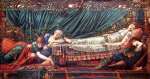
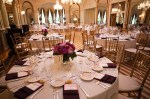


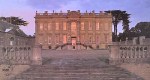
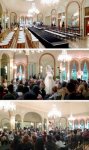
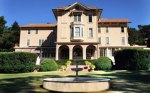
Belmont means ‘Beautiful Mountain’. Many folks who aspire to being California Royalty, get married at Ralston Hall in Belmont. To envision oneself as a banking heiress whose Daddy owned gold and silver mines, and then be whisked off your feet by a Knight of the Realm who takes you to his stately home in Merry Ol England, is the Acme of good breeding!
“A REGAL WEDDING FEAST; MARRIAGE OF MISS SHARON AND SIR THOMAS HESKETH.
SAN FRANCISCO, Dec. 24.–The most brilliant wedding ever celebrated in California took place last evening at Belmont, the princely country seat of Senator William Sharon. Mr. Sharon’s daughter Flora, a petite brunette of 19 years, was united, in the presence of about 150 invited guests, to Sir Thomas Henry Fermor Hesketh, Baronet, of Rufford Hall, Lancashire, England.”
Louis Tevis was the daughter of Lloyd Tevis the President of Wells Fargo Bank. She married into the Breckenridge family who were not only Kentucky Bluebloods, they are kin to the Royal Stewarts as I discovered! Louis did not know this when she got a divorce, and then marries William Sharon, a partner of William Ralston President of the Bank of California! How many banks is that?
Now, all over the internet are claims there is a divine bloodline that descends from Jesus and Mary Magdalene that begat the Stewarts and the Freemasons, who in turn owned banks. Why not gold and silver mines? Surely folks kin to King Solomon would want to have a gold collection as big as this Davidic King who collected 666 talons of gold a year in taxes! Wow! How much silver was taken out of the Comstock mine that Sharon owned?
Last month I tried to communicate some doubt to a bunch of nasty Sinclair folk, that they are all what they make themselves out to be. Surely if they own God’s blood, then His Divine Will would have bid the Sinclairs to do truly wonderous things on His Green Earth – like find plenty of gold in the new world! Actually, they do make the claim the Money Pit is their doing, their Templar line finding all this gold in the ground – then putting it back where no one can spend it – not even the Sinclairs! The check is in the mail!
What was perfectly clear when Sir Thomas sailed into San Francisco Bay, he was looking for a rich heiress to marry – like so many other landed Brits before him – so he would have the monies to remodel his decaying estates. Thomas struck pay dirt when he married Louis Tevis Breckenridge at Ralston Hall, where my great grandparents were married in what may have been seen as the Oddfellow marriage of the century. Surely the Knight Templars in this Masonic-like fraternity, compared the Stuttmeister-Janke union as ordained.
Louis took no chances, and moved the Hand of Fater back into the Breckenridge-Stewart lineage, when her son married Florence Witherspoon Breckenridge, thus tying another knot that links this titled family to the Bentons and Prescos, via the marriage of the world famous artist, Christine Rosamond Benton!
My parents died without this knowlege, and the father of my niece, Garth Benton knew nothing about it. Since Christine died, I have sent letters to the Court that are filed in Rosamond’s Probate, that speak of the Grail, Knight Templars – did mention the Stewarts?
What is curious, is that the Oddfellows, and the Orange Lodge which Bennett Rosamond was the Grand Master of, beleived they were the remnants of the Royal Kings of Judea. Did I tell you that my niece, Drew Benton, descends from Colonel Thomas Hart Benton the Grand Master of the Iowa Freemasons, who saved Albert Pike’s Masonic Library, and thus the Scotish Rite? Add it all up, folks!
Gold and Silver Mines
Big Banks
Knight Templars
Freemasons
Royal Lineages
Senators
Congressmen
Signer of Constitution
Diasporic Lineages
Looks like God’s Work to me!
“The child plays
The toy boat sails across the pond
The work now has just begun
Oh child
Lokk what you have done ”
Jon Presco
Copyright 2011
Furthering the cause was the marriage of Flora’s son Thomas to another American heiress, Florence Louise Witherspoon Breckinridge. The union kept the Fermor-Heskeths in silver, at least until next week.
Flora’s branch of the Sharons does not appear to have any heirs left in the Bay Area, at least according to an online family history, and an official said there seems to be no interest in the goods at Ralston Hall — still a fine place for a wedding. Going once…….
Louise married John Witherspoon Breckenridge, son of Congressman, Senator, Vice President, Presidential Candidate and Confederate General John C. Breckenridge, c. 1878 and lived in San Rafael, CA. Their marriage ended in divorce and she married secondly Frederick W. Sharon.
Louise Tevis Breckenridge Sharon (1858-1938)
We are privileged to be able to offer a selection of exciting San Francisco made and retailed flatware owned by one of San Francisco’s leading 19th century families who married into the English nobility.
Louise Tevis Breckenridge Sharon, was the daughter of Lloyd Tevis, president of Wells Fargo and one of the richest men in California. When he became president of Wells Fargo, it was an express (coach) company; when he retired it was a bank as we know it today. Tevis was assessed by the state of California as having a fortune worth $1,590,000.00 in 18801.
Louise married John Witherspoon Breckenridge, son of Congressman, Senator, Vice President, Presidential Candidate and Confederate General John C. Breckenridge, c. 1878 and lived in San Rafael, CA. Their marriage ended in divorce and she married secondly Frederick W. Sharon.
Frederick Sharon was the son of Senator William Sharon (right), one of California’s very richest men. Sharon arrived in San Francisco in 1849, first investing in real estate, then also in mining and banking. By 1880, the state of California assessed his personal fortune at $4,470,000.002 and he was the largest single taxpayer in the state. Louise and Frederick were married at Sharon’s 55,360 square foot palatial estate ‘Belmont’ in 1884 (below).
In preference to William Sharon’s ‘Belmont’, Louise and Frederick Sharon lived in Paris, in New York at their mansion at 323 5th Avenue and at their Menlo Park mansion ‘Sharon Heights’ (below) after its completion in 1906.
In 1909 Florence Louise Breckenridge, Louise’s daughter by her first marriage to John W. Breckenridge, married Sir Thomas Fermor-Hesketh, 8th Baronet (elevated to the rank of Baron in 1935). Their wedding presents included a large selection of silver from San Francisco’s famous Shreve & Co.
Florence, then Lady Hesketh, lived in the Hesketh country seat, Easton Neston, one of England’s great country houses. It is currently on the market, see here. The silver descended in the family until recently.
It is interesting to note that after the death of William Sharon in 1885, such was his wealth that many people claimed to be related (one even claimed to be a wife) to get a share of the fortune. One person made a claim 30 years later, saying that records of his birth had been destroyed in the great San Francisco fire of 1906. None of these claims ever succeeded.
Most of these pieces appear to date to the time of her first marriage to John W. Breckenridge. Others, as noted below, are later. Some of these items, including the Vanderslice ‘Gargoyle’ pattern flatware service, the Gorham ‘Medallion’ tea knives and the Gorham ‘Old Medici’ salad forks are very rare.
“It’s quite clear the girls knew what they were up to,” Miller says. “They knew they had this cash, which would allow them to become objects of interest. Also, it was a passport to Europe, to a certain degree of freedom and what they saw as a more sophisticated environment. So they traded money for access to what they saw as the cream of world society.”
So Sharon — known here mostly as “Flora,” there as “Florence” or “Emily” — traded her cash for Sir Thomas’ cachet, and they were married at Ralston Hall (known as Belmont at the time) on Dec. 23, 1880
They boarded the Lancashire Witch and made their way to Japan, then zipped over to San Francisco, where Sir Thomas heard that a ship registered in Tahiti with Americans aboard had gone missing in Mexico.
Sir Thomas sent the yacht and a few of his shipmates over to search for the missing, but had the good sense to stay in San Francisco and party
.
“I was lucky enough to find a journal of this journey of 1879-1880, which was a pivotal moment in the family history,” Miller says. “It was written by someone aboard his ship, obviously a great friend, and it makes it quite clear that they were all aware of the, er, potential prospects America had to offer. So when they were in San Francisco, they knew there were pretty American girls who had ‘the needful.’ ”
The city toasted Sir Thomas for his heroic, though reportedly futile, rescue gesture, making him a member of the San Francisco yacht club and honoring him with a scroll from the Board of Trade, Miller says.
Society also feted him at parties from San Francisco’s Palace Hotel to Belmont’s Ralston Hall. By 1880, the former Nevada senator Sharon owned both, due to the suicide of his business partner, William Ralston, and had such a massive empire that he paid more taxes than any individual in California.
Here’s one of the journal entries: “I must say American girls are very pretty, dress well, have good feet, lots of fun & very sharp. Some have lots of money.”
And another: “To my astonishment Hesketh has been making love to Miss Sharon, a most charming girl, daughter of Senator Sharon. The engagement was announced in the Chronicle & Newsletter.”
No need to call Sir Thomas a cad, however.
When the new Lady Fermor-Hesketh boarded The Lancashire Witch, $2 million and a few hundred words of outrage accompanied her.
“There were lots of newspaper reports, general comments in San Francisco, saying how disgraceful it is that this money should leech out of the country,” Miller says.
The new lady of the manor quickly set out to spend some of that money when she found things not entirely to her liking. She had hoped for a “rambling, medieval” home, Miller reports, and had to work to instill those qualities in Nicholas Hawksmoor’s graceful Baroque masterpiece of architecture.
Hawksmoor’s painted oak model of the house is listed among the more precious pieces at auction, valued at more than $150,000. There are also many pieces of silver in mint condition — unused wedding presents from fine American purveyors such as Tiffany and Shreve — and a striking portrait of the lady of the house by Emile Charles Wauters.
“She’s got great style, doesn’t she?” says Miller, chuckling at the in- charge, elegantly clad image of Lady Fermor-Hesketh. “She was apparently very outspoken, too — you know, talked straight, where English girls didn’t, particularly. That’s a nice American characteristic.”
One perhaps Sir Thomas tired of, because after the birth of their two sons Flora eventually began to spend more time in London until she died in 1924.
“She seems to have had a lover who was an admiral at some point,” Miller says. “She converted her house in London to have the sash windows bricked up and put portals in to make him comfortable.”
The admiral’s comfort came at no expense to Easton Neston, which continued to be maintained by a steady flow of American dollars from San Francisco — interrupted, Miller says, only in 1906 by the great earthquake.
Furthering the cause was the marriage of Flora’s son Thomas to another American heiress, Florence Louise Witherspoon Breckinridge. The union kept the Fermor-Heskeths in silver, at least until next week.
Flora’s branch of the Sharons does not appear to have any heirs left in the Bay Area, at least according to an online family history, and an official said there seems to be no interest in the goods at Ralston Hall — still a fine place for a wedding. Going once…….
Easton Neston, built by Nicholas Hawksmoor in around 1700 in Northamptonshire, England, will open to the public for the first time for viewing Friday through Monday; the three-day auction of more than 1,500 lots of furniture, art, silver and other antiques begins on Tuesday. The full catalog is online at http://www.sothebys.com, and interested parties can call the firm’s San Francisco office for more information,
Daily Alta California, Volume 42, Number 14175, 24 June 1888
STUTTMEISTER-JANKE.
One of the most enjoyable weddings of the past week took place at
Belmont, Wednesday morning last, the contracting parties being Miss
Augusta Janke, daughter of Mr. and Mrs. August Janke of Belmont,
and Dr. Wm. Stuttmeister of San Francisco. The house was
handsomely decorated with a rich profusion of ferns and flowers, and
at the appointed hour was filled with the relatives and intimate friends
of the contracting parties. At 11 o’clock the wedding march was played
and the bridal party entered the parlor. The bride was attended by Miss
Alice Stuttmeister, a sister of the groom, and Miss Minnie Janke, a
sister of the bride, as bridesmaids, and Dr. Muldownado and Wm.
Janke, a cousin of the bride, were groomsmen. The Rev. A. L. Brewer
of San Mateo performed the beautiful and impressive ceremony under
an arch composed of flowers and greens very prettily arranged, after
which the guests pressed forward and offered their congratulations.
The bride was attired in a very pretty and becoming costume of the
crushed strawberry shade, and wore a corsage bouquet of orange
blossoms. She carried a handsome bouquet of white flowers. After the
guests had paid their compliments the bride and groom led the way to
the dining-room, where the wedding dinner was served and the health
of the newly married pair was pledged. The feast over, the guests
joined in the dance, and the hours sped right merrily, interspersed with
music singing and recitations, until the bride and groom took their
departure amid a shower of rice and good wishes. Many beautiful
presents were received. Dr. and Mrs. Stuttmeister left Thursday
morning for Santa Cruz and Monterey, where they will spend the
honeymoon. On their return they will make their home in Belmont.
1911: Dr. Willian O. Stuttmeister was practicing dentistry in Redwood
City, CA. (Reference: University of California, Directory of Graduates,
1864-1910, page 133).
Records from Tombstones in Laurel Hill Cemetery, 1853-1927 – Janke
– Stuttmeister
Mina Maria Janke, daughter of William A, & Cornelia Janke, born
February 2, 1869, died March 1902.
William August Janke, native of Hamburg, Germany, born Dec. 25,
1642, died Nov. 22, 1902, son of Carl August & Dorette Catherine
Janke.
Frederick William R. Stuttmeister, native of Berlin, Germany, born
1612, died January 29, 1877.
Mrs. Matilda Stuttmeister, wife of Frederick W.R. Stuttmeister, born
1829, died March 17, 1875, native of New York.
Victor Rudolph Stuttmeister, son of Frederick W.R. & Matilda
Stuttmeister, born May 29, 1846, died Jan. 19, 1893, native of New
York.
http://www.ebooksread.com/authors-eng/daughters-of-the-americanrevolution-
california-s/records-from-tombstones-in-laurel-hill-cemetery-
1853-1927-gua/page-6-records-from-tombstones-in-laurel-hillcemetery-
1853-1927-gua.shtml
http://www.ralstonhall.com/tour/video.html
The Turners
Posted on November 26, 2014 by Royal Rosamond Press


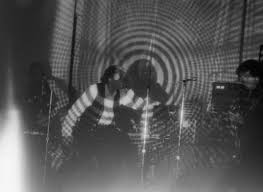
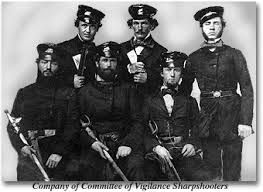

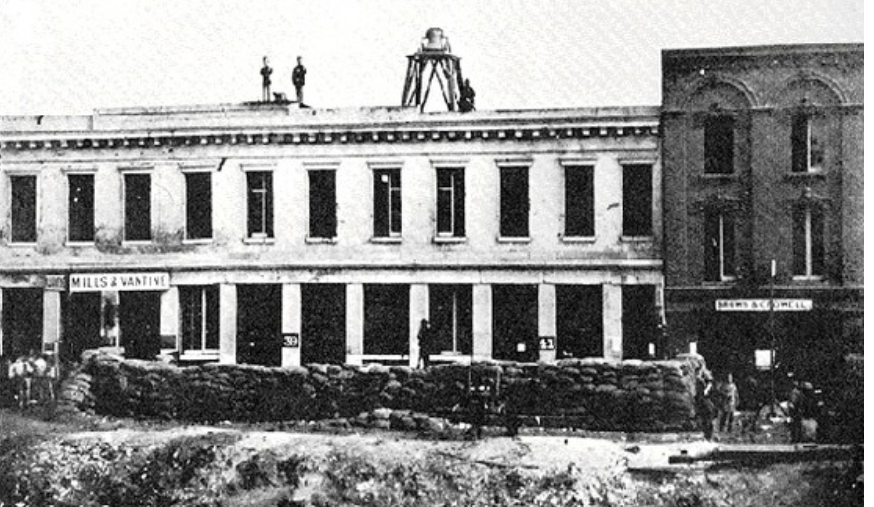

Yesterday I discovered one of my great grandfathers founded a Turnverein Hall on Bush Street in San Francisco. This hall was a place one could go hear music and practice gymnastics. The Seamens Friendly Union met here, and the Vigilance Committee. Plays were performed, and debates held. This is the radical root of San Francisco that I have traced to the Longshoreman’s Hall and the first Acid Tests. The Turner hall offered music and other entertainment as an alternative to gambling and prostitution. My father was a Merchant Marine and would be pleased to know the first institution for furthering sailor rights met in the Bush hall.
“All seamen are invited to attend at the Turn Verein Hall on Bush Street between Stockton and Powell Streets on Thursday Evening, January 11 at 7 1/2 o’clock to form a Seamens Society for the Pacific Coast.”
The Vigilance Committee combatted corruption and violence. These were idealists that lay the groundwork for a city famous for it cultural revolutions.
“Flaunting their rebellious spirit, the gymnasts of Vormärz wore their hair long and sported large black hats decorated with a rooster feather”

Above are my grandparents having picnic in the Oakland Hills. There is a sharpshooters rifle hanging in the tree. Janke had marksman contests Belmont Park. Many Turnverein were Socialists and Marxists.
Jon Presco
http://art.famsf.org/wa-janke-founded-belmont-picnic-grounds-and-first-turn-verein-bush-street-39933
“W.A. Janke, founded the Belmont Picnic Grounds, and the first Turn Verein on Bush Street.”
Yesterday I received information from Shirley Schwoerer of the Redwood City Library, that said my ancestor, Carl August Janke, was instrumental in establishing a Turnverien in Belmont, and the Bay Area. Was it the first?
“He erected the old amusement hall of the Turnverein, and managed this for several years.”
Janke may be the first real estate developer in the San Francisco bay area.
“In 1849 the family came around the Horn on an old Clipper ship, and Mr. Janke brought with him on the trip the material for six portable houses. He set up these houses, and at once engaged in a successful business, as a building contractor.”
This information confirms my theory that the Tanforan cottages in the Mission, are the Turnverein cottages that Janke brought around the Cape in order to establish a German community of Freethinkers in the New Western Land of the Free -free of church rule! The Jüdischen Turnverein was established for the same reason. For awhile Jews and Germans shared the same Turnverien in Berlin, and were seen as Liberal-Socialists. San Francisco is considered the most Liberal and ethnically diverse city in the world where folks from the old world can practice their traditions of total freedom. Hitler banned and persecuted the Freethinkers, and outlawed the Turnverein.
The membership of the new clubs was more inclusive, as the cor of students and academics which had made up the rank and file of the Turnverein in its early years was joined by a large contingent of craft workers, along with many Jewish members, often in positions of leadership. These gymnastic clubs were often closely aligned with workers’ organizations and democratic clubs with whom they shared a desire for reform and a rejection of traditional hierarchies.
They even imparted a new spirit to their gymnastic program by initiating training sessions for children and, far more radical in light of the times, for women as well. Flaunting their rebellious spirit, the gymnasts of Vormärz wore their hair long and sported large black hats decorated with a rooster feather instead of the more formal attire of the Biedermeier period.
Given the radicalization of the movement in the 1840s, it is not surprising that the German gymnasts were directly involved in the 1848 revolutions. Turnverein leaders won renown for their leading roles in local uprisings,
The Turnverein as an organization was most closely associated with the uprisings in Baden, the center of the radical sentiment in southwest Germany
http://en.wikipedia.org/wiki/Turners
http://patch.com/california/sanrafael/history-street-name-the-only-remnant-of-sharp-shooter
| TURNVEREIN SHARPSHOOTERSThe Home Guard Willing to Shed Its Blood but Only at Los Angeles The contemplated home guard of sharpshooters connected with the Turnverein Germania Is making but slow progress In getting organized. A minority of intending members met last night but failed to do anything. A score or so were willing to sign the roll to be forwarded to the adjutant general, but several others held back, not from lack of patriotism or want of sympathy with the United States, but for fear that In the event of the state’s accepting their services as an Independent company they might be called upon to do duty or fight away from home. These men hay* ties here which preclude their leaving their families or interests and they are unwilling to sign any papers which might turn out to be no obligation to leave Los Angeles and march to the front. They want to be strictly what the name Implies—home guard. As one man put it tersely, “I am for this country, willing to defend It here and shed my blood right in Los Angeles for the Stars and Stripes, but I’ll be goll-darned if I want to have it run out of my body at Milpitas or Sausalito.” At the next meeting, however, it is expected that so many will sign the roll that the sharpshooters will be able to organize.Los Angeles 1898 |
The first organization of seamen in the United States occurred in January of 1866 when the following notice appeared in a San Francisco paper:
Seamens Friendly Union Society
All seamen are invited to attend at the Turn Verein Hall on Bush Street between Stockton and Powell Streets on Thursday Evening, January 11 at 7 1/2 o’clock to form a Seamens Society for the Pacific Coast.
This meeting resulted in organization of the Seamens Friendly Union and Protective Society. Alfred Enquist was elected president and George McAlpine, secretary. It was the first organization of seamen in this country, perhaps the first in the world. In 1875, the United Seamen’s Association was formed in the port of New York, and it sent a delegation to Congress to petition for laws to protect seamen. The delegation, according to a news report in The New York Times of January 21, was “graciously received by the President.”
No more was heard of this organization.
The Seamen’s Friendly Union and Protective Society in San Francisco did not last long, and the next organization to come along was the Seamen’s Protective Union formed in San Francisco in 1878 with 800 members. It, too, had a short life.
http://www.ohio.edu/chastain/rz/turnvere.htm
Seamens Friendly Union Society
All seamen are invited to attend at the Turn Verein Hall on Bush Street between Stockton and Powell Streets on Thursday Evening, January 11 at 7 1/2 o’clock to form a Seamens Society for the Pacific Coast.
This meeting resulted in organization of the Seamens Friendly Union and Protective Society. Alfred Enquist was elected president and George McAlpine, secretary. It was the first organization of seamen in this country, perhaps the first in the world. In 1875, the United Seamen’s Association was formed in the port of New York, and it sent a delegation to Congress to petition for laws to protect seamen. The delegation, according to a news report in The New York Times of January 21, was “graciously received by the President.”
http://www.digthatcrazyfarout.com/trips/trips_festival_history.html
| In practice the event engulfed the two shows. Both America Needs Indians and the Open Theater’s cabaret theater were mournfully out of place in the rackety, echoing space of Longshoremen’s Hall. America Needs Indians was just a little tepee and some slides, so far as most people could tell. But there were things to do. Mikes and speakers and electrical gadgets strewn around. A light show with strobe. A booth selling books on psychedelic subjects, and another selling books about insects. There were Trips Festival T-shirts for sale. And a shopping bag full of Owsley’s latest LSD was making the rounds of the hall. But mostly it was unparalleled chaos in a crowded hall pulsing with undirected energy. A young woman jumped up on stage, stripped to the waist and danced until Brand got her off. This clinched it for the Open Theater, which was supposed to go on at ten__they weren’t going to attempt their nude “Revelations” in this wild energy. They read their sermons and got about halfway through the God Box skits when it became obvious that the crowd wanted rock and roll. They quickly brought on the Marbles, who had recently metamorphosed into a band calling itself the Loading Zone. On Saturday night the Tape Center was going on with films by the Canyon Cinema Group in something called “Options and Contracts at the Present Time.” The Ann Halprin Dancers, films by Bruce Baillie and Anthony Martin and a Vortex Light Box were going to be the visuals. Sound would come from a synthesizer invented by Donald Buchla, which would perform on its own and also modulate the rock and roll sounds of Big Brother and the Holding Company in freakish and avant-garde ways. The Acid Test would follow at 10:00 P.M. “Can you die to your corpses? Can you metamorphose? Can you pass the twentieth century? “What is total dance?” |
Turners (German: Turner), are members of German-American gymnastic clubs. A German gymnastic movement was started by Turnvater (turners’ father) Friedrich Ludwig Jahn in the early 19th century when Germany was occupied by Napoleon. The Turnvereine (“gymnastic unions”) were not only athletic, but also political, reflecting their origin in similar “nationalistic gymnastic” organizations in Europe. The Turner movement in Germany was generally liberal in nature, and many Turners took part in the Revolution of 1848.[1] After its defeat, the movement was suppressed and many Turners left Germany, some emigrating to the United States. Several of these Forty-Eighters went on to become Civil War soldiers, the great majority in the Union Army, and American politicians.
The Forty-Eighters were Europeans who participated in or supported the revolutions of 1848 that swept Europe. In the German states, the Forty-Eighters favored unification of the German people, a more democratic government, and guarantees of human rights.[1] Disappointed at the failure of the revolution to bring about the reform of the system of government in Germany or the Austrian Empire and sometimes on the government’s wanted list because of their involvement in the revolution, they gave up their old lives to try again abroad. Many emigrated to the United States, England, and Australia after the revolutions failed. These emigrants included Germans, Czechs, Hungarians, and others. Many were respected and politically active, wealthy, and well-educated; as such, they were not typical immigrants. A large number went on to be very successful in their new countries.
SIU & Maritime History
This article includes parts of a series written by John Bunker, former Seafarer and SIU historian. It features, among other information, a review of the SIU’s origin and early activities, through World War II. It also describes the beginnings of maritime labor in the U.S. in the 1800s and early 1900s. The entire 27-part series was published in the Seafarers Log from June 1980 to June 1983.
A HISTORY OF THE SIU
by John Bunker
The Struggle Begins for a Class of Workers
For hundreds of years, seamen yearned to better their lot. From the whip-lashed oarsmen of Roman and Spanish galleys to the crews of modern windjammers, seamen were usually underfed, underpaid and overworked and considered workmen beyond the usual recourses of the law.
Along with the harsh and vigorous nature of their daily labors were the constant hazards of seafaring. Untold thousands of sailors have set out from port never to return, becoming victims of storms, collisions and that most dreaded foe of the ocean voyager–fire at sea. And in the pages of old shipping journals there was always this recurrent notice beside the name of a ship: “missing and presumed lost with all hands.”
The new Committee of Vigilance enrolled about fifteen hundred people that first day in 1856. Meanwhile a larger meeting place was secured at Turn Verein Hall on Bush Street and in that hall later that evening the committee met again and signed another five hundred or so men. After some discussion, William Coleman proposed dividing into companies of a hundred men in Roman style and forming them into regiments of ten companies each. Since this met with a general consent men were organized according to their number, from one to one hundred and so on until there were fifteen regiments. They were to select the best men, from a military standpoint, from each company to lead them.
Because there were many Frenchmen in the committee Coleman called for all the French speakers to assemble in the middle of the room and also divide into companies of a hundred men, and from each company select officers who spoke their own language. And then, because their numbers were somewhat less than a regiment, they were to form into a French Legion. This all met with hearty approval. The companies, regiments and legion were quickly organized, the officers selected and approved by the executive committee and within the relatively short time of twelve to fifteen hours the 1856 Committee of Vigilance was in nearly complete working order.
http://www.examiner.com/topic/committee-of-vigilance
http://californiamilitaryhistory.org/Sheman2.html
Letters written during the time of the great Vigilance Committee of 1856 at San Francisco, and containing some account of its work as viewed by an interested resident of the place, are rare in the literature of the subject, and are sure to be valuable. How much more must this be true of letters written under such circumstances by General W. T. Sherman. The case for the Vigilance Committee is authoritatively stated in the November number of this magazine, by the former president of the committee, Mr. William T. Coleman. Sherman’s relation to the committee has been described by himself in his “Memoirs,” and that account has led to considerable controversy.
| The Governor saw the entire mass of people arrayed against the civil authorities, the only military force in existence sharing the feelings of the people, the cause of the civil authorities being a bare naked principle with two such wretches as Casey and Cora as its exponents. All this time the Vigilance Committee was strengthening its numbers, then 2,500 now 5,000, having at its head such men as William T. Coleman, the brothers Arrington, Flint, of Flint, Peabody & Co, Myras Truett, and indeed all the large merchants, active controlling members, whilst Parrott, Ralston, Drexel, Satlier and Church and most of the rich men are contributing means and countenance sub rosa. I suggested to Johnson for us to go right to their headquarters at the Turn Verein Hall on Bush Street, and we all concluded to go, Garrison, the Governor and his brother, and myself. We reached the hall about eleven o’clock at night, found it lighted up and a stream of people coming and going. . . . After a little delay we were admitted into a bar-room at the right, where we sat down and Mr. Coleman, President of the Vigilance Committee, sat down and had a very general conversation, in which Coleman said the purpose of the association was not designed to subvert the law but to assist it in purging the community of the clique of shoulder strikers, ballot-box stuffers, and political tricksters generally; that the courts and juries had become of no use, and that they must be purged or spurred on; that they did not meditate violence, and were willing to await King’s fate. If he dies, Casey to be tried and speedily executed. All this was fair, and we almost coincided with him in opinion. At first he intimated a desire that Casey should be given up to them, but Governor Johnson told him distinctly that he would enforce the law as speedily as its forms would allow, but he would never consent to Casey being taken from the sheriff’s custody; but that if the committee felt any uncertainty about Casey’s being safe in custody there was no objection to a few men of their number being admitted, who were to be considered as assistant-guards but under control of the sheriff. It was then agreed that if such an arrangement were made that the committee should pledge themselves that those of the committee so admitted should not attempt any violence or league with those outside, but if a change of purpose became necessary the committeemen should be withdrawn and reasonable notice given. Coleman then went into the large hall, and after some time returned with six other gentlemen, with whom further conversation was held, all to the same effect, and the treaty was made verbally, Governor Johnson telling them that he treated with them as individuals, and not in their capacity as a body of men leagued together for a purpose unknown to the law. We were there till half past one at night, and parted with a clear, distinct understanding that no mob violence was contemplated at all, and no demonstration on the jail should be made until their guard was withdrawn and reasonable time thereafter to enable the sheriff to resume the status quo. We agreed to meet at the jail at two o’clock to admit their ten men – the sheriff being at liberty to keep as many as he pleased. We went to the jail, found the sheriff disinclined to admit the enemy, but as he could not depend on the citizens to defend the jail, he became satisfied his only chance of life was to save time, and therefore consented. At two o’clock Friday night ten men of the Vigilance Committee were introduced, and a room in the jail placed at their service, and one or two of them were allowed to stand or sit near the cell door in which Casey is confined. Coleman and Truett came with their posse, assured themselves that Casey was there, and we all left, thinking that, under the circumstances, it was the best thing then at our choice. We all parted Friday night at three o’clock, satisfied to await King’s fate, and believing that the community at large would be satisfied. |
The following is an extract from a letter, no date, from General Sherman to Major Turner of St. Louis, contained in a letter from Mrs. Sherman, dated May 18, 1856, to her father, Mr. Thomas Ewing. The letter to Major Turner, as appears from its contents, was also completed on Sunday, May 18, but was begun on Saturday.
| I got C.K. Garrison to go with me, and we met the Governor and his brother on the wharf, and walked up to the International Hotel on Jackson Street, above Montgomery. We discussed the state of affairs fully; and Johnson, on learning that his particular friend, William T. Coleman, was president of the Vigilance Committee, proposed to go and see him. En route, we stopped at King’s room, ascertained that he was slowly sinking, and could not live long; and then near midnight we walked to the Turnverein Hall, where the committee was known to be sitting in consultation. This hall was on Bush Street, at about the intersection of Stockton. It lighted up within, but the door was locked. The Governor knocked at the door, and in inquiry from inside–“Who’s there?”–gave his name. After some delay we were admitted into a sort of vestibule, beyond which was a large hall, and we could hear the suppressed voices of a multitude. We were shown into a bar-room to the right, when the Governor asked to see Coleman. The man left us, went into the main hall, and soon returned with Coleman, who was pale and agitated. After shaking hands all round, the Governor said, “Coleman, what the devil is the matter here?” Coleman rejoined that “the people were tired of it, and had no faith in the officers of the law.” A general conversation then followed, in which it was admitted that King would die, and that Casey must be executed; but the manner of execution was the thing to be settled, Coleman contending that the people would do it without trusting the courts or the sheriff. It so happened that at that time Judge Norton was on the bench of the court having jurisdiction, and he was universally recognized as an able and upright man, whom no one could or did mistrust; and it also happened that a grand-jury was then in session. Johnson argued that the time had passed in California for mobs and vigilance committees, and said if Coleman and his associates would use their influence to support the law, he (the Governor) would undertake that, as soon as King died, the grand-jury should indict, that Judge Norton would try the murderer, and the whole proceeding should be as speedy as decency would allow. Then Coleman said “the people had no confidence in Scannell, the sheriff,” who was, he said, in collusion with the rowdy element of San Francisco. Johnson then offered to be personally responsible that Casey should be safely guarded, and should be forthcoming for trial and execution at the proper time. I remember very well Johnson’s asserting that he had no right to make these stipulations, and maybe no power to fulfill them; but he did it to save the city and state from the disgrace of a mob. Coleman disclaimed that the vigilance organization was a “mob,” admitted that the proposition of the Governor was fair, and all he or any one should ask; and added, if we would wait awhile, he would submit it to the council, and bring back an answer. We waited nearly an hour, and could hear the hum of voices in the hall, but no words, when Coleman came back, accompanied by a committee, of which I think the two brothers Arrington, Thomas Smiley the auctioneer, Seymour, Truett, and others, were members. The whole conversation was gone over again, and the Governor’s proposition was positively agreed to, with this further condition, that the Vigilance Committee should send into the jail a small force of their own men, to make certain that Casey should not be carried off or allowed to escape. The Governor, his brother William, Garrison, and I, then went up to the jail, where we found the sheriff and his posse-comitatus of police and citizens. These were styled the “Law-and-Order party,” and some of them took offense that the Governor should have held communication with the “damned rebels,” and several of them left the jail; but the sheriff seemed to agree with the Governor that what he had done was right and best; and, while we were there, some eight or ten armed men arrived from the Vigilance Committee, and were received by the sheriff (Scannell) as part of his regular posse. |
http://www.sfmuseum.org/hist6/sherman2.html
Political power in San Francisco was transferred to a new political party established by the vigilantes, the People’s Party, which ruled until 1867 and was eventually absorbed into the Republican Party. The vigilantes had thus succeeded in their objective of usurping power from the Democratic Party machine that hitherto dominated civic politics in the city.[6] Notable people included William Tell Coleman, Martin J. Burke, San Francisco mayor Henry F. Teschemacher, and San Francisco’s first chief of police James F. Curtis.
Vigilante headquarters in 1856 consisted of assembly halls, meeting rooms, a military kitchen and armoury, an infirmary, and prison cells, all of which were fortified with gunny sacks and cannons.[3] Four people were officially executed again in 1856, but the death toll also includes James “Yankee” Sullivan, an Irish immigrant and professional boxer who killed himself after being terrorized and detained in a Vigilante cell.[3][7]
One prominent critic of the San Francisco vigilantes was General W. T. Sherman, who resigned from his position as Major-general of the Second Division of Militia in San Francisco. In his memoirs, Sherman wrote:
As [the vigilantes] controlled the press, they wrote their own history, and the world generally gives them the credit of having purged San Francisco of rowdies and roughs; but their success has given great stimulus to a dangerous principle, that would at any time justify the mob in seizing all the power of government; and who is to say that the Vigilance Committee may not be composed of the worst, instead of the best, elements of a community? Indeed, in San Francisco, as soon as it was demonstrated that the real power had passed from the City Hall to the committee room, the same set of bailiffs, constables, and rowdies that had infested the City Hall were found in the employment of the “Vigilantes.”[10
Janke Park, Hall, And Stagecoach Line
Posted on November 27, 2014 by Royal Rosamond Press
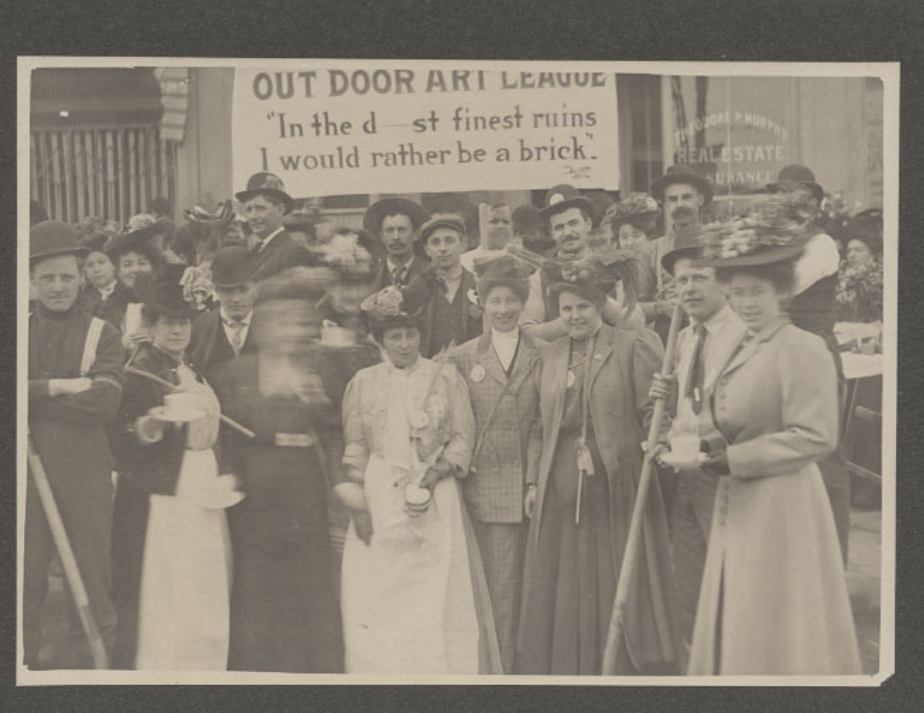
The Art League held a event in Mill Valley that looks like a Renaisance Fair.
”
OUTDOOR ART LEAGUE HAS YULETIDE FESTIVAL
Old Time Music and Costumes. Features of Jinks
Special Dispatch to The Call. MILL VALLEY. Jan. 9.— An old English yuletide festival was” given last night, with fifteenth century, music and costumes of the same period, by , the Outdoor Art. league. The jinks was under the direction of Mrs. F. ßostick and each member of the club brought one guest; so that there was a large” gathering of society folk.”
What we are beholding in the Genesis of the Hippie/Bohemian Movement. This is the heart and soul of San Francisco Culture. The Outdoor Art League played a big roll in rebuilding this world famous city after the Earthquake of 1907. This may be the first instance where a group of artists contribute to the redevelopment of a major city.
These are Magical Tree People. Janke built spiral stairs to take his guests into the embrace of the Giant California Oaks. Here are the Ents and the Hobbits celebrating life, art, poetry, dance, and music. I see young lovers in the tree tops beholding rainbow sunsets and the bright star in the West. This is the first Disneyland. Here come the Jester of the Jinks, with her Magic Wand. Do you hear the tinkling of the bells high in the tree amongst the stars of the Milky Way. Tinker Belle of Beautiful Mountain.
Disneyland is famous for its monorails.
”
“The same year the Belmont Soda Works opened, the Independent Order of Odd Fellows (I.O.O.F.) hired 75 Southern Pacific railroad cars to transport 7,000 of its members from San Francisco to Belmont Park. There, 1,000 other members met them there, making the largest picnic ever held at Belmont Park.
Jon Presco
Copyright 2014
The Cap and Bells Club was organized for the development of wit and humor, and for the study of the drama, music, languages and kindred subjects.
The pointed cap, wand and bells of the Jester form its emblem, and unusual dramatic and musical talent characterizes the membership list, so that the programs during the sixteen years of the club’s existence have been of great excellence.
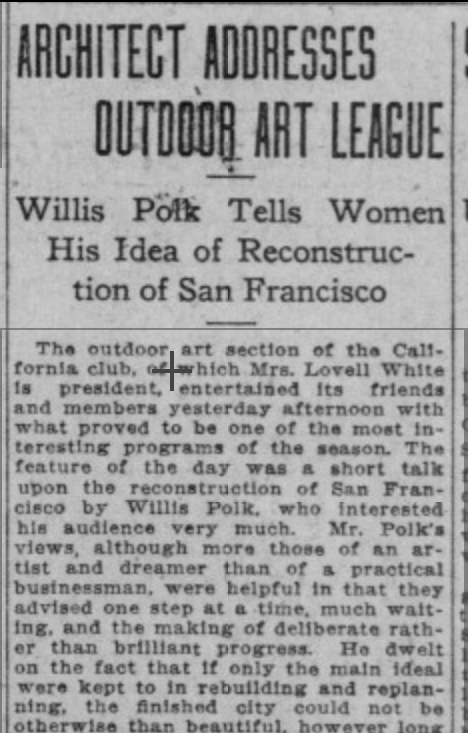
ARCHITECT ADDRESSES OUTDOOR ART LEAGUE
Willis Po-lfc Tells Women His Idea of Reconstruction of San Francisco
The outdoor art section of the California club, of which Mrs. Lovell White Is president, entertained its friends and members yesterday afternoon with what proved to be one of the most interesting programs of the season. The feature of the day was a short talk upon the reconstruction of San Francisco by Willis Polk, who interested his audience -very much. ‘ Mr. Polk’s views/although more those of an artist and [ dreamer than of a – practical businessman, were helpful in that they advised one step at a time, much waiting, and the making of deliberate rather than brilliant progress. He dwelt on the fact that if only the main ideal were kept to in rebuilding and re-planning, the finished city could not be otherwise: than beautiful, however long it was in reaching even comparative completion.


Here is the obituary of William in the San Francisco Call.
JANKE – in this city, Nov. 22, 1902 at his residence 320 Haight St. William August Janke, beloved husband of Cornelia L. Janke, and beloved father of Mrs. W.O. Stuttmeister and Carl and W.E. Janke, a native of Hamburg Germany aged 59 years. Internment, Laurel Hill
“According to Belmont Historical Society records, Dorothea and Carl August Janke sailed around Cape Horn from Hamburg, Germany, in 1848. After landing in San Francisco, they settled in Belmont in 1860″
I found Carl and Dorothea (also and Doretta) are buried at the Union Cemetery in Redwood City.
Carl_August_Janke
Names Listed on the Marker:
Janke, Carl August
Janke, Dorette Catherine
Janke, Mutter Heinrich
Inscription:
— From the 1937 headstone survey –
Carl August Janke, born in Dresden, Germany Oct. 1806, died Belmont, Calif. Sept. 2, 1881
Dorette Catherine, wife of Carl August Janke, born in Hamburg, Germany, July 21, 1813, died in Belmont, California, Feb 16, 1877
Mutter Heinrich, mother of Dorette Catherine Janke, born in Island of Heligoland, Germany, 1781 died in Belmont, California 1876
NOTE: In 1937 the Daughters of the American Revolution recorded all the headstones.
A BRIEF HISTORY OF UNION CEMETERY
By: John G. Edmonds
Before Union Cemetery
The first entry that mentioned a cemetery in the Times and Gazette (which was the only newspaper in San Mateo County at that time) was in early January 1859. William Cary Jones had allowed 13 burials on his property, the site of today’s Sequoia High School. Now that Horace Hawes had taken over the property, he informed the county that he no longer wanted the dead to be buried on his property and he wanted all 13 bodies exhumed and moved elsewhere. This caused great anxiety in Redwood City.
1864-1910, page 133).
Records from Tombstones in Laurel Hill Cemetery, 1853-1927 – Janke
– Stuttmeister
Mina Maria Janke, daughter of William A, & Cornelia Janke, born
February 2, 1869, died March 1902.
William August Janke, native of Hamburg, Germany, born Dec. 25,
1842, died Nov. 22, 1902, son of Carl August & Dorette Catherine Janke. Frederick William R. Stuttmeister, native of Berlin, Germany, born
1812, died January 29, 1877.
Mrs. Matilda Stuttmeister, wife of Frederick W.R. Stuttmeister, born
1829, died March 17, 1875, native of New York.
Victor Rudolph Stuttmeister, son of Frederick W.R. & Matilda
Stuttmeister, born May 29, 1846, died Jan. 19, 1893, native of New
York.
The most popular daytime excursion destination on the Peninsula during the late 19th century once occupied the area in Belmont now known as Twin Pines Park. The Belmont Picnic Grounds proved so popular, in fact, that scores of picnickers would travel regularly from San Jose and San Francisco for sun, fresh air and libations.
The size of the crowds and the fondness for libation, however, eventually led to the attraction’s demise.
According to Belmont Historical Society records, Dorothea and Carl August Janke sailed around Cape Horn from Hamburg, Germany, in 1848. After landing in San Francisco, they settled in Belmont in 1860. Industrious and entrepreneurial, Carl Janke purchased land in the vicinity of 6th and Ralston. Janke set out to create a site for leisure activities, modeled after the biergarten in his native Hamburg. His creation became Belmont Park.
Janke’s park offered all the necessary provisions for an outdoor holiday, which included a dance pavilion to accommodate 300 large glassless windows, a conical roof and a dance floor situated around a large spreading tree. The pavilion was also equipped with a bar, an ice cream parlor and a restaurant.
Outside the pavilion, the park provided a carousel for children, footpath bridges crossing the meandering of creeks, and a shooting gallery, with picnic benches and lathe houses situated about the shady grounds. Brass bands performing from bandstands could be heard all around the woodland.
In 1876, Janke opened Belmont Soda Works, located north of Ralston along Old County Road. Janke’s sons, Gus and Charlie, operated the soda works, which offered a variety of sarsaparillas. Within two years, the Soda Works produced more than 1,000 bottles a month — a large percentage of which would be sold at Belmont Park. Between the Soda Works and the several bars situated in and around the park, the liquid refreshment flowed abundantly.
Belmont Park became so popular that Southern Pacific Railroad began reserving exclusive trains for the sojourn to Belmont. Several local organizations and fraternities used the grounds for the celebrations, such as the Germania Rifles, the Apollo Verein, the Blue Bells, the Bunker Hill Association, the Ignatian Literary Society, the Hibernians and the Purple Violets. Races – foot, three-legged, and pony cart – as well as other amusements became commonplace at the gatherings.
The same year the Belmont Soda Works opened, the Independent Order of Odd Fellows (I.O.O.F.) hired 75 Southern Pacific railroad cars to transport 7,000 of its members from San Francisco to Belmont Park. There, 1,000 other members met them there, making the largest picnic ever held at Belmont Park.
With all the alcohol, dancing and overheated bodies gathered in a relatively small place, trouble seemed destined to follow.
In 1880, rival gangs started a small riot at Belmont Park, leaving one person dead and several injured. On another occasion, a young girl named Anne Mooney mysteriously disappeared. Authorities assumed she had been kidnaped, but a suspect was never identified. The fate of Anne Mooney remains a mystery.
By the turn of the century, the weekly treks to Belmont had become something of a nuisance. The drunken tussling would often begin at the on-board bars, continuing and intensifying by the time the passengers reached Belmont. The small communities through which the trains rumbled complained about the outsiders cavorting and otherwise disturbing their peaceful Peninsula neighborhoods. Southern Pacific, tired of the rowdies and the damage inflicted to the railroad cars, finally stopped operating the excursions in 1900.
In her book “Heritage of the Wooded Hills,” Ria Elena MacCrisken writes, “… if the railroad looked down its nose at the San Francisco picnickers, the little town of Belmont welcomed them with open arms. These early-day tourists brought lively times to Belmont and revenue to its stores…” Unfortunately for the Jankes , when the train stopped bringing carloads of revelers, much of Belmont Park’s clientele disappeared.
By 1910, the property had sold to George Center, the director of the Bank of California, who built a home on the property. Later Dr. Norbert Gottbrath opened a sanitarium called “Twin Pines,” which operated until March of 1972. The City of Belmont took over the property, dedicating Twin Pines Park in June of 1973.
http://cdnc.ucr.edu/cgi-bin/cdnc?a=d&d=SFC19021124.2.75.3#
http://www.sfgenealogy.com/sanfranciscodirectory/1916/1916_928.pdf
http://cdnc.ucr.edu/cgi-bin/cdnc?a=d&d=SFC19091115.2.40.9#
http://www.historicunioncemetery.com/Person.php?person=Janke%2C+Carl+August
http://www.historicunioncemetery.com/Person.php?person=Janke%2C+Lilly
http://en.wikipedia.org/wiki/Union_Cemetery_(Redwood_City,_California)
| The social day of the Cap and Bells club will be held Thursday afternoon, Mrs Walter E. Janke being. the chairman of the day. An elaborate program will be given, opening with numbers by the Cap and Bells mandolin orchestra. after which Arthur Moore will sing. A farce. “The Silent System,” will be presented by Miss Mac Sullivan and Reginald Travers, and Miss Elizabeth Ruddle Price will sing. In closing, a comedy In one act. “The Mere Man,” will be played with the following cast: Mrs. L. R. Ellert.^Jklrs. E. P. Heald. Mrs. F* S. Samuels, Miss Kate Van Duier. Miss Vina Elsenmann, Mrs. Walter E. Janke. Mrs. Will S. Pardy and Mrs. Glenn C. Barnhart. • • • |
City and County Federation of Women’s ClubsSan Francisco 1918 – 1920Cap and Bells ClubTranscribed by Elaine Sturdevant
Cap and Bells Club
Mrs. Ella M. SEXTON, President
Organized 1904
Federated 1918
First and third Thursdays
The Cap and Bells Club was organized for the development of wit and humor, and for the study of the drama, music, languages and kindred subjects.
The pointed cap, wand and bells of the Jester form its emblem, and unusual dramatic and musical talent characterizes the membership list, so that the programs during the sixteen years of the club’s existence have been of great excellence.
Section work, always an indication of progress, has received much earnest attention, and has proved a marked success during 1918-1920.
The study of Art, under Mrs. J. H. CRABBE, of Household Economics, under Mrs. J. A. KUYKENDALL, of Literature, including California authors, with Mrs. Jesse WHITED, of French with Mrs. J. K. PLENCZ, bridge with Mrs.Marshall HARRIS, and modern dancing with Mrs. A. J. ROSSI as chairman, added knowledge and variety, broadening, also, the outlook and self-expression of the members. Mrs. M. H. HEYNEMANN was chairman of an excellent Red Cross Section during 1918.
The Cap and Bells Orchestra, with Mrs. B. Frank HOWARD as leader, preceded by Mrs. Charles KER, furnishes delightful numbers for programs, and is of much advantage to the members composing it.
The dramatic work has been in charge of Miss Mae F. O’KEEFE, during 1918-1920.
Willis Po-lfc Tells Women His Idea of Reconstruction of San Francisco
The outdoor art section of tha Call-, fornia club, of which Mrs. Lovell White Is president, entertained its friends and members yesterday afternoon with what proved to be one of the most interesting programs of the season. The feature of > the day was a short talk upon the reconstruction of San Francisco by Willis Polk, who interested his audience -very much. ‘ Mr. Polk’s views/although more those of an artist and [ dreamer than of a – practical businessman, were helpful in that they advlaed one step at a time, much waitIng, and the making of deliberate rather than brilliant progress. He dwelt on the fact that if only the main ideal were kept to in rebuilding and replanning, the finished city .could not be otherwise: than beautiful, however long it was -In reaching even comparative completion.
; As yesterday was the anniversary of Whlttler’s birth the remainder of the program was devoted to the Quaker poet and his work.’ Mrs. Orr presided, and among those who read clever papers on this subjeot were Mrs. Truesdale and’ Mrs., White. A cup of tea and , an informal chat about the ; tea table finished the ; afternoon, which was: enjoyed by about sixty of the club’s prominent members.
Turn Verein Cottages
Posted on November 27, 2014 by Royal Rosamond Press
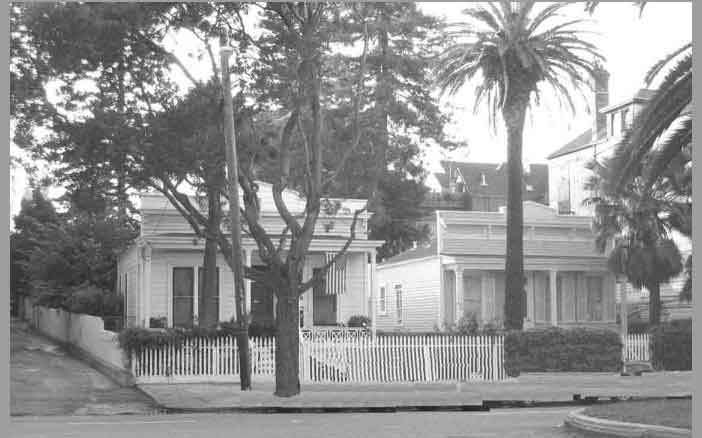
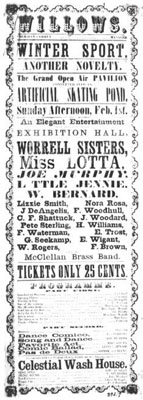
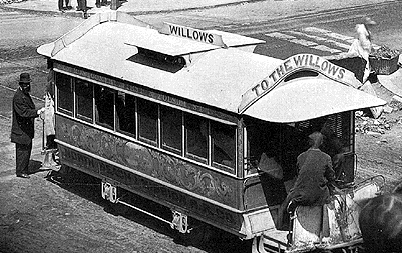
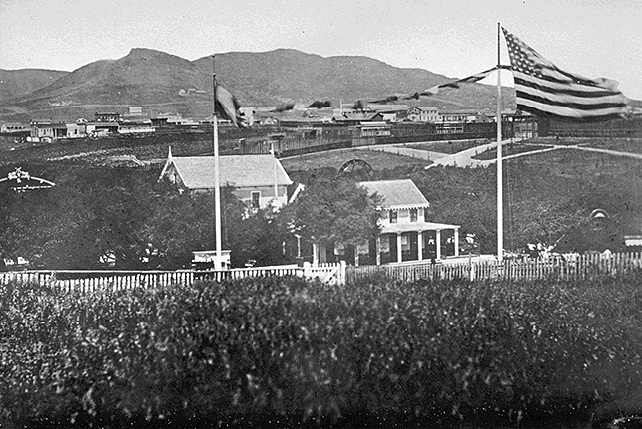


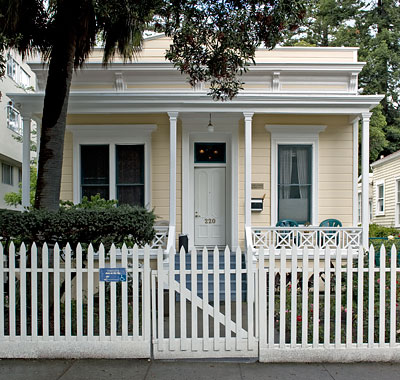

I suspect the Tanforan Cottages are two of the six portable houses that Carl Jake brought about the cape on a Clipper Ship and set of up south of San Francisco. I assumed they were erected in Belmont, but, I just read there was a theme park called ‘The Willows’ in the Mission Dolores that was a retreat as well. With the establishment of the Turnverein on Bush, and another in Redwood City, I believe Janke was part of a movement to bring Forty-Eighter Revolutionaries to the Bay Area in order to make a Utopian State. During, and after WW1, when anti-German hatred was at its peak, these pioneers lost their dream, and all the work they had done. Tanverien became Tanforan, and alleged Spanish name, but, there is nothing Spanish about it. The story of Toribio Tanforan is hogwash. I suspect the old schoolhouse in Belmont is one of the portable houses.
Before the Gold Rush Americans and European wanted to visit and live in California, the last Frontier. Amusement Parks were all the rage. They were Human Be-ins. I suspect my grandmother, Melba Broderick, met Victor Hugo Presco at a theme park.
Jon Presco

Landmark 67
Tanforan Cottage 1
214 Dolores Street Between 15th and 16th Streets
Mission Dolores
Built 1853
This is one of a pair of redwood cottages built by the Tanforan ranching family on land that lay within the 1836 Mexican Grant to Francisco Guerrero. Located only half a block from Mission Dolores, the oldest building in San Francisco, these two cottages are probably the oldest residential buildings in the Mission District.
Landmark 68
Tanforan Cottage 2
220 Dolores Street Between 15th and 16th Streets
Mission Dolores
Built 1854
The following is quoted from Here Today, San Francisco’s Architectural Heritage by Roger Olmsted and T. H. Watkins, published by Chronicle Books in 1969:
Two very old houses that have maintained their original appearance can be seen side-by-side at 220 and 214 Dolores Street. The “Tanforan Cottages,” so called because members of the family of Toribio Tanforan occupied them from 1896 to 1945, are simple frame structures with modified late Classical Revival facades. Though very nearly identical in appearance, they were not constructed at the same time; 214 Dolores is said to have been built a little before 1853, 220 not long after that date. This dating is questionable, though, as the first substantiated date is 1866, when Revilo Wells, owner of 214, had water piped in. There is still a small carriage house behind 220 Dolores – occupied as late as 1940 by one of the Tanforan carriages. The large gardens of these houses have been well-maintained and contain many specimens of turn-of-the-century San Francisco taste in flora.
William had married Augustus the daughter of Carl Janke and lived in the city of Belmont California. I then looked for Carl Janke in the catalogue and found an entry in the history of the Daughters of the American Revolution, a encyclopedia of around four books. It said Carl brought six portable houses around the cape and erected them in the city of Belmont that was not incorporated until 1926. About ten years ago I read that one of the Tanforan cottages was moved from Belmont, they on a Spanish land grant that came to be owned by Toribio Tanforan, the grandson-in-law of Jose Antonio Sanchez.
No one can find any history of Toribio. Why then is being honored? Jose Sanchez is very famous in regards to Spanish land grants. There is no Tansforan land grant. One historian says Toribo was a gaucho from Chile, and thus he was a excellent horseman. And, that’s it! This is what conects the mysterious Torribo to the Tanforan race track and Belmont. Give me a break! Why are two houses in San Francisco named Tanforan?
I suspect Tanforan was the name of the German theme park that Charles Janke built in Belmont, it said he modeling it after a German way of life. Tanforan is not a Spanish name. It also resembles Turnverien, who were Forty-Eighters who fled Europe in the ‘Erupecan Spring’. Consider the ‘Arab Spring’ no doubt named after the revolutions that swept Europe, including Italy, that bid Count Leonetto Cipriani to leave his home in Belmont and pretty much rule the United Italy under Garibaldi and Victor Emanuel. Why wasn’t Ciprianis name applied to a race track? I did find a ‘Cipriani Dog Park’.
In his Overland Diaries Cipriani discuss his prefab house that was out together by screws. This is the famous house in Belmont, called ‘Ralston Hall’. Across the bay in emryville Mr. Coggeshall and his wife have screwed together their new home that was shipped around the cape in 1849. Is this yet another of six portable houses brought around the Cape by my kindred, Carl Janke? San Francisco realtors are selling land in Emeryville. What we are looking at is the birth of California Real estate where track homes are built to arrack folks from back east. Did Cipriani invest in real estate? Who financed him if her did?
“The second sale that Vicente Peralta made was for the greater portion of his estate to a group of San Francisco investors for $100,000 in August 1853. These investors then sold off plots within the estate. Perhaps the first American to settle in what later became Emeryville was Frederick Coggeshall, a native of Massachusetts who came to San Francisco in 1849 and purchased a 45-acre tract on the San Pablo road near where 45th Street is today. He and his wife Lavinia assembled a small house, which may have been shipped around Cape Horn, farmed the land, and raised pigs and cattle.”
One so called historian says the Tanforan Cottages were built by ships carpenters from ships that were abandoned in the Gold Rush by 49ers, sailors who jumped ship to look for their gold mine, that were in want of experience carpenters, who were not paid much. One citations said portable houses were built on the east coast where labour was cheap thanks to the Irish immigration. As to the idea that the Tanforan cottages were moved from Belmont to the Mission, after the San Francisco, consider ‘The Vans’ a structure that was moved to Belmont from San Francisco.
It is thought that the Tanforans built 214 and 220 Dolores as farm houses. 214 was built first, and 220 followed a year or so later. The homes are simple frame structures with classic revival facades (an architectural movement based on the use of pure Roman and Greek forms in the early 19th century). Their false fronts, full width porches with square posts, and four-over-four window sashes (four panes of glass on the top frame and four panes of glass on the bottom frame of a double hung window) are common features of the 1890s. The deep-set backyard, another feature of that era, holds a carriage house that contained a Tanforan-owned carriage until 1940.
The houses were originally inhabited by the Tanforans’ daughter Mary and were handed down from sister to sister until 1952. It is not known if Torbio and Maria ever lived in them. They both died in San Francisco in 1884 and were buried in Mission Dolores; the home address listed on their obituary was Well Street.
http://cheznamastenancy.blogspot.com/2008/01/tanforan-cottages.html
In the 1860’s, SF had its first amusement park just two blocks away. Located at 16th and Valencia, it was called “The Willows” and its prize exhibit was a Emu. That inspired one of Bret Harte’s early verses (not very well known but maybe better so).
“O say, have you seen the Willows so great,
So charming and rurally true,
A singular bird, with the manner absurd,
Which they call the Australian Emu?”
Well, maybe you had to be there.
The houses were originally inhabited by the Tanforans’ daughter Mary and were handed down from sister to sister until 1952. It is not known if Torbio and Maria ever lived in them. They both died in San Francisco in 1884 and were buried in Mission Dolores; the home address listed on their obituary was Well Street.
http://cheznamastenancy.blogspot.com/2008/01/tanforan-cottages.html
The site that The Shops at Tanforan mall is built on has a rich history. Prior to its reincarnation as a shopping center, Tanforan once also served as a racetrack, at various times as an airfield, a military training center, an internment camp, as well as a golf course.
Racetrack[edit]
The Tanforan Racetrack was built in 1899. It was named after Toribio Tanforan, the grandson-in-law of Jose Antonio Sanchez, the grantee of Rancho Buri Buri.[citation needed] Horse, dog, motorcycle, and auto races were held year round at the track. One of Tanforan’s most famous residents while it was used as a racetrack was Seabiscuit, who was stabled there for a time.[4] Today, a statue of Seabiscuit may be found on the grounds of the Tanforan mall.
The site found other uses after 1909, when the state of California banned all gambling at racetracks.[
The Willows, a popular resort “out in the country” in the Mission District, in the 1860s. It was near today’s 18th and Mission, and the willows of its name are growing around the now-buried Mission Creek.
Photo: Private Collection, San Francisco, CA
From the Diary of John “Don Juan” Riley Robinson, Silver Magnate of Batopilas, Mexico:
August 18, 1861 I purchased some clothes, as I am about as seedy as I ever was in this life. Was busily employed all the morning in my room, showing [silver] specimens and talking of Mexico. In the afternoon I went to the Willows and spent an hour in looking at the crowds who spend their pleasant times in that beautiful retreat. It is 3 miles from the city by rail, and Sundays the cars run every 15 minutes, and are crowded with happy faces going and returning from this really beautiful place for recreation. It is beautifully fitted up with books and machinery for amusement for the children, and shooting, and innocent games for the grownups.
http://foundsf.org/index.php?title=Willows_Resort_1860s
http://en.wikipedia.org/wiki/The_Shops_at_Tanforan
http://en.wikipedia.org/wiki/Tanforan_Racetrack
http://www.sfgenealogy.com/sf/history/hgres.htm
Share this:
Come To Magic Mountain
Posted on November 24, 2014 by Royal Rosamond Press
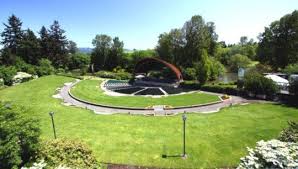

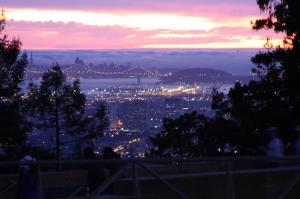


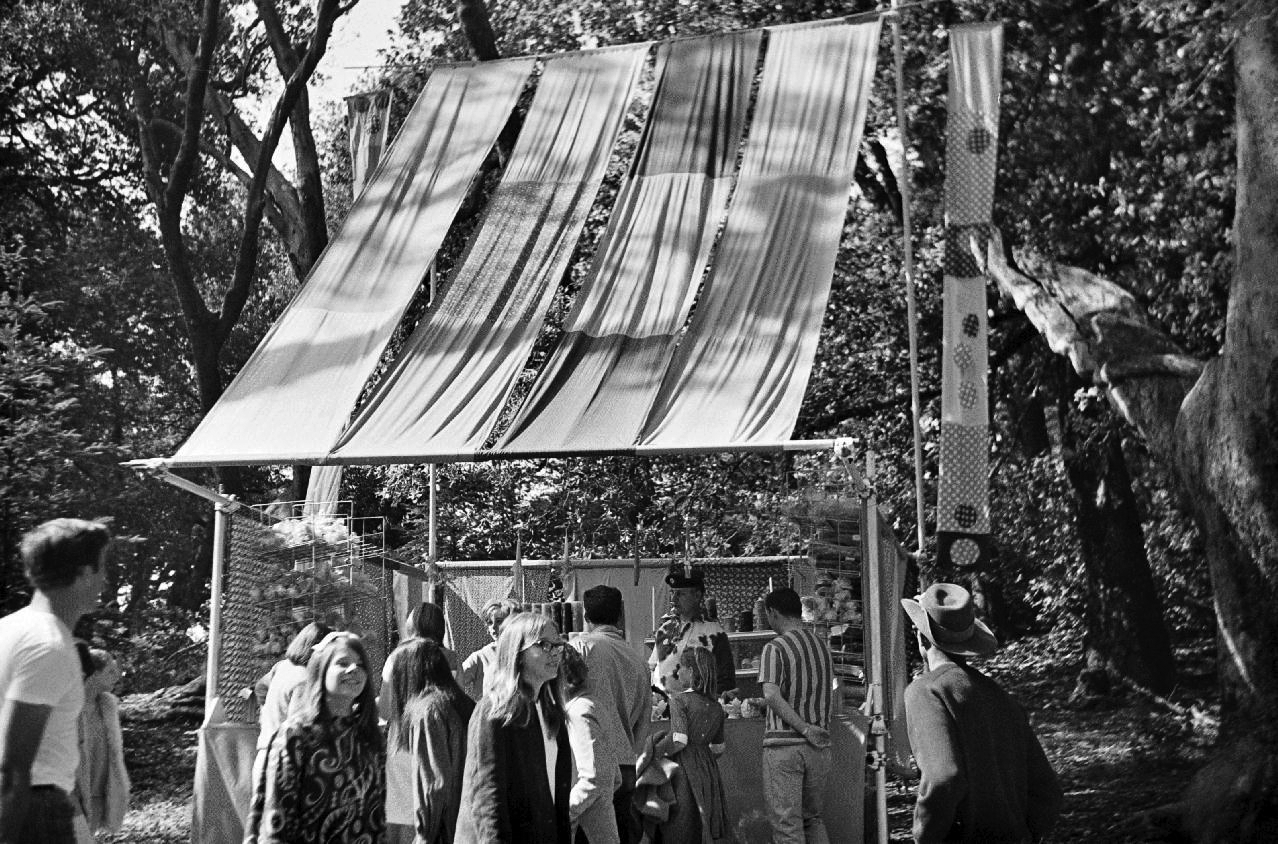

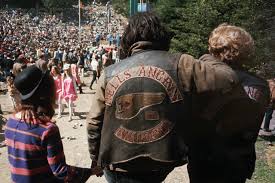

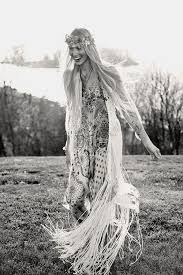

This is a tale of Three Amphitheaters, and, One Magical Mountain.
In June of 1967 I watched the Loading Zone pack their trailer with their sound equipment and head out for Mount Tamalpais to play at a concert in the amphitheater. I lived with this band in a large Victorian in Oakland. They played at the first Acid Test. Historians say this was the first rock festival. I say it was our Woodstock. This is the blue print for everything that came after. Note the hippie trinket booth. I am the first to connect this history to Eugene.
“While the highly documented Monterey International Pop Festival continues to be remembered as the seminal event of the 1967 Summer of Love, the KFRC Festival took place one week before Monterey and is considered to have been America’s – if not the world’s – first rock festival.[
Last year I was shocked to learn the Eugene Celebration was canceled. I came up with an idea in days that included free concerts at the Cuthbert Amphitheater. I had just discovered a pamphlet advertising Joaquin Miller Day. Jaunita Miller was putting on a play about the Pre-Raphaelite Artists who befriended and promoted her father poetry when he met them in England. In my astute opinion this constitutes the Hipster Be-in in the Bay Area. As it turned out the Cuthbert Amphiteater was chosen to host the musical aspects to the Eugene Celebration.
Here is a pic of my friend, Marilyn Reed, with her friend, Jane Marie Mansfield, the daughter of the famous actress. The Star Trek actress, Maggie Trett, took this photo of their trip to the Renaissance Fair that inspired The Fantasy Fair and Magic Mountain Music Festival. Marilyn made hippie clothes for Maggie and others.
In the summer of 63 I ran into my friend, Bryan McLean of Love, in a music store. He had on long leather boots and a puffed shirt. He told me his friends had hire him to play lute at the new festival they started. We were seventeen.
Jon Presco
Yesterday I presented to Mayor Kitty Piercy my idea for the New Eugene Celebration that would be centered around the Cuthbert Amphitheater and the Mill Race that I see as flowing from the Woodminster Amphitheater Cascade. I see O Lake as a reflecting pond. I see a Japanese arch at the end of a pier where is docked a Japanese boat. Up the hill is a Zen Garden and the cottages rescued from Columbia Terrace located in the lost city of Fairmont platted by George Melvin Miller, the brother of Joaquin.
There is a Writer’s Grove planted next to the cascade. I see a similar grove planted near the Cuthbert. Where will sit the two Craftsman housed rescued from Columbia Terrace. Once house will be a Miller Brother’s Museum, and the other a Museum of Bohemian Art and Literature. Ken Kesey lived in one of the barracks that was moved from Fort White. I see a Museum to Peace, with Kesey and Hippie memorabilia. Our Mayor should contact officials I Japan to see if they see these barracks that once housed soldiers destined to go to war with Japan, of historic significance.
The Calm Waters of Peace, Poetry, and Art, flow underground all the way from Oakland California, and surface in a New Arcadia in Eugene. From brother to brother. let there be a New Cultural Unity!”
The KFRC Fantasy Fair and Magic Mountain Music Festival was an event held June 10 and 11th, 1967 at the 4,000 seat Sidney B. Cushing Memorial Amphitheatre high on the south face of Mount Tamalpais in Marin County, California. At least 36,000 people attended the two-day concert and fair that was the first of a series of San Francisco area cultural events known as the Summer of Love.[1] The Fantasy Fair was influenced by the popular Renaissance Pleasure Faire and became a prototype for large scale multi-act outdoor rock music events now known as rock festivals.[2][3]
Beefheart http://www.youtube.com/watch?v=7kl6cCp_eWc
http://www.youtube.com/watch?v=VPSMirw5z14
http://www.youtube.com/watch?v=eGt2u7KNMDU
http://www.youtube.com/watch?v=S3idNhnO9iI
http://oaklandish.com/oakblog/joaquin-miller-oaklands-first-hipster/
http://en.wikipedia.org/wiki/Ecovillage
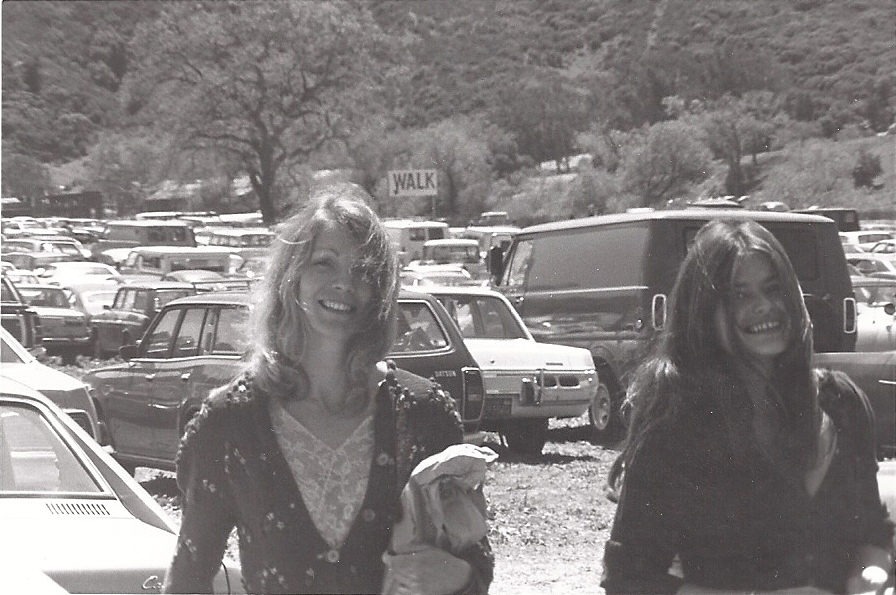

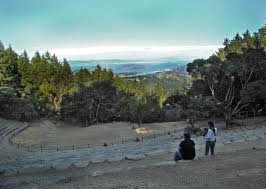

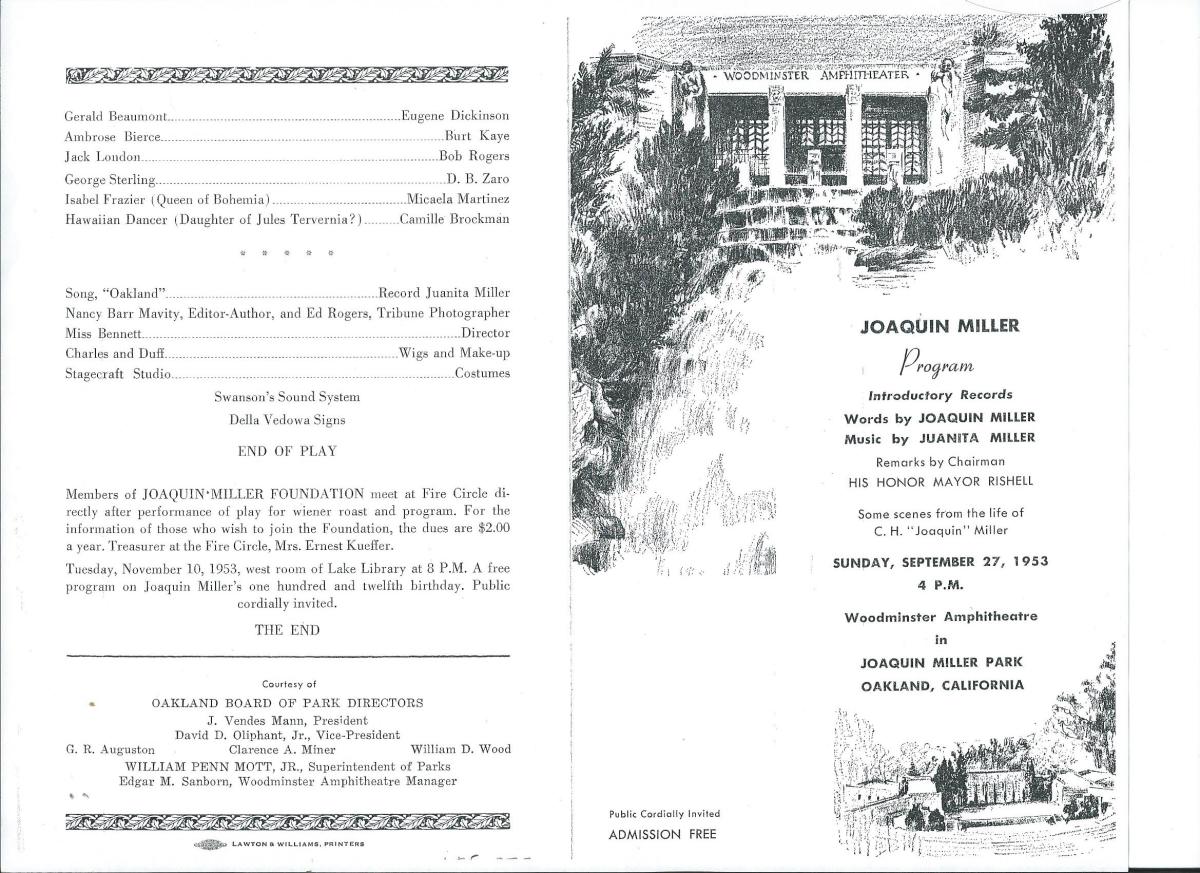
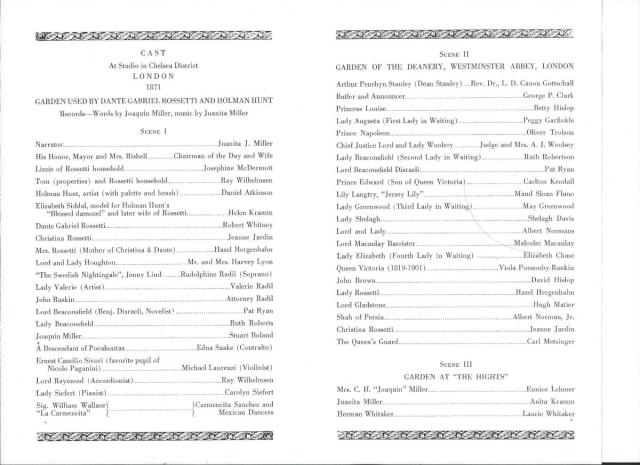
Eugene Celebration has brought attention to community issues and concerns regarding environmental responsibility within the greater context of a weekend festival. Recurring features at the celebration include the “Community Causeway” where nonprofit, charitable and advocacy organizations promote their services and, as of 2007, the “Sustainability Village” where Celebration participants can learn about sustainable lifestyle choices. A related event, the coronation of the SLUG Queen, occurs prior to the event.
In 2014, the event’s management company, Kesey Enterprises, initially released a statement in June cancelling the August Celebration, citing new construction and growth in Eugene’s revitalized downtown that reduced the space needed for entertainment and food venues.[2] Kesey Enterprises later agreed to partner with the City of Eugene to host a $5 concert at the Cuthbert Amphitheater during the weekend. A free alternative “Festival of Eugene” at Skinner Butte Park was organized by Krysta Albert, who persisted despite a saga of funding and location uncertainties lasting as late as two weeks before the event.[3] The Festival included “health and wellness vendors, nonprofit groups, food booths, live music and poetry readings.”[4] The Eugene Celebration Parade featured Lane Community College as the grand marshal, and included 70 groups of “school bands and dance troupes, the 2014 Slug Queen and his entourage, the fencers, roller derby skaters and belly dancers, and the primarily liberal politicians and political causes.”[5]
http://en.wikipedia.org/wiki/Eugene_Celebration
http://en.wikipedia.org/wiki/Maria_Zambaco
mount tamalpais amphitheater
Admission to the festival was $2.00 and all proceeds were donated to the nearby Hunters Point Child Care Center in San Francisco. The Fantasy Fair was originally scheduled for June 3 and 4 as a benefit for the center, but was delayed one week by inclement weather. Several acts booked for the original dates were unable to perform.[4]
KFRC 610, the RKO Bill Drake “Boss Radio” Top 40 AM station in San Francisco, had significant influence in the music industry among both counter-culture and commercial acts. This enabled festival organizer Tom Rounds, KFRC’s program director, to present a colorful and eclectic line-up of popular musicians from both in and outside the region. Canned Heat, Dionne Warwick, Every Mother’s Son, The Merry-Go-Round, The Mojo Men, The Seeds, Blues Magoos, Country Joe and the Fish, Captain Beefheart, The Byrds with Hugh Masekela on trumpet, Tim Hardin, The Sparrow, The Grass Roots, The Loading Zone, The 5th Dimension and Jefferson Airplane were among the performers who appeared.[4] The Fantasy Fair was also The Doors‘ first large show and happened during the rise of the group’s first major hit, “Light My Fire“, to the top of the charts.[5]
Among posters created for the event was one designed by artist Stanley Mouse, then gaining acclaim for poster-art created for Bill Graham, the Fillmore Auditorium and Grateful Dead.
After enjoying a scenic ride up the mountain from embarkation points at the Marin County Civic Center, Mill Valley and other locations, a giant Buddha balloon greeted attendees when they arrived at the amphitheater. Transportation was provided by the tongue-in-cheek-named “Trans-Love Bus Lines”, a variation of the line “Fly Trans Love Airways, get you there on time” from the lyrics to Donovan‘s song “Fat Angel”. Performances were on a main stage and a smaller second stage. Various art-fair type vendors sold posters, crafts and refreshments from booths scattered in the woods around the amphitheater. The festival included a large geodesic dome of pipes and fittings covered with white plastic that contained a light and sound show.
The Magic Mountain Music Festival was favorably reviewed for safety in contemporary press accounts. Fights or disturbances were not an issue, and at the end of the day, trash was placed in or next to the garbage cans provided, and the crowd left the Mount Tamalpais as they found it.[6] In a foreshadowing of dark events to come at the 1969 Altamont Free Concert, this festival was rumored to be the first to employ Hells Angels motorcycle club members as security guards. Although Jefferson Airplane asked Hells Angels members to escort them from San Francisco to the venue, which they did without incident, the Hells Angels did not actually provide security for the event.
Significance[edit]
To some commentators, the festival represented a sea change in musical preferences among young Bay Area radio listeners as the hippie culture fully arose in mid-1967. Alec Palao and Jud Cost chronicled the San Francisco mid-sixties era music scene in 1991 in their magazine Cream Puff War #1. Writing about the weeks surrounding the Fantasy Fair, Cost noted that “the dichotomy in Bay Area music was never so evident, as the self-proclaimed “adult” scene separated itself from the “teen/pop” scenes.”[7] Scram Magazine juxtaposed that view with pioneer rock magazine editor Greg Shaw’s recollection that the rift between the tastes of teens and adults didn’t form until later, after the freeform radio style then being established by Tom Donahue fully emerged in the fall of 1967.[8] A review of the bands that played indicates that most were groups that played the Fillmore and Avalon ballrooms and were part of the psychedelic rock scene at the time.
While the highly documented Monterey International Pop Festival continues to be remembered as the seminal event of the 1967 Summer of Love, the KFRC Festival took place one week before Monterey and is considered to have been America’s – if not the world’s – first rock festival.[2][6][9][10][11][12][13]
Performances[edit]
Saturday, June 10[edit]
- Mount Rushmore
- Rodger Collins
- Dionne Warwick
- The Doors
- The Lamp of Childhood
- Canned Heat
- Jim Kweskin Jug Band
- Spanky and Our Gang
- Blackburn & Snow
- The Sparrow
- Every Mother’s Son
- Kaleidoscope
- The Chocolate Watch Band
- The Mojo Men
- The Merry-Go-Round
Sunday, June 11[edit]
- Sons of Champlin
- Jefferson Airplane
- The Byrds with Hugh Masekela
- P. F. Sloan
- Captain Beefheart & the Magic Band
- The Seeds
- The Grass Roots
- The Loading Zone
- Tim Buckley
- Every Mother’s Son
- Steve Miller Blues Band
- Country Joe and the Fish
- The 5th Dimension
- The Lamp of Childhood
- The Mystery Trend
- Penny Nichols
- The Merry-Go-Round
- New Salvation Army Band
http://en.wikipedia.org/wiki/The_Loading_Zone


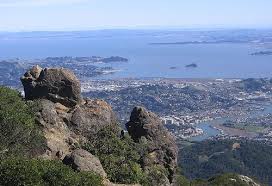
c
 Rosamond Press

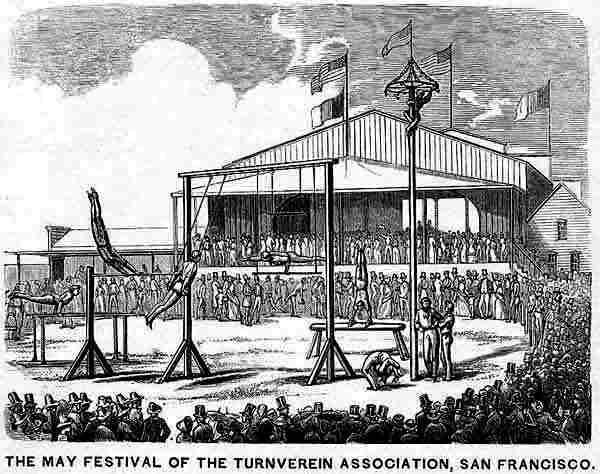


Leave a comment