
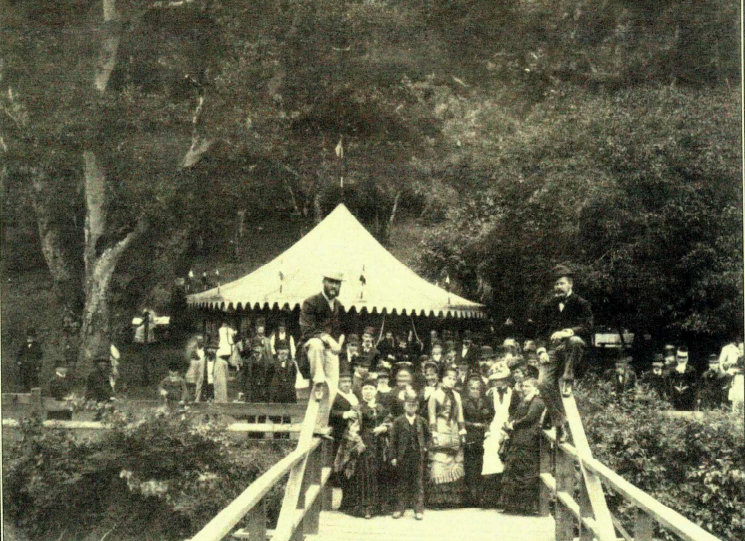
San Sebastian Avenue
by
John Presco
The Stuttmeister family might have been the wealthiest family to step foot in Belmont California after William Ralston. How about Cark Janke? That is William Stuttmeister on left, and William Janke holding children. Are those the infamous Twin Pines? This family got married at Ralston Hall, and took the Janke Stagecoach to Halfmoon Bay. The Stuttmeisters got pelts in the New world. Amalie is listed as a millionaire. Did she invest in America?
The Stuttmeisters lived on Berliner Straffe and may have known the Janke family, who may have operated a beer garden – with amusement. Wealthy people lived here. Did the Stuttmeisters fiancé Carl Janke’s expedition to California? Were they members of the Berlin Turnverein?
John Presco
https://publicdomainreview.org/collection/hamann-turner/
Recreational and residential area
In the late 18th century, Charlottenburg’s development did not depend only on the crown. The town became a recreational area for the expanding city of Berlin. Its first true inn opened in the 1770s, in the street then called Berliner Straße (now Otto-Suhr-Allee), and many other inns and beer gardens were to follow, popular for weekend parties especially. Berliners seeking leisure and entertainment came by boat, by carriage and later by horse-drawn trams, above all to a large amusement park at the shore of the Spree river called Flora, that went into bankruptcy in 1904.

Age 53 —Listed as a Millionaire
1912 • Berlin, Germany
Jahrbuch des Vermögens und Einkommens der Millionäre in Preussen,1912, Band 1 von Rudolf Martin2 media
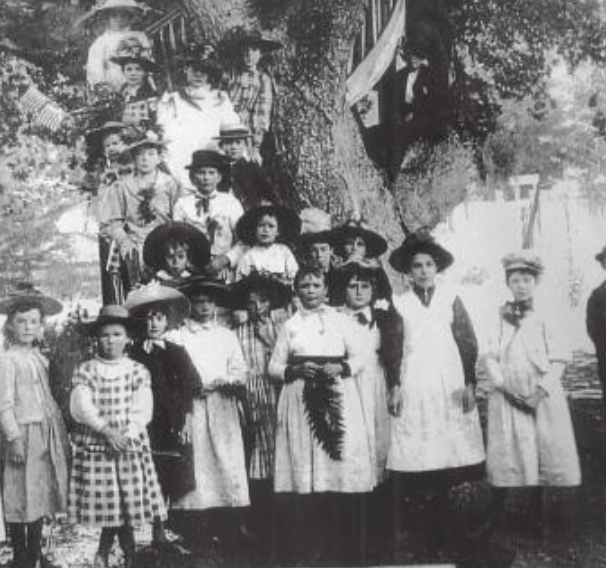


Johannes Hermann Stuttmeister
1826–1890
BIRTH 24 MARCH 1826 • Berlin, Brandenburg, Preußen
DEATH 8 JAN 1890 • Berlin, Berlin, Deutschland
Skip to sourcesFilter
Facts
- 1826(AGE)Select factAge 0 —Birth24 March 1826 • Berlin, Brandenburg, Preußen5 sources
- 1826Select factBaptism4 Mai 1826 • Berlin, Brandenburg, Preußen1 source
- 1826Select fact
 Baptism04 May 1826 • Friedrichswerder Berlin,Brandenburg,Prussia1 source1 media
 - 183610Age 10 —Death of father Friedrich Wilhelm Stuttmeister (1771–1836)Aft. 1836 • Berlin, Berlin, Deutschland
- 184822Age 22 —Death of half-sister Marie Caroline Sophie Suttmeister (1802–1848)26 Aug 1848 • Berlin
- 185226Select fact
 Age 26 —Address1852 • Brüderstrasse 44, Berlin, Germany1852 Allgemeiner Wohnungsanzeiger für Berlin lists this address for H. Stuttmeister, Furrier and Peltware trader. The business is listed as Brüderstrasse 1.6 media
 - 185226Select fact
 Age 26 —The Fur Shop at Brüderstrasse 1 and Schlossplatz1852 • Berlin GermanyThe photograph is from before 1890 and shows part of the neighbouring house Brüderstraße 2 before it was demolished in 1890. To the right of it the searched no. 1 (picture Mi- B 808) (Berlin History Association)1 media
 - 185327Select fact
 Age 27 —The Stuttmeister Family Fur Shop1853 • Berlin, GermanyThis is a photo of Brüderstrasse 1 and Schlossplatz after WWII. The Suttmeister’s sold the fur shop in 1866.1 media
 - 185529Select factAge 29 —Marriage22 Aug 1855 • Berlin, Brandenburg, PreußenHenriette Theodore Emma Pohlig1834–18991 source
- 185529Select fact
 Age 29 —Address1855 • Friedrichsgracht 56, Berlin, GermanyStuttmeister H., listed as Furrier and Pelts ware trader residing at this address.3 media
 - 185529Select factViewAge 29 —The Fur Shop at Brüderstrasse1/Schloss Platz1855 • Berlin (Alt Cöln)https://www.stadtbild-deutschland.org/forum/gallery/index.php?image/2349-stadtschloss-4/ https://www.stadtbild-deutschland.org/forum/gallery/index.php?image/2348-stadtschloss-7/
- 185529Select fact
 Age 29 —Family Business1855 • bruderstrasse 1/schlossplatz, Berlin, GermanyThis was the location of the Stuttmeister fur shop on the corner of Schlossplatz and Brüderstrasse 1 across from the Berlin City Palace. They sold the shop in 1866 to Gustav Bender. This is an advertisement for their fur wares in a magazine.1 media
 - 185630Age 30 —Birth of daughter Agnes Emma “Hedwig” Stuttmeister (1856–1908)15 Juli 1856 • Berlin, Brandenburg, Preußen, Germany
- 185630Age 30 —Death of mother Amalie Dorothea Friederike Sparschuh (1783–1856)25 Aug 1856 • Königs Wusterhausen, Königs Wusterhausen, Teltow, Brandenburg, Germany
- 185832Age 32 —Birth of son Wilhelm Erdmann Arthur Stuttmeister (1858–1862)12 Oct 1858
- 185933Age 33 —Birth of daughter Amalie Charlotte Johanne Elisabeth Stuttmeister (1859–1912)26 December 1859
- 185933Select factAge 33 —Hermann Stuttmeister’s business1859 • BerlinAccording to the Allgemeine Wohnungsanzeiger of 1859, Hermann Stuttmeister was also an importer of furs from North America; perhaps he enlisted the help of his emigrated brother. (Information from the Berlin Historical Association)
- 186034Age 34 —Birth of son Victor Emanuel “Felix” Stuttmeister (1860–1899)20 December 1860 • Berlin, Germany
- 186135Age 35 —Birth of son Friedrich Heinrich “Hugo” Stuttmeister (1861–1914)16 November 1861 • Berlin, Prussia, Germany
- 186235Age 35 —Death of son Wilhelm Erdmann Arthur Stuttmeister (1858–1862)17 Jan 1862
- 186236Select fact
 Age 36 —Address19 May 1862 • Salzburg, AustriaJohannes Hermann Stuttmeister visits Salzburg.2 media
 - 186236Select fact
 Age 36 —Travel in Austria18624 media
 - 186539Select factAge 39 —Address1865 • Schöneberger Ufer 28, Berlin, GermanyThe address book gives the entry of Stuttmeister, H., Landowner (Gutsbesitzer), Schöneberger Ufer 28. 29. Pt. E. 8-9. The “H” could refer to Hermann or his son Hugo.1 media
- 186943Select fact
 Age 43 —Address2 Nov 1869 • Erzherzog-Karl-Stadt, Vienna, Wien, Vienna, AustriaJohannes Hermann appears to have moved to Vienna for some time. He is also seen in Salzburg.2 media
 - 187145Age 45 —Birth and death of son Stuttmeister (1871–1871)6 Mai 1871 • Berlin, Brandenburg, Preußen
- 187347Select fact
 Age 47 —Address1873 • Berlinerstrasse 3, Berlin, GermanyListed as Neubau (new construction), E. (Eigentümer) or Owner, Rittergutsbesitzer (Estate owner) (Berlin: Schoneberger Ufer 28).Hernig, Portier (Butler)3 media
 - 187750Age 50 —Death of half-brother Friedrich Wilhelm “Rudolph” Stuttmeister (1815–1877)29 Jan 1877 • California
- 187751Select factAge 51 —Address1877 • Schöneberger Ufer 28, Berlin, GermanyThe address book gives the entry of Stuttmeister, H., Landowner (Gutsbesitzer), Schöneberger Ufer 28. 29. Pt. E. 8-9. The “H” could refer to Hermann or his son Hugo.
- 187953Select factAge 53 —Address1879 • Schöneberger Ufer 28, Berlin, Germany
- 188155Select factAge 55 —Membership in Nachweis der Grossen Landes-Loge der Freimaurer voJune 1881 • BerlinHe is mentioned on page 82 of the Nachweis der Grossen Landes-Loge der Freimaurer von Deutschland zu Berlin …as being a member of St. Johannis lodge zum Goldene Schiff https://zum-goldenen-schiff.de/
- 188256Select fact
 Age 56 —Address1882 • Berlinerstrasse 3, Berlin, Germany1882 Berlin Charlottenburg Addressbook lists, Stuttmeister, H., Gutsbesitzer., Berlinerstrasse 3.I. E.1 media
 - 188357Select fact
 Age 57 —Address1883 • Berlinerstrasse 3, Berlin, Germany1883 Berlin Charlottenburg Addressbook lists, Stuttmeister, H., Gutsbesitzer., Berlinerstrasse 3.I. E2 media
 - 188761Select factAge 61 —Passenger List18871887 passenger list says that a Hermann Stuttmeister, age 50 departed Germany. No more info available.
- 188963Select factAge 63 —Wannsee Sailing Club1889 • Wannsee, Berlin, Berlin, Germany2 media
- 189063Select fact
 Age 63 —Death8 Jan 1890 • Berlin, Berlin, Deutschland5 sources2 media
 - 1898Select factAddress1898 • Schwedter Strasse 14, Berlin, Germany1898 Address book for Berlin and Suburbs “Addressbuch für Berlin und seine Vororte” lists: Schwedter Strasse 14, E. (Emily) Stuttmeister, E, Rentiere (Landlord). Emma was the wife of Johannes Hermann Stuttmeister
- 1899Select factDeath of his wife Emma Stuttmeister1899 • Berlin, Germany
- Select factBurialBerlin-Mitte, Mitte, Berlin, Germany
https://www.ancestry.com/family-tree/person/tree/110989485/person/310136793483/facts
Amalie Charlotte Johanne Elisabeth Stuttmeister
1859–1912
Fact detailsMediaSource citations
Fact details
1912
Berlin, Germany
Jahrbuch des Vermögens und Einkommens der Millionäre in Preussen,1912, Band 1 von Rudolf Martin
https://www.ancestry.com/family-tree/person/tree/110989485/person/310099194306/facts
Esplanade, term from the French for a large space or forecourt, as we can see it between rows of houses or fortifications and the associated city.
in 1874 the road was created by the landowner Stuttmeister (Charlottenburg), which probably belonged to this terrain. The route still without a name is drawn on the map from 1877. Originally should at the end of the Esplanade, a free place on a map of 1902 called Wilhelm Platz, built. On that map, runs the Esplanade also at right angles. That running to the North, as the Wilhelmplatz only projected piece, was however not the Esplanade annexed to, but was subsequently named Trienter road. The South side of the Esplanade ranks to Prenzlauer Berg, the northern side to Pankow.
Recreational and residential area
In the late 18th century, Charlottenburg’s development did not depend only on the crown. The town became a recreational area for the expanding city of Berlin. Its first true inn opened in the 1770s, in the street then called Berliner Straße (now Otto-Suhr-Allee), and many other inns and beer gardens were to follow, popular for weekend parties especially. Berliners seeking leisure and entertainment came by boat, by carriage and later by horse-drawn trams, above all to a large amusement park at the shore of the Spree river called Flora, that went into bankruptcy in 1904.
From the 1860s on the wealthy Bourgeoisie of Berlin discovered Charlottenburg as a residential area, among the first were Gerson von Bleichröder and Ernst Werner von Siemens, who had a villa built in the Berliner Straße in 1862. At the same time industrial companies like Siemens & Halske and Schering erected large factories in the north-east, at the border with the Moabit district of Berlin. In 1877 Charlottenburg received town privileges and until World War I saw an enormous increase of population with 100,000 inhabitants as of 1893 and a population of 306,000 in 1920, being the second largest city within the Province of Brandenburg, after Berlin.
Prussia Reborn In New World
Posted on January 27, 2020 by Royal Rosamond Press


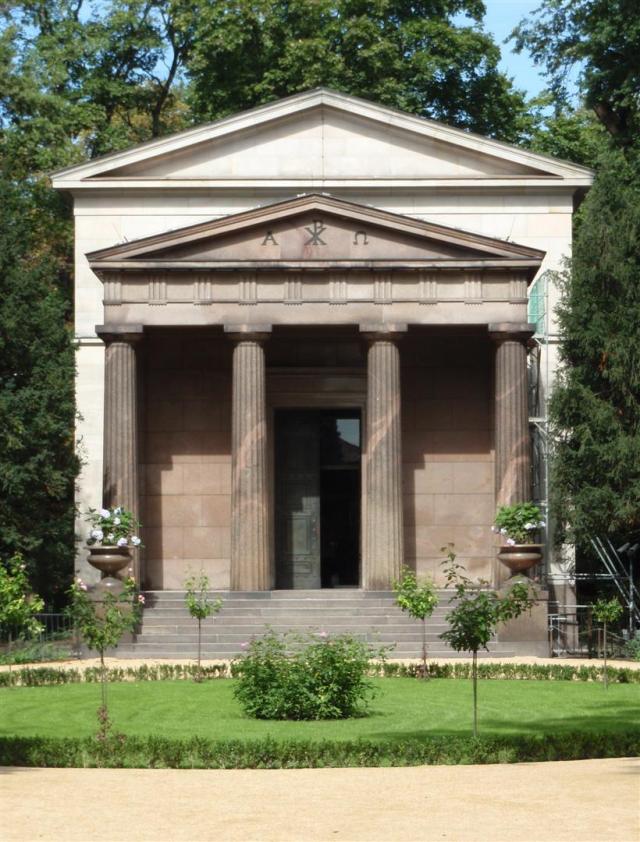

I suspect many Prussians came to Chile.
John
https://en.wikipedia.org/wiki/German_Chileans
Hamburg and Valparaíso[edit]

Valparaíso, Chile, in 1830
In 1818 Chile became independent from Spain and began to engage in trading with more nations. The port city of Valparaíso became a major center for trade with Hamburg, with commercial travellers and merchants from Germany staying for lengthy periods of time to work in Valparaíso. Some settled there permanently.
On 9 May 1838 Club Alemán de Valparaíso, the first German cultural organization was established in the city. German residents and visitors held cultural functions here. The club began to organize literary, musical and theatre productions, contributing to the cultural life of the city. Aquinas Ried, a physician, became widely known in the city for composing operas, and for writing poetry and plays. The club had its own orchestras and academic choir (singakademie) which would perform works composed by local musicians.[5] During World War I, the German Club of Valparaiso welcomed Admiral Maximilian von Spee‘s East Asia Squadron of the Imperial German Navy after they fought the Battle of Coronel off the Chilean coast.[6]
Colonization of Southern Chile[edit]
Main article: German colonization of Valdivia, Osorno and Llanquihue
The Chilean government encouraged German immigration in 1848, a time of revolution in Germany. Before that Bernhard Eunom Philippi recruited nine working families to emigrate from Hesse to Chile.
The origin of the German immigrants in Chile began with the Law of Selective Immigration of 1845. The objective of this law was to bring people of a medium social/high cultural level to colonize the southern regions of Chile; these were between Valdivia and Puerto Montt. The process was administered by Vicente Pérez Rosales by mandate of the then-president Manuel Montt. The German immigrants revived the domestic economy, and they changed the southern zones. The leader of the first colonists, Karl Anwandter, proclaimed their goals:
The Hermann Nautical Museum
Posted on April 29, 2016by Royal Rosamond Press

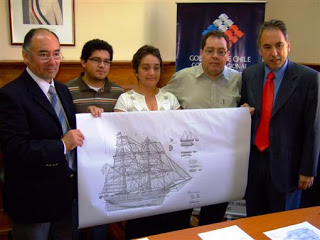


Alas a member of our family had a real chance be in a museum.
Here is a e-mail written by my cousin Daryl Broderick-Bulkley. Rudolph Stuttmeister appears to be a recruiter for the German Colony in Chile. Stuttmeister appears be the name of the area later named Charlottenburg. Did the Stuttmeisters own and develop this land? There was a amusement park named Flora? Were the Jankes involved? With the revelation Victor Emanuel established a colony in Belmont California, one wonders if the Stuttmeisters were not experienced in establishing colonies for refugees. Did that have Huguenot roots? Berlin was a haven for them.
Jon Presco
The other puzzler is, did the HERMAN stop in Philadelphia before going on
to Valparaiso, and pick up passengers? My ancestor arrived in the US
before 1844, as he was married on that date, so eight years later he is
traveling to Chili, and what was the attraction? And where was his wife?
More puzzles! Or did he travel back to Germany, and take this emmigrant
ship to Chili from Hamburg? I guess I cannot rule that out.
Has anyone done any extra reading about the Germans who went to Chili? I
noticed from the passenger list, broken down by occupations, there were
three doctors, l lawyer, and various professions represented, along with a
few farmers, carpenters, etc. which I found intriguing. Stuttmeister did
not travel as a physician, but as a `Commercial’. He was a doctor.
Anyone have any comments on this?
“German immigrants arrived in Chile following the failure of the
liberal revolutions of 1848 in Germany. They settled the rainy and,
until then, largely unimproved provinces south of the Biobío River.
This region had remained largely controlled until the mid-19th
century by the indigenous Araucanians. The German settlers
introduced small industries and farming and in the lake district
established resorts that remain popular with tourists. Small groups
of settlers from Italy, Austria, Switzerland, Spain, and Yugoslavia
also came in the mid-19th century. Most of them settled in the same
area as the Germans.
One of the ships used for the German emigration to Chile in the mid-nineteenth was the brig “Hermann”. This boat made five trips to Chile transporting German settlers and their families to the port of Corral in southern Chile, and Valparaiso. He also made several trips from Hamburg to Australia transporting settlers and the United States of America.
There is a Chilean project to build a replica and turn this into a museum of immigration in Valdivia, but now it seems that this project is stopped.
http://historiadevaldivia-chile.blogspot.com/2013/10/barcos-inmigracion-alemana.html
Barco “Hermann” Captain OA Kleingarn
31.07.1852 Hamburg to Valdivia and Valparaiso
| Passenger | Occupation | Origin |
| Backhaus, Franz | LDM. | Berlin |
| Bentjerodt, Heinr. | Hutmacher | Berkel (OVC.) |
| Betz, Marie | – | Egelsheim (W.) |
| von Bock, Eugen | Gelehrter | Kempten (W.) |
| Breckle, Gottlieb | Zimmermann | Osweil (W.) |
| Callisen, Ernst | LDM. | San Francisco (Cal.) |
| Gebhardt, Emil | Mechniker | Ludwisgburg (W.) |
| Gebhardt, Ernst | LDM. | Ludwisgburg (W.) |
| Gebhardt, Gustav | LDM. | Ludwisgburg (W.) |
| Greve, Hermann | Seifensieder | Frankfurt a. OR. |
| Greve, Wilhelmine | – | Frankfurt a. OR. |
| Hahn, Nicolaus | Dr. med. | Korb (W.) |
| Heindl, Ernst | Backer | Passau (Bay.) |
| Holtz, Joh. Ludw. | Kfm. | Schonbach (Meckl.) |
| Jensen, Christian | Tischler | Tondern |
| Kapf, Adelaide | – | Ludwisgburg (W.) |
| Landbeck, … | – | Mossingen |
| Michael, August | Maurer | Prauska (W.) |
| Otto, Baptiste | LDM. | Rietenhausen (W.) |
| Ohlsen, Maria | – | Flensburg |
| Rohlffs, Ernst | – | San Francisco (Cal.) |
| Roth, C. Theod. | Zimmermann | Neuenburg (W.) |
| Stahlmann, Wilh. | Sattler | Hildesheim |
| Stillfried, Hugo | LDM. | schlesien |
| Stuttmeister, Rud. | Kfm. | Philadelphia (Am.) |
| Tietz, Pauline | – | Frankfurt a. OR. |
| Tyroldt, Joh. ML | LDM. | Culmbach (W.) |
“After Victor Emmanuel became King of Sardinia he appointed Cipriani to be his first consul in San Francisco.”
Cipriani’s home was brought around the Cape by my kindred, Carl Janke, whose daughter married William Stuttmeister. I believe my kindred were chosen to help found the Sardinian Colony that would support Victor Emmanuel’s kingdom. This is astonishing! With the history of John Fremont and his wife, Jessie Benton, my kindred are the Acme of California History.
Janke Park, Hall, And Stagecoach Line
“German immigrants arrived in Chile following the failure of the
liberal revolutions of 1848 in Germany. They settled the rainy and,
until then, largely unimproved provinces south of the Biobío River.
This region had remained largely controlled until the mid-19th
century by the indigenous Araucanians. The German settlers
introduced small industries and farming and in the lake district
established resorts that remain popular with tourists. Small groups
of settlers from Italy, Austria, Switzerland, Spain, and Yugoslavia
also came in the mid-19th century. Most of them settled in the same
area as the Germans.
Letter From Charlottenburg
Posted on August 14, 2011by Royal Rosamond Press


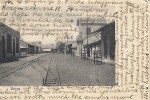

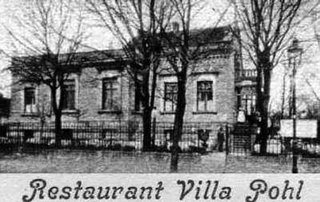
Folks who met the Prescos sensed there was an air of nobility around us. For some reason we felt special, and others treated us such.On this site you will find the Stuttmeister Villa in the Pankow area of Berlin near, or in, Charlottenburg. It was a very exclusive area where the very rich had homes. The address of Villa Pohl is No.1 Esplanade St. which is Berlin Way on the marriage certificate of Frederick William Stuttmeister. We knew next to nothing of our this history. I believe in genetic memory.
http://www.ansichtskarten-pankow.de/pankowhaeuserv.htm
The cremated remains of Alice and William Broderick are in Oakland.
Jon Presco
Copyright 2011
Charlottenburg is a locality of Berlin within the borough of Charlottenburg-Wilmersdorf, named after Queen consort Sophia Charlotte (1668–1705). It is best known for Charlottenburg Palace, the largest surviving royal palace in Berlin, and the adjacent museums.
Charlottenburg was an independent city to the west of Berlin until 1920 when it was incorporated into “Groß-Berlin” (Greater Berlin) and transformed into a borough. In the course of Berlin’s 2001 administrative reform it was merged with the former borough of Wilmersdorf becoming a part of a new borough called Charlottenburg-Wilmersdorf. Later, in 2004, the new borough’s districts were rearranged, dividing the former borough of Charlottenburg into the localities of Charlottenburg proper, Westend and Charlottenburg-Nord. In addition, Charlottenburg features a number of popular kiezes.
The Stuttmeisters were Teutonic Knights
“1874 were put on the road by the owner of manor Stuttmeister
(Charlottenburg), probably this terrain belonged. On the map of 1877
the route is drawn in still without names.”
The marriage cirtificate of William Stuttmeister says they lived on
Berlin Way. The main road through Charlottenburg castle was called
the road to Berlin. I was told the Stuttmeisters owned a great
estate in Berlin. It appears Charlottenburg Castle was built on the
Stuttmeister estate where Trekhener horses were long raised for the
King of Prussia and his wife Charlotte Stewart. Vic’s mother’s
middle name was Charlotte.
The Invalids’ Cemetery (German: Invalidenfriedhof) is one of the oldest cemeteries in Berlin. It was the traditional resting place of the Prussian Army, and is regarded as particularly important as a memorial to the German Wars of Liberation of 1813-15.
The development was accompanied by an urban planning of broad streets and sidewalks, parks and spacious residential buildings, especially around the southern Kurfürstendamm area, which enabled large parts of Charlottenburg to preserve their affluent residential character. “The richest town of Prussia” established a Royal Technical College in 1879 (which later became the Berlin Institute of Technology), followed by the Physikalisch-Technische Reichsanstalt and the College of the Fine Arts. A new town hall with a 88 m (289 ft) tall spire was erected on the occasion of its 200-year jubilee in 1905 and an opera house opened in 1912. The history of Charlottenburg as a municipality in its own right ended with the Greater Berlin Act of October 1, 1920, when the town became a part of Berlin. The Province of Brandenburg was administered in Charlottenburg from 1918 until the province’s dissolution in 1946 after World War II.
In the 1920s the area around the Kurfürstendamm evolved into the “New West” of Berlin, a development that had already started around 1900 with the opening of the Theater des Westens, the Café des Westens and the Kaufhaus des Westens, followed by several theatres, cinemas, bars and restaurants, which made Charlottenburg the Berlin centre of leisure and nightlife. Artists like Alfred Döblin, Otto Dix, Gottfried Benn, Else Lasker-Schüler, Bertolt Brecht, Max Liebermann, Stefan Zweig and Friedrich Hollaender socialized in the legendary Romanisches Café at the Kaiser Wilhelm Memorial Church. However the days of the Golden Twenties came to an end with the rise of the Nazi Party. In World War II the area around the Breitscheidplatz was heavily damaged by air raids and the Battle of Berlin.[citation needed]
Nevertheless after 1945 the Kurfürstendamm area quickly regained its importance, as with the partition of the city in the Cold War it became the commercial centre of West-Berlin. It was therefore the site of protests and major demonstrations of the late 1960s German student movement, that culminated on June 2, 1967 when student Benno Ohnesorg was shot by a police officer during a demonstration against Mohammad Reza Shah Pahlavi at the Deutsche Oper.[citation needed]
Before the reunification of Berlin, Charlottenburg was the center of West Berlin, with many high market bars and restaurants. After 1990 German reunification Charlottenburg struggled with the rise of the Mitte borough as Berlin’s historic centre.[1] The “City West” is still the main shopping area, offering several major hotels, theatres, bars and restaurants.
[edit] Sights
Town hall, about 1905
Theater des Westens
Museum Berggruen
[edit] Overview
Beside the palace, Charlottenburg is also home to:
the old and new Kaiser Wilhelm Memorial Church on the Breitscheidplatz, built in 1895 by Franz Schwechten and in 1961 by Egon Eiermann, the former West Berlin landmark
the Europa-Center, Berlin’s first shopping mall opened in 1965
Bahnhof Zoo, the main railway station in Berlin until the opening of Berlin Hauptbahnhof in 2006
the adjacent Berlin Zoological Garden, opened in 1844, officially located on the territory of the neighbouring Tiergarten locality
Kurfürstendamm avenue, first laid out about 1542, today together with the Tauentzienstraße Berlin’s main shopping area
Technical University of Berlin with about 27,000 students, founded in 1879
Berlin University of the Arts with about 4,500 students
Charlottenburg Town Hall, built in 1905
Charlottenburg Gate
Luisenkirche on Gierkeplatz, built in 1823 by Karl Friedrich Schinkel
the Amerika Haus on Hardenbergstraße, built in 1957 by the United States Information Agency
the Malteser-Hilfsdienst (Order of Malta) building at Alt-Lietzow str. 33
the Literaturhaus on Fasanenstraße and the nearby Institute for Media and Communication Policy
[edit] Theatres
Deutsche Oper Berlin on Bismarckstraße, opened in 1912, one of the three Berlin opera houses with relief in memory of Benno Ohnesorg by Alfred Hrdlicka, 1971 (installed in 1990)
Theater des Westens musical theatre on Kantstraße, built in 1896
Renaissance-Theater on Hardenbergstraße, 1902, rebuilt in Art deco design by Oskar Kaufmann in 1927
Schillertheater by Max Littmann, 1906
Tribüne theatre, 1919
Theater am Kurfürstendamm, 1921
[edit] Museums
Museum Berggruen for classic modern art
Museum Scharf-Gerstenberg for surrealist art
both located in the former Gardes du Corps barracks at Charlottenburg Palace, built by Friedrich August Stüler 1859
Museum für Vor- und Frühgeschichte (Museum for Pre- and Early History)
Museum of Photography and Helmut Newton Foundation, next to Bahnhof Zoo
Bröhan Museum for Art Nouveau and Art Deco
Literaturhaus Berlin and
Käthe Kollwitz Museum on Fasanenstraße
Gipsformerei (Replica workshop) of the Berlin State Museums
Beate Uhse Erotic Museum
From Wikipedia, the free encyclopedia
Jump to: navigation, search
For the neighborhood Charlottenburg-Nord, see Charlottenburg-Nord. For the village in Timiş County, Romania, see Bogda.
 Rosamond Press
Leave a comment