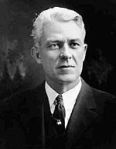

“Romney was a candidate for the Republican nomination for President of the United States in 1968. While initially a front-runner, he proved an ineffective campaigner, and fell behind Richard Nixon in polls. Following a mid-1967 remark that his earlier support for the Vietnam War had been due to a “brainwashing” by U.S. military and diplomatic officials in Vietnam, his campaign faltered even more, and he withdrew from the contest in early 1968.
Romney was born to American parents living in the Mormon colonies in Mexico; events during the Mexican Revolution forced his family to flee back to the United States when he was a child.”
Members of the Romney family have been deeply concerned about their colony they established in Mexico in order to escape Federal Laws. Does it matter – what laws? How about not paying Federal taxes and serving in the U.S. Military? Have any of Romney’s kindred served in the Mexian Army – and paid taxes in support of a foreign govvernment?
These question need answering because Donald Trump ‘The Birther’ has just come to Mitt’s defence in regards to shunning the “very poor” in America. This may not be a case of divided loyalties, but loyalty to the lawless Mormon church which recognizes no borders or bounderies for their religion, some discribe as a cult. Consider Jim Jones and the murder of Congressman Ryan.
Jon Presco
“Colonists would be exempted from military service and taxes for 20 years and they could bring with them, free of duty, teams, wagons, agricultural implements, building materials and provisions.”
(Updates with Trump-Romney relationship in third paragraph. For more 2012 campaign news, see ELECT.)
Feb. 2 (Bloomberg) — Mitt Romney, a day after being criticized by Democrats for his comments about America’s poor, will win the backing of real estate developer Donald Trump, according to two people who aren’t authorized to speak about the matter before a joint event today in Las Vegas.
Trump, 65, the host of “The Celebrity Apprentice” on NBC, flirted last year with his own presidential run. He planned what he billed as a “major announcement” today, and didn’t immediately return a call seeking comment.
Trump and Romney have had bumps in their relationship. In December, Romney declined to attend a Republican presidential candidates’ debate Trump had proposed in Iowa. The event was subsequently canceled. Trump, who owns a casino hotel in Las Vegas, would be throwing his support behind Romney two days before Nevada’s party caucuses. The timing has the potential to be both beneficial and awkward.
Romney, 64, a former private equity executive, is facing fresh questions about whether he is out of touch with less- fortunate people after saying in a CNN interview yesterday that “I’m not concerned about the very poor” because they have many programs to help them. He later told reporters on his campaign plane that his comment was taken out of context.
‘Ample Safety Net’
“No, no, no, no,” Romney protested when asked about his statement. “I’ve said throughout the campaign my focus, my concern, my energy is going to be devoted to helping middle- income people, all right?” He said poor people have an “ample safety net,” including Medicaid, housing vouchers, food stamps and the Earned Income Tax Credit.
“If there are people that are falling through the cracks, I want to fix that,” Romney said. “Wealthy people are doing fine. But my focus in the campaign is on middle-income people.”
Former U.S. House Speaker Newt Gingrich, defiant after his 14-point loss in Florida and vowing to stay in the race, pounced on Romney’s comments, saying they illuminated a “perfect distinction” between himself and his competitor.
At a rally in Reno, Nevada, Gingrich, 68, said he is “fed up with politicians of either party dividing Americans against each other. I am running to be the president of all the American people and I am concerned about all the American people.”
The reason that George was born in Mexico is that his grandfather – Mitt’s great-grandfather – had taken refuge there in order to escape US laws against polygamy. It was this family patriarch, Miles Park Romney, who established the colony and lived there with four wives.
Mitt Romney has decried what he has called the “awful’’ practice of polygamy and has never visited the colony, even though several dozen of his cousins continue to live there.
Romney was a candidate for the Republican nomination for President of the United States in 1968. While initially a front-runner, he proved an ineffective campaigner, and fell behind Richard Nixon in polls. Following a mid-1967 remark that his earlier support for the Vietnam War had been due to a “brainwashing” by U.S. military and diplomatic officials in Vietnam, his campaign faltered even more, and he withdrew from the contest in early 1968.
Romney was born to American parents living in the Mormon colonies in Mexico; events during the Mexican Revolution forced his family to flee back to the United States when he was a child. The family lived in several states and ended up in Salt Lake City, Utah, where they struggled during the Great Depression. Romney worked in a number of jobs, served as a Mormon missionary in England and Scotland, and attended two universities in the U.S. but did not graduate from either
Romney’s grandparents were polygamous Mormons who fled the United States with their children due to the federal government’s opposition to polygamy.[1] His maternal grandfather was Helaman Pratt (1846–1909), who presided over the Mormon mission in Mexico City before moving to the Mexican state of Chihuahua and who was the son of original Mormon apostle Parley P. Pratt (1807–1857).[2][3] In the 1920s, Romney’s uncle Rey L. Pratt (1878–1931) played a major role in the preservation and expansion of the Mormon presence in Mexico and in its introduction to South America.[4] A more distant kinsman was George Romney (1734–1802), a noted portrait painter in Britain during the last quarter of the 18th century.[5]
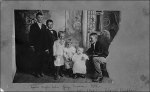
Gaskell Romney, sitting, and family, of Colonia Dublan, Chihuahua, c. 1908. Son George is fourth from the left.
Romney’s parents, Gaskell Romney (1871–1955) and Anna Amelia Pratt (1876–1926), were American citizens and natives of Utah. They married in 1895 in Mexico and lived in Colonia Dublán in Galeana in the state of Chihuahua (one of the Mormon colonies in Mexico) where George was born on July 8, 1907.[1][3][6] They practiced monogamy[1] (polygamy having gone into decline following the 1890 Manifesto). George had three older brothers, two younger brothers, and a younger sister.[7] Gaskell Romney was a successful carpenter, house builder, and farmer who headed the most prosperous family in the colony,[8][9] which was situated in an agricultural valley below the Sierra Madre Occidental.[10] The family did not speak Spanish and chose U.S. citizenship for their children, including George.[10]
The Mexican Revolution broke out in 1910 and the Mormon colonies were endangered in 1911–1912 by raids from marauders,[11] including “Red Flaggers” Pascual Orozco and José Inés Salazar.[12] Young George heard the sound of distant gunfire and saw rebels walking through the village streets.[12][13] The Romney family fled and returned to the United States in July 1912, leaving their home and almost all of their property behind.[1][14] Romney would later say, “We were the first displaced persons of the 20th century.”[15]
In the United States, Romney grew up in humble circumstances.[16] The family subsisted with other Mormon refugees on government relief in El Paso, Texas for a few months before moving to Los Angeles, California, where Gaskell Romney worked as a carpenter.[14][17] In kindergarten, other children mocked Romney’s national origin by calling him “Mex”.[18][19]
Rey Lucero Pratt (October 11, 1878 – April 14, 1931) served The Church of Jesus Christ of Latter-day Saints for 23 years as president of its Mexican Mission and for six years as a general authority. Pratt helped establish the church in Mexico and among Spanish-speaking populations in the United States and Argentina. He also translated LDS Church materials into Spanish, wrote magazine articles and spoke regularly at general conference.
Pratt has at times been called the father of the Mexican mission.[1]
Church membership in Mexico more than doubled during Pratt’s first six years as mission president. By 1911, over a thousand Church members lived in the Mexican Mission.
However, Mexico’s political climate gradually worsened. Porfirio Diaz, Mexico’s longtime dictator, lost control of the government and revolution ensued. Shortly after serious fighting began in Mexico City in 1913, the First Presidency authorized the Pratts and the American missionaries to return to the United States. The Pratts moved to Salt Lake City in September 1913. Two years later, the First Presidency again instructed the Pratts to move, this time to Manassa, Colorado, and establish missionary work among Mexicans in the United States. After five years, in November 1918, Church leaders moved the mission headquarters to El Paso, Texas, making it closer to the center of the vast mission territory.
In March 1921, Pratt reopened missionary work in Mexico with eight missionaries. In November, jurisdiction of the Juárez Stake in Chihuahua was transferred to the Mexican Mission. This made Pratt president of all the Spanish-speaking organizations in the Church. He continued to expand the mission, opening up work in southern California in 1924 and establishing a Los Angeles branch.
Seventy is a priesthood office in the Melchizedek priesthood of several denominations within the Latter Day Saint movement, including The Church of Jesus Christ of Latter-day Saints (LDS Church). Traditionally, a Latter Day Saint holding this priesthood office is a “traveling minister”[1] and an “especial witness”[2] of Jesus Christ, charged with the mission of preaching the gospel to the entire world under the direction of the Twelve Apostles.[3] The office of seventy was anciently conferred upon Church members by Jesus Christ himself, as seventy disciples mentioned in the Gospel of Luke 10:1-2. Multiple individuals holding the office of seventy are referred to collectively as seventies
 Rosamond Press
Leave a comment