This account appears to be lie!
“A few days after having been scorned by his other rival, the Bishop of Basle, Frederic II was mysteriously assassinated in his Ferrette castle. Public rumour implicated his son, Louis the Fierce, as the agent of the crime, and as such he was immediately excommunicated by the Pope and banished, leaving the possession of the county to his brother Ulrich. But it was reported in the cold, dark halls of the castle that on Ulrich’s death he made a deathbed confession to having been the real perpetrator of the crime!”
Another account says a paper was found where Ulrich gives his approval to his brother to murder their father. How convenient! I would never have penned such a note – and if I did, make sure it was destroyed – before I died. What is going on?
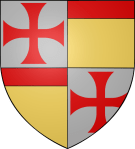
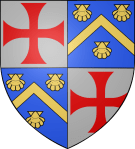
I suspect the Bishop of Basel employed a knight to murder Frederic who is kin to two Grand Masters of the Knight Templars, one who died mysteriously.
Jon Presco
Copyright 2012
“Frederic I thus became the first Count of Ferrette (1125-1160). He and his fellow counts of Bar and Montbéliard shared a common coat of arms, featuring two fish.
Born about 1190
Died before 1238
Parents
Richard Ier de FERRETTE ca 1165
Marie de BRIENNE
Spouse(s) and child(ren)
Married to Thibault Ier de NEUCHÂTEL ca 1195-1268 (Parents : Fromond II de DRAMELAY ca 1145-1213 & x de ROUGEMONT) ,
Richard de NEUCHÂTEL ca 1215-1269
Thierry II, Count of Montbéliard, had a castle built at the top of a steep hill above the Savoureuse River. He named this castle “Belfort”.
The territory of Frederic I, the Count of Ferrette, extended to the hill, facing Belfort castle. So he in turn decided to erect his own castle which he named “Montfort”, on the current site of the “Tour de la Miotte” (Miotte Tower).
From this point onwards the two related families shared a long common history of both happy events and conflicts of interest.
In examining the life of Frederic II, Count of Ferrette (1197-1232), there are obvious parallels between this unscrupulous, violent and arrogant man and the cruel customs and mysterious intrigues of the Middle Ages. Of all the Counts of Ferrette throughout the ages, Frederic II’s government was by far the most troubled, with the Count never ceasing to wage war against his neighbour Richard de Montfaucon, Count of Montbéliard.
A few days after having been scorned by his other rival, the Bishop of Basle, Frederic II was mysteriously assassinated in his Ferrette castle. Public rumour implicated his son, Louis the Fierce, as the agent of the crime, and as such he was immediately excommunicated by the Pope and banished, leaving the possession of the county to his brother Ulrich. But it was reported in the cold, dark halls of the castle that on Ulrich’s death he made a deathbed confession to having been the real perpetrator of the crime!
If the counts of Ferrette possessed the majority of the Sundgau, the ‘Sundgauvian’ territories of the north-east had long since belonged to the Habsburg dynasty, a wealthy local family whose heritage also includes Swiss lands. Moreover, the Habsburgs had passed on the honorary title of Landgrave of Upper Alsace (Sundgau) from father to son for centuries.
To seal the alliance, after Ulrich’s death Jeanne immediately married Albert II of Habsburg at Masevaux. By legitimate process the Sundgau became an entirely Austrian territory and remained so until 1648. However, according to documents of the time, this marriage of political interest seemed to quickly transform into one of love. Albert II and Jeanne de Ferrette settled in Vienna, from where their offspring would later extend their possessions into central and Eastern Europe.
The Sundgau quickly became a Habsburg bastion: a base for the dynasty which would later seek to conquer Europe and the rest of the world.
Two elements allow us to understand why the Austrian influence was so strong in Upper Alsace and why the Sundgau is different from other countries which, willingly or unwillingly, were conquered by the future Austrian empire:
✤The Sundgauvians’ deep loyalty towards the House of Austria, which they considered to be born of their country.
✤The establishment of the capital of Anterior Austria (Vorderösterreich) in Ensisheim in Upper Alsace. Anterior Austria included the Habsburgs’ personal possessions, from the Vosges to the Arlberg Pass to Tyrol, passing by Bade and northern Switzerland.
It was further complicated by the intervention by France, which had long been hostile to the ambitions of the House of Austria in Europe. During the Thirty Years’ War (1618-1648), Belfort was coveted by each side and was thus considered a sort of Gibraltar of the East. But King Louis XIV of France’s victories forced the Habsburgs to surrender Upper Alsace to him. The Habsburgs withdrew from the other side of the Rhine and made Freiburg-im-Breisgau the new capital of the rest of their possessions in Anterior Austria.
On the 24th October 1648 the Habsburgs signed the Treaty of Westphalia, stipulating the transfer of the Sundgau to France. However, public protests against the new French authority in the Sundgau were felt until the Treaty of Rijswijk (1697) and, it seems, until the beginning of the 18th century.
From 1648 the Sundgau was ruled by France and remained under its national colours until 1871, despite the Austrian desire to win back the Sundgau. By the Westphalia Treaty, the Sundgau was snatched from Anterior Austria, causing it to lose much of its strategic value. Nevertheless, the Habsburgs continued to hang onto the Rhine since they still, with difficulty, held the key town of Breisach, the “Gate to Germany”.
During the French Revolution (1789), Alsace and the Sundgau were administratively reorganised. From December 1789 to February 1790, the Constituante completely reorganised the French administration. The former provinces (Lorraine, Normandy, Alsace, Burgundy, Provence, etc) gave way to départements, which were themselves divided into several districts (or arrondissements). The province of Alsace was thus divided into two départements: the Bas-Rhin to the north and the Haut-Rhin to the south, with their respective administrative centres of Strasbourg and Colmar. Belfort, Mulhouse and Altkirch became the three sub-prefectures of the Haut-Rhin.
In 1806, in the Napoleonic period, the rest of Anterior Austria still under the direct power of the Habsburgs was shared between the duchy of Bade and Switzerland. From then on, Vienna became the epicentre of an empire which was more and more turned towards Eastern Europe: the romantic banks of the Rhine were eclipsed by those of the beautiful blue Danube.
1871 was a year that would go down in the Sundgau’s history, as it symbolises the defeat of the French army by the Prussian army. In 1870, Belfort sustained a memorable siege for 103 days, personified and symbolised by the statue of the Lion erected in 1880 by Bartholdi (a Colmar native renowned for having designed the Statue of Liberty in New York).
The French were obliged to surrender the territories of Germanic cultures and languages (north-east Lorraine and Alsace) to the victors. The preliminaries of the French-Prussian Treaty which was signed on 26 February, 1871, set the new border to the west of the Haut-Rhin département, however Article 1 stipulates that:
“On the other hand, the town of Belfort and its fortifications will remain French with a radius which will be determined later…”
At the celebration of Austria’s one thousandth anniversary in 1996, Anterior Austria returned to a place of honour. A business of European dimensions was put in place (with the creation of tourist brochures and books, exhibitions, European trades, and popular and cultural festivals) and mobilised the European Union, the Alsace region, Bade-Wurtemburg, Alemanic Switzerland, and of course all of Austria. The recognisable traits of the Habsburgs (the Austrian flag and the two-headed eagle) were henceforth visible in all of Anterior Austria and seem to be the silent witnesses of the common history of these regions… at the very least they remind us, rather curiously, that before being French or German, the Sundgau was completely Austrian!
The flag of the Sundgau is an unofficial design that emerged recently in the local landscape, maybe as an initiative to reinforce a sense of unity and belonging. It does not appear on public buildings (such as town-halls, schools, local councils) alongside the European, French and Alsatian flags. In Altkirch, you can see it as an iron sign of the Sundgau museum and in the neighbouring village of Carspach, featured in the centre of … the village’s roundabout!
Castle of the counts of Ferrette © French Moments
Forest of Hirtzbach, Sundgau © French Moments
This page was originally written in French and translated into English by Alison Walden for French Moments.
During the 14th century the Habsburgs and Ulrich III, the last Count of Ferrette, became very close. Seriously ill and realising that he would not have a male heir; Ulrich undertook several difficult measures in order to save his county from the Bishop of Basle and his ambitions.
A master strategist, Ulrich III was anxious for his daughter, Jeanne de Ferrette, to inherit his county. During the Middle Ages only the Pope had the power to arbitrate exceptionally in his favour. Against all hope, Ulrich received the precious papal consent in 1320.
The Count died on 15 March, 1324 in Basle, having no idea of the incredible destiny reserved for his descendants:
✤His county would become a powerful bastion of Austrian lands.
✤His daughter Jeanne de Ferrette, a direct descendant of Charlemagne, would enable the dynasty of the Habsburgs, future masters of Europe, to continue. Thanks to her, the Habsburgs could claim to be blood descendants of Charlemagne.
In becoming entirely Austrian, the Sundgauvians were not safe from the desires of Austria’s powerful enemies: the influential duchy of Burgundy, the fierce Swiss Confederates and the distant kingdom of France.
The frequent passing of enemy armies due to the Sundgau’s strategic position between the North and Mediterranean Seas, and between the two rivals, Paris and Vienna, did it more harm than good.
Later, in the 16th century, the Sundgau found itself surrounded by powerful Protestant cities: Mulhouse to the north, Basle to the east and Montbéliard to the west. The Habsburgs took a very firm stance against all attempts to introduce the Reform in the Sundgau.
Subsequently, the dynasty was the spearhead of the Counter Reformation, encouraging the introduction of anti-reformist works (particularly monasteries and Jewish schools) in the Sundgau.
However, from the Peace of Augsburg in 1555, Protestantism continued to make progress in Europe.
The Protestant princes of Bohemia refused to recognise the authority of the emperor of the Holy Roman Empire (HRE), Ferdinand II (who himself was a Habsburg).
War erupted in 1618 due to the extreme tension between Catholics and Protestants, and the emperor and Protestant princes.
Rudolph I (also known as Rudolph of Habsburg) (German: Rudolf von Habsburg, Latin: Rudolphus) (1 May 1218(1218-05-01) – 15 July 1291(1291-07-15)) was King of the Romans from 1273 until his death. He played a vital role in raising the Habsburg dynasty to a leading position among the Imperial feudal dynasties. Originally a Swabian count, he was the first Habsburg to acquire the duchies of Austria and Styria, territories that would remain under Habsburg rule for more than 600 years and would form the core of the Habsburg Monarchy and the present-day country of Austria.
The disorder in Germany during the interregnum after the fall of the Hohenstaufen dynasty afforded an opportunity for Count Rudolph to increase his possessions. His wife was a Hohenberg heiress; and on the death of his childless maternal uncle, Count Hartmann IV of Kyburg in 1264, he also seized his valuable estates. Successful feuds with the Bishops of Strasbourg and Basel further augmented his wealth and reputation, including rights over various tracts of land that he purchased from abbots and others.
These various sources of wealth and influence rendered Rudolph the most powerful prince and noble in southwestern Germany (where the tribal Duchy of Swabia had disintegrated, leaving room for its vassals to become quite independent) when, in the autumn of 1273, the prince-electors met to choose a king after Richard of Cornwall had died in England the year before. Rudolph’s election in Frankfurt on 29 September, when he was 55 years old, was largely due to the efforts of his brother-in-law, the Hohenzollern burgrave Frederick III of Nuremberg.
John of Brienne (c. 1155 – 27 March 1237) was a French nobleman who became King of Jerusalem by marriage, and ruled the Latin Empire of Constantinople as regent.
Jean de Candia-Nevers was the second son of Erard II, count of Brienne, in Champagne, and of Agnes de Montfaucon. Destined originally for a clerical career, he had preferred to become a knight, and in forty years of tournaments and fights he had won himself a considerable reputation, when in 1208 envoys came from the Holy Land to ask Philip Augustus, king of France, to select one of his barons as husband to the heiress and ruler of the Kingdom of Jerusalem. Philip selected John of Brienne, and promised to support him in his new dignity. In 1210, John married the heiress (Mary) Maria (daughter of Isabella and Conrad of Montferrat), assuming the title of king in right of his wife. In 1211, after some desultory operations, he concluded a five years’ truce with Malik-el-Adil; in 1212 he lost his wife, who left him a daughter, Yolande (also known as Isabella); soon afterwards he married the princess Stephanie, daughter of Leo II of Armenia.
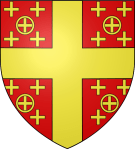
Coat of arms of the Latin Empire of Constantinople.
During the Fifth Crusade (1218–1221) he was a prominent figure. The legate Pelagius of Albano, however, claimed the command; and insisting on the advance from Damietta, in spite of John’s warnings, he refused to accept the favourable terms of the sultan, as the king advised, until it was too late. After the failure of the crusade, King John came to the West to obtain help for his kingdom. In 1223 he met Pope Honorius III and the emperor Frederick II at Ferentino, where, in order that he might be connected more closely with the Holy Land, Frederick was betrothed to John’s daughter Isabella, now heiress of the kingdom. After the meeting at Ferentino, John went to France and England, finding little consolation; and thence he travelled to Santiago de Compostela, where King Alfonso IX of Leon offered him the hand of one of his daughters and the promise of his kingdom. John passed over Alfonso’s eldest daughter and heiress in favor of a younger daughter, Berenguela of Leon. After a visit to Germany he returned to Rome (1225). Here he received a demand from Frederick II (who had now married Isabella) that he should abandon his title and dignity of king, which, so Frederick claimed, had passed to himself along with the heiress of the kingdom. John, though fifty or fifty-five years of age, was still vigorous enough to avenge himself on Frederick, by commanding the papal troops which attacked southern Italy during the emperor’s absence on the Sixth Crusade (1228–1229).
http://www.de-bric-et-de-broc.com/France/bar.html
The Château de Ferrette is a ruined castle in the commune of Ferrette in the Haut-Rhin département of France. It has been classified as a monument historique by the French Ministry of Culture since 1842.
Contents
[hide]
1 History
2 The castle in 1600
3 Today
4 See also
5 Notes and references
6 External links
[edit] History
It was on a rocky peak reaching 612 m altitude, overhanging the town of Ferrette, that Frederic of Montbeliard, son of Louis IV, count de Monbéliard, built the Château de Ferrette. It is not known if Frederic completely built the castle or simply restored a fortress by building on the ruins of what was an observation tower built by the Romans.
In 1103, Frederic I inherited the lands of upper Alsace, which later became the county of Ferrette. He died in about 1168. His son, Louis, succeeded him but died during a crusade he undertook in 1189.
Louis’ son, Frederic II, inherited. He developed his possessions to the point of attracting the covetous eye of the Bishop of Basel, with whom he had many conflicts. Frederic was assassinated in 1233, officially by his son, Louis, who was accused of patricide and excommunicated. His other son, Ulrich, seized power. It was only six centuries later that a parchment was discovered containing Ulrich’s consent to the assassination of his father.
Thes patricide was not a success because, in 1271, Ulrich was forced to sell to the Bishop of Basel the castle and the town of Ferrette, thus becoming a vassal of the Bishop, as were his son Thiébaut and his grandson Ulrich III.
With the death of Ulrich III, in 1324, Jeanne de Ferrette inherited the County of Ferrette. She married the Archduke Albert II of Habsburg and thus integrated her county into Austria which had it managed by administrators appointed by the Emperors. Given as a bailiwick to the lords Reich von Reichenstein in 1504, then to the Fuggers of Augsburg from 1540 to 1567, the castle was transformed into a garrison.
[edit] The castle in 1600
In 1600, the castle had three buildings:
– The “Oberschloss” or higher castle, comprising six rooms and eleven bedrooms, kitchen, bathroom and cellars. This part of the castle had a well 60m deep and a chapel dedicated to the virgin Saint Catherine.
– The bailiff’s house had four rooms, seven bedrooms, two kitchens, a stable to house three horses, a cellar and even a bathroom. It also had lofts to store 1000 sacks of grains. A bastion with two dungeons was designed to defend this building.
– The House of the Knights had only one room and one bedroom but with lofts able to contain 500 sacks of grains.
A wall with towers and bastions designed to be held in a determined attack, surrounded the castle.
[edit] Today
Set on fire by the French in 1635, the castle was destroyed after the Thirty Years’ War and only the lower part was restored. In 1644, at the Treaty of Munster in Westphalia, the Emperor of Austria yielded the county of Ferrette to the King of France, Louis XIV, who gave it to his minister, Cardinal Mazarin, who offered it to his niece. Her husband took the titles of Duke de Mazarin and Count de Ferrette. These titles were passed on to his heirs and exist today in the person of the Prince of Monaco who still carries the title of Count de Ferrette.
Thereafter, the castle was sold to the Zuber family, rich textile manufacturers from the Mulhouse region. Its ruins are maintained with the financial aid of the town of Ferrette, of the départment of Haut-Rhin and the Services des Bâtiments de France.
1286–1296
Peter I Reich von Reichenstein
The realm of realm stone were a Swiss knight sex, which is mentioned for the first time 1166/79 with Rudolf Dives. The sex stood in the service of the bishops of Basel, dressed starting from the beginning 13. Century the office of the treasurer and got the castle realm stone around 1250 with Arlesheim of the bishop of Basel as Lehen. The realm of realm stone were of 13. to center 15. Century in the advice of the city represented, placed Basel six mayors of Basel, a bishop of Basel as well as a rector of the University of Basel. Since that 15. The family members stepped century increasingly into the service of the Habsburger and the Mark counts von Hachberg and Baden. The possession of the family was appropriate for Sundgau and southern Black Forest in Basel-offered, and consisted of Lehen of the dukes of Austria, the bishop of Basel and the Mark counts von Baden. In addition bromine brook belonged in the meadow valley, Buschweiler in the Elsass, Inzlingen and realm stone with Arlesheim. Toward end 15. Century acquired they the rule Landskron in the Elsass, 1457 the pledge shank Thann as well as 1503/04 the pledge shank Pfirt. The realm by realm stone remain catholic also after the reformation time and withdrew themselves to their goods into the Black Forest and Sundgau. 1773 received it from the French king the title of a baron.
family members [Work on]
Peter Reich von Reichenstein († 1296), from 1286 to 1296 bishop of Basel
e county Pfirt with the principal place Pfirt (frz. Ferrette) developed in the 11. Century from the rule over the castle Pfirt. The southern Oberelsass was subordinate to the count von Pfirt. 1324 came the county by the marriage of the heiress Johanna of Pfirt with Albrecht II., duke of Austria, to the Habsburger. The formal Belehnung by the bishop of Basel took place in the year after (1325). By the Westfäli peace Pfirt came 1648 as Comté de Ferrette to the Kingdom of France.
count von Pfirt from the house Scarponnois [Work on]
Ludwig von Mousson, count, Mr. von Mousson, 1042 castellanus in Mömpelgard, Altkirch and Pfirt, † 1073/76
Dietrich I., count in Altkirch and Pfirt, 1033 in bar, † 1102/05, son of Ludwig
Friedrich Ith, 1125 count von Pfirt, † probably 1160, son of Dietrich
Ludwig Ith, 1161 count von Pfirt, † 1180, son Friedrichs Ith ∞ Richenza of having castle
Ulrich Ith, 1194 count von Pfirt, † 1197, son of Ludwig I.
Ludwig II., count von Pfirt, † 1189, brother Ulrichs I.
Friedrich IITH, 1194 count von Pfirt, † 1234, son of Ludwig II.
Ulrich IITH, 1227 count von Pfirt, † 1275, son Friedrichs II.
Ludwig III. the Grimmel, 1227 count von Pfirt, † 1236, brother Ulrichs II.
Theobald, 1271 count von Pfirt, 1292/97 Landvogt in the Elsass, † 1310/11, son Ulrichs II.
Ulrich IIITH, 1311 count von Pfirt, † 1324, son Theobalds
Johanna, 1324 countess of Pfirt, † 1352; ∞ 1324
Albrecht II., duke of Austria, 1324 count von Pfirt, † 1358

 Rosamond Press
Leave a comment