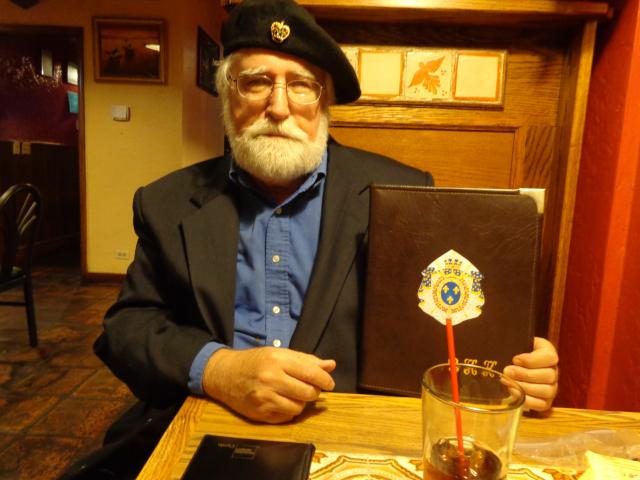
Royal Rosamond Press
Here is my post I made in the yahoo.groups titled The Priory, on Wed Nov 15, 2006 1:52 pm. That’s twenty years ago.
On this day, I challenge Bill Rozier to produce evidence he was studying the Knights Templar and the Shroud of Turin around this time. I own scopious notes. I contend Rozier only became aware his great grandfather was Thibault 1V Rougemont – about six years ago when he used the search engine at Geni. He got the impetus to do this after reading my man posts on the Rougemont Templars on Facebook. Just because he is a great grandson, does not mean he can scoop everything with the name Rougemont – into his pile! No court recognizes the Leglity of a Bloodline, or, counts onces DNA as containing special privileges. Rozier might find some foreigners who would pledge felty, but, we live in a
DEMOCRACY
Forinstance: Rozier claims he descend from the Real Robinhood. If true, this does not mean he can hire an attorney – and claim Sherwood Forest!
Several days ago Bill Rozier bid my attorney contact his attorney in regards to his violation of my Copyright. But what is more important, Rozier used Artifitial Intelligence to ATTACK ME – and members of my Facebook group…
JOHN NAZARITE
On this day, August 17, 2026, I accuse Bill Rozier of creating the first…
ARTIFICIAL INTELLIGENCE KNIGHT ATTACK TEMPLAR
William Rozier – is an Attack-bot! I will produce the many warnings we have recieved that…..IT IS COMING! Theo Baker WARNED US!
I challenge Rozier to produce his genealgy showing his kinship to any Rougemont Templar, and produce evidence of what he was doing in 2006 to make his alleged discoveries that his AI site claims I “echo”.
John Presco
President: Royal Rosamond Press
Archbishops of Besancon resided over the Knights of Saint-George who
met at Rougemont Castle.
| braskewitz · braskewitz@yahoo.com | Group Member – Edit Membership | Start a Group | My Groups |
thepriory · The Priory – Let’s talk medieval conspiracy!

SearchWeb Search
Wed Nov 15, 2006 1:52 pm
 Show Message Option
| Here is the premiere family of the Shroud of Turin that some suggest was owned by the Knight Templars. http://tinyurl.com/yku9cw Amédée de Tramelay is kin to Bernard de Dramelay/Tramelay. Archbishops of Besancon resided over the Knights of Saint-George who met at Rougemont Castle. 1180-1190 : Thierry II de Montfaucon 1191-1193 : Etienne de Vienne 1993-1220 : Amédée de Tramelay 1221-1225 : Gérard de Rougemont Jon Presco The Rougemonts The Premiere Shroud Family http://tinyurl.com/yku9cw by Jon Presco Copyright 2003 http://rougeknights.blogspot.com/ http://tinyurl.com/ycfnto http://tinyurl.com/wnjq4 http://tinyurl.com/ykfrds Bernard de Tramelay/Dramelay was a Grand Master of the Knight Templars who is said to have died just after he and forty Knight Templars breached the walls of Ascalon during the Crusades. Information on Bernard is very scarce, it suggested his greed got him and the forty Templars killed, as the first to conquer a city got the lion’s share of the spoils. There is a suggestion there was a falling out between the Templars and the Christian forces who did not follow Bernard into the breach. When the Muslim defenders saw this, they closed on Bernard who I suspect was trying to capture the Ark of the Covenant that Joseph Flavius said was in Ascalon. The Templars were very keen to own the Ark, and when they first arrived at the temple grounds they began to dig extensively, especially atop the Mount of Olives where they built a substantial fortress. Did they suspect what I have put forth, that the Ark was either the Oracle of Delphi, or kin to this object and the process which allowed great men and women to see their fate? I suspect Absalom was an Oracle, the angel Ariel/Uriel. For two years now I have been looking at the name Fromond de Dramelay who married a “dame de Rougemont”. He is shown in many genealogies (including a Rougemont chart) to be the son of Amedee, the Archbishop of Besancon, which is located fifty miles or so from Rougemont in the Franche-Comte where it is said Bernard was born. His father was named Humbert. All the Humbert names I have found on the net belong to the Ferrette/Rougemont family. Several Rougemonts were the Archbishops of Besancon. The Templars were also in possession of the Shroud of Turin that was given to Amedee by Othen de la Roche (of the small rock). It has been concluded that Bernard de Tramelay is the related to Amedee. The de la Roche family is kin to the Rougemont and Dramelay family. j. Jean de Montreaux (Montrose) married Marguerite de Rougemont. Jean is a Ferrette who built Montreux castle that is fifty miles from Rougemont. Their daughter Alix married Fromond of Saint-Loup where the Templars are said to have brought their treasure. The Marquis d’Auxelles came to live in the rebuilt castle of Rougemont. Chambrun d’Uxeloup de Rougemont bought Arginy castle and began to look for the lost Templar treasure. The name Uxeloup come from Saint-Loup and Auxelles a castle that was built by the Ferrette family who dwelt in Rougemont castle. Members of the ‘Arginy Renaissance’ are said to be descendants from Knight Templars, even a Grand Master in regards to Guillaume de Beajeau, but, I suspect this group knew who Bernard Tramelay was…..and what he captured at Ascalon? Marguerite de Saint Loup d’Auxelles married Thibaut 4 of Rougemont. Richard d’Auxelles married Thibaut’s daughter, Helvuis, whose grandfather was Humbert. This Humbert appears to be the Archbishop of Besancon, a name that means “house of light”. Here is a quote about the Rougemonts and Counts of Champagne who commisioned some of the Grail legends; “By skillful policy, “always acquiring never alienating” the family formed matrimonial alliances with the great families, Montbeliard, Commercy, Chatteauvillian, Geroldseck, Chalon- Auxere, Montague, Ray, Rougemont, Joinville, and Grandson.” Shround of Turin and Knights of Saint-George The Knights of Saint-George met at Rougemont Castle and had a room in a tower in Besancon. The Archbishop of Besancon resided over a ritual there that involved ceratin relics. Was the Shroud of Turnin one of them? “A room in the tower of Montmartin was granted to him by a treaty with the town of Besancon, as well as the exemption of the housing of people of war for the knights residing in Besancon. The knights of Saint-George were besides only noble city of Besancon has to profit from this inappreciable privilege. “These portraits like that of the prince of COP, special guard of the brotherhood decorated the superb room with the Large Carmelite friars of Besancon, unfortunately destroyed at the time of the Revolution. The plank of the woodworks of the room was decorated series of the blasonnés ecus of the alive knights, with their confined inscriptions of their four districts, which one descended at the time of their death to be carried in ceremony with the church, then suspended with their row in the nave where one saw a great number of it which had decorated a long time the vault with Rougemont.” Archbishops of Besancon 1180-1190 : Thierry II de Montfaucon 1191-1193 : Etienne de Vienne 1993-1220 : Amédée de Tramelay 1221-1225 : Gérard de Rougemont http://gilles.maillet.free.fr/histoire/genealogie_bourgogne/famille_r ougemont_faucogney.htm The daughter of Geoffrey II de Charny, Marguerite de Charny, marries Jean de Beaufremont who will be killed at the battle of Azincourt in 1415. In 1418 Marguerite de Charny marries again, to Humbert de Villersexel, seigneur de Saint Hippolyte sur le Doubs. 1418 The Shroud is given to Humbert de Villersexel by the Canons of Lirey. It will be conserved in the chateau de Monfort, near Montbard, then transferred to Saint Hippolyte sur le Doubs, in the Chapelle des Buessarts. 1438 Death of Humbert de Villersexel ; the canons of Lirey want to recover the Shroud. Marguarite de Charny refuses. The case is carried before the parliament of Dole (May 1443), then to the Court of Besancon (July 1447). Both decide in favour of Marguarite de Charny. The canons refuse to accept this judgment, and ask for the excommunication of Marguarite de Charny. In 1459 they abandon their claim in return for financial compensation. The quarrel had lasted 21 years ! http://freepages.genealogy.rootsweb.com/~jamesdow/s025/f001534.htm The PEDIGREE of Ermentrude de MONTBELLIARD Born: abt. 1120 Died: abt. 1171 Husband/Partner: Eudes (Othon) de la ROCHE-SUR-OGNON Child: Pons I de la ROCHE-SUR-OGNON Louis I de MOUSSON + “The commune of the Mount was joined together with that of Dramelay on March 19, 1825. At the time Gallic, it was the oopida surrounding populations. A tower, placed at Chaitelot, rose in the region along the way which went the Saline ones in Izernore. The tradition populates spirits the Wood of the Fairy which shade the foot of the mountain. The Temple of Bacchus was replaced by a church dedicated to Saint Martin’s day, substitution all the more constant as, not far from the church, is a space of ground called as a Bacchus. These places known as prove the high antiquity of Dramelay. Let us note in the passing that there was the pagan Temple dedicated to Segomon Mars in Arinthod, and the menhir of the small valley of Vogna. With the fall of the Roman empire, Burgundes take this southern region of the Jura. The Lords de Dramelay obtain a prerogative between Suran and Valouse, to the river of Ain. Lords: TheReferees made him return freedom. The marriage which took place between Jean de Chalons II and Alix of Burgundy in 1317, inserted the baronnie of Dramelay in the house of the Lords of Orgelet. On March 6, 1365, a division grants Tristan de Chalons Arinthod, Dramelay, Boutavent. Jean, Lord de Chalons, wire of Tristan, bequeath by will of May 3, 1396, in Alix of Trawl-nets his sister, married in 1384 in François de Sassenage, Montfleur, Arinthod, Chavannes and Dramelay. Alix remarie in 1403 in Guillaume of Saulieu. She bequeaths all her goods to her nephew, Louis of Trawl-nets-Arlay III, in 1426. And the house of Trawl-net-Arlay will preserve the ground of Dramelay until the beginning of the XVI eme century. Philiberte of Luxembourg sells it in 1512 to Philippe-François de Luyrieux. This last resells it in Louis of Saix, repurchases it in 1531 with its successors. In March 1643, it passes from Charles of the Room and Isabelle de Luyrieux to Jean de Méria and Jean Mouchet. Successive owners: Philibert of the Room, its sons Claude and Jean of the Room The latter find a ground grévée of debts. On October 29, 1561, their uncle bishop of Belley and their curator authorizes them to sell to Nicolas Chupin and Louise Battefort her wife. Leonel de Battefort, wire of Louise de Battefort succeeds.” “The only city to have claimed to possess the Shroud from 1208 to 1329 was the French city of Besançon. The theory is that during the Fourth Crusade, the Burgundian knight who commanded the district of Blachernae where the Shroud was kept, Othon de la Roche, Duke of Athens and Sparta, received it as part of his recompense.” Hugues de ROUGEMONT Seigneur de VILLERSEXEL Born: ? Died: abt. 1227 Wife/Partner: Beatrice de FAUCOGNEY Possible Child: Aymon de FAUCOGNEY Alternative Father of Possible Child: Aymon de FAUCOGNEY — Thiebaut I de ROUGEMONT / — Thiebaut II de ROUGEMONT (? – 1173+) / \ — Poncette de TRAVES (? – 1156+) / — Humbert II de ROUGEMONT (? – by 1227) / \ — Alais – Hugues de ROUGEMONT \ / — Odon de BESANCON \ — Sibille de BESANCON \ — Julienne “The theory that the Templars may have possessed the Shroud is supported by the discovery in 1944 of a painting of the Holy Face (circa 1280) on a wooden panel in the village of Templecombe, England. This village was owned by the Knights Templars from about 1185. Rex Morgan, a Shroud scholar, hypothesized that the wooden panel may actually have been a lid to a wooden box which contained the Shroud when it was transferred from France to England during the suppression of the Templars. “The Templecombe panel has 125 points of congruence with the Shroud face . . . The fleur-de-lis decoration of the painting strongly suggests French influence and the quatrefoil design is recurrent in Templar . . . decorative motifs.” The theory is very plausible, except that the Templars never admitted to possessing the Shroud. The only city to have claimed to possess the Shroud from 1208 to 1329 was the French city of Besançon. The theory is that during the Fourth Crusade, the Burgundian knight who commanded the district of Blachernae where the Shroud was kept, Othon de la Roche, Duke of Athens and Sparta, received it as part of his recompense. The claim that the Shroud was in Athens is attested to directly in a letter by Theodore of Epirus dated August 1, 1205, and indirectly by Nicholas of Otranto, abbot of the monastery of Casole. Othon, in turn, sent the cloth to his father, Ponce de la Roche, who then handed it over to the Bishop of Besançon, who placed it in the Cathedral of St. Etienne where it was exposed for veneration each year on Easter until 1349. In that year a fire burned down the Cathedral causing slight damage to the Shroud. In the midst of all the confusion, the Shroud disappeared. According to a dubious sixteenth-century account kept in the second church of Lirey, the Shroud was given to King Philip VI. He subsequently gave it to a friend whose name, coincidentally, was the same as the Templar Grand Master who was burned at the stake, Geoffrey I de Charny! http://www.tanbooks.com/doct/shroud_turin.htm Archbishops of Besancon 1180-1190 : Thierry II de Montfaucon 1191-1193 : Etienne de Vienne 1993-1220 : Amédée de Tramelay 1221-1225 : Gérard de Rougemont 1225-1227 : Jean 1er HAlgrin 1229-1235 : Nicolas de Flavigny 1236-1241 : Geoffroy 1245-1268 : Guillaume II de la Tour 1269-1301 : Eudes de Rougemont 1302-1311 : Hugues de Chalon (ex évêque de Liège) 1312-1333 : Vital de Maignaut 1333-1355 : Hugues VI de Vienne 1355-1361 : Jean IIII de Vienne 1361-1362 : Louis de Montbéliard 1363-1370 : Aymon de Villersexel 1371-1391 : Guillaume II de Vergy 1391-1404 : Gerard III d’Athies 1405-1429 : Thiébaudde Rougemont 1430-1437 : Jean III de Rochetaille 1437-1438 : François Ier Condomieri 1438-1439 : Jean IV de Norry 1439-1462 : Quentin Ménard 1462-1498 : Charles de Neufchâtel The noble association of the knights of Saint-George was founded in Rougemont about the year 1300 by the sovereigns of the county of Burgundy to gather Burgundian gentlemen of former knighthood. Their badge at that time was a medal representing holy George with horse embanking a dragon, suspended with a gold chain. This brotherhood was destroyed at the end of XIVe century by the wars. She was restored by Philibert of MOLLANS (3), knight comtois who would have brought back Holy Land of the relics of Saint-George. He consequently thought of offering them to the nobility of the county of Burgundy. He thus joins together about 1435 or 1440, a certain number of knights comtois to honour these relics in a vault which he had with the castle of Rougemont. And it solved to celebrate each year the festival of a saint, that the nobility regarded as its owner, because it was knight and that one represented it with horse armed with a lance. Philibert of MOLLANS was undoubtedly the first governor of the order elected by the body of the knights. Consequently, the largest lords of the country hastened to be made receive in the brotherhood, and were assembled each year in the vault of Rougemont on April 22, day before the George Saint. Philippe the Good authorized the order to like carry the suspended medal to a red ribbon that of the Golden Fleece. In 1648, the brotherhood settled in Besancon and not in Dole, then capital county of Burgundy, indeed the brotherhood had already a political role while being opposed to the Parliament of Pares. A room in the tower of Montmartin was granted to him by a treaty with the town of Besancon, as well as the exemption of the housing of people of war for the knights residing in Besancon. The knights of Saint-George were besides only noble city of Besancon has to profit from this inappreciable privilege. However, it seems to have met several times at Vesoul, city which has as Saint-George patron saint. Then on April 25, 1661, the brotherhood is assembled in Salins and decides that henceforth it will meet in Besancon, with the convent of the Large Carmelite friars, rested by a fellow-member: Jean of VIENNA. After the conquest, Louis XIV decided to tolerate the brotherhood, in spite of his resistance to the invader. He made it possible even to the knights to carry their medal of Saint-George suspended to a blue moire ribbon like that about the Holy Spirit, this in order to adapt has lower cost part of the nobility comtoise, which would provide him executives devoted for its army. Besides Louis XV & Louis XVI, continued the policy of the Sun king with regard to the brotherhood, they addressed to the company portraits the them same ones, in foot, where one could read: “Given by the king the knights of George Saint of his county of Burgundy.”. These portraits like that of the prince of COP, special guard of the brotherhood decorated the superb room with the Large Carmelite friars of Besancon, unfortunately destroyed at the time of the Revolution. The plank of the woodworks of the room was decorated series of the blasonnés ecus of the alive knights, with their confined inscriptions of their four districts, which one descended at the time of their death to be carried in ceremony with the church, then suspended with their row in the nave where one saw a great number of it which had decorated a long time the vault with Rougemont. The church which was papered blazons of the knights of George Saint was also paved of their tombs, “as if they had wanted to join together in this place the emblems of human vanity to the testimony of his nothing”. At the time of the general assembly of April 25, 1768, new statutes were written, they will be studied here. Article II – If the governor or ordering province wants to attend these assemblies, the four appointed knights will accompany it instead of the assembly, where it will take the row and the meeting due to his load and the sovereign which it represents, which is the chief of the knighthood.Article III – The archbishops and bishops, knights of the order, will be drawn from their row of reception, in consideration of their dignities joined together with that of knight, and will immediately have meeting after the governor of the order, in armchairs placed at its left and with the top of the table, and the other knights will sit each one with their row of reception. y go down from the sovereign Counts of Burgundy. Bernard de Dramelay: (1134) figure at the court of Renaud III of Bourgogne.Il goes to the crusade préchée by Saint-Bernard in 1147, fights with the head office of Ascalon, and obtains the distinguished title of Large Maitre of the Temple of Midsummer’s Day of Jerusalem. Hugues de Dramelay: (1175) He is constable of the county of Burgundy. Amédée de Dramelay becomes Archevêque of Besancon at the end of the XII eme century. Put to the test by its political options, it was locked up with the Castle of Montbeliard a few months in 1199. Returned to freedom, it goes back on its seat, but the count Etienne of Burgundy often devastated his fields. Wearied troubles which its canons caused him, it left for the crusade in 1218 and died out of Holy Land in 1220. In him the family of the Lords de Dramelay died out. Etienne of Burgundy, owner of Baronnie d’ Orgelet, joins together Baronnie de Dramelay with his fields. The descendants of Guillaume de Dramelay, nephew of Bernard, do not preserve any right on this ground. Jean de Chalons collected the baronnie of Dramelay, in the succession of his father in 1248. He lays out about it in favour of Philippe de Courtenay, and in August 1248 gives it into stronghold- liege to Raoul de Courtenay and his successors, by stipulating that the castle would be jurable and rendable with him or (and?) with those of the children whom it would have of Isabelle de Courtenay his wife. What enabled him to return in possession of this property when good would seem to him; what did not delay since in 1262 his/her son ainé Hugues entered in property of this ground. The latter was allocated to the son of Hugues, named Renaud, who did not want to recognize any more Jean de Chalons for his suzerain. This last made him the war and did it captive. |
“Jon Presco” <braskewitz@yahoo.com>
braskewitz
Send Email
| braskewitz · braskewitz@yahoo.com | Group Member – Edit Membership | Start a Group | My Groups |
thepriory · The Priory – Let’s talk medieval conspiracy!
HomeMessagesPostFilesPhotosLinksDatabaseMembersCalendarPromoteGroups Labs (Beta)ApplicationsChatYahoo! Groups TipsDid you know…Hear how Yahoo! Groups has changed the lives of others. Take me there.Best of Y! Groups Check them out and nominate your group. Check them out and nominate your group. |  Click here for the latest updates on Groups Message searchMessages Messages HelpMessage # Search: AdvancedStart TopicShroud Family Message List Reply | DeleteMessage #4457 of 4656 | Here is the premiere family of the Shroud of Turin that some suggest Click here for the latest updates on Groups Message searchMessages Messages HelpMessage # Search: AdvancedStart TopicShroud Family Message List Reply | DeleteMessage #4457 of 4656 | Here is the premiere family of the Shroud of Turin that some suggestwas owned by the Knight Templars.http://tinyurl.com/yku9cwAmédée de Tramelay is kin to Bernard de Dramelay/Tramelay.Archbishops of Besancon resided over the Knights of Saint-George who met at Rougemont Castle.1180-1190 : Thierry II de Montfaucon 1191-1193 : Etienne de Vienne 1993-1220 : Amédée de Tramelay 1221-1225 : Gérard de RougemontJon PrescoThe Rougemonts The Premiere Shroud Familyhttp://tinyurl.com/yku9cwbyJon Presco Copyright 2003http://rougeknights.blogspot.com/http://tinyurl.com/ycfntohttp://tinyurl.com/wnjq4http://tinyurl.com/ykfrdsBernard de Tramelay/Dramelay was a Grand Master of the Knight Templars who is said to have died just after he and forty Knight Templars breached the walls of Ascalon during the Crusades. Information on Bernard is very scarce, it suggested his greed got him and the forty Templars killed, as the first to conquer a city got the lion’s share of the spoils. There is a suggestion there was a falling out between the Templars and the Christian forces who did not follow Bernard into the breach. When the Muslim defenders saw this, they closed on Bernard who I suspect was trying to capture the Ark of the Covenant that Joseph Flavius said was in Ascalon. The Templars were very keen to own the Ark, and when they first arrived at the temple grounds they began to dig extensively, especially atop the Mount of Olives where they built a substantial fortress. Did they suspect what I have put forth, that the Ark was either the Oracle of Delphi, or kin to this object and the process which allowed great men and women to see their fate? I suspect Absalom was an Oracle, the angel Ariel/Uriel.For two years now I have been looking at the name Fromond de Dramelay who married a “dame de Rougemont”. He is shown in many genealogies (including a Rougemont chart) to be the son of Amedee, the Archbishop of Besancon, which is located fifty miles or so from Rougemont in the Franche-Comte where it is said Bernard was born. His father was named Humbert. All the Humbert names I have found on the net belong to the Ferrette/Rougemont family. Several Rougemonts were the Archbishops of Besancon.The Templars were also in possession of the Shroud of Turin that was given to Amedee by Othen de la Roche (of the small rock). It has been concluded that Bernard de Tramelay is the related to Amedee. The de la Roche family is kin to the Rougemont and Dramelay family. j.Jean de Montreaux (Montrose) married Marguerite de Rougemont. Jean is a Ferrette who built Montreux castle that is fifty miles from Rougemont. Their daughter Alix married Fromond of Saint-Loup where the Templars are said to have brought their treasure. The Marquis d’Auxelles came to live in the rebuilt castle of Rougemont. Chambrun d’Uxeloup de Rougemont bought Arginy castle and began to look for the lost Templar treasure. The name Uxeloup come from Saint-Loup and Auxelles a castle that was built by the Ferrette family who dwelt in Rougemont castle. Members of the ‘Arginy Renaissance’ are said to be descendants from Knight Templars, even a Grand Master in regards to Guillaume de Beajeau, but, I suspect this group knew who Bernard Tramelay was…..and what he captured at Ascalon?Marguerite de Saint Loup d’Auxelles married Thibaut 4 of Rougemont. Richard d’Auxelles married Thibaut’s daughter, Helvuis, whose grandfather was Humbert. This Humbert appears to be the Archbishop of Besancon, a name that means “house of light”. Here is a quote about the Rougemonts and Counts of Champagne who commisioned some of the Grail legends; “By skillful policy, “always acquiring never alienating” the family formed matrimonial alliances with the great families, Montbeliard, Commercy, Chatteauvillian, Geroldseck, Chalon- Auxere, Montague, Ray, Rougemont, Joinville, and Grandson.”Shround of Turin and Knights of Saint-GeorgeThe Knights of Saint-George met at Rougemont Castle and had a room in a tower in Besancon. The Archbishop of Besancon resided over a ritual there that involved ceratin relics. Was the Shroud of Turnin one of them?”A room in the tower of Montmartin was granted to him by a treaty with the town of Besancon, as well as the exemption of the housing of people of war for the knights residing in Besancon. The knights of Saint-George were besides only noble city of Besancon has to profit from this inappreciable privilege.”These portraits like that of the prince of COP, special guard of the brotherhood decorated the superb room with the Large Carmelite friars of Besancon, unfortunately destroyed at the time of the Revolution. The plank of the woodworks of the room was decorated series of the blasonnés ecus of the alive knights, with their confined inscriptions of their four districts, which one descended at the time of their death to be carried in ceremony with the church, then suspended with their row in the nave where one saw a great number of it which had decorated a long time the vault with Rougemont.”Archbishops of Besancon1180-1190 : Thierry II de Montfaucon 1191-1193 : Etienne de Vienne 1993-1220 : Amédée de Tramelay 1221-1225 : Gérard de Rougemonthttp://gilles.maillet.free.fr/histoire/genealogie_bourgogne/famille_r ougemont_faucogney.htmThe daughter of Geoffrey II de Charny, Marguerite de Charny, marries Jean de Beaufremont who will be killed at the battle of Azincourt in 1415. In 1418 Marguerite de Charny marries again, to Humbert de Villersexel, seigneur de Saint Hippolyte sur le Doubs.1418The Shroud is given to Humbert de Villersexel by the Canons of Lirey. It will be conserved in the chateau de Monfort, near Montbard, then transferred to Saint Hippolyte sur le Doubs, in the Chapelle des Buessarts.1438Death of Humbert de Villersexel ; the canons of Lirey want to recover the Shroud. Marguarite de Charny refuses. The case is carried before the parliament of Dole (May 1443), then to the Court of Besancon (July 1447). Both decide in favour of Marguarite de Charny. The canons refuse to accept this judgment, and ask for the excommunication of Marguarite de Charny. In 1459 they abandon their claim in return for financial compensation. The quarrel had lasted 21 years !http://freepages.genealogy.rootsweb.com/~jamesdow/s025/f001534.htmThe PEDIGREE of Ermentrude de MONTBELLIARD Born: abt. 1120 Died: abt. 1171Husband/Partner: Eudes (Othon) de la ROCHE-SUR-OGNON Child: Pons I de la ROCHE-SUR-OGNONLouis I de MOUSSON +”The commune of the Mount was joined together with that of Dramelay on March 19, 1825.At the time Gallic, it was the oopida surrounding populations. A tower, placed at Chaitelot, rose in the region along the way which went the Saline ones in Izernore. The tradition populates spirits the Wood of the Fairy which shade the foot of the mountain. The Temple of Bacchus was replaced by a church dedicated to Saint Martin’s day, substitution all the more constant as, not far from the church, is a space of ground called as a Bacchus. These places known as prove the high antiquity of Dramelay. Let us note in the passing that there was the pagan Temple dedicated to Segomon Mars in Arinthod, and the menhir of the small valley of Vogna. With the fall of the Roman empire, Burgundes take this southern region of the Jura. The Lords de Dramelay obtain a prerogative between Suran and Valouse, to the river of Ain. Lords: TheReferees made him return freedom. The marriage which took place between Jean de Chalons II and Alix of Burgundy in 1317, inserted the baronnie of Dramelay in the house of the Lords of Orgelet. On March 6, 1365, a division grants Tristan de Chalons Arinthod, Dramelay, Boutavent. Jean, Lord de Chalons, wire of Tristan, bequeath by will of May 3, 1396, in Alix of Trawl-nets his sister, married in 1384 in François de Sassenage, Montfleur, Arinthod, Chavannes and Dramelay.Alix remarie in 1403 in Guillaume of Saulieu. She bequeaths all her goods to her nephew, Louis of Trawl-nets-Arlay III, in 1426. And the house of Trawl-net-Arlay will preserve the ground of Dramelay until the beginning of the XVI eme century.Philiberte of Luxembourg sells it in 1512 to Philippe-François de Luyrieux. This last resells it in Louis of Saix, repurchases it in 1531 with its successors. In March 1643, it passes from Charles of the Room and Isabelle de Luyrieux to Jean de Méria and Jean Mouchet.Successive owners: Philibert of the Room, its sons Claude and Jean of the Room The latter find a ground grévée of debts. On October 29, 1561, their uncle bishop of Belley and their curator authorizes them to sell to Nicolas Chupin and Louise Battefort her wife. Leonel de Battefort, wire of Louise de Battefort succeeds.””The only city to have claimed to possess the Shroud from 1208 to 1329 was the French city of Besançon. The theory is that during the Fourth Crusade, the Burgundian knight who commanded the district of Blachernae where the Shroud was kept, Othon de la Roche, Duke of Athens and Sparta, received it as part of his recompense.”Hugues de ROUGEMONT Seigneur de VILLERSEXELBorn: ? Died: abt. 1227Wife/Partner: Beatrice de FAUCOGNEY Possible Child:Aymon de FAUCOGNEY Alternative Father of Possible Child: Aymon de FAUCOGNEY– Thiebaut I de ROUGEMONT/ — Thiebaut II de ROUGEMONT (? – 1173+)/ \ — Poncette de TRAVES (? – 1156+) / — Humbert II de ROUGEMONT (? – by 1227) / \ — Alais – Hugues de ROUGEMONT \ / — Odon de BESANCON \ — Sibille de BESANCON\ — Julienne”The theory that the Templars may have possessed the Shroud is supported by the discovery in 1944 of a painting of the Holy Face (circa 1280) on a wooden panel in the village of Templecombe, England. This village was owned by the Knights Templars from about 1185. Rex Morgan, a Shroud scholar, hypothesized that the wooden panel may actually have been a lid to a wooden box which contained the Shroud when it was transferred from France to England during the suppression of the Templars. “The Templecombe panel has 125 points of congruence with the Shroud face . . . The fleur-de-lis decoration of the painting strongly suggests French influence and the quatrefoil design is recurrent in Templar . . . decorative motifs.”The theory is very plausible, except that the Templars never admitted to possessing the Shroud. The only city to have claimed to possess the Shroud from 1208 to 1329 was the French city of Besançon. The theory is that during the Fourth Crusade, the Burgundian knight who commanded the district of Blachernae where the Shroud was kept, Othon de la Roche, Duke of Athens and Sparta, received it as part of his recompense. The claim that the Shroud was in Athens is attested to directly in a letter by Theodore of Epirus dated August 1, 1205, and indirectly by Nicholas of Otranto, abbot of the monastery of Casole. Othon, in turn, sent the cloth to his father, Ponce de la Roche, who then handed it over to the Bishop of Besançon, who placed it in the Cathedral of St. Etienne where it was exposed for veneration each year on Easter until 1349. In that year a fire burned down the Cathedral causing slight damage to the Shroud. In the midst of all the confusion, the Shroud disappeared. According to a dubious sixteenth-century account kept in the second church of Lirey, the Shroud was given to King Philip VI. He subsequently gave it to a friend whose name, coincidentally, was the same as the Templar Grand Master who was burned at the stake, Geoffrey I de Charny!http://www.tanbooks.com/doct/shroud_turin.htmArchbishops of Besancon1180-1190 : Thierry II de Montfaucon 1191-1193 : Etienne de Vienne 1993-1220 : Amédée de Tramelay 1221-1225 : Gérard de Rougemont 1225-1227 : Jean 1er HAlgrin 1229-1235 : Nicolas de Flavigny 1236-1241 : Geoffroy 1245-1268 : Guillaume II de la Tour 1269-1301 : Eudes de Rougemont 1302-1311 : Hugues de Chalon (ex évêque de Liège) 1312-1333 : Vital de Maignaut 1333-1355 : Hugues VI de Vienne 1355-1361 : Jean IIII de Vienne 1361-1362 : Louis de Montbéliard 1363-1370 : Aymon de Villersexel 1371-1391 : Guillaume II de Vergy 1391-1404 : Gerard III d’Athies 1405-1429 : Thiébaudde Rougemont 1430-1437 : Jean III de Rochetaille 1437-1438 : François Ier Condomieri 1438-1439 : Jean IV de Norry 1439-1462 : Quentin Ménard 1462-1498 : Charles de NeufchâtelThe noble association of the knights of Saint-George was founded in Rougemont about the year 1300 by the sovereigns of the county of Burgundy to gather Burgundian gentlemen of former knighthood. Their badge at that time was a medal representing holy George with horse embanking a dragon, suspended with a gold chain. This brotherhood was destroyed at the end of XIVe century by the wars. She was restored by Philibert of MOLLANS (3), knight comtois who would have brought back Holy Land of the relics of Saint-George. He consequently thought of offering them to the nobility of the county of Burgundy. He thus joins together about 1435 or 1440, a certain number of knights comtois to honour these relics in a vault which he had with the castle of Rougemont. And it solved to celebrate each year the festival of a saint, that the nobility regarded as its owner, because it was knight and that one represented it with horse armed with a lance. Philibert of MOLLANS was undoubtedly the first governor of the order elected by the body of the knights. Consequently, the largest lords of the country hastened to be made receive in the brotherhood, and were assembled each year in the vault of Rougemont on April 22, day before the George Saint. Philippe the Good authorized the order to like carry the suspended medal to a red ribbon that of the Golden Fleece. In 1648, the brotherhood settled in Besancon and not in Dole, then capital county of Burgundy, indeed the brotherhood had already a political role while being opposed to the Parliament of Pares.A room in the tower of Montmartin was granted to him by a treaty with the town of Besancon, as well as the exemption of the housing of people of war for the knights residing in Besancon. The knights of Saint-George were besides only noble city of Besancon has to profit from this inappreciable privilege. However, it seems to have met several times at Vesoul, city which has as Saint-George patron saint.Then on April 25, 1661, the brotherhood is assembled in Salins and decides that henceforth it will meet in Besancon, with the convent of the Large Carmelite friars, rested by a fellow-member: Jean of VIENNA. After the conquest, Louis XIV decided to tolerate the brotherhood, in spite of his resistance to the invader. He made it possible even to the knights to carry their medal of Saint-George suspended to a blue moire ribbon like that about the Holy Spirit, this in order to adapt has lower cost part of the nobility comtoise, which would provide him executives devoted for its army. Besides Louis XV & Louis XVI, continued the policy of the Sun king with regard to the brotherhood, they addressed to the company portraits the them same ones, in foot, where one could read: “Given by the king the knights of George Saint of his county of Burgundy.”.These portraits like that of the prince of COP, special guard of the brotherhood decorated the superb room with the Large Carmelite friars of Besancon, unfortunately destroyed at the time of the Revolution. The plank of the woodworks of the room was decorated series of the blasonnés ecus of the alive knights, with their confined inscriptions of their four districts, which one descended at the time of their death to be carried in ceremony with the church, then suspended with their row in the nave where one saw a great number of it which had decorated a long time the vault with Rougemont. The church which was papered blazons of the knights of George Saint was also paved of their tombs, “as if they had wanted to join together in this place the emblems of human vanity to the testimony of his nothing”. At the time of the general assembly of April 25, 1768, new statutes were written, they will be studied here.Article II – If the governor or ordering province wants to attend these assemblies, the four appointed knights will accompany it instead of the assembly, where it will take the row and the meeting due to his load and the sovereign which it represents, which is the chief of the knighthood.Article III – The archbishops and bishops, knights of the order, will be drawn from their row of reception, in consideration of their dignities joined together with that of knight, and will immediately have meeting after the governor of the order, in armchairs placed at its left and with the top of the table, and the other knights will sit each one with their row of reception. y go down from the sovereign Counts of Burgundy.Bernard de Dramelay: (1134) figure at the court of Renaud III of Bourgogne.Il goes to the crusade préchée by Saint-Bernard in 1147, fights with the head office of Ascalon, and obtains the distinguished title of Large Maitre of the Temple of Midsummer’s Day of Jerusalem. Hugues de Dramelay: (1175) He is constable of the county of Burgundy.Amédée de Dramelay becomes Archevêque of Besancon at the end of the XII eme century. Put to the test by its political options, it was locked up with the Castle of Montbeliard a few months in 1199. Returned to freedom, it goes back on its seat, but the count Etienne of Burgundy often devastated his fields. Wearied troubles which its canons caused him, it left for the crusade in 1218 and died out of Holy Land in 1220. In him the family of the Lords de Dramelay died out. Etienne of Burgundy, owner of Baronnie d’ Orgelet, joins together Baronnie de Dramelay with his fields. The descendants of Guillaume de Dramelay, nephew of Bernard, do not preserve any right on this ground.Jean de Chalons collected the baronnie of Dramelay, in the succession of his father in 1248. He lays out about it in favour of Philippe de Courtenay, and in August 1248 gives it into stronghold- liege to Raoul de Courtenay and his successors, by stipulating that the castle would be jurable and rendable with him or (and?) with those of the children whom it would have of Isabelle de Courtenay his wife. What enabled him to return in possession of this property when good would seem to him; what did not delay since in 1262 his/her son ainé Hugues entered in property of this ground. The latter was allocated to the son of Hugues, named Renaud, who did not want to recognize any more Jean de Chalons for his suzerain. This last made him the war and did it captive.Wed Nov 15, 2006 1:52 pm  Show Message Option“Jon Presco” <braskewitz@yahoo.com>braskewitz Show Message Option“Jon Presco” <braskewitz@yahoo.com>braskewitz Offline Offline Send Email Send EmailDeleteMessage #4457 of 4656 | Expand MessagesAuthorSort by Date Here is the premiere family of the Shroud of Turin that some suggest was owned by the Knight Templars. http://tinyurl.com/yku9cw Amédée de Tramelay is kin to… |
x
 Rosamond Press
Leave a comment