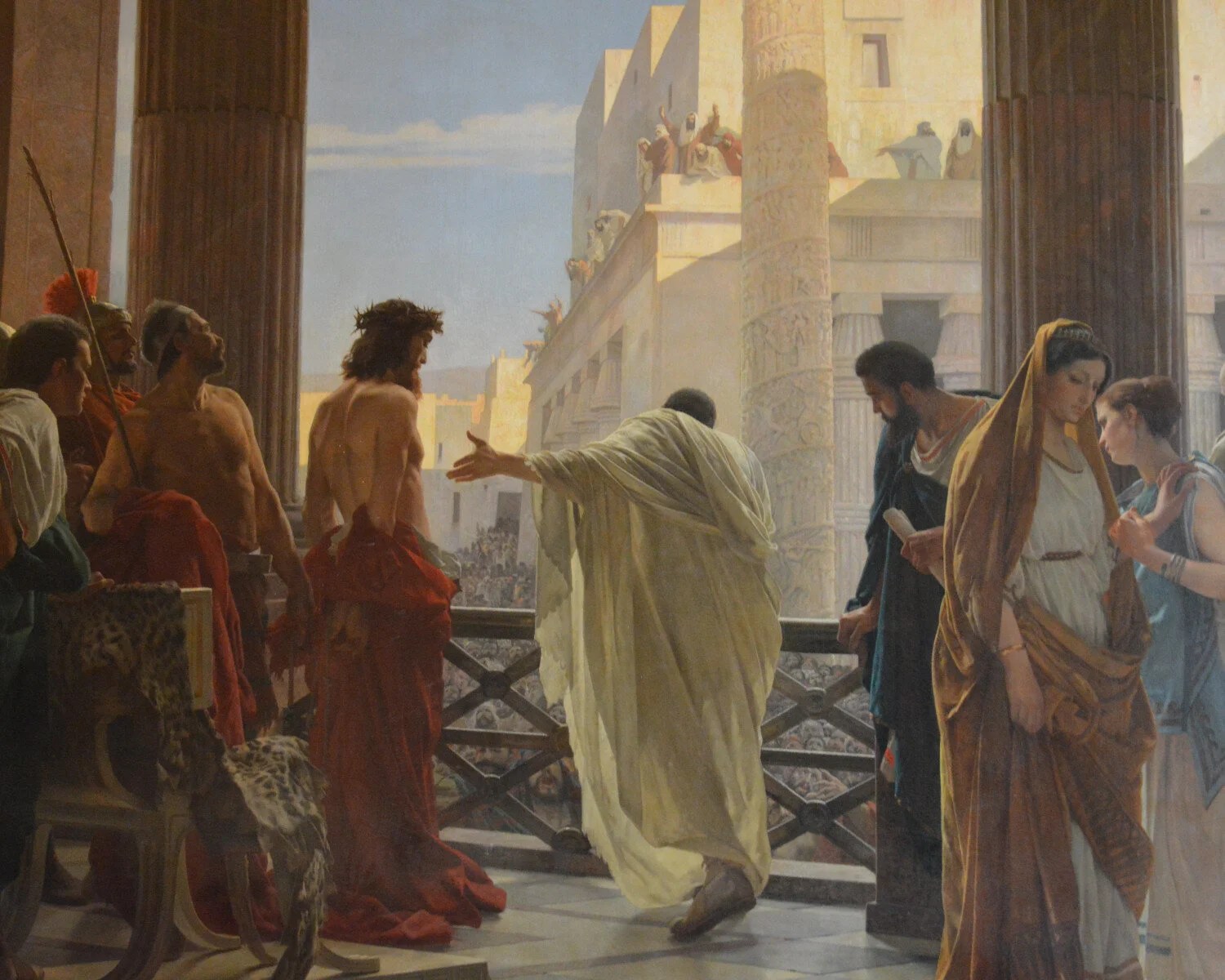
Where Art Thou?
“Later in the history of ancient Israel, the title of nasi was given to the Kings of Judah (Ezekiel 44:2–18; Ezra 1:8). Similarly, the Mishnah defines the nasi of Leviticus 4 to mean the king.[2]
Moses was titled ‘The Lawgiver’. He gave to the Jewish People, the laws that God gave – DIRECTLY TO HIM!
When King Donald Trump gave his family immiunity from Tax Scrutiny, and when he GAVE pardons to convicted INSRECTIONISTS – along with compensation monies – he acted like King Herod and Pontius Pilate who was steeped in the The Laws of Moses. He surely knew the Ten Commandments when he placed objects of IDOL WORSHIP near the temple. How about, other places in Judea, like. Bethleham?
I suspect Pilate laid a trap for the……
Rabbeinu HaKadosh
Was it foretold he would be born in Bethlehem and would be of the House of Judah? Did King Harrod and Pilate have long conversations. Did Pilate tell Herod he is a Master Augur, and has a plan to install……
THE LAWS OF AUGURY?
Seeing the future entailed studying many birds. What role does the eagle play in seeing the fate of………CAESAR?
I suspect Jesus WAS ELECTED by the Sanhedrin to be The Holy Teacher – that Pilate wanted to debate. The idea that Nasi ‘Prince lawgiver’ had a direct channel to….
TO THE GOD OF JEWS
…..was a direct assault on the Caesars who were go-betweens of….
THE GODS!
How many wealthy and learned Romans liked the Holy Teacher, more than they liked
THE CAESARS?
How many prominate Romans wanted Rome to be……
A NATION OF JUDAIC LAWS?….AND THUS MORE DEMOCRATIC?
Did not Caesar-Trump attack the base of…
OUR NATION OF LAWS?
Look at the timing of this!
I WARN YOU….if anyone takes a nickel of the Insurrectionist Reward, you will be..
A JUDAS TO THIS DEMOCACY – AND MAY GO TO HELL!
To be continued
Posted 8:42
John ‘The Nazarite’
Starting with Rabbi Judah I haNasi (born 135 CE), not even the nasi was given the title rabban. In its place, Judah haNasi was given the lofty accolade Rabbeinu HaKadosh (‘Our Holy Teacher’).[13]
The Standards (Ensigns) Incident
Josephus (c. 38 – after 100 C.E.) gives two accounts of the “Standards” incident, which took place during the term of Pontius Pilate, Roman prefect from 26 to 37 C.E.6 The first account, from War 2:175-203 (Williamson translation),7 was written during the 70s of the first century.8 The reader’s attention is called to the italicized passages.
As procurator [Greek: “hegemon”] of Judaea Tiberius sent Pilate, who during the night, secretly and under cover, conveyed to Jerusalem the images of Caesar known as standards. When day dawned this caused great excitement among the Jews; for those who were near were amazed at the sight, which meant that their laws had been trampled on — they do not permit any graven image to be set up in the City — and the angry City mob was joined by a huge influx of people from the country. They rushed off to Pilate in Caesarea, and begged him to remove the standards from Jerusalem and to respect their ancient customs. When Pilate refused, they fell prone all round his house and remained motionless for five days and nights.
The next day Pilate took his seat on the tribunal in the great stadium and summoned the mob on the pretext that he was ready to give them an answer. Instead he gave a pre-arranged signal to the soldiers to surround the Jews in full armour, and the troops formed a ring three deep. The Jews were dumbfounded at the unexpected sight, but Pilate, declaring that he would cut them to pieces unless they accepted the images of Caesar, nodded to the soldiers to bare their swords. At this the Jews as though by agreement fell to the ground in a body and bent their necks, shouting that they were ready to be killed rather than transgress the Law. Amazed at the intensity of their religious fervour, Pilate ordered the standards to be removed from Jerusalem forthwith.”
The account in Antiquities 18:55-59 (Feldman translation),9 written roughly 16 years after War, is parallel to the War version, but with a few additional details:
Now Pilate, the procurator [Greek: Hegemon] of Judaea, when he brought his army from Caesarea and removed it to winter quarters in Jerusalem, took a bold step in subversion of the Jewish practices, by introducing into the city the busts of the emperor that were attached to the military standards, for our law forbids the making of images. It was for this reason that the previous procurators [Greek: hegemones], when they entered the city, used standards that had no such ornaments. Pilate was the first to bring the images into Jerusalem and set them up, doing it without the knowledge of the people, for he entered at night. But when the people discovered, they went in a throng to Caesarea and for many days entreated him to take away the images. He refused to yield, since to do so would be an outrage to the emperor; however, since they did not cease entreating him, on the sixth day he secretly armed and placed his troops in position, while he himself came to the speaker’s stand.
Nasi (Hebrew: נָשִׂיא, romanized: nāśī) is a title meaning “prince” in Biblical Hebrew, “Prince [of the Sanhedrin]” in Mishnaic Hebrew. Certain great figures from Jewish history have the title, including Judah ha-Nasi,[1] who was the chief redactor of the Mishnah as well as nasi of the Sanhedrin.
In Modern Hebrew, its meaning has changed to “president“.
Usage
Genesis and ancient Israel
The noun nasi (including its grammatical variations) occurs 132 times in the Masoretic Text of the Hebrew Bible and is usually translated “prince”, or occasionally “captain.” The first use is for the twelve “princes” who will descend from Ishmael, in the Book of Genesis (Lech-Lecha, Genesis 17:20), and the second use (in Chayei Sarah Genesis 23:6), is the Hittites recognising Abraham as “a godly prince” (נְשִׂיא אֱלֹהִים nǝśi ʾǝlohim).
In the Book of Leviticus (Vayikra, Leviticus 4:22–26), in the rites of sacrifices for leaders who err, there is the special offering made by a nasi.
In the Book of Numbers (Naso Numbers 7), the leader of each tribe is referred to as a nasi, and each one brings a gift to the Tabernacle. In Numbers 34:16–29, occurring 38 years later in the Biblical story, the nǝśiʾim (נְשִׂיאִים, plural) of each tribe are listed again, as the leaders responsible for apportioning tribal inheritances.
Later in the history of ancient Israel, the title of nasi was given to the Kings of Judah (Ezekiel 44:2–18; Ezra 1:8). Similarly, the Mishnah defines the nasi of Leviticus 4 to mean the king.[2]
Second Temple period
During the Second Temple period (c. 530 BCE – 70 CE), the nasi was the highest-ranking member and leader of the Sanhedrin (סַנְהֶדְרִין from Koine Greek: Συνέδριον, romanized: sunédrion, lit. ‘council’), including when it sat as a criminal court. The position was created in c. 191 BCE when the Sanhedrin lost confidence in the ability of the High Priest of Israel to serve as its head.[3]
In the time of the Roman Republic, the Romans recognized the nasi as Patriarch of the Jews and required all Jews to pay him a tax for the upkeep of that office, which ranked highly in the Roman official hierarchy.[citation needed]
After the Siege of Jerusalem (70 CE), in the time of the destruction of the Temple in Jerusalem and the Jewish diaspora, the office of nasi in Palestine was comparable with the office of exilarch in Mesopotamia.[4]
Late Roman empire
This position as patriarch or head of court was reestablished several years after the Bar Kokhba revolt.[5] This made the nasi a power which both Jews and Romans respected. The Jewish community in Mesopotamia, referred to by the Jews as Babylonia, also recognized him. The nasi had leadership and served as a political representative to the authorities while the religious leadership was led by Torah scholars. He had the power to appoint and suspend communal leaders inside and outside of Israel.
The Romans respected the nasi and gave extra land and let control of own self-supported taxes. Under Jewish law, the intercalary thirteenth month in the Hebrew calendar, Adar Bet, was announced by the nasi.[6]
The last nasi of the Judean Sanhedrin was Gamaliel VI (d. 425); the Byzantine Empire subsequently issued an edict recorded in the legal code of the Codex Theodosianus of 426 that transformed the nasi tax into an imperial tax deposited into the Aerarium, or Roman treasury.
Middle Ages
The term nasi was later applied to those who held high offices in the Jewish community, and Jews who held prominence in the courts of non-Jewish rulers. The nasi were also prevalent during the 8th-century Frankish kingdom. They were a highly privileged group in Carolingian France. The Jews of Narbonne collaborated with Pepin the Short to end Muslim rule over their city in 759. The Jews accepted surrender and Pepin was able to hold off the Saracens in the Iberian peninsula. Pepin rewarded the Jews with land and privileges such as the right to judicial and religious autonomy. The heirs of the king and nasi held a close relationship until the tenth century.[7]
17th–20th-century Jewish community in Yemen
According to ethnologist Erich Brauer, among the Jews of Yemen, the title of nasi was conferred upon a man belonging to the community’s most noble and richest family. There was no direct election for this post. In general, the nasi was also a scholar, well-versed in Torah, but this was not a condition for his office. Among his duties, he was a representative of the community in all its affairs before the government. He was also entrusted with the duty of collecting the annual jizya or poll-tax, as well as settling disputes arising between members of the community.[8]
Chabad
The term nasi was used by Menachem Mendel Schneerson to refer to the spiritual leaders of Chabad. In particular, he used the term Nesi Hador (נשיא הדור; “prince of the generation”) or Nesi doreinu (נשיא דורנו; “prince of our generation”) to refer to his father-in-law, Yosef Yitzchak Schneersohn.[9]
Modern Hebrew
In Modern Hebrew, nasi means “president”, and is not used in its classical sense. The word nasi is used, in Israel, as the title of the President of Israel and the Chief Justice of the Supreme Court of Israel. In Hebrew, the word “prince” is now expressed by a synonym: nasi (as in Yehuda HaNasi) and nasīkh (נָסִיך).
Much more recently, Adin Steinsaltz took the title nasi in an attempt to reestablish the Sanhedrin in its judicial capacity as the supreme court of Judaism.
List of Nesi’im
During the Mishnaic period, the office of nasi was filled as follows:[10][11]
| Nasi | Term in office | |
|---|---|---|
| Yose ben Yoezer | 170 BCE | 140 BCE |
| Joshua ben Perachyah | 140 BCE | 100 BCE |
| Judah ben Tabbai (who later absconded)[12] | 110 BCE | ca. 80 BCE |
| Simeon ben Shetach | ca. 80 BCE | 60 BCE |
| Sh’maya | 65 BCE | c. 31 BCE |
| Hillel the Elder | c. 31 BCE | 9 CE |
| Shimon ben Hillel | 9 | 9 |
| Rabban Gamaliel the Elder | 30 | 50 |
| Rabban Shimon ben Gamliel | 50 | 70 |
| Rabban Yohanan ben Zakai | 70 | 80 |
| Rabban Gamaliel II of Yavne | 80 | 118 |
| Rabbi Eleazar ben Azariah | 118 | 120 |
| Interregnum (Bar Kokhba revolt) | 120 | 142 |
| Rabban Shimon ben Gamliel II | 142 | 165 |
| Rabbi Judah I haNasi | 165 | 220 |
| Gamaliel III | 220 | 230 |
| Judah II Nesi’ah | 230 | 270 |
| Gamaliel IV | 270 | 290 |
| Judah III Nesi’ah | 290 | 320 |
| Hillel II | 320 | 365 |
| Gamaliel V | 365 | 385 |
| Judah IV | 385 | 400 |
| Gamaliel VI | c. 400 | 425 |
| President | Term in office | |
|---|---|---|
| Chaim Weizmann | 1949 | 1951 |
| Yitzhak Ben-Zvi | 1952 | 1963 |
| Zalman Shazar | 1963 | 1973 |
| Ephraim Katzir | 1973 | 1978 |
| Yitzhak Navon | 1978 | 1983 |
| Chaim Herzog | 1983 | 1993 |
| Ezer Weizman | 1993 | 2000 |
| Moshe Katsav | 2000 | 2007 |
| Shimon Peres | 2007 | 2014 |
| Reuven Rivlin | 2014 | 2021 |
| Isaac Herzog | 2021 | incumbent |
Rabban
Rabban was a higher title than rabbi and was given to the nasi starting with Gamaliel the Elder.
The title rabban was restricted in usage to the descendants of Hillel the Elder, the sole exception being Rabban Yochanan ben Zakai (c. 30–90 CE), the leader in Jerusalem during the Siege of Jerusalem in 70 CE and who safeguarded the future of the Jewish people after the Great Revolt by pleading with the Emperor Vespasian.
Rabbi Eleazar ben Azariah, who was nasi between 118 and 120 CE, was not given the title rabban, perhaps because he only occupied the office of nasi for a short while, after which it reverted to the descendants of Hillel.
Prior to Rabban Gamliel the Elder, no titles were used before anyone’s name, in line with the Talmudic adage “Gadol miRabban shmo” (“Greater than the title rabban is a person’s own name”). For this reason, Hillel the Elder has no title before his name: his name is in itself a title. Similarly, Moses and Abraham have no titles before their names, but an epithet is sometimes used to differentiate between biblical and historic personages, hence Avraham Avinu (Abraham ‘Our Father’) and Moshe Rabbeinu (Moses ‘Our Teacher’).
Starting with Rabbi Judah I haNasi (born 135 CE), not even the nasi was given the title rabban. In its place, Judah haNasi was given the lofty accolade Rabbeinu HaKadosh (‘Our Holy Teacher’).[13]
Starting with Rabbi Judah I haNasi (born 135 CE), not even the nasi was given the title rabban. In its place, Judah haNasi was given the lofty accolade Rabbeinu HaKadosh (‘Our Holy Teacher’).[13]
Starting with Rabbi Judah I haNasi (born 135 CE), not even the nasi was given the title rabban. In its place, Judah haNasi was given the lofty accolade Rabbeinu HaKadosh (‘Our Holy Teacher’).[13]
 Rosamond Press
Leave a comment