
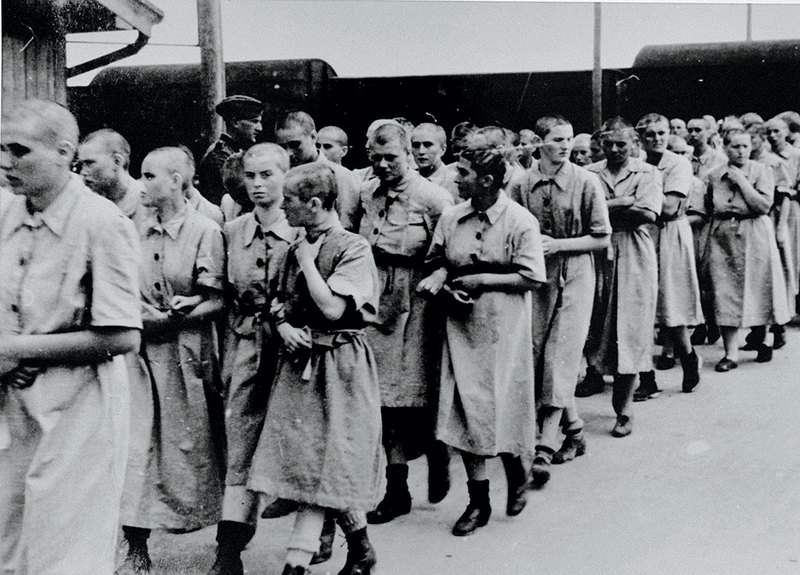

Irma Grese (along with Bergen-Belsen commandant Josef Kramer, right) in the courtyard of the prison at Celle during their war-crimes trial, June 1945
Where Art Thou?
Did David take the clothes from the women and children before he murdered them?
9Whenever David attacked an area, he did not leave a man or woman alive, but took sheep and cattle, donkeys and camels, and clothes. Then he returned to Achish.
You would want the men, women, and children to strip naked before you murdered them, becuse you would have to wash the blood out – before you resold them. God ordered the murder of children before, because there is this Eye For An Eye Rule. Children took oaths to kill those who murdered thier parents. So David had the children stripped naked – BEFORE HE SLAUTHERED THE POOR INNOCENT LAMBS.
You don’t have to believe in a God that slaughter’s children and their mothers!
The Nazis stripped Jewish women naked – all the time! Everything they owned was recycled. King David is – HIGHLY REVERED IN ISLAM! DID YOU KNOW THIS? How can millions of American Voters be accused of being antisemitic if they don’t know all the facts? I am am against the harassment and killing of unarmed Jews.
You have my permission NOT TO FOLLOW DAVID’S GOD, THE ONE THE SECRETERY OF WAR WORSHIPS. Hegseth called for………….NO QUARTER! He quotes the Bible. If Pete had his way, would he be for Irma Grese and Kramer being stripped naked before they are plugged with holes? Look at those nice clothes. David could make money off reselling them.
John ‘The Nazarite’
Dāwūd, or David[b], is considered a prophet and messenger of Allah (God) in Islam, as well as a righteous, divinely anointed king of the United Kingdom of Israel. Additionally, Muslims also revere David for receiving the divine revelation of the Zabur.
Dawud is considered one of the most important people in Islam.[3][4] Mentioned sixteen times in the Quran, David appears in the Islamic scripture as a link in the chain of prophets who preceded Muhammad.[5] Although he is not usually considered one of the “law-giving” prophets (ulū al-ʿazm), “he is far from a marginal figure”[according to whom?] in Islamic thought.[3] In later Islamic traditions, he is praised for his rigor in prayer and fasting. He is also presented as the prototypical just ruler and as a symbol of God’s authority on earth, having been at once a king and a prophet.
David is particularly important to the religious architecture of Islamic Jerusalem.[6] Dawud is known as biblical David who was, according to the Hebrew Bible, the second king of the United Kingdom of Israel and Judah, reigning c. 1010–970 BCE.[citation needed]
As of March 2026, U.S. Defense Secretary Pete Hegseth declared that the U.S. military will show “no quarter, no mercy” to enemies, specifically during operations against Iran. This phrase, interpreted as refusing to take prisoners, has drawn severe criticism for potentially violating international laws and the Geneva Convention against war crimes
No quarter, during military conflict or piracy, implies that combatants would not be taken prisoner, but executed. Since the Hague Convention of 1899, it is considered a war crime; it is also prohibited in customary international law and by the Rome Statute. Article 23 of the Hague Convention of 1907 states that “it is especially forbidden […] to declare that no quarter will be given”.[1]
Etymology
The term no quarter may originate from an order by the commander of a victorious army that they will not quarter (house) captured enemy combatants. Therefore, none can be taken prisoner and all enemy combatants must be killed.[2]
9Whenever David attacked an area, he did not leave a man or woman alive, but took sheep and cattle, donkeys and camels, and clothes. Then he returned to Achish.
Ziklag, a town on the southernmost boundary of Judea, is first mentioned in the Bible as part of the inheritance of the tribe of Judah (Joshua 15:31). Ziklag was assigned to the tribe of Simeon within Judah (Joshua 19:5) but appears not to have been conquered by the Israelites before the time of David. Ziklag was still under Philistine control when Saul reigned as king.
For many years King Saul sought to harm David. After the death of Samuel, David fled for his life with six hundred men and their households to Philistine territory. While there, Achish, the Philistine king of Gath, gave Ziklag to David at his request: “‘Then David said to Achish, ‘If I have found favor in your eyes, let a place be assigned to me in one of the country towns, that I may live there. Why should your servant live in the royal city with you?’ So on that day Achish gave him Ziklag, and it has belonged to the kings of Judah ever since” (1 Samuel 27:5–6). Achish awarded Ziklag to David most likely to ensure David’s continued neutrality.
David ruled over Ziklag for 16 months, during which he made the town his base of operations for military exploits against the Amalekites. Many of Israel’s disillusioned warriors flocked to join forces with David’s private army there (1 Chronicles 12:1–22).
While David and his men were away attempting to join the Philistine army to fight against Saul, Amalekite raiders attacked Ziklag. When the Philistines refused to let David and his men fight with them, David returned to Ziklag and found his city had been burned down and all its inhabitants taken hostage: “David and his men reached Ziklag on the third day. Now the Amalekites had raided the Negev and Ziklag. They had attacked Ziklag and burned it, and had taken captive the women and everyone else in it, both young and old. They killed none of them, but carried them off as they went on their way. When David and his men reached Ziklag, they found it destroyed by fire and their wives and sons and daughters taken captive” (1 Samuel 30:1–3). In a daring rescue, David and his men pursued and defeated the raiders, recovering all that had been taken, including David’s two wives, Ahinoam and Abigail (verses 16–31).
 Rosamond Press
Leave a comment