

San Sebastian Avenue
by
John Presco
On June 8, 2025, I spent three hours on my IPhone looking for the history of Ralston Hall. I found very little. This blog ‘Royal Rosamond Press’ contains most of that history, because, it is my history. My history was stolen from me, and my right to make more history, was thwarted.
Today, the Governor of California challenged the President of the United States – to arrest him! Gavin Newsom is threatening to sue our President.
I was in the emergency room for seven hours om June 4th. I have an infected liver and bladder. I wonder how long I have to live. I wonder how many people want me to die, including a members of the Belmont Historical Society. I
I found my dream home on June 6th. I want this home as a settlement in the lawsuit against several people and organizations. I will live the rest of my days here. I will make sure it is declared a Historic California Abode. The California Kid…..will live forever! He will haunt this house. Rena is invited to haunt this house….with me!
I found……My Room….down in the basement. All my books and brick brack will have a home on the shelves. I may finish my books here. However, they are better unfinished. There is an old telephone – there! Some people who love history will dial…the number! It will ring. The ghost of the California Kid, may pick-up.
To be continued
In 1851 he brought to Belmont a prefabricated house in 1,200 parts,
to be fastened together with 700 hooks and 26,000 screws. He invested
in local realestate but lacked the Midas touch. The Count sold his
prefab house and sailed back east to organize a wagon train to move
overland to the Pacific. In 1853 the Count left Missouri with 11
wagons, 24 hired hands, 500 cattle, 600 cattle, 60 horses, and 40
mules. He wrote an account of this six-month journey that became the
book ‘The California and Overland Diaries of Count Leonetto Cipriani’
by Ernest Falbo.
Build Janke Crypt Inside Ralston Hall
Posted on July 6, 2024 by Royal Rosamond Press


Before one launches the Greatest Historic Justice Case in California History, one is required to establish Good Faith and Honorable Intensions as proof your suit is not pure malice and revenge. You want to prove Historic Justice – is on your side. When I found the floorplan of Ralston Hall showing the original outline of the small house Count Cipriani put together with screws, I wondered if he purchased one of the six homes Janke brought around the Cape. Was it – unpacked? There is talk about whether or not the citizens of Belmont will still have access to Walston Hall after Stanford build there campus. I will write them, again, and insist they respect my dead – and conduct a complete historic research,
I became an Oddfellow a year ago. I am going to get baptized into the LDS Church, and my ancestors will be baptized – with me! The Ralston Family Crypt will contain the DNA of Carl and Dorothea, and her mother. There will be three vacant crypt for my daughter and grandson who were with me inside the Janke-Stuttmeister in Colma that William Stuttmeister paid for to inter his kin before they were dug out of their graves at the Oddfellow Cemetery. My attorneys will paint a beautiful landscape as seen throught the eyes of William, where he is – very well pleased with – the results!
There will be a stain glass window like the one in Colma that reads
“Carl and Dorothea Janke: Founders of Belmont.”
“All’s well…………………………………………………………………………………………………..that ends well!”
My Odd Fellow Kindred Evicted From Graves
Posted on March 23, 2013 by Royal Rosamond Press


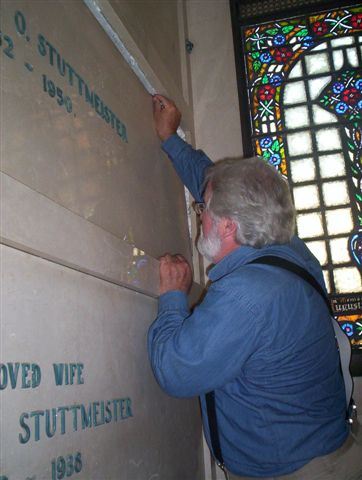

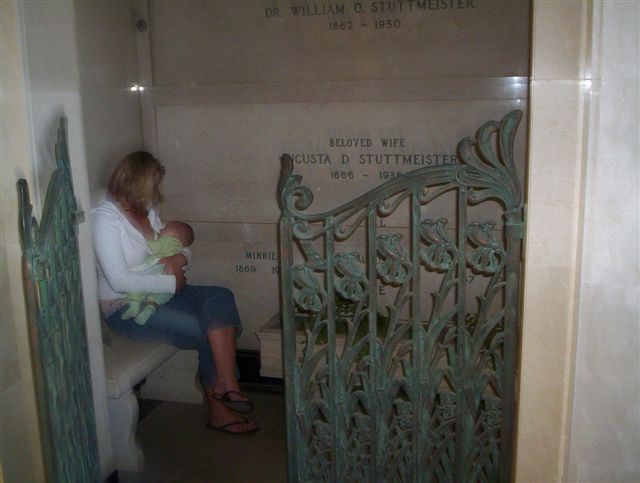
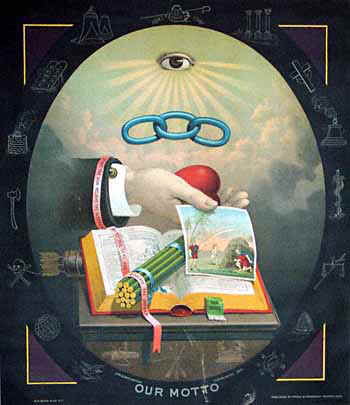
At great expense to himself, my great-grandfather, William Suttmeister, moved the bodies of his wife and kindred from the Laurel Hill cemetery in San Francisco to a tomb in Colma where I brought my daughter and grandson so they can own their heritage. These bodies were evicted from their graves. Many tombstones were used to make a sea wall.
The Royal Crockett Gallery | Rosamond Press
Laurel District | Rosamond Press
William Oltman Stuttmeister went to the University of California and practiced dentistry in San Francisco. He bought two vacation properties in San Geronimo where he retired and died. The Maillard, Count Cipriani, Napoleon, and Prince Victor Napoleon connection is interesting. Is this the continuation of the Belmont Colony? Was this land purchased with a recovered treasure? Many have searched for the lost treasure of Sir Francis Drake near this valley overlooked by the ‘Sleeping Maiden’ mountain.
Below is a video showing Cipriani’s home inside Ralston’s additions. It was a portable house. An expert needs to compare this with the Tanforan cottages. Samples of the wood and screws need to taken and compared to the houses Janke brought around the Cape. William married Augusta Janke.
Jon Presco
Yesterday I found a image of an appartment building William built on McCallister street in 1910 four years after the earthquake. My great, great, grandfather helped rebuild San Francisco. This morning I found an old photo of the Dental College he attended in San Francisco that became a part of the University of California. That these apartments are named ‘Laurel’ goes with my theory that William built around forty homes in the Laurel District – that could have been named by him. William, who helped build Oakland, is a pioneer in the field of Dentistry, and is labeled such by Redwood City. The Stuttmeisters lived in Fruit Vale, and their kin, the Jankes, founded the City of Belmont. They are listed as Pioneers of San Francisco.
06/06/11 at 9:44 PM
Hi Jon,
You are a good researcher! You remarked that someone lived in Pankow? That is new to me. This German family left Mecklenburg in 1732. They became citizens of Berlin. They started out selling pelts, and that grew into furs with a large warehouse in Berlin. One Stuttmeister, who was a builder/architect had his office at the Kaiser’s court. They grew quite wealthy. Kim went to the Records department and received a list of all the residences that the Stuttmeister had in Berlin, and she took pictures of all the churches, where they were baptized and the properties they had owned. . Freddie has always said that the Stuttmeister was not their true name, but the records in Germany indicate that Stuttmeister was their legal name.
Daryl Bulkley
Months after my sister’s death I went to the Sacramento Library and looked at microfish about a legal battle between the heirs of Carl Janke’s estate in Belmont that appeared in the San Francisco Call. I lost the copy I made of that article that I am certain mentioned William O. Stuttmeister, and the sisters of Augusta Stuttmeister-Janke. Carl’s sons did not want Minni and Cornillia, to have anything, and one brother (or cousin) took their side, and was cut out. This has to be William, or W. JANKE. “The bride was attended by Miss Alice Stuttmeister, a sister of the groom, and Miss Minnie Janke, a sister of the bride, as bridesmaids, and Dr. Muldownado and Wm. Janke, a cousin of the bride, were groomsmen.” When Victor Presco turned twenty-one, the the Janke spinsters offered him a moving company in San Francesco. Apparently they saw him as the heir to the Stuttmiester legacy, and the Hope of a return to former glory because they had no children. How about their brother, William? Rosemary said this; “Your father was a made man.”
http://art.famsf.org/wa-janke-founded-belmont-picnic-grounds-and-first-turn-verein-bush-street-39933
Stuttmeister – Pioneer of Marin County | Rosamond Press
“W.A. Janke, founded the Belmont Picnic Grounds, and the first Turn Verein on Bush Street.”
Yesterday I received information from Shirley Schwoerer of the Redwood City Library, that said my ancestor, Carl August Janke, was instrumental in establishing a Turnverien in Belmont, and the Bay Area. Was it the first?
“He erected the old amusement hall of the Turnverein, and managed this for several years.”
Janke may be the first real estate developer in the San Francisco bay area.
“In 1849 the family came around the Horn on an old Clipper ship, and Mr. Janke brought with him on the trip the material for six portable houses. He set up these houses, and at once engaged in a successful business, as a building contractor.”
Yesterday I talked to Dick Moyer, a curator of the Crockett Museum. I had talked with his late father back in the 70s about my grandfather, Hugo Presco. He said he was a great man, known as a gambler. I asked Dick about the gambling in Crockett, but he knew very little. There were some raids during Prohibition, but Moyer had not read the article that I found in 1994 that said there were about sixty bordello and gambling houses in Crockett. My father had said the same thing. Rosemary said there were about five thousand people at Hugo’s funeral, including the Mayor of San Francisco. Was the funeral held in Crockett? According to my mother, Vic took the money collected for burial, and went and got drunk. Where Hugo is buried, is unknown.
Vic took us to see his father but one time. Hugo was living on a houseboat in Scowtown located in the shadow of the Carquinis Bridge. We had to walk along a maze of floating dock. A malato answered the door, then went and got The Gambler. In reading about gambling in Portland’s Scowtown, Hugo’s houseboat could have been the sight of a infamous poker game that was impossible to raid. You could see, and feel the cops coming as they rocked the dock.
Mr. Moyer told me he had a drawing of Scowtown on the wall in his office done by a Portuguese resident. I asked him if he would get it scanned and put on the museum webpage. I told him I was writing about my famous artistic sister. Dick didn’t get it. Royal Rosamond’s novel ‘Bound In the Clay’ was compared to ‘Tobacco Road’. consider John Steinbeck’s novel ‘Canary Row’.
Victor William Presco wanted to be a bigger man then his father. Above we see the captain with on e of his Chriscraft boats he had docked in Martinez, located about five miles from Crockett. In 1969 I took my father and his best friend and business partner, Ernie quinones, down to the estuary and showed them any empty plot of land. I told Vic he should get together some investors and build a commercial community here. Jack London Village was built several years later, and is now about to be torn down. How time flies. Mr. Moyer is kin to Jim Strehlow who owned Neptune Beach in Alameda. Bobby Jensen, the brother of the Yankee ball player, Jackie Jensen, did watercolors of the boats in Jack London Square, and was my teacher at McCheznie High.
I was living on my sailboat about a mile from the square when I had my brain-storm. In 1962 I did a watercolor of Oakland’s produce market where Vic operated Acer Produce in an old Victorian Warehouse located on 4th. Street and Webster. This painting was chosen to tour the world in a Red Cross show.
Stuttmeister ‘The Wonder Man’ | Rosamond Press
Robert Jensen Born: 1922 – San Francisco, California
Died: 1984 – Vallejo, CaliforniaKnown for: Marine-seaport views, townscape
TributariesArt images copyright© of artist or assigneeThe following biography, submitted April 2004, is from Terry Jack Jensen, son of the artist.
My father was born on December 15, 1922 in San Francisco, California. His parents were Wilfred Jensen and Alice I. Jensen. My father had two brothers; Jack E. Jensen and an older brother Wilfred (Bill) Jensen. Jack became a gifted athlete, All American College football and baseball player. Jackie played for the Yankees and Red Sox (MVP 1958). Bill was a business man. The family moved to Oakland when my father was in elementary school.
The Depression came along, and the family business (butcher shop) went out of business. Wilfred senior left the family and did not return until after WWII. Hard times hit the family hunger and malnutriti … Displaying 750 of 3667 characters.
Subscriber Members, please Sign In for artist biographies and for all services.
For non-paying users, good news! Full text bios for all artists are available every Friday.
If you are not currently a member, please See Details about membership.
Jackie Jensen And William Stuttmeister | Rosamond Press
Stuttmeister-Janke Wedding at Belmont
Posted on May 5, 2021 by Royal Rosamond Press
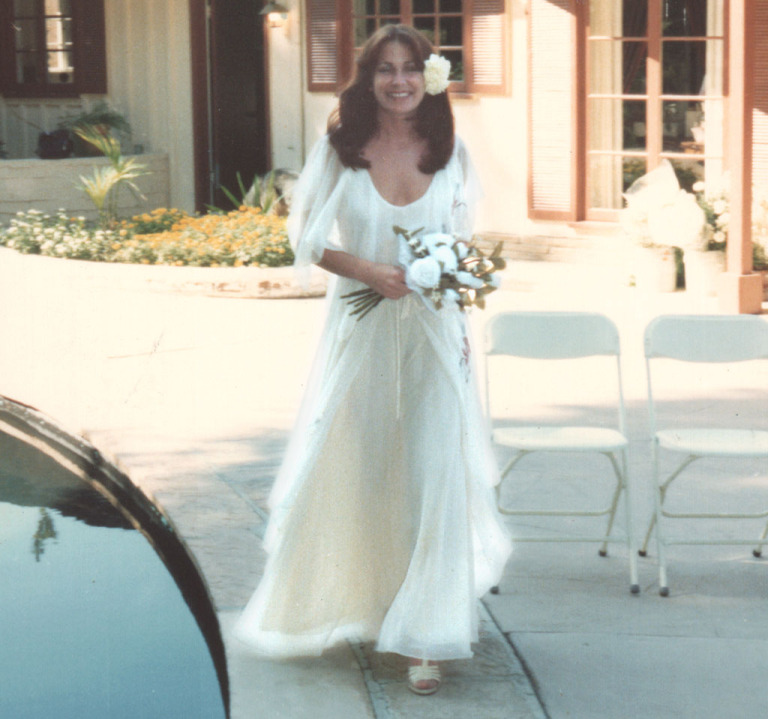
Below is the artist Christine Rosamond Benton, the great granddaughter of Alice Stuttmeister, the sister of William Stuttmeister. My sister got married to Rick Partlow who won an Emmy.
John Presco
President: Belmont Soda Works; Royal Rosamond Press; California Barrel Company
The Belmont Soda Works of California | Rosamond Press
William Janke on Haight St. | Rosamond Press
The California Barrel Company – Site Title
The Keepers and Destroyers of History | Rosamond Press
Daily Alta California, Volume 42, Number 14175, 24 June 1888
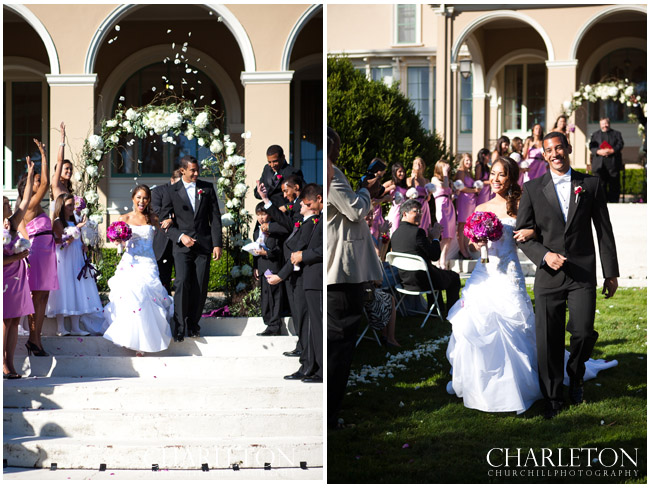
STUTTMEISTER-JANKE. One of the most enjoyable weddings of the past week took place at Belmont, Wednesday morning last, the contracting parties being Miss Augusta Janke, daughter of Mr. and Mrs. August Janke of Belmont, and Dr. Wm. Stuttmeister of San Francisco. The house was handsomely decorated with a rich profusion of ferns and flowers, and at the appointed hour was filled with the relatives and intimate friends of the contracting parties. At 11 o’clock the wedding march was played and the bridal party entered the parlor. The bride was attended by Miss Alice Stuttmeister, a sister of the groom, and Miss Minnie Janke, a sister of the bride, as bridesmaids, and Dr. Muldownado and Wm. Janke, a cousin of the bride, were groomsmen.
The Rev. A. L. Brewer of San Mateo performed the beautiful and impressive ceremony under an arch composed of flowers and greens very prettily arranged, after which the guests pressed forward and offered their congratulations. The bride was attired in a very pretty and becoming costume of the crushed strawberry shade, and wore a corsage bouquet of orange
blossoms. She carried a handsome bouquet of white flowers. After the guests had paid their compliments the bride and groom led the way to the dining-room, where the wedding dinner was served and the health of the newly married pair was pledged. The feast over, the guests joined in the dance, and the hours sped right merrily, interspersed with music singing and recitations, until the bride and groom took their departure amid a shower of rice and good wishes. Many beautiful presents were received. Dr. and Mrs. Stuttmeister left Thursday morning for Santa Cruz and Monterey, where they will spend the honeymoon. On their return they will make their home in Belmont. 1911: Dr. Willian O. Stuttmeister was practicing dentistry in Redwood City, CA. (Reference: University of California, Directory of Graduates,
1864-1910, page 133).
Records from Tombstones in Laurel Hill Cemetery, 1853-1927 – Janke
– Stuttmeister
Mina Maria Janke, daughter of William A, & Cornelia Janke, born
February 2, 1869, died March 1902.
William August Janke, native of Hamburg, Germany, born Dec. 25,
1642, died Nov. 22, 1902, son of Carl August & Dorette Catherine Janke. Frederick William R. Stuttmeister, native of Berlin, Germany, born
1612, died January 29, 1877.
Mrs. Matilda Stuttmeister, wife of Frederick W.R. Stuttmeister, born
1829, died March 17, 1875, native of New York.
Victor Rudolph Stuttmeister, son of Frederick W.R. & Matilda
Stuttmeister, born May 29, 1846, died Jan. 19, 1893, native of New
York.
Share this:
The Belmont Soda Works of California
Posted on May 5, 2021 by Royal Rosamond Press


Yesterday, The Belmont Soda Works – rose from the ashes like a Phoenix Bird. That a Senator refers to Jason Bourne and “spy movies and books” is a REAL COUP for me, and a testimonial to my amazing research, and this blog. My Man In The Field, Spooky Noodles, suggested more than once, important people -must be reading Royal Rosamond Press! Four of my characters suffer from a Generalized Anxiety Disorder. Victoria Rosemond Bond, does sculptures to deal with her GAD at BAD. I wanted my spies to be VERY HUMAN, for in looking within for what makes us tick, they have boosted their powers of observation.
WE ARE FLAWED
We own….”sticky thoughts”?
John Presco
President: Royal Rosamond Press; Belmont Soda Works; California Barrel Company
The California Barrel Company – Site Title
Belmont Soda Works California – A School for Spies and Propaganda Making
Belmont School of Espionage – Belmont Soda Works California
Admiral, Sir Arthur Lancelot Nelson Swinburne
Art Lesson At Osborne House | Rosamond Press
The clip went viral on social media earlier this week, prompting conservatives to mock the ad.
“If you’re a Chinese communist, or an Iranian Mullah, or Kim Jong Un…would this scare you? We’ve come a long way from Jason Bourne,” Cruz tweeted late Monday, mentioning the protagonist of the “Bourne Identity” spy movies and books.
A CIA spokeswoman told Insider: “In 2019, we started our ongoing social media series, “Humans of CIA,” for real officers to share their firsthand experiences.”
Trump also tweeted, “China and Russia love this,” adding in a second tweet that the two countries were “laughing their asses off watching CIA go full woke. ‘Cisgender.’ ‘Intersectional.’”
BELMONT SCHOOL OF ESPIONAGE
Braskewitz Comments 0 Comment
“I did not sneak into CIA,” she adds. “I earned my way in, and I earned my way up the ranks.”
Senator Ted Cruz made disparaging remarks about a CIA advertisement that featured a woman who labeled herself in a manner that offended Senator Cruz. Because the Central Intelligence Agency is a United States Government institution, paid for by Tax Payers, I believe it is wise to found a Private Company that has the best interests of the U.S. at heart, and owns Bad Intentions for our Enemies who threaten us. My company will be an overt enterprise, verses a covert company that disguises its true intentions. Because I rendered the protagonists of my Spy Novel ‘The Royal Janitor’ a bi-sexual, and other characters, homosexual, I have shown that I am All Inclusive. Cissgender works for me.
True Patriotism does not come with any other labels attached. If you love your country, you are qualified. There is no training for work at the CIA in the private sector. I will teach writers how to author a Spy and Detective novels, and do works of art with a powerful message. I am kin to Ian Fleming via Elizabeth Rosemond Taylor. My grandparents were friends of Black Mask authors. Royal Rosamond went camping with Dashiell Hammett. We are a Think Tank. Analyzing information is key to anticipating the next move of foes.
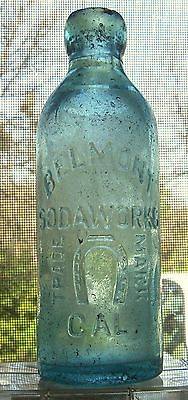
I am employing the name of a company owned and operated by one of my kin, William Janke, who lived in Belmont, and made a soda. I will use the Belmont Soda Works Ca. bottle as my logo. This will include a horseshoe in the cote of arms I will design.
John Presco
President: Belmont Soda Works
Copyright 2021
Why are Australian officials hinting at war with China? (msn.com)
- The CIA released a recruitment ad starring a Latina officer identifying as a “cisgender millennial.”
- It’s part of the “Humans of CIA” series meant to attract a more diverse pool of candidates.
- Sen. Ted Cruz and Donald Trump Jr. mocked the CIA on Monday; Trump said it’d gone “full woke.”
Sen. Ted Cruz of Texas and Donald Trump Jr. have derided the CIA for releasing a recruitment ad starring a female staffer who celebrated being a “cisgender millennial” with anxiety.
The video, released on YouTube by the CIA as part of its “Humans of CIA” series on March 25, sees a Latina woman talk candidly about identity and success.
“I am a woman of color. I am a mom. I am a cisgender millennial who has been diagnosed with generalized anxiety disorder. I am intersectional, but my existence is not a box-checking exercise,” the woman says.
“I did not sneak into CIA,” she adds. “I earned my way in, and I earned my way up the ranks.”
Cisgender vs. Straight: What’s the Difference? And 9 Other FAQs (healthline.com)
Count Cipriani and Napoleon
Posted on April 10, 2021 by Royal Rosamond Press


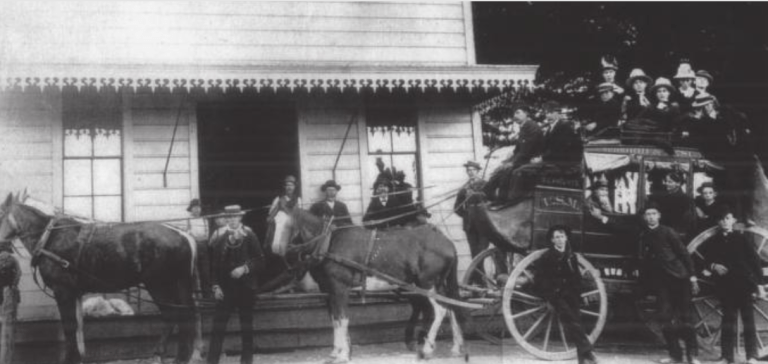
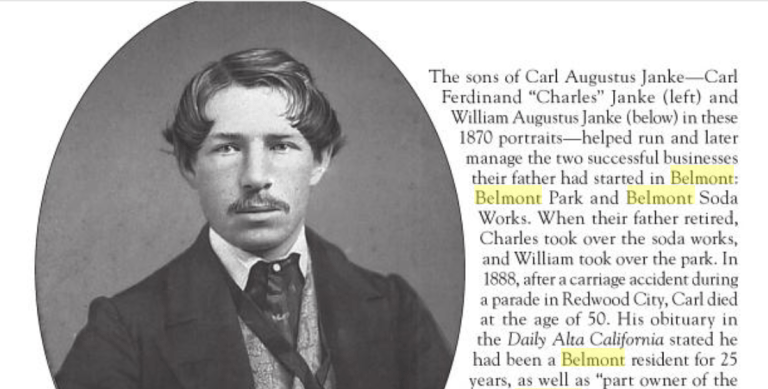


The daughter of Lenonetto, Lisi Cecilla Cipriani, appears to have been employed as a spy. Her great uncle had many conversations with the Napoleon family who made plans to invade California from Mexico. My kin, John Fremont, with the help of the Jessie Scouts, thwarted this plan. This is as close to much of European History as any territory that comprises the United States, as you can get. It has sat over there in the city of Belmont, in a captured state, that is resisted being shared with the rest of the Bay Area, and California!
Yesterday I purchased my THIRTY-FOUR year sober AA coin on Amazon. I bought an Angel Coin for Cristine, and put it in William Stuttmeister niche on our family tomb, where rest his bones. The 91 earthquake opened a crack. With Lisi’s treatise on The Romance of the Rose and the poetry of Dante, alas we have the touchstone and branding my grandfather, Royal Rosamond, worked hard at. Lisi mentions the play Troylus which was one of Shakespeare’s problem plays. I mentioned Belmont having a Shakespeare theatre. Rena as Helen may now be Rena as Cressida.
John Presco
Troilus and Cressida – Wikipedia
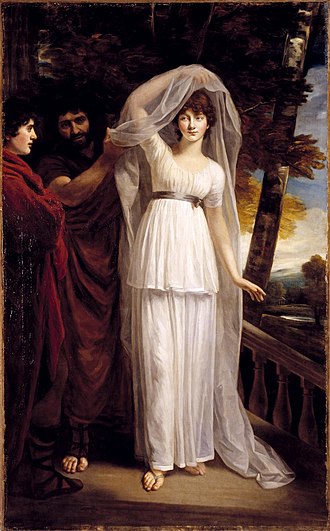

Studies in the Influence of the Romance of the Rose upon Chaucer (jstor.org)
Cipriani of Roman Times | Rosamond Press
In 1851 he brought to Belmont a prefabricated house in 1,200 parts,
to be fastened together with 700 hooks and 26,000 screws. He invested
in local realestate but lacked the Midas touch. The Count sold his
prefab house and sailed back east to organize a wagon train to move
overland to the Pacific. In 1853 the Count left Missouri with 11
wagons, 24 hired hands, 500 cattle, 600 cattle, 60 horses, and 40
mules. He wrote an account of this six-month journey that became the
book ‘The California and Overland Diaries of Count Leonetto Cipriani’
by Ernest Falbo.
Belmond Hotel Cipriani – Wikipedia
Count Cipriani was born in Centuri Corsica, on October 10,
1812. On his father’s side he is descended from an old Florentine
family of Ghibellines, which after a long struggle with the vitorious
Guelfs, found refuge in Corsica in the fifteenth century. On his
mother’s side he is descended from Saint Francis Caracciolo of
Naples, and thus Saint Aquinas. This struggle inspired Shakespear to
write ‘Romeo and Juliet’ and thus the question “What is in a name?”
came to be.
“Returning to Paris in October, 1855, he was warmly received
by his friend Prince Napoleon who overwhelmed him with questions
about his travels in America. “I answered them the best I could.”
Cipriani wrote, “But , it is a veritable deluge….We keep talking
about my journeys, of the Sanora, of conquering it.” Perhaps he
thought of seizing it for France and hoped the prince might persuade
his cousin the Emperor to finance the undertaking. “It is an idea in
the air,” he added, “that I would willingly undertake, if necessary
capital and men were available.”
To another member of the imperial household, Jerome
Bonaparte, ex-king of Westphalia, Cipriani revealed tha the had
considerable investments in California and hinted at receiving
interest of twelve to fifteen percent a month on his money. He also
boasted of his house in Belmont which “out there is considered
magnificent.”
On behalf of the Emperor Napoleon 3, he visited King Victor
Emanuel of Sardinia to explore the possibilities of a matrimonial
arrangement between the ruling houses as a prelude to a political-
military alliance between France and Sardinia. The conversation
eventually turned to Cipriani’s overland journey of 1853, which
apparently had not escaped the king’s notice. “I have heard tell,” he
said, “of a great journey of yours, with you on horseback and camping
out.”
“For eight solid months, Your Majesty,” Cipriani replied,
making certain to include the time he left San Francisco in February
to October, 1853.
“But it is true.” the king continued, “that you led covered
wagons and crossed the Rocky Mountains where there was roads, and
great rivers without any bridges.”
The above is from the ‘California and Overland Diaries of
Count Leonetto Cipriani’. a journey that may constitute the first
cattle drive. What this diary reveals is France’s plan to conquer
Mexico, and perhaps the Western United States.
Sardinian Kingdom Founds SF Colony
Posted on April 27, 2016 by Royal Rosamond Press
Not only have I found Sleeping Beauty Rosa, I have found her Kingdom in San Francisco!
“After Victor Emmanuel became King of Sardinia he appointed Cipriani to be his first consul in San Francisco.”
Cipriani’s home was brought around the Cape by my kindred, Carl Janke, whose daughter married William Stuttmeister. I believe my kindred were chosen to help found the Sardinian Colony that would support Victor Emmanuel’s kingdom. This is astonishing! With the history of John Fremont and his wife, Jessie Benton, my kindred are the Acme of California History.
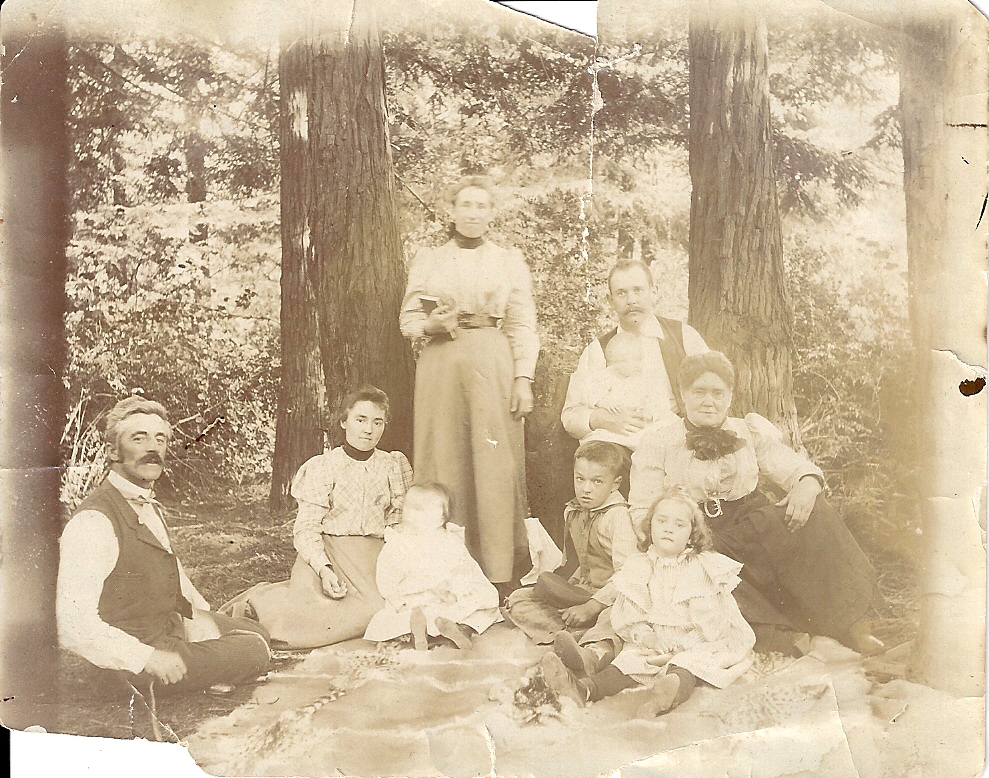
Many historians have wondered why the Italian Mafia was not present in California (with the exception of Big Bone Remmer) It appears the Sardinians own the franchise. Now I understand why, and how, my father, Victor William Presco, was a “made man”. The Stuttmeisters may be Italian-Germans. Here is William Stuttmeister and Cipriani.
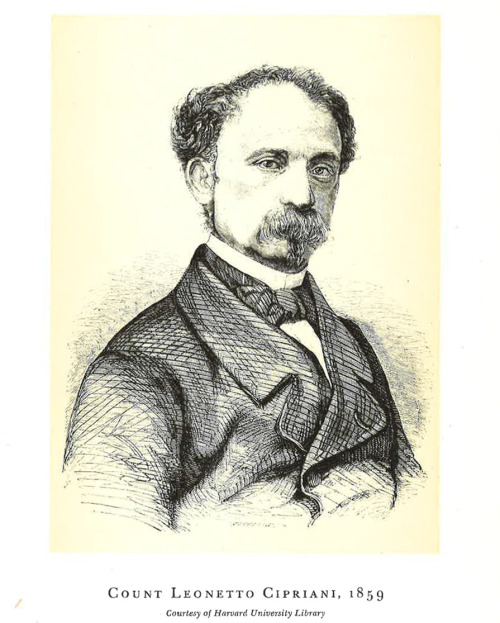
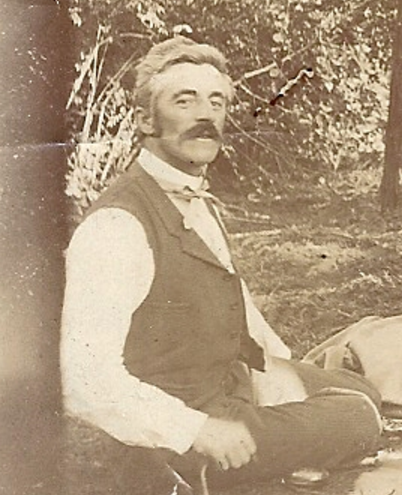
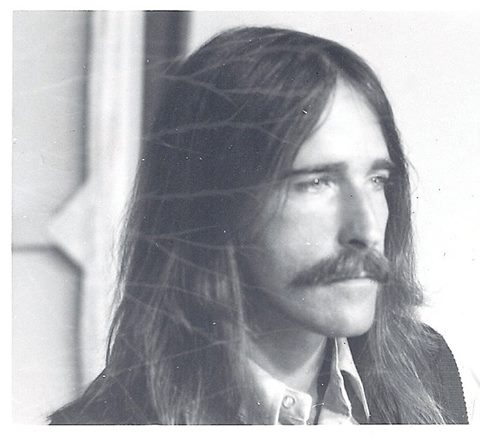
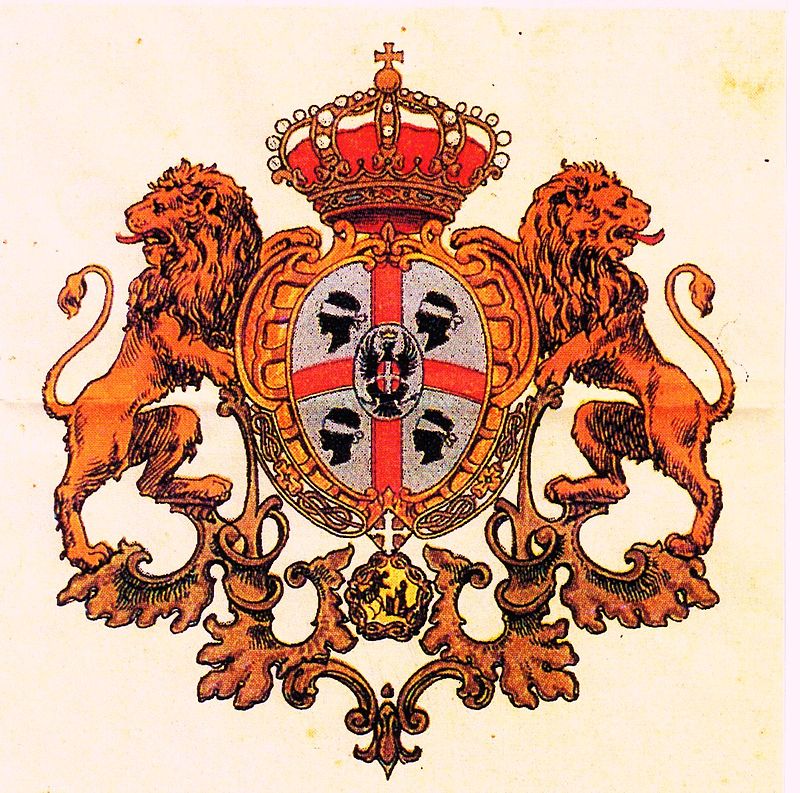
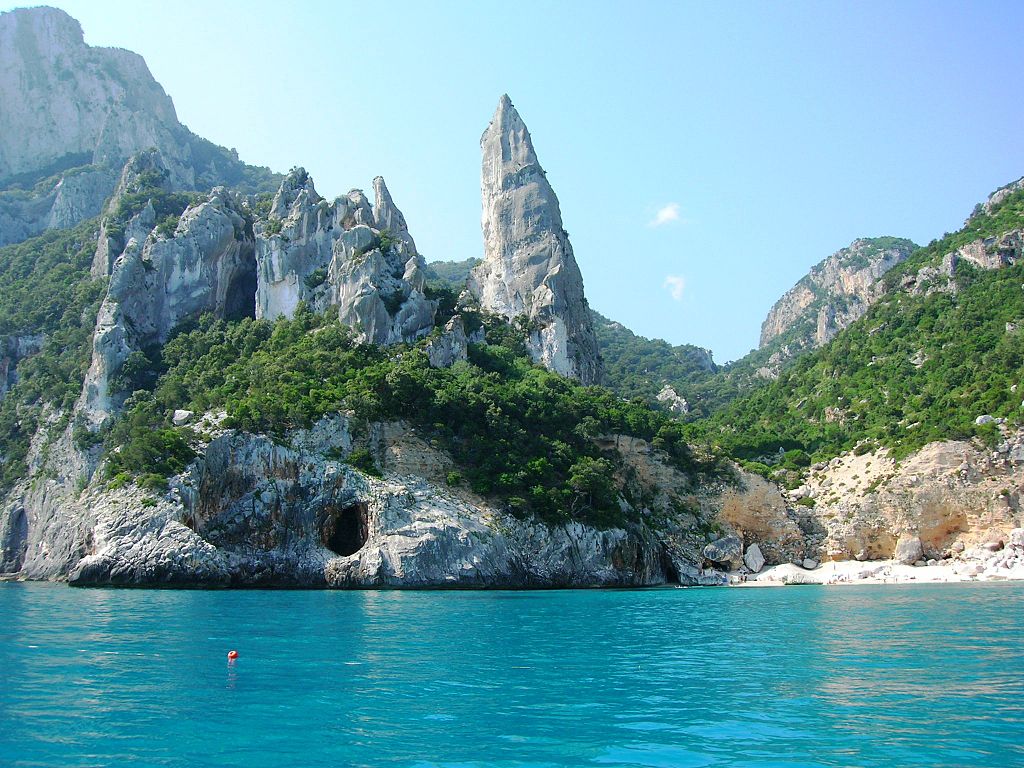
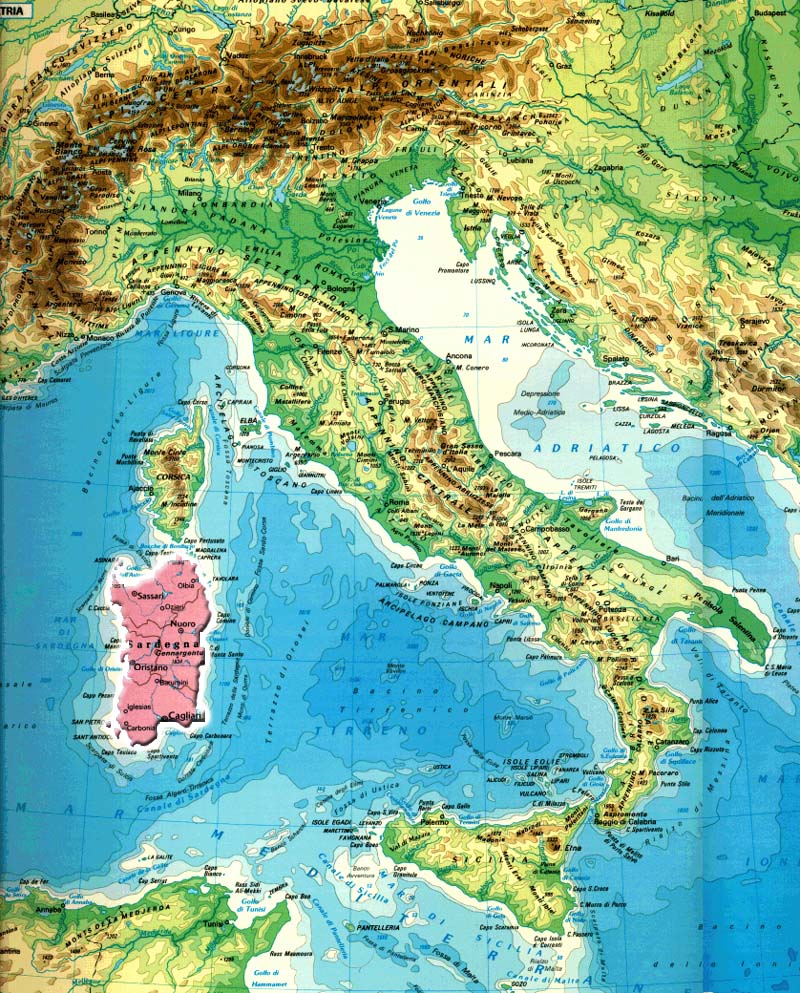
I declare myself the Cultural Embasador of the Kingdom of Sardinia. I will establish a cultural exchange between Sardinia and its California Colonly. I will make Sardinia the the Tourist Mecca for San Francisco natives. We will form a Art Exchange program based upon the works of Frederico Biesta, a owner of a SF newspaper. There will be a Festival Sardinia Day held in Belmont.
This is the history that Christine Rosamond Benton – a world famous artist – would want to read and be a part of. Instead,
Christine came to live with me at the Idle Hands Commune in San Francisco paid for by Betty Williams, who was married to Col. Zorthian, a Armenian who was titled ‘The Last Bohemian’. We knew the manufacturers of LSD that fueled the Kesey Revolution. Nancy Van Brasch lived with us. Jessie Benton was a good friend of Lewis Kossuth who lived with Giuseppe Mazzini in London. She and John had a bodyguard made up of Hungarian Forty-Eighters who also fought the Papal Army in Europe. Wenzel Anton Prescowitz was a Forty-Eighter from Bohemia. We are looking at the most radical people in the world that would form the Abolitionist Republican Party.
This is the Invisible Revolution that made California a Colony of the Kingdom of Sardinia that was surrounded by the Habsburgs who had backed the Papacy for a thousand years. This is why Count Cipriani drove a herd of cattle to California known for its fruit and vegetables. The Rose of the World Revolution would not be starved out. If Opus Dai had a mortal enemy, it was Victor Emanuel, and Belle Marie Rosa.
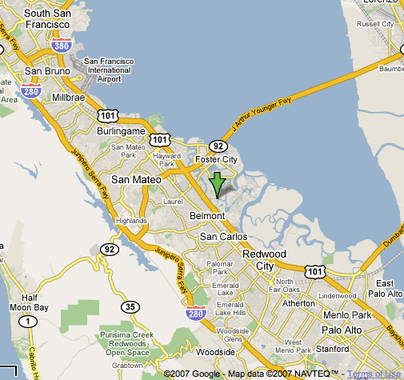
http://burlingameproperties.com/en/communities/belmont/carlmont
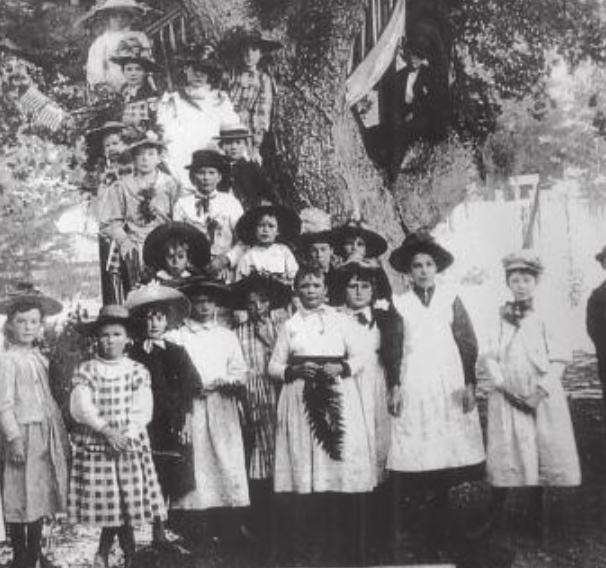
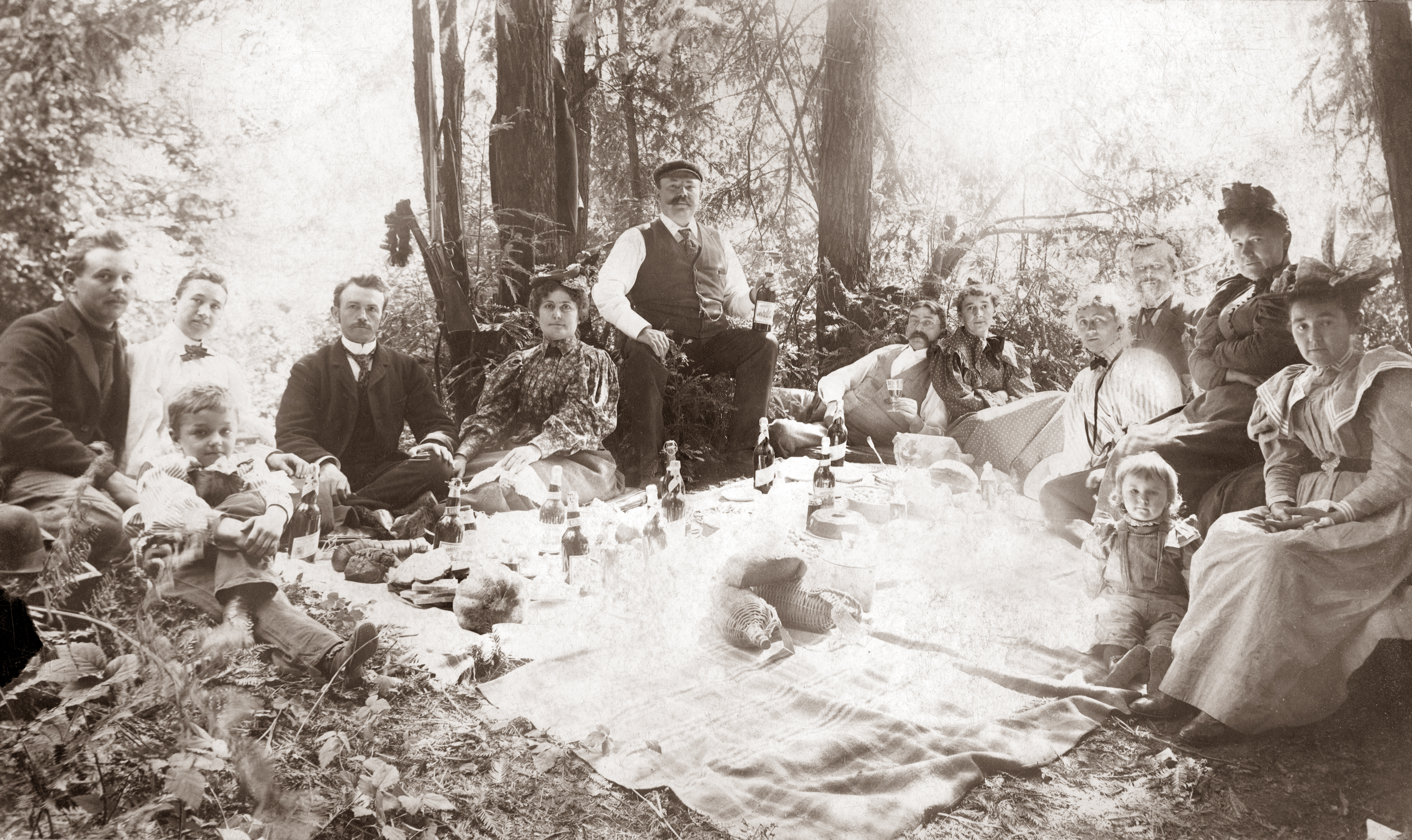
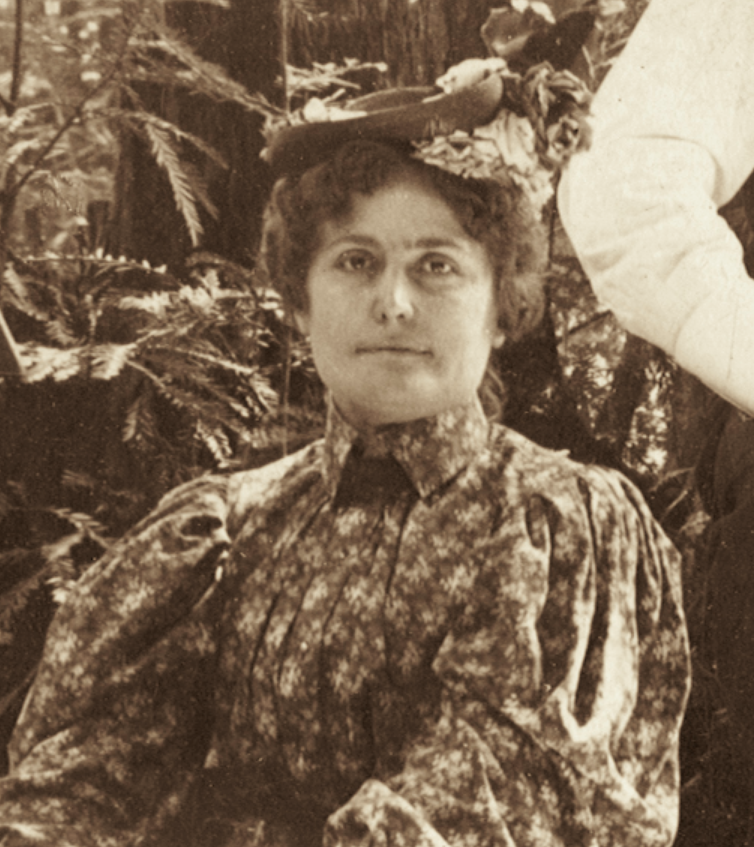
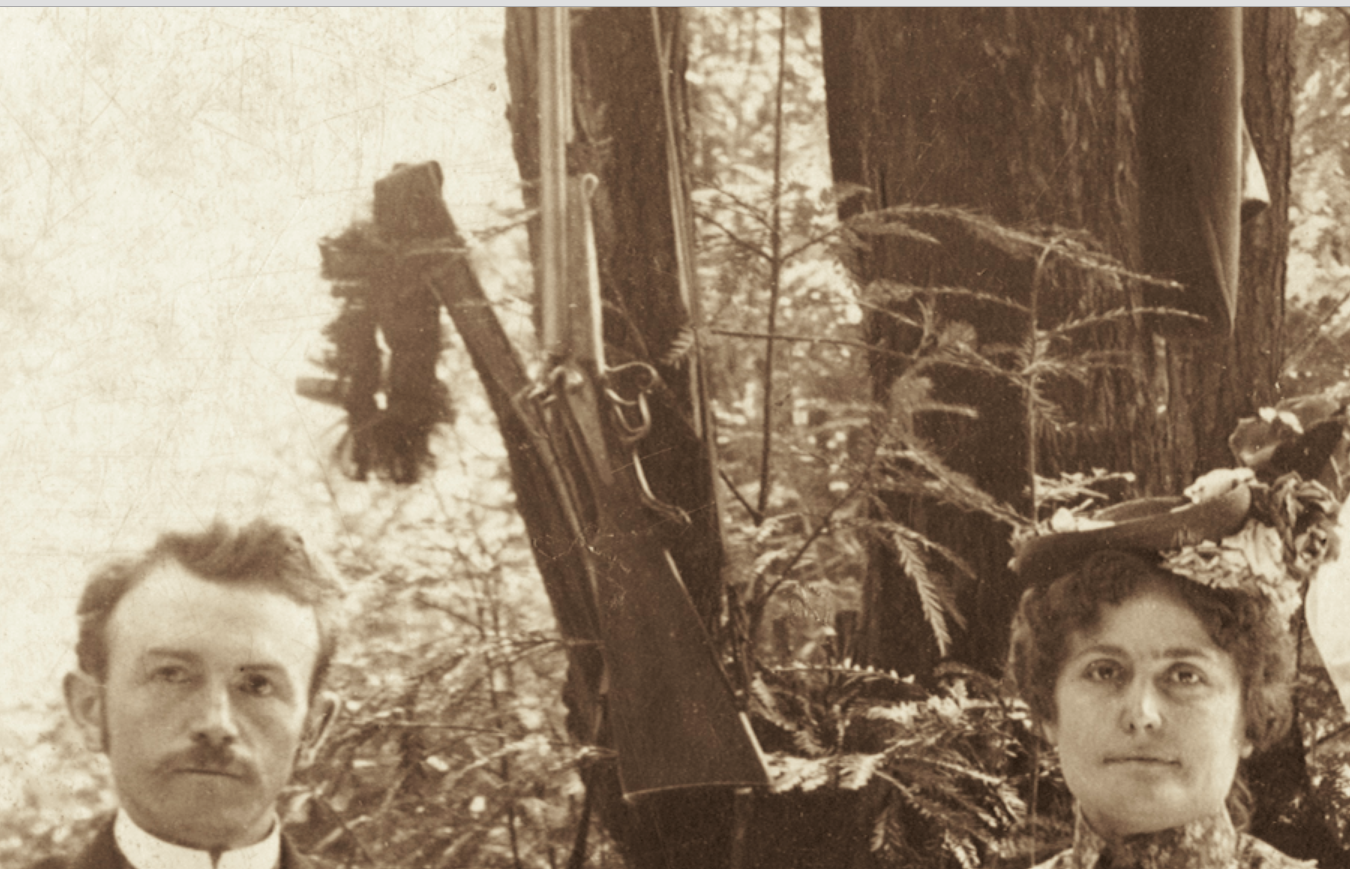
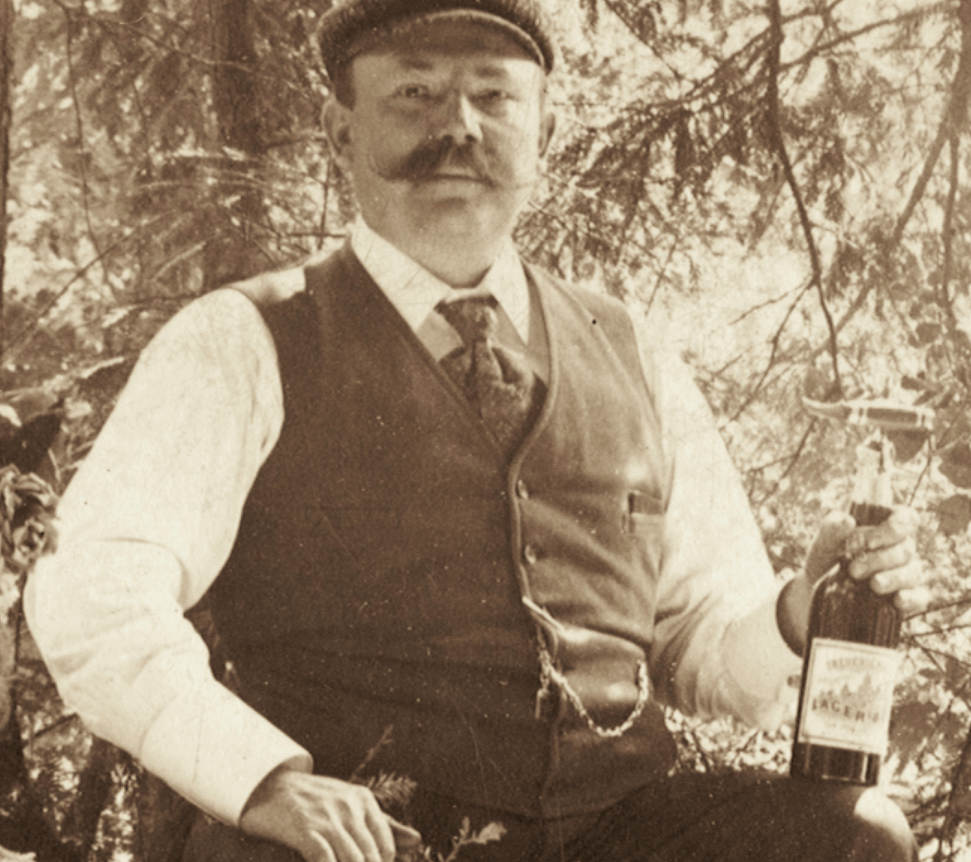
Click on top photo to enlarge. There is a gun hanging in the tree between my father;s grandfather, William Broderick, and his wife, Alice Stuttmeister, who looks like Christine and Vicki. We lived with Beema and Beepa in Oakland where these folks fled after the San Francisco after the earthquake. The gentleman holding the wine may be the father of William Broderick. There is no lineage for this branch who I suspect were the Illuminati, and sold barrels to bootleggers during Prohibition. Who do you think owns that rifle? How many Catholics fell in the sights of this weapon?
There is a black wreath hung in the tree next to the rifle. What message does that give?
http://www.britannica.com/topic/Carbonari
Then there are the Rougemont Knight Templars that owned the Shroud of Turin. They were the Dukes of Athens, and very possible my kindred on my mother Rosemary’s side. The Stuttmeisters were Teutonic Knights. President Obama sent more troops to fight ISIS from Germany.
To my loyal friends, Marilyn Reed, and Amy Sargent, history will honor you as Good Souls, who cared about my mental and physical health. Like I told my sixteen year old daughter after we met for the first time……
“All’s well, that ends well.”
Jon Presco
Copyright 2016
http://www.academia.edu/5778858/The_Italian_Colony_of_San_Francisco_during_the_Italian_Risorgimento
http://www.britannica.com/event/Risorgimento
After Napoleon’s defeat in 1815, the Italian states were restored to their former rulers. Under the domination of Austria, these states took on a conservative character. Secret societies such as the Carbonari opposed this development in the 1820s and ’30s. The first avowedly republican and national group was Young Italy, founded by Giuseppe Mazzini in 1831. This society, which represented the democratic aspect of the Risorgimento, hoped to educate the Italian people to a sense of their nationhood and to encourage the masses to rise against the existing reactionary regimes. Other groups, such as the Neo-Guelfs, envisioned an Italian confederation headed by the pope; still others favored unification under the house of Savoy, monarchs of the liberal northern Italian state of Piedmont-Sardinia.
Victor Amadeus initially resisted the exchange, and until 1723 continued to style himself King of Sicily rather than King of Sardinia. The state took the official title of Kingdom of Sardinia, Cyprus and Jerusalem, as the house of Savoy still claimed the thrones of Cyprus and Jerusalem, although both had long been under Ottoman rule.
Towards the Kingdom of Italy[edit]
On 17 March 1861, law no. 4671 of the Sardinian Parliament proclaimed the Kingdom of Italy, so ratifying the annexations of all other Apennine states, plus Sicily, to the Kingdom of Sardinia.[17] The institutions and laws of the Kingdom were quickly extended to all of Italy, abolishing the administrations of the other regions. Piedmont became the most dominant and wealthiest region in Italy and the capital of Piedmont, Turin, remained the Italian capital until 1865, when the capital was moved toFlorence. But many revolts exploded throughout the peninsula, especially in southern Italy, and on the island of Sicily, because of the perceived unfair treatment of the south by the Piedmontese ruling class. The House of Savoy ruled Italy until 1946 when Italy was declared a republic by referendum. In this referendum the southern regions, including Sardinia, voted overwhelmingly in favor of the House of Savoy, with the results being 63.8% in favor of maintaining the monarchy.
It appears that Cipriani was successful in uniting the House
of Savoy with the Bonapartes, and thus the House of Stuart. Prince
Napoleon Joseph Charles Paul of France, Pr Napoléon, married in Turin
in 1859, Princess Clothilde of Savoy daughter of Victor Emanuel. From
this union would come other Bonapartes with the name Victor. Prince
Napoléon Victor Jérôme Frédéric, Prince LOUIS Jérôme Victor Emmanuel
Léopold Marie, and, Prince Charles Marie Jérôme Victor
Was the Jacobite ‘Order of the White Rose’ somewhat successful
in their plan to put the Stuarts on a throne and rule the world?
There appears to contention with the Prussians who can claim the same
ancestry through the Winter Queen of Bohemia, Elizabeth Stuart,
daughter of King James, and thus the Hanovers who are in all regards,
the Windsors.
Before introducing the issue of the relationship between theColony and the central government, let us look into this type of political immigration which was characterised by different social implications and cultural backgrounds. In fact, one of these political immigrants was the young Leonetto Cipriani (1812-1888), destined to become the first Sardinian Consul of San Francisco. Assigned the tasks of improving trade between the Sardinian Kingdom and California,
’ in 1852, in quarters which he had physically brought from home. Curiously, the newborn Sardinian Consulate was constructed from 1200 pieces of wood, transported by sea and personally assembled by Cipriani and his entourage. Undoubtedly the official representative of the Sardinian Kingdom was welcomed with “interestand distinction” within a young Italian community which needed political support. Cipriani ’s activity in San Francisco essentially concerned the financial enhancement of the Colony, by improving maritime trade with the homeland. To this end the Consul enlisted the help of Nicola Larco and widely favoured him, funding the most lucrative initiatives of the Ligurian entrepreneur Cipriani was also a romantic: both his venturesome choice of emigrating to California and his early resignation can be traced to this inclination. In any case, more relevant than Cipriani’s impetuous nature is his list of citizens of the Kingdom, which he sent to Turin in 1853: this document is the first original report giving the names and activities of early Italian pioneers in California. Thanks to the list, we are introduced to a number of Italian residents in the West, including Larco and another personage who would later become historically significant: a certain Federico Biesta, vaguely and informally defined as a property owner Possibly even more interesting than the names included on the list is the exclusion of certain others. For instance, though his presence in San Francisco during the same period is well-established, the Sardinian Consul did not mention Felice Argenti, founder of the 1941 North American Chapter of the Giovine Italia. We now know that many others were also excluded from the list as well as Argenti: the new Consul, in fact, deliberately
http://sanfranciscoitaly.com/post/123993261859/meet-the-first-italian-consul-in-san-francisco
During the nineteenth century many prominent Italian travelers visited the Far West. One of the earliest visitors was Leonetto Cipriani (1812-1888). Cipriani was born in Corsica but his family roots (like those of Napoleon Bonaparte) were in Tuscany. After the Battle of Waterloo the family returned to Tuscany where it established a successful mercantile business. Cipriani was eventually appointed by Grand Duke Leopold II to be governor of Livorno and in that capacity established relations with King Carlo Alberto (King of Sardinia) and Louis Napoleon (President of France). – See more at: http://sanfranciscoitaly.com/post/123993261859/meet-the-first-italian-consul-in-san-francisco#sthash.e7UAQ3f2.dpuf
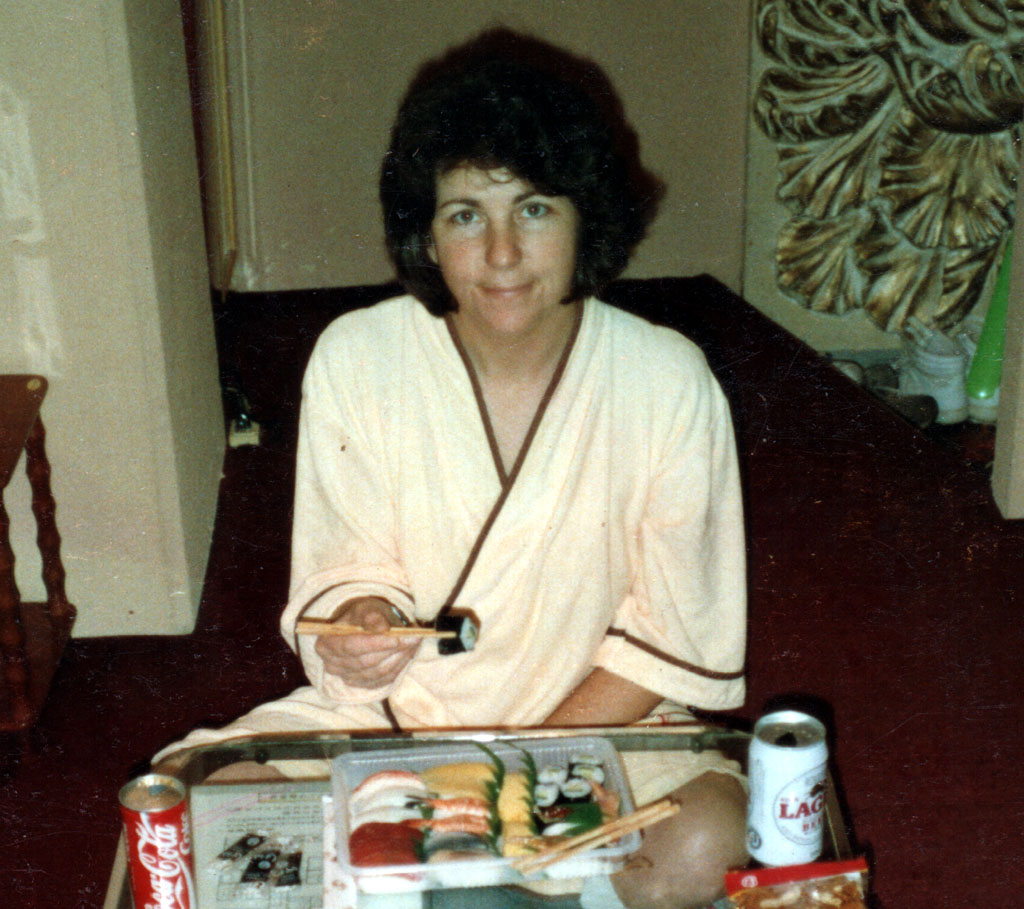
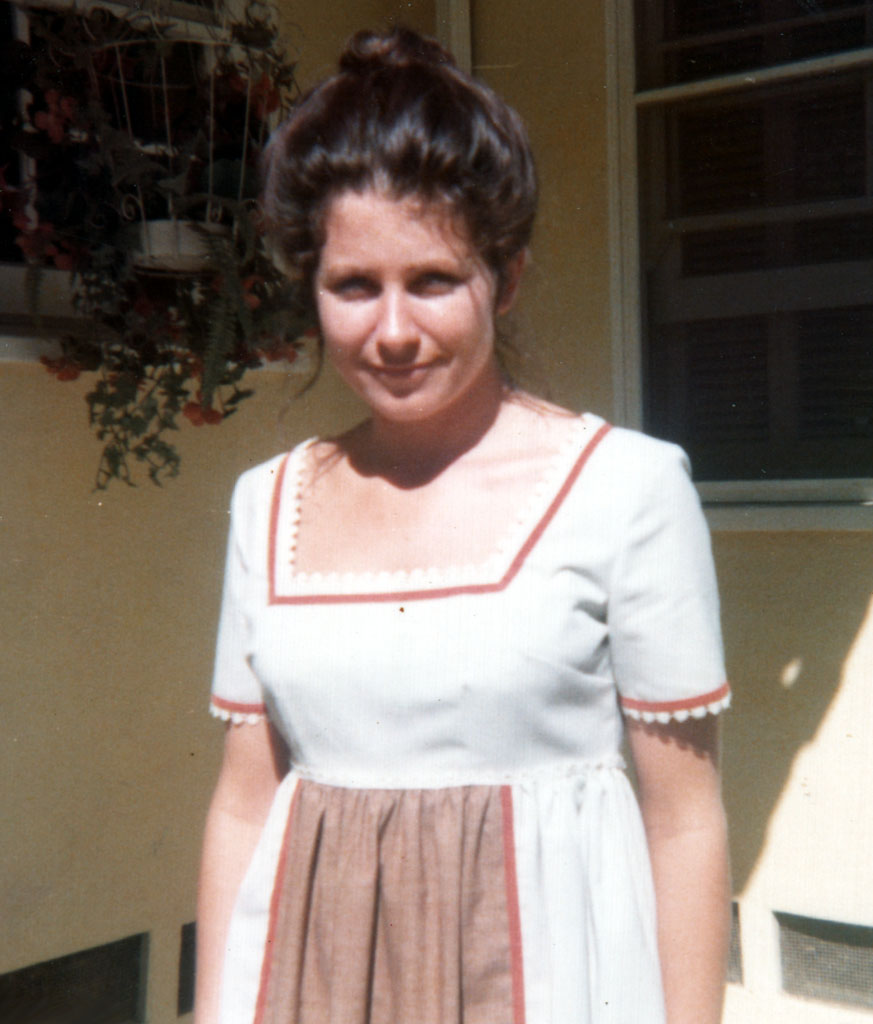
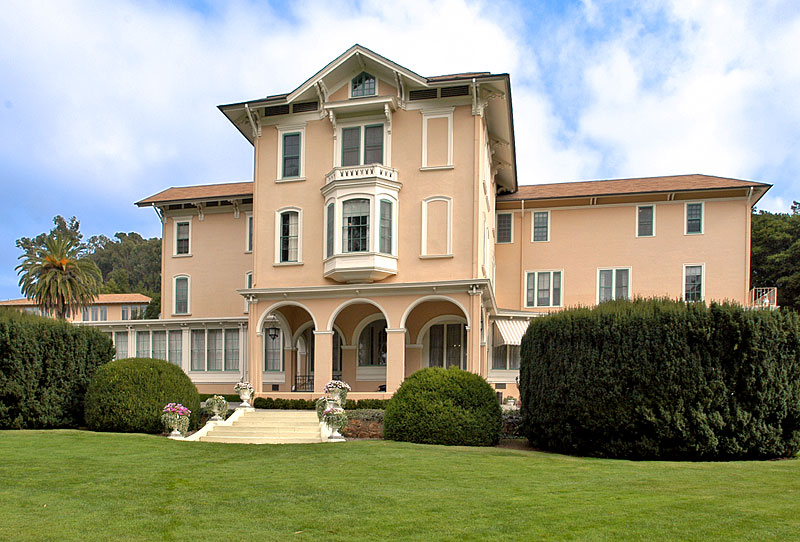
After Victor Emmanuel became King of Sardinia he appointed Cipriani to be his first consul in San Francisco. Cipriani’s memoirs, which contain narratives of three separate journeys to California in 1851, 1853 and 1871, were published in1934. He recorded some very interesting encounters. In fact, the accounts of his two earliest journeys are the only central overland narrative written by an Italian. Throughout his travels he encountered local leaders and diplomats as well as other Italians. In Salt Lake City he met Brigham Young and other members of the Mormon hierarchy, with whom he established good relations, as well as an Italian musician named Gennaro Capone. In San Francisco, he was introduced to the French and Austrian Consuls as well as Nicola Lauro who he described as “the richest Italian merchant in the city” and his cousin Ottavio Cipriani. He also describes how he assembled his elegant prefabricated home in Belmont, the first of consequence on the San Francisco peninsula, later to become the Ralston mansion.
His memoirs Avventure della mia vita (pictured above) were published more than forty-five years after his death and were based on a manuscript that is still located in Bastia, Corsica in the original sea chest that he used during his travels. These memoirs were first translated into English by Ernest Falbo and published as California and Overland Diaries of Count Leonetto Cipriani from 1853 through 1871 (Portland, OR: The Champoeg Press, 1962). More recently I had the honor to examine the Cipriani archives in Bastia, Corsica. I included excerpts from Cipriani’s account in my documentary history of European travelers (including other prominent Italians) who visited Utah entitled “On the Way to Somewhere Else” (Salt Lake City: University of Utah Press, 2010) which is still in prin
The Papal States were territories in the Italian Peninsula under the sovereign direct rule of the pope, from the 8th century until 1870. They were among the major states of Italy from roughly the 8th century until the Italian Peninsula was unified in 1861 by the Kingdom of Piedmont-Sardinia. At their zenith, they covered most of the modern Italian regions of Lazio (which includes Rome), Marche, Umbria and Romagna, and portions of Emilia. These holdings were considered to be a manifestation of the temporal power of the pope, as opposed to his ecclesiastical primacy. After 1861, the Papal States, reduced to Lazio, continued to exist until 1870. Between 1870 and 1929, the pope had no physical territory at all. Eventually Italian leader Benito Mussolini solved the crisis between modern Italy and the Vatican, and, in 1929, the Vatican City State was granted sovereignty.
- See more at: http://sanfranciscoitaly.com/post/123993261859/meet-the-first-italian-consul-in-san-francisco#sthash.e7UAQ3f2.dpuf
http://osdir.com/ml/culture.templar.history/2003-10/msg00001.html
Count Cipriani was born in Centuri Corsica, on October 10,
1812. On his father’s side he is descended from an old Florentine
family of Ghibellines, which after a long struggle with the vitorious
Guelfs, found refgue in Corsica in the fifteenth century. On his
mother’s side he is descended from Saint Francis Caracciolo of
Naples, and thus Saint Aquinas. This struggle inspired Shakespear to
write ‘Romeo and Juliet’ and thus the question “What is in a name?”
came to be.
Royal Rosamond Press dedicates this closure to my
chapter ‘Bohemians and Bankers’ to Cipriani, a man who shaped the
West, and knew the ancestor of Rosamond, the ‘Rose of the World.
John Presco
Copyright 2003
“Returning to Paris in October, 1855, he was warmly received
by his friend Prince Napoleon who overwhelmed him with questions
about his travels in America. “I answered them the best I could.”
Cipriani wrote, “But , it is a veritable deluge….We keep talking
about my journeys, of the Sanora, of conquering it.” Perhaps he
thought of seizing it for France and hoped the prince might persuade
his cousin the Emperor to finance the undertaking. “It is an idea in
the air,” he added, “that I would willingly undertake, if necessary
capital and men were available.”
To another member of the imperial household, Jerome
Bonaparte, ex-king of Westphalia, Cipriani revealed tha the had
considerable investments in California and hinted at receiving
interest of twelve to fifteen percent a month on his money. He also
boasted of his house in Belmont which “out there is considered
magnificent.”
On behalf of the Emperor Napoleon 3, he visited King Victor
Emanuel of Sardinia to explore the possibilities of a matrimonial
arrangement between the ruling houses as a prelude to a political-
military alliance between France and Sardinia. The conversation
eventually turned to Cipriani’s overland journey of 1853, which
apparently had not escaped the king’s notice. “I have heard tell,” he
said, “of a great journey of yours, with you on horseback and camping
out.”
“For eight solid months, Your Majesty,” Cipriani replied,
making certain to include the time he left San Francisco in February
to October, 1853.
“But it is true.” the king continued, “that you led covered
wagons and crossed the Rocky Mountains where there was roads, and
great rivers without any bridges.”
The above is from the ‘California and Overland Diaries of
Count Leonetto Cipriani’. a journey that may constitute the first
cattle drive. What this diary reveals is France’s plan to conquer
Mexico, and perhaps the Western United States.
“Cipriani must have followed with close interest the
activities of Count Raousset-Boulbon and other French filibusters in
the Sonora province of Mexico. The French consul in San Francisco, in
difficulty with the American government for his alleged support of
such filibustering activity, wrote to the Sardinian Ministry of
Foreign Affairs in 1854 that he was grateful (moral) support he was
receiving from Colonel Cipriani. That Cirpiani had entertained some
such expedition in the Sonora is clear from his memoirs though there
is no evidence of any actual participation.”
https://books.google.com/books?id=ESusAAAAIAAJ&pg=PA213&lpg=PA213&dq=frederico+biesta+cerruti&source=bl&ots=yMSEfYTxVz&sig=e2EUDGXoyaBRpHftjQRoFAGpUzk&hl=en&sa=X&ved=0ahUKEwiqvbWyxq_MAhWHKGMKHdfKBIYQ6AEILDAE#v=onepage&q=frederico%20biesta%20cerruti&f=false
With the ‘Gold Rush’ came foreigners who sought to fulfill
the manifest destiny of their nations who now feared the growing
richness and power of America and the role she might play on the
world stage. One could say pre-emptive strikes were made against
the “boastful barbarians” as Count Cipriani titled most of the
Americans he encountered. Without a doubt he followed with interest
the moves of Count Gaston Raousset-Boulbon, who arrived in San
Francisco on August 22, 1850, just at moment US laws segregated the
foreign people who came to search for California riches. His arrival
coincided with the move of thousands of French-people who looked for
a way out of the wars in their country, who came to find substance
and well-being in California. Not finding any gold, Raousett wondered
if California’s gold extended into the Mexican State of Sonora. I am
sure Ciprinai wondered this as well, and he may have organized his
cattle drive for such an expedition, he selling some California
property to the Rothschilds to bank-roll his adventure that the
Bonapartes were well aware of.
Raousset-Boulbon made his first trip to Mexico in February
1852. Once in Mexico City, he met Consul André Levasseur who
introduced him to investors of a company called La Restauradora whose
majority partner was Jecker, Torre and Co. On April 7, 1852, Raousset-
Boulbon singed a contract with La Restauradora on which he is
appointed jointly with an “agent”, who he met in San Francisco, to
explore all places in northern Sonora, and discover gold mines..
The Count returned to San Francisco, and recruited a company
of about 270 men, in addition to weapons and food. On May 19, 1852,
he left San Francisco, on the Archival Gracie to arrive Guaymas,
Sonora, the first day of July, under a spectacular welcome provided
by the Guaymas people and Sonora authorities. But in no time it was
clear he was a rebel. Raousset-Boulbon granted the company with a
flag with the French colors and the words “Indepéndance de Sonora”.
On October 1852, General Navarro and Blanco faced Roausset
near Hermosillo. The treaty with the French company was dissolved,
but Blanco guaranteed the security of the French. Raousset-Boulbon,
who had hidden in Guaymas, and did not sign the treaty. The project
in ruin, the French nobleman returned to San Francisco where he
consolidated his mission in Sonora:
Becoming rich with the supposed Sonora gold
Putting a stop to the US expansionism.
Reestablish the pure Latin-blood on the Americas.
Taking revenge on Mariano Arista.
Back in Mexico, Arista was deposed and replaced by Juan
Bautista Ceballos as the presidency, then by Manuel María Lombardini,
who in turn was succeeded by Santa Anna, and Gandsen, US minister to
Mexico. Raousset-Boulbon departed from San Francisco on June 16,
1853, arriving in Mexico City on July 7. He met Santa Anna and
discused with him his colonization project in Sonora by bringing
6,000 emigrants from Upper California from Europe in six years. Santa
Anna refused the proposals and Raousset-Boulbon’s forces were finally
defeated by General José María Yáñez on July 13, 1854. He is shot
dead on August 12, 1854.
Around 1860 a group of rich Mexican emigrants met in Europe,
they had fled the Juarez revolution. Catholic and conservative, they
looked for support in Europe for their plan to establish a monarchy
in Mexico. They needed money, troops and a genuine European noble.
The Bonapartes had tried to bestow nobility upon Cipriani, but he
refused fearing to become more of a puppet then he was. Victor
Emanuel had made him Governor of Balogna, and he would become the
first President of the United Kingdom of Italy. Cipriani would marry
an American, Mary Tolly Worhtington of Baltimore County who a
descendant of George Washington. Cipriani descends from the famous
Caracciolo family of Naples, and appears to be the son of Napoeleon’s
major dommo, Franchesci Cipriani. The whole truth is not being told
here, and Cipriani may have been playing down the royal hand he was
dealt.
Jerome Bonaparte married Elizabeth Patterson, and wealthy
heiress. Emperor Napoleon had marred Marie-Louis von Habsburg, and it
was a Habsburg that be amply qualified to become the first Emperor of
Mexico. Napoleon III. gave the emigrants troops, French financial
circles assured their assistance. The French supported the
conservatives in the civil war with the radicals and occupied the
capital. They planned an expansion of France on the American
continent close to the United States of America, torn up by the civil
war. Maximilian supported aspect of the Confederacy, it said he
financing Quantril. After the Civil War many Confederate officers and
politicians found sanctuary in Mexico.
The brother of the emperor Franz Josef, archduke Ferdinand
Max, seemed to be a suitable candidate. He was married to the Belgian
princess Charlotte. As commander of the Austrian navy and governor
general of Milan, he could not live all his ideas. Poet, lover of
large gestures, an emperor throne was enticing for him. In addition
he was honestly convinced to be able to bring law and peace to Mexico.
In 1863, pushed by Napoleon III., the ambitious Maximilian
and its wife Charlotte, fulfilled by romantic ideas, are proclaimed
emperor of Mexico. Charlotte saw herself as co-emperor, perhaps even
as the actual emperor, requesting her husband to finally show his
qualities – in Mexico. Perhaps she wanted also to flee the bores the
Miramar castle and the shades of the more beautiful empress Elisabeth.
The Austrian court was suspicious about this adventure,
Maximilian had to resign any rights of succession to the Austrian
throne. An Austrian volunteer corps followed him. Their uniforms
aroused the mockery of the Mexican children. On the trip the couple
prepared for their new job: How to behave at the audience, how to
place guests at diner, which medals to be given, what uniforms the
guards should wear.
But the emperor found only few followers and an indebted
government. The Mexican empire remained limited to a considerable
number of generals, ministers, chamberlains, stable masters, cooks,
gardeners and palace guards, plus some land owners and businessmen,
who profited from the emperor. Maximilian, a Sombrero on his head,
traveled around the country, gave dinners and distributed medals. He
adopted a small Mexican boy as his son, his mother reclaimed him back
later. This was a gesture my father would imitate as he loved history
and admired the Habsburgs.
The republicans became stronger and advanced. Vienna stood
briefly before the 1866 war against Prussia and Italy, and permitted
only a limited recruitment of volunteers. But they sent from the
imperial collections the shield of Montezuma and the report by Cortez
to Karl V., how he had won victory against the Aztecs.
The USA supported the opponents of the emperor, conforming to
the Monroe doctrine “America the Americans”. They demanded and
obtained that the recruitment of volunteers in Austria was stopped,
2000 men already embarked had to leave their ships. With the victory
of the north in the American civil war 1865 the decision fell also in
Mexico. In vain, empress Charlotte searched assistance. She arrived
in Europe after the battle of Königgrätz. In Paris, which had an
assistance contract with Mexico, she got the answer from Napoleon
III., “it would be good, if her majesty would not hang on to
illusions”.
Napoleon did not want to invest money into an affair without
future. She did not even bother to go to Vienna. Franz Josef did not
want to hear anything of its brother, specially not since the
Viennese rallied after the lost war against Prussia “Vivat emperor
Maximilian”, who seemed to them as more liberal and the better
emperor for Austria. Her last hope was the Pope, who could have
talked to Napoleon and Franz Josef, concluded a concordat with Mexico
and convinced the Mexican catholic church. But Pius IX. only wanted
to pray. Charlotte fell into depression, one night fled from the
hotel and required lodging in the Vatican. Her brother brought the
mentally ill Empress back to Miramar.
The French troops withdrew. Maximilian was on the way back to
Austria, however his Belgian and Austrian advisor’s, specifically
father Fischer convinced him not to give up the throne. Even his
mother now requested from him to endure as long this “can happen with
honor “. His wife had written in a memorandum before her departure
that “abdication is condemning himself, an certification of
inability, acceptable for the old and stupid, but not for a prince of
34 years full of live and future.”
But his armed forces were small and little motivated. On May
15th, 1867 Maximilian handed his sword to the partisan leader
Escobedo. He was taken prisoner. He could have fled, but he had
refused to leave his most devoted officers. He was condemned to
death. In the prison he complained briefly before his execution, that
he was here because he had followed his wife.
Now the diplomacy got into motion to prevent that a member of
the ruling European dynasty would be shot like a simple murderer.
Franz Joseph restored Maximilian’s rights to the succession of the
Austrian throne and asked the American secretary of state to
intervene.
On June 19th, 1867 Maximilian was executed on the Cerro de
las Campanas, a hill near the city Queretaro together with the
generals Miguel de Miramon and Thomas Mejia – latter an Indian –
scarcely 350 years after the murder of Montezuma by Spanish
mercenaries. Maximilian gave a golden piece of twenty pesos to each
soldier of the firing squad.
He was idealist, a human full of liberal thoughts and had
honestly hoped to bring the Mexican people liberty and internal
peace, “a figure of beautiful, pure knighthood, which will teach up-
striving souls that it there is something higher than the bare life
and benefit” wrote Adalbert Stifter.
He was idealist, a human full of liberal thoughts and had
honestly hoped to bring the Mexican people liberty and internal
peace, “a figure of beautiful, pure knighthood, which will teach up-
striving souls that it there is something higher than the bare life
and benefit” wrote Adalbert Stifter.
It appears that Cipriani was successful in uniting the House
of Savoy with the Bonapartes, and thus the House of Stuart. Prince
Napoleon Joseph Charles Paul of France, Pr Napoléon, married in Turin
in 1859, Princess Clothilde of Savoy daughter of Victor Emanuel. From
this union would come other Bonapartes with the name Victor. Prince
Napoléon Victor Jérôme Frédéric, Prince LOUIS Jérôme Victor Emmanuel
Léopold Marie, and, Prince Charles Marie Jérôme Victor
Was the Jacobite ‘Order of the White Rose’ somewhat successful
in their plan to put the Stuarts on a throne and rule the world?
There appears to contention with the Prussians who can claim the same
ancestry through the Winter Queen of Bohemia, Elizabeth Stuart,
daughter of King James, and thus the Hanovers who are in all regards,
the Windsors.
Did the Jacobite movement come to America? I am authoring a
biography of my family, and came upon Count Leonetto Cipriani who
became the President of Italy.
Jon
“On behalf of the Emperor Napoleon 3, he visited King Victor
Emanuel of Sardinia to explore the possibilities of a matrimonial
arrangement between the ruling houses as a prelude to a political-
military alliance between France and Sardinia.”
“It appears that Cipriani was successful in uniting the House
of Savoy with the Bonapartes, and thus the House of Stuart.”
Anarchists, Jacobites, Masons & Manifest Destiny
The City of Belmont
California was founded by Count Cipriani who appears to be related to
the Anarchists of Italy, who may have had something to do with
Sissi’s assasination. Anarchists Clubs sprang up in Italy in response
to the Hapsburg’s and Austria coming to rule Italy. Opposed by the
Piedmontese and the Milanese, Count Leonetto Cipriani would champion
the cause of a free and democratic Italy.
“A writer hostile to Cipriani accused him of forbidding his
son Italian citizenship because he did not want the boy to be a
subject of an Italy that, after 1882, was allied with the traditional
enemy, Hapsburg Austria. Cipriani seldom forgave and never forgot an
enemy.”
Whether Leonetto Cipriani is related to the infamous Italian
Anarchist, Amilcare Cipriani, I do not know. But, they surely had the
same cause, that would come to shape the culture of San Francisco, if
not the whole Pacific Coast, and not just the Italian community. It
appears that Cipriani was successful in uniting the House
of Savoy with the Bonapartes, and thus the House of Stuart. Prince
Napoleon Joseph Charles Paul of France, Pr Napoléon, married in Turin
in 1859, Princess Clothilde of Savoy daughter of Victor Emanuel. From
this union would come other Bonapartes with the name Victor. Prince
Napoléon Victor Jérôme Frédéric, Prince LOUIS Jérôme Victor Emmanuel
Léopold Marie, and, Prince Charles Marie Jérôme Victor
Was the Jacobite ‘Order of the White Rose’ somewhat successful
in their plan to put the Stuarts on a throne and rule the world?
There appears to contention with the Prussians who can claim the same
ancestry through the Winter Queen of Bohemia, Elizabeth Stuart,
daughter of King James, and thus the Hanovers who are in all regards,
the Windsors.
Count Cipriani was born in Centuri Corsica, on October 10,
1812. On his father’s side he is descended from an old Florentine
family of Ghibellines, which after a long struggle with the vitorious
Guelfs, found refuge in Corsica in the fifteenth century. On his
mother’s side he is descended from Saint Francis Caracciolo of
Naples, and thus Saint Aquinas. This struggle inspired Shakespear to
write ‘Romeo and Juliet’ and thus the question “What is in a name?”
came to be.
“Returning to Paris in October, 1855, he was warmly received
by his friend Prince Napoleon who overwhelmed him with questions
about his travels in America. “I answered them the best I could.”
Cipriani wrote, “But , it is a veritable deluge….We keep talking
about my journeys, of the Sanora, of conquering it.” Perhaps he
thought of seizing it for France and hoped the prince might persuade
his cousin the Emperor to finance the undertaking. “It is an idea in
the air,” he added, “that I would willingly undertake, if necessary
capital and men were available.”
To another member of the imperial household, Jerome
Bonaparte, ex-king of Westphalia, Cipriani revealed tha the had
considerable investments in California and hinted at receiving
interest of twelve to fifteen percent a month on his money. He also
boasted of his house in Belmont which “out there is considered
magnificent.”
On behalf of the Emperor Napoleon 3, he visited King Victor
Emanuel of Sardinia to explore the possibilities of a matrimonial
arrangement between the ruling houses as a prelude to a political-
military alliance between France and Sardinia. The conversation
eventually turned to Cipriani’s overland journey of 1853, which
apparently had not escaped the king’s notice. “I have heard tell,” he
said, “of a great journey of yours, with you on horseback and camping
out.”
“For eight solid months, Your Majesty,” Cipriani replied,
making certain to include the time he left San Francisco in February
to October, 1853.
“But it is true.” the king continued, “that you led covered
wagons and crossed the Rocky Mountains where there was roads, and
great rivers without any bridges.”
The above is from the ‘California and Overland Diaries of
Count Leonetto Cipriani’. a journey that may constitute the first
cattle drive. What this diary reveals is France’s plan to conquer
Mexico, and perhaps the Western United States.
“Cipriani must have followed with close interest the
activities of Count Raousset-Boulbon and other French filibusters in
the Sonora province of Mexico. The French consul in San Francisco, in
difficulty with the American government for his alleged support of
such filibustering activity, wrote to the Sardinian Ministry of
Foreign Affairs in 1854 that he was grateful (moral) support he was
receiving from Colonel Cipriani. That Cirpiani had entertained some
such expedition in the Sonora is clear from his memoirs though there
is no evidence of any actual participation.”
http://www.jstor.org/stable/25155579?seq=1#page_scan_tab_contents
In 1851 he brought to Belmont a prefabricated house in 1,200 parts,
to be fastened together with 700 hooks and 26,000 screws. He invested
in local realestate but lacked the Midas touch. The Count sold his
prefab house and sailed back east to organize a wagon train to move
overland to the Pacific. In 1853 the Count left Missouri with 11
wagons, 24 hired hands, 500 cattle, 600 cattle, 60 horses, and 40
mules. He wrote an account of this six-month journey that became the
book ‘The California and Overland Diaries of Count Leonetto Cipriani’
by Ernest Falbo.
But, I have just touched the surface, for it appears Count Cipriani
was a relative of Napoleon’s’s major donmo, Franchisci Cipriani who
was a fellow Tuscan, whose family knew the Bonapartes well, and were
with him in the end, in the emperor’s exile on St. Helena. What is
truly extraordinary, is, there have recently appeared several books,
and a couple of television documentary in Europe suggesting it is the
body of Franchesci Cipriani who was found in the coffin of Napoleon
when it was exhumed and moved from England to France. You will hear
more about this as this genealogical tale, and mystery, unfolds.
Count Cipriani would make seven more voyages to the United States,
dabbling in mining, ranching, and the stock market. When Cipriani was
called home to serve in the Italian Senate in 1853, he turned over
his consular duties to a most unlikely Italian, Patrice Guillaume
Dillon, the French consul with the Irish last name. Dillon was
responsible for all matters concerning all the Italians in the Far
West. Since he could not read or write Italian, Dillon employed a
friend of Cipriani’s, Frederico Biesta. Biesta would eventually serve
as acting consul for Sardinia within the French Consulate. What is
going on here?
Biesta was born in Turin, the home of the Holy Shroud, and served in
the Army of King Charles Albert of Sardinia with considerable
distinction. He was made a cavalier. After six months he had to turn
to his friend Cipriani for financial help, and because of his many
talents, Cipriani became his backer. When the French government
reassigned Dillon to Port au Prince in 1857, Biesta became acting
consul of Sardinia. Everyone expected him to be named permanently,
but to everyone’s dismay he was passed over, and a native of London,
Benjamin Davidson got the post.
Davidson owed his selection to the fact he was the local agent of the
Rothschild banking house of London. Count Cavour’s of Sardinia
policies were commonly said to be financed by loans from the
Rothschilds. European Bankers were eager to have their agents in
consulates where thy could be on the lookout for financial
opportunities. Napoleon had his agents all over thw world and was
forever at war with Jacob Rothschild
Members of the emporers family were said to be Freemasons. I suspect
Dillon was a Mason, as was Bret Harte, the Californian writer and
poet who was the discovery of Jesse Benton Fremont, the wife of the
founder of the Republican Party, and its first Presidential
candidate, John Fremont who was titled ‘The Trail Blazer’, he a
Pioneer of the West. Jesse Benton is an ancestor of my niece Drew
Benton, whose father, Garth Benton, married my late siser, the world
renowned artist who signed he art by her middle name, Rosamond, which
is my mother Rosemary’s maiden This name hails from Rougemont
Switzerland.
Ralston’s’ death by drowning in San Francisco Bay while taking his
usual swim, has been titled a murder by some, it said his demise
coming at the hands of the agents for Rothschild Banking. William
Sharon would come to own the chateau of Cipriani, and beget a
powerful family of politicians and bankers, including the founder of
Welles Fargo. These bankers are related to the famous Preston family
who are kin to the Benton family, and thus my niece.
When Ralston needed silver and gold bullion to back up his bank notes
and stop a run on his, and other Sand Francisco banks, he had a un-
named person let him into the San Fransisco Mint, and in the middle
of the night they carried a couple of tons of bullion through the
streets. In the morning, Ralston showed the people the large pile of
gold and silver stacked-up in his bank. I believe this person who
worked in the Mint was Bret Harte, as it was Jesse Benton who got him
the job at the mint, where was minted the first U.S. coin where on is
printed these words “In God We Trust”. Some believe this motto is of
Masonic origin.
FEDERICO BIESTA.
A Veteran Italian Editor Passes Away. He Died With His Pen in His Hand While at Work Translating Telegrams. The veteran Italian editor, soldier and diplomat. Fedeilco Kle>ta, died in his apartments on Mdtitgouieiy street at 7 o’clock yesterday morning. He passeci away quiellyiwith lits pen in his hand, and seemed as If he was going to sleep, so peaceful was the end.
i-‘ederico Uiesta was one of the best- known Kalians in California, tie was looked upon by bis own people as a man of high Intellectual attainments, and was respected by them. Somewhat irritable in disposition, but most reserved Iv manner, he counted his intimate friends only by hundreds, but ihose that he had loved him and appieciaied his intellectual aitainnients. At the tune of his death he was trausl.tlne telegrams lor the Ittliau paper L’Elvezia, and woiKed up to the lait moment, and ouiv stopped wiiting to die. lie had been sick for some time w itn a torm of anaemia, hut his deaib was unexpected by any
atiacue of the Italian consulate, m which he tilled me position of secretary naUl 1857, when lie went to British Columbia ana engaged iv tne business of assayer. He only remained at It for a few yeais and returnrd to California, agaiu taking a position In i he Italian consulate. From that time on lie rilled various offices of bis Government until 1881, when he went Into journalism eniliely. Ha started the tii>t Italian paper in California, called LEctio della l’atn.i, and was also editoi of the illustrated l ■au i r, La Patria, ISefote coming to this country Federico Biesia was in the Italian army under Klnc diaries Albert, aud In the revolution of 1849 gained
considerable distinction in the service. At the battle of Novarra he was ihe l’«;irer of the mi I’oitani dispatches from the King to bis son. Yicioi Emanuel. For his .ictiou ou that occasion he was made a chevalier. The life of lederico Diesta was filled with work, and he passed away knowing, he had done every duty sei him.
Victor William Presco made several expiditions across the border
and was good friends and partners with Americans who have been titled
the “Mexican Mafia”. He smuggled Connie, his Mexican bride to be,
over the border in a marijuana shipment, and it was his desire to
make Connie’s eleven children his heirs, which he did, much to the
consternation of Vicki who saw this a more grandstanding from a man
who commanded attention everytime he walked into a room, and got it;
for Victor was a Leo, a Lion-King in his own mind, and was forever
conducting loyalty checks.
I know he heard things from his mother. His cousin Bill was
hoisted atop a great wall in Belmont at ten, and told to go get his
stolen legacy. But, when one has lost a fortune, or a title, one
quickly learns to not talk about it, as one can be
titled “delusional” – especially when one has nothing to show for
their royal adventures and contacts with the high and mighty.
Vic was present when his daughter presented her portrait of
Jimmy Stuart to the actor my father was mistaken for when he and
Rosemary came out of a theater in Westwood, Vic just out of the
Merchant Marines. This was the only male she rendered because of the
striking resemblance. I do not know if Jimmy is a Stuart royal. But,
Vic wore the same white suit Jimmy wore in the painting, and upon it
was a large blazon. I asked Rosemary about it, and she said my father
had paid a genealogist to research his background, and apparently he
had found he was of a noble birth. He was very secretive about this.
Christine may have known, for in our last conversation she spat this
question at me; “You don’t know who I am!” I wondered at this, and
answered; “Yes I do. You are my sister.
Like myself, Rosemary and Vic loved world history, and they were
at peace when they conducted their long discussions about world
events. This no doubt had a influence on their children, and the art
of Rosamond, who revived realism in the 70s in regards to her
portraits. And what is history without its portraits and busts of
famous people? Rosamond was the model for many of the ‘Rosamond
Women’. I consider my sister to be a new Pre-Raphaelite artist – and
model – who had conversations with Joaquin Miller’s daughter on the
phone, she known as the ‘White Witch’ of Oakland, and is not unlike
the White Dame de Rougemont. Here is an account of Miller’s dinner
with the Pre-Raphaelites.
William Ralston
Historical Essay
by Ben Ratliff

William Ralston, after his Bank of California closed its doors on “Black Friday” in 1875, took his daily swim off the end of Larkin Street in the shadow of the Selby Lead Smelting Works and unexpectedly drowned.
Image: Harper’s Weekly
William Chapman Ralston is held to be the most influential catalyst of San Francisco’s growth after the Gold Rush of 1849. As a successful banker and investor in San Francisco, Ralston established a monopoly of the gold mine industry from 1864 to his death in 1875. Using his incredible clout, Ralston was able to generate millions of dollars for San Francisco during its heady boom years.
Like fellow San Francisco citizen Mark Twain, William Ralston worked on Mississippi riverboats as a youth. In the late 1850s, he captained a ship that brought “Argonauts” from Central America to work in the newly created gold mines. He stayed in San Francisco and soon became a successful banker.

William Ralston Memorial on the Marin Green, 2022.
Photo: Chris Carlsson
In 1864, Ralston joined with Darius Ogden Mills to open the Bank of California at the corner of Battery and Washington. Through this entity, Ralston became involved in a number of dicey schemes, some of which proved to be complete shams (e.g. The Great Diamond Hoax of 1871). However, it was the silver-producing Comstock Lode that would eventually become the Bank of California’s cash cow. Ralston was convinced that there was still plenty of silver ore to be extracted from Sun Mountain, even though many thought it had already played out after the initial Silver Rush of 1859. The same year Ralston opened the Bank of California, he commissioned William Sharon, a failed real-estate broker, to oversee the bank’s interests in Nevada. The Bank of California offered loans to the failing mining companies at a competitive 2% interest rate. Since the average interest rate then was in the range 3% to 5%, the companies flocked to Ralston, seeking loans to continue their operations. Then, when most of the mines were unable to repay the debt, Ralston took control of the mines, either by foreclosing on them or accepting majority stock as payment. In addition, Ralston bought the silver mills of Virginia City, where all of the mining companies sent their silver ore to be refined. Thereby Ralston insured that even those mines that had not sold their interests to him were subject to his influence. Ralston had effectively established a monopoly on the Comstock Lode.
Once he had control, Ralston poured money into new machinery to extract silver ore from Sun Mountain. Whereas earlier mining companies had run into problems trying to prick the buried veins of silver, Ralston hired new engineers to deal with typical mining problems like drainage, ventilation and removal of the precious ore. Soon some of the mines had gone bonanza again and mining stocks were again being bought and sold like crazy at Ralston’s own Mining Exchange across the street.
Thus began the rapid development of San Francisco’s financial district. William Ralston was now in a position to generate incredible amounts of revenue from investors on the east coast, while continuously strengthening his stranglehold on the Comstock Lode by purchasing mines, mills, lumber companies and stage lines. The money garnered from speculation was far more crucial to the growth of San Francisco than from the actual mining of precious metals. The excitement over the potential output from Sun Mountain led to a speculation frenzy that put San Francisco on the map in a short amount of time. From 1865-1875, more money was wrapped up in Comstock speculation than existed on the entire Pacific Coast in real dollars.
Needless to say, Ralston was living large. He invested in opera houses and theaters in San Francisco, in addition to building a gargantuan eighty-room mansion in Belmont, which lies south of San Francisco. Ralston bought up fur companies, furniture factories, sugar refineries, railways and watch companies. He gained controlling interest of the Spring Valley Water Company — San Francisco’s major water supplier at that time. Ralston also poured money into the formation of the nascent Golden Gate Park, which, at that time, was merely a bunch of sand dunes.
In 1870, Ralston commissioned the construction of the most ostentatious monument to his wealth, the Palace Hotel, which was $7 million in the making and sat on two-and-a-half acres. When it opened, the Palace Hotel was the largest hotel in the country and it boasted a bar tended by 30 men. For its construction, Ralston had linen, marble, wood and china from all over the world. It was equipped with state-of-the-art water and safety systems, and had a seven-story atrium for guests to drive their carriages into. The Palace would eventually host such prestigious visitors as Ulysses Grant, Rudyard Kipling and Emperor Dom Pedro III of Brazil. But one person who did not get to enjoy the opulence of the Palace hotel was Ralston himself, who fell victim to a stroke while swimming off North Beach and drowned, only two months before its opening in October of 1875. The refurbished post-earthquake Palace that was built after 1906 is now the property of Sheraton and stands today at the corner of New Montgomery and Market Street.
In spite of his apparent taste for grandeur, Ralston was reputedly a modest man. It was once proposed during a banquet that an agricultural community to the south of San Francisco be named after Ralston. Ralston respectfully declined the honor, not wishing to be lionized in this manner. The next speaker quipped that the town be named after Ralston’s modesty. Thus, the town of Modesto was born and a good laugh was had by all.
Although Ralston moved a lot of cash in his lifetime, he actually died severely in debt, observing a fine tradition of rags-to-riches-to-rags entreprenuers in the history of San Francisco. At the time of his death, it was rumored that Ralston had actually committed suicide to escape from his accruing debt. However, his successors managed to keep the largest monument to his wealth — the Palace Hotel — up and running until it burned down in the fire of 1906.
 Rosamond Press
Leave a comment