Dear Governor Newsom;
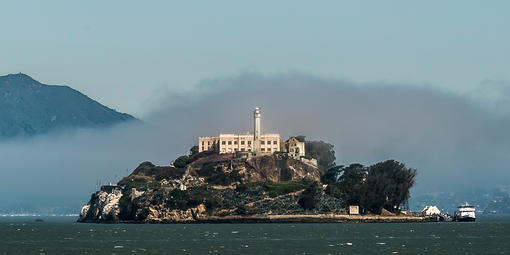
At around 11:00 AM on May 5th. Cinco de Mayo, I John Presco discovered that my relative, John Fremont, hired attorneys and claimed Alcatraz Island. Two hours earlier, I read the President has plans to incarcerate illegal aliens on Alcatraz. On this day – I claim Alcatraz! I am asking you to provide me with the best legal team in California so that I can take possession of what is destined to be mine.
Sincerely
John Presco
President: Royal Rosamond Press
Fremont’s Claim
During the last years of the Mexican regime, a number of citizens, native and naturalized, of the Republic applied for grants of land around San Francisco Bay at locations that within a short time would be demanded by the United States for use as military reservations for the defense of the harbor. While some of the original grantees had intentions of developing these lands, others were purely speculators and, after the conquest of California, undoubtedly had high hopes that the United States would be forced to pay well to obtain possession of them. Ownership disputes would soon plague all the early military reservations: Presidio, Point San Jose (Fort Mason), Lime Point, Angel Island, and Alcatraz.
Early in 1849 the U. S. Congress appropriated funds for a joint commission of army and navy officers to examine the Pacific Coast with reference to its defense. Maj. John Lind Smith, senior officer of the commission, wrote from San Francisco concerning Mexican titles. He understood that the only titles that existed in California were those derived from Mexican grants and from uninterrupted occupancy for the length of time prescribed by the laws of Mexico. He had also learned that “all valid Mexican grants contain a reservation that they may be resumed by the Government when needed for public purposes; and that any grant without the reservation is not valid because there is a law of Mexico expressly requiring it to be inserted.” Smith confidently concluded that the United States could take possession of any land in California that might be required for public use. Alcatraz Island would not test Smith’s thesis as much as Lime Point or Point San Jose would in the years ahead; nonetheless the story of its claimants is a curious one.
The Spanish colonial government had, in fact, retained control of all coastal islands. But on July 20, 1838, the Mexican government, fearful that foreigners might occupy some of these islands, passed a law that authorized the governor of California to certify ownership. The prefect, J. de Jesus Noe, at Monterey, did his duty but was puzzled as to why Workman wanted the “completely bare” island. Another Monterey official pointed out that the only possible use Alcatraz could have would be the location of “some kind of lamp which may provide some light in the dark and stormy nights for the protection of ships that pass by.” On June 8, 1846, as the sun was setting on Mexico’s ownership of Alta California, Governor Pico granted Workman the small island, with the one condition that he establish a navigation light “as soon as possible.” Workman did not erect a light on Alcatraz; almost immediately he conveyed the title to his son-in-law, Francis P. Temple, another naturalized Mexican. In 1847, John Charles Fremont, appointed governor of California by Commodore Stockton, “purchased” Alcatraz Island from Francis Temple, “giving a bond for the purchase money in my official capacity as governor of California.” Fremont said he regarded the island “as the best position for Lighthouse and Fortifications in the bay of San Francisco. Later in Washington, D. C., Fremont was court-martialed on a number of charges and specifications, among them being this purchase in the name of the United States. The United States rejected the “purchase” on the grounds that Fremont had not possessed the authority to make it. Furthermore, President Fillmore’s 1850 order reserving Alcatraz and other parcels of land from sale was a clear indication that the federal government considered itself the rightful owner and purchase from anyone unnecessary. The army’s Board of Engineers for the Pacific Coast confirmed that belief in 1851 when it wrote that while it had no specific information concerning Temple and Fremont, it was under the impression “that our Government had succeeded to the right of property in that and other Islands which had been vested in the Mexican Government.
The army proceeded to develop plans for the defense of Alcatraz. But Fremont was not at all convinced that his claim was dead. He decided that if he had not purchased Alcatraz for the government, then he had bought it for himself: “The Island consequently reverted to me, and has ever since been held by me to be my property.” Eventually, through Simon Stevens of New York, Fremont paid $5,000 to the holder of the bond. From the 1850s on, Temple’s name dropped from the records. Not so, Fremont’s. By early 1855 the San Francisco law firm of Palmer, Cook, and Company, which seemed to specialize in land litigations that involved the federal government, entered the case either on behalf of Fremont, or in partnership with him. They brought an action of ejectment in the District Court, Fourth Judicial District, San Francisco. The engineer in charge of the works on Alcatraz, Maj. Zealous Bates Tower, notified Chief Engineer Joseph Totten that “Messers Palmer Cook & Co. have commenced suit against me personally for trespass in occupying Alcatraz.” The secretary of war quickly authorized Tower to call upon the U. S. district attorney for any assistance he needed.
At the same time Palmer went into court, Fremont wrote U. S. Attorney General Caleb Cushing outlining the case as he saw it, concluding: “I thought it not improbable that the government upon a full examination might be disposed to make some arrangement which would spare us the great expense and delay of litigation.” But the government was not so disposed. The construction of fortifications on Alcatraz went on. Fremont’s claim came up again in 1859 when D. W. Perley, said to have been the “Pathfinder’s” attorney at that time, threatened to institute a suit for the possession of the island. Sec. Lt. James B. McPherson, then in charge of Alcatraz, informed Washington that according to his intelligence Perley was threatening this action because he had lost $30,000 when the federal government declined to pay $200,000 for the purchase of Lime Point on the north side of the Golden Gate. As before, the subject quickly dropped from army correspondence, indicating that nothing much came from the affair.
As late as the 1890s attorneys for the heirs of General Fremont, probably in association with another land dispute at Point San Jose (Fort Mason), placed on record a deed dated August 3, 1883, from Fremont to Charles A. Lamont of New York, stating that for the sum of one dollar and other valuable considerations Fremont sold one-half of all his rights to Alcatraz Island. The newspapers guessed that the old claim was to be renewed before Congress or the Court of Claims. But the Fremont heirs seem to have dropped their interest in Alcatraz about this time. They would, however, continue the battle over Point San Jose. Alcatraz has remained firmly in the hands of the federal government from its first occupation by the army engineers until today.
President Donald Trump said Sunday he will direct several federal agencies to “reopen a substantially enlarged and rebuilt Alcatraz,” a facility that for decades was a federal prison and is now a national park.
“REBUILD, AND OPEN ALCATRAZ! For too long, America has been plagued by vicious, violent, and repeat Criminal Offenders, the dregs of society, who will never contribute anything other than Misery and Suffering,” Trump wrote on Truth Social.
“I am directing the Bureau of Prisons, together with the Department of Justice, FBI, and Homeland Security, to reopen a substantially enlarged and rebuilt ALCATRAZ, to house America’s most ruthless and violent Offenders,” he added.
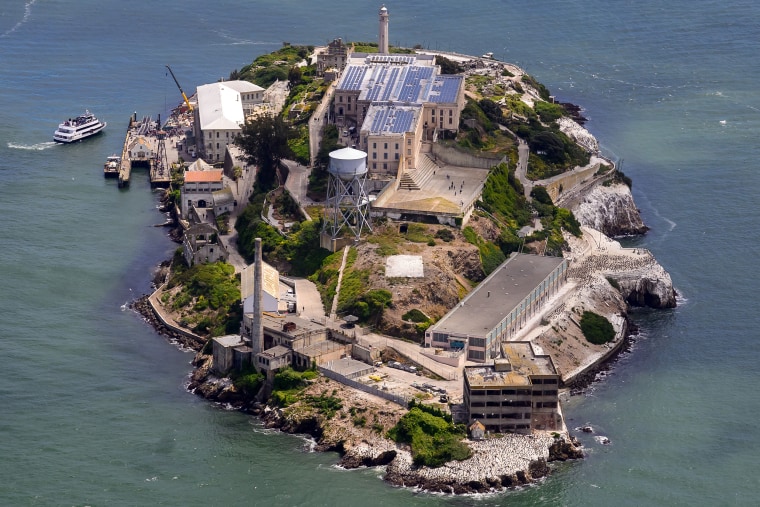
Alcatraz Island, a former military fortress and prison in San Francisco Bay, was turned into a federal penitentiary in 1934 and over the course of 29 years housed more than 1,500 people “deemed difficult to incarcerate elsewhere in the federal prison system,” according to the National Park Service.
We’ve received your message!
You have successfully sent your message.
Thank you for the message – your feedback and ideas are a priority to me and my administration. Californians like you are helping us build an even stronger Golden State, and I thank you. Your comments are being reviewed by my staff. Please allow some time for us to get back to you as we build an inclusive, responsive, and people-powered government. I encourage you to revisit my website in the coming days to learn about what my administration is doing to keep our state moving forward and to expand opportunity to every Californian.
Thank you again for sharing your feedback and helping us shape California’s future.
Sincerely,
Governor Gavin Newsom
 Rosamond Press
Leave a comment