“Students, faculty members, staff and alumni are invited to submit name suggestions, which will go to the New Residence Halls Building Naming Committee. Suggestions are due by 5 p.m. Feb. 23. Committee members are looking for name suggestions that connect with a sense of inclusion, equity, justice and belonging.“
It is 11:25 AM.In two and half hours there will be a dedication ceremony to rename Walton Hall, Yasui Hall. U smell – a rat! I demand an investigation! Did any member of the Yasui family constribute a large sum in order to be immortalized? I suspect another scalping job was done, perhaps by the secret group of non-whites – out for revenge!
John Presco
“In 1849 the plains were crossed with ox-teams, on the route via Salt Lake City; and the journey was brought to an end at Frémont, California, a place at the junction of the Feather and Sacramento rivers. Two years later the line of march was resumed; and Yreka was made the objective. The next year a”
Upon the outbreak of the Indian war in 1853, the family went to the fort at Jacob Wagner’s, and remained until the autumn. By the various scares and indeed great perils of the time, Mrs. Walton had acquired a constant dread of the savages, and, in order to giver her less anxiety, Mr. Walton decided to seek a new location, less isolated and less exposed, and consequently sold his right to Mr. Beason, and made the same year a new home in the Umpqua valley, a few miles west of Oakland, in a little oasis known as Green valley.
Naming suggestions sought for two new residence halls
February 10, 2023 – 10:15am
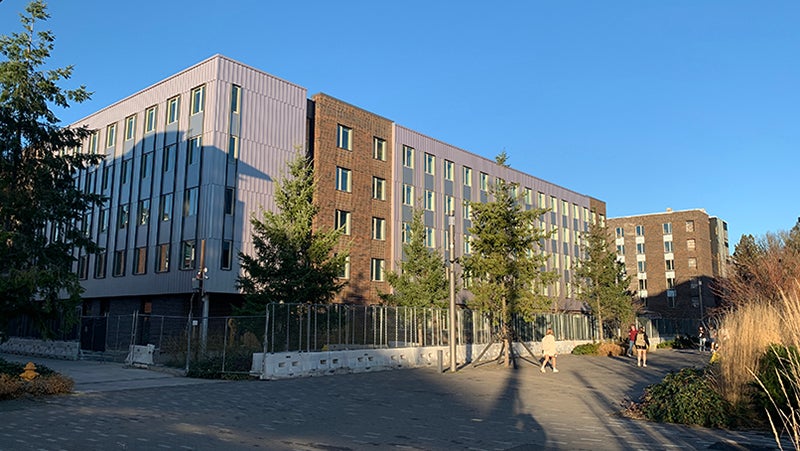
The University of Oregon will be opening two new residence halls this fall, and you can help name them.
The halls, temporarily called Building B and Building C, are currently under construction at the corner of East 15th Avenue and Agate Street opposite Hayward Field in the space formerly occupied by Walton Hall. They will open this fall.
Students, faculty members, staff and alumni are invited to submit name suggestions, which will go to the New Residence Halls Building Naming Committee. Suggestions are due by 5 p.m. Feb. 23. Committee members are looking for name suggestions that connect with a sense of inclusion, equity, justice and belonging.
“Names mean a lot, convey stories, meaning, values, connection — they build legacies,” said University Housing Director Michael Griffel, who also is the associate vice president for student services and enrollment management. “We are excited to have the opportunity to invite you as a member of the university community to recommend ideas for the names of two new residence halls on the University of Oregon campus that are part of the housing transformation project.”
Submit nominations using an online form.
The committee will follow the Naming of Facilities Policy in selecting its recommendations. For additional guidance on name submissions, view a comprehensive list of current UO building names and a list of current residence hall names, namesakes and naming histories.
The committee will send its recommendations to the president, who will then select a final recommendation for a vote by the University of Oregon Board of Trustees.
The construction of Building B and Building C comprise the second of three phrases of the Hamilton Walton Transformation Project, which included the construction of Unthank Hall and will see the removal of Hamilton Hall. The project got underway in 2019.
Building B will offer a mix of double and triple rooms, all with attached bathrooms and showers, and provide housing for about 700 students.
Building C embodies a new apartment-style residence hall with room for roughly 400 students. It will have a variety of apartment-living options for returning Ducks that is distinct from their first-year arrangements.
Both DeNorval Unthank Jr. Hall and Kalapuya Ilihi Hall were named in a similar way after the university sought name suggestion from community members. More information can be found on the University Housing website.
Is Joseph Orosco The Ringleader?
Posted on May 31, 2019 by Royal Rosamond Press

I believe this dude is the ringleader. Let us look at the photo again. The majority of these people are Hispanic. Is this why they did not want to give their names, because they will be identified as Latinos. Orosco worships Chez Guevara. I grew up in Oakland where I had Hispanic friends who hated gringos and wanted to take back California that my kindred, John Fremont, rested away from the owners of huge land grants. Fremont’s father-in-law is Senator Thomas Har Benton. Joe lies about all this renaming being “open”. Joseph Orosco is a propagandist, who believes telling lies to white people for the sake of his people, is permitted.
Two new residence halls welcome Ducks, new and returning
September 22, 2023 – 8:49am
For more than 60 years, Walton Hall was home away from home for tens of thousands of Ducks, providing a place to study, sleep and hang with friends in the heart of campus.
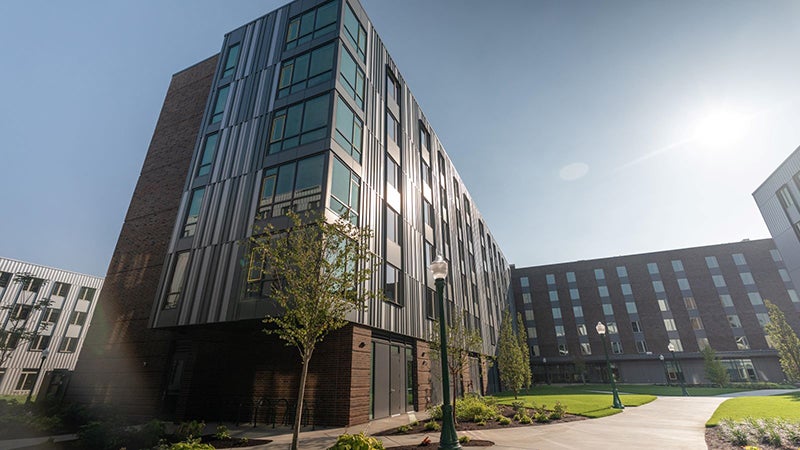
Now Walton Hall is gone, and in its place are two new residence halls opening this fall at the corner of Agate and East 15th streets, featuring modern amenities and commanding views of the Coburg Hills and central campus. And as with Walton, from the upper floors track fans will be able to keep tabs on track meets at Hayward Field across the way.
The complex, which cost an estimated $121.3 million, features a combined 301,250 square feet of living space, and will be home to up to 1,300 Ducks. And they’re not just for first-year students but for upper-division students as well.
The two halls are dubbed Buildings B and C for now. The University of Oregon Board of Trustees is expected to name the halls sometime in the coming school year.
Today’s college students are looking for “a balance of community and connection” in residence halls, said Michael Griffel, director of University Housing.
“They want a place they belong and can contribute to the community and make a difference, and where they are supported,” he said. “They want to make friends and meet other people who have some shared interests and who they can build a connection with.”
The six-story Building B offers a mix of double and triple rooms, all with attached bathrooms and showers, with room for 700 to 900 students. While some students prefer a bathroom down the hall cleaned by custodians, many prefer the privacy and convenience of an en suite bathroom, Griffel said.
Resident floors pinwheel around a central community lounge, which offers study space, areas to hang with friends, and views across campus. The ground floor has dedicated spaces for five Academic Residential Communities, a community kitchen, a service center and a package delivery hub. In addition, the ground floor hosts apartments for the community director and for a resident faculty member.
The five-story Building C is a new apartment-style residence hall that offers living options for returning Ducks that are distinct from the first-year experience. Second-, third- and fourth-year students and even graduate students can live alone or with friends, with options including a micro studio and quad-unit layouts. Each apartment-style unit includes a private bathroom and a kitchen. The complex will house about 400 students.
The Walton Hall complex was built in the late 50s, along with the Earl (1954-55), Hamilton (1962) and Bean (1964) complexes, in response to the post-World War II baby boom, which increased enrollment at the UO. Initially called George Rebec Hall, the complex was named for Joshua J. Walton, a Eugene city judge and member of the UO Board of Regents from its inception in 1872 to 1906.
It featured two wings and 10 separate halls, each housing between 60 and 70 students. The design concept was based on the idea of creating small unit living with large unit management, which meant a centralized kitchen, but separate dining halls in each unit. A recreation room, snack machines and laundry facilities were in the basement, but each unit had its own lounge. The design allowed the UO to house men and women in the same complex, but in different units.
In a 2006 UO cultural resources survey, the building was found to be in excellent condition, but carried little historic significance and “lacks distinction.”
—By Tim Christie, Office of the Provost
Biography of Judge Joshua J. Walton
JUDGE JOSHUA J. WALTON. – This eminent jurist and public leader of our state was born April 6, 1838, at Rushville, Illinois. At the age of two years he was taken by his parents to a new home near Springfield, Illinois. After a brief sojourn there another move was made, bringing the family as far west as St. Louis, Missouri; and in 1842 they moved on to Keosauque, Iowa. In 1849 the plains were crossed with ox-teams, on the route via Salt Lake City; and the journey was brought to an end at Frémont, California, a place at the junction of the Feather and Sacramento rivers. Two years later the line of march was resumed; and Yreka was made the objective. The next year a more permanent location was found in the Rogue river valley; and a Donation claim was taken on Wagner creek on the beautiful farm now known as the Beason place. That was at a time when the Rogue river Indians were very troublesome, and quite generally on the warpath. The elder Walton engaged to some extent in mining at Jacksonville and Rich Gulch; and young Joshua, then but a lad of fourteen, also essayed to make his pile by rocking a “Long Tom.” With his father he also used to go on freighting expeditions to procure goods from the Willamette valley for the market at Jacksonville, Yreka, or the mining camps on the Klamath; and his work was to ride the bell animal. While thus occupied he carried his school books, and spent the slow hours in the saddle acquiring the rudiments of an education.
Upon the outbreak of the Indian war in 1853, the family went to the fort at Jacob Wagner’s, and remained until the autumn. By the various scares and indeed great perils of the time, Mrs. Walton had acquired a constant dread of the savages, and, in order to giver her less anxiety, Mr. Walton decided to seek a new location, less isolated and less exposed, and consequently sold his right to Mr. Beason, and made the same year a new home in the Umpqua valley, a few miles west of Oakland, in a little oasis known as Green valley. Among other benefits derived from this change was the advantage of a good school then just started, at which Joshua made rapid progress in his books under the tutelage of Professor J.S. Gilbert, a worthy man and an excellent teacher.
In the fall of 1858 a final removal was made to Eugene City, Oregon. At that beautiful place a permanent home was located; and there Judge Walton resides at the present time. With the exception of a short time spent in the Idaho mines, he has resided there continuously. At that center, which even in the early days boasted much culture and ability, young Walton found opportunities not hitherto enjoyed for the development of his mind, and soon began the study of law under Honorable Riley E. Stratton, then circuit judge of the second judicial district. He also read somewhat with Honorable Stukeley Ellsworth. He was admitted to the bar in 1863, at the September term of the supreme court, in the first class ever examined by that court in open session. The class was large, including in the number some whose names have since become eminent, as C.B. Bellinger, Joseph F. Watson, P.S. Knight and other men of mark.
Soon after completing his studies, Mr. Walton was called upon to occupy public positions, and has spent the greater part of his life in official or other public duties. In 1866 he was elected county judge of Lane county. In 1876 he was appointed to the same position by Governor L.F. Grover, to fill the place made vacant by the resignation of Judge John M. Thompson. In the same year his position was confirmed by election; and he served out a full term. In 1874 he was elected president of the Union University Association, and successfully superintended the erection of the university building at Eugene, and also succeeded in securing the location of the State University at that city. In 1880 he received the nomination for circuit judge of the second judicial district; but the contest resulted in the election of his opponent on the Republican ticket, Honorable Joseph F. Watson.
Judge Walton has been twice married, first to Miss Lizzie Gale, who died in 1873, and secondly, in 1876, to Miss Emma Fisher.
Surnames:
Topics:
Locations:
Eugene Oregon, Keosauque Iowa, Rushville Illinois, Springfield Illinois,
Collection:
History of the Pacific Northwest Oregon and Washington. 2 v. Portland, Oregon: North Pacific History Company. 1889.
Hamilton Walton Transformation Project Construction
Dynamic and attractive communities are needed to help drive and support student recruitment and retention in a very competitive environment.
Students who live on campus in the UO’s high-quality, learning-centered residential communities have higher grades, higher retention and graduation rates, and graduate faster than students who live off campus.
Living on campus at the UO facilitates diverse and inclusive communal engagement, contributes to students’ exploring purpose and meaning, and facilitates students making long-term social connections.
Project Overview
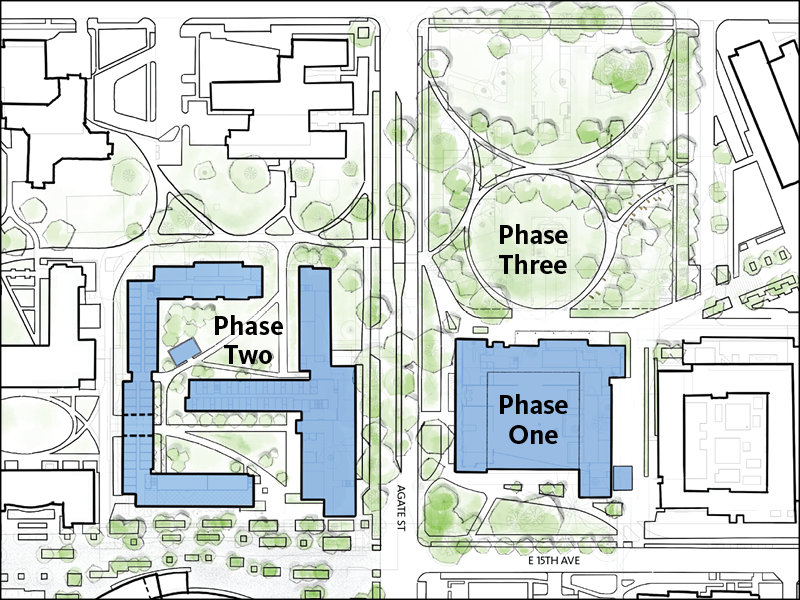
The Hamilton Walton Transformation Project will unfold in three phases:
- Unthank Hall (completed summer 2021) on Humpy Lumpy Lawn contains the Student Welcome Center, PNW Market, academic spaces, and residences for 700 students.
- Removal of Walton Hall and construction of two new residence hall buildings (completed August 2023): the New Residence Hall will contain academic spaces, a service center, a package locker delivery center, and residences for 705 students. The New Apartment-Style Residence Hall (named Yasui Hall) will contain four-person and single-occupant studio units for 400 students.
- Removal of Hamilton Hall and development of a new green space which will be larger than the Humpy Lumpy Lawn that Unthank Hall replaced.
Phase Three
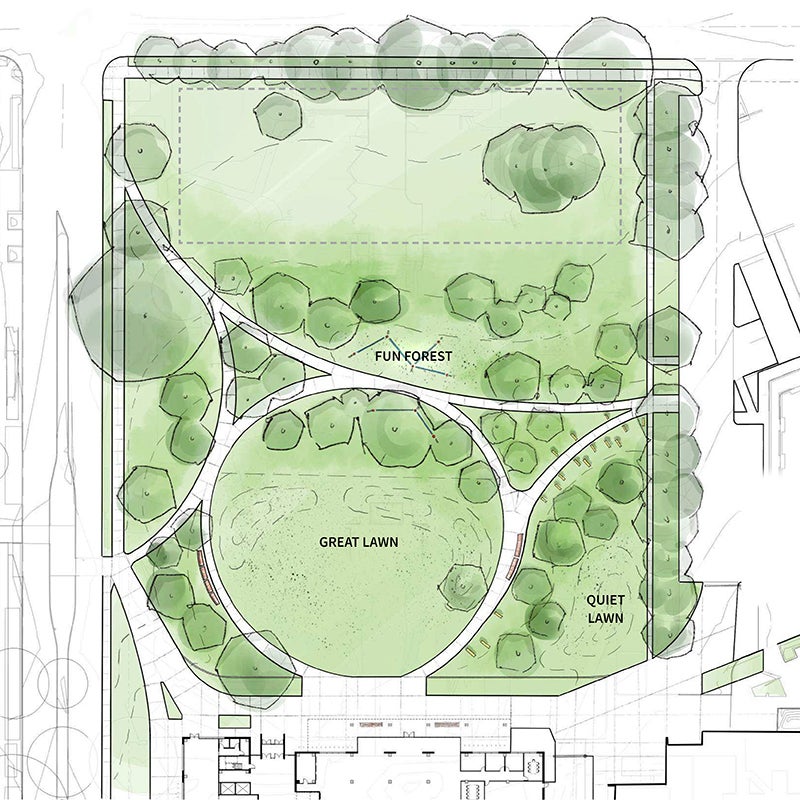
Phase three of the Hamilton Walton Transformation Project (HWTP) will be the addition of a beautiful green space in place of Hamilton Hall.
Phase Three Project Facts
- The new green space is being constructed as a replacement for the gone-but-not-forgotten Humpy Lumpy Lawn, on which Unthank Hall (HWTP phase one) was built.
- Completion of phase three will create an uninterrupted green space that stretches from the Erb Memorial Union lawn to the alumni center and Matthew Knight Arena.
- Funding sources: revenue bonds/internal bank
- Phase three combined square footage: 161,500 GSF
Phase Three Timeline
- Anticipated start: Summer 2025
- Anticipated completion: Summer 2026
Sustainability
Project administrators located the building to preserve as many of the large trees along 15th Avenue as possible. Some of the trees that will be harvested will be used in the project.
The amount of green space that will be available after the entire project is completed will be larger than the current green space by approximately 20 percent.
All three new buildings will meet the Advanced Energy Threshold—25 percent above the current state energy code—and will earn LEED Gold certification.
 Rosamond Press
Leave a comment