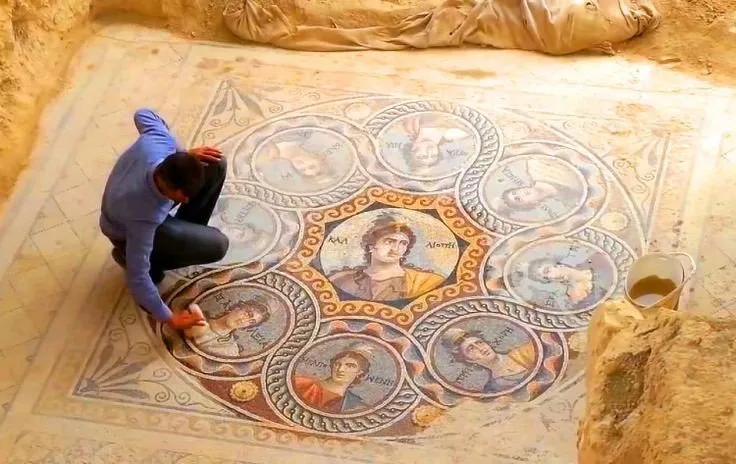
In Gaziantep, Turkey, archaeologists have excavated three stunning mosaics, shedding light on the grandeur of the ancient Greek city of Zeugma.
I used to draw Phoenician ships and Greek columns when I was eleven and twelve. I drew many plans for Atlantis. The world can do this – together! We need a new Alexandrian Library. Jezebel was the grand-aunt of Dido, the founder of Carthage. There are Jews in this linage, suggesting the marriage of Jezebel and Ahab may have led to the founding of Carthage that fought two wars with Rome, who won, and disappeared this great Phoenician colony from the face of the earth. To keep her buried, false teachers made up lies and demonized the Carthaginians – to this very day! We are at the center of the Labyrinth of lies – and here lie – The Truth! We can do this!
John Presco ‘A Friend of Jezebel’
https://en.wikipedia.org/wiki/Ahab

Trade played a significant role in Carthage’s legacy. The Carthaginians dominated the ancient Mediterranean trade. At a time when the Greeks and many others were going through a dark age, they sailed the western Mediterranean. Carthage’s empire grew as a result of trade profits, and it eventually rivaled the Roman military in size and power.
The Carthaginians were highly successful traders who sailed the Mediterranean with their goods, and Carthage became the richest city in the ancient world as a result of their success. Metals, food, slaves, and high-quality manufactured goods such as fine cloths and gold jewelry were purchased and sold to anyone with the means. The Carthaginians developed a reputation for their mercantile prowess and ability to sell anything to anyone, but always at a price.
Suggested Read: How Carthaginians Helped Shape What We Eat Today
The majority of Carthage’s trade took place on the Iberian Peninsula, which was critical because it was where they obtained the majority of their silver and tin. Carthage traded across the Sahara and across the sea to the Cassiterides, where they acquired a large quantity of tin. They traded silver and tin with other Phoenician cities across the Mediterranean Sea. Tin was critical because it is required for the production of bronze, which was extremely valuable at the time. Tin, on the other hand, was difficult to obtain because Carthage’s two sources were Canary Island and the British Isles, both of which were remote, and the Atlantic Ocean had never been mapped.

Carthage & Trading Partners
Carthage began to prosper almost immediately after its founding in the late ninth century BCE by settlers from the Phoenician city of Tyre, due mainly to its strategic location on the trade routes connecting the western Mediterranean and the Levant. Within a century, the city established its own colonies, and by the sixth century BCE, it had supplanted Phoenicia as the region’s greatest trading power.
Carthage’s commercial empire stretched across North Africa, the Iberian Peninsula, Sicily, Sardinia, Corsica, Cyprus, Malta, and numerous other Mediterranean islands. Continuing to be dissatisfied, expeditions were organized to seek out new and even more remote trading opportunities, such as Himilco’s voyage to Britain around 450 BCE and Hanno’s voyage down Africa’s Atlantic coast around 425 BCE.
The new territories would generate enormous wealth, primarily through the extraction of natural resources such as gold and silver from conquered regions. Similarly to how Europeans exploited the indigenous peoples of the ancient Americas in the sixteenth century CE, the Carthaginians profited handsomely by transferring cheaply acquired metals to regions where they had a much higher value.

Additionally, these new territories, which later necessitated the establishment of colonies to safeguard trade interests and market monopolies, would eventually provide new markets for Carthaginian manufactured goods and those acquired through trade with other cultures. Nor were the Carthaginians restricted to sea routes; they were also known to exploit the Sahara’s caravan routes.
In the fifth century BCE, Herodotus describes the method by which the Carthaginians bartered with indigenous peoples in new territories along the North African coast beyond the Pillars of Hercules:
The Carthaginians unload their wares and arrange them on the beach; then they re-board their boats and light a smoky fire. When the native inhabitants see the smoke, they come to the shore and, after setting out gold in exchange for the goods, they withdraw. The Carthaginians disembark and examine what the natives have left there, and if the gold appears to them a worthy price for their wares, they take it with them and depart; if not, they get back on their boats and sit down to wait while the natives approach again and set out more gold, until they satisfy the Carthaginians that the amount is sufficient. Neither side tries to wrong the other, for the Carthaginians do not touch the gold until it equals the value of their goods, nor do the natives touch the goods until the Carthaginians have taken away the gold. (Book IV, 196)Herodotus, an ancient Greek writer.
Of course, Carthaginian merchants traded with contemporary powers in Greece, Egypt, Phoenicia, and the Hellenistic Kingdoms. Carthage joined into treaties with other states to establish exclusive operating zones, most notably with the Etruscans and Rome, respectively, around 509 BCE and 348 BCE. Carthaginian traders were a common sight at Athens’s, Delos’s, and Syracuse’s great markets, occasionally establishing permanent quarters in the great cities of the day, such as Rome’s Vicus Africus neighborhood. As far afield as Massilia (Marseille), Corsica, and Rome, Punic amphorae have been discovered.
Carthage also welcomed foreign traders from Rhodes, Athens, and Italy in exchange. They were treated equally with the city’s merchants, and Carthaginian traders purchased, stored, and re-exported their goods. The minting of coinage in the fifth century BCE facilitated trade, and conversions were facilitated when the Ptolemies of Egypt adopted the same Phoenician standard for their own coins. The Carthaginians minted coins in gold, silver, electrum, and bronze.
The reputation of Carthaginian traders was well-known in the Greek world, as attested by a prominent character in a lost Greek comedy play reworked by the Roman playwright Plautus in his Poenulus (The Punic Chappie). He describes one Hanno, a merchant, who sells pipes, shoe straps, and panthers, a comic cargo intended to demonstrate that the Carthaginians would trade in anything as long as it made a profit.
Carthage Sea Trades
It is unknown how much trade was conducted by the state and how much by private merchants, but there is certainly evidence of both. It is likely that the majority of trade was conducted by aristocratic merchants who also exercised control over Carthage’s political and religious institutions.
The powerful Carthaginian naval fleet was a significant form of state intervention in the area of commerce. This navy enabled Carthage to maintain a stranglehold on strategic waystations along ancient trade routes such as Sicily and Gades (Cadiz) in southern Spain. Additionally, it dealt ruthlessly with rival powers’ trading ships. Foreign ships discovered in waters considered to be under Carthage’s jurisdiction were sunk. Pirates were dealt with similarly.
Carthaginian trading ships were very similar to those used by Phoenician cities for centuries. The largest hippos with a rounded bottom were the most prevalent. The name (horse) derives from the common appearance of a horsehead on the prow. The gaulos (‘ship’ in Phoenician) was a second type, which was smaller and had an even wider hull.

Carthage possessed excellent sailors, such as Hanno the Navigator, who could easily sail down to Africa’s Ivory Coast or Gold Coast. Additionally,
Himilco the Navigator sailed north across the Atlantic to England. Carthaginian sailors invented stories about being attacked by sea monsters and killer sea weed in order to deter other Greeks from attempting to cross the Mediterranean Sea.
This eventually led to their demise, as other Greeks, such as the Etruscans and the Romans, began to desire a piece of their monopoly. This precipitated the first Punic War, which was followed by the second and third Punic Wars. Carthage dominated Mediterranean trade in the eighth century.
The navy of Carthage served as the city’s first line of defense. They had between 300 and 350 warships at their peak, and when warships docked, they entered a circular inner war harbor. The circular war dock’s center contained a palace where the navy’s commander in chief could convene. The outer harbor was home to a large number of merchant ships that arrived and left daily, resulting in an incredible trading system in Carthage.
Additionally, in the event of an attack, they could chain each harbor to prevent enemy ships from entering. Carthage’s navy was one of the largest in the Mediterranean Sea, and it relied on mass production to maintain a large fleet at a reasonable cost. Normally, sailors and marines were recruited from the Phoenician populace. The navy provided financial security and a stable job, which helped to reduce unemployment, as poor people in other cities desired to assist a revolutionary leader in improving their chances of wealth. Carthage’s sailors had a high regard for them, implying that they must have trained oarsmen and coxswains during peacetime.
Hanno was an excellent navigator and was once entrusted with 60 ships to explore and colonize parts of northwest Africa. He crossed the Gibraltar Straits and established seven colonies across the African land that is now known as Morocco. Hanno even ventured further along Africa’s Atlantic coast. He discovered a densely populated island during one of his voyages. When he attempted to capture some of the males there, they were described as uncontrollable savages. They captured several females who were too wild to handle and were forced to slaughter them. They skinned them and returned the skins to the Tannit Temple. They dubbed these individuals gorillae, and it is believed that this is one of the first documented encounters with gorillas.
According to a quote from one of Hanno’s notes, “Females were far more numerous than males, and their skins were rough; our interpreters dubbed them Gorillae. We pursued but were unable to apprehend any of the males; they all escaped to the tops of precipices, which they easily climbed and threw down stones; we apprehended three females, but they engaged in such violent struggles, biting and tearing their captors, that we killed them and stripped off their skins, which we carried to Carthage; we were out of provisions.” According to some accounts, their voyage extended all the way to Senegal. According to some scholars, Hanno traveled even further to Gambia. Many determine the extent of his journey by examining the mountain he described, which was either Mount Cameroon or Mount Kukulima. The image to the left of this paragraph depicts his possible path of travel if he reached Mount Cameroon.
Himilco is another outstanding example of a leader; while little is known about him personally, we do know that he forged numerous great trade routes and contributed to Carthage’s prosperity. He is credited with being the first explorer from the Mediterranean Sea to reach the northwestern shores of Europe. He sailed along the modern-day French, Spanish, Portuguese, and English coasts. He reached the northwestern part of France and traveled through the Oestrimini-infested Portugal. They then traded for bronze, tin, and a variety of other precious metals and resources. Himilco also spread numerous rumors about sea monsters and killer seaweed in an attempt to scare the populace.
Carthaginian and foreign merchant ships had access to a large rectangular merchant port connected to the circular naval harbor of the city. Both ports were constructed by humans, were approximately two meters deep, and may date from 220-210 BCE. This harbor may have supplanted, or perhaps extended, the original simple key, where merchant vessels were moored in a row. The new merchant harbor was 300 x 150 meters in size and was accessed via a 250-metre-long arced channel. If necessary, iron chains could be raised to close off this entrance.
Carthage prospered not only as a result of maritime commerce, but also as a direct consequence of its proximity to fertile agricultural land and abundant mineral deposits. As the primary trade route connecting Africa and the rest of the ancient world, it also provided a plethora of rare and luxurious goods, including terracotta figurines and masks, jewelry, delicately carved ivories, ostrich eggs, and a variety of foods and wines.
Traded Goods
Imports and exports of raw materials included precious metals (gold, silver, tin, copper, lead, and iron), animal skins, wool, amber, ivory, and incense. Slaves were another valuable commodity that entered and exited the port of Carthage. Carthage’s workshops exported priceless works of art made of gold, silver, and ivory. There were exquisitely embroidered textiles, including the Carthaginians’ renowned carpets and cushions, as well as the highly sought-after purple-dyed cloth made with extract from the murex shellfish. Weapons, food-related utensils, scissors, and tools were manufactured, as well as amulets, jewellery, decorative glassware, wooden furniture, ceramic figurines, decorated ostrich eggs, incense burners, and ornamental masks.
Olives, olive oil, wine, cereals, salted fish, garlic, pomegranates, nuts, herbs, and spices were all traded. Two Punic shipwrecks, one discovered off the coast of Ibiza in the fifth century BCE and another off the coast of Marsala in Sicily in the third century BCE, both contained cargoes of fish sauce, the garum to which the Romans became addicted. Additionally, the Marsala wreckage contained amphorae of wine and olives. Low-quality pottery vessels and lamps, affordable to the less prosperous tribes in areas such as Iberia, were first imported to Carthage from Corinth via Syracuse and central and southern Italy, and then shipped for barter with indigenous tribes.
Suggested Read: The Battle of Cannae: Carthage Vs. Rome (216 B.C.E.)
Naturally, the Carthaginians did not have everything their way, and they faced competition for control of lucrative trade routes and access to resource-rich territories. This resulted in warfare in Sicily, particularly against the tyrants of Syracuse, and with Rome, who proved to be an unbeatable adversary. After centuries of dominating the western Mediterranean, the enormously costly and debilitating Punic Wars came to an end with Rome’s destruction of Carthage in 146 BCE. The city would rise to prominence again a century later, becoming a significant trading and cultural center within the Roman Empire, perhaps ranking among the top five, but it never quite reached the heights it had achieved during the Carthaginian era of sea dominance.
If you would like to comment on this article or anything else you have seen on Carthage Magazine, leave a comment below or head over to our Facebook page. You may also message us via this page.
And if you liked this article, sign up for the monthly features newsletter. A handpicked selection of stories from Carthage Magazine, delivered to your inbox.
History of the Jews in Carthage
Carthage (from Punic: 𐤒𐤓𐤕𐤟𐤇𐤃𐤔𐤕, romanized: qart hadaš, lit. ‘New City’) was a city in North Africa located on the eastern side of the Lake of Tunis across from the center of what is now Tunis in Tunisia.


Though Josephus associated the city’s foundation with Jews and some scholars have conjectured that small groups of Jews may have been present in Carthage as early as the Punic era, the earliest evidence of Jewish presence in the area dates to the 2nd century CE.[1][2]
Contents
Originsedit
Carthage was founded by Tyrians.
According to the Hebrew Bible, Tyre and Sidon were part of the tribe of Asher.
The fifth lot fell to the tribe of the Asherites, by their clans. Their boundary ran along Helkath, Hali, Beten, Achshaph, Allammelech, Amad, and Mishal; and it touched Carmel on the west, and Shihor-libnath. It also ran along the east side to Beth-dagon, and touched Zebulun and the Valley of Iphtah-el to the north, [as also] Beth-emek and Neiel; then it ran to Cabul on the north, Ebron, Rehob, Hammon, and Kanah, up to Great Sidon. The boundary turned to Ramah and on to the fortified city of Tyre; then the boundary turned to Hosah and it ran on westward to Mehebel, Achzib, Ummah, Aphek, and Rehob: 22 towns, with their villages. That was the portion of the tribe of the Asherites, by their clans—those towns, with their villages.
Identification with Tarshishedit
The Hebrew Bible never mentions Carthage, though the Septuagint translated the toponym Tarshish at Isaiah 23:1 as Karkhēdōn (Koinē Greek: Kαρχηδών),[3] the Greek term Josephus used in his Against Apion to denote Carthage.[4] The term Tarshish also figures in the Book of Jonah, where Jonah, to evade God’s mission that he preach in Nineveh, boards ship in Jaffa, and sails towards a city of that name. This led some to suggest that there too Carthage was his objective. Much modern research tends to the view, however, that the Tarshish here denotes the Iberian Tartessos.[5][6]
Jewish settlementedit
A tradition conserved among the Jews of Djerba nearby states that the community was built of exiles after the Siege of Jerusalem in 597 BCE who had joined earlier Jews living there, that the el Ghriba Synagogue has an equally ancient date, and that some of this community assisted the Phoenicians in establishing Carthage.[7]
One theory has espoused the idea that, the destruction of Tyre, Sidon, and Carthage created a Phoenician diaspora not unlike that of the Jews and that the puzzling disappearance of Phoenicians may have been due to the attraction they might have felt for a similarly dispersed people, leading to conversion to Judaism.[8] A late source from the 10th century, Josippon, states that Titus had settled some 50,000 Jews in North Africa, and ibn Khaldun (1332–1406), who himself came from Tunisia stated that several Berber tribes he had encountered had converted to Judaism.[1] The Talmud conserves the names of four rabbis of Carthage, with the Jerusalem Talmud mentioning Abba/Ba 4 times, and Hinena (called Hanan in the Babylonian Talmud) twice.[9] There is dispute over the interpretation of these references, with one hypothesis suggesting the references must refer to the flourishing Jewish community in Cartagena, Spain, a Punic settlement whose name is identical with that of Carthage.[10]
The French archaeologist Alfred Louis Delattre uncovered a large Jewish necropolis dating to the early 3rd century CE at Gammarth consisting of 105 chambers, each with roughly 15 loculi, which would have allowed burial for 1500 people. The Jewishness of the site is proven by symbols of the Temple menorah, shofar, lulav and etrog.[1] The epigraphic evidence is predominantly in Latin, with one name, Tibereius, indicating a possible origin in Tiberias in Syria Palaestina. The pagan funerary sign dis manibus, elsewhere disliked by Jews, occurs in one inscription.[11] The overall impression gained from this evidence is that Jews in and around Carthage shared with gentiles a common language, funerary formulae, and ornamentation, differing only in their recourse to synagogues, occasional use of Jewish symbols and their separation at death by interment in a separate cemetery.[12]
Tertullian, though at times venting his ire at Jews, stating that synagogues were “fountains of persecution” and that Jews harassed Christians (a suggestion for which there is no evidence from North Africa at that time), nonetheless in his remarks on the community at Carthage also shows that they earned his grudging respect.[13]
Some accounts state that after Gaiseric sacked Rome, he took the holy vessels that Titus had looted from the Temple in Jerusalem with him to the new Vandal capital in Carthage, where the Byzantine general Belisarius retrieved them when he won the city back in 533 and had them transported to Constantinople. When a wise Jew pointed out the danger of harbouring these vessels, which had brought downfall to Rome and Carthage, Justinian was so unnerved he had them sent to Jerusalem, where they were stored in a church.[14] 215,482[15]
Quotation attributed to the Carthaginian rabbi Abba ben Isaacedit
Rabbi Abba bar Rav Yitzḥak says that Rav Ḥisda says, and some say that Rav Yehuda says that Rav says: The gentiles living from Tyre to Carthage recognize the Jewish people, their religion, and their Father in Heaven. But those living to the west of Tyre and to the east of Carthage recognize neither the Jewish people nor their Father in Heaven.
— Abba of Carthage in Tractate Menaḥot 110a, cited by Isaac Abarbanel in the Rosh Amanah “Principles of Faith”[16]
Ahab (/ˈeɪhæb/; Hebrew: אַחְאָב, Modern: ʾAḥʾav, Tiberian: ʾAḥʾāḇ; Akkadian: 𒀀𒄩𒀊𒁍 Aḫâbbu; Koinē Greek: Ἀχαάβ Achaáb; Latin: Achab) was the son and successor of King Omri and the husband of Jezebel of Sidon, according to the Hebrew Bible.[1] He was widely criticized for causing “moral decline” in Israel, according to the Yahwists. But modern scholars argue that Ahab was a Yahwist and introduced his god to the Kingdom of Judah via imperialism. This mostly occurred in the latter half of his reign.[2][3][4]
The existence of Ahab is historically supported outside the Bible. Shalmaneser III of Assyria documented in 853 BC that he defeated an alliance of a dozen kings in the Battle of Qarqar; one of these was Ahab. He is also mentioned on the inscriptions of the Mesha Stele.[5]
Ahab became king of Israel in the thirty-eighth year of King Asa of Judah, and reigned for twenty-two years, according to 1 Kings.[6] William F. Albright dated his reign to 869–850 BC, while Edwin R. Thiele offered the dates 874–853 BC.[7] Most recently, Michael Coogan has dated Ahab’s reign to 871–852 BC.[8]
Reign[edit]
As Omri’s successor, Ahab married Jezebel, the daughter of Ithobaal I of Tyre. Under Jezebel’s influence, he abandoned Yahweh and established Baal and Asherah cults in Israel (1 Kings 16:29–33). For example, he allowed Hiel the Bethelite to rebuild Jericho, even though it was ‘cursed’ by Yahweh (1 Kings 16:34), and helped his wife kill opponents, such as the “servants of Yahweh” and possibly, the priests of Jeroboam’s cult (1 Kings 18:3–16).[9] Edward Lipiński argues that the “Baal” worshipped by Ahab and Jezebel was actually the “YHWH of Samaria“, which was opposed as Yahwist heresy by the Judean priests.[10] Others disagree based on archaeological evidence and extrabiblical sources about Jezebel’s upbringing.[11][12]
In terms of foreign policy, Ahab continued Omri’s policies against Moab, which was a tributary state of Israel (2 Kings 1:1). According to the Moabite Mesha Stele, Omri and Ahab “oppressed Moab for many days”. By marriage, he allied with Jehoshaphat, who was the king of Judah (2 Kings 8:16–18). Aram-Damascus was the only foreign state that Ahab opposed but he made peace with them after their king promised to withdraw from conquered territory. He also allowed Ahab to conquer Aramean territory to compensate (1 Kings 20:34).[13][13]

Battle of Qarqar[edit]
The Battle of Qarqar is mentioned in extra-biblical records, and occurred at Apamea, where Shalmaneser III of Assyria fought a great confederation of princes from Cilicia, northern Syria, Israel, Ammon, and the tribes of the Syrian desert (853 BCE), including Arabs, Ahab the Israelite (A-ha-ab-bu matSir-‘a-la-a-a)[14] and Hadadezer (Adad-‘idri).[13]
Ahab’s contribution was estimated at 2000 chariots and 10,000 men. In reality, however, the number of chariots in Ahab’s forces was probably closer to a number in the hundreds (based upon archaeological excavations of the area and the foundations of stables that have been found).[15] If, however, the numbers are referring to allies, they could include forces from Tyre, Judah, Edom, and Moab. The Assyrian king claimed victory, but his immediate return and subsequent expeditions in 849 BC and 846 BC against a similar but unspecified coalition implied that the victory had no lasting impact.
Jezreel was identified as Ahab’s fortified chariot and cavalry base.[16]
Ahab and the prophets[edit]
In the Biblical text, Ahab has four important encounters with prophets:
- The first encounter is with Elijah, who predicts a drought because of Ahab’s sins.[17] Because of this, Ahab blames Elijah for Israel’s misfortunes but Elijah proclaims the supremacy of Yahweh so that Ahab could repent.[18]
- The second encounter is between Ahab and an unnamed prophet, who criticized him for sparing Ben-hadad and told him that Israel would be invaded by the Arameans as punishment.[19]
- The third is with Elijah, who criticized his role in Naboth‘s unjust execution. Ahab sincerely repents, which Yahweh relays to Elijah.[20]
- The fifth encounter is with Micaiah, who sarcastically assures that Ahab would re-capture Ramoth-Gilead before revealing that Ahab was deceived by his court advisers, who were empowered by evil spirits. Instead of victory, he would die in battle.[21][22]
Death of Ahab[edit]

After some years, Ahab is mortally wounded by an unaimed arrow after he and Jehoshaphat tried to re-capture Ramoth-Gilead from the Arameans.[13][21] Depending on translation, Ahab’s corpse was licked by dogs or a combination of dogs and pigs, according to Elijah’s prophecy. It marked his “uncleanliness” in the presence of Israelites, who abstained from pork consumption.[23][page needed]
Legacy[edit]
Ahab’s reign was deeply unpopular among Yahwists and was considered to be worse than the previous kings of Israel. Whilst the previous kings followed a “heretical” interpretation of Yahwism, known as the “sins of Jeroboam”, Ahab institutionalized Baalism, which was completely divorced from Yahwism. He was likewise criticized for his oppressive policies, both domestically[24][13] and internationally.[25]
However, Yahwists commend him for fortifying numerous Israelite cities and building an ivory palace. [26] Christian Frevel argues that Ahab used imperialism to introduce Yahweh to the Kingdom of Judah. To do this, he gave his children theophoric names whilst expanding in northern territories and Judah.[27] Michael J. Stahl clarifies that this mostly occurred in the latter half of his reign, according to biblical and extrabiblical evidence.[28]
 Rosamond Press
Leave a comment