Satan-Paul goes after the disciples of John the Baptist who was born with the Holy Spirit and imparted the Holy Spirit to Jesus while in his mother’s womb. At Ephesus, Paul attacked everything and everyone who is not Paul. It is said aprons that touched Paul’s skin, healed many – yet he was rejected. Bullshit! John’s disciples are having Jews take the Nazarite Vow. Paul is jealous of the Temple of Diana. This is what he wants, a temple to Jesus – with wealthy followers tithing! His Catholic church will become the wealthiest institution in the world. Kings and Queens gave vast fortunes to Paul’s Papal Lies! They got Paul’s core message…………..Destroy the true followers! Take their teaching from them! Make tons of money! Un-gifted Money-hungry Liars use Paul as a model.
The problem with Paul’s fairytale, is the church at Ephesus, called “The Way” was founded by THE REAL APOSTLE, John, who was first a follower of John the Baptist, and then a follower of Jesus, after John was murdered. Paul knew John passed on the Holy Spirit. This is the world’s most astounding SPIRITUAL THEFTS, that employs TWO MURDERED PROPHETS, the True Founders of Christianity. If they were alive, they would have used SPRITUAL FORCE to destroy Satan-Paul who would love to take control of the Temple at Jerusalem, and rake in the gold!
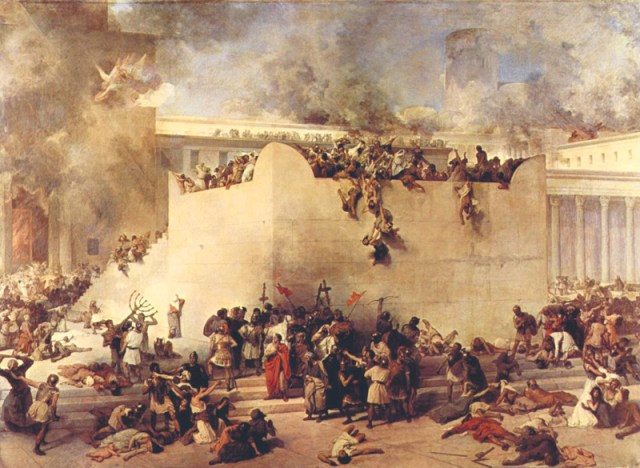
The Evil Trumpire played golf as a violent hurricane tore up people’s lives! The non-Jews and non-Christians built a beautiful world with splendid buildings and works of arts. The Jews had to hire Hiram the Phoenecian to make their temple. Queen Helena of Abdiabene was a Convert to Judaism and a Nazarite. She dedicated many artifacts to the temple, including the manora you see being carted off to Rome. I believe we might be seeing the gold plaque upon which is written the passages from Numbers concerning the judging of the Sotah, who Jesus performs – as I alone discovered! This tablet may be at the front of victory procession. There is another next to the menorah.
Paul took the vow of the Nazarite to prove to the real Apostles he was no false. I suspect he was bid to judge a Sotah. Paul undermined the Temple, that elected evangelical leaders say must be rebuilt by the Jews before their false Jesus returns. Helena had to know about Jesus performing the test that later involved going to the golden tablet, copying the passage onto a scroll, then dissolving in in water. I believe the eucharist usurped this Nazarite ritual.
In my movie-book, I will have Argotta Rosamond take the vow at the temple. She and her warriors will join Helena and her sons for the battle against Rome. Was Satan-Paul still alive? Was he now a Roman quisling?
John ‘The Nazarite’
https://www.biblegateway.com/passage/?search=Numbers+5%3A11-31&version=NIV


https://thetorah.com/queen-helena-of-adiabene-and-her-sons-in-midrash-and-history/
https://en.wikipedia.org/wiki/John_the_Apostle
https://www.biblestudytools.com/classics/barnes-scenes-in-life/paul-at-ephesus.html
The Mishnah (late 2nd century C.E.) describes the donations of Helena and her son Munbaz (=Monbazus II), mentioning his first (m. Yoma 3:10):
|
מֻנְבַּז הַמֶּלֶךְ הָיָה עוֹשֶׂה כָל יְדוֹת הַכֵּלִים שֶׁל יוֹם הַכִּפּוּרִים שֶׁל זָהָב. הִילְנִי אִמּוֹ עָשְׂתָה נִבְרֶשֶׁת שֶׁל זָהָב עַל פִּתְחוֹ שֶׁל הֵיכָל. וְאַף הִיא עָשְׂתָה טַבְלָא שֶׁל זָהָב שֶׁפָּרָשַׁת סוֹטָה כְתוּבָה עָלֶיהָ.
|
King Munbaz had the handles of all the vessels used on Yom Kippur made of gold. His mother Heleni made a golden candelabrum over the opening of the Temple sanctuary. She also made a golden tablet, on which the portion concerning the suspected adulteress was inscribed.[16] |
Judaism in Adiabene survived the death of Izates and Helena. History indicates that the Jewish religion continued to play a part in the kingdom of Adiabene; non-royal Adiabenians converted. “The names of the Adiabenite [sic] Jews Jacob Hadyaba and Zuga (Zuwa) of Hadyab,”33 indicate a non-Hebrew origin and possible conversion to Judaism.
Mindful of the events which in her view were of a positive nature, Helena journeyed with her retinue to Jerusalem and the Great Temple to worship and offer thank-offerings while the throne in Arbela had been safeguarded. Queen Helena offered items of blessing including a special addition to the Kodesh, or Inner Sanctuary of the Great Temple:
The doorway of the Kodesh was 10 cubits wide and 20 cubits high. Over the doorway was a carving of a golden menorah donated by Queen Helena, a convert to Judaism. The morning service could not begin before sunrise. The Temple was surrounded by high walls, and it was not possible to see the rising sun, so priest had to be sent outside to see if it was time for the service to begin. After Queen Helena donated the Menorah, it was no longer necessary to send a priest outside the Temple. As the sun rose in the east it shone against the menorah and the reflected light was cast into the Azarah. The priests then knew that the morning service could begin.18


They asked a question on this: She also made a golden tablet on which the Sotah passage was inscribed.
Someone, some she, had presented to the Temple a copy of a portion of the text of the Torah carved out on a golden tablet. It was the text of the rite of the Sotah, which was then copied from this golden tablet onto a scroll and later dissolved in water. From the story of this golden tablet, the Talmud challenges Rabbah’s ruling, because it shows that it is indeed permitted to reproduce only part of the text of the Torah.
NAZIR (Heb. נָזִיר; “Nazirite”), fourth tractate in the order Nashim, in the Mishnah, Tosefta, and the Babylonian and Jerusalem Talmuds. It deals, as its name indicates, with the laws of the *Nazirite (Num. 6:1–21), and its position after the tractate *Nedarim (“Vows”) is determined by the fact that the assumption of Naziriteship was by vow. In the Babylonian Talmud it comes before Sotah (“The Unfaithful Wife”)–although in the Bible it follows it–because “whosoever sees the degradation of an unfaithful wife will forbid himself the use of wine as leading to such behavior” (2a).
https://www.biblegateway.com/passage/?search=Numbers+5%3A11-31&version=NIV
https://www.jewishvirtuallibrary.org/nazir

Acts 19 Holman Christian Standard Bible (HCSB)
Twelve Disciples of John the Baptist
19 While Apollos was in Corinth, Paul traveled through the interior regions and came to Ephesus. He found some disciples 2 and asked them, “Did you receive the Holy Spirit when you believed?”
“No,” they told him, “we haven’t even heard that there is a Holy Spirit.”
3 “Then what baptism were you baptized with?” he asked them.
“With John’s baptism,” they replied.
4 Paul said, “John baptized with a baptism of repentance, telling the people that they should believe in the One who would come after him, that is, in Jesus.”
5 When they heard this, they were baptized in the name of the Lord Jesus. 6 And when Paul had laid his hands on them, the Holy Spirit came on them, and they began to speak in other languages and to prophesy. 7 Now there were about 12 men in all.
In the Lecture Hall of Tyrannus
8 Then he entered the synagogue and spoke boldly over a period of three months, engaging in discussion and trying to persuade them about the things of the kingdom of God. 9 But when some became hardened and would not believe, slandering the Way in front of the crowd, he withdrew from them and met separately with the disciples, conducting discussions every day in the lecture hall of Tyrannus. 10 And this went on for two years, so that all the inhabitants of Asia, both Jews and Greeks, heard the message about the Lord.
Demonism Defeated at Ephesus
11 God was performing extraordinary miracles by Paul’s hands, 12 so that even facecloths or work aprons[a] that had touched his skin were brought to the sick, and the diseases left them, and the evil spirits came out of them.
13 Then some of the itinerant Jewish exorcists attempted to pronounce the name of the Lord Jesus over those who had evil spirits, saying, “I command you by the Jesus that Paul preaches!” 14 Seven sons of Sceva, a Jewish chief priest, were doing this. 15 The evil spirit answered them, “I know Jesus, and I recognize Paul—but who are you?” 16 Then the man who had the evil spirit leaped on them, overpowered them all, and prevailed against them, so that they ran out of that house naked and wounded. 17 This became known to everyone who lived in Ephesus, both Jews and Greeks. Then fear fell on all of them, and the name of the Lord Jesus was magnified. 18 And many who had become believers came confessing and disclosing their practices, 19 while many of those who had practiced magic collected their books and burned them in front of everyone. So they calculated their value and found it to be 50,000 pieces of silver. 20 In this way the Lord’s message flourished and prevailed.
The Riot in Ephesus
21 When these events were over, Paul resolved in the Spirit to pass through Macedonia and Achaia and go to Jerusalem. “After I’ve been there,” he said, “I must see Rome as well!” 22 So after sending two of those who assisted him, Timothy and Erastus, to Macedonia, he himself stayed in Asia for a while.
23 During that time there was a major[b] disturbance about the Way. 24 For a person named Demetrius, a silversmith who made silver shrines of Artemis,[c] provided a great deal of[d] business for the craftsmen. 25 When he had assembled them, as well as the workers engaged in this type of business, he said: “Men, you know that our prosperity is derived from this business. 26 You both see and hear that not only in Ephesus, but in almost all of Asia, this man Paul has persuaded and misled a considerable number of people by saying that gods made by hand are not gods! 27 So not only do we run a risk that our business may be discredited, but also that the temple of the great goddess Artemis may be despised and her magnificence come to the verge of ruin—the very one all of Asia and the world adore.”
28 When they had heard this, they were filled with rage and began to cry out, “Great is Artemis of the Ephesians!” 29 So the city was filled with confusion, and they rushed all together into the amphitheater, dragging along Gaius and Aristarchus, Macedonians who were Paul’s traveling companions. 30 Though Paul wanted to go in before the people, the disciples did not let him. 31 Even some of the provincial officials of Asia, who were his friends, sent word to him, pleading with him not to take a chance by going[e] into the amphitheater. 32 Meanwhile, some were shouting one thing and some another, because the assembly was in confusion, and most of them did not know why they had come together. 33 Then some of the crowd gave Alexander advice when the Jews pushed him to the front. So motioning with his hand, Alexander wanted to make his defense to the people. 34 But when they recognized that he was a Jew, a united cry went up from all of them for about two hours: “Great is Artemis of the Ephesians!”
35 However, when the city clerk had calmed the crowd down, he said, “Men of Ephesus! What man is there who doesn’t know that the city of the Ephesians is the temple guardian of the great[f] Artemis, and of the image that fell from heaven? 36 Therefore, since these things are undeniable, you must keep calm and not do anything rash. 37 For you have brought these men here who are not temple robbers or blasphemers of our[g] goddess. 38 So if Demetrius and the craftsmen who are with him have a case against anyone, the courts are in session, and there are proconsuls. Let them bring charges against one another. 39 But if you want something else, it must be decided in a legal assembly. 40 In fact, we run a risk of being charged with rioting for what happened today, since there is no justification that we can give as a reason for this disorderly gathering.” 41 After saying this, he dismissed the assembly.
“while Apollos was at Corinth, Paul took the road through the interior and arrived at Ephesus “ Acts 19:1
The first Christian community in Ephesus was established by St John and developed by St Paul. Paul came in to the city to fulfill the promise that he had given on his brief visit when returning from Corinth and stayed for about three and a half years and also wrote his letters to Ephesians in captivity most probably here in Ephesus. When Paul came to Ephesus, first in the synagogues and then everywhere in the city, he preached the gospel and gained followers. The church of Ephesus which became the head of the Seven Churches in western Asia Minor was established by Paul.
St Paul had to struggle with magicians and soothsayers in Ephesus while struggling with state offices and pagans. In a short time, Ephesus became the third important city of Christianity after Jerusalem and Antioch. Christianity rapidly gained popularity in Ephesus and by the popularity of this new religion, the jeweler Demetrius and others who earned a living by selling and making silver statues of Mother Goddess Artemis, were quite distressed. Demetrius and his colleagues provoked thousands of people and met with them in the Ephesus theatre and started shouting “Great is Artemis of the Ephesians.” St Paul wanted to face the crowd but disciples would not let him. Finally, the city clerk announced that the courts were open for people who had a complaint and dispersed the crowd. After this event St Paul left Ephesus and went to Macedonia.
It is seen that Ephesus had an important place in the lives of both apostles but both of them were not in Ephesus at the same time. John and Paul led different communities in Ephesus.
Why had the disciples in Ephesus not received the Holy Spirit (Acts 19:1–7)?
Question: “Why had the disciples in Ephesus not received the Holy Spirit (Acts 19:1–7)?”
Answer: During Paul’s third missionary journey, he encountered some men who are described as “disciples” who had not yet received the Holy Spirit. Luke recounts the incident: “Paul took the road through the interior and arrived at Ephesus. There he found some disciples and asked them, ‘Did you receive the Holy Spirit when you believed?’ They answered, ‘No, we have not even heard that there is a Holy Spirit.’ So Paul asked, ‘Then what baptism did you receive?’ ‘John’s baptism,’ they replied. Paul said, ‘John’s baptism was a baptism of repentance. He told the people to believe in the one coming after him, that is, in Jesus.’ On hearing this, they were baptized in the name of the Lord Jesus. When Paul placed his hands on them, the Holy Spirit came on them, and they spoke in tongues and prophesied. There were about twelve men in all” (Acts 19:1–7).
We know that, when a person is born again, the Holy Spirit takes up residence in that person’s life (1 Corinthians 6:19). If a person does not have the Holy Spirit, then he does not belong to Christ (Romans 8:9). So why is it that these men in Ephesus did not have the Holy Spirit, when it seems that they had believed?
The key is that they had not yet believed in Christ. They did not know about Jesus’ saving work (or the Holy Spirit’s indwelling) until they met Paul. A careful reading of the first part of Acts 19 reveals several facts about this group of twelve men: 1) They were “disciples”—but not of Christ. Rather, they were self-identified disciples of John the Baptist (verse 3). 2) They were not believers in the risen Lord Jesus Christ—Paul’s question about their conversion experience reveals that they knew nothing of the Spirit or His power (verse 2). 3) They had taken the first step—repentance of sins—but they had not taken the corresponding step—faith in Christ.
In short, the “Ephesus Dozen” were still living under the Old Testament economy. They saw the need of repentance and were still awaiting the Messiah. They did not know the Christian message.
A further clue of their spiritual condition is found in the preceding chapter. Apollos, an Alexandrian Jew and a skillful orator, had been preaching in Ephesus (Acts 18:24). However, “he knew only the baptism of John” (verse 25). The only information Apollos had about Jesus was what he had heard from John; thus, he knew Jesus was the Messiah, but he knew nothing of Jesus’ sacrificial death and resurrection. Two believers in Ephesus, Priscilla and Aquila, took Apollos aside and “explained to him the way of God more adequately” (verse 26). After he understood and received the gospel, Apollos became a great apologist for the Lord Jesus (verse 28).
It would seem that the twelve men whom Paul encountered were some of Apollos’ followers. They had been baptized for repentance, but they had not heard the whole gospel message. Paul filled them in on the details of Jesus’ death and resurrection—the essential elements of the gospel—and told them to believe (Acts 19:4). Once the men received Christ by faith, the Holy Spirit, true to form, filled them with His presence. They became new creations (2 Corinthians 5:17).
John the Baptist’s ministry was one of preparation for people to receive Christ (Mark 1:2). He preached repentance of sins, and, as people repented, they showed their change of heart by an outward cleansing. But simply repenting of sin is not enough. We must have Christ. John himself understood the limitations of his ministry: “I baptize you with water for repentance. But after me comes one who is more powerful than I, whose sandals I am not worthy to carry. He will baptize you with the Holy Spirit and fire” (Matthew 3:11).
Those who, like Apollos and the “Ephesus Dozen,” stopped with John’s baptism only had half the story. They needed more than repentance; they needed faith in Christ. The disciples in Ephesus heard about Jesus from Paul the apostle, Jesus’ representative (Acts 9:15). As they received his message, they were baptized in the name of Jesus Christ, and they received the Holy Spirit in a way that publicly, unmistakably linked them to the gospel as preached by Paul.
“For we were all baptized by one Spirit so as to form one body—whether Jews or Gentiles, slave or free—and we were all given the one Spirit to drink” (1 Corinthians 12:13).
 Rosamond Press
Leave a comment