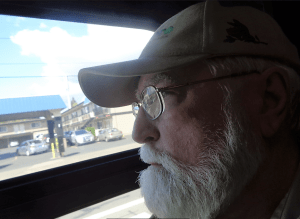

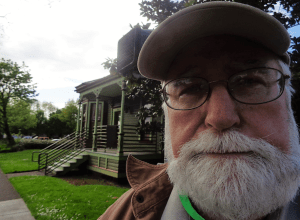
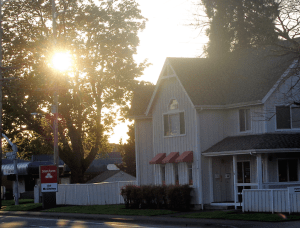

Yesterday I awoke in Springfield, and thanked God I was not in a hotel bed in Oakland. I felt I had been reborn. After blogging on the horrific hazing death, I got on the computer and looked for a AA meeting. I had planned to attend the meeting on Howe Street in Oakland at 5:00 P.M. I looked for a meeting in Springfield, but, all of a sudden I wanted to take a trip into Eugene in order to replicate my urge to journey to Oakland. I got on EMX, and pretended I was getting on United Airlines. The odds of something going wrong was very low. I had a safe trip and chatted with my fellow travelers. We wished each other a good day. I had crossed the river.
I chose a Twelve Step meeting that started at 4:30 P.M. I had to walk seven blocks after getting off a the LTD station in Downtown Eugene. This was a good test to see how well I would do walking around the dangerous downtown of Oakland. We read the Fifth Step, one chapter at a time, going around the table. I told my brothers and sister how grateful I was to be sober, and not in Oakland. I left the meeting feeling elated and hopeful.
I stopped at a yard sale and talked to two women. They gave me the statute of the drunk hanging on the lamppost as a token of my thirty years of sobriety. More about this later. I then had dinner, by myself.
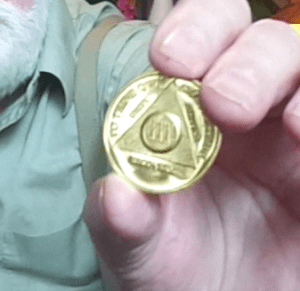
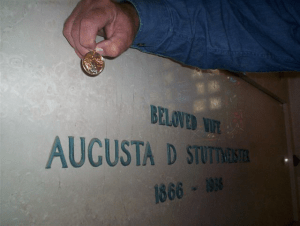
Around 11:00 P.M. I began looking for my recovery coin I replaced. I tilted my easy chair back, picked up the coins that were there, and spotted a box of photos I had not gone through. For over an hour and half I looked at more of my past, and my families history I do not make with them anymore.
Then, I found what I was looking for. I found a picture of Christine before she became an artist, and became famous. I realized this was the person the famous ‘Rosamond’ was looking for – in Recovery. I was looking at my sister in AA. Christine drowned on her first sober birthday. The truth that a AA Birthday Party was going to be held at Rocky Point, was concealed from me, and Rosamond’s fans. Stacey Pierrot does say she was going to a “beach party” that Saturday in Tom Snyder’s biography.
Tom was a ghost writer. He never met my sister or any members of my family. He promised me he would not use Christine’s and my recovery. He then told me he could not keep that promise. His book denigrate Christine. He provides a soap box for Garth Benton to confess unto the world how problematic his wife’s disease was, but, her sobriety was even worse. Did Mark and Vicki concur? Heather told me she heard how bad her aunt was. The special executor, Sydney Morris said this to me;
“I hear your sister was a real pain in the ass!”
My family did not want me to write our biography about two creative sibling in recovery. They got behind Snyder’s fake recovery book, that is the Anti-Christ of recovery books. I ordered it on Amazon, but they refused to complete the order. I will get a copy another way. I will publicly expose it for what it is. Millions of people need to get into recovery, and need our book. All six members of my family were/are alcoholics. The dynamics of one alcoholic member, is complex. Add to this the outsiders who claimed they were family, and even better than family.
Christine fired her business manager and best friend, Jacci Belford. She was replaced by Michael McCurdy, who was in Christine’s home group, along with his wife, Melinda McCurdy. This couple was helping Christine with her steps, and the family dynamics. This did not make Garth and our family, happy. There was a bitter divorce. Mark and Vicki took Garth’s side. Vicki told me Christine wanted to make amends and see me again. That message never got to me, until I looked at that photograph.
I had a blessed day, and arrived back in Springfield as the sun was setting. I will never be that alone, again, thanks to my true brothers and sisters.
It is now so clear to me my family and their outsiders, loathed my sobriety, too, and saw it as a threat. Most people in recovery get support from their family. The reason I was given ill wishes, topped with their hope I would have another drink – in Oakland – and die, is because they plotted to make millions off Snyder’s book, and the movie made from his book. This was their recovery plan. The ungifted drunken ones don’t need to go to AA. They just need to take control of a famous dead artist’s estate – and make a killing!
Do you get the Big Picture? The two Creative Sober Siblings were going to be reunited an together WE were going to pull ticks, leaches, and parasites off one another. None of these practicing drunks could paint or write a poem. They wanted noting to do with our Twelve Step Program. They were not left in Christine’s will, but, they had to have it, to make their utterly dysfunctional lives work for them. Thank God they are – in my past!
Millions need Christine and my story. Trump is considering defunding the agency that fights drug addiction that killed 33,000 Americans. This is why I saw so much death, so many dead people on my path home! I will post the video of me crossing a bridge.
Jon Presco
Copyright 2017

But Tim Piazza had fallen down a flight of stairs on that morning in February and was on a couch in the frat house, unresponsive. Davis said he thought he should be at a hospital instead, and told his new frat brothers so.
“They said ‘No you’re overreacting. You don’t know what you’re talking about,’ ” Davis recounted in an interview on “Good Morning America” that aired Friday. “I said ‘I do know what I’m talking about. He could have a concussion.
“They just wanted to make sure that they themselves were safe rather than Tim truly being safe.”
Getting sober can be a life’s work—it may seem like a monumental effort, sometimes overwhelming. Right when you think you’ve got a foothold, something always goes wrong—something outside of you, beyond your control, that sucks you in and demands that you face and deal with situations and people that push you to your absolute limit. And who can always be counted on to provide the most challenging stressors of all? Family. Our greatest supporters and our biggest thorns in our side, family issues can be a real threat to our recovery.
https://www.pbinstitute.com/a-deeper-look-at-the-5th-step-coming-clean-to-another-person/
http://www.goodtherapy.org/blog/therapy-alcoholic-family-sobriety/
https://www.addictionsandrecovery.org/families-and-addiction.htm
https://www.promises.com/articles/addiction-recovery/dont-let-family-dynamics-threaten-recovery/
The Twelve Steps
The twelve steps are to be worked sequentially:
1. We admitted we are powerless over alcohol– that our lives had become unmanageable.
2. Came to believe that a Power greater than ourselves could restore us to sanity.
3. Made a decision to turn our will and our lives over to the care of God as we understood Him.
4. Made a searching and fearless moral inventory of ourselves.
5. Admitted to God, to ourselves and to another human being the exact nature of our wrongs.
6. Were entirely ready to have God remove all these defects of character.
7. Humbly asked God to remove our shortcomings.
8. Made a list of all persons we had harmed, and became willing to make amends to them all.
9. Made direct amends to such people wherever possible, except when to do so would injure them or others.
10. Continued to take personal inventory and when we were wrong promptly admitted it.
11. Sought through prayer and meditation to improve our conscious contact with God as we understood Him, praying only for knowledge of His will for us and the power to carry that out.
12. Having had a spiritual awakening as the result of these steps, we tried to carry this message to other alcoholics, and to practice these principles in all our affairs.

Digging Into the Fifth Step
The fifth step: “Admitted to God, to ourselves and to another human being the exact nature of our wrongs.”
It’s pretty obvious why we share our inventory with someone else– because we are masters at believing in our own justifications and half-truths. After all, we were the ones who used to say we didn’t have a drinking or drug problem. On several occasions, we told ourselves over and over again that we were doing fine as we were slipping deeper and deeper into the dark abyss that is addiction.
This vital exercise begins to provide emotional, mental, and spiritual relief. By sharing wrong with a trusted confidant, guilt and shame start to melt away. Newcomers begin to realize their troubled past isn’t as unique as once thought.
Both painful and rewarding, the 5th step is essential to the fundamental change of personality required to overcome alcohol and drug addiction. In its simplest form, the fifth step is simply a confession of personal wrong-doings. Confession is a long standing practice in the Judeo/Christian tradition, and alcoholics usually store a vast collection of closet skeletons. By sharing the depths of their conscience with another person, alcoholics allow fresh air to enter their soul’s closely-guarded closet of shameful skeletons.
Stepping Out of The Past
One of the many blessings provided by the steps is that you can put your past behind you. The fifth step marks the beginning of that journey. Once you disclose to another person your inventory, you can finally begin to build a new life, away from the past and your addiction.
You will never not have the disease of addiction. There is no cure. But, through the steps and diligence, you can arrest your disease, and begin the healing process. Most take the fifth step with their sponsor. When choosing a sponsor, it is suggested that you ask someone who has what you want– spiritually, or otherwise.
Respecting your sponsor is important because he may need to guide you in some very important situations. Consider this when choosing a sponsor.
At any rate, the fifth step is generally therapeutic, and has often been called the “confession” step.
Preparation for the Fifth Step
The Big Book is clear that once you have finished your fourth step writing, you are to review your lists, analyze what they mean, and learn something from what you have written. Your analysis will be augmented in the fifth step, buy you should not leave all the thinking up to your guide.
Read page 66 in the Book, make not of these comments:
1. The world is, indeed imperfect, and our lives have been touched by injustice. Our typical reaction has been to try to fix the world. When that didn’t work—it never does—we got good and sore and bitched and drank at it. Only in sobriety have we learned there is but one thing in this universe that we can and must try to influence. You guessed it—self. Many of us have then discovered a miraculous truth. When we set about to have our Creator manage our lives, we are often empowered with incredible influence over people near us and in the world around us. The catch (wouldn’t you know there would be one) is that we must not attempt to exercise self-will.
2. The power of resentment far exceeds any conception we had of negative thinking. Were you aware that:
- ..a life which includes deep resentment leads only to futility and unhappiness.
- The hours in which we all futility and unhappiness in our lives are not worth while. Resentments waste our lives.
- Resentments shut us off from the sunlight of the Spirit, thereby preventing the maintenance and growth of a spiritual experience.
- When shadowed from the sunlight of the Spirit, the insanity of alcohol returns, we drink again, and we die.
- Harboring of resentments is fatal.
Most alcoholics have a deep—almost pathological—sense of justice. If we are wronged (meaning often that we did not get what we wanted), or even conjure up the notion that we might have been wronged, we find full justification to express anger or harbor resentment. It then seems almost a duty to carry a justified resentment. Otherwise those who have wronged us would get off Scot-free. And that wouldn’t be right, would it? So, we waste our God-given lives judging and punishing our fellows. Relinquishing a justified resentment is one of the most difficult experiences known to the alcoholic (12step.org).
In his book The 12 Steps and 12 Traditions, Bill Wilson explains the benefits of thoroughly completing a 5th step. The fifth step of the 12 step recovery program states that we, “Admitted to God, to ourselves, and to another human being the exact nature of our wrongs.” This vital exercise begins to provide emotional, mental and spiritual relief. By sharing wrong with a trusted confidant, guilt and shame start to melt away. Newcomers begin to realize their troubled past isn’t as unique as once thought.
Both painful and rewarding, the 5th step is essential to the fundamental change of personality required to overcome alcohol and drug addiction. In its simplest form, the fifth step is simply a confession of personal wrong-doings. Confession is a long standing practice in the Judeo/Christian tradition, and alcoholics usually store a vast collection of closet skeletons. By sharing the depths of their conscience with another person, alcoholics allow fresh air to enter their soul’s closely-guarded closet of shameful skeletons.
Repentence, similar to confession (and equally painful), is also espoused in the Buddhist verse found in Practices and Vows of Samantabadra Bodhisattva (chapter 40):
“For all the evil deeds I have done in the past,
Created by my body, speech and mind,
From beginningless greed, hatred and delusion,
I now know shame and repent them all.”
The original architects of the 12 steps wove the powerful, spiritual tradition of confession for a reason. It is effective. It is healing. It is one of the most valuable tools to alleviate past burdens. As Bill Wilson notes:
“If we have swept the search light of Step Four back and forth over our careers, and it has revealed in stark relief those experiences we’d rather not remember, if we have come to know how wrong thinking and action have hurt us and others, then the need to quit living by ourselves with those tormenting ghosts of yesterday gets more urgent than ever. We have to talk to somebody about them.” (12×12, pg.55).
This is precisely what the 5th Step of the 12 step process requires of those who genuinely desire sobriety – a candid discussion in light of a 4th step inventory. Although the word “required” repels many an alcoholics or drug addicts, Bill Wilson further warns that “without a fearless admission of our defects to another human being we could not stay sober.” (12×12, pgs. 56&57). Obviously, staying sober is a prerequisite for meaningful, fulfilling recovery.
Bill Dinker is a nationally recognized substance abuse recovery expert. He has multiple appearances on the Huffington Post, where he commented on the state of opiate addiction treatment and the heroin epidemic. Bill devotes thousands of hours of his time on the phone counseling families of alcoholic and addicted persons in his role as Director of Admissions at Discovery Place. Author of over 70,000 original words on substance abuse recovery, he is personally sober as an alcoholic, marijuana, cocaine, opiate and heroin addict. Bill received his degree in the Liberal Arts with a minor in business, magna cum laude, from Aquinas College. Mr. Dinker offers his recovery consultations free of charge for families or anyone seeking direction, knowledge and support for a family member, spouse, friend, patient, client or employee.
https://www.discoveryplace.info/5th-step-aa-benefits
If you or a loved one is struggling with addiction, contact us today at the Palm Beach Institute.
 Rosamond Press
Leave a comment