
Christianity is now CLOSED TILL FURTHER NOTICE!
According to most Christian Scholars, Jesus died on the cross for our sins. This meant, that no early Christian need obey Mosaic Laws that are found in the Old Testament. Paul did this, the anti-Semite, in order to form his own church that got rid of John the Baptist, and Jesus, who I believe was a Moabite, and thus a descendant of Lot – who was not guiity of incest and homosexuality. The laws against homosexuality are found in the Old Testament, and therefore can not be employed by any Christian Lawmaker elected to the Senate, or Congress. These laws were made Null and Void by Jesus’ crucifixion.
I believe Jesus was crucified for the alleged sins of Lot, that did not exist. Lot and his tribe were innocent. For the reason Trump made a Human Law that gives tax exemptions to Churches, and for the reason Church leaders have come out of their church to make SECULAR LAWS aimed at hurting American Citizens, God has CLOSED Christianity down, until Christo-Repubs stop persecuting any American citizen, and return to their DEN OF LIES!
I suggest Homosexuals sue the Chrstian Church and Christ-Repubs. I will testify in their behalf as a Biblical Scholar.
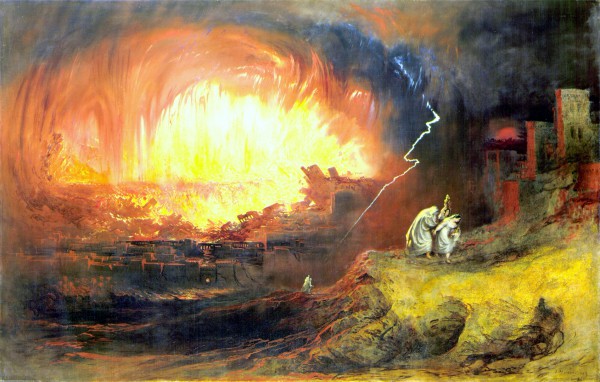
Above we see the ancestors of Jesus fleeing the fire and brimstone. Jesus descends from the Moabites whose forefather in the dude in white. The Moabites were considered ALIENS, and were scorned for sins they did not commit.
Jon ‘The Nazarite’
A great cause of confusion today concerns the place of the Mosaic law in the New Testament believer’s life. While this short study cannot begin to cover all the issues involved, it is my hope that it will shed some light and remove some of the confusion.
One of the profound emphases of the New Testament, especially the epistles of Paul, is that Christians are no longer under the rule of the Mosaic law. This truth is stated in no uncertain terms and in various ways (see Rom. 6:14; 7:1-14; Gal. 3:10-13, 24-25; 4:21; 5:1,
Lot’s story is traditionally used to demonstrate Islam’s disapproval of rape and homosexuality.[29][ISBN missing] Lot’s struggle with his tribe is seen as concerning the question of homosexuality in general or more specifically male-to-male anal penetration, specifically.[30] These interpretations have sometimes widened to condemn homosexuality as a whole, including psychological and social dispositions. However, some scholars dispute these interpretations.[31] They also point out that Quranic narrative is ambiguous as to whether Lot’s tribe was punished because of homosexual acts in the first place or because of infidelity vis-à-vis God.[2]
Passages in the Old Testament book Leviticus that prohibit “lying with mankind as with womankind” and the story of Sodom and Gomorrah have traditionally been interpreted by Christian churches as condemning and prohibiting homosexual acts, along with several Pauline passages. Today, there is more debate than in previous centuries as to whether such passages should still be interpreted in that light. Most Christian churches continue to maintain the long-standing understanding of these passages, while other interpreters maintain that they either have been misunderstood and do not condemn homosexuality, or that the historical context needs to be taken into account
consumed by fire and brimstone. Neighboring Zoar (Bela) was the only city to be spared. In Abrahamic religions, Sodom and Gomorrah have become synonymous with impenitent sin, and their fall with a proverbial manifestation of divine retribution.[6][7][Jude 1:7] Sodom and Gomorrah have been used as metaphors for vice and homosexuality viewed as a deviation. The story has therefore given rise to words in several languages. These include the English word sodomy, used in sodomy laws to describe sexual “crimes against nature”, namely anal or oral sex (particularly homosexual), or bestiality.[8][9][10] Some Islamic societies incorporate punishments associated with Sodom and Gomorrah into sharia.[11]
https://en.wikipedia.org/wiki/Sodom_and_Gomorrah
https://en.wikipedia.org/wiki/Lot_in_Islam
Lut ibn Haran (Arabic: لوط, translit. Lūṭ), known as Lot in the Old Testament, is a prophet of God in the Quran.[2][3] He also appears in the Bible, but the biblical stories of Lot are not entirely accepted within Islam. According to Islamic tradition, Lot lived in Ur and was the son of Haran and nephew of Abraham.[4] He migrated with Abraham to Canaan. He was bestowed as a prophet to the cities of Sodom and Gomorrah.[5] He was commanded by God to go to the land of Sodom and Gomorrah to preach to his people on monotheism and to stop them from their lustful and violent acts.[4] According to both the Quran and the Hebrew Bible, Lot’s messages were ignored by the inhabitants and Sodom and Gomorrah were subsequently destroyed. Their sites cannot be exactly located, but it may be supposed that they were somewhere in the plain east of the Dead Sea or underneath its current limits. Lot’s story is traditionally presented as an Islamic view against rape and homosexual acts.
Lot’s people are the people to whom he is sent on a mission. He was not one of their own brethren, as was Salih or Shu’aib. But he looked upon his people as his “brethren”.[6] The Quran says that Lot is a prophet, and holds that all prophets were examples of moral and spiritual rectitude, so the report of Lot’s drunkenness and incest is considered to be false.[4]
Lot’s story is traditionally used to demonstrate Islam’s disapproval of rape and homosexuality.[29][ISBN missing] Lot’s struggle with his tribe is seen as concerning the question of homosexuality in general or more specifically male-to-male anal penetration, specifically.[30] These interpretations have sometimes widened to condemn homosexuality as a whole, including psychological and social dispositions. However, some scholars dispute these interpretations.[31] They also point out that Quranic narrative is ambiguous as to whether Lot’s tribe was punished because of homosexual acts in the first place or because of infidelity vis-à-vis God.[32]
A great cause of confusion today concerns the place of the Mosaic law in the New Testament believer’s life. While this short study cannot begin to cover all the issues involved, it is my hope that it will shed some light and remove some of the confusion.
One of the profound emphases of the New Testament, especially the epistles of Paul, is that Christians are no longer under the rule of the Mosaic law. This truth is stated in no uncertain terms and in various ways (see Rom. 6:14; 7:1-14; Gal. 3:10-13, 24-25; 4:21; 5:1, 13; 2 Cor. 3:7-18), but in spite of this, there have always been those who insist that the Mosaic Law, at least the Ten Commandments, are still in force for the Christian. In regard to the relation of Christian ethics to the Mosaic Law, Luck writes:
There are Christian teachers of repute who consider the Mosaic law to be the present-day rule of life for the Christian.1 A view not infrequently found among earnest, orthodox believers is that although we are not saved by the law, once we have been justified by faith, then the Mosaic law becomes our rule of life. Those holding such a view generally make a sharp division of the Mosaic law into two parts, which they distinguish as the moral and the ceremonial. The ceremonial portion they consider as having found its fulfillment in Christ at His first advent, and thus as having now passed away. But the moral portion of the Mosaic law, say they, is still in force as the believer’s rule of life. The treatment given to Christian ethics by some highly respected authors is indeed but little more than an exposition of the Decalogue.
It seems exceedingly strange that Bible-believing Christians should advocate such a view, when the New Testament makes it abundantly clear that the believer in Christ is not any longer under the Mosaic law in its entirety… Indeed after having been delivered from the law, to deliberately place ourselves once again under its [control] is said to be “falling from grace.”
But let it be immediately understood that this does not mean to say that we should necessarily behave in a manner just opposite to what the Mosaic law commands—that we should kill, steal, bear false witness, etc. Long before the law was given through Moses, it was utterly wrong to do such evil things. . .2
By contrast, the age in which we live, the church age, has often and rightly been called the age of grace. This is not because God’s grace has not been manifested in other ages, but because in the coming of the Lord Jesus Christ we have the ultimate manifestation of God’s grace.
Titus 2:11-12. For the grace of God has appeared, bringing salvation to all people. It trains us to reject godless ways and worldly desires and to live self-controlled, upright, and godly lives in the present age,
Grace becomes an absolutely inseparable part of the believer’s life in Christ. In the coming of Christ and His death on the cross, the Mosaic Law as a rule of life was terminated. The believer is now to live in the liberty and power of God’s grace by the Spirit, not the rule of law. This new liberty must never be used as an occasion to indulge the flesh or sinful appetites (Gal. 5:13) nor does it mean the Christian has no moral law or imperatives on his life, but simply that he or she is to live righteously by a new source of life as asserted in Romans 8.
Romans 8:2-4. For the law of the life-giving Spirit in Christ Jesus has set you free from the law of sin and death. 3 For God achieved what the law could not do because it was weakened through the flesh. By sending his own Son in the likeness of sinful flesh and concerning sin, he condemned sin in the flesh, 4 so that the righteous requirement of the law may be fulfilled in us, who do not walk according to the flesh but according to the Spirit.
But a great deal of confusion exists over the issues of law and grace and the place of the Mosaic law in the New Testament believer’s life. However, the basic principle is that the “fusion” of law and grace brings a “confusion” which results in sterile legalism. Because of man’s natural bent toward either legalism or license, the place and function of the Law has been an issue in the Christian community since the very early days of the church. There have always been those who have sought to put the Christian back under the Law or make the Law necessary for both salvation and sanctification. As a result large sections of the New Testament are written directly to this issue (see Acts 15 and the council at Jerusalem; Romans 5:10; 6:14; 7:1f; 2 Cor. 3:6-18; and the entire book of Galatians). These passages were written against a legalistic use of the Law, one which promotes works to gain points with either God or people; works of self-effort rather than a life lived by the power and personal leading of the Holy Spirit.
Of course, other parts of the New Testament are written against license and the misuse of liberty (Gal. 5:13ff. Rom. 6:1ff; 8:4ff; Tit. 2:11-14). But the answer is never to put the Christian back under the Law, but rather a proper understanding and appreciation of God’s grace to us in Christ. Christian liberty is not the right to do as one pleases, but the power, desire, and will to do as one ought in and by the power of God and a regenerated life.
This is ultimately the focus of Titus 2:11-14. The glorious manifestation of God’s grace in Christ instructs and trains believers in how to live.3 This grace provides the incentive, the motive, and the means. Regarding Titus 2:11-14 Ryrie writes:
The verb teaching encompasses the whole concept of growth—discipline, maturing, obedience, progress, and the like. This involves denial of improper things and direction into proper channels. These five terms—godliness, worldly lusts, soberly, righteously, godly—do not describe the content of grace teaching so much as they indicate the object and purposeful goal of that teaching. And this intent is, according to this passage, the ultimate purpose of the Incarnation of Christ. He came to display the grace of God in the changed lives of his people. The final cause of the revelation of the grace of God in Christ is not creed but character.4
In Romans 6:14, Paul gives us a fundamental principle as it relates to the Christian’s understanding and the place of the Law in a believer’s life. “For sin will have no mastery over you, because you are not under law but under grace.” (emphasis mine). Romans 6 deals with the believer’s walk or sanctification. In this regard, under grace is never to be taken as an excuse to sin as one pleases since he is under grace (6:1-2) and it is placed in strong contrast5 with under law. Two things are prominent here: (1) these two (law and grace) are set forth as complete opposites, and (2) the text also makes it clear that the only way the believer is going to experience true sanctification (victory over sin plus the production of positive righteousness) is by grace (the work of God in Christ) and never by law. The reasons, which will be set forth below, are bound up in two issues, the weakness of man’s flesh and the nature of the Law and its inability because of man’s weakness to produce a truly holy life. This is not to say that the Mosaic Law is not good and holy and does not have a function, but this too will be set forth below.
So just what is the meaning, nature, and place or function of the law in the New Testament?
The Meaning of the Term “Law”
In the Old Testament, the word “law” is used to translated the Hebrew word torah, “instruction.” The Hebrew word for “law” probably comes from the causative form of the verb yarah, “to throw,” “to shoot (arrows).” In the hiphil stem, the verb horah means “to point, guide, instruct, teach.” Hence, the law is that which provides authoritative guidance. In the New Testament, the Greek word used for law is nomos. Nomos means “that which is assigned,” hence, “usage, custom,” and then “law,” or “a rule governing one’s actions.”
Thus God’s law is His system of rules by which He shows and instructs in His will and administers the affairs of the world. Obviously the definition allows for and even implies that there might be differing systems of rules at various times, depending on what particular aspects or how much of His will God wishes to show at a given time.…A system of rules may be tailored for different times, peoples, or purposes. . . 6
As a result, in the progress of God’s revelation to man, we can see a number of different systems of law in the Scripture. These are:
The Law of Nature (Natural or Inherent)
This is the law Paul mentions in Romans 2:14, “For whenever the Gentiles, who do not have the law, do by nature the things required by the law, these who do not have the law are a law to themselves.” (emphasis mine) The law of nature is one which contains natural revelation of God’s eternal power and divine nature (Rom. 1:20) and is sufficient to condemn those who reject this revelation, but not sufficient to save. Those who do not receive this natural revelation through nature demonstrate they are unable to receive the additional light (special revelation of Scripture) needed for salvation. “If a man rejects the revelation of God in the law of nature, he fails to qualify for the further revelation which will lead him to Christ.”7 This natural law perhaps also falls under the category of the eternal law of God for the moral principles of the Mosaic Law (the Ten Commandments) did not begin with Sinai, but are as eternal and immutable as the very holy character of God Himself (see 1 Pet. 1:16).
The Law of Eden
While the term “law” is never specifically used of Adam and Eve’s relationship with God in the Garden, by the definition of “law,” a system of principles or rules that instructs man as to God’s will and direction, there was a law given to Adam. He was instructed to “dress and keep” the garden, and to eat freely of all the trees except the “tree of the knowledge of good and evil.”
The Law of the Patriarchs
Again, because there was very specific revelation and instruction given to the patriarchs, there was a law given to these Old Testament believers. Though very little detail of this is given, God’s instructions to them still represent His law, the system of principles and rules designed to direct their lives. This is illustrated in Genesis 26:5 which says, “Abraham obeyed Me and kept My charge, My commandments, My statutes and My laws.”
The Law of Moses Given to Israel
The Mosaic Law is what we are most concerned about in relation to the New Testament believer. This consisted of 365 negative commands and 248 positive for a total of 613 commands. These may also be divided into three parts or sections (see below)—the moral, the social, and the ceremonial. As such, it covered every possible area of the life of Israel. It should be stressed that the moral principles embodied in the Mosaic Law given at Sinai were merely the codified expression of the eternal moral law of God as it was given to Israel to govern her life as a nation in order to experience God’s blessing under the Abrahamic covenant. For more on this aspect, see below.
Human Law as Prescribed by Man
There are obviously various forms of human laws, those prescribed by man through human government or custom (see Luke 20:22; Acts 19:38). While human government is an institution ordained by God’s will or law, some of the laws of man are direct expressions of the will of God, but still constitute laws by which men are often bound by the governmental system in which they live. Of course, where such laws conflict with God’s laws, then we are obligated to obey God instead (Acts 4:19-20).
The Law of Christ, the Law of the Spirit of Life
The fact that the Mosaic law has been terminated does not mean that there is no law in this age of grace even though the nature of this law is quite different from the standpoint of incentive, motivation, and means. In fact, the epistles speak of “the perfect law of liberty (Jam. 1:25), “the royal law” (Jam. 2:8), the Law of Christ (Gal. 6:2), and the law of the spirit of life in Christ Jesus (Rom. 8:2). This consists of the many imperatives found throughout the epistles which comprise this law. These too cover all areas of the believer’s life to direct him in the will of God in today’s world.
The moral principles embodied in the law of Moses Paul calls “the righteousness of the law” (Rom 8:4), and shows that such principles are the goal of the Spirit-directed life in the same context in which he teaches the believer is not under the Mosaic law (Rom 6–8).8
The Law of the Kingdom
The New Testament clearly speaks of and anticipates the reign of Christ on earth when He will rule in perfect righteousness and justice (Isa. 11:4-5). This will naturally mean many laws that will govern the life of citizens of the Kingdom. One only needs to consider Isaiah 2:3 which reads,
2:3 many peoples will come and say, “Come, let’s go up to the LORD’s mountain, to the temple of the God of Jacob, so he can teach us his requirements, and we can follow his standards.” For Zion will be the center for moral instruction,9 the LORD will issue edicts from Jerusalem. (NET Bible)
The Significance of these Various Laws
We can see from this that God is the administrator of the world. In the progress of His revelation and the development of His plan, there have been various economies (dispensations) administered by God with different regulations or laws giving precise instruction for each administration. The way God has run each economy or dispensation has varied, however, in each case, different people were addressed with the commands differing in quantity and character, but always with specific instruction.
The Use of the Term “Law” in the New Testament
A great deal of flexibility is found in the use of the term “law” in the New Testament. A few of the uses are as follows.
1. This term is used of the entire Old Testament (John 10:34; 12:34; 1 Cor. 14:21). John 10:34 is a quotation from Psalm 82:6, and 1 Corinthians 14:21f is a quote from Isaiah 28:11-12. Technically neither the Psalms nor Isaiah are a part of the Old Testament “law,” but sometimes the term “law” was applied to the entire Old Testament because it constituted God’s special revelation of instruction for Israel and ultimately for man.
2. It is used with such terms as the prophets, and writings, again as a title for the entire Old Testament Scripture, but in this way it looks at them in their division (Luke 24:27, 44).
3. It is especially used of the first five books of the Old Testament or the Mosaic Law (Genesis, Exodus, Leviticus, Numbers, and Deuteronomy). (Compare Luke 2:23; John 8:5; 1 Cor. 9:9; Gal. 3:10).
4. The term is used of the entire specific Mosaic code given to the nation Israel to govern and guide their moral, religious and secular life, and covers parts of Exodus, Leviticus, Numbers and Deuteronomy (Deut. 4:8, 44-45).
5. The term is used of the Ten Commandments (Exodus 20:3-17).
6. Law is used of a principle, force or influence that impels one to action or behavior (Rom. 7:21, 23a, 25).
7. It is used of law in general (Rom 3:27 and possibly Rom. 5:13b).
The Origin and Source of the Mosaic Law
Though part of the Law was mediated by angels, God is the origin and source of the Mosaic Law, which stems from the eternal and holy character of God. This is true even of the natural law written in the heart or conscience of man (Exodus 31:1b; Acts 7:53; Rom. 2:14-16; Heb. 2:1-2).
The Nature and Content of the Mosaic Law
It is common to divide the Mosaic Law into three parts as illustrated below, but though this is helpful for analysis and the study of the Mosaic Law and the way it functions, such a division is never stated as such in Scripture. Rather it is seen as a unit. Arguments for this will be given below.
- Part 1: The Moral Law or the Ten Commandments. This part of the Law governed the moral life giving guidance to Israel in principles of right and wrong in relation to God and man (Exodus 20:1-17).
- Part 2: The Judgments, or the Social Law. This part of the Law governed Israel in her secular, social, political, and economic life (Exodus 21:1–23:13).
- Part 3: The Ordinances or the Ceremonial Law. This was the religious portion of Law which guided and provided for Israel in her worship and spiritual relationship and fellowship with God. It included the priesthood, tabernacle and sacrifices (Exodus 25:-31: Leviticus).
The Recipients of the Mosaic Law
The Mosaic Law was a bilateral covenant made specifically for Israel alone to govern her life in the promised land. From the Abrahamic Covenant (Gen.12) we see Israel was a chosen nation, an instrument of God to become a channel of blessing to all nations. Yahweh was her Theocratic King who was to rule and guide the nation in her destiny that she might not become polluted or contaminated by other nations and could thus fulfill her purpose. For this the Mosaic Law was instituted to direct Israel as a nation in all spheres of her life—morally, socially, politically, economically and religiously.
By its very nature, the Mosaic Law was not to be, and could not be, obeyed to the letter by any other people in any other place as a rule of life. However, in the spirit of the Law it did set forth moral principles which were applicable and would bring blessing to all people anywhere and at any time when applied and used as a standard of right and wrong.
There were certain economic provisions in the Law to govern and protect the economic life of Israel in their promised land. For example there was the right of property ownership, free enterprise, protection of the poor which guarded against the evils of great concentrations of wealth in the hands of a few with the consequent impoverishment of others. But the poor were provided for in such a way as to avoid the loss of free enterprise and the individual’s initiative by high taxation as well as to avoid making leeches out of men who refused to work.
However, the strict application of these laws to our world is impossible since the original conditions in which God directly intervened cannot he reproduced, at least not until the millennium. Yet, economists could study and learn much from these laws and principles.
The Characteristics of the Mosaic Law
(1) The foundation and basis of the Mosaic Law is the covenant God made with the patriarchs, Abraham, Isaac, and Jacob. In several places in Exodus and Deuteronomy, there are references to the Abrahamic Covenant which establish the fact that the giving of the Law at Sinai was based on the covenant with Abraham and God’s continuing plan for the nation of Israel as a priesthood nation (cf. Ex. 19:4-6; Deut. 4:4-8 with Ex. 2:24-25; Deut. 4:36-38; 29:31; 1 Chron. 16:15-19). God had promised to bless the descendants of Abraham and through them, the world. This was a promises reiterated and expanded to Abraham and to Isaac and Jacob. God would bless Israel and through them, bring blessing to the world (Gen. 12:1f; 15; 17:1ff; 26:24f; 28:13f). The Abrahamic covenant is a unilateral covenant. Its ultimate fulfillment is dependent on God’s sovereign and steadfast faithfulness to His promises to Abraham regardless of Israel’s continued disobedience (cf. Ezek. 20:1-44).

 Rosamond Press
Leave a reply to Royal Rosamond Press Cancel reply