


Christine Friederike Auguste was an artist who had a famous salon in Berlin. She was the fifth child of Frederick William II of Prussia whose father became involved with the Rosicrucians and Pietism that gave birth to the spiritual work of Jakob Bohme who wrote ‘Aurora’. The Grimm Brothers attended Christine’s salon and were helped by Frederick William IV of Prussia . Consider the names on the walls of the Stuttmeister tomb where a light come thru the tiffany window covered in roses. Here at rest are the ancestors of Christine Rosamond Benton, the world famous artist who signed her work by her middle mame ‘Rosamond’ the name the Grimm brothers gave their Sleeping Beauty who belonged to four Huguenot sisters who were the daughters of Mary Magdalene Hassenpflug. My mother was Rosemary Rosamond, the daughter of Mary Magdalene Rosamond. What are the odds?
Christine may have been a Behmenists. She was captured and made a hostage. Here are five women that made Walt Disney the premiere Storyteller of my time. They have not received any credit while the money poured into the pockets of ‘The Pretenders’.
Jon Presco
http://finding-grimm.blogspot.com/2013/06/say-hello-to-hassenpflug.html


Concerned, the three good fairies take Aurora to a secluded cottage in the forest and change her name to Briar Rose. When Aurora grows to be a teenager, she is dancing and singing in the forest when she meets a handsome man who happened to hear her singing. Briar Rose does not realize he is, in fact, Prince Phillip who is betrothed to her and they agreed to meet again that evening.
A salon is a gathering of people under the roof of an inspiring host, held partly to amuse one another and partly to refine the taste and increase the knowledge of the participants through conversation. These gatherings often consciously followed Horace’s definition of the aims of poetry, “either to please or to educate” (“aut delectare aut prodesse est”). Salons, commonly associated with French literary and philosophical movements of the 17th and 18th centuries, were carried on until recently[when?] in urban settings.
In 1840, von Savigny and Bettina von Arnim appealed successfully to Frederick William IV of Prussia on behalf of the brothers who were offered posts at the University of Berlin. In addition to teaching posts, the Academy of Sciences offered them stipends to continue their research. Once they had established the household in Berlin, they directed their efforts towards the work on the German dictionary and continued to publish their research. Jacob turned his attention to researching German legal traditions and the history of the German language, which was published in the late 1840s and early 1850s; meanwhile Wilhelm began researching medieval literature while at the same time editing new editions of Hausmärchen.[9]
https://en.wikipedia.org/wiki/Princess_Augusta_of_Prussia
https://en.wikipedia.org/wiki/Salon_(gathering)
Princess Augusta of Prussia (Christine Friederike Auguste; 1 May 1780 – 19 February 1841) was a German salonist and Electress consort of Hesse. She was the third daughter and fifth child of Frederick William II of Prussia and Frederika Louisa of Hesse-Darmstadt. She was the first consort of William II, Elector of Hesse. Augusta was a talented painter. Among the messages left by her works are also self-portraits.
https://en.wikipedia.org/wiki/Frederick_William_III_of_Prussia
In 1781 Frederick William, then prince of Prussia, inclined to mysticism, had joined the Rosicrucians, and had fallen under the influence of Johann Christoph von Wöllner and Johann Rudolf von Bischoffwerder. On 26 August 1786 Wöllner was appointed privy councillor for finance (Geheimer Oberfinanzrath), and on 2 October 1786 was ennobled. Though not in name, he in fact became prime minister; in all internal affairs it was he who decided; and the fiscal and economic reforms of the new reign were the application of his theories. Bischoffswerder, too, still a simple major, was called into the king′s counsels; by 1789 he was already an adjutant-general.
Princess Aurora (alias Briar Rose or Sleeping Beauty) is a fictional character and the title character of Disney‘s 1959 animated film Sleeping Beauty.
Created by Walt Disney and animated by Marc Davis, Aurora is the princess of a fictionalized English kingdom set in the 14th century[1] and King Stefan’s and Queen Leah’s only daughter. At her christening, three good fairies are invited to bless her with gifts of beauty and song. However, she is also cursed by the wicked and jealous fairy Maleficent, who foretold that on her sixteenth birthday, she would prick her finger on a spinning wheel’s spindle and die. The third remaining good fairy then altered the curse so that when she pricked her finger, she would only fall into a deep slumber and be awakened by the kiss of Prince Phillip, to whom she was betrothed at birth. She was voiced by Mary Costa.


Böhme’s mentor was Abraham Behem who corresponded with Valentin Weigel. Böhme joined the “Conventicle of God’s Real Servants” – a parochial study group organized by Martin Möller. Böhme had a number of mystical experiences throughout his youth, culminating in a vision in 1600 as one day he focused his attention onto the exquisite beauty of a beam of sunlight reflected in a pewter dish. He believed this vision revealed to him the spiritual structure of the world, as well as the relationship between God and man, and good and evil. At the time he chose not to speak of this experience openly, preferring instead to continue his work and raise a family.[citation needed
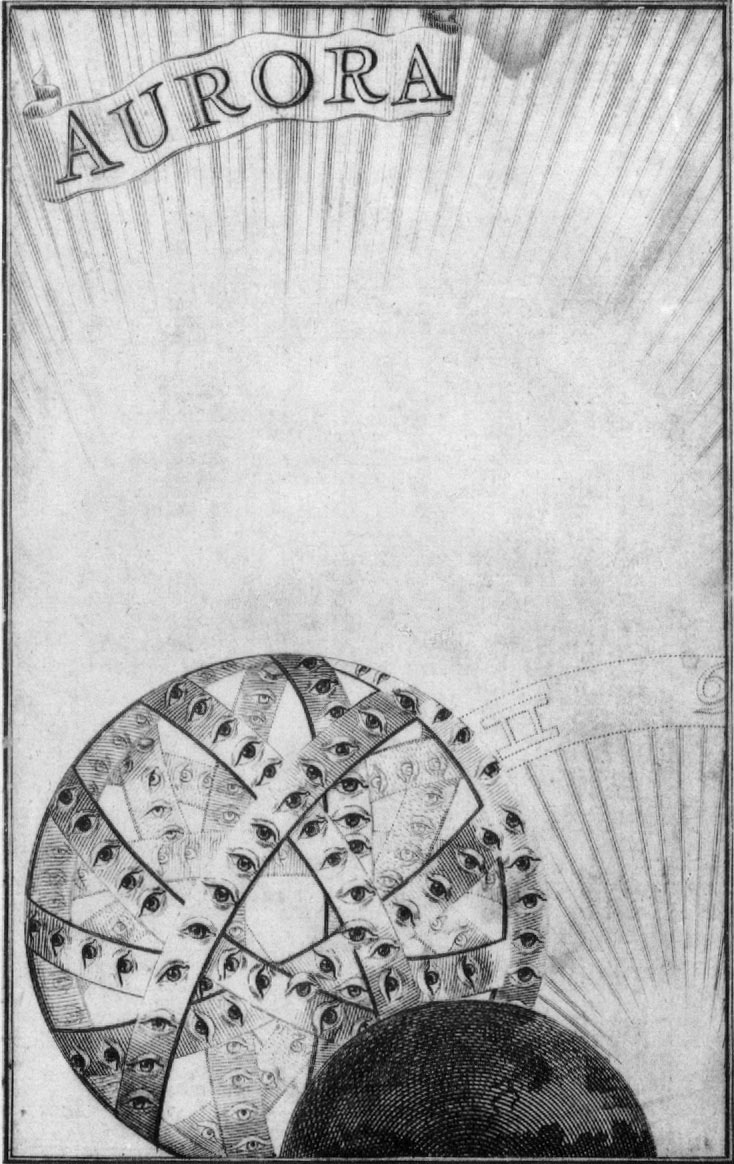
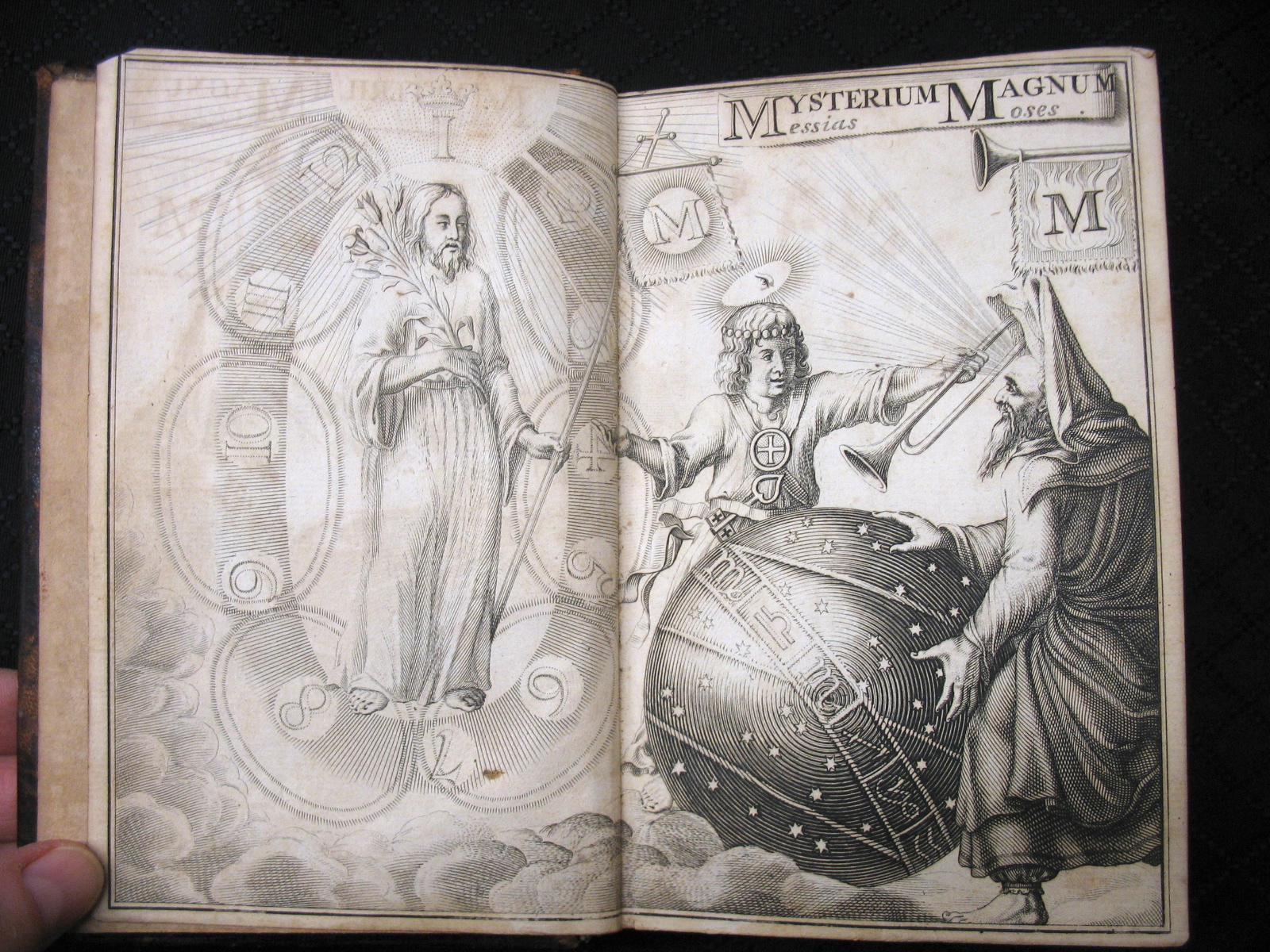
Twelve years after the vision in 1600, Böhme began to write his first book, Die Morgenroete im Aufgang (The rising of Dawn). The book was given the name Aurora by a friend; however, Böhme originally wrote the book for himself and it was never completed.[6] A manuscript copy of the unfinished work was loaned to Karl von Ender, a nobleman, who had copies made and began to circulate them. A copy fell into the hands of Gregorius Richter, the chief pastor of Görlitz, who considered it heretical and threatened Böhme with exile if he continued working on it. As a result, Böhme did not write anything for several years; however, at the insistence of friends who had read Aurora, he started writing again in 1618. In 1619 Böhme wrote “De Tribus Principiis” or “On the Three Principles of Divine Being”. It took him two years to finish his second book, which was followed by many other treatises, all of which were copied by hand and circulated only among friends.[7] In 1620 Böhme wrote “The Threefold Life of Man”, “Forty Questions on the Soul”, “The Incarnation of Jesus Christ”, “The Six Theosophical Points”, “The Six Mystical Points”. In 1622 Böhme wrote “De Signatura Rerum“. In 1623 Böhme wrote “On Election to Grace”, “On Christ’s Testaments”, “Mysterium Magnum”, “Clavis (Key)”. The year 1622 saw Böhme write some short works all of which were subsequently included in his first published book on New Year’s Day 1624, under the title Weg zu Christo (The Way to Christ).[4]
The publication caused another scandal and following complaints by the clergy, Böhme was summoned to the Town Council on 26 March 1624. The report of the meeting was that:
“Jacob Boehme, the shoemaker and rabid enthusiast, declares that he has written his book To Eternal Life, but did not cause the same to be printed. A nobleman, Sigismund von Schweinitz, did that. The Council gave him warning to leave the town; otherwise the Prince Elector would be apprised of the facts. He thereupon promised that he would shortly take himself off.”[8]
In this short period, Böhme produced an enormous amount of writing, including his major works De Signatura Rerum (The Signature of All Things) and Mysterium Magnum. He also developed a following throughout Europe, where his followers were known as Behmenists.
The chief concern of Böhme’s writing was the nature of sin, evil and redemption. Consistent with Lutheran theology, Böhme preached that humanity had fallen from a state of divine grace to a state of sin and suffering, that the forces of evil included fallen angels who had rebelled against God, and that God’s goal was to restore the world to a state of grace.
There are some serious departures from accepted Lutheran theology, however, such as his rejection of sola fide, as in this passage from The Way to Christ:
For he that will say, I have a Will, and would willingly do Good, but the earthly Flesh which I carry about me, keepeth me back, so that I cannot; yet I shall be saved by Grace, for the Merits of Christ. I comfort myself with his Merit and Sufferings; who will receive me of mere Grace, without any Merits of my own, and forgive me my Sins. Such a one, I say, is like a Man that knoweth what Food is good for his Health, yet will not eat of it, but eateth Poison instead thereof, from whence Sickness and Death, will certainly follow.[11]
Another place where Böhme may depart from accepted theology (though this was open to question due to his somewhat obscure, oracular style) was in his description of the Fall as a necessary stage in the evolution of the Universe.[12] A difficulty with his theology is the fact that he had a mystical vision, which he reinterpreted and reformulated.[13] According to F. von Ingen, to Böhme, in order to reach God, man has to go through hell first. God exists without time or space, he regenerates himself through eternity, so Böhme, who restates the trinity as truly existing but with a novel interpretation. God, the Father is fire, who gives birth to his son, whom Böhme calls light. The Holy Spirit is the living principle, or the divine life.[14]
Böhme’s correspondences in “Aurora” of the seven qualities, planets and humoral-elemental associations:
-
1. Dry – Saturn – melancholy, power of death;
-
2. Sweet – Jupiter – sanguine, gentle source of life;
-
3. Bitter – Mars – choleric, destructive source of life;
-
4. Fire – Sun/Moon – night/day; evil/good; sin/virtue; Moon, later = phlegmatic, watery;
-
5. Love – Venus – love of life, spiritual rebirth;
-
6. Sound – Mercury – keen spirit, illumination, expression;
-
7. Corpus – Earth – totality of forces awaiting rebirth.
In “De Tribus Principiis” or “On the Three Principles of Divine Being” Böhme subsumed the seven principles into the Trinity:
-
1. The “dark world” of the Father (Qualities 1-2-3);
-
2. The “light world” of the Holy Spirit (Qualities 5-6-7);
-
3. “This world” of Satan and Christ (Quality 4).
Cosmology[edit]
In one interpretation of Böhme’s cosmology, it was necessary for humanity to return to God, and for all original unities to undergo differentiation, desire and conflict — as in the rebellion of Satan, the separation of Eve from Adam and their acquisition of the knowledge of good and evil —, in order for creation to evolve to a new state of redeemed harmony that would be more perfect than the original state of innocence, allowing God to achieve a new self-awareness by interacting with a creation that was both part of, and distinct from, Himself. Free will becomes the most important gift God gives to humanity, allowing us to seek divine grace as a deliberate choice while still allowing us to remain individuals.
Böhme saw the incarnation of Christ not as a sacrificial offering to cancel out human sins, but as an offering of love for humanity, showing God’s willingness to bear the suffering that had been a necessary aspect of creation. He also believed the incarnation of Christ conveyed the message that a new state of harmony is possible. This was somewhat at odds with Lutheran teachings, and his suggestion that God would have been somehow incomplete without the Creation was even more controversial, as was his emphasis on faith and self-awareness rather than strict adherence to dogma or scripture.[citation needed]
Marian views[edit]
Böhme believed that the Son of God became human through the Virgin Mary. Before the birth of Christ, God recognized himself as a virgin. This virgin is therefore a mirror of God’s wisdom and knowledge.[17] Böhme follows Luther (and all Christians), in that he views Mary within the context of Christ. Unlike Luther, he does not address himself to dogmatic issues very much, but to the human side of Mary. Like all other women, she was human and therefore subject to sin. Only after God elected her with his grace to become the mother of his son, did she inherit the status of sinlessness.[14] Mary did not move the Word, the Word moved Mary, so Böhme, explaining that all her grace came from Christ. Mary is “blessed among women” but not because of her qualifications, but because of her humility. Mary is an instrument of God; an example of what God can do: It shall not be forgotten in all eternity, that God became human in her.[18]
Böhme, unlike Luther (and virtually all other Christians to that point in time), does not believe that Mary was the Ever Virgin. Her virginity after the birth of Jesus is unrealistic to Böhme. The true salvation is Christ, not Mary. The importance of Mary, a human like every one of us, is that she gave birth to Jesus Christ as a human being. If Mary had not been human, according to Böhme, Christ would be a stranger and not our brother. Christ must grow in us as he did in Mary. She became blessed by accepting Christ. In a reborn Christian, as in Mary, all that is temporal disappears and only the heavenly part remains for all eternity. Böhme’s peculiar theological language, involving fire, light and spirit, which permeates his theology and Marian views, does not distract much from the fact that his basic positions are Lutheran, with the one exception of the virginity of Mary, where he invents a more idiosyncratic view.[18]
Influences[edit]
Böhme’s writing shows the influence of Neoplatonist and alchemical[19] writers such as Paracelsus, while remaining firmly within a Christian tradition. He has in turn greatly influenced many anti-authoritarian and mystical movements, such as the Religious Society of Friends, the Philadelphians, the Gichtelians, the Society of the Woman in the Wilderness, the Ephrata Cloister, the Harmony Society, the Zoarite Separatists, Rosicrucianism, Martinism and Christian theosophy. Böhme’s disciple and mentor, the Liegnitz physician Balthasar Walther, who had travelled to the Holy Land in search of magical, kabbalistic and alchemical wisdom, also introduced kabbalistic ideas into Böhme’s thought.[20] Böhme was also an important source of German Romantic philosophy, influencing Schelling in particular.[21] In Richard Bucke‘s 1901 treatise Cosmic Consciousness, special attention was given to the profundity of Böhme’s spiritual enlightenment, which seemed to reveal to Böhme an ultimate nondifference, or nonduality, between human beings and God. Böhme is also an important influence on the ideas of the English Romantic poet, artist and mystic William Blake.
Reaction[edit]
In addition to the scientific revolution, the 17th century was a time of mystical revolution in Catholicism, Protestantism and Judaism. The Protestant revolution developed from Böhme and some medieval mystics. Böhme became important in intellectual circles in Protestant Europe, following from the publication of his books in England, Holland and Germany in the 1640s and 1650s.[22] Böhme was especially important for the Millenarians and was taken seriously by the Cambridge Platonists and Dutch Collegiants. Henry More was critical of Böhme and claimed he was not a real prophet, and had no exceptional insight into metaphysical questions. More, for example, dismissed Opera Posthuma by Spinoza as a return to Behmenism.[23]
While Böhme was famous in Holland, England, France, Russia, Denmark and America during the 17th century, he became less influential during the 18th century. A revival, however, occurred late in that century with interest from German Romantics, who considered Böhme a forerunner to the movement. Poets such as John Milton, Ludwig Tieck, Novalis and William Blake found inspiration in Böhme’s writings. Coleridge, in his Biographia Literaria, speaks of Böhme with admiration. Böhme was highly thought of by the German philosophers Baader, Schelling and Schopenhauer. Hegel went as far as to say that Böhme was “the first German philosopher.”[24] Danish Bishop Hans Lassen Martensen published a book about Böhme.[25]
https://en.wikipedia.org/wiki/Jakob_B%C3%B6hme
https://en.wikipedia.org/wiki/Pietism
https://pegasus.cc.ucf.edu/~janzb/boehme/
http://www.tlchrist.info/aurora.html
https://en.wikipedia.org/wiki/Frederick_William_II_of_Prussia
https://en.wikipedia.org/wiki/Princess_Augusta_of_Prussia
http://www.geni.com/people/Maria-Hassenpflug/6000000018857457945
Margeretha Magdalena Hassenpflug
Found 10 Records, 10 Photos and 3,119 Family Trees
Born in New London, Pennsylvania, USA on 25 Mar 1876 to Lorenz Hassenpflug and Anna Helena Kuech. She passed away on 21 Jan 1959 in Mahanoy City, Schuylkill, Pennsylvania, USA.
Princess Augusta of Prussia (Christine Friederike Auguste; 1 May 1780 – 19 February 1841) was a German salonist and Electress consort of Hesse. She was the third daughter and fifth child of Frederick William II of Prussia and Frederika Louisa of Hesse-Darmstadt. She was the first consort of William II, Elector of Hesse. Augusta was a talented painter. Among the messages left by her works are also self-portraits.

 Rosamond Press
Leave a reply to Royal Rosamond Press Cancel reply