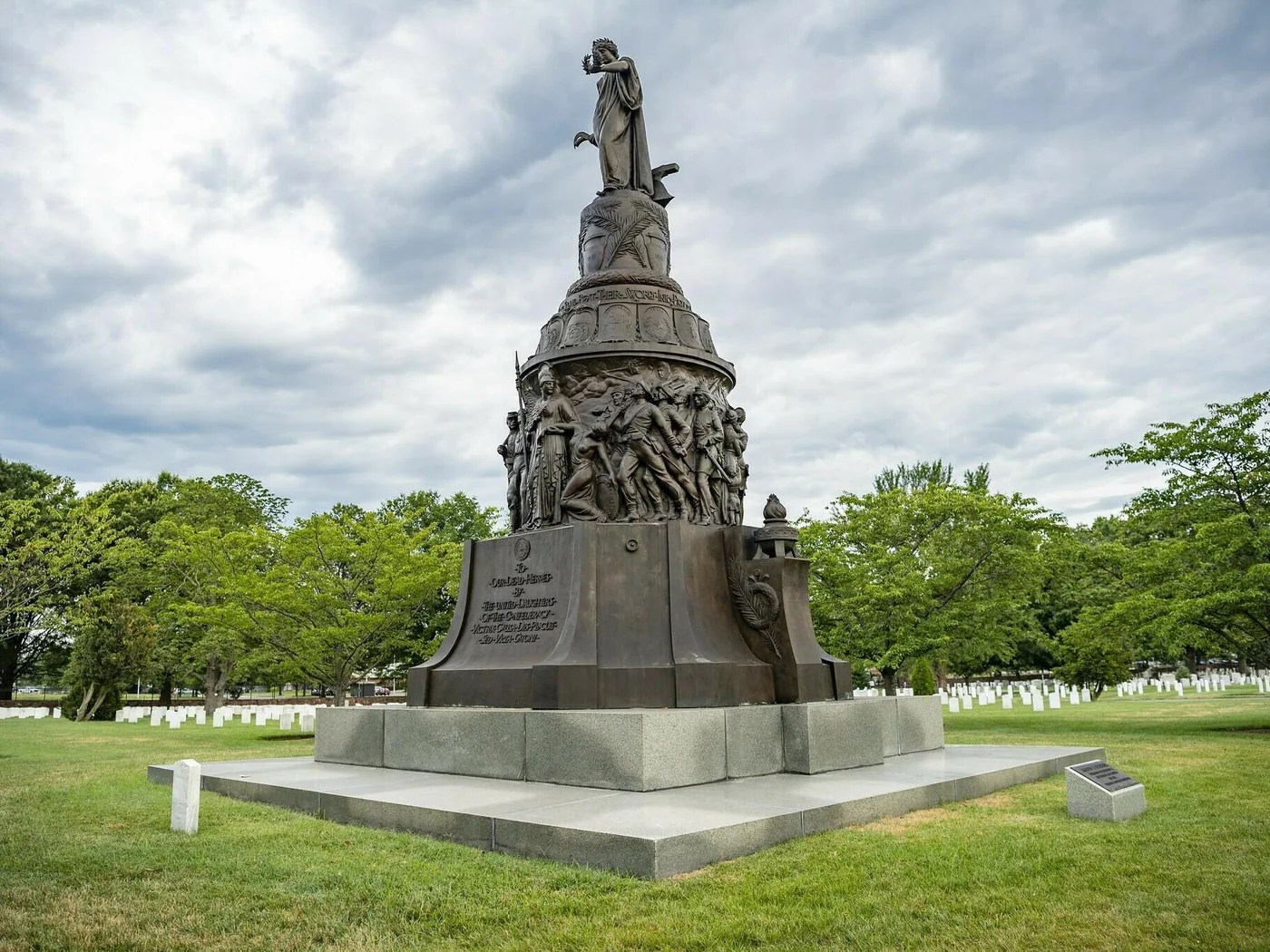

Now that it is in the open, the covert bond between Putin and Trump, this question begs to be asked…..How long has Putin admired, and secretly promoted, the rise of the Treacherous South? Does he compare his war with Ukraine, to the Neo-Confederate cause? Is he pleased about the rise of the White Evengelical Racist Leaders – who did not condemn the illegal warn on Iran, that was instigated by the Zionist cause of Netanyahu – who were right with Putin, and never condemned his invasion of Ukraine. Has Israel prospered in arm sales?
I stumped Google by asking how many Democrat Governors have there been in the Traditional Southern States? Neo-Confederates make memes that show them as….
THE PARTY OF LINCOLN
The Crazed Secretary of War understand there was a Cold War, and does he know the reasons – there was a Civil War? What year was this statue made? I want it melted down, because it is the symbol of Putin’s Evil Scheme to be sure the U.S.A. remains…..
DIVIDED AND UNRESOLVED!
John Presco

The Southern United States as defined by the Census Bureau
Russian President Vladimir Putin does not typically frame himself as an active “destroyer” of the United States. Instead, he and Russian officials have frequently argued that the U.S. political and economic system is leading to its own decline from within, while also warning of Russia’s strategic and nuclear capabilities.
Political Use of History: Putin is trained in law and comes from a KGB and political background rather than an academic historical discipline. However, he regularly uses selective historical narratives—ranging from the American Revolution and the Civil War to atomic bombings and civil rights struggles—to make political points. [1, 2, 3, 4, 5]
Louisiana has had 36 governors from the Democratic Party throughout its history. [1]
Army finalizes plans to return Confederate statue to Arlington National Cemetery
The Confederate Memorial was removed from the military burial grounds in 2023.
October 16, 2026
2 min350
The Confederate Memorial at Arlington National Cemetery in December 2023, in Arlington, Virginia. (Bonnie Jo Mount/The Washington Post)
Chevron right
2 min350More article actions

By Joe Heim
The Trump administration has moved forward with its effort to return a controversial Confederate statue to Arlington National Cemetery next year.
The Office of Army Cemeteries submitted final plans to the U.S. Commission of Fine Arts on Thursday to return the Confederate Memorial to a small section of the cemetery where more than 400 Confederate soldiers were reinterred in the early 1900s.
 Get concise answers to your questions. Try Ask The Post AI.
The Confederate Memorial, a 32-foot bronze statue designed by sculptor Moses Ezekiel, a Confederate veteran and the first Jewish graduate of the Virginia Military Institute, was commissioned by the United Daughters of the Confederacy. It was unveiled in 1914 at a ceremony presided over by President Woodrow Wilson.
The statue was removed from the cemetery in 2023 as part of a congressional mandate to rid U.S. military property of names and symbols honoring the Confederacy. Critics said elements of the memorial glossed over the horrors of slavery and romanticized the pre-Civil War South. Ask The Post AIDive deeper
Defense Secretary Pete Hegseth announced last year the statue would return to Arlington. “It never should have been taken down by woke lemmings,” Hegseth posted on X in August 2025. “Unlike the Left, we don’t believe in erasing American history — we honor it.”
Which States Have Democratic Governors in 2026?
March 14, 2026 | MultiState

/
/
•••
Key Takeaways:
- Democrats hold 24 governorships heading into 2026, compared to 26 for Republicans, which is the closest partisan split in recent years.
- Of the 36 gubernatorial elections in 2026, 18 seats are currently held by Democrats, meaning nearly every Democratic governorship is on the ballot this cycle.
- Six Democratic governors are term-limited and cannot run again in 2026: California, Colorado, Kansas, Maine, Michigan, and New Mexico.
- Two Democratic-held governorships are rated as toss-ups by Cook Political Report as of March 2026: Michigan and Wisconsin, both highly competitive battleground states where trifecta control is also on the line. Arizona, initially rated a toss-up, has moved to Lean Democrat.
- Trifecta control is on the line in multiple states; going into 2026 there are 16 Democratic trifectas and 23 Republican trifectas nationally.
Democrats currently hold 24 governorships heading into 2026, a nearly even split with Republicans, who hold 26. With 36 gubernatorial elections on the ballot this November and trifecta control on the line in multiple states, the partisan makeup of governor’s offices is set to shift.
How Many States Have Democratic Governors in 2026?
Twenty-four states have Democratic governors. That’s up by one from 2025, following the 2025 elections in New Jersey and Virginia. New Jersey Democrats retained control with the victory of then-U.S. Rep. Mikie Sherrill (D), and the Virginia governor’s office flipped from Republican to Democrat after a win by former U.S. Rep. Abigail Spanberger (D).

For a full state-by-state breakdown and downloadable map, see our 2026 Governors resource.
Which Democratic Governors Are Up for Election in 2026?
Incumbents and Term-Limits
Of the 36 gubernatorial elections in 2026, 18 seats are currently held by Democrats. That means nearly every Democratic governorship is on the ballot this cycle. Six of those 18 Democratic governors are term-limited and cannot run again, creating open seat races that are historically more competitive.
The six states where Democratic governors are term-limited in 2026 are California, Colorado, Kansas, Maine, Michigan, and New Mexico. Of these, Kansas and Michigan are the most closely watched. Kansas has been a perennial competitive race, and Michigan is a top-tier battleground where trifecta control is at stake.
Which Democratic Governor Races Are Most Competitive?
According to Cook Political Report ratings as of March 2026, two Democratic-held governorships are rated toss-ups: Michigan and Wisconsin. Arizona, initially rated a toss-up, has since moved to Lean Democrat as the race has developed. Each of these states remains a closely watched battleground heading into November.
What makes these races particularly significant is that trifecta control is on the line in each of them. A trifecta, when one party controls the governorship and both chambers of the state legislature, dramatically expands a party’s ability to move legislation without compromise. Going into 2026, there are 16 Democratic trifectas and 23 Republican trifectas nationally.
Track every governor’s race and the trifecta implications in 2026. MultiState’s resources give you the full picture of partisan control across all 50 states, updated as the cycle evolves. 2026 Governors: Partisan Breakdown & Map → | 2026 State Government Trifectas → | 2026 Governors and Legislatures →

When a state flips from one party to the other, the policy environment can shift quickly. States where a trifecta is newly established often see accelerated legislative activity in the first year of the new administration.
Track Elections and Other Political Activity
Federal and state elections can have significant policy and regulatory implications for businesses and organizations. If your organization would like to further track federal and state elections, please contact us.
 | Alexandre Mouton (1804–1885) [65][66] | January 30, 1843[67] – February 12, 1846 (1110 days; term-limited)[e] | Democratic[68] | 1842[i] | ||||
| 12 |  | Isaac Johnson (1803–1853) [70][71] | February 12, 1846[72] – January 28, 1850 (1447 days; term-limited)[j] | Democratic[68] | 1846 | Trasimond Landry | ||
|---|---|---|---|---|---|---|---|---|
| 13 |  | Joseph Marshall Walker (1784–1856) [74][75] | January 28, 1850[76] – January 20, 1853 (1089 days; term-limited)[k][l] | Democratic[80] | 1849[m] | Jean Baptiste Plauché | ||
| 14 |  | Paul Octave Hébert (1818–1880) [82][83] | January 20, 1853[79] – January 28, 1856 (1104 days; term-limited)[k] | Democratic[80] | 1852 | William Wood Farmer (died October 29, 1854) | ||
| Robert C. Wickliffe | ||||||||
| 15 |  | Robert C. Wickliffe (1819–1895) [84][85] | January 28, 1856[86] – January 23, 1860 (1457 days; term-limited)[k] | Democratic[87] | 1855 | Charles Homer Mouton (resigned 1856) | ||
| William F. Griffin | ||||||||
| 16 |  | Thomas Overton Moore (1804–1876) [88][89] | January 23, 1860[90] – January 25, 1864 (1464 days; term-limited)[n] | Democratic[87] | 1859[o] | Henry M. Hyams | ||
| 17 |  | George Foster Shepley (1819–1878) [92][93] | July 2, 1862[37] – March 4, 1864 (612 days; civil government reestablished) | Military governor[o][p] | Vacant | |||
| 18 |  | Henry Watkins Allen (1820–1866) [94][95] | January 25, 1864[96] – June 2, 1865 (495 days; resigned)[q] | Democratic[97] | 1863 (Confederate)[o] | Benjamin W. Pearce | ||
| 19 |  | Michael Hahn (1830–1886) [98][99] | March 4, 1864[100] – March 4, 1865 (366 days; resigned)[r] | Union Free Trade (Republican)[101] | 1864 (Union)[o] | James Madison Wells | ||
| 20 |  | James Madison Wells (1808–1899) [102][103] | March 4, 1865[104] – June 3, 1867 (822 days; removed)[s] | Citizens Ticket[101] | Lieutenant governor acting | Vacant | ||
| 1865[o] | Albert Voorhies | |||||||
| 21 |  | Benjamin Flanders (1816–1896) [105][106] | June 6, 1867[t] – January 2, 1868 (211 days; resigned)[u] | Appointed by military occupation[109] | Vacant | |||
| 22 |  | Joshua Baker (1799–1885) [110][111] | January 2, 1868[v] – June 27, 1868 (178 days; removed)[w] | Appointed by military occupation[109] | ||||
| 23 |  | Henry Clay Warmoth (1842–1931) [114][115] | June 27, 1868[x] – December 9, 1872 (1627 days; removed)[y] | Appointed by military occupation[109][113] | ||||
| Republican[109] | 1868 | Oscar Dunn (died November 22, 1871) | ||||||
| Vacant | ||||||||
| P. B. S. Pinchback (appointed December 6, 1871) | ||||||||
| 24 |  | P. B. S. Pinchback (1837–1921) [117][118] | December 9, 1872[119] – January 13, 1873 (36 days; retired)[z] | Republican[109] | Lieutenant governor acting | Vacant | ||
| 25 |  | John McEnery (1833–1891) [120] | January 13, 1873[121] – May 22, 1873 (130 days; removed)[aa] | Democratic[ab] | 1872[aa] | Davidson Bradfute Penn | ||
| 26 |  | William Pitt Kellogg (1830–1918) [124][125] | January 13, 1873[121] – January 8, 1877 (1457 days; retired)[ac] | Republican[109] | C. C. Antoine | |||
| 27 |  | Stephen B. Packard (1839–1922) | January 8, 1877[126] – April 25, 1877 (108 days; removed)[ad] | Republican[101] | 1876[ad][ae] | |||
| 28 |  | Francis T. Nicholls (1834–1912) [129][130] | January 8, 1877[126] – January 14, 1880 (1102 days; retired) | Democratic[101] | Louis A. Wiltz | |||
| 29 |  | Louis A. Wiltz (1843–1881) [131][132] | January 14, 1880[133] – October 16, 1881 (642 days; died in office) | Democratic[109] | 1879 | Samuel D. McEnery | ||
| 30 |  | Samuel D. McEnery (1837–1910) [134][135] | October 16, 1881[136] – May 21, 1888 (2410 days; lost nomination)[137] | Democratic[109] | Lieutenant governor acting | William A. Robertson (removed December 24, 1881) | ||
| George L. Walton | ||||||||
| 1884 | Clay Knobloch | |||||||
| 28 | | Francis T. Nicholls (1834–1912) [129][130] | May 21, 1888[138] – May 16, 1892 (1457 days; retired) | Democratic[109] | 1888 | James Jeffries | ||
| 31 |  | Murphy J. Foster (1849–1921) [139][140] | May 16, 1892[141] – May 21, 1900 (2927 days; term-limited)[af] | Anti-Lottery Democratic[142] | 1892 | Charles Parlange (resigned December 11, 1893) | ||
| Hiram R. Lott (died June 2, 1895) | ||||||||
| Robert H. Snyder | ||||||||
| 1896 | ||||||||
| 32 |  | William Wright Heard (1853–1926) [143][144] | May 21, 1900[145] – May 16, 1904 (1457 days; term-limited)[af] | Democratic[109] | 1900 | Albert Estopinal | ||
| 33 |  | Newton C. Blanchard (1849–1922) [146][147] | May 16, 1904[148] – May 18, 1908 (1464 days; term-limited)[af] | Democratic[109] | 1904 | Jared Y. Sanders Sr. | ||
| 34 |  | Jared Y. Sanders Sr. (1869–1944) [149][150] | May 18, 1908[151] – May 20, 1912 (1464 days; term-limited)[af] | Democratic[109] | 1908 | Paul M. Lambremont | ||
| 35 |  | Luther E. Hall (1869–1921) [152][153] | May 20, 1912[154] – May 15, 1916 (1457 days; term-limited)[ag] | Democratic[109] | 1912 | Thomas C. Barret | ||
| 36 |  | Ruffin G. Pleasant (1871–1937) [155][156] | May 15, 1916[157] – May 17, 1920 (1464 days; term-limited)[ag] | Democratic[109] | 1916 | Fernand Mouton | ||
| 37 |  | John M. Parker (1863–1939) [158][159] | May 17, 1920[160] – May 19, 1924 (1464 days; term-limited)[ah] | Democratic[101] | 1920 | Hewitt Bouanchaud (resigned April 12, 1924) | ||
| Delos R. Johnson | ||||||||
| 38 |  | Henry L. Fuqua (1865–1926) [162][163] | May 19, 1924[164] – October 11, 1926 (876 days; died in office) | Democratic[109] | 1924 | Oramel Simpson | ||
| 39 |  | Oramel Simpson (1870–1932) [165][166] | October 11, 1926[167] – May 21, 1928 (589 days; lost nomination)[168] | Democratic[109] | Succeeded from lieutenant governor | Philip H. Gilbert | ||
| 40 |  | Huey Long (1893–1935) [169][170] | May 21, 1928[171] – January 25, 1932 (1345 days; resigned)[ai] | Democratic[109] | 1928 | Paul N. Cyr (removed March 4, 1931)[ai] | ||
| Alvin Olin King | ||||||||
| 41 |  | Alvin Olin King (1890–1958) [173][172] | January 25, 1932[174] – May 16, 1932 (113 days; retired) | Democratic[109] | Succeeded from lieutenant governor | Vacant | ||
| 42 |  | Oscar K. Allen (1882–1936) [175][176] | May 16, 1932[177] – January 28, 1936 (1353 days; died in office) | Democratic[109] | 1932 | John B. Fournet (resigned January 2, 1935) | ||
| James A. Noe | ||||||||
| 43 |  | James A. Noe (1890–1976) [178][179] | January 28, 1936[180] – May 12, 1936 (106 days; retired)[aj] | Democratic[109] | Succeeded from lieutenant governor | Vacant | ||
| 44 |  | Richard W. Leche (1898–1965) [182][183] | May 12, 1936[184] – June 26, 1939 (1141 days; resigned)[ak] | Democratic[109] | 1936 | Earl Long | ||
| 45 |  | Earl Long (1895–1960) [186][187] | June 26, 1939[188] – May 14, 1940 (324 days; lost nomination)[185] | Democratic[109] | Succeeded from lieutenant governor | Coleman Lindsey | ||
| 46 |  | Sam H. Jones (1897–1978) [189][190] | May 14, 1940[191] – May 9, 1944 (1457 days; term-limited)[ah] | Democratic[109] | 1940 | Marc M. Mouton | ||
| 47 |  | Jimmie Davis (1899–2000) [192][193] | May 9, 1944[194] – May 11, 1948 (1464 days; term-limited)[ah] | Democratic[109] | 1944 | J. Emile Verret | ||
| 45 |  | Earl Long (1895–1960) [186][187] | May 11, 1948[195] – May 13, 1952 (1464 days; term-limited)[ah] | Democratic[109] | 1948 | Bill Dodd | ||
| 48 |  | Robert F. Kennon (1902–1988) [196][197] | May 13, 1952[198] – May 15, 1956 (1464 days; term-limited)[ah] | Democratic[109] | 1952 | C. E. Barham | ||
| 45 | | Earl Long (1895–1960) [186][187] | May 15, 1956[199] – May 10, 1960 (1457 days; term-limited)[ah] | Democratic[109] | 1956 | Lether Edward Frazar | ||
| 47 | | Jimmie Davis (1899–2000) [192][193] | May 10, 1960[200] – May 12, 1964 (1464 days; term-limited)[ah] | Democratic[109] | 1960 | Taddy Aycock | ||
| 49 |  | John McKeithen (1918–1999) [201][202] | May 12, 1964[203] – May 9, 1972 (2920 days; term-limited)[al] | Democratic[109] | 1964 | |||
| 1968 | ||||||||
| 50 |  | Edwin Edwards (1927–2021) [205][206] | May 9, 1972[207] – March 10, 1980 (2863 days; term-limited)[am] | Democratic[109] | 1972 | Jimmy Fitzmorris | ||
| 1975 | ||||||||
| 51 |  | Dave Treen (1928–2009) [208] | March 10, 1980[209] – March 12, 1984 (1464 days; lost election) | Republican | 1979 | Robert Louis Freeman Sr.[an] | ||
| 50 |  | Edwin Edwards (1927–2021) [210][206] | March 12, 1984[211] – March 14, 1988 (1464 days; withdrew)[ao] | Democratic | 1983 | |||
| 52 |  | Buddy Roemer (1943–2021) [212][213] | March 14, 1988[214] – January 13, 1992 (1401 days; lost election) | Democratic[ap] | 1987 | Paul Hardy[aq] | ||
| 50 | | Edwin Edwards (1927–2021) [205][210][206] | January 13, 1992[215] – January 8, 1996 (1457 days; retired) | Democratic | 1991 | Melinda Schwegmann | ||
| 53 |  | Mike Foster (1930–2020) [216] | January 8, 1996[217] – January 12, 2004 (2927 days; term-limited)[am] | Republican | 1995 | Kathleen Blanco | ||
| 1999 | ||||||||
| 54 |  | Kathleen Blanco (1942–2019) [218] | January 12, 2004[219] – January 14, 2008 (1464 days; retired) | Democratic | 2003 | Mitch Landrieu[an] (resigned May 3, 2010) | ||
| 55 |  | Bobby Jindal (b. 1971) [220] | January 14, 2008[221] – January 11, 2016 (2920 days; term-limited)[am] | Republican | 2007 | |||
| Scott Angelle[an] | ||||||||
| Jay Dardenne (elected November 22, 2010) | ||||||||
| 2011 | ||||||||
| 56 |  | John Bel Edwards (b. 1966) [222] | January 11, 2016[223] – January 8, 2024 (2920 days; term-limited)[am] | Democratic | 2015 | Billy Nungesser[aq] | ||
| 2019 | ||||||||
| 57 |  | Jeff Landry (b. 1970) [224] | January 8, 2024[225] – Incumbent[ar] (in office 1029 days) | Republican[225] | 2023 | |||
See also
C
Leave a Reply