
I was drafted in 1966, but did not go. I will be eighty, soon. When I die, my generation is gone. Every draftee who died in Vietnam, lost their generation. I honor those who served, and died over there. So many wondered if they died for nothing.
To see the Chinese Dictator climbing the red carpet to our National Archives, and viewing the Bill of Rights and Constitution, is the gretest insult to our Democracy, because the Chinese Generals back home knew all about our Turncoat President banning the press. Chinese propagndists and spys – had a great laugh. They knew….
THEIR GREAT LIAR WOULD WRITE THEIR PROPAGANDA FOR THEM!
I am calling for Reperations for the Black Men who lost their life in Vietnam.
- The American War LibraryVietnam War Deaths, by Race, Ethnicity and Natl Origin
- Of the 7262 blacks who died, 6, 955 or 96% were Army and Marine enlisted men.
How many Black Men joined the Armed Service because President Johnson signed….
THE VOTING RIGHTS BILL?
Christians on the Supreme Court – shat all over this Bill and handed Their King a victory in regards to ferreting out……ILLEGAL CITIZENS! LOOK! There’s the King and Queen of the Christian Nazis making the The Chinese Dictator a honorary citizen!
Seer John
“However, official records document that roughly 7,241 to 7,262 Black or African American service members (both draftees and volunteers combined) died during the Vietnam conflict, accounting for about 12.5% of total U.S. military fatalities. [1, 2]
“China provided an estimated $20 billion in total military and economic aid to North Vietnam and southern communist forces (the Viet Cong) between 1950 and 1970. Rather than going directly to southern guerrillas, this aid was funneled through Hanoi to support both the North Vietnamese Army and the Viet Cong
- Personnel: Deployment of over 300,000 Chinese support troops—including engineering and anti-aircraft units—to North Vietnam to maintain logistics and free up regular Vietnamese soldiers for combat. [1]
Overview of Casualties by Race
- Total Black military deaths: ~7,241 (approx. 12.5% of total U.S. deaths).
- Total U.S. military deaths: ~58,202.
- Total Black service members who served in-country: ~275,000 (approx. 10.6% of forces in Vietnam). [1]
Draftees vs. Volunteers Context
- Draftees overall (all races combined) accounted for 17,725 (30.4%) of combat deaths in Vietnam.
- Historical and sociological studies (such as works by Charles Moskos and John Sibley Butler) note that while Black Americans experienced high exposure to combat roles early in the escalation (particularly in 1965), the overall proportion of Black fatalities across the entire war closely matched their representation in the U.S. military-age population. [1]
If you would like to explore specific branch data or further details on Selective Service policies during the Vietnam War, let me know.
“The event was magnificent — Actually made for Television but, because they’re Fake News, and because they knew how good it would be, they didn’t want credit to be given to ‘TRUMP,’ they refused to be there,” he continued.
The president’s move to bar the two networks plus Politico from the White House last weekend prompted the TV pool, a rotating group of journalists from each of the major networks, to refrain from covering the president’s daily activities.
The American War LibraryVietnam War Deaths, by Race, Ethnicity and Natl Origin
- Of the 7262 blacks who died, 6, 955 or 96% were Army and Marine enlisted men.
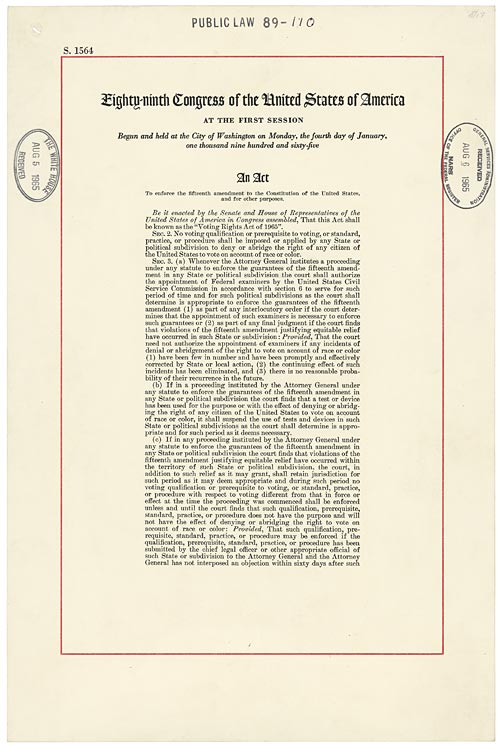
- Voting Rights Act (1965)

- EnlargeDownload Link
- Citation: An act to enforce the fifteenth amendment to the Constitution of the United States and for other purposes, August 6, 1965; Enrolled Acts and Resolutions of Congress, 1789-; General Records of the United States Government; Record Group 11; National Archives
- View All Pages in the National Archives Catalog
- View Transcript
- This act was signed into law on August 6, 1965, by President Lyndon Johnson. It outlawed the discriminatory voting practices adopted in many southern states after the Civil War, including literacy tests as a prerequisite to voting.
- This “act to enforce the fifteenth amendment to the Constitution” was signed into law 95 years after the amendment was ratified. In those years, African Americans in the South faced tremendous obstacles to voting, including poll taxes, literacy tests, and other bureaucratic restrictions to deny them the right to vote. They also risked harassment, intimidation, economic reprisals, and physical violence when they tried to register or vote. As a result, African-American voter registration was limited, along with political power.
The Bill of Rights: A Transcription
Note: The following text is a transcription of the enrolled original of the Joint Resolution of Congress proposing the Bill of Rights, which is on permanent display in the Rotunda at the National Archives Museum. The spelling and punctuation reflects the original.
On September 25, 1789, the First Congress of the United States proposed 12 amendments to the Constitution. The 1789 Joint Resolution of Congress proposing the amendments is on display in the Rotunda in the National Archives Museum. Ten of the proposed 12 amendments were ratified by three-fourths of the state legislatures on December 15, 1791. The ratified Articles (Articles 3–12) constitute the first 10 amendments of the Constitution, or the U.S. Bill of Rights. In 1992, 203 years after it was proposed, Article 2 was ratified as the 27th Amendment to the Constitution. Article 1 was never ratified.
Transcription of the 1789 Joint Resolution of Congress Proposing 12 Amendments to the U.S. Constitution
Congress of the United States begun and held at the City of New-York, on Wednesday the fourth of March, one thousand seven hundred and eighty nine.
THE Conventions of a number of the States, having at the time of their adopting the Constitution, expressed a desire, in order to prevent misconstruction or abuse of its powers, that further declaratory and restrictive clauses should be added: And as extending the ground of public confidence in the Government, will best ensure the beneficent ends of its institution.
RESOLVED by the Senate and House of Representatives of the United States of America, in Congress assembled, two thirds of both Houses concurring, that the following Articles be proposed to the Legislatures of the several States, as amendments to the Constitution of the United States, all, or any of which Articles, when ratified by three fourths of the said Legislatures, to be valid to all intents and purposes, as part of the said Constitution; viz.
ARTICLES in addition to, and Amendment of the Constitution of the United States of America, proposed by Congress, and ratified by the Legislatures of the several States, pursuant to the fifth Article of the original Constitution.
Article the first… After the first enumeration required by the first article of the Constitution, there shall be one Representative for every thirty thousand, until the number shall amount to one hundred, after which the proportion shall be so regulated by Congress, that there shall be not less than one hundred Representatives, nor less than one Representative for every forty thousand persons, until the number of Representatives shall amount to two hundred; after which the proportion shall be so regulated by Congress, that there shall not be less than two hundred Representatives, nor more than one Representative for every fifty thousand persons.
Article the second… No law, varying the compensation for the services of the Senators and Representatives, shall take effect, until an election of Representatives shall have intervened.
Article the third… Congress shall make no law respecting an establishment of religion, or prohibiting the free exercise thereof; or abridging the freedom of speech, or of the press; or the right of the people peaceably to assemble, and to petition the Government for a redress of grievances.
Article the fourth… A well regulated Militia, being necessary to the security of a free State, the right of the people to keep and bear Arms, shall not be infringed.
Article the fifth… No Soldier shall, in time of peace be quartered in any house, without the consent of the Owner, nor in time of war, but in a manner to be prescribed by law.
Article the sixth… The right of the people to be secure in their persons, houses, papers, and effects, against unreasonable searches and seizures, shall not be violated, and no Warrants shall issue, but upon probable cause, supported by Oath or affirmation, and particularly describing the place to be searched, and the persons or things to be seized.
Article the seventh… No person shall be held to answer for a capital, or otherwise infamous crime, unless on a presentment or indictment of a Grand Jury, except in cases arising in the land or naval forces, or in the Militia, when in actual service in time of War or public danger; nor shall any person be subject for the same offence to be twice put in jeopardy of life or limb; nor shall be compelled in any criminal case to be a witness against himself, nor be deprived of life, liberty, or property, without due process of law; nor shall private property be taken for public use, without just compensation.
Article the eighth… In all criminal prosecutions, the accused shall enjoy the right to a speedy and public trial, by an impartial jury of the State and district wherein the crime shall have been committed, which district shall have been previously ascertained by law, and to be informed of the nature and cause of the accusation; to be confronted with the witnesses against him; to have compulsory process for obtaining witnesses in his favor, and to have the Assistance of Counsel for his defence.
Article the ninth… In suits at common law, where the value in controversy shall exceed twenty dollars, the right of trial by jury shall be preserved, and no fact tried by a jury, shall be otherwise re-examined in any Court of the United States, than according to the rules of the common law.
Article the tenth… Excessive bail shall not be required, nor excessive fines imposed, nor cruel and unusual punishments inflicted.
Article the eleventh… The enumeration in the Constitution, of certain rights, shall not be construed to deny or disparage others retained by the people.
Article the twelfth… The powers not delegated to the United States by the Constitution, nor prohibited by it to the States, are reserved to the States respectively, or to the people.
ATTEST,
Frederick Augustus Muhlenberg, Speaker of the House of Representatives
John Adams, Vice-President of the United States, and President of the Senate
John Beckley, Clerk of the House of Representatives.
Sam. A Otis Secretary of the Senate
The U.S. Bill of Rights
Note: The following text is a transcription of the first ten amendments to the Constitution in their original form. These amendments were ratified December 15, 1791, and form what is known as the “Bill of Rights.”
Amendment I
Congress shall make no law respecting an establishment of religion, or prohibiting the free exercise thereof; or abridging the freedom of speech, or of the press; or the right of the people peaceably to assemble, and to petition the Government for a redress of grievances.
Amendment II
A well regulated Militia, being necessary to the security of a free State, the right of the people to keep and bear Arms, shall not be infringed.
Amendment III
No Soldier shall, in time of peace be quartered in any house, without the consent of the Owner, nor in time of war, but in a manner to be prescribed by law.
Amendment IV
The right of the people to be secure in their persons, houses, papers, and effects, against unreasonable searches and seizures, shall not be violated, and no Warrants shall issue, but upon probable cause, supported by Oath or affirmation, and particularly describing the place to be searched, and the persons or things to be seized.
Amendment V
No person shall be held to answer for a capital, or otherwise infamous crime, unless on a presentment or indictment of a Grand Jury, except in cases arising in the land or naval forces, or in the Militia, when in actual service in time of War or public danger; nor shall any person be subject for the same offence to be twice put in jeopardy of life or limb; nor shall be compelled in any criminal case to be a witness against himself, nor be deprived of life, liberty, or property, without due process of law; nor shall private property be taken for public use, without just compensation.
Amendment VI
In all criminal prosecutions, the accused shall enjoy the right to a speedy and public trial, by an impartial jury of the State and district wherein the crime shall have been committed, which district shall have been previously ascertained by law, and to be informed of the nature and cause of the accusation; to be confronted with the witnesses against him; to have compulsory process for obtaining witnesses in his favor, and to have the Assistance of Counsel for his defence.
Amendment VII
In Suits at common law, where the value in controversy shall exceed twenty dollars, the right of trial by jury shall be preserved, and no fact tried by a jury, shall be otherwise re-examined in any Court of the United States, than according to the rules of the common law.
Amendment VIII
Excessive bail shall not be required, nor excessive fines imposed, nor cruel and unusual punishments inflicted.
Amendment IX
The enumeration in the Constitution, of certain rights, shall not be construed to deny or disparage others retained by the people.
Amendment X
The powers not delegated to the United States by the Constitution, nor prohibited by it to the States, are reserved to the States respectively, or to the people.
Leave a Reply