

Starfish: Nordic Shaman of the Shasta Tribe of Saint Nicholas of the Holy Northern Lights.
The Royal Janitor
by
John Presco
ALL RIGHTS RESERVED
Lloyd’s boss warns of ‘man-made catastrophes’ as Iran war hits insurance industry
“WERE FUCKED!” shouted Clive de Rougemont of Lloyds of London. Who saw this coming? Why didn’t you see this was going to happen, Victoria? ” Clive was scowling down on Rosemond Bond from the giant screen in the living room of the Eugene House.
“Well, she had these dreams about a fleet of ships in the area. They were on a Crusade!” offered Starfish, then studied how Clive suppressed a “shut-up!”. Locked In serious eye contact, Clive calmly spoke to Ms. Christling for the first time. He refused to believe his top agent, and distant relative, married a….
WILD CHRISTIAN BARBARIAN
“I read your report on the Vice President, and Secretary of War. Do you still believe they are….
DANGEROUS CHRISTIAN LUNATICS?”
“yES! I believe these Americans are planning for the War of Armageggon, They want the End Times to happen…..
SO JESUS WILL COME!”
“Oh! God!” Clive painfully crieD, and buried his head in hands.
“How can Lloyds insure that!” he pitifully asked his Secret Agents.
“They are backed by Crazy Knight Templars – who want to rent cruise ships.”
“Is this the offer Netanyahu made in order to get TRuMP to invade Iran?”
“I think TRUMP was jealous of Llyods, and wanted to turn it into a…
TRUMP FAMILY BUSINESS!”
“Consider his desire to own the Panama Canal!”
“And the……..Saint Lawrence Seaway?”
“OH GOD! WE ARE SO FUCKED!”
“You might want to see – this! ” Victoria added.
“Holy shit! Of God!”
“It is difficult to be in the prediction game. You just got to be in the prepared game,” he said.
Lloyd’s reported on Thursday that it took a 16.7 per cent hit to its pre-tax profit of £3.5bn for the first six months of 2026. Its core business improved, with the market reporting an underwriting result of £1.9bn, up from £1.5bn.
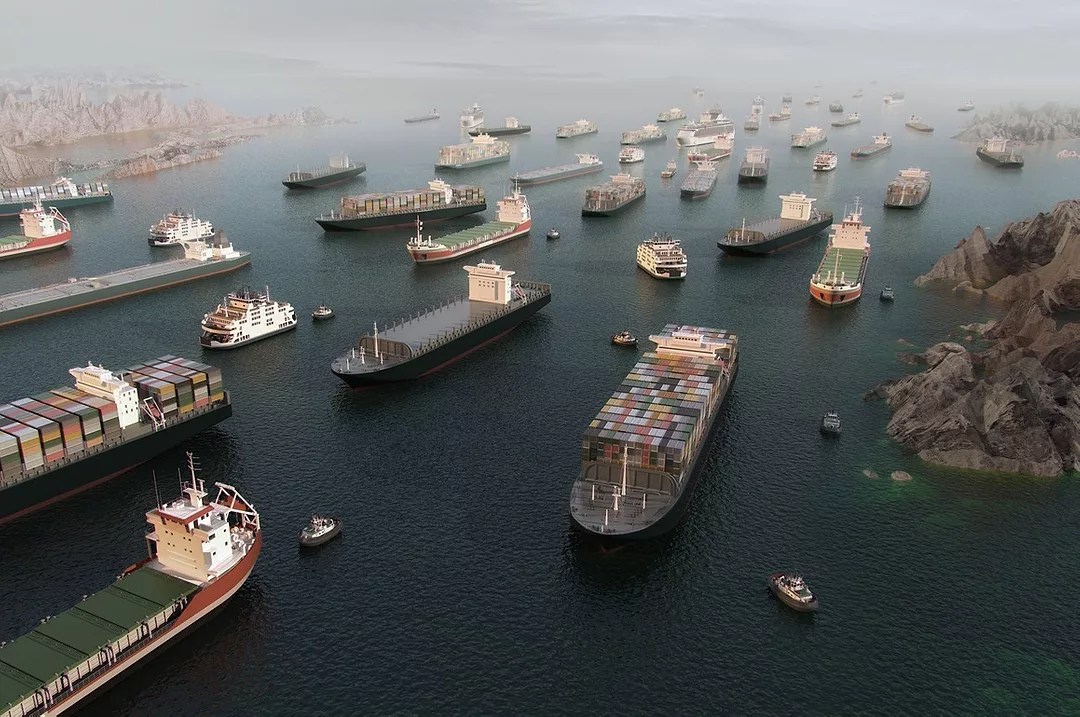
The US has launched a $20bn government-backed reinsurance facility to keep commercial shipping moving through the Strait of Hormuz after US–Israeli strikes on Iran, but details on eligibility still unclear
JD Vance Says He’s OK With Bringing About the End Times
The vice president gave a bizarre interview with an evangelist podcaster.

Nic Antaya/Getty Images
Vice President JD Vance isn’t sure if we’re living in the “end times,” but he’s not afraid to bring them about, either.
In a sit-down interview with 22-year-old evangelist podcaster Bryce Crawford, Vance said that he’s “OK” if his work on earth brings about a biblical doomsday event.
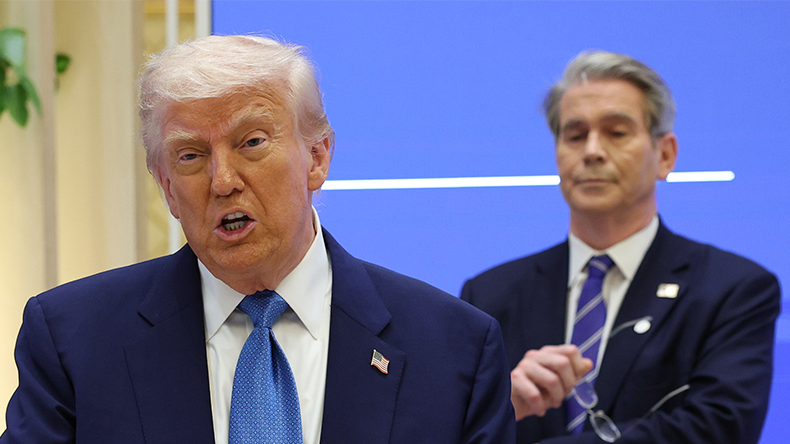
Source: Win McNamee / Getty ImagesUS Treasury Secretary Scott Bessent has launched a plan approved by president Trump to deploy maritime reinsurance, including war risk, in the MEG region.
THE US government has unveiled initial details of its $20bn reinsurance facility aimed at restarting shipping through the Strait of Hormuz following the American and Israeli strikes on Iran.
The US Development Finance Corporation announced on Friday that its facility would be insuring losses up to about $20bn “on a rolling basis” and will apply only to vessels “that meet the criteria”, according to a statement.
Details of what that criteria entails were not immediately available.
DFC chief executive Ben Black and US Treasury Secretary Scott Bessent launched the facility, following a directive from US President Donald Trump to create a political risk insurance and financial security mechanism to ensure free energy flows. Trump also said the US Navy would escort tankers through the Strait “if necessary”, however no further details of that plan have been unveiled.
“DFC and Treasury are coordinating closely with CENTCOM on next steps in the implementation of this plan,” the development agency said, referring to the US military’s central command.
The DFC said it has identified “best-in-class, preferred American insurance partners”.
The DFC plan was ordered by Trump after some governments, including the US, had suggested insurance availability was blocking transit. However insurance has continued to be provided by the market, albeit at significantly increased rates.
The Lloyd’s Market Association said on Thursday following meetings with US government representatives, that it welcomed the DFCs intention to “support the movement of non-sanctioned vessels and their commodities through the Strait of Hormuz in order to facilitate global trade and economic stability”.
However, the LMA also noted that “it is important to note that the vast majority of these vessels are insured in the London market and for those vessels, insurance currently remains in place”.
While Lloyd’s List understands that insurers have expressed interest in partnering with DFC to offer the reinsurance, details on Saturday remained unclear.
DFC, the US government’s international investment arm, said it will closely coordinate with Central Command, which runs American military operations in the Middle East.
“Working alongside Centcom, DFC coverage will offer a level of security no other policy can provide,” Black said. “We are confident that our reinsurance plan will get oil, gasoline, [liquefied natural gas], jet fuel and fertiliser through the Strait of Hormuz and flowing again to the world.”
Brent crude rose above $92 a barrel on Friday, its highest level since the start of the war.
Separately, Bessent said the US may lift sanctions on further Russian oil supply after a move Thursday to give Indian refiners the green light to purchase crude from the nation.
“Treasury agreed to let our allies in India start buying Russian oil that was already on the water,” Bessent said in an interview with Fox Business Friday. “To ease the temporary gap of oil around the world, we have given them permission to accept the Russian oil. We may unsanction other Russian oil.”
Bessent said there’s “hundreds of millions of sanctioned barrels” of crude on the water now. “In essence, by unsanctioning them, treasury can create supply,” he said.
Lloyd’s boss warns of ‘man-made catastrophes’ as Iran war hits insurance industry

Professional Services EditorShare
Add as a preferredsource on Google
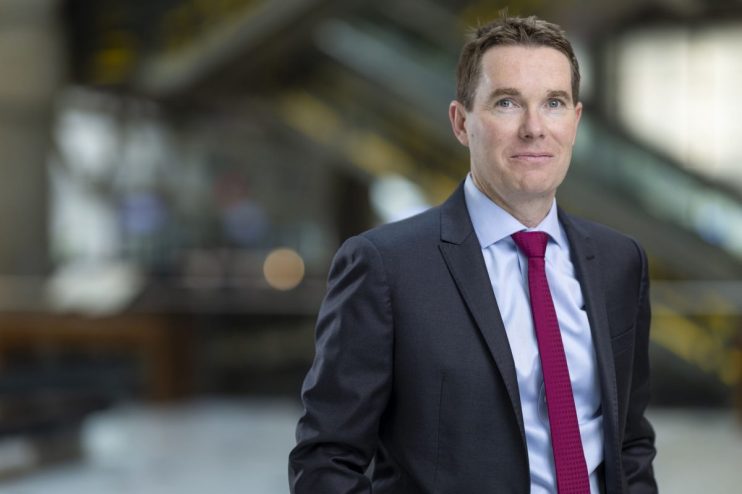
Squeezed by inflation and rising geopolitical tensions, the historic insurance market Lloyd’s of London suffered a hit to its profit in the first half of the year. Nowhere was this impact more acute than in its marine business, which faced severe pressure at the height of the US war with Iran.
Over the past six months, the world’s largest insurance market has navigated a rapidly evolving and increasingly volatile global landscape, driven largely by conflict in the Middle East. The marine sector faced severe pressure, with reports of thousands of vessels trapped in the Persian Gulf at the height of the US war with Iran.
The Strait of Hormuz closure and strikes on vessels in the waterway forced the London Joint War Committee, a group of marine insurance experts run by the Lloyd’s Market Association (LMA) alongside the International Underwriting Association (IUA), to expand its designated high-risk areas to include the coastlines of Bahrain, Qatar, and Oman, prompting a sharp rise in premiums as insurers priced in the risk of attack.
In June, Lloyd’s had to step in to ensure ships could access cover in the Strait with a $400m (£316m) war-risk facility.
Speaking to City AM, chief executive Patrick Tiernan argued that every major risk is now “disorderly at the same time” and the industry must move from trying to predict specific risks to being prepared for all eventualities.
News Updates
Stay ahead with our three daily briefings delivering all the key market moves, top business and political stories, and incisive analysis straight to your inbox.
“Last year we were talking about natural catastrophes, but this year, we’re talking about man‑made catastrophes,” he added.
Because the threats are so deeply interconnected, he said the industry can no longer rely solely on traditional probability models that try to predict specific disaster scenarios. The strategy must shift from predicting what will happen to being broadly prepared for anything that could happen, he said.
Read more
FTSE 100 Beazley profit plunges as war roils insurance market
“It is difficult to be in the prediction game. You just got to be in the prepared game,” he said.
Lloyd’s reported on Thursday that it took a 16.7 per cent hit to its pre-tax profit of £3.5bn for the first six months of 2026. Its core business improved, with the market reporting an underwriting result of £1.9bn, up from £1.5bn.
Navigating the soft market
The insurance market is in a softening cycle, Tiernan said. “We’re very cognizant of the fact that we are in a period where there is softening in the underlying prices”, he said, adding that the board is closely monitoring the underlying business to ensure it continues hitting its targets.
When an insurance market softens, it is driven by abundant capital and high insurer profits from previous hard-market cycles, but this reduces premium rates and compresses profit margins for insurers.
Tiernan said: “We’re seeing those who are here already doing more business with us, or retaining more of their business and then we’re seeing some of those new entrants, those very high-profile insurance companies from Europe, the States, and further afield, now joining the Lloyd’s market.”
Jim Bichard, chief financial officer, told City AM: “A lot of that is because of the capital advantage which we believe is unique in Lloyd’s in terms of how much risk you can take, if you like, for every dollar of capital, and we think you can shoulder more of that risk here in Lloyd’s than you can anywhere else.”
8/9/2013
Michael John de Rougement Richardson
Michael John de Rougement Richardson had a solidly upper-class education at Harrow and then Kent School in Connecticut. Then, in 1943 he was commissioned in the Irish Guards. Though twice wounded, he became adjutant to the First Battalion, and was demobbed as a captain.
George de Rougemont: “In 1791, it travels to England where it returns visit to his established banking brothers to London.””Although it had originally operated from offices in the Palais-Royal, in 1851 the CNEP took out a lease on the Hôtel Rougemont (the residence and offices of the banker Rougemont) and transferred its head office to 14 rue Bergère.””Here, too dwell the great bankers of the rues
Laffitte and Bergère and also the merry gentlemen of private means of the chaussée d’Antin. Rothschild and Fould, Rougemont de Lowemberg and Ganneron live here. In a word, here lies the Stock Exchange, Tortoni[103] and all that is connected with or dependent on them.”
Arthur Mallet b. 1821 d. 1891 & Anna de Rougemont de La Schadau Arthur MALLET est né le 21.01.1821 à Paris. Il est lui aussi banquier. Il épouse le 04.04.1847 à Paris 1er, Sophie Denise Anna du TEMPLE de ROUGEMONT. Il décède le 12.01.1891 et Anna le 22.05.1896, tous deux à Paris.
Sir Michael Richardson
Banker who advised Thatcher on her privatisation programme, but ended his career with a lifetime ban from City
ONCE KNOWN as “Mr Privatisation”, Sir Michael Richardson flew as high as any in the City during a 50-year banking career, working for the glittering names, advising Chancellors and Prime Ministers, and himself enjoying virtually celebrity status. And then in 2001 he was banned for life from doing business in the City “in any capacity”.
When Sir Evelyn de Rothschild recruited Richardson to be managing director of the merchant bank N. M. Rothschild in 1981, the chairman of rivals S. G. Warburg said it was the worst news he had had for a year. And Richardson soon showed why. Within a couple of months Rothschild was handling its first new issue for seven years, and the bank was beginning a period of domestic and international growth.
It was a propitious moment. Margaret Thatcher was embattled in her early and massively unpopular attempts to freeze the money supply, liberalise markets and remove the union noose from the necks of business. But by the time Richardson had arranged all the hunting prints and paintings in his plushly, pinkly carpeted office at Rothschilds, victory in the Falklands had given her the electoral security to push through a programme of privatisations that even she had not dared dream of when she first entered No 10.
Privatisations such as the gas, water and electricity industries, and the Big Bang in the City, would make Rothschilds several new fortunes, win Thatcher the gratitude of millions of small investor-voters, and turn Britain from the sickest to the healthiest of the European economies. As one of the chief deal- makers during these sell-offs, Richardson was intimate with the whole process.
Although he did not always concern himself with logistics — he had teams of people to worry about those — he became Thatcher’s favourite banker thanks to his support for her vision, his indeflectible outlook and his knowledge of how to gain the co-operation of the City. And as with most of Thatcher’s coterie of advisers in various fields, the admiration was mutual. “She has been a truly great Prime Minister,” Richardson said in 1990. “She has done more for the City and the country by creating free markets than anyone.”
Richardson’s zesty attitude to doing deals was similar to Thatcher’s attitude to running the country. He worked hard — usually at his desk by 8am — and followed his principles, but it had to be enjoyable too. So there were visits to the opera with the Thatchers, and one year the Richardsons spent Boxing Day at Chequers.
But as well as friendships with Cabinet Ministers such as Peter Walker, who organised the flotation of British Gas in 1986, Norman Lamont and other political standard bearers, Richardson’s charm and joie de travailler won him the personal loyalty of important private clients such as Lord King, with whom he had served in the Army in Palestine.
Another lucrative client was Lord Hanson, whom Richardson advised on the ballooning takeovers of London Brick in 1984 (£254 million), Imperial Group in 1986 (£2.6 billion) and, appropriately, Consolidated Gold Fields in 1989 (£3.5 billion). Richardson was also a friend of Asil Nadir, though his colleagues were more cautious than he about dealing with the proprietor of Polly Peck.
Born in London in 1925, the eldest of three sons, Michael John de Rougement Richardson had a solidly upper-class education at Harrow and then Kent School in Connecticut. Then, in 1943 he was commissioned in the Irish Guards. Though twice wounded, he became adjutant to the First Battalion, and was demobbed as a captain.
A flirtation with Cambridge quickly showed that the academic life was not for him, and in 1949 he began work for Harvey Drayton, working in the investment trust business for three years.
His true career began, however, when he joined Panmure Gordon as a junior partner in 1952. It was there that he first came across Robert Maxwell, when the firm acted in the flotation of Pergamon Press. Richardson claimed that they were not friends, but quarter of a century later, this time at Rothschilds, he acted again for Maxwell, whose Mirror Group he brought to market in 1991, and whose empire he tried to save, before it went belly-up in the Atlantic. Richardson was one of the first people telephoned by Kevin Maxwell when the news of his father’s disappearance came through, and he handled the request to the Stock Exchange to suspend the shares.
Richardson’s 19 years at Panmure Gordon were spent building a network of contacts, not least over lunches at the Savoy, where he was a director, and through the ultimate clique, the freemasons. In 1971 he moved to the stockbrokers Cazenove, and there — under his mentor Luke Meinertzhagen — he took part in important events such as the first sale of BP state shares, and relished battles such as the epic Grand Metropolitan/Watneys takeover, and the House of Fraser’s defence against the Lonrho takeover bid.
With his love of gossip, Richardson was a favourite with City editors, though he was sometimes over-optimistic about his own successes. The partners at Cazenove, that smoothest and most discreet of institutions, feared that he dropped rather too many names, and lived rather too flamboyantly, and the senior partnership did not come his way.
So the move to Rothschilds as managing director, 1981-90, suited him perfectly, giving him a vehicle for his energetic wheeler-dealing. He is said to have generated more fees in the state sell-offs than any other adviser, leading to a knighthood on his retirement from the firm in 1990. But at 65, perhaps unwisely, he had not had enough.
He became chairman of the stockbrokers Smith New Court for four years, and remained a consultant there for a further two. The results were once again impressive, with Smith New Court enjoying growth in its overseas business and becoming broker to four FTSE 100 stocks. However, the years of high Thatcherism and Richardson’s political influence were waning (dealing with John Major was a different matter, he found), and all the while the rules of the City were tightening, the way of doing business was changing, and his grasp of details was becoming weaker.
In 1996 Richardson moved again, to work for Hawkpoint Partners, an investment boutique then owned by NatWest. It was there that he wrote a series of letters on behalf of an acquaintance, Alan Shephard, which declared that credit of “up to $350 millions” would be available. Shephard, however, had twice been declared bankrupt, and in 2001 the Securities and Futures Authority decided that Richardson had been reckless in providing letters that might have been used in an advance fee fraud — a kind of money laundering.
Although Richardson had left Hawkpoint in 1999, the SFA found that he was no longer a fit and proper person to be working in the City. It accepted that he had not been dishonest or written the letters for personal gain, but said that he had ignored all modern compliance procedures. He had just happened to like Shephard. “I believed in him,” he said.The lifetime ban was perhaps rather an academic matter for a man of 76, but he was also ordered to pay £85,000 costs.
Richardson, who lived on the Isle of Wight, was a keen sailor, and a member of the Royal Yacht Squadron at Cowes. As joint master of the Crawley and Horsham hunt, he was passionate about foxhunting, and never gave up the campaign for its continuance.
Michael Richardson married Octavia Mayhew (known as Paddy) in 1949, and was radiantly happy with this “most enchanting woman” for half a century until her death in 1999. He is survived by their son and two daughters.
Sir Michael Richardson, banker, was born on April 9, 1925. He died on May 12, 2003, aged
London, UK, is undisputedly the premiere global financial capital of the world in the 21st century.
The City is undoubtedly Europe’s largest and most vibrant center of world finance. More euros are traded daily in London than in the rest of Europe combined. Some 300 languages are spoken there, everything from Acholi to Zulu, all linked to the global lingua franca, english, the native language of the UK.
The “City” of London is a small enclave within the greater part of the larger city of London that is populated by an estimated 7.5 million people. The CITY is almost exactly 1 square mile (2.6 km) in area and is located dead center in the very heart of the larger city of London, per se’.
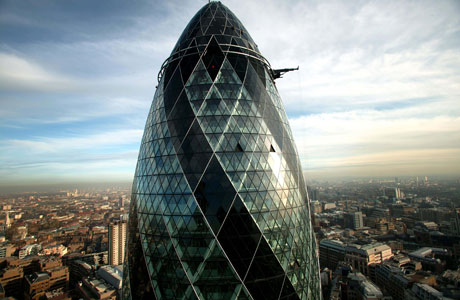
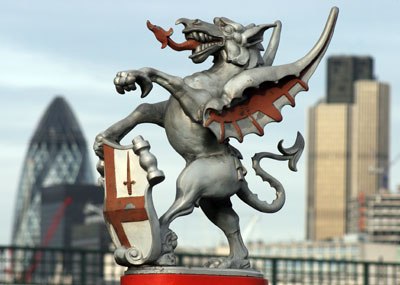
The City is a major business and financial powerhouse, has a resident population of roughly 10,000 and employs roughly 350,000 professional financial managers. The City is a sovereign entity unto itself and is governed by the City of London Corporation. It has a coat of arms containing 2 inward facing dragons that have a latin motto which translates into, “Lord, guide us”. Construction is booming in the City, as a new wave of skyscrapers are continually being built. Already the City boasts the tallest building in Europe, a 300 meter high glass pyramid at the foot of the London Bridge, similiar in design to the TransAmerica pyramid in the city of San Francisco, California, USA.
London has a vast critical mass of markets and financial services in commercial and investment banking, securities and derivatives, fund management, insurance and commodities. The City is playing a key role in pioneering and proliferating the development of the euro and financial service markets across the European Union.
Commonly referred to as the world’s new financial hub, the City houses the London Stock Exchange, Lloyds of London and the Bank of England, as well as other important financial institutions such as Barclays Bank, CitiGroup and HSBC. There are over 500 international banks that have offices and branches within the City.
The upcoming 2012 Olympic games are slated to be held in the City of London, bringing investment, status, prestige and international recognition to this newly dubbed 21st century hyper-capitalist city/state.
The City is often referred to as the “wealthiest square mile of land on Earth”. It is the Jewish House of Rothschild that owns, runs and controls the infamous ‘City’ in the very heart of downtown London. As a sovereign entity unto itself, the City commandeers its own internal police force and has recently fortified its perimeter boundries with a so-called “ring of steel”, ostensibly to protect its interests against any and all outside external threats.
According to Niall Ferguson’s book, “The House of Rothschild”, a history of the legendary European/Jewish/Zionist banking family, “there is but one power in Europe and that is Rothschild”. The Jewish House of Rothschild, headquartered in the City of London, has been in control of the world for a very long time. Their tentacles reach into many aspects of peoples daily lives throughout the world, principally because of their extensive global financial power in the affairs of nations. The infamous Bilderberg group, formed in the late 1950’s and meeting annually in various locations throughout the world, is merely a deceptive front through which the House of Rothschild publically sculpts and shapes its fascist New World Order agenda.
The extent of Jewish Rothschild control over the finances of the USA, in particular, is accomplished through direct private ownership of the US Federal Reserve system, owned by Nathan M Rothschild and Sons of London. Further financial power is furnished through the activities of great jewish banking and investment corporations, headquartered predominantly within the city of New York, USA. These include; Goldman-Sachs, Kuhn-Loeb, Lazard Freres and Lehman Brothers. This hidden force also provides US politicians and universities with large jewish endowments, further solidifying control, influence and subservience to the Jewish House of Rothschild.
Further control is exercised by the US Council of Foreign Relations (CFR), a cousin of the Royal Institute of International Affairs based in London. CFR membership is practically a requirement for getting elected to the US President and Vice President offices in the USA. In fact, VP Dick Cheney was a former director of the CFR.
9/11 and the attack on the World Trade Center in New York, was orchestrated by Britain, America and Israel under orders from the Rothschild Empire as a pretext for removing the freedom and liberty from people worldwide in exchange for global Nazi style state security.
The Jewish House of Rothschild and their New World Order agenda calls for centralized control and authority over the entire planet. Their power is concentrated in the City of London, UK, the core centre of the international banking establishment. Highly organized and operating in a veil of secrecy and deception, international jewry rules the world by proxy, that is, they get others to fight and die for them (i.e. the so-called “American” War on Terror being fought in Iraq and Afghanistan).
The fact that the richest, most powerful transnational empire on Earth is jewish should come as no suprise. The House of Rothschild unabashedly owns and controls the land, economy and destiny of the State of Israel and international judaism, and has been THE major force behind world zionism. Their sole objective at present is to gain control of the entire land base of Palestine, particularily the Holy Temple Mount in Jerusalem.
The Endgame is to implement One World Government, theologically headquartered in Jerusalem, Israel, the spiritual nerve center and endtime platform through which Lucifer (the god of this world) will make his final stand (through a self-annointed jewish Christ figure- the Antichrist of holy scripture) against the coming interdimensional/multidimensional alien/extraterrestrial invasion of the coming Kingdom of Heaven from on high at Judgement Day.
c
 Rosamond Press
Leave a comment