Savoy of California
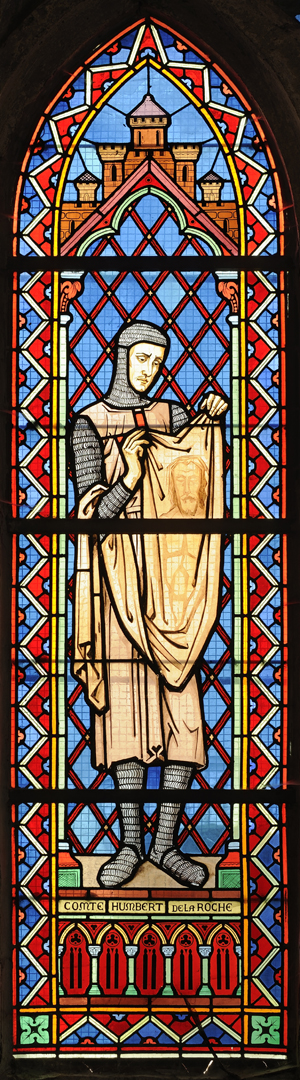
Above is a stain glass of Humbert 111 Comte De La Roche, and Lord of Rougemont. He is holding the Shroud of Turin.
In 1938, my kin, Leland Rosamond published his study of the Rosamond-Rougemont Family. I was not born, yet, nor was my enemy, who after reading my copyrighted article on the Rougemont family owning the shroud, used Geni to search for a Rougemont connection to his name, and found it. Hence he is claiming as much of Leland and my family history – that is concurrent. There are books about the Rosamond family, and my famous sister, Christine Rosamond, a world famous artist. There is a movie script. Thibault Rougemont would bless my endeavors to remember him, and carry on his illustrious name!
Today, I found no reason to assume the identity of any Knight Templar, or group of Knight Templars, until my Belmont California Prophecy came true. Theo Baker has made Stanford and nearby cities, a poweful epicenter of Artificial Intelligence, that threatens to take over the world.
On this day, August 15, I anoint the late Denis de Rougemont, the spiritual head of the….
BELMONT LEAGUE OF KNIGHTS TEMPLAR
Denis de Rougemont is considered a Founding Father of the European Union that is being attacked by a Rouge State Grunt-head, who lost his crusade against Iran, and who has destroyed much American Art. I consider the Shroud an Artifact, that might come under attack by the Gun Goons of the Rouge-butted Ape-Shitters, who were pardoned by the King Goon-butt Golfer. These AI Anti-European Devil Eggs were laid several years ago, and are hatching.
Jean de Rougemont
9/3/2025
Denis De Rougemont and Von Der Leyen

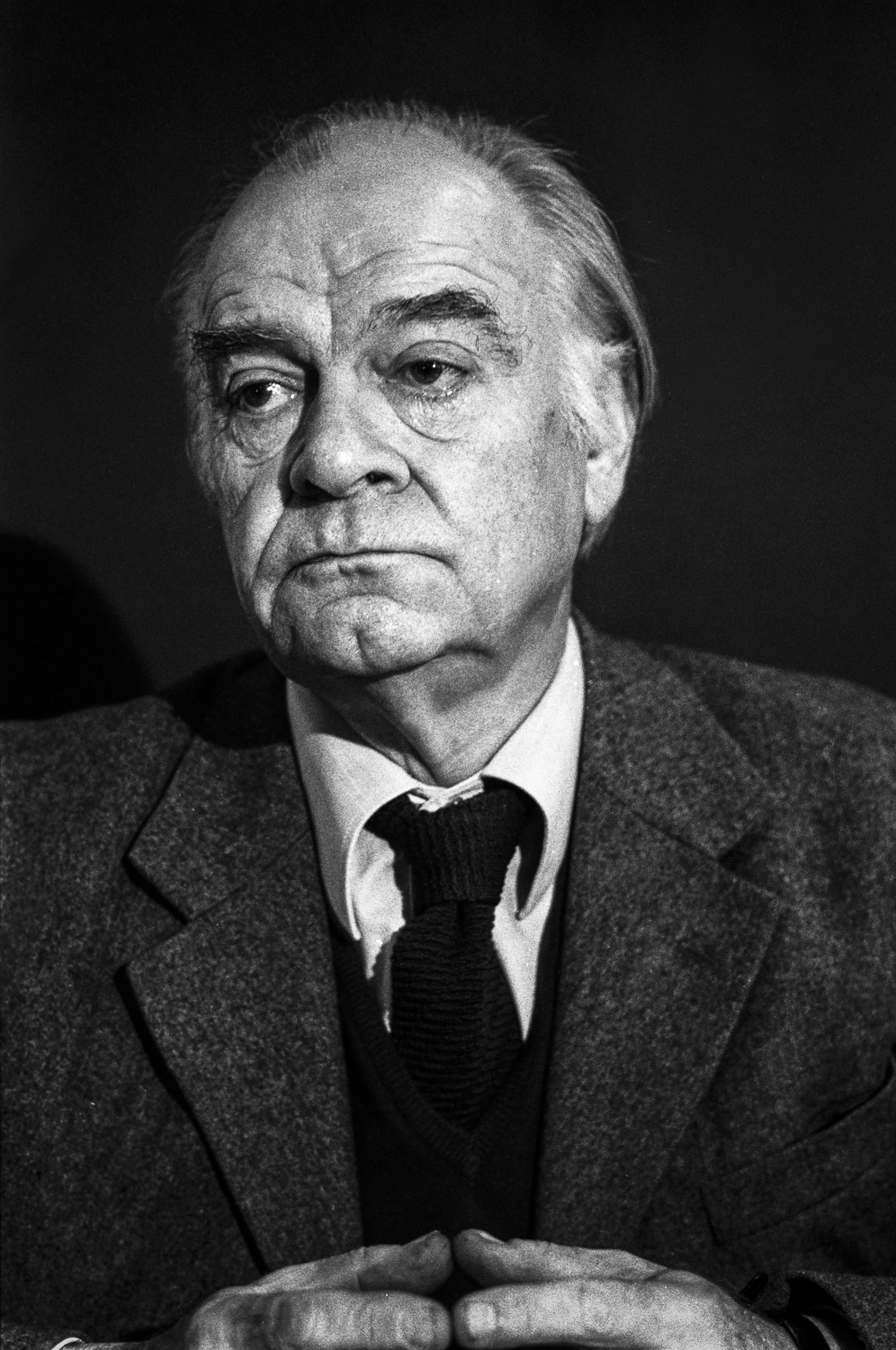
Denis de Rougemont, Schriftsteller, aufgenommen in den 1970er Jahren in Genf. (KEYSTONE/Max Vaterlaus)

Denis de Rougemont was titled ‘The Prince of European Culture’. He was at the first Bilderberg meeting, and is considered a co-founder of the European Union. Frederich the Great granted the Rougemonts of Neufchatel a title of old nobility when he came to this area in Switzerland. Rougemont was the Director of Congress of Cultural Freedom that employed Writers and Artists against the Soviet Block.
The Swiss writer and cultural theorist Denis de Rougemont (born September 8, 1906, in Couvet; died December 6, 1985, in Geneva)
Thibaut IV of Rougemont (c. 1251/1289), son of Humbert IV of Rougemont and Hélius, lord of Rougemont, viscount of Besançon
, married Countess of Belmont , daughter of N and N,
then Alix of Beaumont , daughter of N and N
“The Huguenot tradition in the family, confirmed by such sources as
O’Hart’s Irish Pedigrees and Agnew’s French Protestant Exiles,
suggests a French origin also and this has been found in the
name “Rougemont”, still perpetuated by the name of a village in
southeastern France, near Switzerland, and another village in
southwestern Germany. Why this source seems preferable for our origin
will be mentioned again.
*Fred L. Rosemond
Book shows end of Page 4 here
his father’s will in 1679 nor thereafter. This James (or Jacob, for
these names were once interchangeable) was the son of Hans Ulrich
Rosemond, born 1623, a weaver; who was a son of Hans, a weaver, born
1581; who was a son of Fred Rosemond, born 1552, a weaver, member of
town council and a local captain; who was the son of another Hans
whose date of birth is not known, but he too, was a weaver and became
a citizen of Basle in 1534. His father was Erhart de Rougemont who
bought in 1495 “the house called Rebleuten-Zunft in Basle in the
Freistrasse.’ Peter Rosemond further reported information from the
Records Office in Basle that “before Basle the family resided in
Holland up to 1338, and it is said they descended from the estate
Rosemont, near Belfort, in France, where also the village Rougemont
is found.” A family coat-of-arms was registered in Basle about 1537
when the first Hans became a resident there. A reproduction of this
coat-of-arms in the writer’s possession shows a weaver’s crook
conspicuously, and it will be remembered that in Ireland our people
were linen weavers and farmers, and that Edward, the elder, was a
weaver in this country. Peter Rosemond had seen in print the letters
from Erasmus to Gotschalk Rosemondt. He noticed that a seal used by a
Rosemont in Holland, bearing a jumping fox, was like an emblem he had
noticed in a wall of the house Rebleuten-Zunft in Basle. This seal
dated back to 1430, whereas the coat-of-arms above mentioned dates
from 1534, it seems. Peter Rosemond died September 22, 1930. This is
but a sketch of what he wrote.”
Book shows end of Page 6 here
of a brother of Philip, the elder, has told the writer that a lodge
of Orangemen regularly met in the home of the former in Leitrim. The
recognition of the family name in Ireland as a Huguenot name carries
with it the weight of contemporary knowledge and opinion.
“If Rougemont be accepted as the origin of the line from which the
drill sergeant sprung, that location is in harmony with the Huguenot
tradition. There is a Rougemont parish in Department Doubs, and there
is a Rougemont village in Department Haut Rhine (Upper Rhine), near
Belfort, with two destroyed castles. There was a time, it seems, when
this territory was a part of Pfirt, in Austria, as a part of what was
locally known as `the Sundgau’, extending form Basle to Belfort. Maps
show another Rougemont village in southwestern Germany not far away.
The name means `red mountain’ and is accounted for by local mountains
of reddish color; therefore having a purely logical significance and
being distinguishable from other origins of the name. The variations
in the family name in these records illustrate strikingly how readily
Rougemont could become Rosemond, especially in view of the French
pronunciation.
“After this lapse of time the writer* does not expect the origin of
the name to be susceptible of strict proof, but is disposed to accept
the view shared by Peter Rosemond in Holland, that our family
originated in the Rougemont region in southeastern France and were
Huguenots. In one of his last letters, Peter Rosemond wrote that he
was inclining to the belief that the coat-of-arms relates to the
Crusades and that the `weaver’s cross’ is that worn on the shoulder
by some Crusaders.”
“Rougemont village is said to have been at one time embraced in
Neufchatel, which was a principality of William III of Orange, which
suggests a reason why this James (or Jacob)
The Swiss writer and cultural theorist Denis de Rougemont (born September 8, 1906, in Couvet; died December 6, 1985, in Geneva) belonged to an old noble Protestant family originally from Saint-Aubin in the canton of Neuchâtel, Switzerland. [1, 2, 3, 4]
Immediate Family
- Father: Georges-Arthur de Rougemont (1875–1947), a strict Protestant pastor.
- Mother: Alice Sophie Bovet (1877–1973).
- Siblings: Henri (1902–1942), Antoinette (1903–2002), and Anne-Marie (1910–2002).
- Spouse: Simone Vion (1908–2010), whom he married in Paris in 1934.
- Children: At least one daughter with Simone Vion. [1, 2, 3, 4, 5]
Family Background & Origins
Historical Notability: Earlier notable figures in the broader family tree include  Denis de Rougemont de Löwenberg (1759–1839), a prominent banker and politician who managed a banking house in Paris (Rougemont, Hottinger & Cie), and the geographer Frédéric de Rougemont (1808–1876). [1, 2, 3]
Ancestry Roots: The de Rougemont family trace their lineage in the Neuchâtel region back centuries, with various members serving in local government and the State Council. [1]
Prussian Recognition: In 1784, the family received recognition of ancient nobility (reconnaissance d’ancienne noblesse) from King Frederick II of Prussia, as Neuchâtel was at the time a Prussian principality. [1]
The Lords of Rougemont – The Viscounts of Besançon – The Rougemont Family
Humbert I of Rougemont (c. 1090/1096), son of Oldaric II of Clefmont (?), Count of Clefmont-en-Bassigny, and Reitlande of Oltigen, Lord of Rougemont, Viscount of Besançon, crusader (1096), Count of Montbéliard, married [name missing ] , daughter of [name missing] and [name missing]
.
Thibaut I of Rougemont (c. 1117/1147), son of Humbert I of Rougemont (?) and of N, lord of Rougemont, viscount of Besançon
, married Ponce , daughter of N and of N
Humbert II of Rougemont (?-?), son of Thibaut I of Rougemont and Ponce, lord of Rougemont, viscount of Besançon , married to [ Name Missing ] , daughter of [Name Missing] and [Name Missing]
.
Thibaut II of Rougemont (c. 1173/1213), son of Humbert II of Rougemont and of [unknown], lord of Rougemont, viscount of Besançon
, married Alix of Traves , daughter of Thibaut of Traves (?), lord of Traves, constable of Burgundy, and of Alix.
Thibaut III of Rougemont (c. 1230/1259), son of Thibaut II of Rougemont and Aix of Traves, lord of Rougemont, viscount of Besançon
, married Cécile , daughter of N and Ne
Humbert IV of Rougemont (c. 1239), son of Thibaut III of Rougemont and Cécile, lord of Autoreille
, married Hélius , daughter of N and Ne
Thibaut IV of Rougemont (c. 1251/1289), son of Humbert IV of Rougemont and Hélius, lord of Rougemont, viscount of Besançon
, married Countess of Belmont , daughter of N and N,
then Alix of Beaumont , daughter of N and N
Humbert V of Rougemont (?-1331), son of Thibaut IV of Rougemont and [name missing], Lord of Rougemont, Guardian of the County of Burgundy
, married Agnès of Durnay , Lady of Durnes , daughter of Gérard II of Durnay, Lord of Durnes, and Marguerite of Joux,
then Isabelle of Rochefort-sur-Brevon , Lady of Tilchâtel , widow of Guy III of Tilchâtel , daughter of Gaucher of Rochefort, Viscount of Chartres, and Marguerite of Plancy, Lady of Bragelone
The Lords of Tilchâtel – The Rougemont Family
Stephen I of Tilchâtel (c. 1133), son of Humbert I of Rougemont (?), lord of Rougemont, and of N, lord of Tilchâtel
, married N , daughter of N and N
Renaud de Tilchâtel (c. 1163), son of Etienne I de Tilchâtel and of N, lord of Tilchâtel
, married N , daughter of N and N
Etienne II of Tilchâtel (c. 1200), son of Renaud of Tilchâtel and N, lord of Tilchâtel
, married N , daughter of N and N
Etienne III of Tilchâtel (c. 1256), son of Etienne II of Tilchâtel and N, lord of Tilchâtel
, married Amélie , daughter of N and N
Jean de Tilchâtel (?-1275), son of Etienne III de Tilchâtel and Amélie, lord of Tilchâtel
, married Marie Simone de Joinville , daughter of N and Ne
Guy III of Tilchâtel (?-1299), son of Jean of Tilchâtel and Marie Simone of Joinville, Lord of Tilchâtel
, married Isabelle of Rochefort-sur-Brevon , daughter of Gaucher of Rochefort, Viscount of Chartres, and Marguerite of Plancy, Lady of Bragelone
The Lords of Rougemont – The Lords of Tilchâtel – The Lords of Ruffey – The Rougemont Family
Thibaut V of Rougemont (c. 1321), son of Humbert V of Rougemont , lord of Rougemont, and Agnès of Durnay, lord of Rougemont, lord of Tilchâtel
, married Isabelle of Tilchâtel , lady of Tilchâtel , daughter of Gui III of Tilchâtel , lord of Tilchâtel, and Isabelle of Rochefort-sur-Brevon, lady of Tilchâtel.
Guy I of Rougemont (?-1380), son of Thibaut V of Rougemont and Isabelle of Tilchâtel, lord of Rougemont, lord of Tilchâtel
, married Etiennette of Ruffey , daughter of Jean of Ruffey, lord of Ruffey, and Ne
Jean de Rougemont (?-1375), son of Gui I de Rougemont and Etiennette de Ruffey, lord of Rougemont, lord of Tilchâtel, lord of Ruffey
, married Jeanne de Vienne , daughter of Henri de Vienne , lord of Mirebel, and Jeanne de Sainte-Croix
Guy II of Rougemont (?-1420), son of Jean of Rougemont and Jeanne of Vienne, lord of Rougemont, lord of Tilchâtel, lord of Ruffey, lord of Montfort, lord of Châtelmaillot
, married Jeanne of Montagu , daughter of Jean I of Montagu , lord of Sombernon, and Marie of Beaujeu-en-Beaujolais
Thibaut VI of Rougemont (?-1476), son of Gui II of Rougemont and Jeanne de Montagu, lord of Rougemont, lord of Tilchâtel, lord of Ruffey, knight of Saint George
, married Gauthière de Saulx , daughter of Gérard de Saulx, lord of Vantoux, and Jeanne de Rye
The Lords of Belvoir – The Rougemont Family
Thibaut I of Rougemont, known as of Belvoir (c. 1222), son of Thibaut II of Rougemont (?), lord of Rougemont, and Alix of Traves, lord of Belvoir
, married Simone of Vergy , daughter of Hugues of Vergy , lord of Vergy, and Gille of Trainel
Hugh I or Huon I of Belvoir (c. 1188/1239), son of Theobald I of Belvoir and Simone of Vergy, lord of Belvoir, crusader
, married Simonette of Champagne , daughter of N and N
Thibaut II of Belvoir (c. 1283), son of Hugh I of Belvoir and Simonette of Champagne, lord of Belvoir
, married Elvis of Toul , daughter of Ferry of Toul, lord of Fontenoy, and Agnes of Ferrette.
Hugues II or Huon II of Belvoir (?-1315), son of Thibaut II of Belvoir and Elvis of Beaufort, lord of Belvoir
, married Alix of Ray , daughter of Jean I of Ray , lord of Ray, and Yolande of Choiseul
Thibaut III of Belvoir (?-1339), son of Hugues II of Belvoir and Alix de Ray, lord of Belvoir, knight
, married Jeanne de Montfaucon , daughter of Gauthier II of Montfaucon , lord of Montfaucon, and Mahaut de Chaussin,
then Gille de Courcelle , daughter of Jean de Courcelle, and Ne
Henri de Belvoir (?-1365), son of Thibaut III de Belvoir and Jeanne de Montfaucon, lord of Belvoir, knight
, married Jeanne de Neufchâtel , daughter of Thibaut IV de Neufchâtel , lord of Neufchâtel, lord of Blamont, and Agnès de Géroldseck
Isabeau de Belvoir (?-1346), daughter of Thibaut III de Belvoir and Jeanne de Montfaucon,
married Jean I de Cusance , lord of Cusance, Bailiff of Amont , son of Thibaut de Cusance, lord of Cusance, and Etiennette d’Oiselay
The Lords of Belvoir series – The Cusance Family
The Lords of Faucogney – The Viscounts of Vesoul – The Rougemont Family
Humbert III of Rougemont (c. 1230/1239), son of Thibaut II of Rougemont , lord of Rougemont, and Alix of Traves, lord of Rougemont
, married Sibille of Besançon (?), daughter of Odon and Ne
Hugues de Faucogney (c. 1230), son of Humbert III de Rougemont and Sibille de Besançon, lord of Villersexel, lord of Faucogney, viscount of Vesoul
, married Béatrice de Vesoul , lady of Faucogney , daughter of Aymon II de Vesoul , viscount of Vesoul, lord of Faucogney, and of Ne
Aymon III of Faucogney (?-1244), son of Hugh of Faucogney and Beatrice of Vesoul, Viscount of Vesoul, Lord of Villersexel, Lord of Faucogney
, married Elisabeth of Mailly , daughter of Hugh of Mailly, Lord of Mailly, and Ne
Jean I of Faucogney (c. 1264), son of Aymon III of Faucogney and Elisabeth of Mailly, Viscount of Vesoul, Lord of Faucogney
, married Helvis of Joinville , daughter of Simon of Joinville, Lord of Joinville, and Beatrice of Burgundy, Lady of Marnay.
Aymon IV of Faucogney (c. 1290), son of Jean I of Faucogney and Helvis of Joinville, Viscount of Vesoul, Lord of Faucogney
, married Jeanne of Salm , daughter of Henri IV of Salm, Count of Salm, and Lorette of Burgundy.
Jean II of Faucogney (?-1319), son of Aymon IV of Faucogney and Jeanne of Salm, Viscount of Vesoul, Lord of Faucogney
, married Catherine of Neufchâtel , daughter of Thibaut III of Neufchâtel , Lord of Neufchâtel, and Agnes of Commercy
Jean III of Faucogney (?-1365), son of Jean II of Faucogney and Catherine of Neufchâtel, Viscount of Vesoul, Baron of Faucogney
, married Isabelle of France , widow of Guigues VIII of Albon, Dauphin of Viennois, daughter of Philip V the Tall , King of France, and Jeanne II of Burgundy , Countess of Burgundy and Countess of Artois.
Henri III de Faucogney (?-1371), son of Jean II de Faucogney and Catherine de Neufchâtel, Viscount of Vesoul, Lord of Château-Lambert
, married Jeanne de Blamont , daughter of Aimé de Blamont, Lord of Deneuvre, and Isabelle de Saint-Dizier
The Lords of Usier – The Rougemont Family
Guillaume I de Rougemont (?-1352), son of Humbert V de Rougemont , Lord of Rougemont, and Isabelle de Rochefort, Lord of Rougemont, Lord of Tilchâtel, and Lord of Usier
, married Marguerite de Ray , daughter of Gauthier de Ray , Lord of Ray, and Cunégonde de Blamont,
and later Jeanne d’Usier , Lady of Usier , daughter of Hugues II d’Usier , Lord of Usier, and Nicole de Clairvaux en Montagne
Humbert V of Rougemont (?-1412), son of William I of Rougemont and Jeanne d’Usier, lord of Rougemont, lord of Usier
, married Alix of Neufchâtel , daughter of Thibaut V of Neufchâtel , lord of Neufchâtel, and Jeanne of Chalon-Auxerre
Guillaume II de Rougemont (?-1389), son of Humbert V de Rougemont and Alix de Neufchâtel, knight, lord of Usier
, married Marguerite de Vienne , daughter of Gui de Vienne , lord of Ruffey, lord of Chevreaux, and Marie de Thoire et Villars
Humbert VI of Rougemont (?-1440), son of William II of Rougemont and Margaret of Vienne, Lord of Usier
, married Henriette of Vienne , daughter of Henry of Vienne , Lord of Neublans, and Jeanne of Gouhenans.
The Lords of Villersexel – The Lords of Noidans-les-Vesoul – The Rougemont Family
Hugues de Rougemont (c. 1220): see Lord of Faucogney – The Rougemont Family
Aymon III of Faucogney (?-1244): see Lord of Faucogney – The Rougemont Family
Aymon II of Villersexel (?-1300), son of Aymon III of Faucogney and Elisabeth of Mailly, lord of Villersexel, lord of Noidans-les-Vesoul
, married Guillemette of Ray , daughter of Othon II of La Roche , lord of Ray, and Marguerite of Tilchâtel,
then Simone of Longwy , daughter of N and Ne
Jean de Villersexel (?-1344), son of Aymon II de Villersexel and Guillemette de Ray, lord of Villersexel, lord of Noidans-les-Vesoul
, married Marguerite de Clairvaux , daughter of Humbert de Clairvaux, lord of Clairvaux, and Isabelle d’Avilley
Aymon III of Villersexel (?-1360), son of Jean of Villersexel and Marguerite of Clairvaux, lord of Villersexel, lord of Noidans-les-Vesoul
, married Jeanne de La Roche , countess of La Roche-en-Montagne , daughter of Richard de La Roche , count of La Roche-en-Montagne, and Mahaut of Montfaucon
The Lords of Clairvaux – The Rougemont Family
Humbert de Villersexel (?-1345), son of Jean de Villersexel , lord of Villersexel, and Marguerite de Clairvaux, lord of Clairvaux
, married Marguerite de La Roche , daughter of Richard de La Roche , count of La Roche-en-Montagne, and Mahaut de Montfaucon
Guillaume de Villersexel (?-1396), son of Henri de Villersexel , Count of La Roche-en-Montagne, and Guillemette de Vergy, Lord of Clairvaux
, married Catherine de Montagu , Lady of Sombernon, Lady of Mâlain , daughter of Jean I de Montagu , Lord of Sombernon, and Marie de Beaujeu-en-Beaujolais
The Count of La Roche-en-Montagne – The Rougemont Family
Henri de Villersexel (?-1412), son of Aymon III de Villersexel , Lord of Villersexel, and Jeanne de La Roche, Lord of Villersexel, Lord of Noidans-les-Vesoul, Count of La Roche-en-Montagne, Lord of Maîche, Baron of Clairvaux
, married Marguerite , daughter of N and N,
then Guillemette de Vergy , daughter of Jean II de Vergy , Lord of Fouvent, and Gille de Vienne
http://gilles.maillet.free.fr/…/famille_rougemont…
3/30/2013
Templar Holy Shroud and Fountain
Hughes de Rougemont of Villersexel was a Grand Master of the Knight Templars. Who is he?
Jon Presco
Copyright 2013
http://montagna-le-templier.voila.net/page5/index.html
By this Charter, Ponce de Moysia, prior of Gigny, together with John of Chalon, count of Burgundy, soul, Lord of Coligny and of Andelot and Hugues de Rougemont, Grand Ma tre of the Temple, gave its seal authenticity to a famous donation. This was the one that Manasses of Coligny, brother of soul, made to the order of the Temple by receive Knight of the suzerainty of Montagna, Broissia, Eperigna (closed at Montfleur) and Holy Fountain (La Balme of Epy). This Charter, which also contains the name of the property, is one of the oldest written in French language. It mentions a large number of sites across the country and is of interest in more than one respect. Since this donation, the village of Montagna was nicknamed the Templar by distinction of Montagna-le-renewed, near Saint-Amour.
Excerpts from the history of the Canton of Saint-Julien sur Suran in Franche-Comté, book of Marius de VEYRE, corresponding member of the Academy of Sciences, Belles Lettres and Arts de Lyon (1965).
Hugues de Payens: the birth of the Templars: the memory regainedBy Thierry Leroy (Champagne historian
Humbert de Rougemont owned the Shroud of Turin
(Images: Montfort Castle home to Humbert and Margaret de
Charney/Rougemont)
http://gilles.maillet.free.fr/histoire/famille_bourgogne/famille_rougemont_faucogney.htm
“June 1418: The widowed Margaret de Charny marries Humbert of
Villersexel, Count de la Roche, Lord of St.Hippolyte sur Doubs.”
Humbert de Villersexel is Humbert de Rougemont.
“1208 – Pons de la Roche presents to Amadeus de Tramelay, Archbishop
of Besançon, the Shroud that his son Othon de la Roche, Latin Duke
of Athens, had sent him from Constantinople.”
Aymon 2 de Rougemont was the Seigneur of Villersexel. He married
Guillemette de Ray, the daughter of Othon 2 de la Roche.
Othon 1 de la Roche (-before 1161) had a son named Pons de la Roche
the Seigneur de Ray. He first married Marguerite Tilchatel who may
be a Rougemont who came to own Til-Chatel. Guillaume, Gui, Humbert4,
Gui 2, and Thibaut 6 were Seigneurs of Til-Chatel. Othon then
married Pontia de Rougemont/de Dramelay the daughter of Thiebaud 2
de Rougemont. They has three children. Humbert, Thiebaud, and
Sibylle de la Roche. This union makes the Shroud the Rougemont
family icon, or relic.
Jon Presco
Copyright 2006
It has long been suspected the Knights Templars came to own the
Shroud of Turin, some scholars suggesting it is the Holy Graal
itself. Here is evidence this was the case.
Jeane de Vergy, the grandniece of Othon de la Roche, son of Pons de
la Roche, presented the shroud to Amadeus de Tramelay, Archbishop of
Besancon, and Latin Duke of Athens. Tramelay is also spelled
Dramelay, as in the case of Bernard Dramelay/Tramelay, the fourth
Grand Master of the Knights Templar. Fromond Dramelay married
N.Rougemont, and from them descend the de la Roches, they the Lords
of Neufchatel. You can follow the Rougemont line to Aumiry de
Rochefoucauld who was the Grand Master of the Templars in Paris.
http://genforum.genealogy.com/roseman/messages/186.html
The fifth son of Guy II of Rougemont and Guillemette de Coublant,
was lord of Pichanges. In December 1265, having
recalled the donations made to the temple by Aimon IV and Guy II, he
gave to the Templars, with the agreement of his elder brother, Jean,
Lord of Rougemont, the right of pasturage on his lands of Pichanges
and Spoy. He died in 1271 and was buried before the altar in the
chapel of Fontenotte and conferring his Templar rank of Preceptor
(priest-templar).
Humbert of Villersexel
An article from Wikipedia, the free encyclopedia
Go to: Navigation, Search
Humbert of Villersexel (1385-1437) County of la Roche, Lord of Villersexel, Maîche, ORB and Saint Hippolyte.
Summary
[hide]
1 Biography
1.1 Shroud of Turin
2 . See also
3 External links
Biography[Edit]
Humbert of Villersexel, from the House of Faucogney, was born in 1385, son of the count of La Roche Henri de Villersexel and Guillemette of Vergy (daughter of Jean II de Vergy’s House of Vergy)
In 1398, he married his first wife Marguerite of Montfaucon, (circa 1388-1410), ORB Lady, daughter of the count de Monbéliard Henri de Montbéliard, Montfaucon family.
In 1418, he married his second wife Marguerite de Charny (daughter of Lord Geoffroy II of Charny and widow by first marriage of Jean de Beauffremont (Maison de Bauffremont) killed at the battle of Agincourt in 1415. They have no children.
Humbert disappears in June 1437 at the age of 62 years, last count of the Roche.
Shroud of Turin [Edit]
This section does cite enough sources. To improve it, add Note of verifiable references or the Templates {{refnec}} or {{refsou}} on the passages requiring a source.
At the beginning of the XVe century, bands of brigands, large companies, then ravaging the France. Fearing for the preservation of the shroud, the canons of Lirey, who have inherited the relic, the Entrust 6 June 1418 Marguerite de Charny, granddaughter of Geoffroy de Charny, and her husband, Humbert of Villersexel.
In 1418, Humbert of Villersexel, count of the Roche and husband of Marguerite de Charny, plaça again the shroud in his castle of Montfort to protect it from looters and the hundred years warbands. It the then moved to Saint-Hippolyte (Doubs), another of his fiefs. At his death in 1438, the canons of Lirey appealed in court to force his wife to return the relic, but the Parliament of Dole and the Court of Besançon gave reason to the latter, who traveled in different places with the shroud, namely Cork, Geneva, Annecy, Paris, France, Nice.
On 13 September 1452, it exchanges the relic with Anne of Lusignan, wife of Duke Louis Ier of Savoy, against the castle of Varambon.
Humbert III de Rougemont, squire , lord of Rougemont and Autoreille cited in charters of Charity and Grace Dieu ( Besancon ) in 1230 , 1233 and 1239 .
Mariage et succession : Marriage and succession:
Il épouse Elvis/Aleydis (de Durnay ?) de qui il a : He married Elvis / Aleydis (of Durnay?) Who has:
Thiébaud IV qui suit, Thiébaud IV below,
Hugues, il épouse Alix de Ray, Hugues, he married Alix de Ray,
Odon ou Eudes, (? – 23 juin 1301), archevêque de Besançon de 1269 à 1301 . Odo or Eudes (? – 23 June 1301), Archbishop of Besançon from 1269 to 1301 . Inhumé devant le grand autel de l’ abbaye Notre-Dame de Bellevaux , Buried before the high altar of the Abbey of Our Lady of Bellevaux ,
Isabelle, elle épouse Jean de la Roche , Isabelle, she married Jean de la Roche ,
Clémence, elle épouse Ponce/Pons de la Roche-Chambornay. Clemence, she married Ponce / Pons de la Roche-Chambornay.
Humbert III ROUGEMONT
( Humbert de ROUGEMONT ) ( Humbert of ROUGEMONT )
Titres: Seigneur de Rougemont en Franche-Comté Titles: Lord of Rougemont in Franche-Comté
FICHE SHEET
MÉDIAS MEDIA
PARENTÉ RELATIONSHIP
CORRESPONDANCES Match
Né vers 1260 julien Born about 1260 Julian
Décédé Deceased
Parents Parents
Thibaud III de ROUGEMONT , Seigneur de Rougemont en Franche-Comté , Vicomte de Besançon , né vers 1230 julien, décédé après 1265 julien Thibaud III of Rougemont , Rougemont Lord of Franche-Comté , Besançon Viscount , born about 1230 Julian, died after 1265 Julian
Marié avec Married
Comtesse de BELMONT Countess of Belmont
Union(s), enfant(s) , les petits enfants et les arrière-petits-enfants Union (s), child (ren), grandchildren and great-grandchildren
Marié après 1306 julien avec Isabelle de ROCHEFORT , née vers 1280 julien, décédée Julian married after 1306 with Isabelle de Rochefort , born about 1280 Julian, died
Marié avec Agnès de DURNAY , née vers 1270 julien, décédée en 1306 julien à l’âge de peut-être 36 ans (Parents : Married Agnes DURNAY , born about 1270 Julian, Julian died in 1306 at the age of maybe 36 years (Parents: Gérard II DE DURNAY , Seigneur de Durnes ca 1245-1275 & Gerard DURNAY II , Lord of Durnes ca 1245-1275 & Marguerite DE JOUX ca 1245- ) dont Marguerite JOUX ca 1245 -), whose
Thibaud IV de ROUGEMONT 1269- Thibaud IV ROUGEMONT 1269 –
Marguerite de ROUGEMONT ca 1290-1350 mariée vers 1310 julien avec Etienne III , Baron d’Oiselet ca 1290-1335 dont Daisy ROUGEMONT ca 1290-1350 married around 1310 with Julian Stephen III , Baron Oiselet which ca 1290-1335
Jean I , Baron d’Oiselet †1372 marié avant 1335 julien avec Isabelle de VILLERSEXEL †1368 dont : John I , Baron Oiselet † 1372 married before 1335 Julian with Isabella VILLERSEXEL † 1368 including:
Etienne IV , Baron d’Oiselet 1338-1402 Stephen IV , Baron Oiselet 1338-1402
Jeanne d’OISELET †1400 Jeanne birdie † 1400
Jean II d’OISELET 1335-1355 John II birdie 1335-1355
Élisabeth d’OISELET ca 1325- mariée avec Gauthier de CHAUVIREY , Chevalier 1327/- dont : Elizabeth of birdie ca 1325 – married Gauthier Chauvirey , Knight 1327 / – including:
Odette de CHAUVIREY , Dame de Chauvirey-le-Vieil †ca 1345 Odette Chauvirey , Lady Chauvirey-the-Old † ca 1345
Odon ou Eudes de ROUGEMONT /1299-1341 Odo or Eudes de Rougemont / 1299-1341
Fratrie Siblings
Isabelle de ROUGEMONT ca 1225- Mariée vers 1243 avec Robert Ier de CHOISEUL ca 1223- Isabelle de Rougemont ca 1225 – Married about 1243 with Robert I of CHOISEUL ca 1223 –
Humbert III de ROUGEMONT , Seigneur de Rougemont en Franche-Comté ca 1260- Marié après 1306 julien avec Isabelle de ROCHEFORT ca 1280- Humbert III of Rougemont, Rougemont Lord of Franche-Comté ca 1260 – after 1306 Married with Julian Isabelle de Rochefort ca 1280 –
Humbert III de ROUGEMONT, Seigneur de Rougemont en Franche-Comté ca 1260- Marié avec Agnès de DURNAY ca 1270-1306 Humbert III of Rougemont, Rougemont Lord of Franche-Comté ca 1260 – Married Agnes DURNAY ca 1270-1306
http://gilles.maillet.free.fr/histoire/famille_bourgogne/famille_rougemont_faucogney.htm
Isabelle de Villersexel1,2
F, #85629, d. 18 August 1365
Isabelle de Villersexel|d. 18 Aug 1365|p2850.htm#i85629|Jean, Seigneur de Villersexel|d. 27 May 1319|p2850.htm#i85630|Marguerite de Cuiseaux||p2850.htm#i85631|Aymon d. Faucogney, Seigneur de Villersexel|d. 18 Dec 1309|p2850.htm#i85636|Simone d. Longvy|d. 1294|p2850.htm#i85637|Humbert d. Clairvaux||p2850.htm#i85632|Isabelle|d. 1296|p2850.htm#i85633|
Father
Jean, Seigneur de Villersexel1 d. 27 May 1319
Mother
Marguerite de Cuiseaux1
Isabelle de Villersexel married Sir Jean I, Baron d’Oiselet, Seigneur de Villeneuve & Clervans, son of Etienne III, Baron d’Oiselay, la Villeneuve, & Seveux and Marguerite de Rougemont, before 1335.1,2 Isabelle de Villersexel died on 18 August 1365.1
Family
Sir Jean I, Baron d’Oiselet, Seigneur de Villeneuve & Clervans d. 1372
Children
Jean d’ Oiselet3 b. 19 Sep 1335, d. 10 Jul 1355
Sir Etienne IV, Baron d’Oiselay+3 b. 21 Jul 1338, d. 2 May 1402
Jeanne d’ Oiselet+1 b. c 10 Aug 1342, d. 1400
Etienne III, Baron d’Oiselay, la Villeneuve, & Seveux1,2
M, #85638, d. 16 April 1335
Etienne III, Baron d’Oiselay, la Villeneuve, & Seveux|d. 16 Apr 1335|p2850.htm#i85638|Etienne II, Baron d’Oiselay & Chamblay|d. 19 Aug 1324|p2850.htm#i85645|Alix de Choiseul|d. 5 Dec 1310|p2850.htm#i85646|Sir William I. Baron d’Oiselay|d. 23 Oct 1270|p2850.htm#i85647|Marguerite d. Vienne||p1957.htm#i58812|Jean I. Sire de Choiseul & d’Aigremont, Constable of Burgundy|d. Mar 1309 or May 1309|p2125.htm#i63848|Alix-Bertremette d’ Aigremont|d. Mar 1302|p1907.htm#i57314|
Father
Etienne II, Baron d’Oiselay & Chamblay1 d. 19 Aug 1324
Mother
Alix de Choiseul3 d. 5 Dec 1310
Etienne III, Baron d’Oiselay, la Villeneuve, & Seveux married Marguerite de Rougemont, daughter of Humbert III, Sire de Rougemont and Agnes de Durnay, circa 1310.1,2 Etienne III, Baron d’Oiselay, la Villeneuve, & Seveux died on 16 April 1335.1,2
Family
Marguerite de Rougemont d. 13 Oct 1350
Child
Sir Jean I, Baron d’Oiselet, Seigneur de Villeneuve & Clervans+1 d. 1372
Bellevaux, Bella Vallis was founded by Pons i. de La Roche and Etienne de Traves in 1119, he comes to the first girl of theAbbey of Morimond and was also the first Cistercian Abbey in Franche-Comté[1].
The birth of the Abbey of Bellevaux coincides with the appearance of the line of the Lords of La Roche-sur-L’ognon likely from the Lords of Scey and Traves. an estate it is formed with the help of the Lords of Cirey and Chambornay[1].
The Church is consecrated in 1143 and dedicated to our Lady[1].
Abbey dependent on four barns in 1139, eight in 1178 (Cirey, Magny, Valleroy, Baslieres, Trevey, Argirey, Champoux and Braillans – the last two for a clearing nearby)[1].
Bellevaux participates in the swarming of the abbeys following mother Morimond : from 1124, it contributes to the creation of theLucelle Abbey in the diocese of Basel and then to the diocese of Lausanne, to Montheron (around 1130)[1]. In its immediate proximity, it creates institutions Rosières (1132) and charity (1133); then, the Lords of La Roche became Lords in Attica as a result of the Fourth Crusade, theAbbey of Daphni (sometimes called “Laurum Abbey” in certain acts)[2], in present Greece[1].
End of thee century XII, the Abbey has the chance to get the very important relics: those of Pierre de Tarentaise. Former monk became Archbishop of Tarentaise (1141-1174), he travels the Burgundy to get the Pope to support in its fight against the emperor when the death surprises him. Despite the wishes of the canons of Tarentaise, it is buried in Bellevaux, and reputation of holy man and miracle worker, was canonized in 1191[1].
Bellevaux therefore became an important centre of pilgrimage of many nobles of the surroundings while (first amongst which the Lords of La Roche) and even three archbishops of Besançon (Gerard, Nicolas and Eudes de Rougemont are buried in the Abbey Church[1]. After the French Revolution, the relics are transferred to the Church of Cirey.
From thee century XIV, barns are leased and the Abbey invests in Saltworks in Lons-le-Saunier and Salins. They are building a mansion in Besançon. Workforce decline to reach a score of monks (18 in 1352 during the visit of the Abbot of Morimond)[1].
The situation is more difficult: the Abbey account more than six monks in 1497 and it comes to expose the relics of Pierre de Tarentaise exceptionally to attract alms to repair the Church[1].
Commendatory Abbot stands little by little: Jean Rolin, son of the Chancellor Rolin became Abbot in 1455. It is definitive from 1551 and D’andelot Pierre abbatiate[1].
The ten years war hit head-on Abbey: in 1650, said prior have more water for the altar or book to say mass. It is the sole occupant[1]. In the 18th century the situation improved considerably: the earnings of many possessions were abundant, 4-5 monks with a dozen employees lived a comfortable life, and sumptuous buildings are erected during the last commendatory Abbot, also Bishop of Évreux, Louis-Albert de Lezay-Marnésia.
The Abbey was sold as national property in 1791 Thomas de Vesoul, which resells them in 1795 at the général Pichegru[1]. In 1817, Eugene Huvelin, former monk of theAbbey of Sept-Fons, and two lay of the same monastery bought the buildings from the heirs of Charles Pichegru and settle a new community of twenty-five monks, under the observance of Sept-Fons. DOM Huvelin made back the relics of Pierre de Tarentaise, installed in a chapel built in an extension of the building with the stables outside the fence.
Pons i. de La Roche (?- 1134), son of Otto i. Scey in Varais and Sybille, is the founder of the lineage of la Roche sur L’ognon (today Rigney) and co-founder (with Etienne de Traves) of theAbbey of Bellevaux in 1119.
He has three sons:
Pons de la Roche (?- 1156) 1er Abbot of Bellevaux
Hugh de la Roche (? – circa 1164) who married the daughter of Guillaume de Roulans.
Otto I of the rock, it was the name of Roulans
Click to access PianaMYHSWeb.pdf
Click to access ScavoneBesanconWeb.pdf
History
Bellevaux , Bella Vallis fut fondée par Pons I er de La Roche et Étienne de Traves en 1119, il s’agit de la première fille de l’ abbaye de Morimond et fut aussi la première abbaye cistercienne en Franche-Comté [ 1 ] . Bellevaux, Vallis Bella was founded by Pons I de La Roche and Etienne de Traves in 1119, it is the first daughter of the Abbey of Morimond and was also the first Cistercian abbey in Franche-Comté [1] .
La naissance de l’abbaye de Bellevaux coïncide avec l’apparition de la lignée des seigneurs de La Roche-sur-Ognon vraisemblablement issus des seigneurs de Scey et de Traves ; un domaine foncier lui est constitué avec l’aide des seigneurs de Cirey et de Chambornay [ 1 ] . The birth of the Abbey Bellevaux coincides with the appearance of the line of the lords of La Roche-sur-l’Ognon likely from the lords of Scey and Traves, an estate it is made with the help of lords Cirey and of Chambornay [1] .
L’église est consacrée en 1143 et dédiée à Notre-Dame [ 1 ] . The church was consecrated in 1143 and dedicated to Our Lady [1] .
De l’abbaye dépendent quatre granges en 1139, huit en 1178 (Cirey, Magny, Valleroy, Baslières, Trevey, Argirey, Champoux et Braillans – les deux dernières permettant des défrichages aux alentours) [ 1 ] . Abbey depend four barns in 1139, eight in 1178 (Cirey Magny Valleroy, Baslières, Trevey, Argirey, Champoux and Braillans – for the last two clearings around) [1] .
Otto (or Othon) de la Roche (died 1234) was a Burgundian nobleman from the castle of La Roche-sur-l’Ognon, in the Franche-Comté commune of Rigney, Doubs. He joined the Fourth Crusade in 1204 and became the first Duke of Athens.
He took the title of megaskyr or grand seignior in Athens. He held his Greek possessions from the King of Thessalonica. He fortified the Acropolis. In 1208, he took the title of duke.
In May 1209, the Latin emperor Henry called his first of two parliaments at Ravennika and Otto and his close ally Geoffrey I of Villehardouin made an appearance to demonstrate their loyalty to the emperor. On 2 May 1210, at the second parliament, the two barons ratified the pact between church and state, but he did little to effect it. He was accused of treating the Greek priests as serfs, since many of them were former serfs raised to their clerical status by Greek prelates desiring to lift the heavy burden the Franks could impose with their corvées on the local populace. Pope Honorius III excommunicated him and put his lands under interdict, as he did to Geoffrey for like disobedience to the pact. About 1223, Otto made a treaty with the pope by which he returned church lands, but kept church furnishings at the cost of an annual indemnity. A quota was also placed on the number priests proportional to the population of the community.
With Geoffrey, Otto embarked on a series of military adventures to consolidate mainland Greece. Together they took Acrocorinth (1209), Argos (1210), and Nauplia (1211). In compensation, he received two lordships in the Argolid: Argos and Damala. After the Italian crusaders Albertino and Rolandino of Canossa returned, their fief of Thebes was divided between Geoffrey and Otto. The city itself became Otto’s capital and the economic centre of his domains, due to its silk industry. He built a square tower, destroyed in the late nineteenth century, on the propylaea there and gave the city as a lordship to his nephew Guy. Athens itself remained Otto’s residence. There he lived in his castle atop the Acropolis, having converted the Parthenon into the Cathedral of Our Lady.
Otto established Cistercians from Bellevaux Abbey at Daphne. In 1225, he resigned the Duchy of Athens to his nephew Guy I de la Roche and returned home to Burgundy with his wife.
Hugues de ROUGEMONT
Seigneur de VILLERSEXEL
Born: ? Died: abt. 1227
Poss. HM George I’s 15-Great Grandfather. Poss. U.S. President [BUSH-41]‘s 26-Great Uncle. HRH Charles’s 23-Great Grandfather. PM Churchill’s 24-Great Grandfather. Lady Diana’s 26-Great Grandfather. Louis XVII’s 17-Great Grandfather. HM Manuel II’s 21-Great Grandfather.
Wife/Partner:Beatrice de FAUCOGNEY
Child:Aymon de VILLERSEXEL (Sire) de FAUCOGNEY
| ________ | ________ | ________ | ________ | _______ | _______ | _______ | _______ | _______ | _____ | _____ | _____ | ||
|---|---|---|---|---|---|---|---|---|---|---|---|---|---|
| / | — Humbert (? – 1098+) | ||||||||||||
| / | — Thiebaut I de ROUGEMONT (? – 1107+) | ||||||||||||
| / | — Thiebaut II de ROUGEMONT (? – 1173+) | ||||||||||||
| | | \ | / | — Hugh (Sn.) de TREVES (? – 1073+) | ||||||||||
| | | | | / | — Stephen (Sn.) de TREVES (? – 1098+) | ||||||||||
| | | | | / | — Thibaud (Sn.) de TREVES (1064? – ?) | ||||||||||
| | | \ | — Poncette (Dame) de TREVES (1090? – 1156+?) | |||||||||||
| / | \ | — Alice (Alix) | |||||||||||
| / | — Humbert II de ROUGEMONT (? – by 1227) | ||||||||||||
| / | \ | — Alais | |||||||||||
| – Hugues de ROUGEMONT | |||||||||||||
| \ | / | — Odon de BESANCON | |||||||||||
| \ | — Sibille de BESANCON | ||||||||||||
| \ | — Julienne | ||||||||||||
About us
The genealogy of several families bearing the name Rosamond, or a variant thereof, have been researched. To date no documentation has been found to connect these families. In particular, the Rosamond family in the Southern US, the Rosemond family in the Northern US and Canada, the Rosamond families in Ireland and England, and the Rosamond families in Australia and New Zealand.
Note: The spelling Rosamond herein encompasses the spellings Rosemond, Roseman, Rosamund, Rosman, and all other common variations of the name that have been found in census records and other documents.
The goal of the Rosamond Family Y-DNA Project is to determine if, and how, these various family lines are related. Each of these lines is discussed very briefly below. Based on family legends four of the family lines given are said to be related and descended from one man. This alleged common ancestor is generally referred to as Sergeant Rosemond. Be aware that Sergeant is a military rank, and not a given name as some believe. His given name is thought to be James. Sergeant Rosemond is reputed to have had three sons; Thomas, Nathaniel, and one son whose given name is unknown. The Legend of Sergeant Rosemond is shown below.
THE LEGEND OF SERGEANT ROSEMOND
It can be stated unequivocally that the central figure and bottleneck in the Rosamond family history is a man known to the family as Sergeant Rosemond. At least four branches of the Rosamond family are believed to descend from this man. Going backwards in time from Sergeant Rosemond, the possible ties to the de Rougemont family in France are based on the genealogy of a James Rosemond who is believed by many researchers to be the elusive Sergeant Rosemond, but this has not been proven. The problem is, what we know of Sergeant Rosemond is based almost solely on family legend.
The legend of Sergeant Rosemond says that he was a Huguenot, a French Protestant who followed the teachings of John Calvin. Most versions of the legend say he was born in France around 1650, but it is more accurate to say he was living in France at the time of the revocation of the Edict of Nantes in October 1685. There is no actual record of where he was born. At the time of Louis XIV’s revocation of this edict, which had provided the French Protestants religious freedom, Huguenot church elders were allowed two weeks to exit the country or stay and convert to Catholicism. Those Huguenots not associated with the church hierarchy were ordered to remain in France. Despite this, in a very short period of time, over 200,000 Huguenots fled from persecution in France to other countries including Germany, Switzerland, Holland and England. Sergeant Rosemond is said to have been one of these refugees, and the legend says he went to Holland where he joined the army of Prince William of Orange.
While in Holland, he is reported to have become a drill sergeant in William’s army. This is the origin of him being called Sergeant. Sergeant is a rank, not a given name. His given name is not known for certain although there are three possibilities which will be discussed below. Sergeant Rosemond traveled with William’s army when William and his wife Mary, the daughter of the English king James II, went to London for their coronation as King and Queen of England after Mary’s father was non-violently deposed.
James II, the father-in-law of William III as William of Orange was known after his coronation, went into exile in France where he and Louis XIV made plans for James to regain the English throne. The first step of this plan was to gain control of Ireland. Using James’ troops and Louis’ finances a military force was sent to Ireland. William III responded by sending his army to Ireland to repel the invasion. The leader of William’s army was Count Schomberg, a Huguenot general. A large part of William’s force consisted of Huguenot soldiers. Sergeant Rosemond supposedly traveled to Ireland as a part of this force.
It is said that in the decisive battle between James’ and William’s armies, now known as the Battle of the Boyne, Sergeant Rosemond distinguished himself such that William III offered him an entire township. Sergeant Rosemond declined the offer but did eventually settle in County Leitrim in the northwest part of Ireland where he remained until his death. There are family tales that say his wife’s name was Anne d’Orr but this is another fact with no documentation. Sergeant Rosemond and his wife are said to have had three sons. It is better stated that they had at least three sons and nothing is known about any other children.
Two of these sons were said to be named Thomas and Nathaniel. According to the story both Thomas and Nathaniel immigrated to the colony of South Carolina. Nathaniel Rosemond is said never to have married and is believed to have been killed in the Revolutionary War. This seems unlikely as there is no record of his service. Also, Nathaniel would have been born in the early 1700s and by the time the war began in 1776 he would have been to old to have been an active participant. However, this can’t be ruled out because non-combatants were also killed during the war. No records of a Nathaniel Rosemond have been found in colonial South Carolina.
The Sergeant’s son Thomas Rosemond is said to have arrived in South Carolina with his wife Sarah and two year old son Samuel in 1740. No record of their arrival in South Carolina has been located. One deed found in the South Carolina State Archives shows that there was a tract of land that bordered on the property of a Thomas Rosamond in a SC county somewhat distant from Abbeville County where the Rosamond family is known to have lived. This is the only record of a Thomas Rosamond having lived in South Carolina in colonial times. Thomas and Sarah’s son Samuel is Captain Samuel Null Rosamond, a well documented South Carolina Revolutionary War soldier and plantation owner.
The given name of the third alleged son of Sergeant Rosemond is unknown. One researcher claims that this son’s name was William and that he too came to the colonies, but only stayed for five years before returning to Ireland. This son of Sergeant Rosemond had at least one son who was named James. This James Rosemond is documented in County Leitrim and a number of his numerous children came to America where they settled in the northern states and southern Canada.
However, the question remains. Who was Sergeant Rosemond? There are three men of whom I am aware that bore the surname Rosemond, and who lived in France or the United Kingdom during the latter seventeenth and early eighteenth centuries. These are Peter Rosemond, Jean Baptiste de Rosemond, and James Rosemond. Virtually nothing is known of Peter Rosemond except that he is listed in a denization record dated prior to the date of the Revocation of the Edict of Nantes. While Peter can’t be ruled out as being the elusive Sergeant Rosemond, the fact that the name Peter was not passed down to any of the Rosamond sons in Ireland or the United States would seem to indicate that he was not the primary ancestor of this particular clan. Also the date of his denization would indicate he went directly to England from France. However, research into Peter Rosemond could yield valuable clues regarding the family as a whole. And, it is possible that he went from England to Holland after his denization.
The same record that shows the denization of Peter Rosemond also contains the denization of John Baptist Rosemond (Jean Baptiste de Rosemond) who went through the denization process on the same day as Peter Rosemond. The fact that they bore the same surname and their denizations were apparently processed together would indicate a familial tie between these two men. Some of the current researchers of the Rosamond family history consider Jean Baptiste de Rosemond as the most likely prospect to be Sergeant Rosemond. I respectfully disagree. First, quite a lot is known about Jean Baptiste de Rosemond as he was a well known translator of history books from English into French. But, he was a Huguenot. He is known to have gone to England about four years prior to the revocation of the Edict of Nantes. Against Jean Baptiste being Sergeant Rosemond is that the dates of his translations would preclude him having served in the army of William III, and being in Ireland following the date of the Battle of the Boyne. For references to Jean Baptiste de Rosemond go to http://books.google.com and search on his name. Finally, I located and obtained a copy of his will which shows that he was a chaplain aboard an English naval vessel, and he died in England.
The most likely candidate for Sergeant Rosemond is the James Rosemond mentioned in the book The History of the Rosemond Family by Leland Eugene Rosemond which was published in 1939. The information provided in this small book was researched by a Peter Rosemond of Flushing, Holland in the early 1900s. This Peter Rosemond moved to Basle, Switzerland for about 7-8 years where he conducted on-site research into the ancestry of this James Rosemond. James Rosemond from Basle was born 1 Jan 1649, a reasonably close match to the legendary 1650 date for the birth of Sergeant Rosemond. He was a Huguenot. He moved to France as a young man, and it is likely that he fled France at the right time. After he left France, nothing is known about him. This James Rosemond’s ancestry in Switzerland traces back to an Erhart de Rougemont who purchased a home in Basle, Switzerland in 1495. It appears that Erhart was a member of the de Rougemont family that lived in Belfort, France. Belfort is about 50 miles from Basle. The members of the de Rougemont family in Belfort were minor nobles and can be traced back to the 12th century.
BRANCHES OF THE ROSAMOND FAMILY
The Southern US
The Rosamond family which resides primarily in southern half of the United States is said to be descended from Sergeant Rosemond’s son Thomas. According to the legend, Thomas Rosamond arrived in South Carolina from County Leitrim, Ireland in 1740 with his wife Sarah and son Samuel. Samuel Rosamond, his brother James Rosamond and their sisters are well documented in South Carolina in the late 1700s, but current research has shown that their father was a John Roseman who came to South Carolina from Augusta County, Virginia about 1765. It is believed John Roseman’s father-in-law, his wife Sarah’s father, was named Thomas, and that Sarah Roseman had a brother named Nathaniel. This could be the reason for the confusion in given names.
No one has been able to document the origin of John Roseman of Virginia. One possible origin is that he came from Maryland. In December of 1725 a John Roseman arrived in Annapolis, MD aboard the ship Forward. He came to the colonies as an indentured convict having been found guilty of committing highway robbery back in England. He has been dubbed “John, The Highwayman”. His period of indenture was fourteen years so he would have been free to pursue life as a free man around 1739-1740. John Roseman of Virginia first appears in the records of Augusta County, VA in 1749, so there is a possibility that John of Virginia and John, The Highwayman are one and the same. However, a will was recorded in Maryland in 1787 for a John Roseman. If the will is that of John, The Highwayman, then John Roseman of Virginia can’t be the same person because we know John of Virginia was in South Carolina at that time. He could perhaps be a son of John, The Highwayman, or the reverse could be true. The will could be for a son, and John, The Highwayman may have gone to Virginia. Without further research the question of the origin of John of Virginia remains open. A famous descendant of this line of the Rosamond family is the artist Christine Rosamond who signed her paintings simply as Rosamond. Christine was actually born Christine Rosamond Presco. Her mother’s maiden name was Rosemary Rosamond, the daughter of the writer Royal Rosamond.
The Northern US and Canada
The northern U.S. and Canadian branches of the family are said to be descended from Sergeant Rosemond’s son whose given name is not known. This son supposedly never left Ireland, although one researcher has claimed that this son’s given name was William, and that William came to the colonies for five years and then returned to Ireland. What is known is that this son of Sergeant Rosemond with no known given name had a son named James who was born in County Leitrim, Ireland. This James Rosamond, the grandson of the elusive Sergeant Rosemond, had a number of sons who migrated to the United States and southern Canada. At least one of these descendants, another James Rosamond, lived in Lanark County in Ontario, Canada and founded the Rosamond Woolen Mill there. Records of the Canadian James Rosamond show that he is descended from Rosamonds in County Leitrim.
The most famous descendant of this branch of the Rosemond family, and arguably the Rosamond family as a whole, is the actress Elizabeth Rosemond Taylor whose grandmother was Elizabeth Mary Rosemond from Guernsey County, Ohio.
Colonial New York/New England
There is a northern branch of the family that was situated in New York in Colonial times. It is uncertain to which, if any, of these branches the New York Rosamonds are tied. A Nathan Rosamond is known to been in Maryland in 1739, and there is a will for a Nathan Rosamond in Chester County, PA dated 1742. I obtained a copy of the will and there is no mention of other Rosamond relatives.
The United Kingdom
Ireland: The Rosamond family in Ireland is also said to be descended from Sergeant Rosamond’s son with the unknown given name. It is believed that a number of this son’s children and grandchildren remained in County Leitrim, Ireland or migrated to England. At least one Rosamond descendant in California, Mary Jane Loya, is from this line as her mother’s maiden name was Rosamond, and her mother was born in County Leitrim. Jane (Rosamond) Chambers, a cousin of Mary Jane’s lives in England and has done some research on the family there.
England: There may be two or more Rosamond lines in England. First, the family of Mary Jane Loya’s cousin who we know is descended from the Rosamonds in County Leitrim, Ireland. The other Rosamond family I know of is that of Bob Rosamond, a retired policeman. Bob’s family also has a legend of descent from a military man back several generations ago. There are a number of other Rosamonds in England that are not known to be connected to either of these lines. DNA analysis could prove or disprove a familial connection.
Scotland: There is a least one Rosamond family that has contacted me from Scotland who has origins in Ireland.
The Descendants of Johann Jacob Rosenmann
Most researchers believe that the descendants of Johann Jacob Rosenmann are not related to the other Rosamond families listed above. Following his arrival in Philadelphia in the late 1600s his sons began using the surname Rosamond. He and his sons then migrated down to the area around Rowan County, NC and have spread from there into Tennessee and some of the other surrounding states. However, the area from which this Johann Jacob Rosenmann originated, the Palatinate, is only about 100 miles north of Belfort, France where Sergeant Rosemond’s ancestors are believed to have originated. The relationship, or non-relationship, of this family line to those above needs to be proved one way or another. DNA analysis is the only answer.
Down Under I have been contacted several times via email by Rosamond family members in Australia and New Zealand who believe they are from this same line. These families will also be included in the Y-DNA project as they are located.
4/4/2013
Genetic Keys to the Templar Kingdom of God
In 1938 the ‘History of the Rosemond Family’ by Leland Eugene Rosemond, was published. Here is what Wikipedia has to say about Genealogy;
“The pursuit of family history tends to be shaped by several motivations, including the desire to carve out a place for one’s family in the larger historical picture, a sense of responsibility to preserve the past for future generations, and a sense of self-satisfaction in accurate storytelling.”
Sixteen years ago I took up this “accurate storytelling” after I became interested in the book ‘Holy Blood, Holy Grail’ wherein it is suggested the Merovingians were Nazarites, as was Jesus.
“On the whole the Merovingian attitude towards Judaism seems to have been without parallel in Western history prior to the Lutheran Reformation. The Merovingians themselves believed their miraculous power to be vested, in large part, in their hair, which they were forbidden to cut. Their position on this matter was identical to that of the Nazorites in the Old Testament, of whom Samson was a member. There is much evidence to suggest that Jesus was also a Nazarite. According to both early Church writers and modern scholars his brother, Saint James, indisputably was. In the Merovingian royal house, and in the families connected with it, there were a surprising number of specifically Judaic names. Thus, in 577, a brother of King Clotaire II was named Samson.”
In 1969 I discovered the Nazarene Artists of Germany, and let my hair grow long. In 1989 I began to author a book about the Nazarites who made up the first church that did not behold Jesus as a son of God, but a mortal being. I already entertained the possibility Jesus had a wife and children before I read HBHG. That the mortal offspring of Jesus would be Nazarites, made sence, because James, the brother of Jesus was a Nazarite, as was the cousin of Jesus, John the Baptist, who was seen as the Messiah by the Jews, even the second coming of Elijah who performed the same miracles as Jesus. John was a mere mortal.
Bagaint and Leigh made a name for themselves via their storytelling that created, or, discovered a (lost) genealogy for Jesus and his offspring. Dan Brown made the Sinclair family famous, and they now own “the desire to carve out a place for one’s family in the larger historical picture.”
When I read this in Leland’s book, I wondered if my kindred were involved in the narrative that was destined to make Dan Brown famous;
““The Huguenot tradition in the family, confirmed by such sources as O’Hart’s Irish Pedigrees and Agnew’s French Protestant Exiles, suggests a French origin also and this has been found in the name “Rougemont”, still perpetuated by the name of a village in southeastern France, near Switzerland, and another village in southwestern Germany.
These authors employ genealogies to give the impression their books are real and accurate. Most of their readers do not understand genealogies, and view them as some kind of scientific proof. There are many genealogies in the Bible, including two for Jesus in the New Testament. Why two genealogies – that are different?
“Genealogy is the study of families and the tracing of their lineages and history. Genealogists use oral traditions, historical records, genetic analysis, and other records to obtain information about a family and to demonstrate kinship and pedigrees of its members. The results are often displayed in charts or written as narratives.”
That my alleged ancestor was a French Huguenot who fought under William of Orange, was of great interest to me, for here was a real and very powerful rebellion against the Catholic church that was ruled a heresy. The Knight Templars were ruled heretics, but they never founded a new religion that would topple the Papal system that put, and kept, royal families on the throne. Surely the Ppapcy keot very accurate genealogies, if only to see how closely related those royals who wished to marry, were to one another.
“From 1568, La Rochelle became a centre for the Huguenots, and the city declared itself an independent Reformed Republic on the model of Geneva.[17] This led to numerous conflicts with the Catholic central government. The city supported the Protestant movement of William of Orange in the Netherlands, and from La Rochelle the Dutch under Louis of Nassau and the Sea Beggars were able to raid Spanish shipping.”
La Rochelle was a Templar port. Many authors have made a name, acquired many levels of fame in their genealogical storytelling because they claim the Knight Templars were formed to protect a Holy Grail Line that descends from Jesus and Mary Magdalene. How accurate these tales are does not matter in most cases, because most of these folks title themselves ‘Scholars’ and are not engaged in constructing a ‘Family genealogy’. Indeed, anyone who claims they are of the Holy Blood, are vilified, damned, titled “insane”. Why? It’s because fake scholars adhore proof! And, more often than not you will be accused of trying to emulate the divine god-like Jesus who is no longer a mere mortal – in your case! Being a Divine Scholar and Divine genealogist – is much safer!
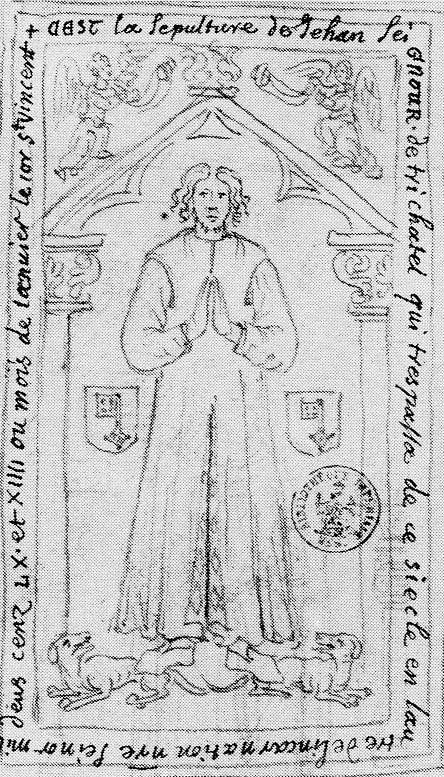
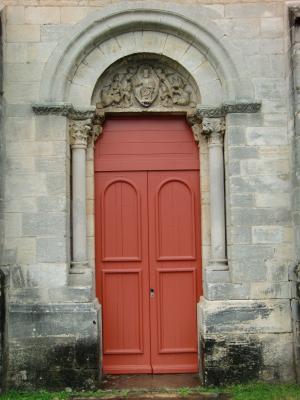
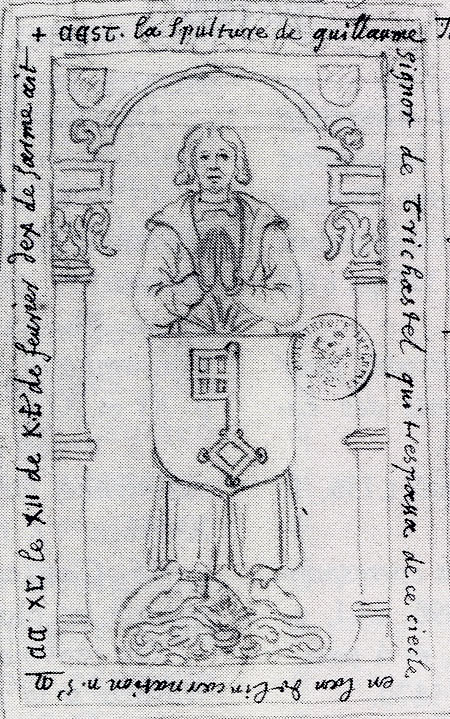
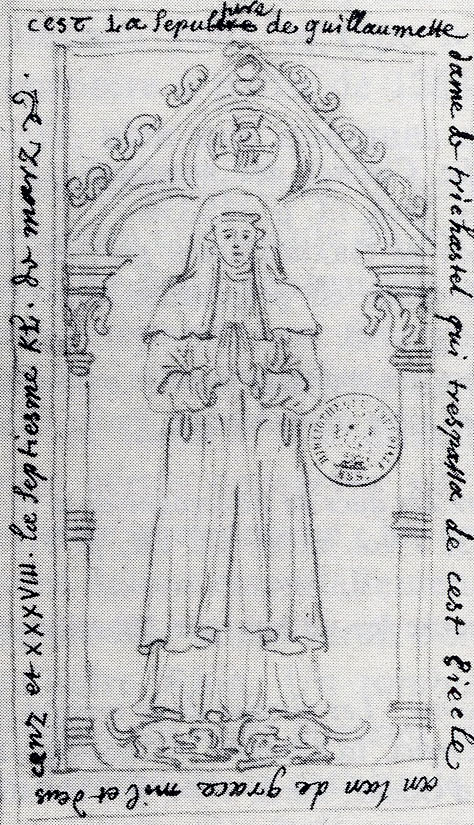
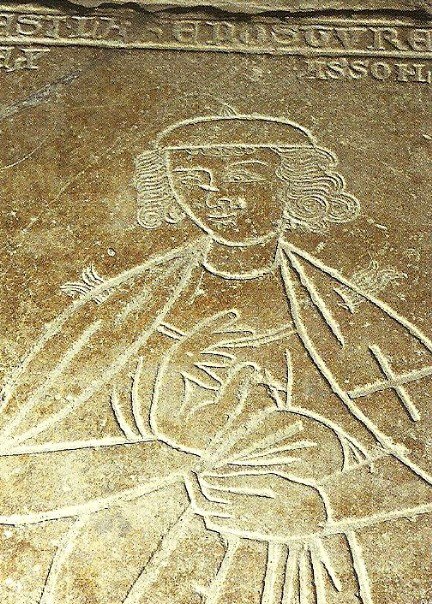
Above are the gravestones of Jean and Guillaume Til-Chatel who were Knight Templars. Here are two images of real Templars, that are very rare! The Lords of Til-Chatel became the Lords of Rougemont. The bottom image is of Knight Templar, Étienne de Til-Châtel, who is buried at Fontenotte. He may being holding a dove with olive branch.
“Til-Châtel family members will follow one another until 1299, date to which the name blends into the family of Rougemont through Til-Châtel Jeanne, daughter of Guy III of Til-Châtel. At the end of the 15th century, the last of the Rougemont, absence descendants, ceded the seigniory to Antoine de Baissey, which immediately paid tribute to the Bishop of Langres.”
I have been looking at new genealogies of the Rougemont family in the last week that suggest they were the core family that allegedly became extinct. However, if you consider the history of Leland Rosemond, our Rougemonts kindred left France for Holland, and then moved to Basel.
” This James (or Jacob, for these names were once interchangeable) was the son of Hans Ulrich Rosemond, born 1623, a weaver; who was a son of Hans, a weaver, born
1581; who was a son of Fred Rosemond, born 1552, a weaver, member of town council and a local captain; who was the son of another Hans whose date of birth is not known, but he too, was a weaver and became a citizen of Basle in 1534. His father was Erhart de Rougemont who bought in 1495 “the house called Rebleuten-Zunft in Basle in the
Freistrasse.’ Peter Rosemond further reported information from the Records Office in Basle that “before Basle the family resided in Holland up to 1338, and it is said they descended from the estate Rosemont, near Belfort, in France, where also the village Rougemont is found.”
The Rosemond/Rougemont family were Swan Brethren and belonged to several guilds. Were they carrying on Templar traditions in a more covert manner due to the alleged persecution of the Templars, and the War of Religions? I believe I have discovered a more realistic and obvious motive, that I will reveal in my book.
What I now suggest is that a DNA test be made of the bones of these Templars that include Guillamette Til-Chatel. I will submit my DNA to this study. I know other revelant people who may be my kindred. Some of this material is in the chapell of Saint-Florent, that means “in flower”. What is in a name?
Jon Presco
Copyright 2013
The pursuit of family history tends to be shaped by several motivations, including the desire to carve out a place for one’s family in the larger historical picture, a sense of responsibility to preserve the past for future generations, and a sense of self-satisfaction in accurate storytelling.[1]
Juliet.
‘Tis but thy name that is my enemy;–
Thou art thyself, though not a Montague.
What’s Montague? It is nor hand, nor foot,
Nor arm, nor face, nor any other part
Belonging to a man. O, be some other name!
What’s in a name? that which we call a rose
By any other name would smell as sweet;
So Romeo would, were he not Romeo call’d,
Retain that dear perfection which he owes
Without that title:–Romeo, doff thy name;
And for that name, which is no part of thee,
Take all myself.
http://www.lordredutemple.com/la-commanderie-de-fontenotte.html
According to Jean-Marc Roger and Marie Delphine, This is a simple house of the Temple dependent Bures, who becomes a commander after the devolution of the property of the Templars to Hospitallers. Elle a peu de dépendances, peu d’actes la concerne. It has few dependencies, few acts concerned. La première mention de la maison de Fontenotte est de 1178. The first mention of the house is Fontenotte 1178. Les seigneurs de Til-Châtel furent de généreux donateurs envers cette maison. Lords of Til-Châtel were generous donors to the house. Étienne de Til-Châtel fut chapelain dans cette maison. Etienne de Til-Châtel was chaplain in the house. Sa pierre tombale se trouve dans la chapelle. His tombstone is in the chapel.
The first task is to retrieve a golden key from the belly of a toad who lives at the bottom of a tree . In the second task she must use the golden key to retrieve a dagger, but in that room is an evil creature sitting at a table, and on the table is a feast of beautiful foods which she must not eat . The third and final task involves her taking her baby brother and delivering him to the center of the Labyrinth by midnight of the Full Moon that very same evening .
http://www.sciencedaily.com/releases/2010/02/100201171756.htm
Researchers excavating an ancient Roman cemetery made a surprising discovery when they extracted ancient mitochondrial DNA (mtDNA) from one of the skeletons buried at the site: the 2,000-year-old bones revealed a maternal East Asian ancestry.
http://www.exploratorium.edu/evidence/lowbandwidth/INT_ancient_dna.html
Heraldry, arms and Blazon – texts and images
http://lalanguedublason.blogspot.com/2012/08/la-seigneurie-de-til-chatel-ou-trichatel.html
Florent \f-lore-nt, fl(o)-rent\ as a boy’s name is of Old French origin, and the meaning of Florent is “in flower”. The feminine version is Florence. Florenz Ziegfeld.
Florent has 9 variant forms: Fiorentino, Florentin, Florentino, Florentz, Florenz, Florinio, Florino, Floris and Florus.
The lordship of Til-Châtel or Trichatel
The name of the lordship of Til-Châtel has existed under different spellings depending on the period: Tilicastro originally, then Tylicastrum, Tilchastel or Thilchastel, Trichastel or Triechastel, Trichateau or Trechateau or Trichatel, Mont-sur-Tille during the revolutionary period, and finally -Til-Châtel since 1860.
Another variant can still be found: Johanz, Lords of Tile Chastial for John of Til – Châtel in a deed dated September 1265 (see below).
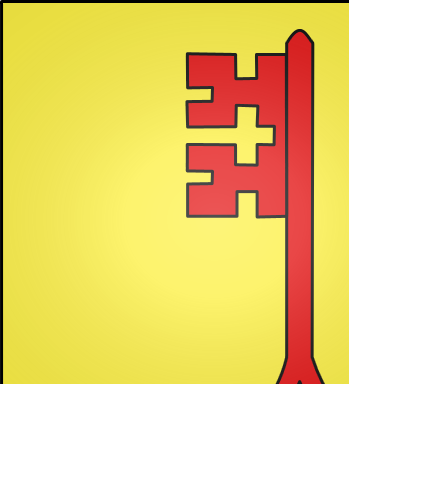
“Golden at the clef gules”,
Guy III, Til-Châtel sgr (†1299), LBR 445 (© year)
N.B. The family of Til-Châtel is why I had the greatest difficulty in finding contemporary illustrations because the first known seal dates from 1248 and the last bearer of the name disappeared in 1299.
• History of the lordship of Til-Châtel (Burgundy)
The village, located on the way Agrippa between Langres (Andemantuno) and Chalon (Cabillione) is mentioned in 230 known Filena on River Tille.
He took the name of Tilae Castrum (castrum ad tillam) later before it is destroyed during an invasion from the North, after the year 400.
After the reconstruction, the village of Til-Châtel is found under the authority of the Bishop of Langres. From the year 801, the latter concedes the Church of Tilicastro and revenues at the Augustins de Saint-Etienne de Dijon.
The Lords of the place have their origins ofAudón I of Til-Châtel, son of Garnier, count of Troyes which found the signature in an act of Richard, Duke of Burgundy, dated 918. They pay tribute to the Dukes of Burgundy.
Til-Châtel family members will follow one another until 1299, date to which the name blends into the family of Rougemont through Til-Châtel Jeanne, daughter of Guy III of Til-Châtel. At the end of the 15th century, the last of the Rougemont, absence descendants, ceded the seigniory to Antoine de Baissey, which immediately paid tribute to the Bishop of Langres. In 1618, the last of the Baissey passes the Earth of Til-Châtel to half-brother Erard of the Châtelet, which makes it a marquisate. Implementation Decree [sold to repay the debt], it is acquired in 1663 by the baron of the Housset. It is again Decree and was then bought by the widow of the latter. Marie d’Aguesseau in fact gift in 1703 to his niece Catherine d’Aguesseau, married to Charles-Marie de Saulx, comte de Tavannes. The lordship remained the possession of this family until the French Revolution.
A hypothesis on the origin of the Til-Châtel key might be that they have inherited from the Clefmont in the 12th century, but inverting the colors. (cf. P. Palasi, Armorial of the Haute-Marne, record 267 on the family of Clefmont, off in the family of Choiseul in 1370). This raises the problem of the colors of the shield of the Clefmont, but this is another issue.
• coat of arms in relation to the holders of the name, sometimes identified
-1248- [Golden at the clef gules]: seal of Hugues de Til-Châtel, sgr of Conflans (~ 1220-1250), died on the seventh crusade (1248-1254)
An illustration for the seal is proposed on the site Early Blazon.
Excerpt from A page. Baudin on Jean de Joinville (1225-1317):
“Louis IX who vowed to cross if he healed from a serious illness (1244), the Seneschal of Champagne [Jean de Joinville] announced at Easter 1248 willingness to follow the King of France, with nine of his vassals to Hugues de Landricourt and Hugues de Trichatel, Lord of Conflans, all two Knights-standard-bearers, Gautier of Écurey, Gautier de Curel, Erard de Sivry-sur-Ante”Raoul de Vanault-le-Châtel, Frédéric de Louppy-le-Château, Renaud de Menoncourt and Hugh of Ecot-la-Combe.’
– 1265 – Johanz, Lords of Tile Chastial [no representation of seal]: Jean de Til-Châtel.
Cf. Act under seal seigneurial (Burgundy) dated September 1265 (to bring the seal cited by Mr. Prinet and dated 1266?;) cf. later, in the comments under the date of 1297).
-1265-1270 -[d’Or in Chief gules], Armorial Wijnbergen 860: unnamed
-1265-1270 -[key in pale golden], Armorial Wijnbergen 1087: unnamed
-1265-1270 -[golden sand in the pal key], Armorial Wijnbergen 1088: unnamed
The illustrations were drawn by Brian Timms, but meanwhile its site has been vandalized.
-1274- [ecu to the key], gravestone of John, Lord of Tilchatel
Jean, Lord of Tilchatel (Tilchatel Church) (small, 1898)
Cf. dan Board 21 s E book. Small, history of the Dukes of Burgundy…, t. 6.
–1292-1295- s. of tchatel [Golden at the clef gules], Armorial Le Breton 445
Guy III, Til-Châtel sgr (†1299), LBR 445 (© YEAR)
Instructions for E. Boos:
“445 Sire ofriT chatel
gules key gold.
Guy III († 1299), Lord of Til-Châtel, gonfaloniere of the County of Burgundy. Son of John, Lord of Til-Châtel († 1275), guardian of Champagne and Brie, Marshal and gonfaloniere of the count of Burgundy, and of his second wife, Marie de Joinville, Lady of Marnay († 1263), married firstly in 1263, Mahaut of Courtenany (†1284), and then, in 1285, Isabelle de Rochefort(-sur-Brevon) [† ad 1309], daughter of Gaucher de Rochefort, Lord of le Puiset in Beauce, Viscount of Chartres, and of Marguerite de Plancy. In 1306, the married Humbert de Rougemont.
Wijnbergen 1087; Chifflet-Prinet 83
Europäische Stammtafeln, XV, 184-185 ”
— 1297 – Distance of Triechastel bears the Golden weapons [Chief / a key] of gheules, Armorial Chifflet-Prinet 93 or 94
This Blazon is problematic because, according to the editions of the manuscript, it meets the variations “in the head” or “a key”.
Found in the edition of the armorial by Mr. Prinet (p. 35 [= 31], online )) :
93 Distance of Triechastel bears the Golden weapons at the head of gheules (1).
(1) Gui, Lord of Thil-Châtel (Côte-d’Or, arr. of Dijon, Is-sur-Tille cant.) in 1275, 1276, 1280, 1291, 1293, gonfaloniere of the County of Burgundy (Arch. of the Doubs, B, 53, 69; Arch. of the Côte-d’Or, B 1336; Bibl. NAT., ms. French 31969, fol. 65 v, 66; Gollut, historical memories, ed. Duvernoy, col. (1744) His widow, Isabeau de Rochefort, was remarried, in 1311, Humbert, Lord of Rougemont; the eldest of his daughters, Isabeau of Thil – Châtel, married Rougemont Thibaud, son of Humbert (Arch. of the Côte-d’Or, B 10492, 10493; Peincede, t. XVII, p. 168). Through this marriage, the land of Thil-Châtel and the hereditary Office of gonfaloniere of the County of Burgundy passed to Rougemont House.
Seal Gui of Thil-Châtel (1276) is armorié with an ECU to a key and not a leader (seals of Burgundy, no. 448), as the seals of Jean de Thil-Châtel, in 1266 (Archives du Doubs, B 53) and of Isabeau de Thil-Châtel, dame de Grancey, in 1282 (seals of Burgundy, no. 489). The headstone of Jean, sire de Thil-Châtel, died in 1275, was also armoriée ECU to the key (Ernest Petit, history of the Dukes of Burgundy, t. VI, fig. 21).
In the edition proposed by G.J. Brault, latter reflects some of the P. Adam-Even notes about the armorial:
94 Distance of Triechastel bears the Golden weapons a gheules key (21).
(21) to the Chief.
Notes [on the edition of Prinet:]
[CP 94 – for the emendation Chief] a key, see Prinet, p. 31, n. 1.
S. Clemmensen assumed an error of mirroring the part of Max Prinet (record 114: “Prinet misread the legend as ‘head’ rather than ‘key’ gold key.”;) cf. scholarly publishing in pdf).
Jules Chifflet having the first copied the presumed original written in picard and dating back to the 13th century, “taking quite a lot of freedoms”, it may be rather that should have been suspect bad fill.
– 1454-1457 – Trichatel sr [empty ecu], Armorial Le Bouvier 700.
Instructions for E. Boos:
“700 sr d Trichatel
vacuum
Thil-Châtel: gold at the clef gules ; House off at the end of the 13th century in Rougemont (J.B.. of Vraivre, “Seven mounds slabs of Til-Châtel House”, in Heraldry Books No. IV, pp. 137-146;) (Prinet XXIV). ”
– 1560 – Tricastel, gate of gold at wrench gules, in Palliot p. 175.
Tricastel (Palliot, p. 176)
– 1770 – Tricastel door gold key in Pale gules, rather than gules to the silver key, in Ménestrier p. 216.
Tricastel (Ménestrier, windsurfing XXXI, fig. 1)
N.B. The illustration is incorrect, what the text says but few explicitly.
– 1884 – Trichatel – Ile-de-France, Picardie – gold at wrench gules in pal, in Rietstap.
Til-Châtel (Rolland from Rietstap)
• To go further – variants in the family name and in representation of the ecu
If the graphic change ‘castel/chastel/Châtel/Castle’ is relatively well known in French, metathesis is less (inversion of vowels and consonants within a Word). It is recognisable in the Til-Chastel pair / Tri-Chastel. If you know that the consonants “l” and “r” are two close achievements at the phonetic level, and that metathesis is a specificity of the picard talk, one might wonder if the variants “Tri-…” would be not specific time where the Lords of Til-Châtel settled in Picardy (cf. Rietstap reference)
At the level of the representation of the coat of arms, the confusion between “head” and “key” has been very punctual and inconsequential subsequently.
History of the Rosemond Family
_________________________________________
Compiled and Written by
Leland Eugene Rosemond
_________________________________________
New York, New York
Printed by the Waterman Press, 1938
End of Title Page here
FOREWORD
The writer has for many years been interested in knowing more of the
Family History and about the name Rosemond and its variations. He
has, therefore, collected material form different sources and is now
putting it into book form, so that it will not become lost; also to
the end that others who desire it, may have it.
The writer learned that the members of the Rosemond family as a whole
have not had any great interest in preserving records of the family
but have permitted them to become lost or misplaced. The interest on
the part of many has not been great, and it has been hard work trying
to get authentic information. It has been secured only after many
years, and the fact that it is so complete even now is due almost
entirely to the efforts of Fred L. Rosemond of 40 West Long Street,
Columbus, Ohio. He has spent years in trcing the ancestory of the
family and has collected the details concerning “Philip the Elder”
and much about “Edward the Elder” in this country. (The
designation, “elder,” is simply for the purpose of distinguishing the
first members of the family to have the names Philip and Edward from
later members of the family who had the same given names.)
This booklet would not have been possible were it not for Fred L.
Rosemond’s most help cooperation and the information turned over to
the writer which was secured entirely by the formers efforts. Much of
this is printed exactly as written by him. He gives credit, where
due, for the assistance he received so it need not be repeated here.
The writer’s side of the family for years spelled their name Roseman
and this was the real cause of this History being printed. For years,
in fact since childhood, the writer remembers his father, Edward
Monroe, telling about the family in Ireland and of his saying that
the name had been changed in
Book shows end of PAGE 1 here
spelling as compared to the original. His father told of many members
of their family having died in Guernsey County, Ohio, of a
disease “Milk Sickness.” He, himself, almost succumbed. His father
and other relatives died from this disease. This left him (Edward
Monroe), who was the eldest of twelve children, head of the family at
the age of twenty-one. They suffered many hardships over the period
fo the next few years. The mother died six years later and the family
split up, moving to different sections. They lost race of each other
to a great extent. Some members of the family continued spelling the
name Roseman while others used the original spelling of Rosemond.
THe change occurred with this branch, which did not retain the
spelling as Rosemond about this time. Edward Monroe’s father, who was
Joseph Rosemond, born December 13th, 1802, and who was the son of
Edward, the elder, signed his name both as Rosemond and as Roseman,
also at times as Rosman. Edward, the elder, did likewise. However,
when they took or passed title to land it was always as Rosemond. It
will be noticed later in this book that Edward, the elder, signed his
name as Rosman at the time he was naturalized. However, he used the
correct spelling of Rosemond when taking title to land, in marriage,
and was buried with the spelling on his tombstone as Edward Rosemond.
Naturally, many omissions will be found in this History of the
Rosemond Family. There has been no attempt
to make it a complete history. It is printed to give information on
the name, the derivation, and mainly concerning the ancestry of
Edward, the elder, and Philip, the elder, and some of their
descendants. It will enable those, who have the desire, to preserve
the information for their descendants.
The writer, Leland Eugene Rosemond, at present living at Scarsdale,
New York, married Emma Janet Ray in Syracuse, New York, at the home
of her father and mother, Mr. and Mrs. Earle Knox Ray. The service
was making it a complete history. It is printed to give information
on the name, the derivation, and mainly concerning the performed by
Rev. Dr. Rock-
Book shows end of Page 2 here
wood Ferris, September 24, 1927. There are tow children, Leland Ray
Rosemond, born September 19th 19__ (year was blacked out), and Janet
Rosemond, born September 13th, 19__ (year was blacked out). Both were
born in Boston, Mass.
Throughout the following pages will be found many paragraphs in
quotation marks. These are
exactly as written by Fred L. Rosemond. Much of the information
secured by the writer is a
duplication of this, so the quotations are taken direct from Fred L.
Rosemond’s record.
Leland E. Rosemond
March, 1938
Scarsdale, N. Y.
THE NAME ROSEMOND
Some confusion seems to have resulted from the fact that more than
one origin for this name has existed. The oldest, perhaps, is the
Teutonic “Hrosmond”, conspicuous as far back as the 6th century in
the history of the Gepidae and the Lombards of northern Italy. “Mond”
in the Anglo-Saxon signified the protection given by a noble, or
chieftain, to this dependents of every kin, and the name signified
among them strong, or famous, protection. The form “Rosenmund”,
usually reckoned as German, has been interpreted as “rose of the
world,” form the Latin “mundus” for world. In Danish the name appears
as Rozamond; in French, as Rosemonde, in Italian, as Rosmonda, and in
Latin and Spanish, as Rosamunda.
“The Huguenot tradition in the family, confirmed by such sources as
O’Hart’s Irish Pedigrees and Agnew’s French Protestant Exiles,
suggests a French origin also and this has been found in the
name “Rougemont”, still perpetuated by the name of a village in
southeastern France, near Switzerland, and another village in
southwestern Germany. Why this source seems preferable for our origin
will be mentioned again.
Book shows end of PAGE 3 here
“Such a name, transported to other countries and dealt with in other
languages, was certain to be changed and even distorted. Our own
people have at times adopted the form “Roseman”, or “Rosman”,
or “Rossman”, or “Rosmond”, or “Rosmon”. The first three forms are
common in Germany although wholly unconnected with our family. Elders
in the family have held the view that the presence of the “d” is
significant and, since it is the equivalent of the “t”
in “Rougemont,” that seems reasonable. As many as thirty variations
are found, and yet the name in any form is not a common one in this
country if the German forms above are to be disregarded.
“In the Southern states among those identified with our line in
Ireland, the form “Rosamond” prevails as it does in England and
Canada, but the legends of “Fair Rosamond” Clifford which popularized
it there have no significance for us. It is, in one form or another,
the name of towns, but inquiry has developed that our family had
nothing to do with giving them.
“It is not to be thought surprising, therefore, if persons bearing
the name be found whose ancestry traces back along a line quite
different from the Huguenot line.”
THE “ROUGEMONT” ORIGIN
The gracious and intelligent aid of Peter Rosemond of Flushing,
Holland, who lived for some years in Basle, Switzerland, was a large
contribution to the writer’s* investigation of the Huguenot
tradition. His family went from Basle to Holland in 1754. Researches
he made over many years, including 1911 to 1917 in Basle, furnished
him with material which he regarded as identifying us with a James
(or Jacob) Rosemond, born in Basle, January 1st, 1654 (which date is
not far from our traditional date of `about 1655′) who left home and
who did not reappear there even for the reading of
_______
*Fred L. Rosemond
Book shows end of Page 4 here
his father’s will in 1679 nor thereafter. This James (or Jacob, for
these names were once interchangeable) was the son of Hans Ulrich
Rosemond, born 1623, a weaver; who was a son of Hans, a weaver, born
1581; who was a son of Fred Rosemond, born 1552, a weaver, member of
town council and a local captain; who was the son of another Hans
whose date of birth is not known, but he too, was a weaver and became
a citizen of Basle in 1534. His father was Erhart de Rougemont who
bought in 1495 “the house called Rebleuten-Zunft in Basle in the
Freistrasse.’ Peter Rosemond further reported information from the
Records Office in Basle that “before Basle the family resided in
Holland up to 1338, and it is said they descended from the estate
Rosemont, near Belfort, in France, where also the village Rougemont
is found.” A family coat-of-arms was registered in Basle about 1537
when the first Hans became a resident there. A reproduction of this
coat-of-arms in the writer’s possession shows a weaver’s crook
conspicuously, and it will be remembered that in Ireland our people
were linen weavers and farmers, and that Edward, the elder, was a
weaver in this country. Peter Rosemond had seen in print the letters
from Erasmus to Gotschalk Rosemondt. He noticed that a seal used by a
Rosemont in Holland, bearing a jumping fox, was like an emblem he had
noticed in a wall of the house Rebleuten-Zunft in Basle. This seal
dated back to 1430, whereas the coat-of-arms above mentioned dates
from 1534, it seems. Peter Rosemond died September 22, 1930. This is
but a sketch of what he wrote.”
http://www.knightstemplar-uk.co.uk/holygrail.html
The Holy Grail & the Keepers of the Faith
Who were the keepers of the wisdom and sacred secrets all these years? Was it the Knights Templars, guardians of the truth and keepers of the faith? Do they have the Ark of the Covenant that Moses had? Is the Holy Grail really the bloodline of Jesus Christ? Are the Knights Templars the guardians of that bloodline? Why did the church hunt them down to destroy them? Was it because of the knowledge they have, even to this day? Is there a direct descendant of Jesus alive today, if so who is he/she? Would such a bloodline be powerful? Or is the real Holy Grail and secrets the truth about our planet, Humans & secret enemies within. Our we all living an illusion of freedom? Our the Templars the real Gedi Knights. Is there a secret WAR OF THE WORLDS going on today?
http://lib.znate.ru/docs/index-291941.html?page=39
http://www.bibliotecapleyades.net/sociopolitica/esp_sociopol_dragoncourt06.htm
http://www.oocities.org/vampiricstudies/knights.html
http://www.lordredutemple.com/la-commanderie-de-fontenotte.html
According to Jean-Marc Roger and Marie Delphine, This is a simple house of the Temple dependent Bures, who becomes a commander after the devolution of the property of the Templars to Hospitallers. Elle a peu de dépendances, peu d’actes la concerne. It has few dependencies, few acts concerned. La première mention de la maison de Fontenotte est de 1178. The first mention of the house is Fontenotte 1178. Les seigneurs de Til-Châtel furent de généreux donateurs envers cette maison. Lords of Til-Châtel were generous donors to the house. Étienne de Til-Châtel fut chapelain dans cette maison. Etienne de Til-Châtel was chaplain in the house. Sa pierre tombale se trouve dans la chapelle. His tombstone is in the chapel.
The first task is to retrieve a golden key from the belly of a toad who lives at the bottom of a tree . In the second task she must use the golden key to retrieve a dagger, but in that room is an evil creature sitting at a table, and on the table is a feast of beautiful foods which she must not eat . The third and final task involves her taking her baby brother and delivering him to the center of the Labyrinth by midnight of the Full Moon that very same evening .
http://www.sciencedaily.com/releases/2010/02/100201171756.htm
Researchers excavating an ancient Roman cemetery made a surprising discovery when they extracted ancient mitochondrial DNA (mtDNA) from one of the skeletons buried at the site: the 2,000-year-old bones revealed a maternal East Asian ancestry.
http://www.exploratorium.edu/evidence/lowbandwidth/INT_ancient_dna.html
Because of the claims by Corbu, Rennes-le-Château became the centre of conspiracy theories about Saunière’s mysterious wealth. The story grew in the telling, from the initial rumours that perhaps he had uncovered hidden treasure, to speculation that he had discovered secrets about the history of the Church, which could threaten the foundations of the Catholic Church. The entire area around Rennes-le-Chateau has become the focus of increasingly sensational claims involving the Knights Templar, the Priory of Sion, the Rex Deus, the Holy Grail, the Knights Templar and the treasures of the Temple of Solomon, the Ark of the Covenant, ley lines, Cathars, Montségur (another Cathar Castle), Druids, Jesus, Mary Magdelene, space aliens and sacred geometry.
http://www.castlesandmanorhouses.com/renneslechateau.htm
 Rosamond Press
Leave a comment