
Jane of Haddon Hall
by
John Presco
ALL RIGHTS RESERVED
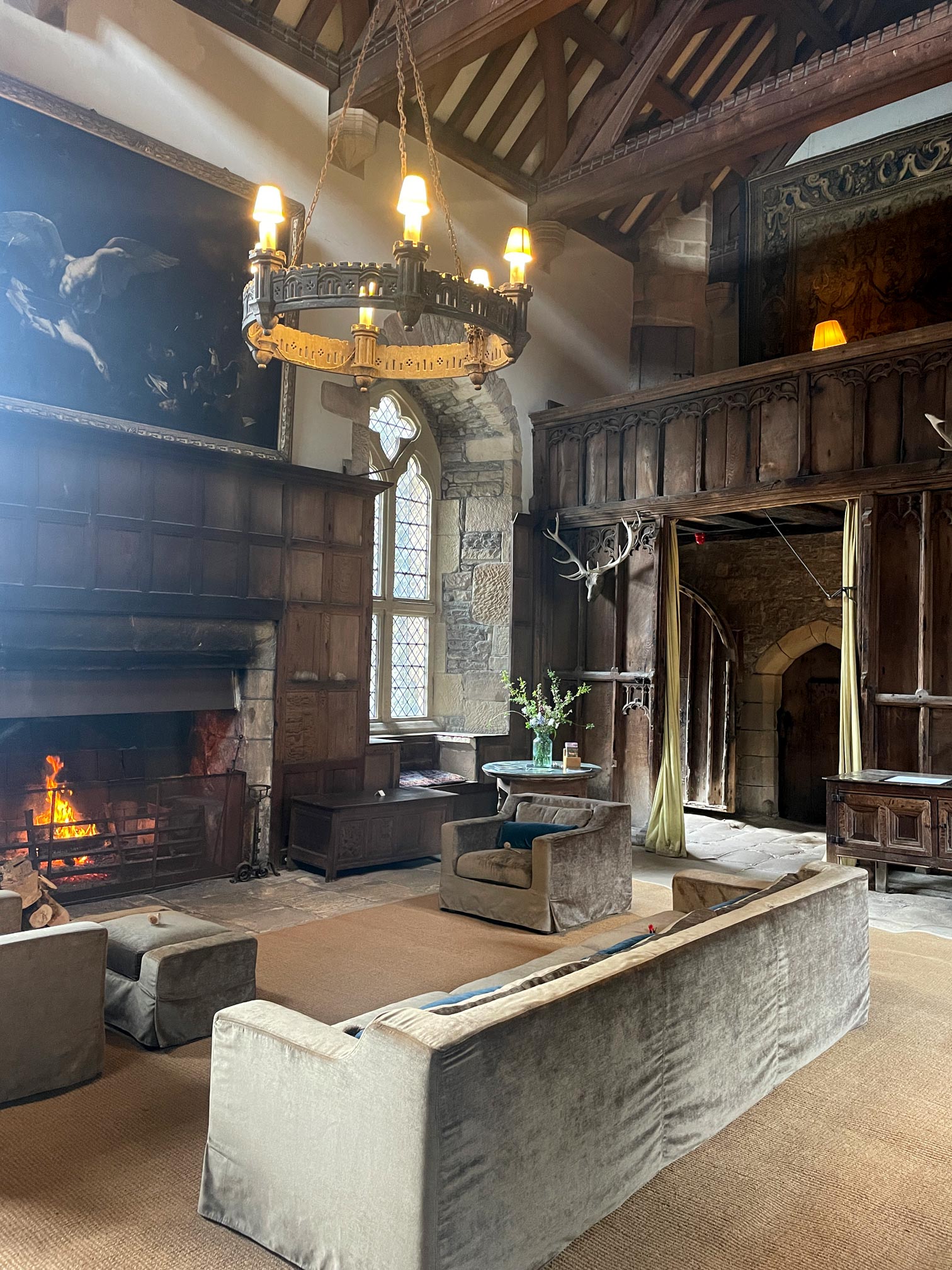
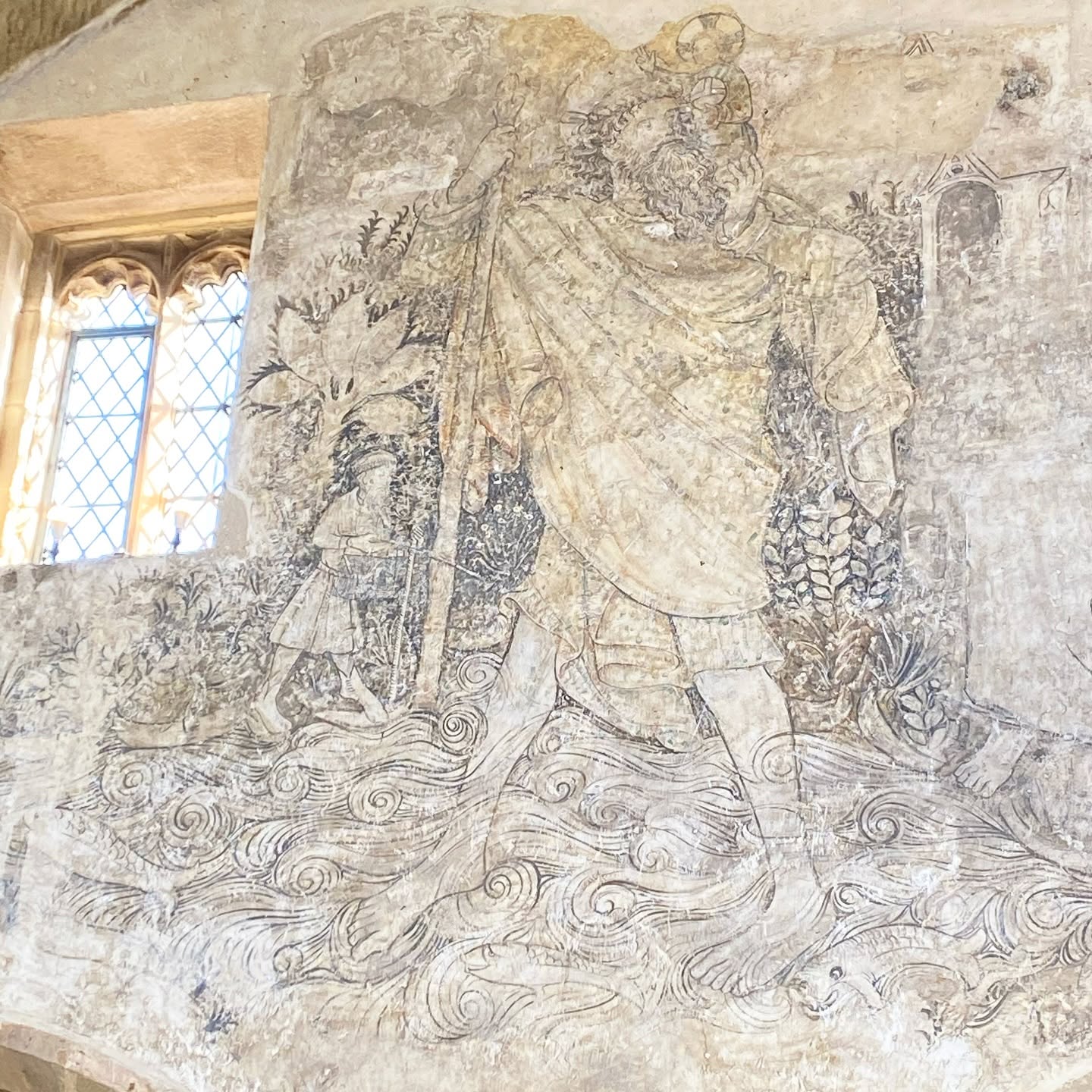
At 4:38 PM on August 4, I discovered Hadden Hall was used as Thornfield Hall. I was looking at images of the mural that was un-covered by Lady Ursula and they reminded me of the work of Garth Benton, who sued the Gettys for painting over his mural – with white paint.
I thought about Rena being a ballerina like Ursula, and I thought about her reading Jane Eyre on the beach – with her back to the sea. I have long wondered if she saw me a Mr. Rochester. I told her we are not going to have intercourse anymore, because she lied to me about her age. I did not know she was adopted, and, was in character. This is when she fell in love with me.
This is beyond un-canny and, borders on the Twilight Zone. Rena’s destiny was to live at Haddon Hall…..forever, and ever! She is not a ghost, or a haunt. She is….
A Great Muse
I have been looking for her home. Jane Irene Victoria Easton, led me to another unsung muse. How could I have missed her? Here is…
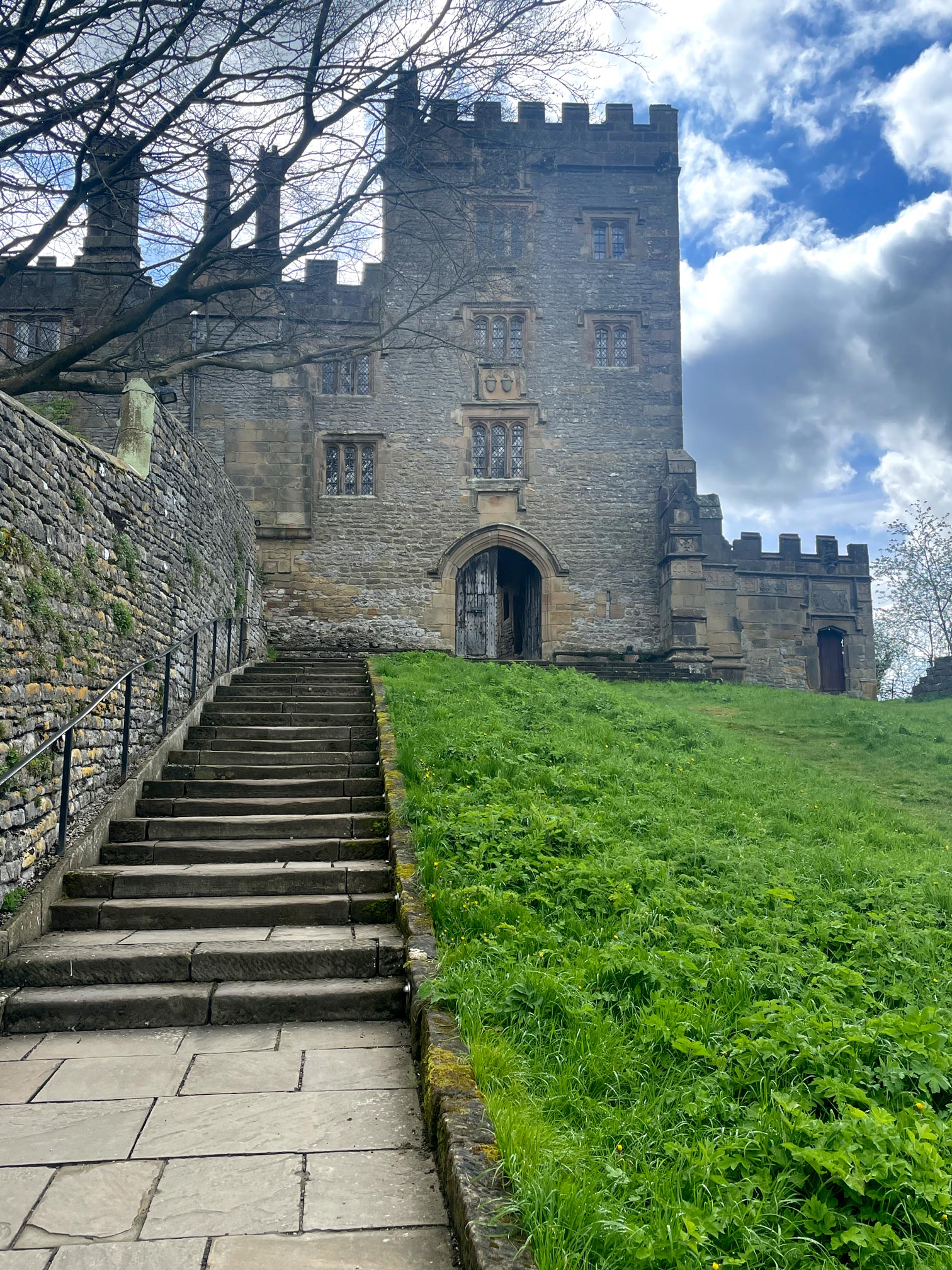
The Great Stage of the Great Muse. Here are the stairs the muses climb, to that utterly creative place, and our human time to do something…..Grand!
I will meet you here, my beloved Irene. Again and again, at the top….
of the stairs!
John Presco
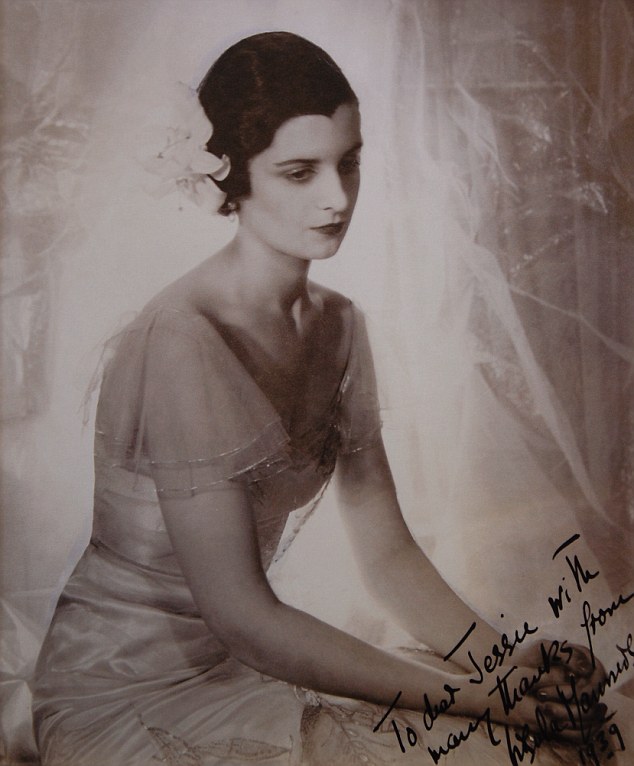
The forthcoming publication of Lady Ursula’s memoirs, The Girl With The Widow’s Peak, will appeal to admirers of Mitfordiana. Born in 1916 to the Marquess and Marchioness of Granby, Lady Ursula’s memoirs recall a gilded age at the centre of high society. Recalling her childhood spent at Belvoir Castle in Leicestershire, the rigid formalities of liveried servants, maids and the ‘pig man’ are reminiscent of Downton Abbey. Following her father’s ascent to the Dukedom of Rutland in 1925, Lady Ursula writes about the extensive restoration of another Manners’ family seat, the medieval Haddon Hall in Derbyshire. Fans of Debo and the restoration of Chatsworth are sure to enjoy this section of the book!
Lady Ursula first lived at Wood House, a small farmhouse in Derbyshire, and at a residence in London.[5] She spent a lot of time at the family estates, Haddon Hall and Belvoir Castle, the latter of which she moved to once her father inherited the dukedom in 1925.[6] When she was eight years old, she helped her father with the restoration at Haddon Hall, where she discovered medieval frescoes of Saint Christopher in the chapel. These had been whitewashed over during the English Reformation.[7]
 |
| Ballroom mural by Garth Benton in the Getty Residence, San Francisco |
A couple of years later Mr. Benton made headlines for suing his clients, Ann and Gordon Getty, for having painted over one of his older murals in their San Francisco home, which he had hoped to photograph for a glossy catalogue raisonné of his work. The mural had been painted on canvas and could easily have been removed, but the Gettys had not realized this when they redecorated, and had to settle a large amount of money on him for the error. While I felt deeply over the heartbreaking loss of the artwork, the case made me cringe: suing an otherwise supportive client likely didn’t help his future business. The mural is still gone and the book was never published.
Depiction

Haddon Hall, near Bakewell, Derbyshire, has been used to depict Thornfield on several occasions: for the 1996 film directed by Franco Zeffirelli (starring William Hurt and Charlotte Gainsbourg); in the BBC 2006 mini series directed by Susanna White (Toby Stephens and Ruth Wilson), and for the 2011 film (Mia Wasikowska and Michael Fassbender) directed by Cary Fukunaga.[3] In 1996 and 2011 Wingfield Manor, in Derbyshire, was used to depict Thornfield after the fire, and in 2011 Chatsworth House was used for the gardens.[4][5]
Other locations include Ripley Castle, Yorks, in 1970;[6] Renishaw Hall, Derby, in 1973;[7] and Deene Park, Northampton, in 1983.[8] The 1997 film used Naworth Castle, Cumbria, for the exteriors and Knebworth House, Herts, for the interiors.[9]
The story of the Haddon Hall Chapel skeletons
- Post authorBy Helen Moat
- Post date12th June 2025
Haddon Hall Chapel has more than a few skeletons in its closet. And on its walls.
In this article, Helen Moat – author of our Slow Travel guide to the Peak District – explores one of Derbyshire’s most beautiful chapels.
Inside Haddon Hall Chapel
Tucked in a corner of the courtyard at Haddon is the hall’s chapel. It takes a few seconds for the eyes to adjust to the diffused light in this ancient place of worship, dating back to the 12th century in places, and even longer to take in everything this small space has to offer.
The colourful east window dates back to 1427, with a finely detailed and intricately carved alabaster reredos of the crucifixion beneath it. In the nave, there’s a touching alabaster effigy of a child in peaceful repose: nine year-old Robert Charles John Manners, deeply mourned by his mother Violet.
All around, the rough walls are covered in splendid 15th century wall paintings, busy with leaf and flower patterns, but also of religious figures and scenes: a resplendent St Christopher; St Nicholas blessing the passengers on board a small sailing vessel; three children, also being blessed – rather bizarrely in a tub; a forest hunting scene and, most curious of all, a rather disturbing sketch of three skeletons. Gill Shimwell, Haddon Hall guide (and friend) explained the story behind the skeletons to me.
- Recommended reading: how to walk from Grindleford to Hathersage

The grounds at Haddon Hall are spectacular
The skeletons
Sections of the walls of Haddon Hall’s chapel were whitewashed over, as not all the paintings were scriptural. On one wall, all that’s left are three skeletons. The story of the skeletons is a memento mori, instructing the medieval lords and privileged aristocracy ‘look after your peasants and treat them well, because underneath all those fine clothes, you are just men and women who are going to die.’
The story goes that three kings were riding through the forest when they came to a silent clearing with no birdsong. No matter how much the kings cut and slashed and spurred their horses, the animals wouldn’t move. So the kings got off their horses and walked in. And there they drew their swords, hacking away to see if they could find anything. Three skeletons, at first kneeling in the grass, jumped up and towered above them with a great rattling of bones. Out of their cavernous, empty ribs came voices that boomed and rustled and creaked and said:
“As you are now, so once were we. As we are now, so you will be.”
The three kings ran away, but that night they were killed in their beds in the town where they were staying. Centuries later, in the early 20th century, as the duke and duchess pulled away the whitewash, the kings crumbled with the wash, while the skeletons remained. And so it is today.
If you have more time to explore the Peak District, check out Buxton, the Bath of the Midlands.
More information
For more information, see our Slow Travel guide to the Peak District:
A Family Home
The current owners of the house can trace their lineage back to the early 12th century. This continuity probably accounts for the development of the house over the centuries without drastic alterations. Even when it passed to the Manners family it was due to matrimonial union. Dorothy Vernon was the daughter and heir of Sir George Vernon, whose family had owned Haddon since the 13th century. She married Sir John Manners and they inherited the house in 1565.
The family moved to Belvoir Castle in 1703 resulting in the house being empty for 200 years, thus preserving the house’s integrity and saving it from the Victorian temptation to over-restore.
The subsequent restorations begun in the early 20th century have been done with the intention of preservation rather than modernisation. All these factors have created a medieval masterpiece to be enjoyed.
This week I was saddened to learn of the passing of a great muralist, Mr. Garth Benton, an internationally recognized artist who was well known for his stylish first-century style trompe l’oeil decoration of the magnificent Getty Villa in Malibu, California.
The novel revolutionised prose fiction, being the first to focus on the moral and spiritual development of its protagonist through an intimate first-person narrative, where actions and events are coloured by a psychological intensity. Literary critic Daniel S. Burt has called Charlotte Brontë “the first historian of the private consciousness”[4] and the literary ancestor of writers such as Marcel Proust and James Joyce.[5]
Thornfield Hall
Main article: Thornfield Hall
After six years as a pupil and two as a teacher at Lowood, Jane decides to leave in pursuit of a new life, growing bored with her life at Lowood. Her friend and confidante, Miss Temple, also leaves after getting married. Jane advertises her services as a governess in a newspaper. The housekeeper at Thornfield Hall, Alice Fairfax, replies to Jane’s advertisement. Jane takes the position, teaching Adèle Varens, a young French girl.
One night, while Jane is carrying a letter to the post from Thornfield, a horseman and dog pass her. The horse slips on ice and throws the rider. Despite the rider’s surliness, Jane helps him get back onto his horse. Later, back at Thornfield, she learns that this man is Edward Rochester, master of the house. Adèle was left in his care when her mother, a famous dancer, abandoned her. It is not immediately apparent whether Adèle is Rochester’s daughter.
At Jane’s first meeting with Mr Rochester he teases her, accusing her of bewitching his horse to make him fall. Jane stands up to his initially arrogant manner. Despite his strange behaviour, Mr Rochester and Jane soon come to enjoy each other’s company and they spend many evenings together.
 Rosamond Press
Leave a comment