
Pioneer Log Cabin in Golden Gate Park
San Sabastian Avenue
On May 29, 2026, I found a cabin that was visited by my ancestors who were members of the Association of Pioneer Women of California. I could have brought my daughter and newborn grandson here – after we went to the Stuttmeister crypt in Colma. Tyler is two months old. Here is my daughter, Heather Hanson. breastfeeding her beloved baby boy. How….motherly! We did not know about the handwritten account of our ancestor, and the glorious cabin.
Belmont is celebrating a century of their history, and our Nation is celebrating it’s 250th. Anniversary. I am going to try to get this history included in the Belmont time capsule. Augusta D. Stuttmeister is the granddaughter of Carl Augustus Janke, who brought six portable houses around the Cape in 1848 and erected them in Belmont California.
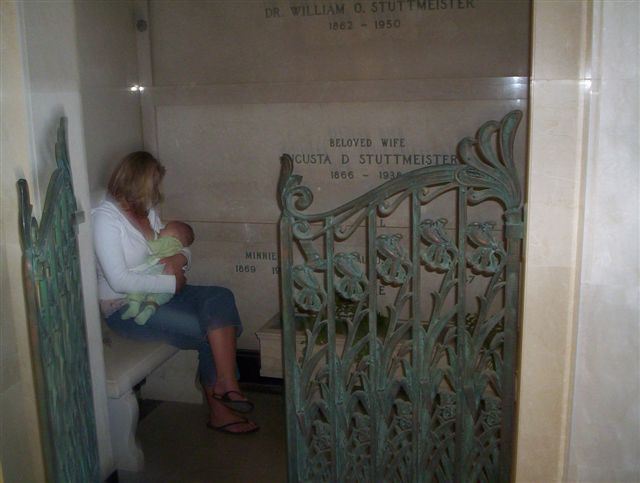
Carl Janke and family are mentioned, but, Janke is spelled Janki. I will get this corrected. I am looking at having my grandson, Tyler Hunt, designated a National Treasure. I will write Governor Newsom and the Japanese Government. As it is, this is Tyler’s resumé. He is….The Giant of the Woods! He is the great, great, grandson of Carl Janke, whose bones need to be exhumed from the mass-grave in Redwood City, and a DNA test conducted. Perhaps our remains can find a home amongst…
THE PIONEER MOTHERS?
Tyler will guard them, This cabin was built, and a handwritten account was made specifically for descendants of an mazing Historic Pioneer Tree. I am reminded of Tolkien and Joaquin Miller, as well as the Pre-Raphaelite Artists. Then, there are the California Poets, Tyler’s great grandfather, Royal Rosamond, is amongst them. How about Jack London, who lived and worked in Belmont? Did he visit this place?
We are a very young nation. Two hundred and fifty years is a drop in the bucket. The handwriting of 800 hundred American Pioneer Women, who had come to the Western Edge of our Nation – where they born children to inhabit this heavily place, is profoundly important in seeding our National Tree. What became of their children is recorded in the words of a Western Grandson, who owns a newspaper named after my grandfather.
I am going to contact Governor Newsom, and bid him to launch an investigation as to why there are two tombstones for the founder of Belmont, and, why he is in the same grave as his mother-in-law. Would the Governor like to be buried with his mother-in-law? In founding the Pioneer Women, my outrage is not lessened, but…
INCREASED TEN FOLD!
Think about it! When did Catharine “Mutter” Hendrickson sail around the Cape? What does “Mutter” mean?
Tyler says he would like to be employed working events. I see thousands of descendants celebrating ‘Carl Janke Day’ in front of the Pioneer Cabin, in a glade.
According to his granddaughter, Carl Janke built the first Turnverein in San Francisco. When it burned down – he built a replacement! He built one in Redwood City! Carl was a builder! Why is he depicted as a ruthless German come to America to get good citizens all liquored-up, and thrown in a jail….he built? When you take someone’s land away, and dig them out of their grave at midnight, you will want to use the local press to depict my great great, grandfather – as a demon! Those evil days, and those lying ways….are behind us now!
Tall ships will arrive in Washington. What ship did the Janke family sail on that entered the Golden Gate. Was there a child on board. Who was her…..
MUTTER?
John Presco
President: Royal Rosamond Press
Table of Contents Previous | Next Random Click to enlarge image
“Elizabeth D. Johnson Birth Place: Germany Pioneer Father: Carl August Janki Birth Place: Germany Date of Arrival in California: Sept. 12, 1850 Pioneer Mother: Anna Dorthea Peterson Birth Place: Germany Date of Arrival in California: Sept. 12, 1850 Death: Father: Belmont 1881; Mother: […]”
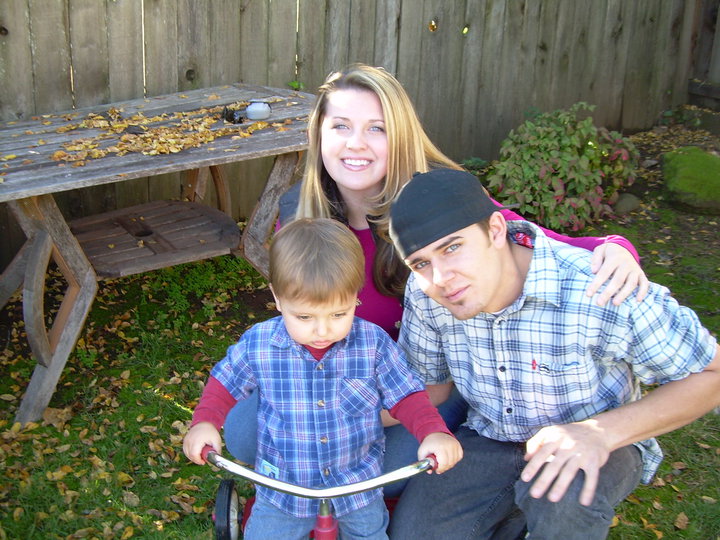
Heather, Tyler, and Ryan Hunt

German: Derived from muoter (mother), it often served as a matronymic or a nickname for a nurturing person.
Background, origin and meaning of Mutter:
The name “Mutter” translates directly to “mother” in German. As such, it doesn’t have a conventional etymological origin as a given name, but rather derives from the Proto-Germanic word “mōdēr” and the Proto-Indo-European root “*méh₂tēr,” both also meaning “mother.” It is not typically used as a personal name but rather as a familial title. Derivable or associated names are rare, given its primary function as a noun.
Because “Mutter” is not a conventional personal name, there are no famous persons directly bearing this title. However, countless famous individuals have been celebrated as mothers, embodying the qualities associated with the word.
Mutter is most popular in the following countries: Germany, United Kingdom, United States, Switzerland, France

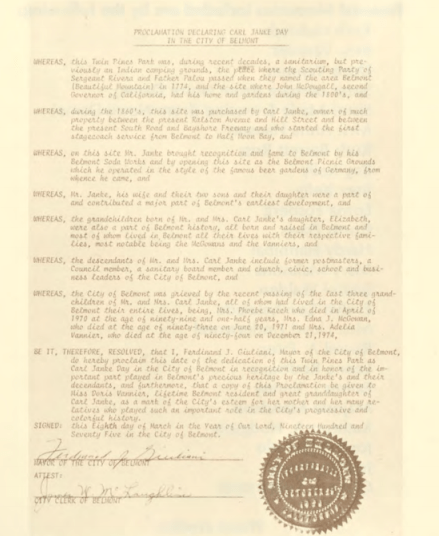
https://www.findagrave.com/memorial/87628501/augusta-d-stuttmeister
— From the 1950 headstone survey — (and the current stone)
JANKE
ANNA D
Died Feb 16, 1877
CARL A.
Died Oct. 31, 1881
CATHERINE HENDRICKSON
— From the 1937 headstone survey — (apparently there was a different stone)
Carl August Janke, born in Dresden, Germany Oct. 1806,
died Belmont, Calif. Sept. 2, 1881
Dorette Catherine, wife of Carl August Janke,
born in Hamburg, Germany, July 21, 1813,
died in Belmont, California, Feb 16, 1877
Mutter Heinrich, mother of Dorette Catherine Janke,
born in Island of Heligoland, Germany, 1781 died
in Belmont, California 1876
Family Members
Parents
Spouse
Association of Pioneer Women of California

As preparations were being made for the commemoration of California’s Golden Jubilee (celebrating fifty years of statehood on September 9, 1900), a letter printed in a San Francisco newspaper asked why “no provisions had been made for the pioneer mothers” and, in turn, The Association of Pioneer Women of California was formed. Their mission was to collect and preserve the reminiscences of women arriving in California before January 1, 1854.The founding members of The Association of Pioneer Women of California and their women descendants had a log cabin erected in San Francisco’s Golden Gate Park, where they hosted events honoring the contributions of pioneer women. Although the organization disbanded in 1970s, the log cabin remains popular with park visitors.
Of greater interest to historians, however, are the hundreds of first-person accounts, detailed descriptions, and engaging reminiscences that the organization collected from its members and compiled in a large book. These handwritten entries, all from the unique perspective of a pioneer woman or her daughter, create a more complete and balanced understanding of our shared history; previous records of this time were most often written by, and about, men. Recently donated to our research library by the estate of the organization’s last president, the ledger is being exhibited and published online for the first time.
“In 1972, faced with the possibility of the park being re-zoned for offices and apartments, concerned citizens campaigned to save it, and in 1973, the park and old Manor House were designated city landmarks. Today, the Twin Pines Park is headquarters for a number of civic and artistic endeavors serving Belmont’s population of 27,000.
Despite the recent gentrification of Belmont — delis, cell phone stores, bistros and coffee houses not withstanding — the most glamorous thing about the town remains the legendary Billy Ralston and his estate.
Bay from Belmont hills showing Red Rock Hill. Doris Vannier has picture of sister Florence, when 6 years old, during dedication of cabin in Golden Gate Park for California Pioneers . Bill Knowland is holding her hand. Ellie will have picture copied . Tom Seivert mentioned picture of people in grandstand at dog track from Earl Miller . Doris Vannier said there were more people at the dog track than lived in Belmont. There were thousands. Eve Sterry discussed Historical Bay Tree in the Park . Doris Vannier told of Carl Janke & wife being buried there before being moved to Union Cemetery in R.C. Denny suggested further discussion & permission from City Council . Tom suggested that this was a good idea and should be put on the agenda for new business
https://sfrecpark.org/933/GGP—Pioneer-Log-Cabin-Picnic-Area
Park Picnic Area Information
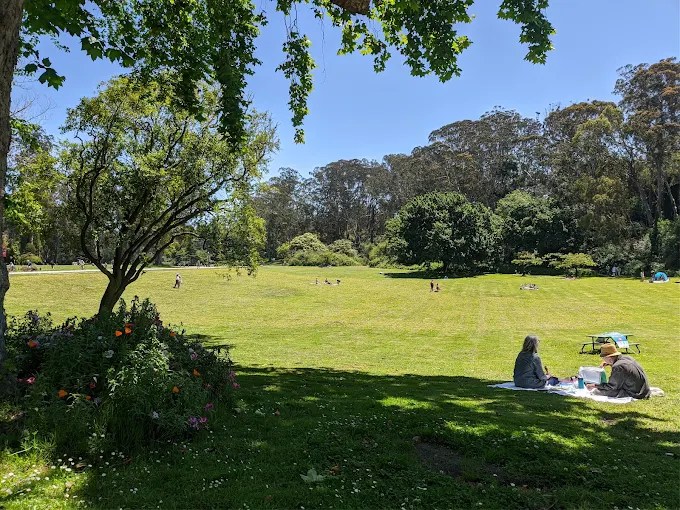
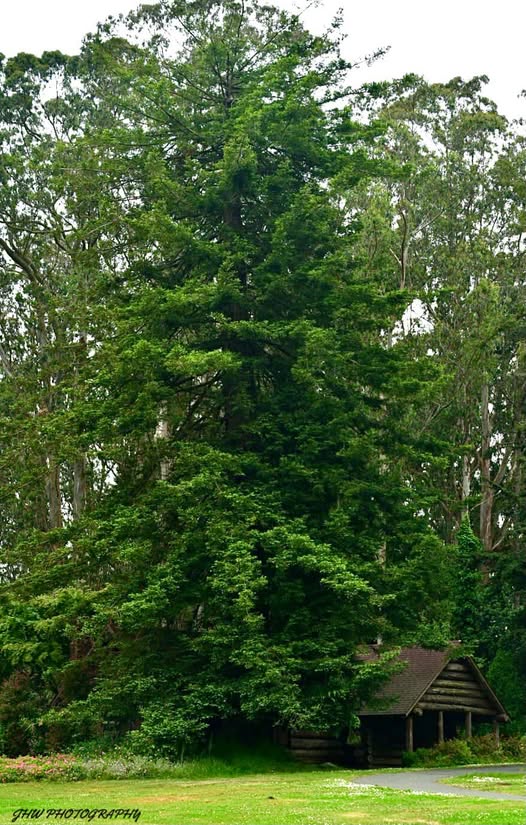
The expansive field of the Pioneer Log Cabin picnic area is framed at the back by tall trees and nested up against the picturesque Pioneer Log Cabin, making it one of the prettiest gathering spots in all of Golden Gate Park. The Pioneer Log Cabin’s grass, tables and grills offer the perfect San Francisco lawn party spot – book it today!
Address
https://www.facebook.com/tyler.hanson.14811692
Association of Pioneer Women of California
As preparations were being made for the commemoration of California’s Golden Jubilee (celebrating fifty years of statehood on September 9, 1900), a letter printed in a San Francisco newspaper asked why “no provisions had been made for the pioneer mothers” and, in turn, The Association of Pioneer Women of California was formed. Their mission was to collect and preserve the reminiscences of women arriving in California before January 1, 1854.The founding members of The Association of Pioneer Women of California and their women descendants had a log cabin erected in San Francisco’s Golden Gate Park, where they hosted events honoring the contributions of pioneer women. Although the organization disbanded in 1970s, the log cabin remains popular with park visitors.
Of greater interest to historians, however, are the hundreds of first-person accounts, detailed descriptions, and engaging reminiscences that the organization collected from its members and compiled in a large book. These handwritten entries, all from the unique perspective of a pioneer woman or her daughter, create a more complete and balanced understanding of our shared history; previous records of this time were most often written by, and about, men. Recently donated to our research library by the estate of the organization’s last president, the ledger is being exhibited and published online for the first time.
The Ledger
Table of Contents Transcriptions Keyword Search
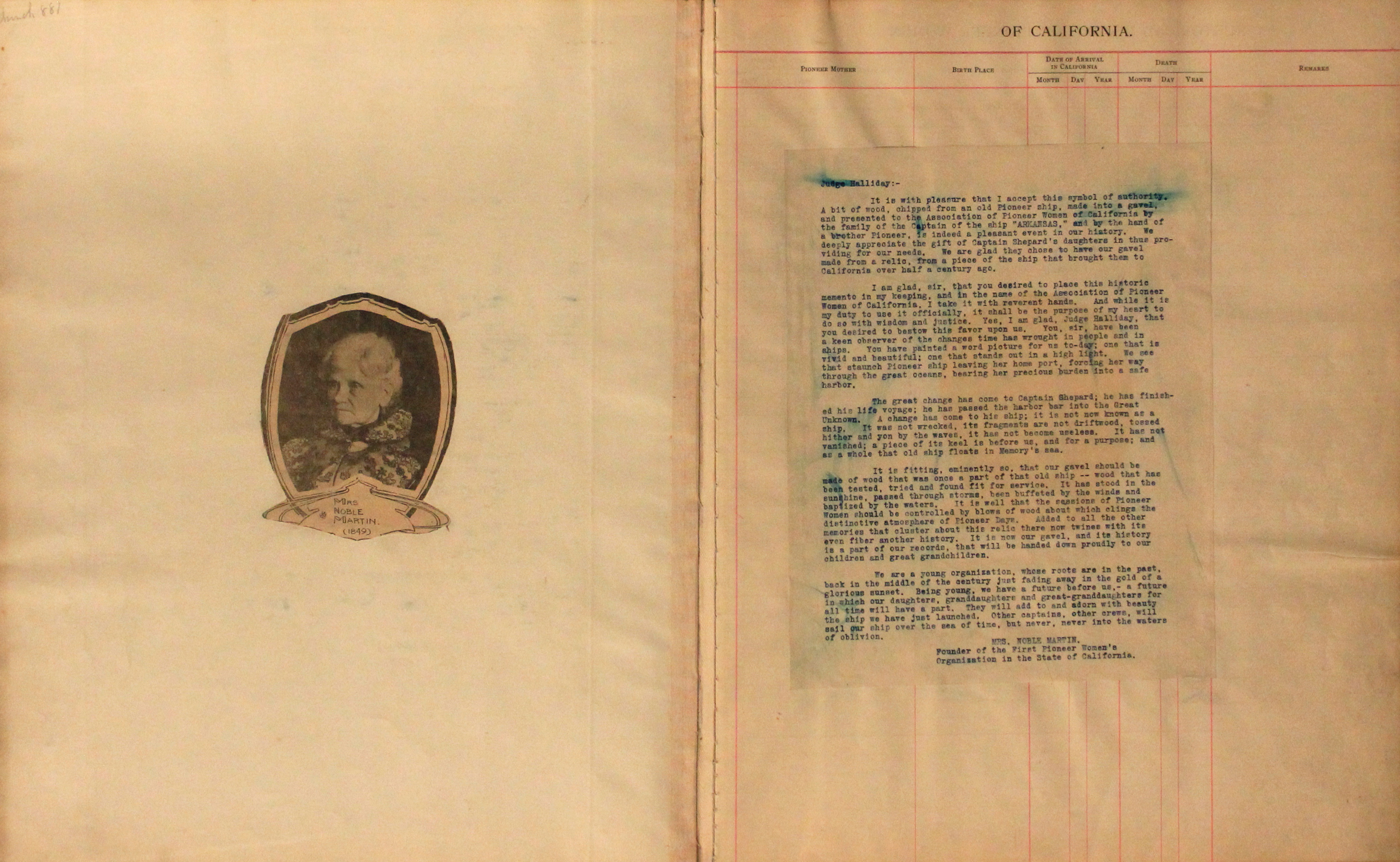
On January 15, 2008, the Alice Phelan Sullivan Library received a call from Mr. Ivo Stipinovich informing us that his aunt, Lorna Claire Stipinovich, had passed away and that it was her wish that we receive the records of The Association of Pioneer Women of California (of which she had been its final president). The Library happily accepted the donation knowing that the Association was one of the earliest organizations of women descendants of Gold Rush pioneers. The collection is comprised not only of the cloth-bound book featured on this website, but also Association bylaws, business receipts, minutes, and plans for the Log Cabin they designed and built in Golden Gate Park (where their meetings were held, and which still stands today).
The Association’s book contains over 800 accounts of their members’ journeys to California and their lives after arriving. It is also a trove of genealogical detail. The entire collection is a unique and significant addition to the state’s history of women Pioneers and The Society of California Pioneers is honored to make it available for researchers.
A brief note on methodology: Our transcripts are an attempt to make the content of the book accessible to a wide audience regardless of geography or ability. The formatting standards we’ve adopted aim to balance fidelity to the handwritten text while also translating its content to improve access. Please email info@californiapioneers.org to suggest revisions.
A Living Human Treasure is, according to UNESCO, a person who possesses to a high degree the knowledge and skills required for performing or re-creating specific elements of the intangible cultural heritage.[1][2] This title or a form of it is awarded by the nation’s government to a person who is regarded as a national treasure while still alive. The title is also known as Living National Treasure.
History
In 1950, the government of Japan began to designate certain individuals or groups who embodied intangible national cultural values as living human treasures. This was supplementary to buildings or places of great cultural and historical value that were designated as national treasures. Living Human Treasures thus became eligible for special protection and government support.[3] Some of the ancient protected crafts initially were pottery, music, handmade paper, dolls, and swordmaking, but have been expanded to also include song, dance, cuisine, and other categories.[citation needed] n

The City of Belmont is proud to celebrate 100 years as an incorporated city! Over the past century, our community has seen remarkable growth and transformation. As we reflect on our rich history, we also look ahead with excitement to the future. This milestone offers a once-in-a-generation opportunity to reflect on our shared heritage and come together to celebrate Belmont’s vibrant spirit through a series of inclusive events, public art, educational programs, and neighborhood activities.
Be sure to bookmark this page—we’ll be regularly updating it with exciting details as our centennial celebrations take shape!
Want to get a head start on learning about Belmont’s rich history? Visit the Belmont Historical Society. You can learn more about Belmont’s history in this year’s 2026 State of the City Centennial-themed video.
Tall ships from around the world will grace America’s 250th maritime celebrations in 2026.
America250—the nation’s year-long semiquincentennial celebration of the United States’ 250th anniversary—is underway with major events across the country. Among these festivities, tall ship gatherings and maritime parades will be a standout draw, offering breathtaking sights for sailing and history enthusiasts alike.
In Virginia, the Sail250® Virginia festival in the Chesapeake Bay region will welcome an international fleet of tall ships and naval vessels in June 2026, with more than 60 ships from roughly 20 countries and thousands of visiting sailors and dignitaries.
The Sail4th 250 International Parade of Tall Ships—scheduled for July 4, 2026 in the Port of New York and New Jersey—is set to feature over 30 tall ships from around the globe sailing up the Hudson River, accompanied by an International Naval Review and aerial demonstrations.
These maritime celebrations tie into the broader America250 initiative that highlights national history, culture, and innovation throughout the year as communities commemorate this historic milestone.
Tall ships expected to participate include historic sail training vessels such as the USCGC Eagle (“America’s Tall Ship”) and dozens of others from countries spanning the globe, making this maritime gathering one of the largest since the Bicentennial.

7/28/2024
Today Is Carl Janke Day
Credit Tom Paiva

ccc
 Rosamond Press
Leave a comment