
MAGA evangelical leaders are facing backlash after praying over a giant gold Donald Trump statue at Trump National Doral Miami during a dramatic dedication ceremony led by pastor Mark Burns. X via @pastormarkburns
Where Art Thou?
I had a dream where a beautiful black woman came, and she pressed her face close to mine. And we were so in love! But when, Oh Lord? When – and where?
I am convinced Jesus was taken to the temple to talk to the Learned Elders –
FOR A REASON!
To make it appear Josesph and Mary had no purpose, no business with the Sanhedrin of Judah, and the Sanhedrin, is a deliberated lie, aimed at divorced The First Church from Jesus who I believe was called….
JESUS ‘SON OF THE FATHER’
At twelve years old, Jesus was an expert in the Laws of Moses, who God says is…
HIS SON…..SEVERAL TIMES!
I am looking at this being the words on the plaque nailed above his head…..
“Jesus, Nasi of Judah Sanhedrin” or “Jesus Barsabbas”
The Roman Emperor set Pontius Pilate to be The Judge of God’s Children. If he dismiss the Sanhedrin, that would be The Last Straw. The Nasi of Judah and Benjamin would have to act. I believe Jesus Barsabbas went to Bethlehem and deliberately read from Isiah, in order to declare the liberation of God’s Children from Roman Law, and perhaps from Lesser Sanhedrin Courts that caved to Roman Rule, For how can a Nation be a Nation without………
THE RULE OF LAW
Yesterday, I tried to contact a black man who headed the NAACP in Eugene, so he could drive me to the LDS church in Springfield. We would go to lunch afterwards. I wanted the both of us to begin a lawsuit to throw out all rulings by the Supreme Court that chewed away Voting Rights Laws that my kindred, John Fremont helped establish as a Co-Founder of the Republican Party and its first Presidential Candidate. John would be horrified to see his party promote…..
JIM CROWISM
I man a member of Alcoholic Anonymous. I am thirty-eight clean and sober. We have Steps and Traditions. What id AA was taken over by folks who subscribed to….
“Thou can have one drink during the meeting. You beer lovers can enjoy a sixteen ounce can of your favorite beer, while you share you story about getting sober. For members who love a good bourbon, a bottle will be passed, and thou shalt bring thy own shot glass! I know you sober ladies just love….Coctails in can! So be it!”
Take note I used Holy-like Speak. This applied the Seal of Jesus-God to our Unity.
Yesterday, the Republican National Church of King Jesus made it official, declaring Trump as the Prince of their God Forsaken church that took over a Secular Political Party, and like ravenous wolves – hid amongst the Democratic Voters in hope of peeling off unwary voters, do they can take over the White House.
THIS IS POLITICAL APOSTESEY!
I say – GET OUT – of my ancestors party, and form your own party that will be made in the image of – your king-messiah, Donald Trump. Put your God-Jesus to the test. Have your version of Jesus…….
COME FACE TO FACE WITH GOD!
Do not hide you light under a bushel? Go, run to him! Bow down before His Golden Being, and ask…
“What does this mean, oh Golden One!”
On this day, May 10, 2026, I found….
THE AMERICAN SANHEDRIN
God tells me He wants this New Sanhedrin established on the grounds of….
NOTRE DAME DE NAMUR
So be it!
John ‘The Nazarite Judge’
EXTRA! I published this post at 7:42 AM. I then turned on TV eighteen minutes later and saw this report. I am on….
GOD TIME!

The Bible in the Book of Mormon
Charles Swift and Nicholas J. Frederick, Editors
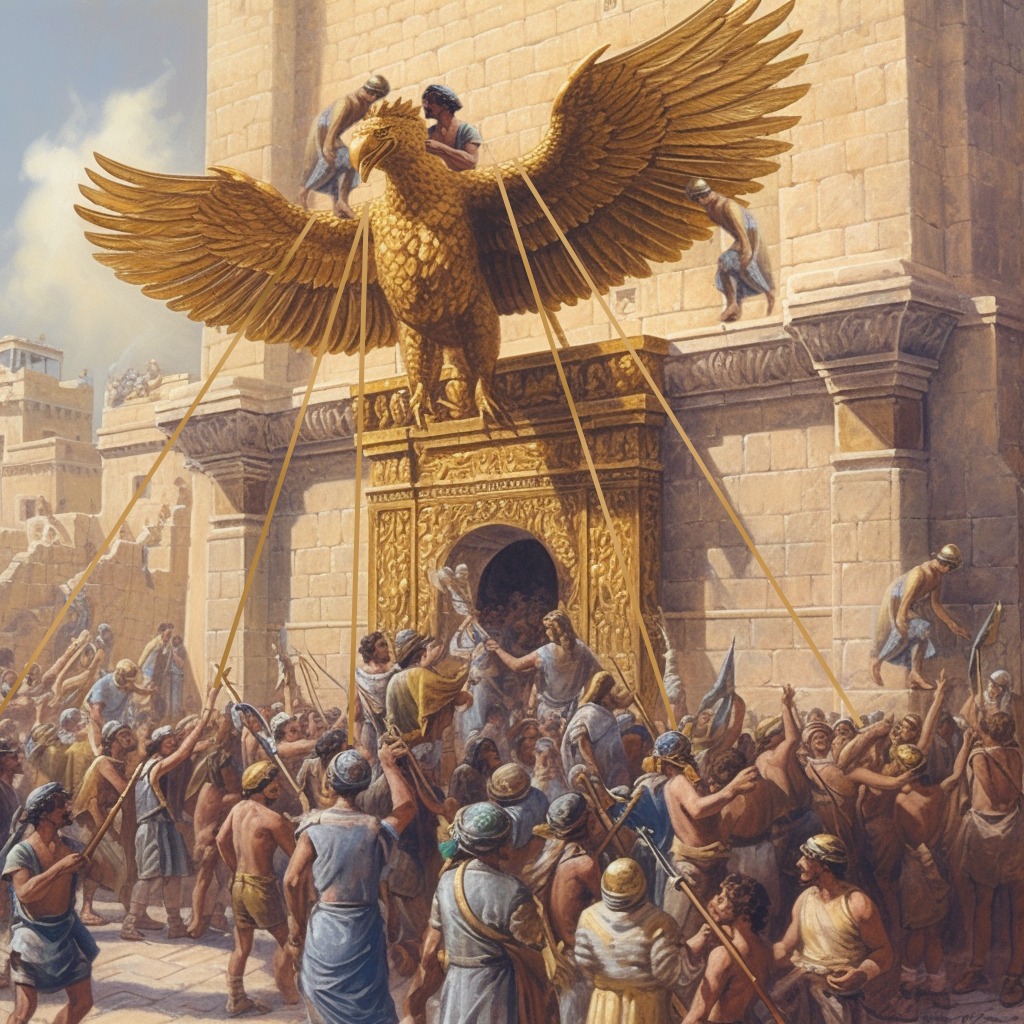
Making idols was forbidden to the Jewish people, even if there was no attempt to worship them. Yet the Romans regarded eagle standards as holy symbols, anointing them on special days. Two respected teachers of the law, Judas and Matthias, spoke to religious scholars about this violation.A group of these men pulled down the golden eagle and cut it into pieces. The king’s captain detained 40 participants, along with Matthias and Judas, and brought them before Herod. They explained that they made the choice to destroy the idol because they upheld the laws of Moses, and loved their religion.
Occasionally, the term is also used metaphorically to refer to the renunciation of a non-religious belief or cause, such as a political party, social movement, or sports team. The term has also been used in the Catholic Church to refer to abandonment of the clerical or monastic state, without leaving the religion itself.
There were two classes of Rabbinite courts called sanhedrins: Greater and Lesser. A lesser Sanhedrin of 23 judges was appointed to sit as a tribunal in each city. In general usage, the Sanhedrin without qualifier usually refers to the Great Sanhedrin. There was only one Great Sanhedrin of 71 judges, which, among other roles, acted as a supreme court, taking appeals from cases that lesser courts decided. The Great Sanhedrin was presided over by the Nasi (lit. “prince,” often translated as “president” in modern English), assisted by the Av Beit Din (“chief of the court”).
Robert Jeffress sparked debate after saying President Donald Trump has a better understanding of the Bible than the Pope.
In a study of the gospels and the book of the Acts of the Apostles, several times Jesus and His followers were brought in front of a body of rulers known as the Sanhedrin. Jesus went before the Sanhedrin in Mark 14:53-55, Peter and the apostles were sent to the Sanhedrin in Acts 5:27-40, Stephen was brought before the Sanhedrin in Acts 6:12, and Paul was forced to appear before the Sanhedrin in Acts 22:30. What do we know from history about this group and what was its function in the Jewish time period that Jesus was here on the earth? A look into history reveals some interesting information.
The Influence of the Figure of Moses in the Book of Mormon
Jared W. Ludlow
One biblical figure who looms large in the Book of Mormon is Moses. His influence inspires various Book of Mormon prophets as they use his example, law, and testimony to encourage others. Particularly in the early part of the Book of Mormon, Moses becomes a significant model of utilizing God’s power to accomplish great things. Not only does Moses’s law influence the worship practices of Lehi’s posterity, but his example leads Nephi and others who sometimes faced situations analogous to that of Moses to accomplish great things. This essay will not only review mentions of Moses on the surface level but also analyze how his life and example may have deeply influenced Book of Mormon prophets like Nephi. Because the figure of Moses was employed in the Book of Mormon in many situations similar to Moses’s and the Israelites’ experiences, he became an instrument to strengthen the authority and testimony of Book of Mormon prophets.
Retrieving the Brass Plates from Laban
The first explicit mention of Moses by name comes only a few chapters into the Book of Mormon, in the account of Nephi and his brothers’ attempts to retrieve the brass plates from Laban. When two initial efforts to retrieve the record failed, Nephi’s brothers were ready to give up and return to their father in the wilderness. Nephi, however, encouraged faithfulness to the Lord’s commandments by calling attention to Moses’s success in delivering the Israelites from Egypt:[1]
Therefore let us go up; let us be strong like unto Moses; for he truly spake unto the waters of the Red Sea and they divided hither and thither, and our fathers came through, out of captivity, on dry ground, and the armies of Pharaoh did follow and were drowned in the waters of the Red Sea. Now behold ye know that this is true; and ye also know that an angel hath spoken unto you; wherefore can ye doubt? Let us go up; the Lord is able to deliver us, even as our fathers, and to destroy Laban, even as the Egyptians. (1 Nephi 4:2–3)
Val Larsen has pointed out, “Moses was probably the greatest exemplar of prophetic and sovereign power in Hebrew history. It is significant, therefore, that Nephi links himself to Moses in this episode, both through explicit comparison and through multiple narrative parallels between the life of Moses and this episode in Nephi’s life.”[2] Both Moses and Nephi demonstrated perseverance in fulfilling their required tasks. Moses went to Pharaoh’s court multiple times, while Nephi likewise pursued his charge with new stratagems and firm resolve in fulfilling the Lord’s commandments and likely would have continued to pursue the plates if further attempts became necessary despite mounting risk. Murmuring against the Lord on Nephi’s part is absent from all the records of his life.
Nephi’s emphasis while evoking Moses is the faith in the Lord that Moses demonstrated in splitting the Red Sea for the Israelites to pass through on dry ground, despite the fact that he faced an unbelieving audience somewhat similar to what Nephi was facing. After observing the pursuing Egyptian armies, the Israelites cried out to Moses, “Because there were no graves in Egypt, hast thou taken us away to die in the wilderness? . . . It had been better for us to serve the Egyptians, than that we should die in the wilderness” (Exodus 14:11–12). Laman and Lemuel likewise murmur, asking how the Lord could deliver Laban into their hands. After all, if Laban could command fifty, even slay fifty, “then why not us?” (1 Nephi 3:31).[3] Nephi then alludes to how Moses’s actions led to the destruction of the pursuing Egyptian army. Thus the power of Moses’s word not only delivered his people but destroyed the Egyptians. In Nephi’s situation, he confidently asserts that God will be able to deliver them and that God is able to destroy Laban. Nephi’s faith moves from the abstract to the concrete a few verses later when the Spirit confirms multiple times to Nephi that the Lord has delivered Laban into his hands (see 4:11–12).
The earlier Israelites were carried out of captivity to receive the law in the wilderness en route to the promised land. Similarly, Nephi came to realize that in order for his seed to keep God’s commandments and prosper in their land of promise, they needed the brass plates, and more specifically that same law engraved thereon, the law of Moses (see 1 Nephi 4:14–15).[4] The plates were needed because the law maintained the foundation of the people’s worship especially when they would be far away from the original covenant land promised to Abraham and his descendants.[5] The combination of people, law, and land of promise are all found together in both Moses’s and Nephi’s experiences. And while it may be difficult to understand how to connect a loving God with the destruction of others, it seems it was inevitable in both cases so that God’s plans could move forward. The preservation of God’s people physically and spiritually required the destruction of those seeking to destroy them. Laban is killed through the instrumentality of Nephi just as the Egyptian armies were destroyed by God through the instrumentality of Moses.[6] Nephi’s actions are an early example of how Book of Mormon prophets drew strength and inspiration from Moses when given extremely challenging tasks. Not only was Moses a figure evoked by Nephi to encourage his brothers’ faith in an outwardly hopeless situation, but he likely was directly in Nephi’s own thoughts as he wrestled with carrying out the Spirit’s commands. In doing so, Nephi eventually came to understand that the Lord had delivered Laban into his hands and that he needed the plates so his family and posterity could have Moses’s law.
Building a Ship
Another direct mention of Moses came while Nephi was fulfilling the command to build a ship that could reach the promised land.[7] This command came after Lehi’s family had journeyed through the wilderness, where God provided means for their sojourn there similar to how he provided manna, quail, and water for the earlier Israelites.[8] Now they had come to a large body of water and needed the Lord’s help to traverse it, just as the earlier Israelites had faced a water obstacle. The Lord promised Nephi a sign by which he would know the Lord was with him, one that recalls Ether 12:6 (“ye [shall] receive no witness until after the trial of your faith”): “After ye have arrived in the promised land, ye shall know that I, the Lord, am God; and that I, the Lord, did deliver you from destruction; yea, that I did bring you out of the land of Jerusalem” (1 Nephi 17:14). The Lord treated Moses similarly when he promised him a post-deliverance sign of the Lord’s role in bringing the Israelites out of Egypt. “Certainly I will be with thee; and this shall be a token unto thee, that I have sent thee: When thou hast brought forth the people out of Egypt, ye shall serve God upon this mountain” (Exodus 3:12). Perhaps these after-the-fact signs may not seem helpful initially, but as one proceeds with faith and trust in God’s promises, the witness and confirmation of God’s assistance along the way becomes stronger when the apparently unachievable is later accomplished.
Nephi had the faith to proceed, but once again Nephi’s brothers murmured against him and lacked the faith to assist him, so Nephi hearkened back to Moses’s experience with the children of Israel. Besides murmuring and calling Nephi a fool for thinking he could build a ship, Nephi’s brothers also proposed that it would have been better to have died in Jerusalem than be stranded in the wilderness (see 1 Nephi 17:17–20). They believed the people in Jerusalem were righteous and specifically cited their obedience to the “the statutes and judgments of the Lord, and all his commandments, according to the law of Moses” (v. 22), and thereby acknowledging the core Mosaic requirements of following the Lord. In response to this claim of obedience to the law of Moses, which may not have been as accurate as stated because of Jerusalem’s impending judgment, Nephi asked them two questions:
Do ye believe that our fathers, who were the children of Israel, would have been led away out of the hands of the Egyptians if they had not hearkened unto the words of the Lord? Yea, do ye suppose that they would have been led out of bondage, if the Lord had not commanded Moses that he should lead them out of bondage? (vv. 23–24)
As important as following past revealed law is, it is even more important to follow present commands from the Lord in one’s current situation. Both the Israelites and Moses played a role in their own deliverance from bondage through their obedience to God’s commands.
Nephi went on to explain that the Israelites’ bondage was “laden with tasks, which were grievous to be borne; wherefore, ye know that it must needs be a good thing for them, that they should be brought out of bondage” (1 Nephi 17:25). Even though the Israelites did not always appreciate what God did for them (e.g., they would later murmur during their wanderings in the wilderness and seemed to forget how bad their life in bondage had been), Nephi tried to show his brethren that what God had done and was doing for them were good things and that they would be better off than if they had stayed in Jerusalem and been subjected to Babylonian bondage.
Nephi also returned to Moses’s specific role in the people’s deliverance—when Moses “was commanded of the Lord to do that great work” (1 Nephi 17:26)—by mentioning four mighty acts that occurred as part of the Exodus: the waters of the Red Sea parted so the Israelites could pass through on dry ground,[9] the Egyptian armies of Pharaoh “were drowned in the Red Sea,” the Israelites “were fed with manna in the wilderness,” and Moses smote the rock to bring forth water so that “the children of Israel might quench their thirst” (vv. 26–29).
The last act of striking the rock and bringing forth water is noteworthy for two reasons. First, it is the only act that Nephi specifically connects with God’s power working in Moses as Moses accomplished it (“by his word according to the power of God which was in him” (1 Nephi 17:29). Second, in the Israelite wanderings in the wilderness, Moses strikes the rock to bring forth water two different times. The first time, Moses strikes the rock in obedience to God’s command. “Behold, I will stand before thee there upon the rock in Horeb; and thou shalt smite the rock, and there shall come water out of it, that the people may drink. And Moses did so in the sight of the elders of Israel” (Exodus 17:6). The second time, Moses is told to speak to the rock and it would bring forth water (see Numbers 20:8). Instead, Moses chides[10] the Israelites for needing him and Aaron to fetch them water out of the rock; then he smites the rock twice and the water came out abundantly (see v. 11). So instead of speaking to the rock as God commanded him, Moses smote it. As a consequence of Moses’s actions, he and Aaron would not accompany the Israelites into the promised land. “And the Lord spake unto Moses and Aaron, Because ye believed me not, to sanctify me in the eyes of the children of Israel, therefore ye shall not bring this congregation into the land which I have given them” (v. 12). In both cases, God allowed the miracle to proceed but was obviously more pleased with how Moses handled it the first time, not the second. Nephi seems to be recounting the first of these events because there is no negative attitude toward Moses.[11] The first event would also fit with fulfilling the meaning of the phrase “by his word” in 1 Nephi 17:26 because it seems more likely to be talking about doing it in obedience to God’s command (so his would mean God’s word, not Moses’s).
As mentioned above, instead of being constantly grateful for what God and Moses had done for them, the Israelites “hardened their hearts and blinded their minds, and reviled against Moses and against the true and living God” (1 Nephi 17:30). The word notwithstanding at the beginning of the verse is a painful reminder of how God may try to do many things for his children, but sometimes they fail to realize it and turn against him. “Notwithstanding they being led, the Lord their God, their Redeemer, going before them, leading them by day and giving light unto them by night,[12] and doing all things for them which were expedient for man to receive,” they became embittered (see v. 30).
Surely faith was required to accept Moses as a prophet and follow him into the wilderness. Certainly there were those in Egypt who asked how they were to cross the Red Sea. Others asked how they would find food. And what of water? And clothes? And what army would protect them, should Pharaoh come after them? And what of their other enemies in the desert, so anxious to attack and plunder? Could not countless questions be asked by the doubters? Yet Israel followed their prophet, and miracle followed miracle. . . . Is it easier in one day to follow a living prophet than in another? Would those who murmured against Moses and his God not also murmur against Nephi and his God? And what of our day? Should there not be unanswered questions? Should it not require faith to accomplish that which the Lord has asked of us?[13]
After a brief digression on the Israelite conquest of the land of Canaan, Nephi reminds his brothers that because of the covenants God made with Abraham, Isaac, and Jacob, God brought the Israelites out of the land of Egypt (see 1 Nephi 17:40). However, because they hardened their hearts (like his brothers, Nephi reminds them), “he did straiten them in the wilderness” (v. 41) by sending fiery flying serpents among them.[14] Yet God prepared a simple way for them to be healed; but because of the easiness of it, many paid no heed and perished. Nephi then makes another summary statement about the Israelite condition and situation in the wilderness up to the conquest: “And they did harden their hearts from time to time, and they did revile against Moses, and also against God; nevertheless, ye know that they were led forth by his matchless power into the land of promise” (v. 42).
Nephi returns to talking about his own time period by stating that the Israelites around Jerusalem had since become wicked, “nearly unto ripeness,” and their day of destruction will come soon, if not already, and only some will be preserved and taken away into captivity (1 Nephi 17:43). This destruction and captivity are the reasons Lehi was told to depart into the wilderness, but rather than feeling gratitude toward their father for preserving them, Nephi’s brothers sought to take away his life (see v. 44). Nephi insinuates that his brothers are like the Israelites and are reviling against God, Lehi, and himself despite their great acts on behalf of Lehi’s family.
Ye are swift to do iniquity but slow to remember the Lord your God. Ye have seen an angel, and he spake unto you; yea, ye have heard his voice from time to time; and he hath spoken unto you in a still small voice, but ye were past feeling, that ye could not feel his words; wherefore, he has spoken unto you like unto the voice of thunder, which did cause the earth to shake as if it were to divide asunder. (v. 45)
Just as the Israelites hardened their hearts against God, so did Laman and Lemuel, prompting Nephi to ask, “Why is it, that ye can be so hard in your hearts?” (v. 46). Nephi fears that his brothers might be cast off forever (see v. 47) and lose their chance at the promised land, just as many of the Israelites had lost their chance to enter the promised land and were destroyed in the wilderness (see v. 31).[15]
Nephi’s brothers did not take his words well and became angry and intended to “throw [him] into the depths of the sea.” But Nephi forbade them from touching him lest they be smitten by the power of God. He commanded them to stop murmuring against their father and to stop withholding their labor from building the ship (see 1 Nephi 17:48–49). He confidently asserted, “If God had commanded me to do all things I could do them. If he should command me that I should say unto this water, be thou earth, it should be earth; and if I should say it, it would be done” (v. 50). This assertion could be another way of alluding to Moses’s actions at the Red Sea, where the water parted to reveal dry land (see Exodus 14:29).
Besides inspiring Nephi’s words and warnings, the Lord through Nephi later physically shocked (or shook) Laman and Lemuel to reinforce the fact that God’s power and spirit was with Nephi. They fell down to worship Nephi, but he would not allow it, instead encouraging them to “worship the Lord thy God, and honor thy father and thy mother, that thy days may be long in the land which the Lord thy God shall give thee” (1 Nephi 17:55). The whole dramatic episode thus ends with some of Moses’s teachings on the Ten Commandments: to have no other gods before the Lord God (see Exodus 20:3)[16] and, almost[17] quoting directly, to honor one’s parents, including the attached blessing—“that thy days may be long upon the land which the Lord thy God giveth thee” (v. 12)—they will need en route to a new land that the Lord was giving them. Throughout this extended dialogue with his brothers, Nephi interweaves the story of Moses and the Israelites. The stories he retells can provide faith to undertake seemingly impossible tasks—such as building a ship to cross a large ocean—but also warn about disobedience and murmuring. Given the Lehite migration’s similarity to the Exodus, it is not surprising to see Nephi turn to the Moses account not only for support in reproving his brothers but also for strength in fortifying himself to accomplish great things with God’s help and power as Moses had done.[18]
Nephi’s Writing to Future Posterity
In 2 Nephi 25, Nephi summarizes why he had quoted from many Isaiah chapters and shares some of the future happenings of his people in relation to the house of Israel. Among his teachings, Nephi alludes to Moses both for what Moses had done and for the law that he had left behind. More specifically, Nephi talks about God’s power manifested through Moses as support for the point he is making, that it is only through Jesus Christ that one can be saved:
And as the Lord God liveth that brought Israel up out of the land of Egypt, and gave unto Moses power that he should heal the nations[19] after they had been bitten by the poisonous serpents, if they would cast their eyes unto the serpent which he did raise up before them, and also gave him power that he should smite the rock and the water should come forth; yea, behold I say unto you, that as these things are true, and as the Lord God liveth, there is none other name given under heaven save it be this Jesus Christ, of which I have spoken, whereby man can be saved (v. 20)
Within this verse, Nephi mentions three actions of God working through Moses that he has discussed earlier with his brothers (see above): Israelites brought out of the land of Egypt, healing those bitten by poisonous serpents, and striking the rock to bring forth water. The second action was conditional on their casting their eyes on the serpent that was made for their healing, perhaps reinforcing the point Nephi is making that one must look unto “this Jesus Christ” to be spiritually healed.[20] In this episode, Nephi is still referencing Moses to convince or strengthen others to believe in his words, but it lacks the same direct personal application that we saw in the first two examples above. This difference is likely because the audience is broader (his people) and the teaching horizon is long-term, not for an immediate need like obtaining the brass plates or building a ship. Additionally, the narrative focus shifts from Moses to God. Moses is mentioned secondarily as the object recipient of God’s power to accomplish these things. The key point here is that because God lives (mentioned twice in the verse), he gave Moses power to do certain things; and because he lives, Jesus’s redemption will fulfill its powerful effects.[21]
In the second half of the chapter, Nephi treats the relationship between Christ and the law of Moses. Here Moses is simply invoked for the law associated with him, but not as a distinct figure. Nephi and his people will continue to observe the law because they have been commanded to do so and it is what will reconcile them to God until Jesus comes to earth and performs the atoning sacrifice. After Jesus’s ministry and sacrifice, they will obey whatever teachings and law Jesus leaves for them.[22] Therefore there is the notion that as necessary as obedience to the law is now, it is only temporary until it is fulfilled in Christ. A couple of times Nephi mentions that this is why the law was given: “for this end was the law given” (2 Nephi 25:25, 27; see 11:4). Nephi ends his discussion of the relationship between Christ and the law with a summary statement. “Ye must keep the performances and ordinances of God until the law shall be fulfilled which was given unto Moses” (25:30). This perspective on the temporary but necessary purpose of the law is echoed in other parts of the Book of Mormon, as well as built upon in contexts showing that the law was to point to Christ (see Jacob 4:5; Jarom 1:11; Alma 25:15–16).[23] Nephi thus also taught here that “the right way is to believe in Christ and deny him not; for by denying him ye also deny the prophets and the law” (2 Nephi 25:28).
Prophecies Associated with Moses
The figure of Moses is associated with a few prophecies recorded by Nephi. The first one is found in a dialogue between Nephi and his brothers who asked about the meaning of things engraved on the brass plates, specifically whether the prophecies dealt with temporal or spiritual matters. The citation of Moses is a reiteration of the promise given to Moses in Deuteronomy 18:15–19 that the Lord would raise up a prophet like unto him to prepare a way for the righteous to be delivered.[24]
And the Lord will surely prepare a way for his people, unto the fulfilling of the words of Moses, which he spake, saying: A prophet shall the Lord your God raise up unto you, like unto me; him shall ye hear in all things whatsoever he shall say unto you. And it shall come to pass that all those who will not hear that prophet shall be cut off from among the people. And now I, Nephi, declare unto you, that this prophet of whom Moses spake was the Holy One of Israel; wherefore, he shall execute judgment in righteousness. (1 Nephi 22:20–21)
This earlier promise to Moses sees its fulfillment in the coming of Jesus Christ and the completion of his mission. Nephi was not the only one to interpret Jesus Christ as the fulfillment of Moses’s sayings in Deuteronomy. Peter referred to this prophecy being fulfilled by Jesus Christ (see Acts 3:20–23).[25] Stephen mentioned this prophecy and Jesus’s fulfillment of it during his significant speech before being stoned to death (see 7:37). Jesus identified himself as the fulfillment of this prophecy when he appeared to the Nephites following his resurrection:
Behold, I am he of whom Moses spake, saying: A prophet shall the Lord your God raise up unto you of your brethren, like unto me; him shall ye hear in all things whatsoever he shall say unto you. And it shall come to pass that every soul who will not hear that prophet shall be cut off from among the people. (3 Nephi 20:23)[26]
Jesus paraphrased both the prophecy and the related warning for those who did hearken to the words of this prophet (see Deuteronomy 18:19).[27] In Nephi’s setting, he mentions the prophecy and how it will be fulfilled as part of a general discussion about how the obedient will be preserved from Satan and ultimately saved through Christ. It is a significant quotation of Moses’s earlier teachings to his people, a prophecy that has had a rich reception history among Christians.[28]
Another discussion of Moses in prophecy happens in 2 Nephi 3. Here Nephi records his father Lehi’s final blessings and counsel to his son Joseph.[29] Included within this lengthy dialogue is a prophecy of Joseph (of Egypt) about his posterity (which includes Lehi and his descendants, hence the reason for Lehi’s sharing it shortly before his death). Even though the primary focus of this prophecy is on a future choice seer who would do great things for his people, Joseph of Egypt sees that Moses will also be a blessing to his posterity by delivering them from bondage. From that perspective, the work of this choice seer, usually identified as Joseph Smith’s bringing forth the Book of Mormon record as part of the great latter-day work of gathering the house of Israel, is likened to the future deliverance Moses would do for his people. “And he shall be great like unto Moses, whom I have said I would raise up unto you, to deliver my people, O house of Israel. And Moses will I raise up, to deliver thy people out of the land of Egypt” (2 Nephi 3:9–10). Later on, Joseph of Egypt shares his certainty about the future choice seer just as he knows Moses will deliver his people: “I am sure of this thing, even as I am sure of the promise of Moses; for the Lord hath said unto me, I will preserve thy seed forever” (v. 16).
Joseph of Egypt then gives a few more specific details about Moses’s future ministry among his posterity:
And the Lord hath said: I will raise up a Moses; and I will give power unto him in a rod; and I will give judgment unto him in writing. Yet I will not loose his tongue, that he shall speak much, for I will not make him mighty in speaking. But I will write unto him my law, by the finger of mine own hand; and I will make a spokesman for him. (2 Nephi 3:17)
Here, as in other parts of the Book of Mormon, we have repeated references to power being given to Moses to perform great things and the rod as a source or demonstration of that power. Earlier in 1 Nephi 17, the rod is described as an instrument used to straiten the Israelites in the wilderness, but here the rod’s exact function is left unstated. In another prophetic context in the Book of Mormon, the rod of Moses is used as a forerunner for the power given to the Assyrian ruler to conquer the Israelites. A quotation from Isaiah states that as God (through Moses) lifted his rod on the sea, so shall the Assyrian ruler lift it “after the manner of Egypt” (2 Nephi 20:26; Isaiah 10:26), an allusion to the bondage the Israelites felt at the hands of the Egyptians but from which they were subsequently delivered.[30] The Assyrian ruler is now an instrument of justice against the wayward Israelites “for yet a very little while, and the indignation shall cease, and mine anger in their destruction” (2 Nephi 20:25; Isaiah 10:25). The allusion to Moses’s power from God is indirect, but the rod is a concrete symbol of power used to accomplish God’s purposes.
The second part of 2 Nephi 3:17 discusses Moses’s connection to judgment and the law; hence it is not surprising that the law became known as the law of Moses. The risen Lord, quoting from the words of Malachi the prophet, told the gathered Nephites in 3 Nephi to “remember ye the law of Moses, my servant, which I commanded unto him in Horeb for all Israel, with the statutes and judgments” (25:4). God would transmit the law and judgment through Moses to the people, a law that would help deliver them spiritually.[31] Finally, the verse mentions that Moses’s strength would not be in speaking but in the written law he would transmit to the people, so God provided a spokesman for him (his brother Aaron; see Exodus 4:16). The use of a spokesman is likened to the situation of the future choice seer as well, and the rest of the chapter returns its focus away from Moses and back to the choice seer. In this prophecy Moses is not the dominant character, but in many ways he serves as a type for the choice seer who would follow him much later. Moses is granted God’s power, wields his power as needed, transmits law and judgment, and utilizes a spokesman. From a narrative perspective, this chapter is unique because it is primarily the prophecy of Joseph of Egypt through the words of Lehi to his son Joseph and at some point recorded by Nephi. Among these various speakers and writers, Moses is signaled as a figure who assuredly would bring spiritual commandments and physical deliverance to Joseph of Egypt’s descendants.
Abinadi’s Countenance
In addition to Nephi, a few later Book of Mormon writers referred to Moses. When the Spirit of the Lord was upon Abinadi in King Noah’s court, “his face shone with exceeding luster, even as Moses’ did while in the mount of Sinai, while speaking with the Lord” (Mosiah 13:5). This is the only reference in the Book of Mormon to Moses’s experience on Sinai that resulted in Moses wearing a veil before the people because they were afraid to approach him with his shining face (see Exodus 34:29–35). In Moses’s case, his illuminated face resulted from his having been directly speaking with the Lord. In Abinadi’s case, it was because the Spirit of the Lord was upon him and he proceeded to speak “with power and authority from God” (Mosiah 13:6). This parallel between Abinadi and Moses was most likely written by Alma, who had been a priest in King Noah’s court and could have witnessed this event, although potentially it could have been edited later by Mormon as part of his abridgment work on the plates. In either case, it is a simple comparison between the two figures who both had experienced and were demonstrating God’s power residing in them. For the later reader of the account, the association of these two prophets infuses Abinadi with some of the same power and authority that Moses held.
Throughout his speech, Abinadi refers to the law of Moses and criticizes the priests of Noah for not properly teaching it and especially for not living it. In Abinadi’s attempts to help them see that the law of Moses alone could not save them, he emphasized the need for a redeemer. “Salvation doth not come by the law alone; and were it not for the atonement, which God himself shall make for the sins and iniquities of his people, that they must unavoidably perish, notwithstanding the law of Moses” (Mosiah 13:28). To further emphasize his point, Abinadi also mentions Moses’s prophecy or testimony of the future Messiah who would redeem his people. “Did not Moses prophesy unto them concerning the coming of the Messiah, and that God should redeem his people? Yea, and even all the prophets who have prophesied ever since the world began—have they not spoken more or less concerning these things?” (v. 33; see also John 5:45–46). Moses is used in this episode not only as a comparative figure for what Abinadi is experiencing but also as a source of knowledge from which to draw. The teachings of Moses go beyond just the law to include the purpose of that law—to point to divine redemption—as Abinadi exhorts, “Therefore, if ye teach the law of Moses, also teach that it is a shadow of those things which are to come” (Mosiah 16:14). As Joseph Spencer has pointed out in his analysis of Abinadi’s teachings, a prophet anticipates Christ’s atonement:
For Abinadi, a prophet is through and through the figure who looks forward to the coming of the Messiah, the coming of “God himself” who “shall make [atonement] for the sins and iniquities of his people.” The prophet’s task is to make clear that obedience to the Law is not, in the end, what saves the people—whether as a “Saying” or a “Said”—because, “were it not for the atonement, . . . they must unavoidably perish, notwithstanding the law of Moses.”[32]
Alma the Younger
In one of Alma the Younger’s many great sermons, he notes how many earlier prophetic figures, including Moses, had testified of Christ (see Alma 33).[33] He specifically states that Moses spoke of the Son of God and raised a type of the Son in the wilderness to heal those bitten by the poisonous serpents. As Andrew Skinner explains, the earlier Israelite experience highlights both the negative and positive views of the serpent in the ancient Near East:
The agent of both harm and healing, death and life, is, in this instance, the serpent. The people sin, and fiery serpents bite them. Moses constructs a brass image of the harmful creatures, and the people are spared. But it is really Jehovah who is the cause working behind the image, the actual instigator of both death and life. The Israelites may already have been familiar with images of fiery serpents from their exposure to Egyptian mythology while sojourning in Egypt. But the serpent symbol is now seen in its true light—a valid and important representation of God’s ultimate power over life and death. God is the reality behind the symbol.[34]
This serpent episode is brought up earlier in the Book of Mormon as discussed above. Here the emphasis is on the episode’s role as a type of the Savior, and it reiterates how some people looked and lived while others rejected the lifesaving option given them because they lacked faith. “Few understood the meaning of those things, and this because of the hardness of their hearts. But there were many who were so hardened that they would not look, therefore they perished. Now the reason they would not look is because they did not believe that it would heal them” (Alma 33:20).
The allusion to this episode of the early Israelites assumes that the audience knew the story well enough to draw the necessary connections since Alma does not give enough details from the story for a first-time hearer. For example, he never specifically mentions what Moses raised in the wilderness or why he had to do so in the first place. Alma takes for granted that the audience knows these facts, or he simply wants them to know that a type was raised in the wilderness and they do not need to know anything beyond that. Alma next applies this experience to his audience by encouraging them to have the necessary faith to be healed by the object of that type: the Son of God.
O my brethren, if ye could be healed by merely casting about your eyes that ye might be healed, would ye not behold quickly, or would ye rather harden your hearts in unbelief, and be slothful, that ye would not cast about your eyes, that ye might perish? If so, wo shall come upon you; but if not so, then cast about your eyes and begin to believe in the Son of God, that he will come to redeem his people. (Alma 33:21–22)
Moses’s earlier episode is recounted here for the spiritual model it offers and the invitation to believe. In essence, Alma is providing a subtype by emphasizing the Israelites’ reactions to the type raised in the wilderness. Will his listeners have the faith to begin to believe in the Son of God like some believed in Moses’s time, or will they harden their hearts and not believe like the others?[35] They can follow or reject the model provided for them from the earlier setting in Moses’s day. The physical lives of Alma’s audience may not be endangered, but their spiritual lives are.
Moses shows up one other time in relation to Alma the Younger: at the time of his departure. After Alma gave final counsel to his son Helaman and blessed him and his other sons, he departed from Zarahemla.
And it came to pass that he was never heard of more; as to his death or burial we know not of. Behold, this we know, that he was a righteous man; and the saying went abroad in the church that he was taken up by the Spirit, or buried by the hand of the Lord, even as Moses. But behold, the scriptures saith the Lord took Moses unto himself; and we suppose that he has also received Alma in the spirit, unto himself; therefore, for this cause we know nothing concerning his death and burial. (Alma 45:18–19)
The narrator, presumably Mormon, states that “scriptures” told how the Lord took Moses unto himself. The account in Deuteronomy 34 is somewhat ambiguous in its account of Moses’s departure, mentioning that Moses died but that the Lord buried him and no man knew of his sepulchre, suggesting no earthly burial (see vv. 5–6). Latter-day Saint theology teaches that Moses was translated so he could appear to Jesus on the Mount of Transfiguration,[36] so the phrase in Alma 45:19 of the Lord’s taking Moses unto himself could refer to that. Doctrine and Covenants 84:25 also mentions that God “took Moses out of [the children of Israel’s] midst.” Following this interpretation, Deuteronomy’s account of God burying Moses is symbolic. In any case, Alma’s and Moses’s departures are equated in the Book of Mormon with God directly overseeing their exits from the mortal realm.
Nephi2 before the Corrupt Judges
In the Book of Mormon, the final explicit mention of Moses as an exemplar figure occurs in the confrontational episode when Nephi2 condemns the corrupt judges. After being overheard praying on his garden tower, Nephi2 teaches the gathered crowd about the wickedness of their society. He also teaches how Moses was given power from God to part the Red Sea as an analogue to his own power received from God:
Behold, my brethren, have ye not read that God gave power unto one man, even Moses, to smite upon the waters of the Red Sea, and they parted hither and thither, insomuch that the Israelites, who were our fathers, came through upon dry ground, and the waters closed upon the armies of the Egyptians and swallowed them up? And now behold, if God gave unto this man such power, then why should ye dispute among yourselves, and say that he hath given unto me no power whereby I may know concerning the judgments that shall come upon you except ye repent? (Helaman 8:11–12)
Similar to Nephi1 at the beginning of the Book of Mormon, Nephi2 is using Moses as proof that because God could grant Moses power, he could grant him (Nephi2) power also.[37] Also like the earlier recounting, mention of the Red Sea and the subsequent destruction of the Egyptian armies was a warning that judgments could likewise come upon the Nephites for rejecting Nephi2’s teachings.
Nephi2 continues to draw upon Moses, echoing teachings from elsewhere in the Book of Mormon. He emphasizes Moses’s teachings of a future messiah, the raising of the brazen serpent in the wilderness to heal the people, and the promise that those who look on the analogous Son of God would inherit eternal life—all similar to what Alma taught to his audience, as discussed above.
But, behold, ye not only deny my words, but ye also deny all the words which have been spoken by our fathers, and also the words which were spoken by this man, Moses, who had such great power given unto him, yea, the words which he hath spoken concerning the coming of the Messiah. Yea, did he not bear record that the Son of God should come? And as he lifted up the brazen serpent in the wilderness, even so shall he be lifted up who should come. And as many as should look upon that serpent should live, even so as many as should look upon the Son of God with faith, having a contrite spirit, might live, even unto that life which is eternal. And now behold, Moses did not only testify of these things, but also all the holy prophets, from his days even to the days of Abraham. (Helaman 8:13–16)
While Nephi2 goes on to review other prophets who testified of the future Messiah, he spends the most time on Moses and some of his teachings and actions. In summary, we see that Nephi2 cited Moses’s example to emphasize that he had similar power given to him and to demonstrate that Moses had taught similar things to what he was trying to teach the people. Thus these allusions to Moses’s ministry were used as support for both Nephi’s teachings and authority.
Conclusion
The influence of Moses on the Book of Mormon is substantial. The law of Moses stood behind centuries of worship practice among the Book of Mormon peoples. However, beyond the law attributed to Moses was his importance as a figure of faith and power for many Book of Mormon prophets, especially Nephi1. Moses set an example for accomplishing incredible things through God’s power, and his teachings became a meaningful source for testimony of the Messiah. Prophets such as Nephi1 rhetorically used his example to encourage and build faith in order to accomplish great things themselves. In fact, one could alter Nephi1’s well-known statement from 1 Nephi 19:23: “But that I might more fully persuade them to [fulfill the commands of God] I did read unto them that which was written by [and about] the prophet [Moses]; for I did liken all scriptures unto us, that it might be for our profit and learning.” Several episodes from Moses’s ministry were referred to throughout the Book of Mormon to inspire others to “be strong like unto Moses” (4:2). These episodes include the brazen serpent, the parting of the Red Sea and drowning of the Egyptian army, manna in the wilderness, being led by God with light at night, Moses’s face shining, and bringing forth water from a rock. In the Book of Mormon there is never a negative portrayal of Moses, but often there is toward the Israelites that were supposed to follow him. The Israelites’ murmurings and revilings were especially egregious and stood as models of what not to do.
For Nephite prophets, Moses thus became a familiar ideal figure to turn to because of similar settings and audiences. For example, Nephi1 also faced an audience full of doubt and murmuring (some of his family members) while journeying through the wilderness to a promised land. He repeatedly heard the same refrain Moses had—“It would have been better if we had stayed . . . ,” a complaint that ignored all that God had already done for them, not to mention the great things yet in store for them. Nephi1 and Nephi2 had to face adversaries bent on destroying them, and Moses’s instrumentality in bringing God’s judgment against the Egyptians had set an inspiring precedent. The Book of Mormon does not shy away from acknowledging the judgments that came down on those who tried to destroy God’s people or on the Israelites who chose to reject God and his earthly representative, Moses.
Moses’s prophecy and teaching about a future messiah became an important type for both the content of Book of Mormon prophets’ teachings and the basis of their authority. If God gave power and knowledge to Moses, he could give power and knowledge to them as well. If Moses’s words were true, so could their words be true. If earlier Israelites were healed and delivered by heeding Moses’s teachings, Nephites could be healed and delivered by believing in and coming unto the type and substance of the prophetic teachings—the divine Messiah. Moses thus was instrumental in helping both the ancient Israelites in the Old Testament and the prophets in the Book of Mormon to do great things and lead others to the Messiah.
 Rosamond Press
Leave a comment