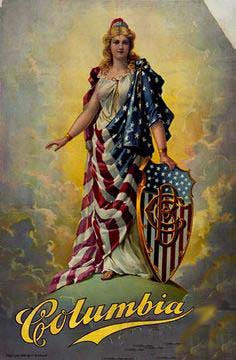
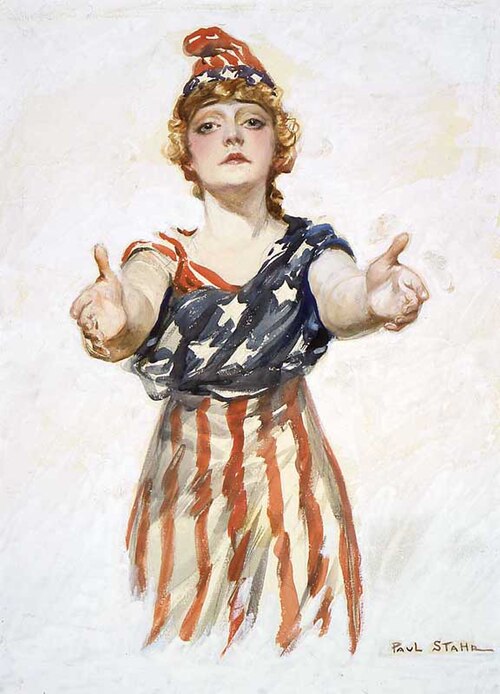
Where Art Thou?
I watched Jesus-Trump order HIS Navy to put the hurt on a Iranian oil tanker that tested the waters, and, tried to…..move out! What most Americans saw was the Gas Slots roll over – and the price to fill your tank – SKYROCKET!
How many Americans wish there was a God, or Goddess of Peace, that they can say prayers to, light a votive candle, and light some incense? Now there is!
On this day, May 8, 2026, I John Presco, resurrect the Goddess of America, and, take her down from that lying cross on the side of PeaceHealth, Riverbend.Being a original hippie, who was ON THE BUS with Ken Kesey, and who marched for peace in Washington – in 1971? – I am, the Last Man of Peace…..standing!
I believe it was 1990, when I watched Pat Robertson call for his viewers to write their elected leaders – and demand the Stature of Liberty be torn down, because “she represents goddess worship”. This was the beginning of the Culture Wars, and Iconography that has attacked The Left. Is the LDS Temple Priests using/employing the Tharaldsen’s statue as a Scarecrow, to keep old Burned-Out Hippies away, thinking they should join a……
ALTERNATIVE CHURCH TO CHRISTIANITY?
On this day, I found…..
THE TEMPLE OF COLUMBIA!
There will be Peace Temples in Canada and England. There will be a simulcast on a large screen. At the end of the Peace Service, everyone stands and sings!
“Columbia – The Gem of the Ocean!”
So be it!
John ‘The Nazarite’
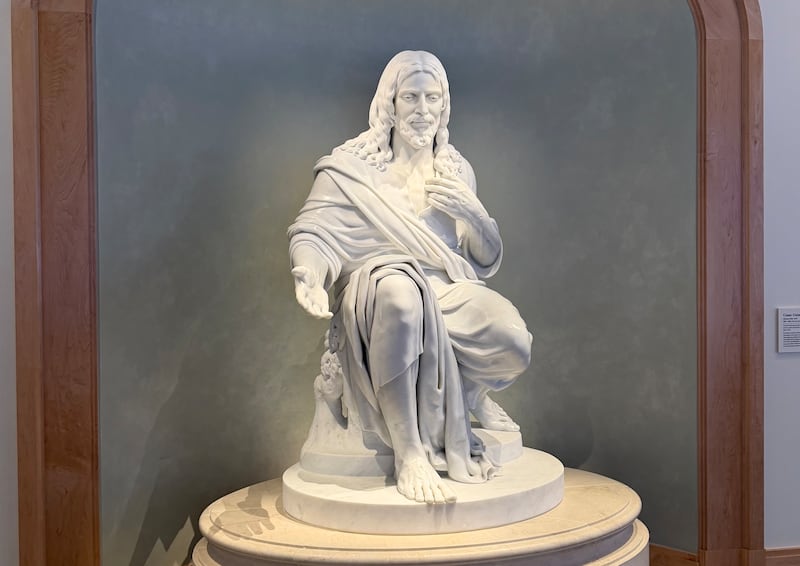
The “Come Unto Me” sculpture has become a centerpiece of the new visitors’ center at Temple Square. Created by Swiss artist Christian Bolt, the marble piece depicts Jesus Christ extending an invitation of peace and compassion. Located at the central point of the lower level, the sculpture connects both wings of the building and draws visitors’ attention.
For the statue of Jesus in Indianapolis, Indiana, see Christus (Indianapolis).

Christus is an 1833 white Carrara marble statue of the resurrected Jesus by Bertel Thorvaldsen located in the Church of Our Lady, an Evangelical Lutheran Church of Denmark in Copenhagen, Denmark. It was commissioned as part of a larger group, which includes 11 of the original 12 apostles and Paul the Apostle (instead of Judas Iscariot).
The statue has been widely reproduced; images and replicas of it were adopted by the leaders of the Church of Jesus Christ of Latter-day Saints (LDS Church) in the 20th century to emphasize the centrality of Jesus in its teachings.
Original sculpture
The Church of Our Lady was destroyed by fire in September 1807 from bombardment by the British Royal Navy during the Battle of Copenhagen in 1807, part of the Napoleonic Wars. When the church was being rebuilt, Thorvaldsen was commissioned in 1819 to sculpt statues of Jesus and the apostles, a baptismal font, other furnishings, and decorative elements. A plaster cast model was supplied for the church’s consecration on 7 June 1829, with the finished white Carrara marble statue replacing it in November 1833.[1] The statue is 11-foot-4-inch (3.45-meter) tall.[2]
The inscription at the base of the sculpture reads “Kommer til mig” (“Come unto me”) with a reference to the Bible verse Matthew 11:28, in which Jesus is depicted with His hands spread, displaying the wounds in the hands of His resurrected body. The original plaster cast model is on display in the Thorvaldsen Museum in Copenhagen, Denmark.
Sites of replicas
Churches
- Wawel Cathedral, Kraków, Poland (1833; mounted in 1835)
- St. Petri Church (Church of Norway), Stavanger, Norway (1853)
- Koranda Congregation Chapel (Evangelical Church of Czech Brethren), Plzeň, Czech Republic
- Church of the Transfiguration of The Lord (Old Catholic Church of the Czech Republic), Varnsdorf, Czech Republic[3]
- St. John United Lutheran Church (1926; originally a Danish-speaking congregation) in the Phinney Ridge neighborhood of Seattle, Washington, U.S.
- St. Paul’s United Methodist Church, Houston, Texas, U.S.
- Trinity Lutheran Church in Galesburg, Illinois, U.S. (a wood carving by Meyer in Oberammergau, Germany)
- Önsta Gryta Church (Church of Sweden) in Västerås, Sweden (2009; six feet tall; 30,000 white Lego pieces)[4]
- In front of the Church of Peace, a Protestant church in Potsdam, Germany (1845–1854)
- In front of the Cathedral Church of the Advent (Episcopal) in Birmingham, Alabama, U.S.
- Bethania Lutheran Church in Racine, Wisconsin, US
- Loviisan Kirkko in Loviisa, Finland
- Hangon kirkko in Hanko, Finland
- Själevads kyrka in Själevad, Örnsköldsvik, Sweden
- St Peter’s Lutheran Church, Loxton, South Australia, Australia
- Landskyrkan, Alingsås Sweden
Cemeteries
- Oakwood Cemetery in Huntsville, Texas, U.S. (bronze)
- Forest Lawn Memorial Park, Glendale, California, U.S. (1947; The Court of the Christus on Cathedral Drive)[5]
- Forest Lawn Cypress cemetery, Cypress, California, U.S. (1959; The Garden of Faith on Sunset Drive)
- Forest Lawn Hollywood Hills cemetery, Hollywood Hills, California, U.S. (The Court of Remembrance)
- Forest Lawn Covina Hills cemetery, Covina Hills, California, U.S.
- Luisenfriedhof I cemetery, Berlin, Germany (bronze)
- Luisenfriedhof III cemetery, Berlin, Germany
- The Haggenmacher family tomb at the Farkasréti Cemetery, Budapest, Hungary (1919)
- Bento F. Silva family tomb at the Cemitério Jardim da Paz, São Borja, Rio Grande do Sul, Brazil (1926)
- Wang Church Cemetery, Karpacz, Poland
Hospital
- Johns Hopkins Hospital, Baltimore, Maryland, U.S. (1896; Christus Consolator)[6]
LDS Church use
Stephen L Richards, an apostle and first counselor to church president David O. McKay in the First Presidency, purchased a replica of the Christus in the late 1950s and gifted it to the church. It was completed by the Rebechi Aldo & Gualtiero studio and made from white Carrara marble from Pietrasanta, Tuscany, Italy in April 1959. It arrived in Salt Lake City, Utah in June 1959. It was placed in the unfinished North Visitors’ Center on Temple Square in Salt Lake City in 1962, and was unveiled in 1967. It is 11-foot-0.25-inch (3.36-meter) tall and weighs 12,000 pounds. In preparation for the demolition of the North Visitors’ Center, the replica was removed in November 2021 and placed in storage for conservation. In an April 2026 media preview, a replica was shown in the west wing of the new visitors’ center, which will open to the public on May 18, 2026.[7]
A second Christus replica was sculpted by the Rebechi Aldo & Gualtiero studio to be displayed in the LDS Pavilion at the 1964 New York World’s Fair. It was an exact duplicate of the Salt Lake City replica being 11-foot-0.25-inch (3.36-meter) tall and weighing 12,000 pounds. Its display “was intended to help visitors understand that Latter-day Saints are Christians”.[8] After the World’s Fair ended on 17 October 1965, the replica was shipped from New York to the Los Angeles California Temple visitors’ center on 21 November 1966.
The church commissioned the Rebechi Aldo & Gualtiero studio to sculpt a third replica of the Christus statue for the Expo 1970 in Osaka, Japan. It was 9’6” tall and weighed 10,000-11,000 pounds. After the expo ended on 13 September 1970, it was stored in a warehouse in Japan for six years. It was then shipped from Japan to New Zealand in March 1977. The renovated Hamilton New Zealand Temple visitors’ centre reopened with it inside on 4 August 1977.
Since then, the church has created replicas of the statue and displayed them in temple visitors’ centers at the Laie Hawaii, Mexico City Mexico, Washington D.C., Oakland California, St. George Utah, Idaho Falls Idaho, Nauvoo Illinois, Palmyra New York, London England, Portland Oregon, Paris France, São Paulo Brazil, Provo City Center,[8][9] and Rome Italy temples, with the statue in Rome also accompanied by replicas of Thorvaldsen’s twelve apostles.[10]
Replicas are also displayed in the visitors’ centers in Nauvoo, Illinois, the Hill Cumorah in Palmyra, New York, and Independence, Missouri. Other replicas are displayed in the church’s meetinghouses in Hyde Park in London, Garðabær, Iceland (2000), and Copenhagen, Denmark.
In December 2019, another replica (8-foot-tall) was placed across the street in the Conference Center.
On 4 April 2020, church president Russell M. Nelson announced a new symbol for the church, featuring an image of the Christus as the central element, placed above the church’s name.[11] The church uses the image on its webpages and in other official publications.[9]
Image gallery
- The original plaster cast model of Christus (1822) by Thorvaldsen in Thorvaldsen Museum in Copenhagen, Denmark
- Marble replica (1959) in the North Visitors’ Center on Temple Square in Salt Lake City, Utah, U.S. This facility was demolished in November 2021.
- Replica (1896) in the Johns Hopkins Hospital in Baltimore, Maryland, U.S.
- Bronze replica in the Luisenfriedhof I Cemetery in Berlin, Germany
- Replica in the Luisenfriedhof III Cemetery in Berlin, Germany
- Replica at the Haggenmacher family tomb at the Farkasréti Cemetery in Budapest, Hungary (1916)
- Replica in front of the Church of Peace (Protestant) in Potsdam, Germany (1845-1854)
- Replica in the St. Petri Church (Church of Norway) in Stavanger, Norway (1853)
- Bronze replica in the Oakwood Cemetery in Huntsville, Texas, U.S.
Columbia (/kəˈlʌmbiə/; kə-LUM-bee-ə), also known as Lady Columbia or Miss Columbia, is a female national personification of the United States. It was also a historical name applied to the Americas and to the New World. The association has given rise to the names of many American places, objects, institutions and companies, including the District of Columbia; Columbia, South Carolina; Columbia University; “Hail, Columbia“; Columbia Rediviva; and the Columbia River. Images of the Statue of Liberty (Liberty Enlightening the World, erected in 1886) largely displaced personified Columbia as the female symbol of the United States by around 1920, and Lady Liberty was seen as both an aspect of Columbia[1] and a rendition of the Goddess of Liberty. She is the central element of the logo of Hollywood film studio Columbia Pictures.
Columbia is a Neo-Latin toponym, used since the 1730s to refer to the Thirteen Colonies that would form the United States. It originated from the name of the Genoese explorer Christopher Columbus and from the Latin ending -ia, common in the Latin names of countries (paralleling Britannia, Gallia, Zealandia, and others).
How a sculptor searched for and found Jesus Christ in the marble of the new Temple Square statue
The marble block was chosen from the Carrara mines of Italy that produced the marble for Michelangelo’s David and Thorvaldsen’s Christus, a Temple Square landmark for 6 decades
Published: May 7, 2026, 9:00 p.m. MDT
See More Deseret News Stories In Search


By Tad Walch
Tad Walch covers religion with a focus on The Church of Jesus Christ of Latter-day Saints.
This article was first published in the ChurchBeat newsletter. Sign up to receive the newsletter in your inbox each Wednesday night.
The immediate impulse her small grandchildren showed at the new statue of Jesus Christ on Temple Square surprised Young Women General President Emily Belle Freeman.
“I watched them walk up to this statue, and I watched them walk all around and look at it, and then I watched all three of them come and stand just here,” she said, pointing to a spot in front of the statue.
“I bent down to see what they were looking at,” she said, from their point of view. What she found filled her heart.
“He was looking right at them once they got here to this level,” she said.
The Swiss sculptor, Christian Bolt, was there when President Freeman described the experience.
“I cannot explain it probably adequately,” he said, “but that touches me. That’s great. It’s all about helping people coming closer to the Savior. It’s all about this.”
Bolt spoke with the Deseret News and shared his journey finding the God inside the marble block he selected from the same famed Carrara mines of Italy that produced the marble for Michelangelo’s David and for Thorvaldsen’s Christus, a Temple Square landmark for six decades.
He explained why this Christ is seated, how the statue was commissioned and some of the symbolism embedded in the sculpture.
Bolt also paints and works with bronze, but his specialty is marble. He studied at prestigious academies in Carrara and Florence and received a professorship at Europe’s oldest and most esteemed art academy, the Accademia delle Arti del Disegno in Florence.
He also is the former president of the St. Gallen Switzerland Stake of The Church of Jesus Christ of Latter-day Saints.
His statue, titled “Come Unto Me,” is now paired with the Christus statue as bookends inside the Salt Lake Temple Visitors’ Center, one on the top level and one below in what may could well be called the hall of temples because it displays about a dozen models of temples around the world.
Tad Walch: How did this statue come into being?
Christian Bolt: I decided at least once in a lifetime you should participate in the Church History Museum’s international art competition, where I met Laura Paulsen Howe, the museum’s art curator. When the Temple Department asked the museum if they knew somebody in the church who sculpts marble, she remembered me. This was in 2019 or 2020. The project really started in 2021 or 2022.
TW: What is it like to work on a piece commissioned by the First Presidency?
Bolt: I started by making a series of three very small sketches (or maquettes, which are small, three-dimensional scale models). I offered these to the First Presidency so that they could give direction on which direction we should develop the project. Then the feedback came that they wanted to have a sitting Christ and not a standing one, because of the iconic Thorvaldsen piece. I received a challenge to realize. We made another maquette in scale and the First Presidency approved it.
TW: Where does this marble come from?
Bolt: It is from Italy, from Carrara, the famous quarries there.
TW: That’s the same quarry the marble for the Christus came from, is it not?
Bolt: Yes, but you need to imagine that it’s a huge area.
TW: How did you, as a church member, find the Christ that you wanted to sculpt? How do you find that face, that feeling, that person, that God?
Bolt: It was a deep inner process for me. I felt that this statue was not about a representation of the Savior. I felt that I should not go in that direction. It’s not about representing him, but it is more presenting him. It’s a manifestation. Then the Spirit, during the process, told me, “Don’t be focused on my look, but on my spirit and on my power.” This was really helpful for me, because I think as human beings, we are simply not able to represent, really represent the Savior in his power, but we can present to the world his Spirit and power, which is so full of love and elevation for everyone. So this became my motivation. I knew the spirit, how it works and how it feels like, but working through the process I kept searching for it again and again. Can I feel it? Can I feel this spirit? I wanted to feel it and maybe even stronger. This was the challenge, or maybe the privilege, and it was a battle. It’s not something you do lightly, trying to infuse that Spirit into the marble.
TW: Was there a scripture or scriptures that guided you?
Bolt: Absolutely. I suggested to the First Presidency that we have a strong reference to John 15, where the Savior stated, “I am the vineyard. You are the branches. If you are in me, and I am in you, you can do everything, but without me, you can do nothing.” (John 15:5) They liked that choice and approved it. There is a symbol of this in the movement of the drapery (intertwined across Christ’s chest). It’s the symbol of the covenant — we in him, and he in us. This is what happens if we follow the invitation of the Savior. It is also in the general movement of the statue (as Christ’s robe draped over his knees) makes the symbol of the alpha. There is also the symbol of the omega in his robe by his left foot on the ground. He is the beginning and the end of our faith.
TW: What else should we notice?
Bolt: It was to important for me to realize in an image of the Savior some movement. When the First Presidency asked for a sitting Christ, I knew movement would be difficult, because a sitting person is static. I wanted to bring in movement so that he’s not just sitting here and waiting for somebody, but he’s moving. That’s the reason why the toes are almost curling over the edge of the platform like he was coming forward. And with one hand he is inviting, reaching out, and with the other arm and hand, he is opening his love and power to individuals. It also was important that when we stand here, that we have the opportunity to look into his eyes and face.
TW: What does it mean to you to have sculpted a statue that ties Christ to a temple, the house of the Lord, in this way at the Visitors’ Center?
Bolt: I believe when we enter into the house of the Lord, we are the guests there. We are in his house and in his kingdom. This specific statue should be a symbol of how welcome we are in his presence. I have great respect for Thorvaldsen and his statue, but it maintains much more distance between the observer and the piece. My vision was to create something which really unites you with him. You feel at home, you feel loved and you can come close. You feel you could touch him or get in touch with him.
About the church
President Henry B. Eyring dedicated the Lindon Utah Temple and Elder Dale G. Renlund dedicated the Davao Philippines Temple. Read about the dedications here.
Church leaders provided a discussion guide and other resources for a fifth-Sunday lesson on religious freedom.
Elder David A. Bednar shares lessons learned from the victims of the deadly attack at Latter-day Saint meetinghouse in Michigan.
Elder Gary E. Stevenson taught young adults in a worldwide devotional about spiritual exploration. So, what does space have to do with faith?
The First Presidency set the dedication date for Idaho’s next Latter-day Saint temple.
c
 Rosamond Press
_by_Thorvaldsen.jpg)


Leave a comment