
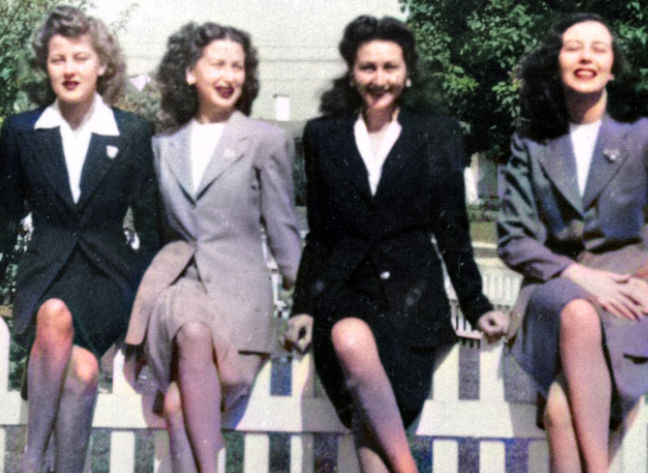
Lillian, Rosemary, June, Bonnie, Rosamond

Capturing Beauty
It took me a week to set up my new forty-inch television so I can enjoy the outstanding cinmetography that exist in new movies. I am still in shock after finding and watching ‘Black Narcissus’. There were fifty frames that were works of art. In one we see Sister Superior doing needlework of Saint Francis. This is the Movie that permeates this blog. Two days ago I considered Rena becoming a Nun.
This is Rosemarie’s Movie. The Four Daughters of Royal Rosamond were all candidates to become Nuns for the Order of Saint Francis. When Mary Magdalene Wiemneke married Royal Rosamond, she became……….
MARY MAGDALENE ROSAMOND
No one else owns this name. My grandmother was bid, driven, blackmailed to become a Nun, like her cousin. Instead she rode on the back of her boyfriends motorcycle from Dabuque to Los Angeles.
I wondered if Christine and Garth Benton watched this movie. The mural in this movie are museum quality. I wonder if there are stills. I saw fifteen Pre-Raphaelite paintings. This movie should be shown at the Getty Villa every day.
John Presco
Black Narcissus (1947)
Director: Michael Powell, Emeric Pressburger
Cast: Deborah Kerr (Sister Clodagh), Sabu (Young General), David Farrar (Mr Dean), Kathleen Byron (Sister Ruth), Flora Robson (Sister Philippa), Jenny Laird (Sister Honey), Judith Furse (Sister Briony), Esmond Knight (Old General), Jean Simmons (Kanchi), May Hallatt (Angu Ayah)
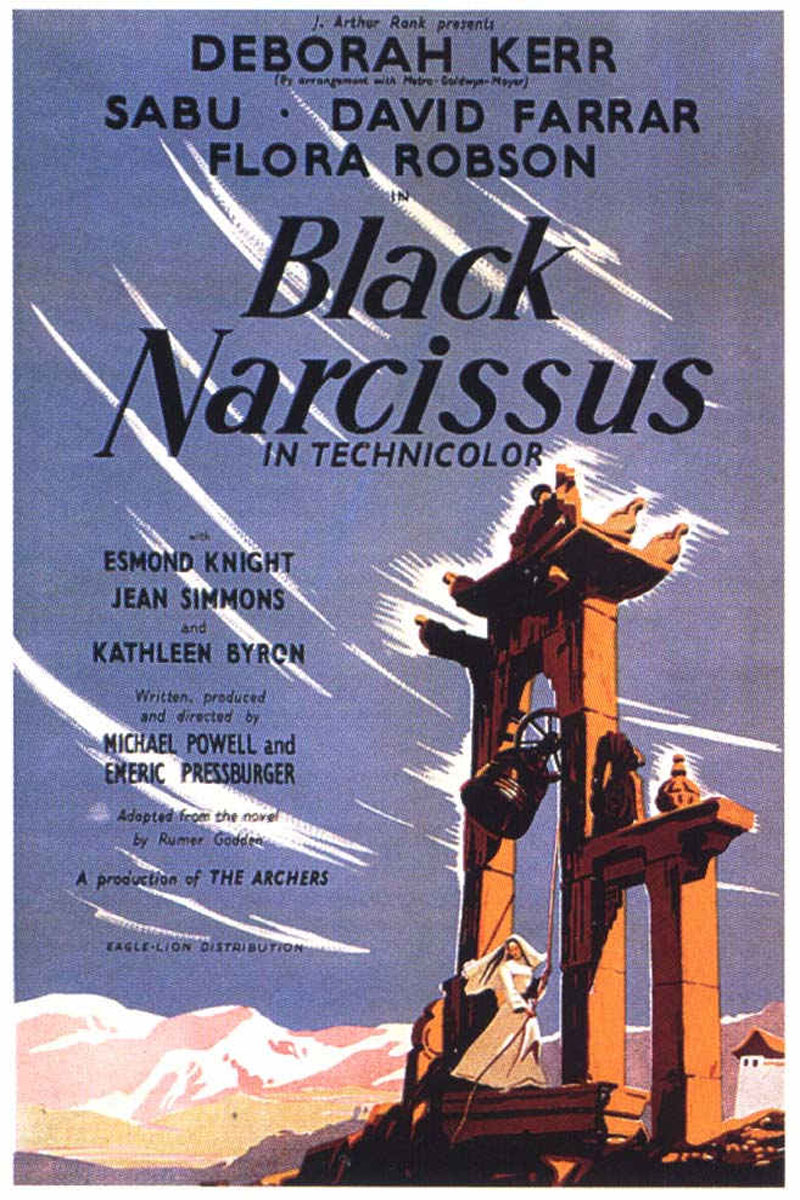
In 1947, people hadn’t seen anything like Black Narcissus. Its triumphant technicolour was like nothing that had been made before – and watching it now on a brand new, shiny restoration, it’s still overwhelmingly impressive. Alongside this beautifully shot action, we have a storyline surprisingly modern in its acute psychology and questioning of the strengths and weaknesses of human nature.
Sister Clodagh (Deborah Kerr) is given leadership of a group of nuns in a remote Himalayan harem building converted into a nunnery. But the isolation of the mountains and the strange atmosphere of the harem bring out weaknesses in the characters of the nuns, leading to profound challenges to their spiritual and mental well-being – not least Sister Ruth (Kathleen Byron), who becomes increasingly pre-occupied with local land captain Mr Dean (David Farrar).
Powell and Pressburger’s film is a brilliant, slightly hard to interpret, psychological gothic drama, a du Maurier-style sexually charged drama set in an exotic Indian location which the nuns struggle to understand. It’s a curious melange of scenes, often moving swiftly, sometimes only with narrow bridge scenes, meaning you soon get as lost in how much time has passed as the nuns themselves. Several key events take place off screen, and the native Indians are curious, unknowable and strangely intimidating in their distance and coolness.
All this is to help build the audience into feeling as unsettled as the characters themselves. It’s a film about the struggles between expression and repression. The two principal nuns – Sisters Clodagh and Ruth – both show elements of this. Both are drawn towards the earthy, manly but still patrician Dean, but both handle these emotions in very different ways – one by denying those feelings, another by trying to embrace them. All of this takes place in a distancing and intoxicating environment, where the convention rules of life seem suspended.
For Sister Clodagh, Dean serves as a bridge back to her own frustrated romantic feelings for an old flame – whose failure to propose guided her towards taking the veil – and elements of her warmer persona (witnessed by us in flashback). But Clodagh resolves never to make herself a slave to these feelings, and these moments of remembrance seem to make her cling all the more to her order – even while the film suggests that it is a strange mixture of pride, insecurity and fear as well as faith that motivates her.
By contrast, Sister Ruth – already acknowledged by the Mother Superior as not an obvious choice for the sisterhood – increasingly loses her grip first on her faith, then sanity, as she struggles with the feelings she clearly has for Dean. This quiet obsession has built up in her mind into representing all the desires for freedom and independence she feels while in the order. Where Clodagh resolves to cling closer to the repression of her feelings, Ruth rejects this very idea and determines to express herself – even as it costs her everything.

This heated growing madness is powers the film – and Kathleen Byron provides most of the drama with a stunningly unhinged performance, which builds so quietly (almost in the background of the film) that it never becomes wearing and also surprises with the extent of her unhinged delusion. One particular night-time encounter with Clodagh sizzles with rival agendas – one woman using a lipstick, the other using a Bible.
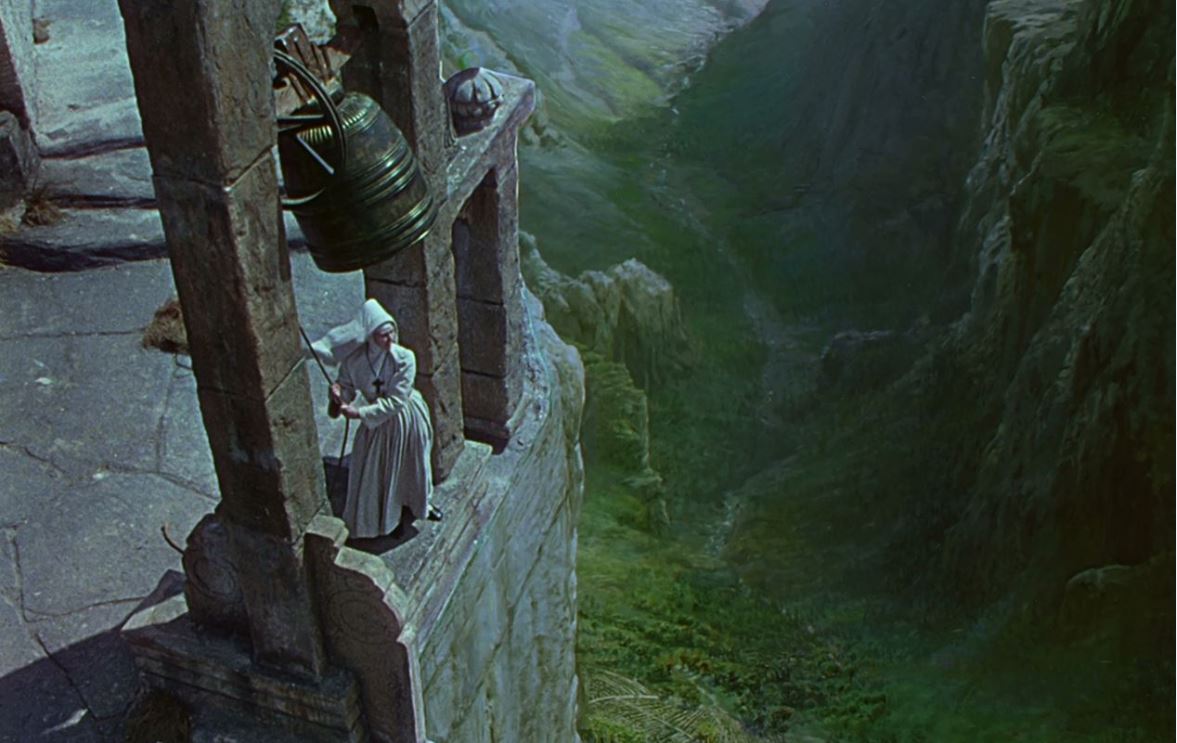
Powell (and it was Powell who largely directed these Archers pictures) uses a variety of techniques to develop this unease. Several shots are direct POV shots, with the audience becoming one of the characters, giving us the slightly unsettling feeling of being addressed by the actors. Quick tableaux editing gives us economic storytelling and a sense of events building swiftly towards a head (several sequences use a series of quick cuts of characters reacting to events). The camera uses a series of close-ups of sweaty foreheads or dizzying, vertigo inducing shots of the Himalayas to increase the unease. A later shot shows Sister Ruth moving through a shimmeringly filmed jungle, bringing a sense of confused eroticism to the picture.
Sexuality is a major theme of the film – and the characters have a series of acknowledged or unacknowledged sexual interests in each other. The music and camera work develop a sense of heated intensity on the mountain that suggests a simmering heat that unnerves the mind and throws open the temptations of physicality. Old wall paintings from the harem of bare-breasted women seem to be a constant presence – no wonder feelings are running high.
Jack Cardiff’s photography is simply extraordinary – it’s hard to believe none of this was filmed on location and most of it was shot in a studio – and this is still a film today that is hugely beautiful. The production by Alfred Junge is hugely impressive, with the nunnery a triumph of mismatched themes.
It’s not perfect. It’s a bit awkward to see actors blacking up. Some of the acting is quite OTT or stagy – in particular May Hallatt at points – and the film’s occasional delight in its visual appeal means its themes don’t always get the exploration that they deserve. One of the disadvantages of its deliberately vague timeline is that sometimes events happen too soon – or we don’t get enough sense of why they are happening. But these are blemishes.
This is a masterfully made picture, still beautiful to look at with impressive performances from Kerr, Byron, Farrar and many of the rest of the cast. It’s a surprisingly gothic melodrama by the end, with reds splashed across the screen with an imposing sense of threat. Still one that needs to be seen: and the end is so melodramatically gothic considering where the film started that the fact it doesn’t seem hugely jarring is an enormous tribute to the talents of those involved.
Benton, who has been described as one of the top five muralists in the world, truly executes museum-quality pieces. He has worked on such notable projects as the 1,000-foot mural in the J. Paul Getty Museum in Malibu, and been published in fine art books. Benton studied art at UCLA and Art Center College of Design after being inspired by the work of his cousin, the late Thomas Hart Benton, a teacher of Jackson Pollock and a well-known artist in his own right.
5/7/2012
Garth Benton is Dead







I learned from sister, Vicki Presco, that the father of our niece, Drew Benton, passed away five days ago. Garth Benton married Christine Rosemond Presco in 1986. Garth was married to the actress, Harlee McBride, before that, and had two daughters, Jessica, and Bree.
I was glad to hear that Drew was there for her father when he passed, with the help of Vicki. This is the family unity that I hoped for when I visited Vicki in June so we can go foreword. We have spent too much time at the stern of the ship looking at the destructive flotsam in our wake. We have been moving to the bow of the ship in order behold a brighter future.
For those who have inherited at least one of the Muses, let us continue to look to our creations, our beautiful children, and the loving bonds we made, for inspiration.
Above are the images of the beautiful Muses that Garth rendered in his mural ‘Hall of the Nine Muses’. Bree is performing a one act show in New York. Drew is working on new artwork. Here is the webpage Drew designed for her father: http://www.garthbenton.com/
Jon Presco
The murals on the J. Paul Getty Museum’s garden walls have been seen by millions of visitors since the Malibu institution opened 20 years ago. But who knew that the artist who painted–and is now restoring–the realistic likenesses of columns, garlands and still-life arrangements is Garth Benton, a third cousin of Thomas Hart Benton? The 53-year-old artist never met his famous relative, an American regionalist painter who rejected modern abstraction and championed a muscular style of realism until his death in 1975. But the younger Benton was turned on to art at the age of 8 when he saw a book of his relative’s paintings, and he occasionally corresponded with the late artist, who spent much of his life in his home state of Missouri.
Fine art connoisseurs insist that Garth Benton creates the kind of exquisite murals that “should be admired and treasured.” Insiders say Benton’s “never-ending” skills are made manifest by the diversity of his commissions, which are inspired by everything from first-century Roman frescoes to eighteenth-century Chinese wallpaper to Art Deco and Modern designs.
Benton, who has been described as one of the top five muralists in the world, truly executes museum-quality pieces. He has worked on such notable projects as the 1,000-foot mural in the J. Paul Getty Museum in Malibu, and been published in fine art books. Benton studied art at UCLA and Art Center College of Design after being inspired by the work of his cousin, the late Thomas Hart Benton, a teacher of Jackson Pollock and a well-known artist in his own right.
Benton is renowned for his meticulous research, immersing himself in the history of a civilization before he lifts his brush. Benton often paints his murals on canvas so they can be transported, a detail clients appreciate—especially when they decide to move. Though sources say they “cannot put a price” on these works of art, they willingly write a very large check.
Representative Client Comments:
“Benton’s work is breathtaking.” “In addition to being one of most talented artists of his time, he is a wonderful person—soulful and real.” “I am glad to know that this kind of skilled artist still exists.” “Garth transports you to another time with his art.”
“To Garth with appreciation of your wonderful assistance and with warmest, best wishes.”
– Betty and Gerald Ford
“What a joy to have your murals!”
– Bob and Dolores Hope
“Your work is truly fine, and you go above and beyond the call of duty. So when you present your final bill to me, make it for whatever you like…within reason, of course.”
– Barbra Streisand
“To master artist Garth Benton, and his two talented daughters, and with gratitude for your beautiful additon to our new home.”
– Rhonda “Mann” Flemming
Clientele
(Partial List)
Mr. and Mrs. Bob Hope
Pres. and Mrs. Gerald Ford
Ms. Barbra Streisand
Mr. Sidney Sheldon
HRH Prince Saud Al Faisal
Ms. Carol Burnett
Mr. and Mrs. David L. Wolper
Ms. Jaclyn Smith
The J.Paul Getty Museum
M.H. De Young Memorial Museum
Mr. Danny Kaye
Mr. and Mrs. Henry Singleton
Mr. And Mrs. Mickey Rudin
Mr. Dean Martin
Mr. Hugh Hefner
Fluor Corporation
Ralph M. Parsons Company
Mr. and Mrs. Leonard Firestone
The Beverly Hilton Hotel
Squaw Valley Inn
Mr. Richard Cohen
Lily and Richard Zanuck
Mr. and Mrs. George Doheny
Princess of Iran
Ms. Polly Bergen
Mrs. Walt Disney
Ms. Pamela Mason
Mr. and Mrs. Jim Knight
Mr. and Mrs. Aaron Spelling
Mr. and Mrs. Kirk Douglas
Mr. Jerry Magnin
Mr. and Mrs. Warren Clark
Mr. and Mrs. Robert Maguire
Mr. and Mrs. Stewart Resnick
Ms. Danielle Steel
Mr. David Nutt, Esq.
http://www.garthbenton.com/gallery/commercial/
Poor Baby Bree is really Bree Benton, 35 and a newcomer to cabaret. But her arresting characterization—unbroken for the length of her show—is worthy of a small theater. She drifts into view, worldly goods slung over her shoulder, and then, through vintage recitations and songs of woe, she recalls every defeated wretch who traipsed through early-20th-century America, looking for home and hanging on by a thread. Opening her bag, she pulls out her “babies”—antique dolls to whom she sings. Is she insane or just lonesome? Benton draws her laments from tattered sheet music and acoustic 78s; her voice is the frail warble heard on those tinny recordings, her face the portrait of despair immortalized by Mary Pickford, Lillian Gish and other silent-era waifs.
Learning of Benton’s incongruous family connection—she’s the stepdaughter of Richard Belzer, the cranky, politically minded comic actor—makes you all the more curious: What led her to adopt this antique persona? So hauntingly does she inhabit it that you may conclude that Bree Benton is not of this time, nor even this world.
Producers of the abandoned revival of Funny Girl struggled to find a new Fanny Brice, someone with the requisite comedic chops and rafter-shaking voice who could shake the ghost of Streisand. They might have done well to consider Bree Benton, who, in the persona of Poor Baby Bree, evokes the comic pathos of Brice and her contemporaries while putting her own indelible stamp on vaudeville revisited.
Since 2005, Benton has been performing in one-person shows as Poor Baby Bree, with musical director Franklin Bruno at piano—championing lost vaudeville songs of the late 19th and early 20th centuries. Baby Bree, a street-smart waif with stars in her eyes and “not a plug nickel” to her name, provides Benton with the ideal vehicle for her repertoire of vintage comic songs, ballads, and patter. In Benton’s skillful hands, tough-talkin’, sweet-singin’ Baby Bree is part Bette Davis, part Fanny Brice, part Judy Garland with a sprinkling of Olive Oyl—a sassy comedian one minute, a heart-breaking balladeer the next.
Baby Bree’s latest adventure, “I Am Going to Run Away,” is now playing at La MaMa through April 29. In this outing, Baby Bree runs away from home to join the circus—only to find herself lost in the big city, with only her dolls for company. This provides the frame for such forgotten standards as the rousing “Oh! You Circus Day” from 1912—a lively celebration of big-top glamour—to the poignant “Laugh! Clown! Laugh!, ”a 1928 ditty about the tragic life of a circus clown. For the most part, Benton breezily walks the tightrope between funny and sad, as epitomized in her charming interpretation of the 1932 novelty song “The Angel Cake Lady (And the Ginger Bread Man),” replete with a dancing marionette, gingerbread man, and larger-than-life doughnut. In some places, however, she is still finding her comedic feet. Not all the jokes land, particularly in the awkward first 10 minutes. (A crack about a wild bear eating sauerkraut crashed with a thud). Under Bruno’s musical direction, the band provides lively accompaniment, driving the momentum while providing rich period sound. Consulting director David Schweizer has built a solid framework—though sometimes the transitions drag—particularly the long, unnecessarily complicated and literal shift from the “woods” to the city. (The action stops to a halt as two stagehands dismantle trees and put up a garbage pail and crates).
Still, this is charming evening—a celebration of old songs whose cleverness and emotional truth still resonate—and a showcase for prodigious performer. In all, “I Am Going to Run Away” is a delightful introduction to the forgotten songs of a century ago.
Poor Baby Bree in I Am Going to Run Away; LaMaMa Etc. Conceived and performed by Bree Benton; Consulting Director: Michael Schweizer; Musical Direction and Piano: Franklin Bruno; The Club at LaMaMa; 212-475-7710; http://www.lamama.org, http://www.poorbabybree.com
7/7/2017
This Spuds – For You!


On Frog Mountain I discovered that all roads lead to Rena. No matter where she be, her Seekers will find her……..The Sleeping Maiden of Rose Mountain. Above, is our road to the beach, the other place I took Rena to swim. Would she let me in, there?

When Rena emerged from the tent to get her first Continental Breakfast, there was a halo around her head and a smile on her face. Alas we had consummated our Destiny together, but, our love making was subdued and gentle. She wanted me to move my hips as little as possible. She told me she did not want to cry out, have our love-making be overheard thru the thin walls of the tent. At the Frog Pond, I assured her we were all lone, as we were on Tam.
‘There’s not a soul within a mile of us!” I said, and, then it occurred to me, she did not know me, and thus, did not trust me – yet. Then came our conversation at the waterfall.
“No one has ever talked to me before. You are the first one.”
As Rena licked her whiskers with the back of her paw, I got my drawing pad and paper ready to do my first masterpiece of my Muse. What can go wrong, now? That’s when I spotted him out the corner of my eye as he quietly emerged from the bushes. He was wearing cut-offs, sandals, and a neckless. He had a big potatoe in his hand. He approached, with caution. He knew men in the ccompany of gorgeous women can be very possessive, very territorial.
With a grin on his face, he is making stabbing motions with his spud.
“Oh look Rena! Here come a mad man from the forest who intends to do me in with a vegetable so he can have you all to himself. Do you think he is a vegetarian, and, has been riled with the smell of frying pork meat”?
I looked at my wide-eyed beauty who was even more aglow at seeing what she really came to California to see – a Holy Man! And, I got it! He had come to Frog Pond to meditate, he on a mission of some kind. He had taken a vow of silence, guessed I.
He now stood by our fire and made motions that said he wanted to put his big patato in Rena’s fire. How did he know she was a red-hot Aries? He only pretended to look at me. He could not get his mind off what he saw as he lurked in the bushes. He awoke to the tinkle and chime of her beautufl laughter. Then, he brought back the veil of the forest, and almost had a heart attack – with holy halo and aura!
Now his dirty hand came at me, his fingers making the sign of the claw. He got closer, and closer……to my pencil!
“Oh look! He wants to use your pencil to write on your pad of paper. Give it to him. I want to hear, I mean, read, what he has to say!”
I threw my No.4 down on the table, in disgust!
“Don’t be such a party-pooper!”
Rena read out loud what he wrote;
“My name is Totu Sahd Mingu. I am a Buddhist monk, come to Frog Mountain to observe a week of total silence. I am not allowed to make fire. Because I took a vow of poverty, I only brought potatoes to eat. After two days I am bored with my diet. Can I put my potatoe in your fire?
P.S. I did not hear your loud love-making. I had a good nights rest.”
Beccause I do not recall exactly what Rena’s personal guru and trainer looked like. I am holding a contest. Pick one!






xcd
 Rosamond Press

Leave a comment