

“The Papal army in 1859 had 15,000 soldiers.[38] A separate military body, the elite Swiss Guard, served as the Pope’s personal bodyguard.”
Pope Pius had an Italian Army at his disposal. Trump acts like he is the Pope of America with his massive building projects. Vance is employing his Hee-Haw History at the peace talks.
John Presco
“Papal Army
The Papal army was composed of volunteers from many European countries, amongst whom the French and Belgian nationals constituted a Franco-Belgian battalion. Among the French volunteers were a notable number of nobles from western France: after the battle, whilst consulting the list of dead and wounded members of the Papal army, the Sardinian general Cialdini is reported to have said, in an example of black humor, “you would think this was a list of invites for a ball given by Louis XIV!”[3]
The Franco-Belgian, Austrian and Irish battalions later joined the Papal Zouaves, an infantry regiment of international composition that pledged to aid Pope Pius IX in the protection of the Papacy for the remainder of the Italian unificationist Risorgimento.”
Like most of his predecessors, Pius IX was a patron of the arts. He supported architecture, painting, sculpture, music, goldsmiths, coppersmiths, and more, and handed out numerous rewards to artists.[41] Much of his efforts went to renovate and improve churches in Rome and the Papal States.[42] He ordered the strengthening of the Colosseum, which was feared to be on the verge of collapse.[43] Huge sums were spent in the excavation of the Christian Catacombs of Rome, for which Pius created a new archaeological commission in 1853.
Pope Pius knew that if he remained in Rome he would simply become a pawn of the revolutionaries who controlled the city. On the evening of November 24, 1848, a well-laid plan was put into effect. With the aid of the French minister, the Bavarian ambassador, and his own personal attendant, Pius escaped from the Quirinal, disguised as a common priest. At last he passed through the gates of Rome and entered a carriage that was to take him to Gaeta, where the king of the Two Sicilies had promised him a refuge.
Pope Pius IX Escapes from the Quirinal: November 24, 1848
 Catholic Textbook Project
- Nov 20, 2023
- 4 min read
This text comes from our book, Light to the Nations, Part 2.
Pope Pius IX’s refusal to declare war on Austria had turned the Liberals of Rome utterly against him. They now sought his downfall. Secret societies in the city stirred up the common people to demand nothing less than a secular, constitutional government for the Papal States. And the more the pope tried to appease the Liberals, the more they demanded of him. Even the pope’s chief ministers, led by a layman, Count Mamiani, demanded that the pope not only declare war on Austria but also abandon his temporal power altogether.
As the months passed, street violence, stirred up by secret societies, increased in Rome. The civil guard was in the hands of the Liberals, while Count Mamiani only wasted government money and did nothing about the violence. When Mamiani at last resigned, the pope appointed Count Pellegrino Rossi as chief minister. Rossi took over the leadership of the mostly lay ministry on September 16, 1848.
The 61-year-old Count Rossi was a famous man. A Liberal who favored constitutional monarchy, he had published well-known works on politics, had written up a constitution for Switzerland, and served as professor of constitutional law at the University of Paris. King Louis Philippe’s chief minister, Guizot, had made Rossi French ambassador to Rome. After the fall of Louis Philippe, Rossi entered private life.
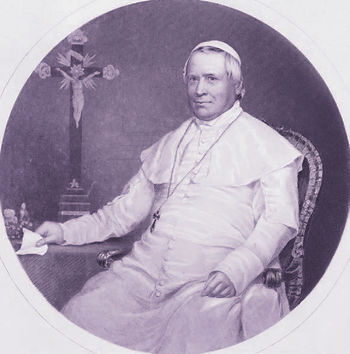
Rossi believed that the world of his day was moving toward representative government and political liberty, but he thought this had to happen gradually. As prime minister, Rossi was intent on protecting the pope’s political authority; and the pope, who had confidence in Rossi, entrusted to him the task of writing up a plan for a new constitution for the Papal States.
Liberal republicans, however, hated Count Rossi because he defended constitutional monarchy and was able to prevent riots in Rome. At last, the secret societies in Rome, Turin, and Florence condemned him to death.
On November 15, 1848, Rossi was to attend a meeting of Rome’s legislative assembly to present his plan for a new constitutional order. After being warned that if he attended the meeting, an attempt would be made on his life, he replied, “I defend the cause of the pope, and the cause of the pope is the cause of God. I must and will go.” That day, November 15, as he entered the assembly hall, someone struck him with a cane. Turning toward his attacker, Rossi was set upon by another assailant, who drove a dagger into his neck. Though members of the Civic Guard were in the courtyard, no one attempted to arrest the count’s killer.
“Count Rossi died a martyr to duty,” said Pope Pius when he heard the news of his minister’s death.
The blow struck at Rossi was a signal to the secret societies to rise against the papal government. The day following Rossi’s murder, Pius found himself besieged within the Quirinal by an unruly mob joined by members of the civic guard and the army. The pope’s Swiss Guard was able to hold back the mob for a time; but just when the crowds began to disperse, about a thousand members of the Civic Guard, the police, and other soldiers marched onto the palace’s piazza. To the music of pipes and drums, the soldiers drew up in formation and, on command, opened fire on the palace. Soon cannon were brought to bear on the Quirinal; and the pope, knowing resistance was useless, agreed to negotiate with revolutionaries.
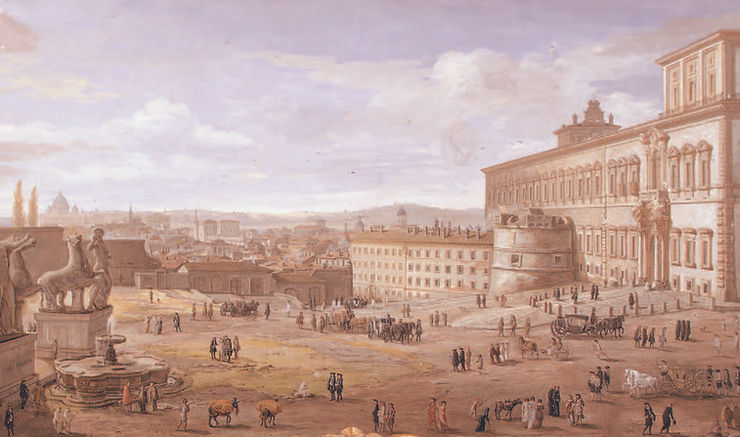
Pius was forced to appoint a Liberal ministry, but he refused to abdicate. He had no authority to do so, he said, for his temporal power came from God. But Pius refused to put up any resistance to the Liberals. “My course at this moment, when I am deprived of all support and all material power, can have but one object,” he said—“to avoid the useless shedding of a single drop of fraternal blood in my behalf.” As a prisoner, he took no further part in the new government, saying he remained “absolutely a stranger to its acts.” He forbade the government to pass any laws in his name.
Pope Pius knew that if he remained in Rome he would simply become a pawn of the revolutionaries who controlled the city. On the evening of November 24, 1848, a well-laid plan was put into effect. With the aid of the French minister, the Bavarian ambassador, and his own personal attendant, Pius escaped from the Quirinal, disguised as a common priest. At last he passed through the gates of Rome and entered a carriage that was to take him to Gaeta, where the king of the Two Sicilies had promised him a refuge.
Jolting in the carriage along the rough roads of his domains, still threatened with danger, the pope drew a small metal object from his breast. It was a pyx containing the Body of Christ—the very same pyx Pius VII had carried when he went into exile from Rome. After pressing the pyx to his lips, the pope turned to those who accompanied him in his flight. “Be calm,” he said, “God is with us. I carry the Blessed Sacrament on my person.”
An Opera That Sings of Italian Nationalism
The well-known Italian opera composer, Giuseppe Verdi, was an ardent partisan of Italian independence from foreign control and the unification of all Italian speakers under a common government. His nationalism is expressed in an opera he composed in 1848, La Battaglia di Legnano, a work (unlike other Verdi operas) not often performed today. The opera saw its first performance in January 1849. Here is the overture of La Battaglia di Legnano.
9/19/2011
Here Come the Forty-Eighters!


Lojos Kossuth was titled ‘The Angel of Fredom’ by smart Americans. The Darbyites were still in Ireland, dumbing-down the Irish with their Doomsday Pre-Trib Terrorism. Kossuth was a good friend of my kin, the Fremonts. Hungarian forty-Eighters made up the Jessie Scouts, and John’s bodyguards. Kossuth led the revolt against the Catholic Hapburgs who all descend from Jeanne de Rougemont, who may be my ancestor on my mother’s side. The Hapsburgs held the titles King and Queen of Bohemia.
Carl Augusta Janke was a Forty-Eighter, he coming to San Francisco in 1848. Many Forty-Eighters in Chile, left for this city to take part in the Gold Rush of 1849.
Above in the Wihelm family of Chile who look like my kinfolk.
Jon Presco
Forty-EightersFrom Wikipedia, the free encyclopedia
The Forty-Eighters were Europeans who participated in or supported the revolutions of 1848that swept Europe. In Germany, the Forty-Eighters favored unification of the German people, a more democratic government, and guarantees of human rights.[1
]Disappointed at the failure of the revolution to bring about the reform of the system of government in Germany or the Austrian Empireand sometimes on the government’s wanted list because of their involvement in the revolution, they gave up their old lives to try again abroad. Many emigrated to the United States, Canada, and Australiaafter the revolutions failed. They included Germans, Czechs, Hungarians, and others. Many were respected, wealthy, and well-educated; as such, they were not typical migrants. A large number went on to be very successful in their new countries.
Contents [hide]
1 Forty-Eighters in the USA
1.1 Notable German Forty-Eighters in the US
1.2 Notable Czech Forty-Eighters in the US
1.3 Notable Hungarian Forty-Eighters in the US
1.4 Notable Irish Forty-Eighters in the US
2 Forty-Eighters in England
2.1 Heligoland
3 Forty-Eighters in Holland
4 Forty-Eighters in France
5 Forty-Eighters in Switzerland
6 Forty-Eighters in Australia
6.1 Famous Australian Forty-Eighters
7 Peripatetic Forty-Eighters
8 See also
9 References
10 Bibliography
[edit] Forty-Eighters in the USAIn the United States, many Forty-Eighters opposed nativism and slavery, in keeping with the liberal ideals that had led them to flee Germany. Several thousand enlisted in the Union Army, where they became prominent in the Civil War. In the Camp Jackson Affair, a large force of German volunteers helped prevent Confederate forces from seizing the government arsenal in St. Louisjust prior to the beginning of the war.[2]
Many Forty-Eighters settled in the Texas Hill Countryin the vicinity of Fredericksburg, and voted heavily against Texas’s secession. In the Bellvillearea of Austin County, another destination for Forty-Eighters, the Germanprecincts voted decisively against the secession ordinance.[3]
More than 30,000 Forty-Eighters settled in the Over-the-Rhineneighborhood of Cincinnati, Ohio. There they helped define the distinct German culture of the neighborhood, but in some cases also brought a rebellious nature with them from Germany. During violent protests in 1853 and 1854, Forty-Eighters were held responsible for the killing of two law enforcement officers.[4]In the Cincinnati Riot of 1853, in which one demonstrator was killed, Forty-Eighters violently protested the visit of the papal emissary Cardinal Gaetano Bedini, who had repressed revolutionaries in the Papal States in 1849.[5]
Many German Forty-Eighters settled in Milwaukee, Wisconsin, helping solidify that city’s progressive political bent and cultural Deutschtum. The Acht-und-vierzigersand their descendants contributed to the development of that city’s long Socialist political tradition.[6]
After the Civil War, Forty-Eighters supported improved labor laws and working conditions. They also advanced the country’s cultural and intellectual development in such fields as education, the arts, medicine, journalism, and business.
[edit] Notable German Forty-Eighters in the USArchitects, Engineers: Louis Burger,[7] Adolf Cluss, Henry Flad
Artists: Friedrich Girsch;[8] Wilhelm Heine; Louis Prang; Adelbert John Volck; Theodore Kaufman
Businessmen, investment bankers: Solomon Loeb, Abraham Kuhnfounders of Kuhn, Loeb & Co.
Generalsin the American Civil War: Louis Blenker; Alexander Schimmelpfennig; Carl Schurz; Franz Sigel; Max Weber; August Willich; Frederick C. Salomon
Journalists, writers, publishers: Mathilde Franziska Anneke; Gustav Bloede (see Marie Bloede); Rudolf Doehn; Carl Adolph Douai; Carl Daenzer; Bernard Domschke; Christian Esselen(editor of Atlantis); Julius Fröbel; Karl Peter Heinzen; Rudolf Lexow(founder of Belletristisches Journal); Niclas Müller; Reinhold Solger;[9] Emil Praetorius; Oswald Ottendorfer; Friedrich Hassaurek;[10] Theodor Olshausen; Hermann Raster; Wilhelm Rapp;[11] Carl Heinrich Schnauffer;[12]Kaspar Beetz; Carl Dilthey; F. Raine; Heinrich Börnstein; Charles L. Bernays; Emil Rothe; Eduard Leyh;[13] George Schneider(who was also a banker); Albert Sigel[14]; Franz Umbscheiden; Edward Morwitz(who was also a physician)
Musicians: Carl Zerrahn; Carl Bergmann; Otto Dresel; Herman Trost(band leader in Sherman’s army who later settled in Lexington, Kentucky, where he conducted the first band at the University of Kentucky; friend of John Philip Sousa)
Physicians: Abraham Jacobi; Herman Kiefer; Ernest Krackowizer;[15] Hans Kudlich; Wilhelm Loewe, Gustav C. E. Weber[16]
Poets: Konrad Krez;[17] Edmund Märklin; Rudolf Puchner
Political activists: Lorenz Brentano(later a member of the Congress); Friedrich Hecker; Carl Schurz(later US Secretary of the Interior); Gustav von Struve; Wilhelm Weitling; Joseph Weydemeyer; Rudolf Dulon; Edward Salomon; Louis F. Schade
Other: Margarethe Schurz(founder of the first kindergartenin the U.S.); Al Sieber(known as “Chief of the Scouts” in Arizona, who fought at Antietam, Fredericksburg, and Chancellorsvillewith Hecker, Schurz, and Sigel, and then in the Battle of Gettysburg); Joseph Spiegel(founder of the Spiegel Catalog); Hugo Wesendonck(founder of the Germania Life Insurance Company, now Guardian Life); Pauline Wunderlich(fought at the Dresden barricades); John Michael Maisch(father of adequate pharmaceutical legislation)
[edit] Notable Czech Forty-Eighters in the USProkup Hudek, one of the “Slavonic Artillerymen” of the 24th Illinois Infantry Regiment, and one of the co-founders of the Workingmen’s Party of Illinois[18]
František Korbel, winegrower in Sonoma County, California
Vojta Náprstek, Czech language publisher in Milwaukee
[edit] Notable Hungarian Forty-Eighters in the USAlexander Sandor Asboth
Charles Zagonyi
Julius Stahel
Albin Francisco Schoepf
Phineas Mendel Heilprin
Michael Heilprin
Edward R. Straznicky
Martin Koszta[19]
[edit] Notable Irish Forty-Eighters in the USThomas Francis Meagher[20]
John O’Mahony
Lola Montez(she fled from Bavariavia Switzerland, France and England)
[edit] Forty-Eighters in EnglandGiuseppe Mazziniused Londonas a place of refuge before and after the revolutions of 1848. In the early years after the failure of the revolutions of 1848, a group of German Forty-Eighters and others met in a salonorganized by Baroness Méry von Bruiningk in St. John’s Wood, England.[21]The baroness was a Russian of German descent who was sympathetic with the goals of the revolutionaries. Among the people who attended her salon, hosted by herself and her husband Ludolf August von Bruiningk, were Carl Schurz, Gottfried and Johanna Kinkel, Ferdinand Freiligrath, Alexander Herzen, Louis Blanc, Malwida von Meysenbug, Adolf Strodtmann, Johannesand Bertha Ronge, Alexander Schimmelfennig, Wilhelm Loewe-Kalbe and Heinrich Bernhard Oppenheim.[22]
Carl Schurz reports “A large number of refugees from almost all parts of the European continent had gathered in London since the year 1848, but the intercourse between the different national groups — Germans, Frenchmen, Italians, Hungarians, Poles, Russians — was confined more or less to the prominent personages. All, however, in common nourished the confident hope of a revolutionary upturning on the continent soon to come. Among the Germans there were only a few who shared this hope in a less degree. Perhaps the ablest and most important person among these was Lothar Bucher, a quiet, retiring man of great capacity and acquirements, who occupied himself with serious political studies.”[23]
Other Germans who fled to England for a time were Ludwig Bamberger,[24] Arnold Ruge, Alexandre Ledru-Rollin and Franz Sigel. Along with several of the above, Sabine Freitag also lists Gustav Adolf Techow, Eduard Meyen, Graf Oskar von Reichenbach, Josef Fickler and Amand Goegg.[25] Karl Blindbecame a writer in England.
Hungarian refugee Gustav Zerffibecame an English citizen and worked as a historian in London. Lajos Kossuth, a Hungarian revolutionary, toured England and then the United States, and then formed a government in exile in England.
[edit] HeligolandIn addition, the British possession of Heligolandwas a destination for refugees, for example Rudolf Dulon.
[edit] Forty-Eighters in HollandLudwig Bamberger was in Holland for a time,[24]as was Heinrich Bernhard Oppenheim.[26]
[edit] Forty-Eighters in FranceLudwig Bamberger settled in Parisand worked in a bank from 1852 until the amnesty of 1866 allowed him to return to Germany.[24]Carl Schurz was in France for a time before moving on to England.[27]He stayed there with Adolf Strodtmann.
[edit] Forty-Eighters in SwitzerlandThe following were all refugees from Germany:
Friedrich Beustsettled in Switzerlandto work in early-childhood education. He lived and worked there until his death in 1899.
Gottfried Kinkelmoved to Switzerland in 1866 after living in England. He was a professor of archaeology and the history of art at the Polytechnikum in Zürich, where he died sixteen years later.
Hermann Köchlyfirst fled to Brussels in 1849. In 1851, he was appointed professor of classical philology at the University of Zürich. By 1864, he was back in Germany as a professor at the University of Heidelberg.
Richard Wagner, the composer, first fled to Paris and then settled in Zurich. He eventually returned to Germany.
[edit] Forty-Eighters in AustraliaIn 1848, the first non-British ship carrying immigrants to arrive in Victoriawas from Germany; the Goddefroy, on February 13. Many of those on board were political refugees. Some Germans also travelled to Australia via London.
In April 1849 the Beulahwas the first ship to bring assisted German vinedresser families to NSW.[28]
The second ship, the Parland[29]left London on 13 March 1849, and arrived in Sydney on 5 July 1849[30]
The Princess Louiseleft Hamburg March 26 of 1849, in the spring, bound for South Australia via Rio de Janeiro. The voyage took 135 days which was considered slow but nevertheless the Princess Louiseberthed at Port Adelaide on August 7, 1849 with 161 emigres, including Johann Friedrich Mosel. Johann, born in 1827 in Berlin in the duchy of Brandenburg had taken three weeks to travel from his home to the departure point of the 350 tonne vessel at Hamburg. This voyage had been well planned by two of the founding passengers, brothers Richard and Otto Schomburgk who had been implicated in the revolution. Otto had been jailed in 1847 for his activities as a student revolutionary. The brothers along with others including Frau von Kreussler and D. Meucke formed a migration group, the South Australian Colonisation Society, one of many similar groups forming throughout Germany at the time. Sponsored by the scientist geologist Leopold von Buch, the society chartered the Princess Louiseto sail to South Australia. The passengers were mainly middle-class professionals, academics, musicians, artists, architects, engineers, artisans and apprentices, and were among the core of liberal radicals, disillusioned with events in Germany.
Many Germans became vintnersor worked in the wine industry; others founded Lutheran churches. By 1860, for example, about 70 German families lived in Germantown, Victoria. (When World War I broke out, the town was renamed Grovedale.) In Adelaide, a German Club was founded in 1854 which played a major role in society.
[edit] Famous Australian Forty-EightersCarl Linger, the conductor and composer who wrote “Song of Australia”
Dr Moritz Richard Schomburgk, later director of the Adelaide Botanical Gardens
Hermann Büring, in the wine industry
Friedrich Krichauff, Chairman of the Agricultural Bureau
[edit] Peripatetic Forty-EightersFerenc Pulszky, a Hungarian politician, who joined Kossuth on his tour of the United States and England, became involved in Italian revolutionary activities and was imprisoned, and then was pardoned and returned home in 1866
 Rosamond Press
Leave a comment