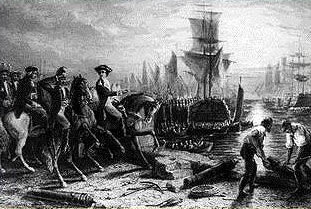
An engraving depicting the British evacuation of Boston at the end of the siege around 1861. | Public domain image, courtesy of Wikimedia Commons
Ken Burnes made a huge mistake by beginning his Story of the American Revolution with the AI voice of a Native American who belonged to the Confederacy of Tribes. It was not – their Revolution!
In Junior High I tried to nlock two schoolmates at the same time. The coach noted they almost split me in two. I had pain in my groin.
“Don’t do it again!”
I do it – all the time, in this newspaper Royal Rosamund Press. I use the spelling from the Revolutionary War pension application of John Hodges. He wanted to be given money every moth by the United States Government for fighting under Captain Samuel ROSAMUND.
‘Taken by Indians should have been THE STORY Revolution should have started with. You want land in the New World. Come and get it, but can you hold it? Can you give up…..
AND GO HOME
because its too fucking hard? Too damn tragic, and too
FUCKING UNREAL
“Were going to do what? Fire on the troops of the best army in the world. Then, we’re going to put cannon on small ships and let go a volley of cannon as a massive Juggernaut! Are you fucking crazy?”
“It’s…..our Revolution! Holy shit!”
John Presco
John Hodges Rosamond

“Dorothy (Hodges) being a young, tall, attractive woman was taken by an Indian Chief before the cabin was torched. She was gone for ten years. When she returned she brought her Indian son with her.”
With warfare all around them, the Rosamond and Hodge family conducted weddings, and from their unions sprang a Nation.
Samuel Rosamond
Place of Burial: Williamston, SC
Birth: circa 1751
Augusta County, Virginia
Death: August 11, 1814 (63)
Anderson District, SC
John Hodges Rosamond
Birth: September 16, 1789
Abbeville District, SC
Death: May 5, 1859 (69)
South Carolina
Elizabeth Rosamond
Birth: circa 1786
Abbeville District, SC
http://www.geni.com/people/John-Rosamond/6000000003263301262
Most of the information about John Hodges comes from his Revolutionary War application, W10117.
John Hodges was born in 1765 in Essex Co., Virginia. He is probably the son of John Hodges of Culpeper, VA, born about 1725, and wife Elizabeth.
Apparently sometime before the Revolution, the John Hodges family moved to SC. At the age of 15, on April 1, 1780, John Hodges joined the military as a private and served about 21 months. He was widely known as “Major” John Hodges later in life, perhaps from a position in the state militia.
His Revolutionary War pension application contains the following, summarized in Annie Walker Burns’ Revolutionary War Soldiers and Other Patriotic Records of Abbeville, County, SC (Washington, DC), pp. 17-18:
John Hodges, a resident of Abbeville District, S.C., age 67, states he entered service April 1, 1780 under command of Capt Samuel Rosamund, who commanded a beat or militia company in Ninety Six Direct, now Abbeville, S.C., and was marched t…
A family legend is that the father of John Hodges was a Revolutionary soldier and while at home on furlough, his cabin was attacked by Indians, and he was killed. The legend continued that the Indians captured four Hodges daughters,
bound them securely and put them inside the cabin which they prepared to burn.
However, an Indian warrior was reported attracted to one daughter, Dorothy, released her and took her with him, while the others perished in the flames.
(Another version has it that the mother and two daughters died in the fire.)
Many years later, Dorothy Hodges and her Indian son returned for a visit on her promise, the story went, that she would return to her Indian husband in Alabama territory. She yielded to pleadings of relatives to remain and eventually
married [ ] Rosamond. Her son attended the neighborhood school, but in his late teens went back to his father and was never heard from. Mr. and Mrs. Rosamond had children, lived for a time in Pickens, then went West, and South Carolina
kin lost contact with them.
With warfare all around them, the Rosamond and Hodge family conducted weddings, and from their unions sprang a Nation. The city of Hodges South Carolina was built on what was called
“the Jews land”. Then Dorothy Hodges was taken away by an Indian chief, and a child was born in the wilderness.
“The story of Dorothy being taken by Indians was so interesting, with the loss of her father and four younger sisters and all, that everybody told it faithfully. At least according to my grandfather who got it from his father and
compared it to other related Hodges family’s traditions in the1930s. It was his contention that the story was true because he had letters from six different families in six different locations. Each family gave the same basic story.
Dorothy being a young, tall, attractive woman was taken by an Indian Chief before the cabin was torched. She was gone for ten years. When she returned she brought her Indian son with her. He was nine when he arrived. The family talked
Dorothy into staying with them. They clothed, and educated, her son in the ways of his mother. They were shocked, and unbelieving when he told them he was going back to his father.Some of them thought it was rude and disrespectful for him to leave and they couldn’t understand why he would rather live with a bunch of savages.
The boy was seventeen when he left. Dorothy stayed with her family and married the widowed brother of Sarah Rosamond. They had a family of their own. The story ends with “They had a family of their own.”John M. Robinson put Dorothy in the
record as having been captured by Indians about 1781, he showed one son, no name, from the Chief. Then he shows a second husband as — Rosamond. I don’t know where he got his information. I believe it was from a tribute for General
George Washington Hodges, from two books; “Moragnes in America and Related Families” by Nell H. Howard and Bessie W. Quinn, and “Greenwood County Sketches” by Margaret Watson.
Share this:
Royal Rosamond Press
During the Revolutionary War, British naval ships were present in Boston Harbor, acting as a blockade and a key part of the military occupation of the city, led by General Thomas Gage. These naval forces supported the occupation of the city, which began in 1775, and provided the ability to project force from the water, though their guns could not effectively target high ground like Bunker Hill. The navy’s presence was crucial for supporting the army in Boston by blockading the port and enforcing royal authority
 Rosamond Press
Leave a comment