King Donald is declaring he is the One Man Art Band, which is me. I am the King of Arts!
JP
Bertel Thorvaldson and Tolkein
Posted on January 26, 2020 by Royal Rosamond Press





Capturing Beauty
by
John Presco
Chapter: Art Overcoming The World
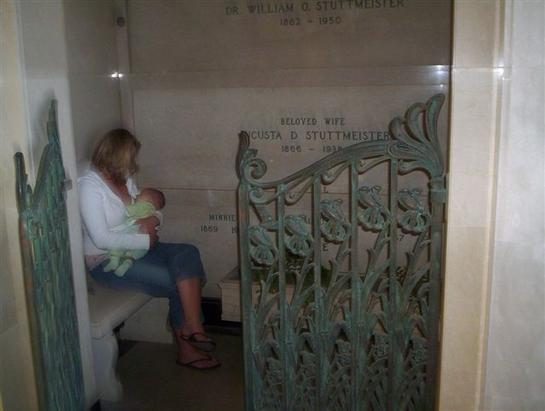
Is there such a thing as Art Justice – With Truth? To discover (after the rival biographers have had their day) that the Stuttmeister Mausoleum is a Outdoor Art Gallery for one of the most famous images of Jesus – of all time – frees me from the Enslaving Darkness that my late family erected, that employed the art of my late sister, Christine Rosamond Benton, who was not a famous artist, but a popular commercial artist – until now! History has caught up with the whole charade, the Art Dollars on the parade, that led to the Getty Museum door – and J.R. Tolkien’s vision of another world, based upon the Icelandic People of Snorri Thorvaldson, who is a ancestor to my late wife. Because of me, my daughter and nieces can go to Berlin, and worship Art and Bilbo. You can just see Heather Hanson and my grandson, Tyler Hunt, inside the Stuttmeister Tomb in Colma. Her days of snubbing me, are at an end. Our ancestor is a proven Teutonic Knight, as Rosemary told her two sons. What about her two grandsons?
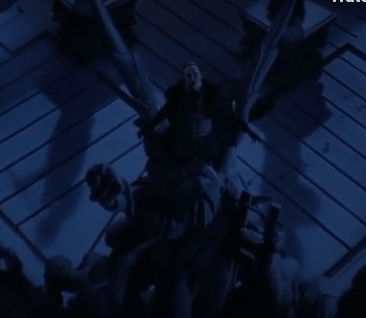
What we have here, is a real Art Book, and a Real Family Legend. How about a Real Broadway Play? In my version of The Phantom of the Opera, Erik dies during a difficult birth where instruments were used, thus his deformity. A Good Doctor breaths life into Erik, and he is Twice Born. He has seen heaven and hell. His parents turn their back on their son who they give to a Persian who can see Erik’s angelic wings – that give him a divine protection. He can hear the Music of The Creation, and those who come in contact with him can hear this music, but faintly. Because of the Fall of Humankind, they can not see the Total Beauty and Truth.
Character history
In the original novel, few details are given regarding Erik’s past. The novel confirms that Erik has traveled to multiple countries including France, Russia, Persia, and northern Vietnam, learning various arts and sciences from each region. Erik himself laments the fact that his mother was horrified by his birth deformity, and that his father, a true master mason, never saw him. Most of the character’s history is revealed by a mysterious figure, known through most of the novel as The Persian or the Daroga, who saved Erik’s life in Persia, and followed Erik to Paris; other details are discussed in the novel’s epilogue (e.g., his birthplace is given as a small town outside of Rouen,

Snorri is an Old Norse name derived from the word snerra, meaning “a fight.” Þorfinnsson is a patronymic, meaning “son of Þorfinnr”, (see Icelandic naming conventions). Snorri was named for his great-grandfather, Snorri Þórðarson,[4] or after Snorri Þorbrandsson who was not a kinsman but a participant in Karsefni’s expedition[5]
Family[edit]
There is speculation about the birth date of Snorri Thorfinnsson. Birth years such as 1005, 1009, and 1012 have been postulated, but all sources agree that he was born between 1005 and 1013. According to the Vinland sagas, when Snorri was 3 years old, his family left Vinland because of hostilities with indigenous peoples (called Skrælingar by the settlers, meaning “barbarians”). The family returned to the Glaumbær farm in Seyluhreppur.[6][7] [8]
Snorri Thorfinnsson had two children; a daughter named Hallfrid, and a son named Thorgeir. Hallfrid was the mother of Thorlak Runolfsson, bishop of Skálholt in the south of Iceland. One of the descendants of Snorri’s brother Thorbjorn, Bjorn Gilsson, was also a bishop of Hólar. Thorgeir was the father of Yngvild who was the mother of Brand Sæmundarsson, bishop of Hólar.[9] The sculptor Bertel Thorvaldsen claimed descent from Snorri Thorfinnsson in the 19th century.[10]
The Stuttmeister Tomb in Berlin
Posted on March 6, 2012by Royal Rosamond Press

A Seer told me in 1987: “You own your own creation – you died!”
What she meant, is, I beheld my conception by my parents, before I went to heaven and saw God.
My parents were playing cards in the sand, naked. I walked up to them as a child of three, looked down at the cards that were all face cards, and they were talking to me in foreign languages. They were my kindred, who were very distressed because they had been silenced in their lifetime. They were Evangelicals (father)and Huguenots (mother) They are buried next to one another in Berlin. Here lies the roses amongst the thorns. I part the veil,
and I behold the Lost Kingdom – and I give a command
“Arise from thy sleep, the true church of God!”
In this video we see the Stuttmeister tomb about 15 seconds into it. This name means ‘Master of the Horse’. Consider the pale horse and rider. Here the Templars and Teutonic Knights have come to rest.
Cut and paste this url:
In Matthew 27:53 we read about Jesus raising Jews from the dead, then saying; “It is done!” He did not say, it is done, and then come the earthquake. These Jewish Saints did not rise on Sunday, but went into Jerusalem Friday night just before sundown. They imparted a restored and new covenant – a Gift for the Chosen Children of God. I believe these Saints were a lineage of Nazarites from Samson and Samuel.
Bertel Thorvaldsen
From Wikipedia, the free encyclopedia
Jump to navigationJump to search
| Bertel Thorvaldsen | |
|---|---|
| Portrait by Carl Joseph Begas, ca. 1820 | |
| Born | Albert Bertel Thorvaldsen19 November 1770[citation needed]Copenhagen, Denmark |
| Died | 24 March 1844(1844-03-24) (aged 73)Copenhagen, Denmark |
| Nationality | Danish |
| Known for | Sculpting |
Bertel Thorvaldsen (Danish: [pæɐ̯tl̩ ˈtˢɒːˌvælˀsn̩]; 19 November 1770 – 24 March 1844) was a Danish sculptor of international fame and medallist,[1] who spent most of his life (1797–1838) in Italy. Thorvaldsen was born in Copenhagen into a Danish/Icelandic family of humble means, and was accepted to the Royal Danish Academy of Art when he was eleven years old. Working part-time with his father, who was a wood carver, Thorvaldsen won many honors and medals at the academy. He was awarded a stipend to travel to Rome and continue his education.
In Rome, Thorvaldsen made a name for himself as a sculptor. Maintaining a large workshop in the city, he worked in a heroic neo-classicist style. His patrons resided all over Europe.[2]
Upon his return to Denmark in 1838, Thorvaldsen was received as a national hero. The Thorvaldsen Museum was erected to house his works next to Christiansborg Palace. Thorvaldsen is buried within the courtyard of the museum. In his time, he was seen as the successor of master sculptor Antonio Canova. His strict adherence to classical norms has tended to estrange modern audiences. Among his more famous public monuments are the statues of Nicolaus Copernicus and Józef Poniatowski in Warsaw; the statue of Maximilian I in Munich; and the tomb monument of Pope Pius VII, the only work by a non-Catholic in St. Peter’s Basilica.
Contents
- 1Early life and education
- 2Career
- 3Death
- 4Works
- 5Museums and collections
- 6Gallery: Thorvaldsen’s works
- 7Notes
- 8Further reading
- 9External links
Early life and education[edit]

Self-portrait by Thorvaldsen while he was a student at the Royal Academy of Arts

Princess Wilhelmine, Duchess of Sagan by Bertel Thorvaldsen 1818, Albertinum, Dresden
Thorvaldsen was born in Copenhagen in 1770 (according to some accounts, in 1768), the son of Gottskálk Þorvaldsson, an Icelander who had settled in Denmark. His father was a wood-carver at a ship yard, where he made decorative carvings for large ships and was the early source of influence on his son Bertel’s development as a sculptor and on his choice of career. Thorvaldsen’s mother was Karen Dagnes, a Jutlandic peasant girl. His birth certificate and baptismal records have never been found, and the only existing record is of his confirmation in 1787.[3] Thorvaldsen had claimed descent from Snorri Thorfinnsson, the first European born in America.[4]
Thorvaldsen’s childhood in Copenhagen was humble. His father had a drinking habit that slowed his career.[5] Nothing is known of Thorvaldsen’s early schooling, and he may have been schooled entirely at home. He never became good at writing, and he never acquired much of the knowledge of fine culture that was expected from an artist.[6]
In 1781, by the help of some friends, eleven-year-old Thorvaldsen was admitted to Copenhagen’s Royal Danish Academy of Art (Det Kongelige Danske Kunstakademi) first as a draftsman, and from 1786 at the modeling school. At night he would help his father in the wood carving. Among his professors were Nicolai Abildgaard and Johannes Wiedewelt, who are both likely influences for his later neo-classicist style.
At the Academy he was highly praised for his works and won all the prizes from the small Silver Medal to the large Gold Medal for a relief of St. Peter healing the crippled beggar in 1793. As a consequence, he was granted a Royal stipend, enabling him to complete his studies in Rome. Leaving Copenhagen on August 30 on the frigate Thetis, he landed in Palermo in January 1797 traveled to Naples where he studied for a month before making his entry to Rome on 8 March 1797. Since the date of his birth had never been recorded, he celebrated this day as his “Roman birthday” for the rest of his life.
Career[edit]

A portrait of Thorvaldsen, by Christoffer Wilhelm Eckersberg
In Rome he lived at Via Sistina in front of the Spanish Steps and had his workshop in the stables of the Palazzo Barberini. He was taken under the wing of Georg Zoëga a Danish archeologist and numismatist living in Rome. Zoëga took an interest in seeing to it that the young Thorvaldsen acquired an appreciation of the antique arts. As a frequent guest at Zoëga’s house he met Anna Maria von Uhden, born Magnani. She had worked in Zoëga’s house as a maid and had married a German archeologist. She became Thorvaldsen’s mistress and left her husband in 1803. In 1813 she gave birth to a daughter, Elisa Thorvaldsen.
Thorvaldsen also studied with another Dane, Asmus Jacob Carstens whose handling of classic themes became a source of inspiration. Thorvaldsen’s first success was the model for a statue of Jason; finished in 1801 it was highly praised by Antonio Canova, the most popular sculptor in the city. But the work was slow in selling and his stipend having run out, he planned his return to Denmark. In 1803, as he was set to leave Rome, he received the commission to execute the Jason in marble from Thomas Hope, a wealthy English art-patron. From that time Thorvaldsen’s success was assured, and he did not leave Italy for sixteen years.
The marble Jason was not finished until 25 years later, as Thorvaldsen quickly became a busy man. Also in 1803, he started work on Achilles and Briseïs his first classically themed relief. I 1804 he finished Dance of the Muses at Helicon and a group statue of Cupid and Psyche and other important early works such as Apollo, Bacchus og Ganymedes. During 1805, he had to expand his workshop and enlist the help of several assistants. These assistants undertook most of the marble cutting, and the master limited himself to doing the sketches and finishing touches. Commissioned by Ludwig I of Bavaria in 1808 and finished in 1832 a statue of Adonis is one of the few works in marble carved solely by Thorvaldsen’s own hand, and at the same time it is one of the works that is closest to the antique Greek ideals.
In the spring of 1818 Thorvaldsen fell ill, and during his convalescence he was nursed by the Scottish lady Miss Frances Mackenzie. Thorvaldsen proposed to her on March 29, 1819, but the engagement was cancelled after a month. Thorvaldsen had fallen in love with another woman: Fanny Caspers. Torn between Mackenzie and Anna Maria Von Uhden the mother of his daughter, Thorvaldsen never succeeded in making Miss Caspers his wife.

Contemporary painting by Fritz Westphal of Thorvaldsen’s reception as a national hero on his return to Denmark in 1838.
In 1819, he visited his native Denmark. Here he was commissioned to make the colossal series of statues of Christ and the Twelve Apostles for the rebuilding of Vor Frue Kirke (from 1922 known as the Copenhagen Cathedral) between 1817 and 1829, after its having been destroyed in the British bombardment of Copenhagen in 1807. These were executed after his return to Rome, and were not completed until 1838, when Thorvaldsen returned with his works to Denmark, being received as a hero.[7]
Death[edit]
Towards the end of 1843 he was prohibited from working for medical reasons, but he began to work again in January 1844. His last composition from 24 March was a sketch for a statue of the genie in chalk on a blackboard. At night he had dinner with his friends Adam Oehlenschläger and H. C. Andersen, and he is said to have referred to the finished museum saying: “Now I can die whenever it is time, because Bindesbøll has finished my tomb.”
After the meal he went to the Copenhagen Royal Theatre where he died suddenly from a heart attack.[8] He had bequeathed a great part of his fortune for the building and endowment of a museum in Copenhagen, and left instructions to fill it with all his collection of works of art and the models for all his sculptures, a very large collection, exhibited to the greatest possible advantage. Thorvaldsen is buried in the courtyard of this museum, under a bed of roses, by his own wish.
Works[edit]

A Daguerreotype of Bertel Thorvaldsen (1840), one of the first photos taken in Denmark

Bertel Thorvaldsen with the Bust of Horace Vernet, painted by Horace Vernet (1789–1863)

Thorwaldsen’s Gutenberg Denkmal in Mainz on an 1840 medal of the printing press‘ 400th anniversary.
Thorvaldsen was an outstanding representative of the Neoclassical period in sculpture. In fact, his work was often compared to that of Antonio Canova and he became the foremost artist in the field after Canova’s death in 1822. The poses and expressions of his figures are much more stiff and formal than those of Canova’s. Thorvaldsen embodied the style of classical Greek art more than the Italian artist, he believed that only through the imitation of classical art pieces could one become a truly great artist.
Motifs for his works (reliefs, statues, and busts) were drawn mostly from Greek mythology, as well as works of classic art and literature. He created portraits of important personalities, as in his statue of Pope Pius VII. Thorvaldsen’s statue of Pope Pius VII is found in the Clementine Chapel in the Vatican, for which he was the only non-Italian artist to ever have been commissioned to produce a piece. Because he was a Protestant and not a Catholic, the church did not allow him to sign his work. This led to the story of Thorvaldsen sculpting his own face on to the shoulders of the Pope, however any comparison between Thorvaldsen’s portrait and the sculpture will show that this is just a fanciful story built on some smaller similarities.[9] His works can be seen in many European countries, especially in the Thorvaldsen Museum in Copenhagen, where his tomb is in the inner courtyard. Thorvaldsen’s Lion Monument (1819) is in Lucerne, Switzerland. This monument commemorates the sacrifice of more than six hundred Swiss Guards who died defending the Tuileries during the French Revolution. The monument portrays a dying lion lying across broken symbols of the French monarchy.
Thorvaldsen produced some striking and affecting statues of historic figures, including two in Warsaw, Poland: an equestrian statue of Prince Józef Poniatowski that now stands before the Presidential Palace; and the seated Nicolaus Copernicus, before the Polish Academy of Sciences building—both located on Warsaw’s Krakowskie Przedmieście. A replica of the Copernicus statue was cast in bronze and installed in 1973 on Chicago’s lakefront along Solidarity Drive in the city’s Museum Campus.[10] A statue (Gutenberg Denkmal) of Johannes Gutenberg by Thorvaldsen can be seen in Mainz, Germany.
Museums and collections[edit]


Cupid, from Thorvaldsens Museum
The Thorvaldsen Museum is the museum in Copenhagen, Denmark where Bertel Thorvaldsen’s works are displayed. The museum is located on the small island of Slotsholmen in central Copenhagen next to Christiansborg Palace. Designed by Michael Gottlieb Bindesbøll, this building was constructed from public collection funds in 1837. The museum displays a collection of the artist’s works in marble as well as plaster, including the original plaster models used in the making of cast bronze and marble statues and reliefs, copies of those works that are on display in museums, churches, and at other locations around the world.[11]
The museum also features Bertel Thorvaldsen’s personal collection of paintings, Greek and Roman sculptures, drawings, and prints the artist collected during his lifetime, as well as personal belongings he used in his work and everyday life.

Outside Europe, Thorvaldsen is less well known.[12] However, in 1896 an American textbook writer wrote that his statue of the resurrected Christ, commonly referred to as Thorvaldsen’s Christus (created for Vor Frue Kirke), was “considered the most perfect statue of Christ in the world.”[7] The statue has appealed to the members of The Church of Jesus Christ of Latter-day Saints and a 3.4 m replica is on display at Temple Square in Salt Lake City, Utah. There is also a replica of this statue in the LDS visitor centers at the Mesa Arizona Temple, the Laie Hawaii Temple, the México City México Temple, the Los Angeles California Temple, the Portland Oregon Temple, the Washington D.C. Temple, and the Hamilton New Zealand Temple. Additionally, the LDS Church uses images of the statue in official church media, such as the Internet site LDS.org.
Additional replicas of the Christus include a full size replica at the Johns Hopkins Hospital in Baltimore, Maryland within its iconic dome,[13] and a full-sized copy in bronze at the Ben H. Powell III family plot in Oakwood Cemetery in Huntsville, Texas as a memorial to the Powell’s son Rawley.
Thorvaldsen’s Christus was recreated in Lego by parishioners of a Swedish Protestant church in Västerås and unveiled on Easter Sunday 2009.[14]
Thorvaldsen’s primary mastery was his feel for the rhythm of lines and movements. Nearly all his sculptures can be viewed from any chosen angle without compromise of their impact. In addition, he had the ability to work in monumental size. Thorvaldsen’s classicism was strict; nevertheless his contemporaries saw his art as the ideal, although afterwards art took new directions.[15] A bronze copy of Thorvaldsen’s Self-Portrait stands in Central Park, New York, near the East 97 Street entrance.
Gallery: Thorvaldsen’s works[edit]
- Bertel Thorvaldsen’s sculptures
- Christus, Copenhagen Cathedral. Copies exist throughout the world.
- Christus draft (discolored by sculpting-room fireplace), Thorvaldsen Museum
- Baptismal font, Copenhagen Cathedral
- Jason with the Golden Fleece, Thorvaldsen’s first masterpiece
- Ganymede Waters Zeus as an Eagle, Thorvaldsen Museum
- Venus with apple
- Dancing Girl
- Tomb monument to Pope Pius VII, St. Peter’s Basilica, Rome
- Lion by Thorvaldsen.
- Nicolaus Copernicus Monument, Warsaw
- Prince Józef Poniatowski Monument, Warsaw
- Lion Monument, Lucerne
- Sir Walter Scott by Bertel Thorvaldsen
- Possibly Lady Georgiana Bingham, carved c. 1821-1824, National Gallery of Art
Knight Stuttmeister (Stallmeister)
Posted on January 26, 2020 by Royal Rosamond Press
“Come unto me”
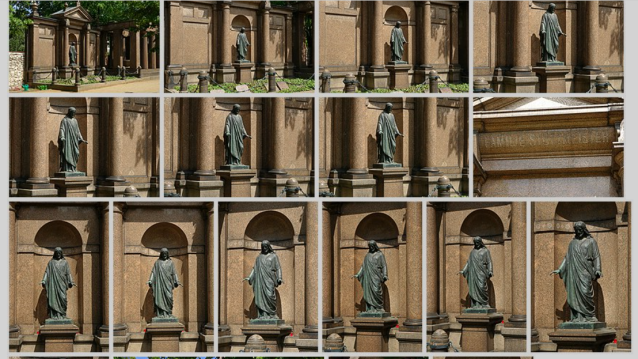
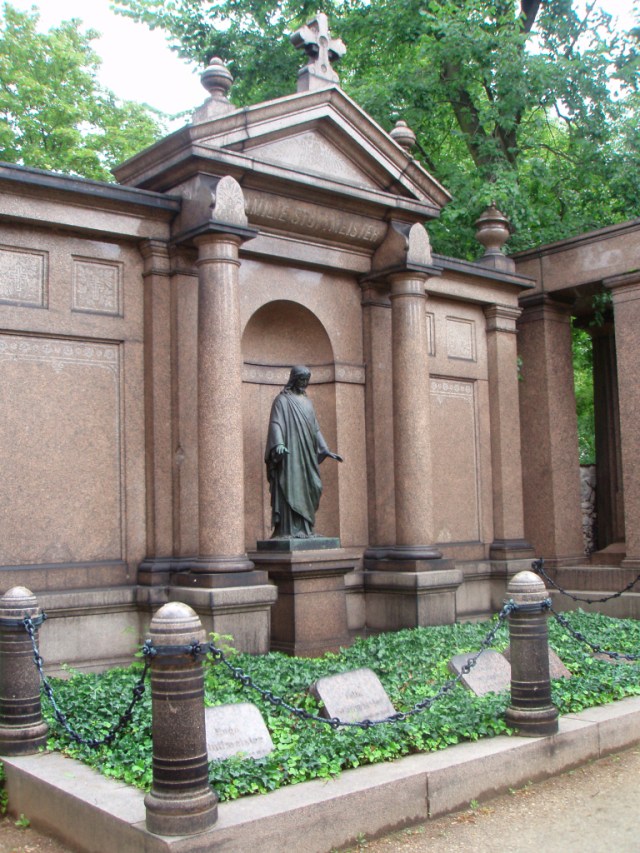
Berlin-Mitte (Stadtbezirk Mitte von Berlin, Ortsteil Mitte), Dorotheenstädtischer Friedhof, Chausseestraße 126 (siehe oben); Grabanlage der Familie Stuttmeister, Rittergutsbesitzer aus Charlottenburg, errichtet 1890 aus Granit, Grabwand mit rundbogiger Wandnische in einer Säulenädikula (Ädikula-Nische) und Christusfigur aus Bronze nach Entwurf des Berliner Bildhauers Julius Moser (1832-1916) in Anlehnung an die berühmte Christusfigur von 1839 des Bildhauers Bertel Thorvaldsen (1770-1844) in der Frauenkirche von Kopenhagen; zuletzt das rechts angrenzende Grab des Hermann Heinrich Alexander Wentzel (1820-1889), Architekt und königlicher Baurat, ebenfalls eine aufwendige Anlage aus Granit mit einer Bildnisbüste aus Bronze des Bildhauers Fritz Schaper (1841-1919); Aufnahmedatum: 20.5.2019
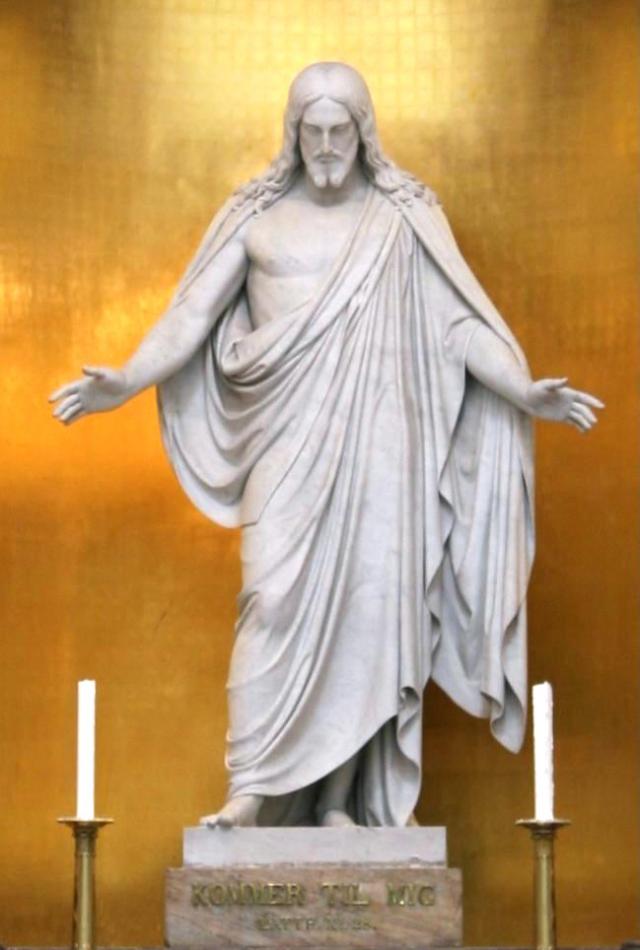
Thorvaldsen was commissioned to sculpt statues of Jesus and the apostles for the Church of Our Lady in Copenhagen. The statue of Jesus was completed in 1821.The statue is 345 centimeter high.[1] The inscription at the base of the sculpture reads “Kommer til mig” (“Come to me”) with a reference to the Bible verse: Matthew 11:28.
http://www.fotografie-architektur.de/stockphoto-galerie-2b-b03.html
Capturing Beauty
By
John Presco
Copyrght 2020
“Cone unto me”
I took my Old Man Nap around three today, and had the saddest dream I ever had. I went to Roseville and was looking for something. I was in Melba Charlotte’s garage. I found her son’s old fishing pole that looked like the one I bought at Goodwill. I climbed up to a loft and found some old rusty bicycles. I looked down on my father’s mother and asked if I could have them. I expected to hear her say “No!” But she was saying there is no one left who would want them, so, they’re years. I started to pull them apart, when I heard;
“What are you looking for my brother?”
I looked down and saw my sister Vicki.
“I’m looking for you. I have been so utterly alone since you went away!”
I climbed down the ladder, and we hugged each other, hard. I began to cry from a very deep place.
“All the time we lost that we could have been together. All that time, gone. Let us spend all our remaining days together.”
I awoke…….all alone. I believe all members of my natal family, are dead. I had been researching the Stuttmeisters and found mention they descend fron Teutonic Knights. The street they lived on may the esplanade hat Napoleon rode down with him army after he defeated the Prussian Army. Then, I googled the sculptor who rendered the image that looks over the Stuttmeisters. This image was based upon the statue done by Bertel Thorvaldsen, the ancestor of my ex-wife, Mary Ann Thorvaldsen.
I said to myself, the Stuttmeisters lived in Charlottenburg Castle. They have royal blood. You are home! You have prevailed…..Parzival!
I did some more research and found Sophia Dorothea – and was blown away by her insane and brutal husband who thwarted her attempt to unite Britain and Prussia via a marriage of her children. Sophia looks like Melba.
For several days I have been considering what I would say to my new therapist on the first day. I considered not going. Who would believe me? The fight over the Presco Children – is still raging! I have looked at this being passed in our DNA. Hohenzollern Castle was built to impress many people. We capture beauty. I had concluded I and my three siblings were not told who the Stuttmeisters were because it would stir up the old hornet’s nest. Victor Stuttmeister went to Germany during WW 1, and died fighting for the Germans. His body was shipped home across the sea.
Fighters and Ritters – with an occasional Artist to be our Witness!


Sophie Dorothea von Preußen, née von Hannover (1687-1757)
*oil on canvas
*1737


Thorvaldsen was commissioned to sculpt statues of Jesus and the apostles for the Church of Our Lady in Copenhagen. The statue of Jesus was completed in 1821.The statue is 345 centimeter high.[1] The inscription at the base of the sculpture reads “Kommer til mig” (“Come to me”) with a reference to the Bible verse: Matthew 11:28.
The Christus was not well known outside of Denmark until 1896, when an American textbook writer wrote that the statue was “considered the most perfect statue of Christ in the world.
Berlin-Mitte (Mitte district of Berlin, Mitte district), Dorotheenstadt cemetery, Chausseestrasse 126 (see above); Grave system of the Stuttmeister family, owner of chivalry from Charlottenburg, built in 1890 from granite, grave wall with a round-arched niche in a columnar pedicel (aedicule niche) and Christ figure made of bronze based on the design by the Berlin sculptor Julius Moser (1832-1916) based on the famous Christ figure from 1839 by the sculptor Bertel Thorvaldsen (1770-1844) in the Frauenkirche in Copenhagen;
The street connects the Dolomitenstraße with the Berliner Straße. It was created in 1874 by the Charlottenburg manor, Stuttmeister, who owned the property. The route does not yet have a name on a map from 1877. A free space at the end of the esplanade was projected as Wilhelmplatz in 1892. The street forms the border to the Pankow district. At the western end, a pedestrian tunnel under the tracks connects the Esplanade with Grüntaler Straße in the Gesundbrunnen district. Until the turning point , several foreign diplomatic missions were based in the GDR.
Esplanade, a French term for a large open space or forecourt, as found between rows of houses or between fortifications and the associated city. In 1874 the road was created by the knight’s owner Stuttmeister (Charlottenburg), who probably owned this terrain. The route is still shown on the map from 1877 without a name. Originally, a free space, called Wilhelmplatz on a map from 1902, was to be created at the end of the esplanade. On that map, the esplanade also runs at a right angle. The north-facing piece, which was only projected like Wilhelmplatz, was not added to the esplanade, but was later given the name Trienter Strasse. The south side of the esplanade now belongs to Prenzlauer Berg, the north side to Pankow.
http://www.fotografie-architektur.de/stockphoto-galerie-2b-b03.html
http://www.imperialteutonicorder.com/id26.html
http://kalliope.staatsbibliothek-berlin.de/de/ead?ead.id=DE-611-HS-338216
Ober-Stallmeister
From Wikipedia, the free encyclopedia
Jump to navigation Jump to search

Prince Alexander Borisovich Kurakin (1697–1749) – Senator, Ober-Stallmeister, diplomat
The Ober-Stallmeister (German: Oberstallmeister – literally “senior head of the stable“) was a post (rank) in the Tsardom of Russia and the Russian Empire, from February 4, 1722 – a court rank of the 3rd class in the Table of Ranks[1] (in 1766 it was moved to the 2nd class of the table[2]).
Like other court officials, abolished after the February Revolution – from March 17, 1917, in connection with the liquidation of the institution of imperial power.
Fedor Alexander Gustav von Rauch (8 August 1822 – 15 January 1892) was a cavalry officer in the Prussian Army and son of Gustav von Rauch. Born in Berlin, he was ‘Oberstallmeister’ (chief equerry) on the privy councils of William I, Frederick III and Wilhelm II. He also took a major part in horse breeding and racing, becoming vice-president of the Union Club in Berlin (modelled on the British Jockey Club).
http://www.imperialteutonicorder.com/id26.html

The National Leadership of the Order
Landmeister
The order was divided in three national chapters, Prussia, Livland
and the territory of the Holy Roman Empire Highest officer of each
chapter was the Landmeister (country master). They were elected by
the regional chapters. In the beginning, they were only substitutes
of the Hochmaster but were able to create a power of their own.
Within their territory, the Hochmeister could not decide against
their will. In the end of the rule over Prussia, factual, the
Hochmeister only was Landmeister of Prussia. There were three
Landmeister
* The Landmeister in Livlan…………………the successor of the Herrenmeister
(lords master) of the former Livonian Brothers of the Sword
* The Landmeister of Prussia…………………..since 1309 united with the office
of the Hochmeister, who was situated in Prussia since then.
- The Deutschmeister…..the Landsmeister of the Holy Empire. When Prussia
and Livland were lost, the Deutschmeister also became Hochmeister.
http://www.bach-cantatas.com/Lib/Werder-Diederich.htm
View in TreeBulkley Family TreeTree Search Kimberley Bulkley•Your Role: GuestSearchTools

Agnes Emma “Hedwig” Stuttmeister
1856–1908
Birth 15 JULI 1856 • Berlin, Brandenburg, Preußen, Germany
Death 3 AUG 1908 • Berlin, Berlin, Deutschland
FactsSourcesFamily
ShowSkip to Sources
Show
Facts
Name and gender
- ViewNameAgnes Emma “Hedwig” Stuttmeister3Sources0Media
- ViewName (Alternate)Hedwig Emma Agnes Stuttmeister1Source0Media
- ViewGenderFemale0Sources0Media
- ViewAge 0 — Birth15 Juli 1856 • Berlin, Brandenburg, Preußen, Germany4Sources 0Media1856(AGE)
- ViewBaptism06 Sep 1856 • Sankt Petri,Berlin Stadt,Brandenburg,Prussia2Sources 0Media1856
- Age 2 — Birth of Brother Wilhelm Erdmann Arthur Stuttmeister(1858–1862)12 Oct 18580Sources0Media18582
- Age 2 — Birth of Brother Wilhelm Erdmann Arthur Stuttmeister(1858–1862)18590Sources0Media18592
- Age 3 — Birth of Sister Amalie Charlotte Johanne Elisabeth Stuttmeister(1859–)26 December 18590Sources0Media18593
- Age 3 — Birth of Brother Victor Emanuel “Felix” Stuttmeister(1860–1899)18600Sources0Media18603
- Age 4 — Birth of Brother Victor Emanuel “Felix” Stuttmeister(1860–1899)20 Dec 18600Sources0Media18604
- Age 4 — Birth of Brother Victor Emanuel “Felix” Stuttmeister(1860–1899)abt 18610Sources0Media18614
- Age 5 — Birth of Brother Friedrich Heinrich “Hugo” Stuttmeister(1861–1914)13 Nov 1861 • Berlin, Prussia, Germany0Sources0Media18615
- Age 5 — Birth of Brother Friedrich Heinrich “Hugo” Stuttmeister(1861–1914)16 November 1861 • Berlin, Prussia, Germany0Sources0Media18615
- Age 5 — Death of Brother Wilhelm Erdmann Arthur Stuttmeister(1858–1862)17 Jan 18620Sources0Media18625
- Age 14 — Birth and Death of Brother Stuttmeister(1871–1871)6 Mai 1871 • Berlin, Brandenburg, Preußen0Sources0Media187114
- Age 33 — Death of Father Johannes Hermann Stuttmeister(1826–1890)8 Jan 1890 • Berlin, Germany0Sources0Media189033
- View
 Age 34 — Art Exhibit1890 • Berlin, Germany (2 Media)0Sources2Media189034
 - Age 43 — Death of Brother Victor Emanuel “Felix” Stuttmeister(1860–1899)10 Nov 1899 • Berlin, Berlin, Deutschland0Sources0Media189943
- Age 43 — Death of Mother Henriette Theodore “Emma” Pöhlig(1834–1899)11 Dez 1899 • Berlin, Berlin, Deutschland0Sources0Media189943
- Age 43 — Death of Brother Victor Emanuel “Felix” Stuttmeister(1860–1899)1899 • Berlin, Berlin, Deutschland
Christus (statue)
From Wikipedia, the free encyclopedia
Jump to navigationJump to search
For the statue of Jesus in Indianapolis, Indiana, see Christus (Indianapolis).

The original statue at the Church of Our Lady, Copenhagen.
Christus (also known as Christus Consolator) is a 19th-century Carrara marble statue of the resurrected Jesus by Bertel Thorvaldsen. Since its completion in 1838, the statue has been located in the Evangelical Lutheran Church in Denmark‘s Church of Our Lady in Copenhagen, Denmark. In the 20th century, images and replicas of the statue were adopted by the leaders of The Church of Jesus Christ of Latter-day Saints (LDS Church) to emphasize the centrality of Jesus Christ in church teachings.
Contents
Original sculpture[edit]
Thorvaldsen was commissioned to sculpt statues of Jesus and the apostles for the Church of Our Lady in Copenhagen. The statue of Jesus was completed in 1821.The statue is 345 centimeter high.[1] The inscription at the base of the sculpture reads “Kommer til mig” (“Come to me”) with a reference to the Bible verse: Matthew 11:28.
The Christus was not well known outside of Denmark until 1896, when an American textbook writer wrote that the statue was “considered the most perfect statue of Christ in the world.”[2][non-primary source needed][dubious – discuss]
 Rosamond Press

_by_Thorvaldsen.jpg)


Leave a comment