


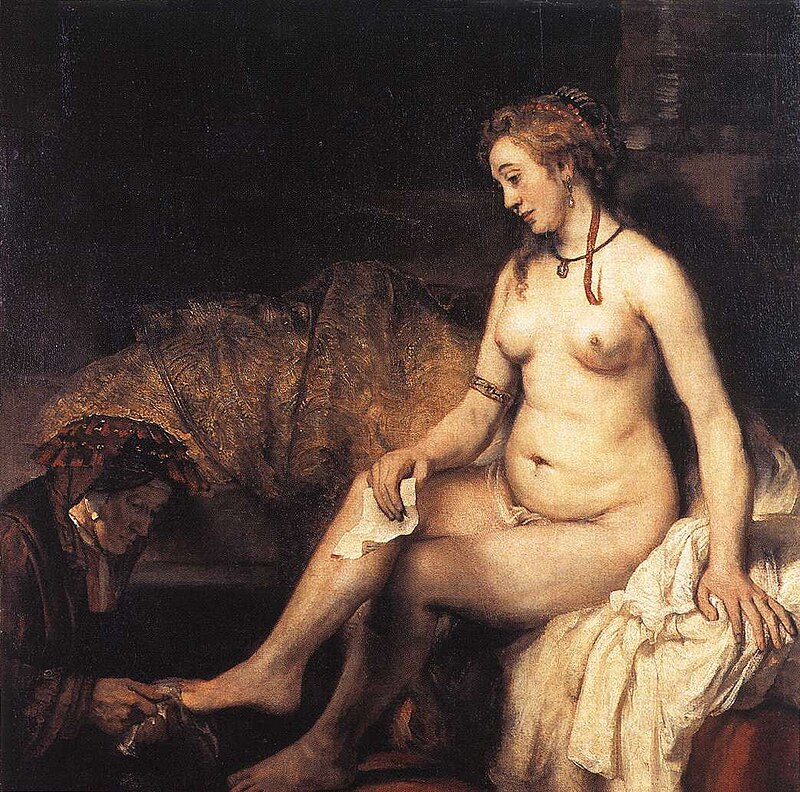

The Royal Janitor
Victoria Bond took an oath she would NEVER watch The Nothing To See Here Show starring the embodiment of Athena and Bathsheba. This expose of Bathsheba, and her relationship with King David, was highly titillating and pandered to the MAGA movement’s love of Donald as King David. To behold Starfish doing a Fan Dance she earned from watch old films of Flora the Queen of Fan Dancers.
Every Saturday night she would come on stage wearing the Corintiah helme of Athena, and nothing more. She carried a clipboard with wings that cleverly moved to hide her mound of Venus. She sat in a chair, glaring at the audience, and, every half hour she uncrossed her legs, to the other side. You could hear a pin drop. The camera panned in on sweating males in the audience, It reminded many of Sharon Stone in the movie Basic Instinct.
“Unless you send me more checks – I won;t continue!” (hard glaring) “Who wants to hear that David and Bathsheba found – FIVE KINGDOMS – via their five children?”
On July 17, 2025 Starfish made this startling revelation.
“I have a daughter. Her father was one of the stars of the Nashi Love Camps that had infiltrated the United States. My father wanted me to BREED with a young Love Star. I was sixteen. He was twenty-four. I was a virgin.”
“What’s your daughter name?”
“Her. Her name is……Her!”
In deep thought Starfish rose and went to the chalkboard and picked up Professor John’s Text Orb and Pointer, and drew a portrait of Her that Victoria Bond raised by herself while her wife went to Stanford and graduated in six months due to her Biblical knowledge,, and long legs of a young woman that could have posed for Greek statues. And this was – just fine – because what came out of her mouth was straight from the forehead of a Greek God. What came from the President, was a Nothing Sanwhich, Not so much as piece of baloney.
To be continued
In Islam, David is considered to be a prophet; Bathsheba is not mentioned in the Quran, and some Islamic tradition views the Bible story as incompatible with the principle of infallibility (Ismah) of the prophets. A hadith quoted in Tafsir al-Kabir and Majma’ al-Bayan expresses that Ali ibn Abi Talib said: “Whoever says that David, has married Uriah‘s wife as the legends are narrate, I will punish him twice: one for qazf (falsely accusing someone of adultery) and the other for desecrating the prophethood (defamation of prophet David)”.[26]
“They became extinct because they did not have enough sex. That must not happen to Russia”.
Obediently, couples move to a special section of dormitory tents arranged in a heart-shape and called the Love Oasis, where they can start procreating for the motherland.
With its relentlessly upbeat tone, bizarre ideas and tight control, it sounds like a weird indoctrination session for a phoney religious cult.
Facing uproar in his MAGA base over the Jeffrey Epstein files, President Donald Trump continues to try to shift blame for the controversy to others, including onto Biden administration officials for what he calls a ‘hoax.”
Trump, in a phone interview with “Just the News” on Real America’s Voice on Wednesday night, alleged without providing evidence that Democrats and former officials doctored files relating to the disgraced financier and convicted sex offender.
The comments came when Trump was asked if he wanted one prosecutor to look into the broad subject of political prosecution.
MORE: What we know and don’t know about Jeffrey Epstein, according to key victims’ attorney
“Well, I think it’s in the case of Epstein, they’ve already looked at it, and they are looking at it, and I think all they have to do is put out anything credible,” Trump said.
“But you know, that was run by the Biden administration for four years. I can imagine what they put into files, just like they did with the others,” Trump continued. “I mean, the Steele dossier was a total fake, right? It took two years to figure that out for the people, and all of the things that you mentioned were fake.”
Bathsheba (/bæθˈʃiːbə, ˈbæθʃɪbə/; Hebrew: בַּת־שֶׁבַע Baṯ-šeḇaʿ, lit. ’Daughter of Sheba’ or ‘Daughter of the Oath’)[1] was an Israelite queen consort. According to the Hebrew Bible, she was the wife of Uriah the Hittite and later of David, with whom she had all of her five children. Her status as the mother of Solomon, who succeeded David as monarch, made her the Gebirah (גְּבִירָה) of the Kingdom of Israel. She is best known for her appearance in the Book of Samuel, which recounts how she was summoned by David’s royal messengers after he witnessed her bathing and lusted after her; David has Uriah killed and then marries Bathsheba, incurring the wrath of God, who strikes down the couple’s first child in infancy before plunging the House of David into chaos and anguish.[2]
In one version of the myth, Pallas was the daughter of the sea-god Triton,[56] and she and Athena were childhood friends. Zeus one day watched Athena and Pallas have a friendly sparring match. Not wanting his daughter to lose, Zeus flapped his aegis to distract Pallas, whom Athena accidentally impaled.[57] Distraught over what she had done, Athena took the name Pallas for herself as a sign of her grief and tribute to her friend and Zeus gave her the aegis as an apology.[57] In another version of the story, Pallas was a Giant;[58] Athena slew him during the Gigantomachy and flayed off his skin to make her cloak, which she wore as a victory trophy.[58][13][59][60] In an alternative variation of the same myth, Pallas was instead Athena’s father,[58][13] who attempted to assault his own daughter,[61] causing Athena to kill him and take his skin as a trophy.[62] In Islam, David is considered to be a prophet; Bathsheba is not mentioned in the Quran, and some Islamic tradition views the Bible story as incompatible with the principle of infallibility (Ismah) of the prophets. A hadith quoted in Tafsir al-Kabir and Majma’ al-Bayan expresses that Ali ibn Abi Talib said: “Whoever says that David, has married Uriah‘s wife as the legends are narrate, I will punish him twice: one for qazf (falsely accusing someone of adultery)
Supporters of the Know Nothing movement believed that an alleged “Romanist” conspiracy to subvert civil and religious liberty in the United States was being hatched by Catholics. Therefore, they sought to politically organize native-born Protestants in defense of their traditional religious and political values. The Know Nothing movement is remembered for this theme because Protestants feared that Catholic priests and bishops would control a large bloc of voters.
Athena is the Greek goddess of strategic warfare, wisdom, weaving and the patron goddess of the ancient city-state Athens, Greece.
Her title, Athena Parthenos, refers to her status as a virgin goddess. “The Parthenon” translates into English as “the house of the virgin.”
Russian Sex Camps – The Nashi Love Power Movement
Posted on March 1, 2012 by Royal Rosamond Press

Russians are running out of newborn babies and the Soviet government is running sex and procreation camps.
Note in the Purity Ball video the father wishes his virginal daughter well – but hopes she will one day have FOUR children. This is because he knows his ilk are losing races to minorities – who are breeding at a much faster rate. Purity Princesses are Breeders for Jesus. How about Hitler and the Fatherland?
This what you get when men took control of women three thousand years go.
Jon
Sex for the motherland: Russian youths encouraged to procreate at campBy EDWARD LUCAS
Last updated at 08:35 29 July 2007
Comments (0) Share Remember the mammoths, say the clean-cut organisers at the youth camp’s mass wedding. “They became extinct because they did not have enough sex. That must not happen to Russia”.
Obediently, couples move to a special section of dormitory tents arranged in a heart-shape and called the Love Oasis, where they can start procreating for the motherland.
With its relentlessly upbeat tone, bizarre ideas and tight control, it sounds like a weird indoctrination session for a phoney religious cult.
But this organisation – known as “Nashi”, meaning “Ours” – is youth movement run by Vladimir Putin’s Kremlin that has become a central part of Russian political life.
Scroll down for more
Sinister: Millions of young Russians at a youth camp discerningly similar to the Hitler Youth
Nashi’s annual camp, 200 miles outside Moscow, is attended by 10,000 uniformed youngsters and involves two weeks of lectures and physical fitness.
Attendance is monitored via compulsory electronic badges and anyone who misses three events is expelled. So are drinkers; alcohol is banned. But sex is encouraged, and condoms are nowhere on sale.
Bizarrely, young women are encouraged to hand in thongs and other skimpy underwear – supposedly a cause of sterility – and given more wholesome and substantial undergarments.
Twenty-five couples marry at the start of the camp’s first week and ten more at the start of the second. These mass weddings, the ultimate expression of devotion to the motherland, are legal and conducted by a civil official.
Attempting to raise Russia’s dismally low birthrate even by eccentric-seeming means might be understandable. Certainly, the country’s demographic outlook is dire. The hard-drinking, hardsmoking and disease-ridden population is set to plunge by a million a year in the next decade.
But the real aim of the youth camp – and the 100,000-strong movement behind it – is not to improve Russia’s demographic profile, but to attack democracy.
Under Mr Putin, Russia is sliding into fascism, with state control of the economy, media, politics and society becoming increasingly heavy-handed. And Nashi, along with other similar youth movements, such as ‘Young Guard’, and ‘Young Russia’, is in the forefront of the charge.
At the start, it was all too easy to mock. I attended an early event run by its predecessor, ‘Walking together’, in the heart of Moscow in 2000. A motley collection of youngsters were collecting ‘unpatriotic’ works of fiction for destruction.
It was sinister in theory, recalling the Nazis’ book-burning in the 1930s, but it was laughable in practice. There was no sign of ordinary members of the public handing in books (the copies piled on the pavement had been brought by the organisers).
Once the television cameras had left, the event organisers admitted that they were not really volunteers, but being paid by “sponsors”. The idea that Russia’s anarchic, apathetic youth would ever be attracted into a disciplined mass movement in support of their president – what critics called a “Putinjugend”, recalling the “Hitlerjugend” (German for “Hitler Youth”) – seemed fanciful.
How wrong we were. Life for young people in Russia without connections is a mixture of inadequate and corrupt education, and a choice of boring dead-end jobs. Like the Hitler Youth and the Soviet Union’s Young Pioneers, Nashi and its allied movements offer not just excitement, friendship and a sense of purpose – but a leg up in life, too.
Nashi’s senior officials – known, in an eerie echo of the Soviet era, as “Commissars” – get free places at top universities. Thereafter, they can expect good jobs in politics or business – which in Russia nowadays, under the Kremlin’s crony capitalism, are increasingly the same thing.
Nashi and similar outfits are the Kremlin’s first line of defence against its greatest fear: real democracy. Like the sheep chanting “Four legs good, two legs bad” in George Orwell’s Animal Farm, they can intimidate through noise and numbers.
Nashi supporters drown out protests by Russia’s feeble and divided democratic opposition and use violence to drive them off the streets.
The group’s leaders insist that the only connection to officialdom is loyalty to the president. If so, they seem remarkably well-informed.
In July 2006, the British ambassador, Sir Anthony Brenton, infuriated the Kremlin by attending an opposition meeting. For months afterwards, he was noisily harassed by groups of Nashi supporters demanding that he “apologise”. With uncanny accuracy, the hooligans knew his movements in advance – a sign of official tip-offs.
Even when Nashi flagrantly breaks the law, the authorities do not intervene. After Estonia enraged Russia by moving a Sovietera war memorial in April, Nashi led the blockade of Estonia’s Moscow embassy. It daubed the building with graffiti, blasted it with Stalinera military music, ripped down the Estonian flag and attacked a visiting ambassador’s car. The Moscow police, who normally stamp ruthlessly on public protest, stood by.
Nashi fits perfectly into the Kremlin’s newly-minted ideology of “Sovereign democracy”. This is not the mind-numbing jargon of Marxism-Leninism, but a lightweight collection of cliches and slogans promoting Russia’s supposed unique political and spiritual culture.
It is strongly reminiscent of the Tsarist era slogan: “Autocracy, Orthodoxy and Nationality”.
The similarities to both the Soviet and Tsarist eras are striking. Communist ideologues once spent much of their time explaining why their party deserved its monopoly of power, even though the promised utopia seemed indefinitely delayed.
Today, the Kremlin’s ideology chief Vladislav Surkov is trying to explain why questioning the crooks and spooks who run Russia is not just mistaken, but treacherous.
Yet, by comparison with other outfits, Nashi looks relatively civilised. Its racism and prejudice is implied, but not trumpeted. Other pro-Kremlin youth groups are hounding gays and foreigners off the streets of Moscow. Mestnye [The Locals] recently distributed leaflets urging Muscovites to boycott non-Russian cab drivers.
These showed a young blonde Russian refusing a ride from a swarthy, beetle-browed taxi driver, under the slogan: “We’re not going the same way.”
Such unofficial xenophobia matches the official stance. On April 1, a decree explicitly backed by Mr Putin banned foreigners from trading in Russia’s retail markets. By some estimates, 12m people are working illegally in Russia.
Those who hoped that Russia’s first post-totalitarian generation would be liberal, have been dissapointed. Although explicit support for extremist and racist groups is in the low single figures, support for racist sentiments is mushrooming.
Slogans such as “Russia for the Russians” now attract the support of half of the population. Echoing Kremlin propaganda, Nashi denounced Estonians as “fascist”, for daring to say that they find Nazi and Soviet memorials equally repugnant. But, in truth, it is in Russia that fascism is all too evident.
The Kremlin sees no role for a democratic opposition, denouncing its leaders as stooges and traitors. Sadly, most Russians agree: a recent poll showed that a majority believed that opposition parties should not be allowed to take power.
Just as the Nazis in 1930s rewrote Germany’s history, the Putin Kremlin is rewriting Russia’s. It has rehaabilitated Stalin, the greatest massmurderer of the 20th century. And it is demonising Boris Yeltsin, Russia’s first democratically-elected president. That he destroyed totalitarianism is ignored. Instead, he is denounced for his “weak” pro-Western policies.
While distorting its own history, the Kremlin denounces other countries. Mr Putin was quick to blame Britain’s “colonial mentality” for our government’s request that Russia try to find a legal means of extraditing Andrei Lugovoi, the prime suspect in the murder of Alexander Litvinenko.
Yet the truth is that Britain, like most Western countries, flagellates itself for the crimes of the past. Indeed, British schoolchildren rarely learn anything positive about their country’s empire. And, if Mr Putin has his way, Russian pupils will learn nothing bad about the Soviet empire, which was far bloodier, more brutal – and more recent.
A new guide for history teachers – explicitly endorsed by Mr Putin – brushes off Stalin’s crimes. It describes him as “the most successful leader of the USSR”. But it skates over the colossal human cost – 25m people were shot and starved in the cause of communism.
“Political repression was used to mobilise not only rank-and-file citizens but also the ruling elite,” it says. In other words, Stalin wanted to make the country strong, so he may have been a bit harsh at times. At any time since the collapse of Soviet totalitarianism in the late 1980s, that would have seemed a nauseating whitewash. Now, it is treated as bald historical fact.
If Stalin made mistakes, so what? Lots of people make mistakes.
“Problematic pages in our history exist,” Mr Putin said last week. But: “we have less than some countries. And ours are not as terrible as those of some others.” He compared the Great Terror of 1937, when 700,000 people were murdered in a purge by Stalin’s secret police, to the atom bomb on Hiroshima.
The comparison is preposterous. A strong argument can be made that by ending the war quickly, the atom bombs saved countless lives.
Franklin D Roosevelt and Harry Truman-may have failed to realise that nuclear weapons would one day endanger humanity’s survival. But, unlike Stalin, they were not genocidal maniacs.
As the new cold war deepens, Mr Putin echoes, consciously or unconsciously, the favourite weapon of Soviet propagandists in the last one.
Asked about Afghanistan, they would cite Vietnam. Castigated for the plight of Soviet Jews, they would complain with treacly sincerity about discrimination against American blacks. Every blot on the Soviet record was matched by something, real or imagined, that the West had done.
But the contrasts even then were absurd. When the American administration blundered into Vietnam, hundreds of thousands of people protested in the heart of Washington. When eight extraordinarily brave Soviet dissidents tried to demonstrate in Red Square against the invasion of Czechoslovakia, in 1968, they were instantly arrested and spent many years in labour camps.
For the east European countries with first-hand experience of Stalinist terror, the Kremlin’s rewriting of history could hardly be more scary. Not only does Russia see no reason to apologise for their suffering under Kremlin rule, it now sees the collapse of communism not as a time of liberation, but as an era of pitiable weakness.
Russia barely commemorates even the damage it did to itself, let alone the appalling suffering inflicted on other people. Nashi is both a symptom of the way Russia is going – and a means of entrenching the drift to fascism.
Terrifyingly, the revived Soviet view of history is now widely held in Russia. A poll this week of Russian teenagers showed that a majority believe that Stalin did more good things than bad.
If tens of thousands of uniformed German youngsters were marching across Germany in support of an authoritarian Fuhrer, baiting foreigners and praising Hitler, alarm bells would be jangling all across Europe. So why aren’t they ringing about Nashi?
 Rosamond Press
Leave a comment