


The Royal Janitor
Victoria Bond got behind the wheel of Grey Cloud that was put in storage when she moved to America. A BAD gentleman handed her her keys at the airport. Starfish called her husband after the amazing Drone attack on Russia
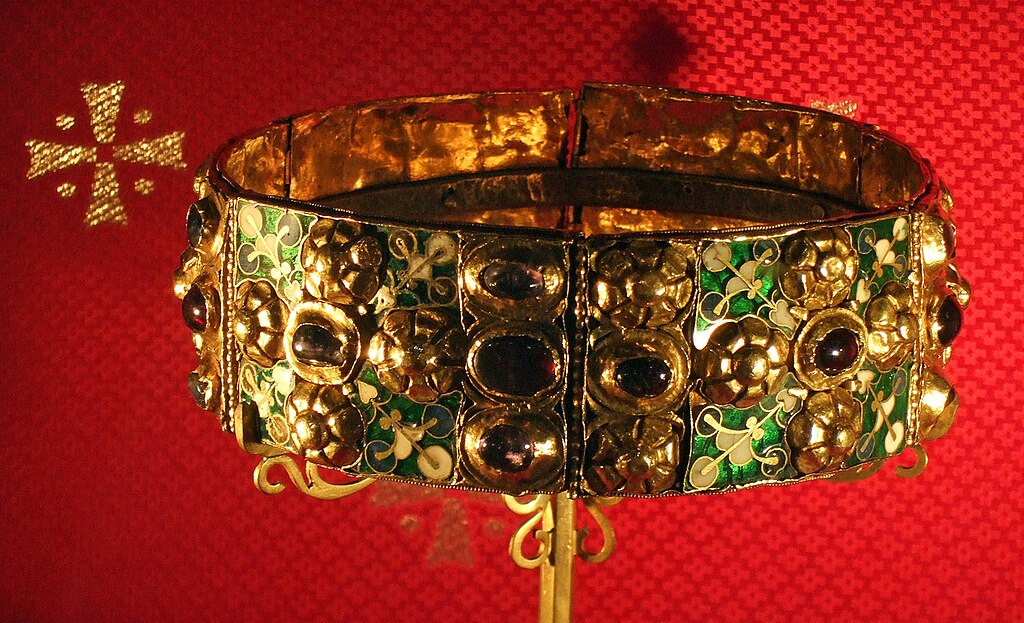
“You’re driving my real father’s car. I can’t believe it. I think I know where the Lombard Treasure is – including the royal regalia of the Lombards. That crown – is fake! The real one is in Belmont California. Meet me in my tree house!”
“She’s out of her tree!: said the Wizard after Victoria suggested Starfish was suffering dissociation. “She suffered a great trauma with the death of her parents. She adopted Mr. Eastwood rather than accept the ttruth she’s an orphan in the world.”
For an hour the Wizard and Bond discussed the amazing story that Starfish concocted. Her parents were great fans of Eastwoods movie, practically ‘The Good, the Bad, and the Ugly’ Being math wizards they noticed there were repetitive scenes that had a hidden meaning, such as how many times Blondy was offered water – and denied! Somehow, they concluded this movie was produced by the Comasin Masters who were Masons that employed a code. When they read the Overland Journal of Count Cipriani, they wondered if he was taking much gold to California, that helped found the Bank of Italy that became the Bank of America. William Ralston is right in the middle of this – transference! He dies, mysteriously. He became a Goodfellow and hired Carl Janke to make a retreat for the Oddfellows in Belmont. This is why the Oddfellows cemetery was dug up. A sinister group was looking for the gold that Paul the Deacon described when the Lombards overran Italy.
“Sound preposterous Said the Wizard, “She is in need of serious mental help. You say her mother stalked Eastwood when she worked on the set of Rawhide, and fell in love? Well, there you go. Case closed!”
“Not quite, Cipriani was very close with the Bonapartes who wanted a report. There is a possibility they were going to retreat to California and make it their kingdom.”
To be conditioned
.
The Comacine masters (magistri comacini) were early medieval Lombard stonemasons working in a region of excellent building stone who gave to Lombardy its preeminence in the stone architecture that preceded Romanesque style.
Comacini
[edit]
Their masons’ marks have suggested arcane meanings for some enthusiasts. The name comacini Romantic historians of the nineteenth century traced to the location where they supposedly had their headquarters, the minute Isola Comacina in Lake Como, alleged to have been a safe haven during the Lombard invasion; a more inventive etymology derives from a supposed Latin expression cum machinis, referring to their tools.[1]
The first mention of Comacine masters was in an edict of 643 of the Lombard king Rothari, which concerned itself in Lombard fashion mainly with the indemnity that would be due should a house collapse which had been built by a magister comacinus for a patron ad opera dictandi (“commissioning the works”).[2] The reference has been interpreted as granting certain privileges to magistri comacini, but the context shows that modern readers are correct in interpreting the key word comacini simply as “masons”. Comacini are also mentioned in a passage in the Memoratorium of Liutprand the Lombard.
The survival of brotherhoods of the comacini are based on the hypothesis[3] that the Roman secrets of masonry construction were never utterly lost in Italy but were passed on by the mason brotherhoods, which were supposed to be among the numerous documented collegia in which workingmen joined together for mutual protection, fraternal banqueting and eventual support of their widows throughout the Roman Empire, sometimes associated together as masters of the arcana or “mysteries” of their craft. Each such confraternity was composed of men (never women) located in a single town, and was made up of men of a single craft or those worshipping a single deity, free, freedmen and slaves together, forming a bond very like the image of a city, always under the uneasy surveillance of officialdom.[4] Such, it supposed, were the comacini whose geographical center in the Early Middle Ages originated in Lombardy, in Como and Pavia.
If mason’s marks were the sign of the comacini, then evidence of their work has been found in several parts of Europe, as far as the capitals of the crypt in the cathedral of Lund. The “Como-Pavian” architectural sculpture is recognized in the cathedral of Modena and its Torre della Ghirlandina,[5] in central[6] and southern Italy, west across Languedoc to Iberian Peninsula, across southern Germany as far as Hungary, and even in England.[7]
In the Middle Ages, artists did not customarily sign their work, so to detect the work of this corporation, historians look to masons’ marks inscribed in the stonework; in this way historians have traced comacine master’s influence as far as Sweden and Syria. Freemasons claimed descent from the guilds of comacini.[8]
The efflorescence of a “Como-Pavian” school of sculptural decoration on pulpits and portals that surfaced in the area of Como in the late eleventh century and developed luxuriously to enrich facades in Pavia in the 1130s, then were disseminated more widely in the twelfth and thirteenth century, doubtless by travelling groups of artisans, is traditionally ascribed to a surfacing of a long-buried tradition of comacini sculptors, who were influenced by the animal interlaces of Lombard metalwork.[9] In this corrente comasca that spread on the periphery of Romanesque and Early Gothic art, geometric interlaces are peopled with sleek monsters and figures that seem to synthesize some very disparate and distant influences: barbaric Longobard metalwork, Ottonian illuminations, Byzantine silk patterns, Islamic patterning, Coptic reliefs, have all been compared to the “Como-Pavian” current of sculpture.[10]
Another notable group of medieval stoneworkers were maestri Campionesi from Campione, not far from Como.
The Kingdom of Italy (Italian: Regno d’Italia; French: Royaume d’Italie) was a kingdom in Northern Italy (formerly the Italian Republic) that was a client state of Napoleon‘s French Empire. It was fully influenced by revolutionary France and ended with Napoleon’s defeat and fall. Its government was assumed by Napoleon as King of Italy and the viceroyalty delegated to his stepson Eugène de Beauharnais. It covered some of Piedmont and the modern regions of Lombardy, Veneto, Emilia-Romagna, Friuli-Venezia Giulia, Trentino, South Tyrol, and Marche. Napoleon I also ruled the rest of northern and central Italy in the form of Nice, Aosta, Piedmont, Liguria, Tuscany, Umbria, and Lazio, but directly as part of the French Empire (as departments), rather than as part of a vassal state.
The most important was the third, proclaimed on 5 June, being the real constitution of the kingdom: Napoleon I was the head of state and had the full powers of government; in his absence, he was represented by the Viceroy, Eugène de Beauharnais. The Consulta, Legislative Council, and Speakers were all merged into a Council of State, whose opinions became only optional and not binding for the king. The Legislative Body, the old parliament, remained in theory, but it was never summoned after 1805; the Napoleonic Code was introduced on 21 March 1804.[3]
An ancestor of Paulus’s named Leupichis emigrated to Italy in 568 in the train of Alboin, King of the Lombards. There, he was granted lands at or near Forum Julii (Cividale del Friuli). During an invasion by the Avars, Leupichis’s five sons were carried away to Pannonia, but one of them, his namesake, returned to Italy and restored the ruined fortunes of his house. The grandson of the younger Leupichis was Warnefrid, who by his wife Theodelinda became the father of Paul.[1] Paulus was his monastic name; he was born Winfrid, son of Warnefrid, about 720 in the Duchy of Friuli.[2]
He built Ralston Hall in Belmont, California, as a summer home; however his wife Elizabeth “Lizzie” Fry and their four children lived there all year round.[6] Listed on the National Register of Historic Places, it became part of the campus of Notre Dame de Namur University.[2][6] He built the California Theatre on Bush Street in San Francisco, which opened on January 18, 1869.[7]
In 1875, his financial empire collapsed as a result of the combination of the expense of building the Palace Hotel, the failure of his attempt to buy and then resell the Spring Valley Water Company, the after-effects of the Panic of 1873, and a crash in the stock value of the Bank of California. The crash occurred just weeks before the opening of the Palace Hotel.[5]: 188–191
The day after the collapse, his body was found in the San Francisco Bay on August 27, 1875.[13] He was the victim of either a stroke during his regular swim, or suicide.[5]: 190 About 50,000 people were said to have watched his funeral procession, and 8,000 of his friends were said by Robert Brereton to have attended the public meeting held in Union Hall on September 8, 1875 to express the community’s loss. His partner, U.S. Senator William Sharon, acquired many of his assets, including the Palace Hotel and Ralston Hall. He was buried at Lone Mountain Cemetery (which had recently been renamed Laurel Hill Cemetery) in San Francisco,[14] and later moved to Cypress Lawn Memorial Park in Colma. In 1941, there was a memorial erected in his honor on the Marina Green in San Francisco.[15]
P E A/Kobal/Shutterstock
Having made A Fistful of Dollars and its follow-up, For a Few Dollars More (1965), Sergio Leone wanted Eastwood back for Round Three. The actor wasn’t sure he wanted to return to Europe for another one; Rawhide had just been canceled, the previous two hadn’t been seen in the U.S. yet and he was desperate to establish himself in Hollywood’s eyes as being more than a TV cowpoke. Leone flew out to California to pitch the lanky actor, and after negotiating a bigger payday, Eastwood signed on. Both men got their money’s worth. Roundly considered one of the greatest Westerns ever made, the third entry of the “Dollars trilogy” pairs the Man With No Name with Lee Van Cleef’s black-clad “Bad” and Eli Wallach’s charismatically amoral “Ugly”; Eastwood’s gunfighter is “the Good” only be default. All three of them are chasing down a missing cache of Confederate gold, and none of them are willing to let a little thing like the Civil War get in their way. It ends with the most protracted, close-up-filled showdown in film history. Eventually, American audiences belatedly got to see the entire trilogy in quick succession; by the time Ennio Morricone’s “ay-yay-yaaa” was released in January 1968 and was racking up huge box-office receipts, nobody in Hollywood considered Eastwood a TV star.
‘Coogan’s Bluff’ (1968)
Universal/Kobal/Shutterstock
Deputy sheriff Walt Coogan knows the Arizona landscape like the back of sunburnt hands. When he’s sent to New York to bring back an escaped convict, however, the Southwestern lawman is a Stetson-wearing fish out of water. All Coogan has to do is apply a little bit of frontier justice and his signature take-no-shit tactics to these city folks, however, and he’ll get his man. Playing off his sagebrush antihero status, Eastwood gives his deputy an edge and then adds a sense of moral indignation about a society filled with hustlers, hookers, hippies and LSD-gobbling freaks (if there’s a funnier, more paranoid psychedelic-Sodom-and-Gomorrah look at ’60s counterculture than this, we’re unaware of it). Coogan is the missing link between his Western tough guys and the reactionary cops à la Harry Callahan he’d play throughout his career, and he ended up tapping into the same “law and order” demographic that would help Nixon become president. It was a hit, and more importantly, paired Eastwood with director Don Siegel for the first time, who’d play a big part in the actor’s career in front of and behind the camera. No less than Quentin Tarantino has declared that Coogan’s Bluff is more or less responsible for Eastwood establishing “a persona that would dominate action cinema for the next twenty-five years.”
‘Where Eagles Dare’ (1968)
Mgm/Kobal/Shutterstock
Eastwood was the co-lead of Brian G. Hutton’s WWII classic, which drops us into viewers into a men-on-a-mission story en media res. A group of British soldiers and an American intelligence operative have just parachuted into Austria. Their goal: to rescue an American general who’s plane has crash-landed near the Bavarian Alps, and who’s being held in a castle high up in the mountains. Thrills, spills, chills, double-crosses, and a lot of derring-do occurs. Eastwood speaks softly and carries a loud machine gun here (he singlehandedly shoots down an entire legion of Nazis in a single set piece), acting as a nice counterpart to Richard Burton’s garrulous Grenadier’s Guard. And he seems perfectly at home in a gung-ho action movie of this size and scope. Along with the Dirty Dozen-like film Kelly’s Heroes a few years later, this rousing adventure proved that he could master the key trifecta of Father’s Day cinema: Westerns, crime films and war flicks.
‘The Beguiled’ (1971)
Universal/Kobal/Shutterstock
By the beginning of the 1970s, Eastwood had become a bona fide sex symbol, and the kind of star who might plausibly drive an entire all-female seminary into a tizzy. Director Don Siegel’s Southern Gothic tale of wounded Union soldier who’s given shelter in a girls’ school and proceeds to set off a civil war among the staff and students, however, turned the tables on the screen tough guy — it’s one of the few movies to ever weaponize Eastwood’s sex appeal and use it against him. Recuperating among so many smitten young women, his corporal attracts both wanted and unwanted attention; when he eventually crosses a line, his hosts turn against him…and things do not end well. The role showed that Clint was willing to play against type, as well as a hint that he was willing to do things outside his genre-based comfort zones. It’s an eerie thriller and a fascinating early Eastwood project, though audiences weren’t as keen as Siegel and his star were about the project. Their next collaboration as director and actor would find them going back to familiar ground.
‘Dirty Harry’ (1971)
Warner Bros/Kobal/Shutterstock
“Why do they call you ‘Dirty Harry,’” a new precinct recruit keeps asking San Francisco police inspector Harry Callahan. He eventually gets his answer: Callahan is the guy who gets “every dirty job that comes along.” So when a Zodiac Killer-like menace named Scorpio (Andy Robinson) starts terrorizing the City by the Bay, guess who’s on the case? Eastwood was already a movie star by the time this Don Siegel film hit theaters, but this was the role that would turn him into a macho screen icon. It’s still the one character he’s most closely associated with — from that famous “Do you feel lucky, punk?” monologue to the .44 Magnum handgun that’s Harry’s weapon of choice. People still argue about where the movie falls in terms of its inherent might-versus-right argument (Pauline Kael notoriously called the film “fascist,” which the actor strenuously objected to), yet Eastwood always defended Callahan as someone who simply saw things in terms of right vs. wrong and acted accordingly, bureaucrats and bleeding hearts be damned. The character was so popular that the star brought him back four more times — including 1983’s Sudden Impact, i.e. the one where Harry dares an armed robber to “Go ahead, make my day,” a taunt that would be quoted by everybody from barroom brawlers to a U.S. president.
‘Play Misty for Me’ (1971)
Universal/Kobal/Shutterstock
“After years of hanging around sets, working with both good directors and bad ones,” Eastwood said, “I’m at the point of being ready to make my own pictures.” For his directorial debut, he chose a story about a Northern California D.J. who picks up a lady at a bar; she’s the same caller who’s been requesting Errol Garner’s song “Misty” over and over again. After she becomes obsessive over their relationship, the man tries to break things off for good — at which point, things take a turn for the homicidal. Eastwood would play the D.J., and he cast the future Lucille Bluth, Jessica Walters, as the woman scorned. (The bartender who’s pouring beers when the couple first meet? That’s Don Siegel, Eastwood’s mentor.) And while it’s notable now for being a proto-Fatal Attraction thriller about paranoia over “crazy” females, the first movie in which the star was also calling the shots gives you a great sense of what would become Eastwood’s directorial style. He not only took a chance on playing a victim, but gambled that he could handle the storytelling duties as well. It paid off, to say the least.
‘High Plains Drifter’ (1973)
Universal/Kobal/Shutterstock
After riding the Spanish range with Leone, Eastwood went on to do a number of other Westerns back home (Hang ‘Em High, Joe Kidd, Two Mules for Sister Sara). When it came time for him to direct his second film, he returned to the genre he knew well — and quickly demonstrated he could make a first-rate frontier-revenge tale as good as anyone else. Eastwood’s squinting, cigarillo-smoking gunfighter is another man with no name (although one is hinted at in the movie’s cryptic penultimate shot, he’s listed as “The Stranger” in the credits). But unlike Leone’s operatic style, Clint plays it way straighter — all the better to deliver a gut punch of a payback tale. It seems that a trio of outlaws have just been released from prison and are heading to the small town to burn it to the ground. The Stranger is hired on to protect the locals, only he’s got a score of his own to settle with these folks. Whether you think there’s a supernatural aspect involved is up to you, Eastwood has said. But by the time he rides off in to the horizon, the town’s new moniker — “Hell” — is all too apt.
‘The Outlaw Josey Wales’ (1976)
Warner Bros/Kobal/Shutterstock
Josey Wales was just an ordinary Missouri farmer during the Civil War when an Union-affiliated militia burned down his house and killed his family. Soon, he’s joined up with a bunch of Southern bushwhackers on sabotage missions. When the war ends, Wales becomes a fugitive and goes on the run, accompanied by everyone from a young rebel (Timothy Bottoms) to an elderly Cherokee (Chief Dan George) to a shy female settler (Sondra Locke). Josey’s vengeance quest against the murderer (Bill McKinney) of his wife and child, however, is still going strong. One of Eastwood’s most impressive Westerns — and one of the finest horse operas of the 1970s, period — this brutal revenge tale was a chance for him to further refine his skills as a filmmaker (co-writer Philip Kaufman was originally set to direct; Clint ended up taking over after the first week of production). But more than anything else, it’s a great vehicle for the star. When you hear Eastwood spit out lines like “Dyin’ ain’t much of a livin’” or “You gonna pull those pistols or whistle Dixie?” before gunning down bad guys, you feel like you’re watching an actor completely working inside his clenched-jaw comfort zone.
‘The Gauntlet’ (1977)
Warner Bros/Kobal/Shutterstock
Eastwood made a name for himself playing outlaws and super-cops — but to say that Ben Shockley, the law-enforcement officer he plays in this 1977 crime flick, is no Dirty Harry would be a huge understatement. This drunk, down-and-out guy is the last person you’d pick to escort a major witness (Sondra Locke) in a Mob case from Las Vegas to Phoenix, Arizona. Then Shockley discovers that Sin City bookies have 100-to-one odds they’ll make it out alive, and he suspects that something’s up. Eastwood stars in and directs what is essentially an odd combination of two-hander scenes between him and Locke (with the occasional temporary third party) and over-the-top action sequences involving cartoonish shoot-outs, chase scenes, biker gangs and helicopters; the golden rule here is why use 50 bullets in a stand-off when you can use 500,000? Yet he somehow makes it work, and the film reminds you of why he and Locke were such a compelling screen couple (even if their real-life relationship was way more fraught). The climax, in which Eastwood justifies the film’s title by driving an armored bus through several precincts’ worth of gun-firing policeman, is spectacular.
‘Every Which Way But Loose’ (1978)
Shutterstock
Lots of Eastwood ’70s movies had a sense of humor and a handful of memorable quips — hardly any of them were out-and-out comedies, however, and none of them had paired him with a beer-drinking ape. That changed in 1978, when the star played Philo Bedoe, a champion bare-knuckle brawler. When his country-singer girlfriend (Sondra Locke) skips town for Colorado, Bedoe and his brother (Geoffrey Lewis) go after her, pursued by two shady cops and a biker gang. Eastwood gets romantic, uses his fists, and cracks wise. He also plays second banana to, yup, an Olympia-guzzling orangutan named Clyde. James Fargo’s blue-collar comedy was closer to a Burt Reynolds-style redneck romp than an Eastwood movie, and the star claimed that everyone in his camp told him not to do it. (He also said that “the script had been refused 46 times” when it was making the rounds.) But his audience ate it up — it became one of his single most popular movies ever, spawning a sequel (1980’s Any Which Way You Can) and ensuring that he’d hear people yell “Right turn, Clyde!” at him for decades.
‘Escape From Alcatraz’ (1979)
Snap/Shutterstock
Convict Frank Marshall had busted out of more than a few penitentiaries in his day. But when the felon is sent to San Francisco’s notorious prison by the bay, a.k.a. “the Rock,” in 1960, he’s told by the warden that “no one has ever escaped from Alcatraz…and no one ever will.” (The fact that the star of the TV show The Prisoner was cast to play the facility’s big cheese is a stroke of genius.) Marshall, however, is about to disprove that theory. Eastwood’s final collaboration with his mentor Don Siegel is, pound for pound, one of their best, and an absolutely knockout thriller, especially during the movie’s tense, methodical breakout scenes. Even by Eastwood standards, his character is tight-lipped and a tough nut to crack; in the film’s famous poster, you can hardly tell where that cracked granite slab ends and Marshall’s flinty mug begins. But this escape artist is also a great opportunity for the actor to remind you that so much of his screen presence’s power relies on silence and one hell of death stare. It’s a lean, mean performance in one lean, mean movie.
‘Bronco Billy’ (1980)
Warner Bros/Kobal/Shutterstock
Once upon a time, he was a salesman from New Jersey — now, he’s Bronco Billy, the fastest gun around and the leader of the “Bronco Billy Wild West Show,” a traveling gang who put on an old-fashioned rootin’, tootin’ evening of entertainment. So what if the general public cares anymore? The show must go on, even if it’s long past its sales date. Eastwood’s tribute to those long-gone “wild west” troupes is one of the hidden gems in his filmography, an affectionate valentine to the kooks and freaks that band together for a common cause…not unlike, say, a film crew. It feels like a ’30s movie, down to the canon-level character actors (Eastwood’s rep company is deep here: Geoffrey Lewis, Sam Bottoms, Bill McKinney, Dan Vadis, Walter Barnes, Hank Worden…plus Scatman Crothers!) and Sondra Locke doing a variation on a rich, daffy screwball-comedy heiress. Eastwood himself said that he thought it “was the kind of film Capra would do.” And though Billy uses his pistols and his fists when he needs to, he’s also knows when to swallow his pride for the benefit of the group. (Asked why the hero doesn’t give an abusive sheriff his comeuppance, the actor said it would be out of character: “He’s not Dirty Bronco Billy.“) It remains one of Eastwood’s favorites of his own films.
‘Honkytonk Man’ (1982)
Warner Bros/Kobal/Shutterstock
A 19-year-old Eastwood was working as a lumberjack in Oregon in when he walked into a bar where Western swing legend Bob Wills was playing — it was the beginning, he later said, of a lifelong love affair with country music. The filmmaker returned the favor with this drama about an Dust Bowl singer-songwriter named Red Stovall, whose dream is to play the Grand Ole Opry. When he hits the highways for Tennessee, his nephew (played by Clint’s son, Kyle) comes with him. The boy eventually helps his uncle compose the title song, which could be the ticket to fame and fortune he’s looking for. Tragedy, however, is waiting at the end of the road. Eastwood said he based Red partially on Wills, as well as Hank Williams Sr. and Red Foley — an affectionate collage “of all those country singers who drank their whiskey neat, burned their life up on the road and ended up by self-destructing.” It’s a great chance for Eastwood to play against type, defy expectations and share the screen with his son; the tender rapport between them is one of the best things about the movie. He’s referred to it as one of his favorite films, even if the public didn’t share his enthusiasm. “The story of someone like Red…they don’t want to see that,” he admitted. “But I do.”
‘Tightrope’ (1984)
Warner/Malpaso/Kobal/Shutterstock
Eastwood’s law-enforcement officers have never really been saints or pristine white knights — but few of them are as tormented as Wes Block, the New Orleans homicide detective at the center of this serial-killer thriller. It seems that someone is strangling and raping sex workers in the Big Easy; Block is working the case, with help from an expert (Genevieve Bujold) on sexual-assault crimes. Only the cop has a thing for kink — handcuffs especially — and the further he dives into the investigation, the more he has to confront his own predilection for rough sex and shady past concerning prostitutes. The gentleman has some demons, and Eastwood doesn’t play down the darker aspects of this character in the slightest; you even start to wonder if he is the killer. It’s an interesting twist on the star’s moral crusaders, with writer-director Richard Tuggle’s psychological potboiler giving Eastwood ample opportunities to let his freak flag fly more than usual. (It’s rumored that Eastwood himself took over directing duties halfway through production, which makes this self-administered deep dive into moral ambiguity even more intriguing.)
‘Pale Rider’ (1985)
Warner Bros/Kobal/Shutterstock
Westerns had long gone out of style by the mid-’80s, at least at the movies — the fact that audiences were less interested in six-guns and saddle leather then they used to be, however, didn’t stop Clint from crafting an extraordinary horse-opera throwback. It’s a loose riff on both Shane and High Plains Drifter, with Eastwood’s mysterious stranger (known only as “the Preacher”) riding into a town where a mining tycoon is threatening the livelihood of independent prospectors. The holy man befriends a local (Michael Moriarty), his beloved (Carrie Snodgress) and her 14-year-old daughter (Sydney Penny). Soon, the underdogs have a guardian angel. But what’s the story behind those six bullet-hole scars on the Preacher’s back? And why does the marshal on the rich man’s payroll recognize him as someone who he swore had died a long, long time ago? If people were disinclined to see Westerns, this surprise hit demonstrated that they’d still go see them if Eastwood was in them. And decades after he’d first made his name riding the range, the star could still outdraw anyone who doubted his abilities, literally and figuratively.
‘Bird’ (1988)
Warner Bros/Kobal/Shutterstock
Despite being a lifelong jazz fanatic, Eastwood seemed like the last person you’d expect to make a biopic about Charlie Parker. And though he’d directed movies before in which he hadn’t starred (his third movie behind the camera, Breezy, focused on a love story between William Holden and a teenage hippie; Eastwood only appeared in a blink-and-you-miss-it unbilled cameo), a free-form montage of a bebop legend living, loving, playing and dying felt like a serious left turn. What he does with Parker’s story, however, is both an unsparing portrait of an artist as a troubled soul and a tribute to one of the 20th century’s most influential musical geniuses. It could not be a more sensitive portrayal of man wrestling with self-doubt, chasing the sound he hears in his head or driving the people around him — whether it’s his wife (Diane Venora) or Dizzy Gillespie (Samuel E. Wright) — crazy with worry and rage. Eastwood’s love of music keeps things from getting too maudlin, and to call Forest Whitaker’s portrayal of Parker “committed” would be a huge understatement. It’s still considered a textbook case of how to do a music bio right.
‘White Hunter Black Heart’ (1990)
Snap/Shutterstock
How much you love Eastwood’s showbiz tale of an egomaniacal filmmaker named John Wilson who’s determined to hunt an elephant while shooting a movie in Africa — or can even get on this rousing drama’s wavelength — usually depends on whether you’re ok with the director-star’s performance. Specifically, the fact that he’s very clearly doing John Huston in what’s a thinly veiled tale about behind-the-scenes shenanigans while prepping The African Queen. (Eastwood has said that the character is an amalgam of several people, but it’s pretty obvious who he’s drawing from the most.) But despite Clint adopting the late, great Huston’s cadences, mannerisms and worldly roguish charm, this isn’t a Vegas lounge-act impersonation. It’s a portrayal of a certain type of old-school Hollywood male that’s one part adventurer, one part artist and two parts self-centered asshole. And while Eastwood is clearly having a blast playing this guy — watch his glee as he eloquently tears into an anti-Semite — there’s a mix of both admiration for this manly man’s cult of personality and admonishment for how that would sometimes overwhelm his compassion. His work behind the camera is solid, but his work in front of it is what makes the movie work.
‘Unforgiven’ (1992)
Warner Bros/Kobal/Shutterstock
Once upon a time, William Munny was a man to be feared — an outlaw who “killed women, children…and just about anything that walks or crawls at one time or another.” That was ages ago, long before he met a good woman who cured him of his wicked ways. Now, he’s just a father, a widower and a pig farmer. When “the Scofield Kid” (Jaimz Woolvett) shows up at his ranch and asks him to split the reward money for some men who cut up a prostitute’s face, he reluctantly recruits an old friend (Morgan Freeman) and joins him. After a career filled with violent men and bloody vendettas, Eastwood made a movie — a Western, no less — that took a long, hard look at a life filled with carnage and the damage done. By the time we get to the showdown between Munny and Gene Hackman’s despicable Sheriff Bill Daggett, the kind we expect from Eastwood’s films, any bloodlust is tempered by a serious sense of loss. It’s Eastwood’s masterpiece, both a comment on the mythology he’s brought to the screen, the genre and the culture…as well as a puncturing of it. It won Oscars for Best Picture, Best Director, Best Supporting Actor (for Hackman) and Best Editing; Eastwood himself was nominated for Best Actor as well. It’s not the last Western ever made, not by a long shot. But it might as well be.
‘The Bridges of Madison County’ (1995)
Moviestore/Shutterstock
Eastwood had done plenty of movies in which his hero gets the girl, but the love stories were usually secondary to the action (if that). And when it was announced that he was going to be directing and costarring in a big-screen adaptation of Robert James Waller’s bestseller about a passionate affair between a photographer and an Italian housewife, most folks did a double-take: Dirty Harry is making the movie version of this? In retrospect, however, it’s an inspired choice — Eastwood knew exactly how to strip the film down to its essence without sparing the swooning. After decades of watching him play superhuman he-men, it was refreshing to watch him play someone so ordinarily, painfully human. (Has Eastwood ever smiled in a movie as much as he does in Bridges‘ early scenes?) And the star’s gray-fox handsomeness is put to extremely good use here. Anyone doubting the attraction between him and a heavily accented Meryl Streep only has to watch the scene where the two of them talk about their past over her kitchen table after first meeting, or see him standing in the rain in this heartbreaking goodbye sequence. Eat your heart out, The Notebook.
‘Mystic River’ (2003)
Merie W Wallace/Warner Bros/Kobal/Shutterstock
Jimmy (Sean Penn) is an ex-con who’s gone straight. Sean (Kevin Bacon) is a cop. Dave (Tim Robbins) is a broken man haunted by something that happened when the three of them were kids growing up in Boston. When Jimmy’s daughter is found murdered, Sean is assigned to the case — and grief, paranoia, anger and their past together ends up leading to yet another tragedy. Clint Eastwood’s airtight adaptation of Dennis Lehane’s crime novel makes the most of its dream cast, including Laura Linney, Marcia Gay Harden and Laurence Fishburne. And should anyone doubt Eastwood’s standing as a first-rate director of actors, this is a great Exhibit A. There’s not a bad performance in the bunch, and the way he sets things up so that Penn’s histrionic showstopper (“Is that my daughter in there?!”) and Linney’s beautifully subtle, whispered speech about “Daddy being a king” can co-exist in the same film is extraordinary. Both Penn and Robbins deservedly won Oscars; Eastwood should have won one as well. With the possible exception of Unforgiven, this is his best directed film — an example of how his “classical,” straightforward style of filmmaking doesn’t dampen the storytelling but enhances it.
‘Million Dollar Baby’ (2004)
Moviestore/Shutterstock
A boxing melodrama about an underdog fighting tooth and nail to become a contender, Eastwood’s pugilist pet project was itself a long shot — even with his track record, he had to convince the studio to let him make it. The result was a multiple Oscar winner, including Best Picture, and is considered by many to be the very best of his late-career work. Clint himself gets a plum role: Frankie Dunn, a former cut man and manager who’s way past his prime. When Maggie Fitzgerald (Hilary Swank), a thirtysomething woman from the Ozarks, shows up at his gym with hopes that he’ll train her, he turns her down. But his best friend (Morgan Freeman) eventually convinces Dunn to take her on, she starts working her way to the top, and then tragedy strikes. It’s such a straightforward, old-fashioned movie — it could have been plucked out of the Golden Age of Hollywood — that you might miss the depth Eastwood is giving this redemption tale, or how deftly he’s combining not one but two genres into a K.O. of a tearjerker. He called it “a surrogate father-daughter love story.” We call it a triumph.
‘Letters From Iwo Jima’ (2006)
Merie W Wallace/Warner Bros/Kobal/Shutterstock
World War II films from Hollywood had long celebrated American valor under fire, and when Eastwood turned his attention to one of the most famous battles in the Pacific — the stand-off at Iwo Jima — you couldn’t be forgiven for thinking he’d deliver a sort of rah-rah ode to the greatest generation. What he did instead, however, was far more complex and interesting: First, he looked at how the men who raised the flag in that famous photograph were turned into salesman for war bonds back home and experienced guilt, PTSD and racism (Flags of Our Fathers). Then, two months later, he released a companion piece, shot back to back with the other film, that examined the notorious battle from the Japanese point of view. In terms of style and tone, it’s one of Eastwood’s most uncharacteristic movies, and a wonderfully sensitive yet unsparing look at the toll war takes on both the “heroes” and the “enemies.” It doesn’t come to bury or praise these troops, only to say that war is hell from all perspectives. “What it boils down to,” Eastwood said in an interview shortly after the film’s release, “is mothers losing their sons, whether they’re Japanese, American, or any nationality.”
‘American Sniper’ (2014)
Keith Bernstein/Warner Bros/Village Roadshow/Malpaso Prods/Kobal/Shutterstock
“There’s been a lot of news about the wars in Afghanistan and Iraq, and everybody has opinions on it,” Eastwood told the L.A. Times, “but nobody has really thought about it from the point of view of the people that go there.” To the then-84-year-old filmmaker, the story of Chris Kyle — a sniper for the U.S. Navy SEALS who allegedly had more than 150 kills to his name — was the perfect vehicle to explore what happens to a solider in heavy combat, as well as once the shooting stops. The result was his single most popular film to date, with Bradley Cooper bulking up to play Kyle from his early days as a rodeo rider to gaining legendary status during his military tenure and battling PTSD after his rocky return home. (It stops right before his murder in 2013 at a Texas shooting range by a disturbed veteran.) The film generated nearly as much controversy as it did box office receipts, with people calling into question whether Kyle should be considered a hero and questioning the film’s glorification of warfare. Eastwood himself said that his intention was to show “what they [veterans] go through, and that life — and the wives and families of veterans. It has a great indication of the stresses they are under. And I think that all adds up to kind of an anti-war message.”
‘The Mule’ (2018)
Warner Bros/Kobal/Shutterstock
The lion in winter as a drug mule: The 88-year-old actor took on the role of Earl Stone, a horticulturist who’s always put work above family. Cut to 2017, and he’s got to close down his business (“The internet ruins everything!”), his house is being foreclosed on and his grown daughter (Alison Eastwood) won’t even speak to him. Then he finds out that some guys are looking for someone to drive to a Southern border town and back every so often. He’s spent his life on the road and it pays well, so why not. Only later does he find out that he’s hauling narcotics for a Mexican drug cartel. Meanwhile, an eager-beaver D.E.A. agent (Bradley Cooper) is hot on his trail. Based on a magazine article, it’s a kinder, gentler version of the cane-shaking curmudgeons Eastwood has played in his later acting career (see: Gran Torino, Trouble With the Curve). But there’s something about watching the venerable actor, looking every bit his age yet still able to conjure up a crusty nobility and withering death stare, that lends an frisson to this part that other stars might not have given it. And the scene in which he offers wisdom to Cooper, who’s unaware the dotty old man is his prey, feels generous and graceful. Even when the movie wobbles, Eastwood doesn’t. If this is his final role in front of the camera, he’d be going out on a minor-key high note.
In this article:
More News
- ‘Freakier Friday’ Trailer: It’s Quadruple Chaos This Time
- Freakshow
- By Kory Grow
- Jonathan Joss: Police Are Investigating Actor’s Sexual Orientation as Motive in His Killing
- ‘premature’
- By Daniel Kreps
- Eva Victor Was an Internet Sensation. Then She Found Her Voice With ‘Sorry, Baby’
- A Star Is Born
- By Rachel Brodsky
- Jimmy Kimmel Roasts Trump and Musk Feud: ‘It’s Even Better Than I Imagined’
- Battle Royale
- By Emily Zemler
- George Wendt’s Cause of Death Revealed
- RIP
- By Charisma Madarang
Read moreWhy the Evergreen Sound of New York City Hip Hop Will Always Stay TrueIn the first installment of KOOL Sound Cities, we explore the significance of NYC to the Hip Hop we know todayBranded Content By KOOL
- Friendship Breakups Suck. Little Simz Turned Hers Into Gold on ‘Lotus’
- Album Review
- 2:07 PM
- The Weeknd Is Stuck in Purgatory in ‘Baptized in Fear’ Video
- Haunting
- 2:05 PM
- ‘Freakier Friday’ Trailer: It’s Quadruple Chaos This Time
- Freakshow
- 1:38 PM
- Billy Joel Reveals Suicide Attempts Following Affair With Best Friend’s Wife in New Doc
- ‘that’s it’
- 12:57 PM
Top stories newsletter
A Cultural Force That Transcends GenerationsEnter your Email
By providing your information, you agree to our Terms of Use and our Privacy Policy. We use vendors that may also process your information to help provide our services.
The Royal Janitor
Victoria Bond got behind the wheel of Grey Cloud that was put in storage whne she moved to America. A BAD gentleman handed her her keys at the airport.
The Comacine masters (magistri comacini) were early medieval Lombard stonemasons working in a region of excellent building stone who gave to Lombardy its preeminence in the stone architecture that preceded Romanesque style.
Comacini
[edit]
Their masons’ marks have suggested arcane meanings for some enthusiasts. The name comacini Romantic historians of the nineteenth century traced to the location where they supposedly had their headquarters, the minute Isola Comacina in Lake Como, alleged to have been a safe haven during the Lombard invasion; a more inventive etymology derives from a supposed Latin expression cum machinis, referring to their tools.[1]
The first mention of Comacine masters was in an edict of 643 of the Lombard king Rothari, which concerned itself in Lombard fashion mainly with the indemnity that would be due should a house collapse which had been built by a magister comacinus for a patron ad opera dictandi (“commissioning the works”).[2] The reference has been interpreted as granting certain privileges to magistri comacini, but the context shows that modern readers are correct in interpreting the key word comacini simply as “masons”. Comacini are also mentioned in a passage in the Memoratorium of Liutprand the Lombard.
The survival of brotherhoods of the comacini are based on the hypothesis[3] that the Roman secrets of masonry construction were never utterly lost in Italy but were passed on by the mason brotherhoods, which were supposed to be among the numerous documented collegia in which workingmen joined together for mutual protection, fraternal banqueting and eventual support of their widows throughout the Roman Empire, sometimes associated together as masters of the arcana or “mysteries” of their craft. Each such confraternity was composed of men (never women) located in a single town, and was made up of men of a single craft or those worshipping a single deity, free, freedmen and slaves together, forming a bond very like the image of a city, always under the uneasy surveillance of officialdom.[4] Such, it supposed, were the comacini whose geographical center in the Early Middle Ages originated in Lombardy, in Como and Pavia.
If mason’s marks were the sign of the comacini, then evidence of their work has been found in several parts of Europe, as far as the capitals of the crypt in the cathedral of Lund. The “Como-Pavian” architectural sculpture is recognized in the cathedral of Modena and its Torre della Ghirlandina,[5] in central[6] and southern Italy, west across Languedoc to Iberian Peninsula, across southern Germany as far as Hungary, and even in England.[7]
In the Middle Ages, artists did not customarily sign their work, so to detect the work of this corporation, historians look to masons’ marks inscribed in the stonework; in this way historians have traced comacine master’s influence as far as Sweden and Syria. Freemasons claimed descent from the guilds of comacini.[8]
The efflorescence of a “Como-Pavian” school of sculptural decoration on pulpits and portals that surfaced in the area of Como in the late eleventh century and developed luxuriously to enrich facades in Pavia in the 1130s, then were disseminated more widely in the twelfth and thirteenth century, doubtless by travelling groups of artisans, is traditionally ascribed to a surfacing of a long-buried tradition of comacini sculptors, who were influenced by the animal interlaces of Lombard metalwork.[9] In this corrente comasca that spread on the periphery of Romanesque and Early Gothic art, geometric interlaces are peopled with sleek monsters and figures that seem to synthesize some very disparate and distant influences: barbaric Longobard metalwork, Ottonian illuminations, Byzantine silk patterns, Islamic patterning, Coptic reliefs, have all been compared to the “Como-Pavian” current of sculpture.[10]
Another notable group of medieval stoneworkers were maestri Campionesi from Campione, not far from Como.
c
 Rosamond Press
Leave a comment