
The California Kid
by
John Presco
This morning, I am on the watch out for the history of a white man telling our young nation the White Man should not cross the Mississippi or Missouri and leave the West to Native Americans. In the Hatchet Job Ed Ray and his Tribe of Historian did on my relative, Thomas Hart Benton, did they take into consideration Benton served as a Senator for thrifty years? How old is our nation? How old was it when Benton suggested the white man – go West? What is the percentage of time? Did I waste my time trying to find reality, and recorder what is REAL in this blog, when I could have written Cowboy Fiction, using Ren Easton as my muse – my model!
Rena went West from Nebraska where John Fremont had a base of operations, that was modeled after Fort Benton in Montana – where many Rich White Men are moving. How many rich White Men lived on the Isle of Wight? When I read Rena lived there with her Commadore husband, I thought about Algernon Charles Swinburne, and his poem, Rosamond, How perfect, Rena loved poetry and committed a million poems to memory. It was this ability that gave birth to Victoria Rosemond Bond……and….The California Kid?
I just found a poem I wrote. I should have three books of my poems on shelves in Libraires. It would help so I can own…..own a little credibility?
The Rose Horse
Posted on May 29, 2017 by Royal Rosamond Press


When I beheld the stone of Kathleen Anne Easton, I saw the “rose” on the black horse. This is ‘The Fifth Rose’.
“My love is like a red red rose”
Then I noticed someone had fashioned a tail out of what looks like heather. Am I correct? Katie was nineteen? That is a Celtic Cross.
The Rose Horse
by
Jon Presco
The old woman of Bonchurch
gather heather to make your tail
a bosen to sweep her tears away
for a mother comes wearing a veil
to place a red rose at your feet
Her young daughter rides the
black, black horse
that has a rose in its name
Death has come too early
and removed her temptations
to kiss the man, then, his child
she loves, she loved
No joy was born from her womb
No mother should survive their daughter
A sacred chain has been broken
Gone are her sunsets
that pull her over the horizon
No fate to catch her
in its net
Still the hoofs of the black stallion
kick high among the shiny stars
The darkest night has come and gone
One setting sun – forever
One red rose
for the eternal dawn.
Pauline, Lady Trevelyan (née Paulina Jermyn;[1] 25 January 1816, Hawkedon, Suffolk – 13 May 1866, Neuchâtel, Switzerland) was an English painter, noted for single-handedly making Wallington Hall in Northumberland a centre of High Victorian cultural life, and for enchanting with her intellect and art John Ruskin, Swinburne, Elizabeth Barrett Browning, Robert Browning, Christina Rossetti, Dante Gabriel Rossetti, William Michael Rossetti, Thomas Carlyle, John Everett Millais, and other members of the Pre-Raphaelite Brotherhood. She was married in May 1835 to Sir Walter Calverley Trevelyan, 6th Baronet.
Entire Montana Town on the Edge of Yellowstone Is Listed for $2.6 Million—and It’s a Potential Gold Mine for Savvy Investors
May 10, 2025
Realtor.com
Kevin Costner‘s John Dutton might have left our screens for good, but the fascination with his rancher lifestyle lives on—particularly in and around Yellowstone, where one deep-pocketed investor is now being given the chance to create a personal land legacy.
On the edge of the storied national park sits the small Montana town of Pray, which has just been put on the market in its entirety, with an asking price of $2.6 million, a sum that would likely be chump change to someone of Dutton’s wealth.
In a very telling sign of Yellowstone’s soaring popularity, that ask represents a 441% increase from the last sale price of the property ($480,000) in 2018.
Lawrence Reed
May 21, 2024
Fort Benton: A Small Town with a Famous Name
“Fort Benton, Montana, is right to take pride in the man for whom it is named.”
Fort Benton (population about 1,500), the seat of Chouteau County, is known as “the birthplace of Montana” for a good reason. Established in 1846, it is the oldest, continuously inhabited community in the state. Because it sits at the very start of the Missouri River’s navigable waters, it was once known as “the world’s innermost port.”
At least two other factoids make Fort Benton an interesting place. One is an animal; the other is the town’s namesake.
If you’re a dog lover and you visit Fort Benton, don’t miss the bronze sculpture of “Shep.” Below his name are the words “Forever Faithful.” When his master passed away in 1936, Shep followed his casket to the train station. For the next five and a half years, he greeted every arriving train. The locals who cared for him believed the lovable canine was hoping his master would come back.
If you’re a history buff, you might know that the town is named for a famous United States Senator from Missouri, Thomas Hart Benton. Why is a Montana town identified so closely with a politician who, so far as we know, never set foot in the Territory of Montana and who died three decades before statehood?
Benton was a remarkable fellow. Born in North Carolina in 1782, he served as an aide-de-camp to General Andrew Jackson during the War of 1812. Later, he moved to Missouri and became the first person to be elected to the Senate five times, serving there for 30 years.
Here’s one for Ripley’s Believe It or Not: In 1813, Benton and Jackson endured a brief falling-out in spectacular fashion. During a tavern brawl in Nashville, Benton shot Jackson in the shoulder. The two did not speak to each other for a decade, until newly elected Tennessee Senator Jackson took his seat next to the freshman Missouri Senator Benton. They reconciled and became the closest of friends and political allies for the rest of their lives.
When Fort Benton’s founder, Alexander Culbertson, gave the town its name on Christmas Day 1850, he intended to honor the Missouri senator who championed the settlement of the American West. Benton had authored the first Homestead Act which granted land to settlers who would farm it. More than any other member of Congress, he was a tireless advocate of America’s “manifest destiny.”
Horace Greeley, editor of the New York Daily Tribune, famously wrote in 1865,
“Washington [D.C.] is not a place to live in. The rents are high, the food is bad, the dust is disgusting, and the morals are deplorable. Go West, young man, go West, and grow up with the country.”
Thomas Hart Benton said as much, many times, long before Greeley stated it so memorably.
The Missouri senator’s nickname, “Old Bullion,” derived from his uncompromising stance in favor of hard money—gold and silver. He didn’t care for paper money even if it was just a receipt for the real thing. The U.S. Treasury printed a 100-Dollar Gold Note in 1922 and put Benton’s portrait on it, though the man had died 64 years earlier and might not have appreciated his picture on a piece of paper, even it was redeemable in gold.
Benton was half-way through his 30-year Senate tenure when President Jackson killed the federal government’s bank at the time, the Second Bank of the United States. Benton supported the move, believing as Jackson did that government had no business in banking. They thought it favored moneyed interests and would exert inflationary pressure on the economy.
They were as right then as would be any critic with the same views today. Benton and Jackson would be horrified at today’s Federal Reserve, which has victimized the country with almost non-stop monetary mischief since its birth in 1913. (For instance, we now know that it caused the Great Depression by artificially lowering interest rates in the 1920s and then jacking them up from 1929 to 1932.)
In the 1840s, as Missouri gravitated towards the South in its political sympathies, Benton’s once sky-high popularity in the state waned. He was out-of-step, though proudly so, with the increasingly pro-slavery, pro-secession sentiments of his state and his party, the Democrats. In 1850, a senator from Mississippi pulled a gun on him but was wrestled to the ground before he could shoot Benton.
John F. Kennedy included a chapter on Thomas Hart Benton in his 1956 book, Profiles in Courage. Kennedy regarded the Missourian as a man of integrity and noted, among other examples, that Benton had once admonished a lobbyist seeking a ship subsidy that he wouldn’t support it unless “when the vessels are finished they will be used to take such damned rascals as you out of the country.”
Fort Benton, Montana, is right to take pride in the man for whom it is named.
*****
Lawrence W. Reed writes a monthly column for the Frontier Institute in Helena, on whose board he serves. He is president emeritus of the Foundation for Economic Education and blogs at www.lawrencewreed.com.
Rosamond Rosamund of the Isle of Wight
Posted on May 29, 2017 by Royal Rosamond Press


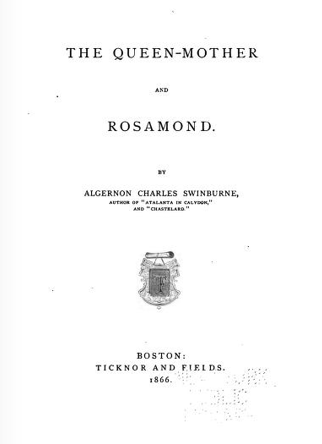


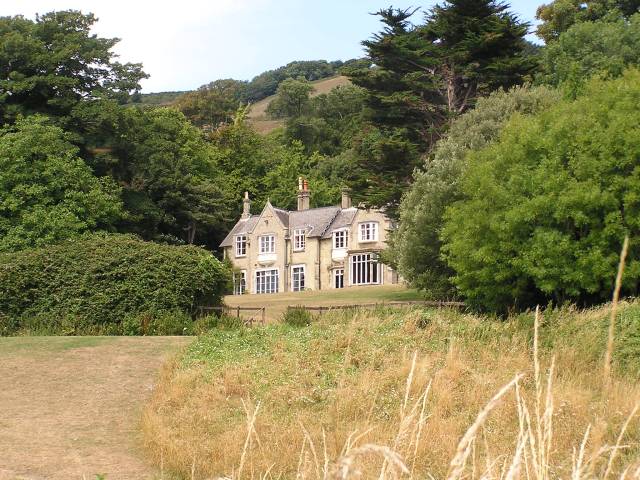
The Poet Swineburne lived on the Isle of Wight where he may have conceived his poem and play about two women named Rosamond. I went looking for Rena in hope she would help me complete her portrait I started, I deciding she would be my version of Fair Rosamond. Last month I made plans to go to Montana to visit the rosy graves of my kindred.
Jon Presco
BORN OF TWO ROSES
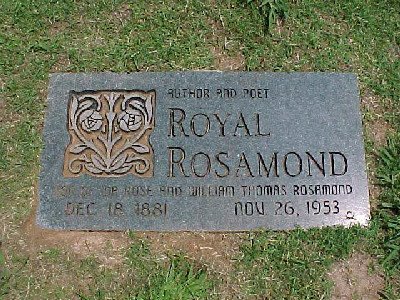
A half hour ago I talked to Deborah Cryder at the Forestvale Cemetary. She is going to send me information on Ida Rose who died when she was 28 years of age of dropsy. Twenty days later, Ida’s daughter, Dollie Rosamond, dies. She is less then one year old. Royal Rosamond lost his mother and baby sister in one fail swoop. He must have been traumatized. Then, his father gets remarried to a Mildred, who may not have wanted Frank around, and he is “bound” out to his uncle, James Taylor, who married Ida’s sister, Laura Rosamond. Frank will call William Scott Spaulding his father. Did William adopt Frank? If so, when? I believe there is a typo, in regards to the Reese name. John Wesley Rose buried here. Is this where Frank got his middle name? This would make three generations of the Rose Family buried in Montana.
Edward Haney Rose is the grandfather of Ida Rose, and father of John Wesley Rose.
To be born by a mother born Rosemary Rosamond, who named me John, not knowing her great grandfather was named John Rose, is a genealogical wonder. I will be recording my findings with the Rose Family Association.



Oxford he met nearly everyone who would influence his later life, including Rossetti, Morris, and Burne-Jones, who in 1857 were painting their Arthurian murals on the walls of the Oxford Union, and Benjamin Jowett, the master of Balliol College, who recognized his poetic talent and tried to keep him from being expelled when he began celebrating Orsini, the Italian patriot who attempted to assassinate Napoleon III in 1858. Leaving Oxford in 1860, he became very friendly with the Rossettis. After Elizabeth Siddall‘s (Mrs. Rossetti)’s death in 1862, he and Rossetti moved to Tudor House, 16 Cheyne Walk, Chelsea.
http://www.victorianweb.org/authors/swinburne/acsbio1.html
| I that have roses in my name, and makeAll flowers glad to set their color by;I that have held a land between twin lips 45And turn’d large England to a little kiss; |
|---|
http://www.bartleby.com/246/765.html
In December 1677, the Norwich Mayor’s Court granted Elizabeth Soane a licence ‘to make shew of a Motion Called Fayre Rosamond until further order’.¹ Now here, finally, we have a clear reference to a well-known story. This play or ‘Motion’ must have recounted the life and death of one of England’s most famous royal mistresses, a surprisingly crowded field.
Hymn to Proserpine” is a poem by Algernon Charles Swinburne, published in Poems and Ballads in 1866. The poem is addressed to the goddess Proserpina, the Roman equivalent of Persephone, but laments the rise of Christianity for displacing the pagan goddess and her pantheon.[1]
The epigraph at the beginning of the poem is the phrase Vicisti, Galilaee, Latin for “You have conquered, O Galilean“, the apocryphal dying words of the Emperor Julian. He had tried to reverse the official endorsement of Christianity by the Roman Empire. The poem is cast in the form of a lament by a person professing the paganism of classical antiquity and lamenting its passing, and expresses regret at the rise of Christianity.[2] Lines 35 and 36 express this best:
Thou hast conquered, O pale Galilean; the world has grown grey from thy breath; We have drunken of things Lethean, and fed on the fullness of death.
The line “Time and the Gods are at strife” inspired the title of Lord Dunsany‘s Time and the Gods.
The poem is quoted by Sue Bridehead in Thomas Hardy‘s 1895 novel, Jude the Obscure and also by Edward Ashburnham in Ford Madox Ford‘s The Good Soldier
eldest of six children born to Captain (later Admiral) Charles Henry Swinburne (1797–1877) and Lady Jane Henrietta, daughter of the 3rd Earl of Ashburnham, a wealthy Northumbrian family. He grew up at East Dene in Bonchurch on the Isle of Wight.[3]
Swinburne’s poetic works include: Atalanta in Calydon (1865), Poems and Ballads (1866), Songs before Sunrise (1871), Poems and Ballads Second Series, (1878) Tristram of Lyonesse (1882), Poems and Ballads Third Series (1889), and the novel Lesbia Brandon (published posthumously in 1952).
Poems and Ballads caused a sensation when it was first published, especially the poems written in homage of Sappho of Lesbos such as “Anactoria” and “Sapphics“: Moxon and Co. transferred its publication rights to John Camden Hotten.[25] Other poems in this volume such as “The Leper,” “Laus Veneris,” and “St Dorothy” evoke a Victorian fascination with the Middle Ages, and are explicitly mediaeval in style, tone and construction. Also featured in this volume are “Hymn to Proserpine“, “The Triumph of Time” and “Dolores (Notre-Dame des Sept Douleurs)“.
Swinburne devised the poetic form called the roundel, a variation of the French Rondeau form, and some were included in A Century of Roundels dedicated to Christina Rossetti. Swinburne wrote to Edward Burne-Jones in 1883: “I have got a tiny new book of songs or songlets, in one form and all manner of metres … just coming out, of which Miss Rossetti has accepted the dedication. I hope you and Georgie [his wife Georgiana, one of the MacDonald sisters] will find something to like among a hundred poems of nine lines each, twenty-four of which are about babies or small children”. Opinions of these poems vary between those who find them captivating and brilliant, to those who find them merely clever and contrived. One of them, A Baby’s Death, was set to music by the English composer Sir Edward Elgar as the song “Roundel: The little eyes that never knew Light“.
Swinburne was influenced by the work of William Shakespeare, Percy Bysshe Shelley, Catullus, William Morris, Dante Gabriel Rossetti, Robert Browning, Alfred Lord Tennyson, and Victor Hugo.[26] While he was popular in England during his life, Swinburne’s influence has greatly decreased since his death.
After the first Poems and Ballads, Swinburne’s later poetry was increasingly devoted to philosophy and politics, including the unification of Italy, particularly in the volume Songs before Sunrise. He did not stop writing love poetry entirely, including his great epic-length poem, Tristram of Lyonesse, but its content is much less shocking than those of his earlier love poetry. His versification, and especially his rhyming technique, remain in top form to the end.[2]
Is thy name
Babe? Sweet are babes as flowers that wed the sun,
But man may be not born a babe again,
And less than man may woman. Rosamund
Stands radiant now in royal pride of place
As wife of thine and queen of Lombards—not
Cunimund’s daughter. Hadst thou slain her sire
Shamefully, shame were thine to have sought her hand
And shame were hers to love thee: but he died
Manfully, by thy mightier hand than his
Manfully mastered. War, born blind as fire,
Fed not as fire upon her: many a maid
As royal dies disrobed of all but shame
And even to death burnt up for shame’s sake: she
Lives, by thy grace, imperial.
 Rosamond Press
Leave a comment