
President Donald Trump signs executive orders in the Oval Office on January 20, 2025 in Washington, DC. Anna Moneymaker/Getty Images
What Pope Von Trump did thirty minutes ago reminded me of Pope Gregory going after the author, John Wycliffe, whose Bible – WAS BURNED! John’s compatriot – WAS BURNED! These are Fathers of the Protestant Religion whom the Habsburgs launched an…..INQUISITION!
The Pimping Pope called one author a “traitor” and launched an investigation against him. Why wasn’t the investigation launched before the Papal President – CONDEMNED HIM? Will he now get death threats from Holy Jan 6th Arm of Jesus who led a Witch-hunt against the winner of the 2020 election. Is not this a – real Witch-hunt? Do they know the true goal behind Protect 25? I think I do….
Goal: Confound Secularism in America – and the world! Use MONEY to bully those who know they are not on the side of the Secret Christian Republican Party. Make them look puny and stupid. Destroy everything they see as sacred. Bring them to their knees – and have them beg for mercy!
Think SWING VOTERS! The elections are too tight. Make people afraid NOT to be a Republican Christian, This is not isolationism. The Republican Christians want to take over the world – with Putin’s help. Putin invading Ukraine was a softening up of Secular NATO Nations, that are seen as the enemy of the Neo-Confederate Evangelical Church that came out of the Southern Red States, The religious schism over slavery – will never end!
John Presco
Trump said: “These countries are calling me up, kissing my ass…they are dying to make a deal… They are, they are dying to make a deal. Please, please, sir, make a deal. I’ll do anything.”
like that can happen. That’s a terrible thing, and it’s time to find out whether or not somebody can do that,” he said.
“I think it’s a very important case, and I think he’s guilty of treason if you want to know the truth, but we’ll find out,” he added.
Taylor, who authored a second book last year warning that Trump would use his position to target his perceived enemies if returned to power, told The Independent in a text message that he’d predicted that Trump would go after him.
Christian nationalism is a form of religious nationalism that focuses on promoting the Christian views of its followers, in order to achieve prominence or dominance in political, cultural, and social life.[1][2] In countries with a state church, Christian nationalists seek to preserve the status of a Christian state.[3]
A tall paper hat was allegedly put upon his head with the inscription “Haeresiarcha” (i.e., the leader of a heretical movement).[49] Hus was led away to the stake under a strong guard of armed men.[50]
Before his execution, Hus is said to have declared, “You may kill a weak goose [Hus is Czech for “goose”], but more powerful birds, eagles and falcons, will come after me.”[citation needed] Luther modified the statement and reported that Hus had said that they might have roasted a goose, but that in a hundred years a swan would sing to whom they be forced to listen. In 1546, in his funeral sermon for Luther, Johannes Bugenhagen gave a further twist to Hus’s declaration: “You may burn a goose, but in a hundred years will come a swan you will not be able to burn.” Twenty years later, in 1566, Johannes Mathesius, Luther’s first biographer, found Hus’s prophecy to be evidence of Luther’s divine inspiration.[51]
Career in education
[edit]
In 1356, Wycliffe completed his bachelor of arts degree at Merton College as a junior fellow.[19] That same year he produced a small treatise, The Last Age of the Church. In the light of the virulence of the plague, which had subsided seven years previously, Wycliffe’s studies led him to the opinion that the close of the 14th century would mark the end of the world. While other writers viewed the plague as God’s judgment on sinful people, Wycliffe saw it as an indictment of an unworthy clergy. The mortality rate among the clergy had been particularly high and those who replaced them were, in his opinion, uneducated or generally disreputable.[15]
In 1361, he was Master of Balliol College .[20] That year he was presented by the college to the parish of Fillingham in Lincolnshire, which he visited rarely during long vacations from Oxford.[21] For this he had to give up the headship of Balliol College, though he could continue to live at Oxford. He is said to have had rooms in the buildings of The Queen’s College. In 1362, he was granted a prebend at Aust in Westbury-on-Trym, which he held in addition to the post at Fillingham.
In 1365, his performance led Simon Islip, Archbishop of Canterbury, to place him at the head of Canterbury Hall, where twelve young men were preparing for the priesthood. In December 1365, Islip appointed Wycliffe as warden,[22] but when Islip died in 1366, his successor, Simon Langham, a man of monastic training, turned the leadership of the college over to a monk. In 1367, Wycliffe appealed to Rome. In 1371, Wycliffe’s appeal was decided and the outcome was unfavourable to him. The incident was typical of the ongoing rivalry between monks or friars and secular clergy at Oxford at this time.[21]
In 1368, he gave up his living at Fillingham and took over the rectory of Ludgershall, Buckinghamshire, not far from Oxford, which enabled him to retain his connection with the university. Tradition has it that he began his translation of the Bible into English while sitting in a room above what is now the porch in Ludgershall Church.[23] In 1369, Wycliffe obtained a bachelor’s degree in theology, and his doctorate in 1372.[24] In 1374, he received the crown living of St Mary’s Church, Lutterworth in Leicestershire,[25] which he retained until his death.
Politics
[edit]

In 1374, Wycliffe’s name appears on a commission, after a bishop, which the English Government sent to Bruges to discuss with the representatives of Gregory XI a number of points in dispute between the king and the pope.[25] He was no longer satisfied with his chair as the means of propagating his ideas, and soon after his return from Bruges he began to express them in tracts and longer works. In a book concerned with the government of God and the Ten Commandments, he attacked the temporal rule of the clergy, the collection of annates, indulgences, and simony.
According to Benedictine historian Francis Aidan Gasquet, at least some of Wycliffe’s program should be seen as (naive) “attempts at social reconstruction” in the aftermath the continuing institutional chaos after the Black Death (1347–1349) [27]
De civili dominio
[edit]
Wycliffe entered the politics of the day with his great work De civili dominio (“On Civil Dominion”), which drew arguments from the works of Richard FitzRalph‘s.[28] This called for the royal divestment of all church property. Wycliffe argued that the Church had fallen into sin and that it ought therefore to give up all its property, and that the clergy must live in poverty. The tendency of the high offices of state to be held by clerics was resented by many of the nobles, such as the backroom power broker John of Gaunt, who would have had his own reasons for opposing the wealth and power of the clergy, since it challenged the foundation of his power.[29]
Conflicts with Church, State and University
[edit]
In 1377, Wycliffe’s ideas on lordship and church wealth caused his first official condemnation by Pope Gregory XI, who censured 19 articles. He was summoned before William Courtenay, Bishop of London, on 19 February 1377. The exact charges are not known, as the matter did not get as far as a definite examination. Lechler suggests that Wycliffe was targeted by John of Gaunt‘s opponents among the nobles and church hierarchy.[30] Gaunt, the Earl Marshal Henry Percy, and a number of other supporters accompanied Wycliffe. A crowd gathered at the church, and at the entrance, party animosities began to show, especially in an angry exchange between the bishop and Wycliffe’s protectors over whether Wycliffe should sit.[25]

Gaunt declared that he would humble the pride of the English clergy and their partisans, hinting at the intent to secularise the possessions of the Church. The assembly broke up and Gaunt and his partisans departed with their protégé.[31] Most of the English clergy were irritated by this encounter, and attacks upon Wycliffe began.
Wycliffe’s second and third books dealing with civil government carry a sharp polemic.
On 22 May 1377, Pope Gregory XI sent five copies of a bull against Wycliffe, dispatching one to the Archbishop of Canterbury, and the others to the Bishop of London, King Edward III, the Chancellor, and the university. Among the enclosures were 18 theses of his, which were denounced as erroneous and dangerous to Church and State: all were drawn from De Civili dominio.[32]: ch8
Stephen Lahey suggests that Gregory’s action against Wycliffe was an attempt to put pressure on King Edward to make peace with France.[29] Edward III died on 21 June 1377, and the bull against Wycliffe did not reach England before December. Wycliffe was asked to give the king’s council his opinion on whether it was lawful to withhold traditional payments to Rome, and he responded that it was.[33]
Back at Oxford, the Vice-Chancellor confined Wycliffe for some time in Black Hall,[34] but his friends soon obtained his release.
In March 1378, Wycliffe was summoned to appear at Lambeth Palace to defend himself. However, Sir Lewis Clifford entered the chapel and in the name of the queen mother (Joan of Kent), forbade the bishops to proceed to a definite sentence concerning Wycliffe’s conduct or opinions.[16] Wycliffe wrote a letter expressing and defending his less “obnoxious doctrines”.[35]: xlii The bishops, who were divided, satisfied themselves with forbidding him to speak further on the controversy.
De incarcerandis fedelibus
[edit]
Wycliffe then wrote his De incarcerandis fedelibus (On the Incarceration of the Faithful), with 33 conclusions in Latin and English. Wycliffe did not think that incarceration should be a permitted form of excommunication.[36]: xxvii In the book he demanded that it should be legal for the excommunicated and incarcerated to appeal to the king and his council against the excommunication or incarceration.[clarification needed][citation needed]
Some ordinary citizens, some of the nobility, and his former protector, John of Gaunt, rallied to him. Before any further steps could be taken in Rome, Gregory XI died in 1378.
The Great Erasmus
Posted on March 4, 2018 by Royal Rosamond Press


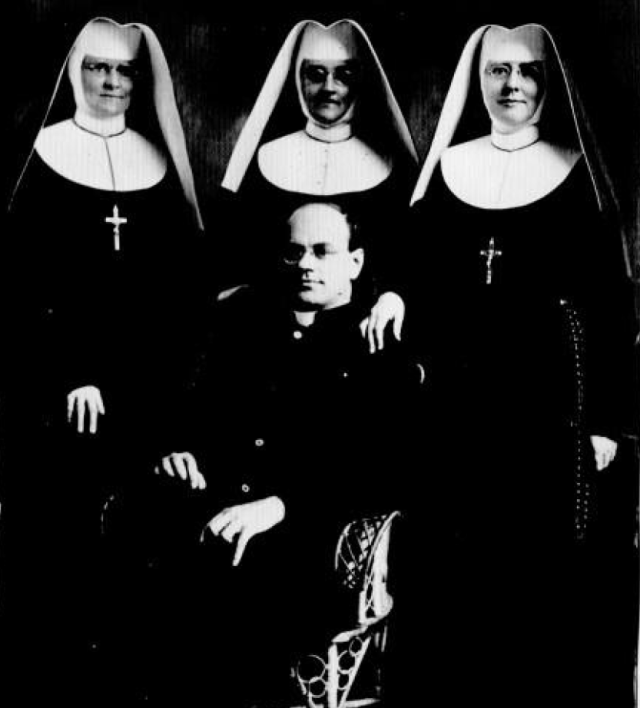

How easy my life would be if I claimed I was a Born Again Christian, and say;
“Let’s go to the mall and count the Demonic Baby Killers!”
Not only was my ancestor a good friend of a Pope, he was a friend of the Great Erasmus – whom he defended! Pope Adrien’s papal papers were probably thrown out in the trash by the Medici, along with Gottschalk’s papers? They were at the cusp of the Reformation and, and the center of Dutch Renaissance. Note the wallpaper behind Erasmus, that is like the work of Kehinde Wily, that took me to the very feet of Erasmus and his Habsburg backer – unknowingly!
Members of the Rosemont family were interred in the Minderbroedersklooster that was founded by the Franciscan Monks. Above are my Wieneke kindred who were members of the Order of Saint Francis. This is the real Rose Line. I was destined for the Church.
Jon Presco
Copyright 2018
Renaissance Castle
Posted on September 5, 2014by Royal Rosamond Press


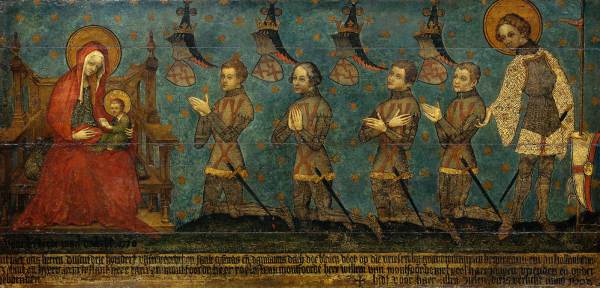
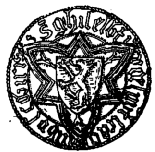

Ghisburtus van Roesmont was a Dutch nobleman of some importance. His mother was jonkvrouw Adriana Theodorici Rover, the daughter of Dirk Edmondszn Roover. The Roover family appears to descend from one of the Radbot rulers of Holland who was given the name Roover, or Rover due to conquest of the Netherlands. Arnoldus Rosemont also descends to Radbot, who was employed by the Franks to fight the Normans, the Vikings, who were called Rovers. The elder Radbot was allied with the Franks to fight the Viking, many who carried a banner with the image of a wolf. Was their marriage with a Merovingian princess, and thus a marriage union to carry on this line?
The Rosemonts are mentioned in the genealogical book, Taxandria, an extinct province that was replaced by ‘s-Hertogenbosch that had no rulers, or Papal interference, which is rare. The Swan Brethren appear to have owned Saint John’s Church, and ran its affairs as a guild.
Ghisburtus Rosemont was the church warden of Saint John, and later sat in the ships chair. The chances her knew the Renaissance Artist, Hieronymus Bosch, and his father, is very high for his job to was to hire artists and craftsman.
“Only in 1454th – in 1455 were Van Aken and his wife a member of the Brotherhood of Our Lady . In 1461 – 1462 kreeg he was commissioned damaged (by fire) altarpiece of the Brotherhood in the former St. John’s Church in collaboration with the master painter Claes Schoonhoven.
This is a remarkable discover. It puts my kindred at the heart of the Dutch Renaissance, for starters.
Here is a translation of a event, a miracle. There is a box. What is the object. What is “Cloth Hall”?
“On March 16, 1384, Ghijsbrecht Rosemont, witnessed a miracle with Jacob Mertensz. [No. 322 Miracles of Our Lady at ‘s-Hertogenbosch 1381-1603].
Henrick Painter, ships from Den Bosch in 1383 shared in 1397 with Chris Ruffle Mont Tijn a box in the Cloth Hall, which had been the case. Late Godscalck Roes Mont. In 1430 Godschalk Roes Mouth, buy the high sheriff of Den Bosch and Meierij castle Maurick. In 1442 he sold it back to Henry of Vladeracken.
The emblem worn by the Swan Brethren depicts a a rose, or lily,
amongst thorns. At the root of the rose is the Latin word SICUT which
is the first word from a line from Song of Songs.
2:2. As the lily among thorns, so is my love among the daughters.
Sicut lilium inter spinas sic amica mea inter filias
http://bossche-encyclopedie.nl/personen/roesmont,%20ghiselbertus.htm
ers, who were then still underage, will have been legal children of Ghijsbrecht and Lady Margriet. Master Godschalc was born in Eindhoven around 1483, studied artes in Leuven in 1499 and was promoted there in 1502 as the third of 99 students to magister artium . In 1510 he was nominated by the OLV fraternity for a benefice in the Bossche St.Jan and since 1515 he was also canon of the St.Petrus church in Leuven. He also always resided in Leuven where he was a professor in theology from 1515 and wrote a number of popular tracts.
On September 18, 1467, Ghijsbrecht Roesmont, counselor of Den Bosch and widower of Mabelia , added a codicil to this will in the presence of Rembout Vilt (no.403). Ghijsbrecht, who previously lived in the Orthenstraat (1422), then stayed – exhausted by his old age – in his house at the Zijle. As witnesses, the codicil includes the secretary Rutgher van Arkel (no.14), Ghijsbrechts servant and clerk Sander Pyeck van Batenburg (no.313) and his servant Lysbeth Goyart Goebelens from Eindhoven. In addition to the latter two, Ghijsbrecht also left goods to the St. Lambert church in Liege, the Bossche St. Jan, the St. Peter’s church in Vught, the parish church of Uden and the Bossche OZ brotherhood, as well as Katherijn, widow of the goldsmith. Arnt vander Weyden, to Goetscalc and Jan, sons of his late cousin Jan Goetscalcs Roesmont, and to “the other heirs”. Ghijsbrecht is mentioned in the obitus fratrum of the OLV fraternity under the year 1469/70, together with Rutgher van Arkel, secretary, and master Gerit Boest, counselor and secretary (see no.57). Ghijsbrecht probably died in the beginning of 1470. He was provided with the last sacraments by Brother Alart Alartss, Minderbroeder, and will be buried in the Minderbroedersklooster, just like some other members of his family. As far as he knows, he did not leave children behind. Still, he must have had a son Goyart because on September 12, 1422, Ghijsbrecht drew up a concept in the Bosch ‘protocol in which Henric Heyme promised to pay 50 Arnoldus guilders to ” michi ad opus Godefridi, filii May “. 9)
Minderbroedersklooster (‘s-Hertogenbosch)
The Minderbroedersklooster in ‘s-Hertogenbosch was the first monastery founded by the Franciscans in the present Netherlands . The monastery stood on the corner of the current Pensmarkt and Minderbroedersstraat and continued until the current Snellestraat . The Franciscans settled in ‘s-Hertogenbosch in 1228 . This is only two years after the death of the founder of order Francis of Assisi . On a site that Henry I of Brabant had given to the Franciscans, they would establish a monastery and a church . In 1256 the church is demolished to build a new, larger monastery church. In 1263 this church is dedicated by Henricus van Vianden , the Bishop of Utrecht .
Jon Presco


The Rose Wolf and Erasmus
Posted on September 15, 2017by Royal Rosamond Press

Erasmus wrote letters to Rosemondt. One letter has the Rosemondt wolf seal on it. This is about the Spanish Inquisition. and of great interest to the history of Haarlem. This is one of the greatest genealogical studies of all time.
Jon Presco
Copyright 2017

1153/ To Godschalk Rosemondt Louvain 18 October 1520
Gottschalk Rosemondt of Eindhoven in Northern Brabant, matriculated
at the University of Louvain on 1499 and remained there until his
death in 1526. A doctor of divinity in 1516, he succeeded in 1520 to
the chair o f theology formerly held by Jan Briart. Like Briart he
was a personal friend of the future Pope Adrian V1. His prominent
position in the theological faculty notwithstanding , he retained an
open mind towards humanists studies and a measure of sympathy for
Erasmus. This letter is addressed to him in his capacity as rector
of the university for the winter term of 1520-21 (cf Matricule de
Louvain 111-1963) It was published in the Epistolae ad diverse. In
preparation for a confrontations with the theologian Nicolass
Baechem Egmondanus, to be held in the presence of the rector,
Erasmus launches an elaborate protest against his opponent, who had
attacked him from the pulpit of St, Peter’s church on 9 and 14
October,
What’s unmistakable about the two pieces is that they aren’t simply works of portraiture: They are works of 21st century art. Built on centuries of what precede them, they break traditions, and barriers, and encourage new generations to tread in their wake. I’m talking about the portraits, but the same applies to the people who sat for them, too.
Desiderius Erasmus, (born October 27, 1469, Rotterdam, Holland [now in the Netherlands]—died July 12, 1536, Basel, Switzerland), humanist who was the greatest scholar of the northern Renaissance, the first editor of the New Testament, and also an important figure in patristics and classical literature.Using the philological methods pioneered by Italian humanists, Erasmus helped lay the groundwork for the historical-critical study of the past, especially in his studies of the Greek New Testament and the Church Fathers. His educational writings contributed to the replacement of the older scholastic curriculum by the new humanist emphasis on the classics. By criticizing ecclesiastical abuses, while pointing to a better age in the distant past, he encouraged the growing urge for reform, which found expression both in the Protestant Reformation and in the Catholic Counter-Reformation. Finally, his independent stance in an age of fierce confessional controversy—rejecting both Luther’s doctrine of predestination and the powers that were claimed for the papacy—made him a target of suspicion for loyal partisans on both sides and a beacon for those who valued liberty more than orthodoxy.
Early life and career
Erasmus was the second illegitimate son of Roger Gerard, a priest, and Margaret, a physician’s daughter. He advanced as far as the third-highest class at the chapter school of St. Lebuin’s in Deventer. One of his teachers, Jan Synthen, was a humanist, as was the headmaster, Alexander Hegius. The schoolboy Erasmus was clever enough to write classical Latin verse that impresses a modern reader as cosmopolitan.
After both parents died, the guardians of the two boys sent them to a school in ’s-Hertogenbosch conducted by the Brethren of the Common Life, a lay religious movement that fostered monastic vocations. Erasmus would remember this school only for a severe discipline intended, he said, to teach humility by breaking a boy’s spirit.
Having little other choice, both brothers entered monasteries. Erasmus chose the Augustinian canons regular at Steyn, near Gouda, where he seems to have remained about seven years (1485–92). While at Steyn he paraphrased Lorenzo Valla’s Elegantiae, which was both a compendium of pure classical usage and a manifesto against the scholastic “barbarians” who had allegedly corrupted it. Erasmus’ monastic superiors became “barbarians” for him by discouraging his classical studies. Thus, after his ordination to the priesthood (April 1492), he was happy to escape the monastery by accepting a post as Latin secretary to the influential Henry of Bergen, bishop of Cambrai. His Antibarbarorum liber, extant from a revision of 1494–95, is a vigorous restatement of patristic arguments for the utility of the pagan classics, with a polemical thrust against the cloister he had left behind: “All sound learning is secular learning.”
Erasmus was not suited to a courtier’s life, nor did things improve much when the bishop was induced to send him to the University of Paris to study theology (1495). He disliked the quasi-monastic regimen of the Collège de Montaigu, where he lodged initially, and pictured himself to a friend as sitting “with wrinkled brow and glazed eye” through Scotist lectures. To support his classical studies, he began taking in pupils; from this period (1497–1500) date the earliest versions of those aids to elegant Latin—including the Colloquia and the Adagia—that before long would be in use in humanist schools throughout Europe.
The wandering scholar
In 1499 a pupil, William Blount, Lord Mountjoy, invited Erasmus to England. There he met Thomas More, who became a friend for life. John Colet quickened Erasmus’ ambition to be a “primitive theologian,” one who would expound Scripture not in the argumentative manner of the scholastics but in the manner of Jerome and the other Church Fathers, who lived in an age when men still understood and practiced the classical art of rhetoric. The impassioned Colet besought him to lecture on the Old Testament at Oxford, but the more cautious Erasmus was not ready. He returned to the Continent with a Latin copy of St. Paul’s Epistles and the conviction that “ancient theology” required mastery of Greek.

On a visit to Artois, France (1501), Erasmus met the fiery preacher Jean Voirier, who, though a Franciscan, told him that “monasticism was a life more of fatuous men than of religious men.” Admirers recounted how Voirier’s disciples faced death serenely, trusting in God, without the solemn reassurance of the last rites. Voirier lent Erasmus a copy of works by Origen, the early Greek Christian writer who promoted the allegorical, spiritualizing mode of scriptural interpretation, which had roots in Platonic philosophy. By 1502 Erasmus had settled in the university town of Leuven (Brabant [now in Belgium]) and was reading Origen and St. Paul in Greek. The fruit of his labours was Enchiridion militis Christiani (1503/04; Handbook of a Christian Knight). In this work Erasmus urged readers to “inject into the vitals” the teachings of Christ by studying and meditating on the Scriptures, using the spiritual interpretation favoured by the “ancients” to make the text pertinent to moral concerns. The Enchiridion was a manifesto of lay piety in its assertion that “monasticism is not piety.” Erasmus’ vocation as a “primitive theologian” was further developed through his discovery at Park Abbey, near Leuven, of a manuscript of Valla’s Adnotationes on the Greek New Testament, which he published in 1505 with a dedication to Colet.
Erasmus sailed for England in 1505, hoping to find support for his studies. Instead he found an opportunity to travel to Italy, the land of promise for northern humanists, as tutor to the sons of the future Henry VIII’s physician. The party arrived in the university town of Bologna in time to witness the triumphal entry (1506) of the warrior pope Julius II at the head of a conquering army, a scene that figures later in Erasmus’ anonymously published satiric dialogue, Julius exclusus e coelis (written 1513–14). In Venice Erasmus was welcomed at the celebrated printing house of Aldus Manutius, where Byzantine émigrés enriched the intellectual life of a numerous scholarly company. For the Aldine press Erasmus expanded his Adagia, or annotated collection of Greek and Latin adages, into a monument of erudition with over 3,000 entries; this was the book that first made him famous. The adage “Dutch ear” (auris Batava) is one of many hints that he was not an uncritical admirer of sophisticated Italy, with its theatrical sermons and its scholars who doubted the immortality of the soul; his aim was to write for honest and unassuming “Dutch ears.”
De pueris instituendis, written in Italy though not published until 1529, is the clearest statement of Erasmus’ enormous faith in the power of education. With strenuous effort the very stuff of human nature could be molded, so as to draw out (e-ducare) peaceful and social dispositions while discouraging unworthy appetites. Erasmus, it would almost be true to say, believed that one is what one reads. Thus the “humane letters” of classical and Christian antiquity would have a beneficent effect on the mind, in contrast to the disputatious temper induced by scholastic logic-chopping or the vengeful amour propre bred into young aristocrats by chivalric literature, “the stupid and tyrannical fables of King Arthur.”
The celebrated Moriae encomium, or Praise of Folly, conceived as Erasmus crossed the Alps on his way back to England and written at Thomas More’s house, expresses a very different mood. For the first time the earnest scholar saw his own efforts along with everyone else’s as bathed in a universal irony, in which foolish passion carried the day: “Even the wise man must play the fool if he wishes to beget a child.”
http://mary-magdalene-wifeofchrist.blogspot.com/2008/01/rose-line-of-mary-magdalene.html
You are the Rose. You are the Flower of Life, the Divine Feminine essence in her fullest. As you start honoring yourself as the most sacred rose, the Divine Bride, and as you enter into the world as a High Priestess, you are embodying the most pure Magdalene Frequency. As you do so, you will begin to manifest a life of harmony, peace, Divine Love, and Twin Flame Love. Stepping into Her, you step into yourself. Vibrating at the Magdalene Frequency is the same as vibrating at the Divine Feminine essence of your soul whilst attracting in (by the Law of Opposites Attract) your Divine Masculine Energies.
http://internationalopulence.com/knights-templar/
http://www.returnofthechrist.org.uk/magdalene-flame/the-roses-of-the-magdalene.html
 Rosamond Press
Leave a comment