
Oregon of Canada
Posted on March 6, 2025 by Royal Rosamond Press
Dear Sir;
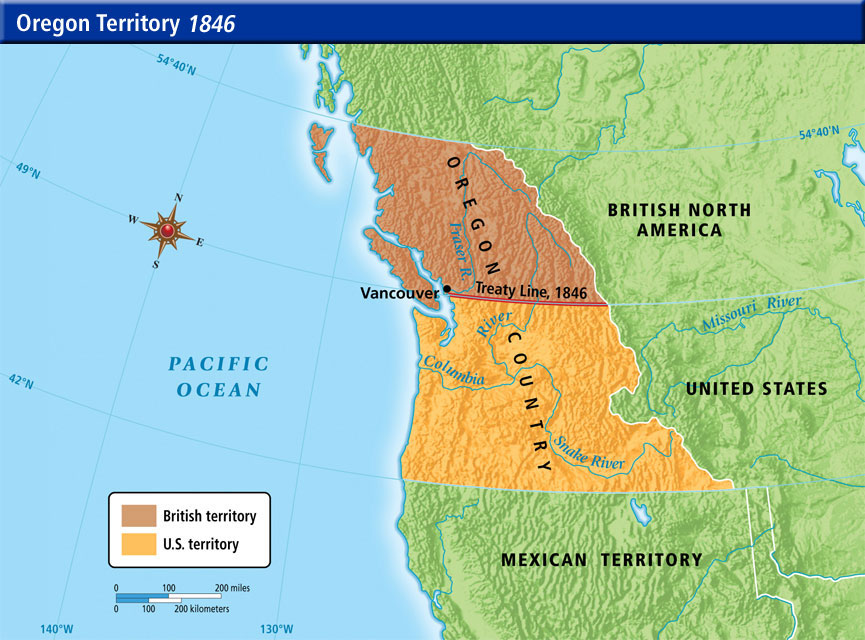
My name is John Presco. I am the grandson of Royal Rosamond, a regional writer who founded Gem Publishing. We are related to Alexander Rosamond, who is the subject of The Volunteer Monument in Almonte, and Bennett Rosamond, a Grandmaster of the Orange Lodge. We are related to Patriot Captain Samuel Rosamond who fought alongside the Swamp Fox in South Carolina. My great grandfather, James Rosamond was also a Patriot in Americas War of Independence. The Army Rangers have their roots here, as does my late sister Christine Rosamond who married into the Benton family who had much to do with the Oregon Territory. John Fremont married Jessie Benton, the daughter of Senator Thomas Hatt Benton, the first Proprotors of the Oregon Territory, and John Astor’s attorney.
Yesterday on the news I heard the Trump Chainsawman will fire 6,000 workers for the Veteran’s Administration. This morning I heard 60,000 will get axed Nationwide. The care of America’s Veterans will degrade rapidly. What I suggest, is, Canadian Voters found the 51st. State of Almonte in the area that once belonged to Canada. Almonte will be a Sanctuary State for all NATO Veterans, including Ukraine Veterans. Any veteran who suffers from fear they will be – cast out in the cold – can seek asylum in Almonte. I see another Volunteer statue in Vancouver, looking West of the water. I see two ships being built in Vancouver. the HMS Winston Churchill, a battleship, and the HMS Rosamond, a hospital ship. These ships will rescue soldiers of any NATO Nation, and soldiers of Ukraine, and bring them home to….Almonte. I see the building of a great Veterans hospital in Almonte.
I would like to be a Co-Curator of the Mississippi Valley Textile Museum (MVTM). I am seventy-eight years of age and am in danger of being rendered homeless with pending cuts to the Social Safety Net, and Medicaid. I am afraid to die in the street. I beseech you to help archive my blog, Royal Rosamond Press, which may be the largest blog in the world, and contins muc history of the Rosamond Family.
The Fifty-First State is a symbolic name, a place that many soldiers find themselves in, in battle, and, where they come home to. It is also the place they go to when they are MIA. I adopted my homeless friend who was a Veteran through the Elk Society so I could be in charge of his funeral arrangement. My local news said VA cuts will hamper burials. The will be a Unified Cemetery in Almonte, a name that means;
The Mountain
Sincerely
John Presco
PresidentL Royal Rosamond Press ‘A Newspapter for the Arts’

Up Where We Belong Lyrics by BeBe and CeCe Winans
The Volunteer by R. Tait McKenzie

The Volunteer is a tribute to 48 men of Almonte and area who were killed in WW1, as well as a tribute to an individual soldier.
Alexander Rosamond was heir to the prosperous Rosamond Woollen Company, a textile mill in Almonte. He happened to be in the UK on business in August 1914, and enlisted in the British army. In June 1915, he was granted a commission in the Canadian Expeditionary Force and joined the Princess Patricia’s Canadian Light Infantry (PPCLIs) in February 1916. He was killed at the Battle of Courcelette on September 15, 1916, aged 43. He has no known grave and his name is on the Vimy Memorial. He left behind his wife Mary and four daughters.
In a codicil to Rosamond’s will was a bequest: I instruct my executors to erect in some promising place in the Town of Almonte, a permanent memorial to all those who lost their lives in the present war who were from the Town of Almonte, Township of Ramsay and surrounding district. The town granted land for the purpose on Bridge St, beside the town hall. The figure was designed by sculptor (and WW1 physician, physical therapist and physical educator) R. Tait McKenzie. The monument was dedicated on September 11, 1923, “to the men of Almonte who fell for freedom.”
Bennett Rosamond Grand Master of Orange Order
Posted on April 1, 2012 by Royal Rosamond Press
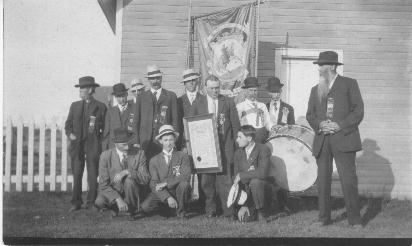
Above is a photograph of Bennett Rosamond the Grand Master of the Orange Order in Canada. Bennett is with members of Lodge 389 in Lanark, or, Almonte. The image on the banner is that of William of Orange who is carried in Orange Parades. That is Bennett on the far right, looking like Gandalf, or, a Levite Prophet.
According to the History of the Rosemond Family by Leland Rosemond, the Rosamond family were members of the Orange Order in Leitrim Ireland, and fled to Canada after a Rosamond son killed a Catholic lad who was invading the Rosamond home with a gang bent on doing my kindred harm.
Bennett may have been a Freemason as well – and an Oddfellow. There is a long history of the Rosamonds belonging to Guilds. They were members of the Swan Brethren.
My grandparents, Royal and Mary Magdalene Rosamond, begat my mother, Rosemary Rosamond, and her sisters, Lilian, Bonnie, and June Rice.
Jon Presco
Almonte’s Oldest Citizen Goes To His Reward
The Rosamond Woolen Company and the Mississippi Valley Textile Museum

Written by: Emma Wyse
If you are looking for an experience which perfectly marries history and the present, art with technology, and a stunning indoor space with outdoor activities, look no further than the Mississippi Valley Textile Museum (MVTM). In operation since 1990, the museum is located in Almonte, about 1.45 hours from Kingston, and 45 minutes from Ottawa, making it ideally situated for a day trip visit. I visited the museum on a grey and drizzly Tuesday in June and was very kindly shown around the museum by Michael Rikley-Lancaster, the Executive Director and Curator of the MVTM.
The site of the museum was once the annex of the Rosamond Woolen Company, a textile operation founded in Almonte in 1861 which specialized in making material for suits. The Rosamond Woolen Company was one of many mills and textile companies operating in the Mississippi Valley region at the turn of the 20th century, as the geography of that area—with its powerful rivers and many waterfalls—was ideal for the construction of mills. In fact, the first settler in Almonte, David Shepherd, constructed a sawmill and gristmill in 1819. The very reason that Almonte exists is down to its history of mills.
The Rosamond family began the business of fabric production in the mid-nineteenth century with James Rosamond’s operation of the Victoria Woolen Mill in Carleton Place. However, in July of 1852 the Victoria Woolen Factory Mill burned down, and James turned his focus to nearby Almonte. He acquired land on Coleman Island in Almonte by the falls and worked to construct a large mill complex which, by the end of the 19th century, included a large six story stone building complete with a tower, a dye house, a warehouse, a counting house, and the annex.

James handed over the management of the Mill in 1862 to his sons Bennett and William Rosamond who took over the business and continued expanding it. With this successful expansion the Rosamond mill became the largest textile mill in Canada at the turn of the 20th century and it specialized in making fine woolen fabrics. At its peak it employed 400 Almonte residents. The end of the 19th century, and beginning of the 20th century, was a period of rapid industrialization and mechanization across Canada, and the new technology introduced in these mills streamlined the process of fabric making with the introduction of new machinery, turning what had previously been a laborious hand craft into something that could be mass produced. Visiting the MVTM allows you to step back in time and appreciate the technological advancements necessary for fabric production, something we now take for granted.
On the second floor of the museum you can learn more about the history of the Rosamond Woolen Company, and about the process of textile production more generally. The permanent second floor exhibit is a well-crafted mix of text displays, photographs, artifacts, videos, and even a taxidermized sheep.
A series of videos spaced throughout the exhibit give voice to some of the former mill workers as part of an oral history project. It’s impactful to be able to hear the workers talk about what their lived experience at the Mill was like, and how they went through the many laborious steps necessary to create fabric. After all, the majority of townspeople living in Almonte were once workers at the mill. According to the MVTM website, “By the turn of the 19th century, there were 10 woolen mills in Almonte,” and “Approximately 1,600 of the 3,000 residents of Almonte worked in a textile mill.” Needless to say, the history of textile production goes hand in hand with the history of Almonte itself.

But the second floor is more than just a museum space, it’s also an artisan workspace with multiple looms set up for making tablecloths, tea towels, and other textiles. When I visited the museum, I was lucky enough to meet one of the artisans who showed me how the loom worked. If you’re there at the right time you might get a demonstration like I did!
The Rosamond Mill changed ownership several times, although it stayed within the Rosamond family until 1959 when it was sold to Zephyr Textiles. It was open for operation until 1980 when it finally closed, the last mill in Almonte to do so. Whereas once, “for the Mississippi Valley region, wool [was] a way of life,” by the last quarter of the 20th century Almonte had moved away from being a textile producing town. Now, 42 years after its closure, the Rosamond Mill has been refashioned into a condominium building. Although Almonte is no longer a textile producing town, the history of the industry can be seen and felt through historic sites like the MVTM.

The museum is open to visitors for the summer season, June 1 to August 31, Tuesdays through Saturday, 10am to 4pm. The rest of the year (September 1 to May 31) the museum remains open with adjusted hours. Tuesday through Friday, 10am to 4pm, and Saturday noon to 4pm. Stop by for a visit to learn more about the fascinating textile production history of Ontario!
The Volunteer War Memorial
Hidden photo gallery
Municipality/Province: Almonte, ON
Memorial number: 35040-001
Type: Wall – granite, statue – bronze
Address: Little Bridge and Bridge Streets
GPS coordinates: Lat: 45.2257152 Long: -76.1940524
Submitted by: Terry MacDonald. Joseph Leblanc. Colonel Andre D. Gauthier (CF Ret’d). MBdr Paul Charlebois. Mark Ward.
Photo credit: Louise Bellec
The Volunteer was sculpted by R. Tait McKenzie and dedicated on 11 September 1923. It was constructed in memory of the men of Almonte who fell in the First World War. The memorial was requested by Alexander Rosamond in a letter he wrote to his family in July 1916. He was a lieutenant in the Princess Patricia Canadian Light Infantry and if he did not return, he hoped a memorial could be built in a central place in Almonte “to the men of Almonte who fell for freedom.”
Lieutenant Alex Rosamond was killed in action at Courcelette during the Battle of the Somme on 15 September 1916. His widow asked Dr. Robert Tait McKenzie, a former local, to create the memorial. Dr. McKenzie, a professor at the University of Pennsylvania, returned after an absence of nearly 40 years to construct this monument. Most of the work was done at the home of Mrs. Alex Rosamond in the garage at Pinehurst on Union Street. Mrs. Rosamond wanted the memorial to have a likeness to her late husband and the statue was based on photographs of him. The finished work looked so much like her late husband that she had it changed. She also left $1000.00 for the memorial’s upkeep.
It is said that “The Volunteer” recalls the spirit of adventure of Dr. McKenzie’s own early days in Almonte. This poem called “The Volunteer” was written by Ethel McKenzie, Dr. McKenzie’s wife.
He watches – in a little northern town,
Through winter cold and parching summer heat,
Where quiet folk go simply up and down,
O’er stony bridge and narrow crooked street.
He guards – alone – alert, with clenched hand,
In readiness with his young manhood’s might,
To spring to action at a word’s command,
Uphold his honour and defend his right.
He watches – while the children leave their play.
To lay their garlands clustered at his feet,
Zinnias and asters from home gardens gay,
In little hands held close and warm and sweet.
He smiles – he leans – and every winsome maid
Feels in her heart this joyous chivalry,
And lads look starry – eyed and unafraid
To grow to manhood strong and brave as he.
He watches. Oh, ye men with him who fell!
Mighty of valour, bold, unflinching free!
Here, in this place, your spirits seem to dwell,
Drawn to the home of your mortality.
He waits! Nor shall his vigil be in vain,
Men like to him shall ever pay the price;
Shun all dishonour, scorn the thought of pain,
And make the great immortal sacrifice!
Additions were later made for the Second World War, Korean War and Peacekeeping. The memorial was refurbished in 1967.
Inscription found on memorial
[front/devant]
TO THE MEN OF ALMONTE WHO FELL FOR FREEDOM
| FRANK ABRAM | 1914 | W. FORSYTHE | J.T. KIRKLAND | 1918 | E.A.P. PLUNKETT |
| EDWIN K. AITKEN | FARQUHAR C. FRASER | THOMAS KNIGHT | ALEX G. ROSAMOND | ||
| E. AMOURETTE | ARCHIBALD GREIG | ARCHIBALD KEAN | JAMES SINCLAIR | ||
| WM. ALFRED BERRY | ROY DICKENSON | FREDERICK HAYNES | THOMAS W. LEE | PETER J. MOORE | SAMUEL SYKES |
| LOUIS C. BOLTON | WILLIAM DYSON | JOHN HOLLAND | JOHN MCDOUGALL | ROBERT NAISMITH | ROBERT WEEKS |
| FRANK S. BROWN | WILLIAM EVOY | EDWARD HOUSTON | GEORGE E. McGREGOR | LESLIE OWRID | ARTHUR WHITE |
| ROBERT H. COCHRAN | GEORGE FAIRBAIRN | EDWARD HOUSTON | JAMES P. McGUIRE | C. PARKER | ROY WILSON |
| THOMAS R. COLLIER | WILLIAM FAIRBAIRN | A.H. ILLINGWORTH | HARRY McINTOSH | F.J. PARKIN | JAMES WRIGHT |
| J.P. CORKERY | SAMUEL FISHER | JAMES JOSS | ALLAN McPHAIL | ARTHUR C. PAUL | ARCHIBALD WYLIE |
| JOHN L. CLEARY | ARTHUR E.G. STRATFORD |
THE
VOLUNTEER
ERECTED TO CARRY OUT A BEQUEST
MADE BY THE LATE
LT. ALEXANDER GEORGE ROSAMOND P.P.C.L.I.
KILLED AT COURCELETTE
SEPTEMBER 15, 1916
KOREA 1950 – 1953
PEACEKEEPING
1939 – 1945
WALLACE BLAKELY
DONALD BADOUR
WILMER CAMELON
DON CAMERON
FRANK CAVERS
BERT DUNCAN
F. DALGITY
FRANK FISHER
ALEX. GOODALL
1939 – 1945
RAYMOND HOUSTON
WM. HEFFERMAN
GEORGE JACKMAN
RUSSELL JAMES
CARL LEE
1939 – 1945
JOSEPH LALONDE
J.F. LAVIGNE
EDGAR LEE
JAMES McINTOSH
KENNETH MILLER
1939 – 1945
JAMES PYE
LLOYD REID
HAROLD K. SCHULTZ
NORMAN SMITH
RAYMOND STANLEY
WM. STANLEY
J. MAC STEWART
V. STEWART
HAROLD STOKES
Street view
Note
This information is provided by contributors and Veterans Affairs Canada makes it available as a service to the public. Veterans Affairs Canada is not responsible for the accuracy, currency or reliability of the inform
Canadian Virtual War Memorial
Alexander George Rosamond
In memory of:
Lieutenant Alexander George Rosamond
September 15, 1916
Courcelette, France
Military Service
Age:
42
Force:
Army
Unit:
Princess Patricia’s Canadian Light Infantry (Eastern Ontario Regt.)
Citation(s):
British War Medal and Victory Medal
Additional Information
Born:
December 23, 1873
Almonte, Ontario
Enlistment:
September 25, 1915
Son of Mrs. L. Rosamond of Almonte, Ontario. Spouse of Mary Eleanor Rosamond of Almonte, Ontario.
Commemorated on The Volunteer War Memorial in Almonte. As a former member of the Royal Ottawa Golf Club, he is also commemorated on a plaque in the entrance to the club.
Commemorated on Page 156 of the First World War Book of Remembrance. Request a copy of this page. Download high resolution copy of this page.
Burial Information
Cemetery:
VIMY MEMORIAL
Pas de Calais, France
Grave Reference:
N/A
Location:
Canada’s most impressive tribute overseas to those Canadians who fought and gave their lives in the First World War is the majestic and inspiring Vimy Memorial, which overlooks the Douai Plain from the highest point of Vimy Ridge, about eight kilometres northeast of Arras on the N17 towards Lens. The Memorial is signposted from this road to the left, just before you enter the village of Vimy from the south. The memorial itself is someway inside the memorial park, but again it is well signposted. At the base of the memorial, these words appear in French and in English:TO THE VALOUR OF THEIR COUNTRYMEN IN THE GREAT WAR AND IN MEMORY OF THEIR SIXTY THOUSAND DEAD THIS MONUMENT IS RAISED BY THE PEOPLE OF CANADA
Inscribed on the ramparts of the Vimy Memorial are the names of over 11,000 Canadian soldiers who were posted as ‘missing, presumed dead’ in France. A plaque at the entrance to the memorial states that the land for the battlefield park, 91.18 hectares in extent, was ‘the free gift in perpetuity of the French nation to the people of Canada’. Construction of the massive work began in 1925, and 11 years later, on July 26, 1936, the monument was unveiled by King Edward VIII. The park surrounding the Vimy Memorial was created by horticultural experts. Canadian trees and shrubs were planted in great masses to resemble the woods and forests of Canada. Wooded parklands surround the grassy slopes of the approaches around the Vimy Memorial. Trenches and tunnels have been restored and preserved and the visitor can picture the magnitude of the task that faced the Canadian Corps on that distant dawn when history was made. On April 3, 2003, the Government of Canada designated April 9th of each year as a national day of remembrance of the Battle of Vimy Ridge.
The Swamp Fox Show
Posted on September 23, 2022 by Royal Rosamond Press
If I had become Governor of Oregon I was going to reach out to Democratic Voters of South Carolina and create a Cultural Exchange. Disney should have another go with a new Swamp Fox show.American History is not going away.
John Presco
In this video, Walt gives a history lesson.
The Swamp Fox (TV series)
From Wikipedia, the free encyclopedia
Jump to navigationJump to search
| The Swamp Fox | |
|---|---|
| Production | |
| Production company | Walt Disney Studios |
| Release | |
| Original release | October 23, 1959 – January 16, 1961 |
The Swamp Fox is a television miniseries produced by Walt Disney and starring Leslie Nielsen as American Revolutionary War hero Francis Marion.[1][2]
The theme song (“Swamp Fox, Swamp Fox, tail on his hat…”[3]) was sung by Nielsen as well.[4] Myron Healey played Marion’s top aide, Maj./Col. Peter Horry. One of the Swamp Fox’s adversaries was Colonel Banastre Tarleton, played by John Sutton. Patrick Macnee played a British captain, Tim Considine played Marion’s nephew Gabe Marion and Slim Pickens played Plunkett, one of the Swamp Fox’s men. Hal Stalmaster appeared in three of the eight episodes as “Gwynn.” The Swamp Fox did not bring to Disney the commercial success that had been achieved by Davy Crockett.
The series encompassed eight intermittent episodes running from 1959 to 1961 as part of Walt Disney Presents.[5] Episodes were presented on Sundays on ABC from 6:30 to 7:30 p.m. and were also broadcast by CBC Television.
The Disney Channel reran Swamp Fox episodes in the 1980s and 1990s,[6] while Nielsen was at the height of a second career as a white-haired comedy movie star. The first three episodes of the series were also released in 2005 on DVD (in a set including three episodes of The Nine Lives of Elfego Baca).
Contents
Episodes[edit]
| Episode # | Title | Original Airdate |
|---|---|---|
| 1 | “The Birth of the Swamp Fox” | October 23, 1959[1] |
| 2 | “Brother Against Brother” | October 30, 1959 |
| 3 | “Tory Vengeance” | January 1, 1960 |
| 4 | “Day of Reckoning” | January 8, 1960 |
| 5 | “Redcoat Strategy” | January 15, 1960 |
| 6 | “A Case of Treason” | January 22, 1960 |
| 7 | “A Woman’s Courage” | January 8, 1961 |
| 8 | “Horses for Greene” | January 15, 1961 |

Panoramic image of Rainbow Row
American Merchant Marine and Privateers in War of 1812
The War of 1812 was fought over the Merchant Marine. The British were seizing American ships on the high seas, and forcing seamen to join the British navy or merchant navy. In addition, Britain seized vessels bound for Europe that did not first call at a British port. France retaliated, confiscating vessels if they had first stopped in Britain. Together they seized nearly 1,500 American vessels between 1803 and 1812.
The War was fought by merchant ships, because the U.S. had almost no Navy. The battle cry was; “Free Trade and Sailors’ Rights!” During the War of 1812, the U.S. Navy and Privateers together captured 30,000 prisoners, while the American army captured 6,000 British prisoners. Privateers captured British prizes worth almost $40,000,000.
http://jbtaylor.typepad.com/jb_taylor/2011/03/the-sandpiper-1965.html
A year ago I discovered there was a ship named Rosamond that was a Privateer. I wonder if she was owned by Captain Samuel Rosamond of Charleston. She was sunk with all hands lost. She was carrying $100,000 in plunder. Captain Samuel Rosamond was a true Patriot who fought alongside the Swamp Fox who was depicted in the movie ‘The Patriot’ starring Mel Gibson.
Samuel owned two lots on Bay Street in Charleston that was spelled Charles Town. Two days ago I saw ‘Black Sails’ for the first time. When I saw Flint’s ship sailing into Charles Town that was located on New Providence, my jaw dropped. I was looking at the replication of real history as lived by my Rosamond kindred. When I saw the moody look of Bonny Ann, I whispered…….”Rena”.
When she came at me out of the darkened doorway at the Venice Pier at 2:3o A.M. I restrained my gasp! Rena became my muse, and later Christine’s after she saw the large painting I did of her. Rosamond lived in Pacific Grove where Robert Lewis Stevens took haunting walks. Point Lobos was his model for ‘Treasure Island’ that Black Sails is based upon. My kindred, Elizabeth Rosemond Taylor, starred in ‘The Sandpiper’ a movie about a artist who lives by the sea near Rocky Point at Pfeiffer Beach. Did Liz ever star in a Pirate movie – with Richard Burton?
Below is the reply I got from my Congressman. I sent his a e-mail almost two weeks ago. I included some of the history of Samuel and James Rosamond. The latter is the great, great, great grandfather if Liz, and myself.
It has all come together, my struggle and long journey. I have immortalized my family. They will forever be in the Congressional Record, and forever known as Patriots. It remains to be discovered whether we were Privateers. John Rosamond was titled ‘The Highwayman’. He served in the militia and had two sons, Samuel and James.
Jon Presco
Copyright 2017


1
Almonte
[edit]
In McKenzie’s final years, he was an internationally recognized figure and comparatively well off, so that he had the ability to retire anywhere. In 1931, he received an invitation from the Mayor of Almonte to return to his hometown to participate in the celebration of Almonte’s 50th Anniversary of Incorporation.[33] During the celebrations, the mayor offered McKenzie “The Freedom of Almonte” – a local award of recognition.[33] While in town, he decided to explore his old boyhood haunts and came across the old gristmill known as Baird’s Mill. The mayor encouraged McKenzie and his wife to purchase the property.[33] The property had long since become abandoned; however, it was situated in a picturesque setting, making a perfect retirement home that would kindle McKenzie’s artistic imagination.[34] After Ethel O’Neil McKenzie’s death in 1954, the Mill of Kintail, as McKenzie and his wife Ethel renamed the property, passed eventually into management by the local natural resource management office, the Mississippi Valley Conservation Authority, who open the museum to the public from May to October.[35] During his retirement, McKenzie took advantage of the peaceful surroundings of Almonte. Being a man who could never sit still for very long, a typical summer’s day would find him working in his studio, walking in the woods, swimming, canoeing, going into town or giving presentations to local groups.[36] His spirit refused to allow him to slow down, despite warnings from his physician about his deteriorating heart, and consequently, McKenzie collapsed suddenly and died on April 28, 1938.[23][37]
Æthelmund, an Anglo-Saxon noble, was Ealdorman of Hwicce in the late 8th and early 9th centuries. He was killed in 802 at the Battle of Kempsford by Ealdorman Weohstan and the levies of West Saxon Wiltshire.[1]
Æthelmund’s predecessors had been kings, but he was a subject of the King of Mercia. However, in one source, the 14th century Chronicon Vilodunense or Chronicle of Wilton Abbey,[2] he is referred to as “King of the March”. Hence he may have also assumed the title of subregulus like his predecessors.[3]
Family
[edit]
Æthelmund was the son of Ingeld,[4] an Ealdorman from the reign of Æthelbald of Mercia. Æthelmund is believed to have married Ceolburh (d. 807), who is recorded by John of Worcester as an abbess of Berkeley, Gloucestershire.[1] They had at least one son named Æthelric.
Charter evidence
[edit]
Æthelmund is attested in several Mercian and Hwiccian charters in the late 8th century, all thought to reference the same person.[5]
In 770 Uhtred of Hwicce issued a charter to his thegn Æthelmund [1]. Later, between 793 and 796 [2] Earldorman Æthelmund witnessed a charter of Offa, King of Mercia. In 796 Ecgfrith, King of Mercia and Offa’s son, granted land to Æthelmund, now styled princeps [3].
He seems to have been succeeded as Ealdorman of the Hwicce by his son Æthelric, who issued a charter in 804 [4], in which he gave land to his mother, Ceolburh, presumably Æthelmund’s widow.
Battle of Kempsford and his death
[edit]
War appears to have been aggravated by the death of the pro-Mercian Beorhtric of Wessex in 802.[1]
According to the ASC, Æthelmund rode south the same day Egbert succeeded to the throne,[6] crossing the river at Cymeresford but was met by Weohstan, Ealdorman of the Wiltshire, with a host numbering in the hundreds. In the following battle, both the leaders were killed but victory rested with the men of Wiltshire. In 1670 a number of spearheads and iron bits were dug up in a field known as “the Battlefield” near Kempsford, which has led to speculation[7] that this was the site of battle.
After his death, Ealdorman Æthelmund was taken to Deerhurst Abbey near Tewkesbury for burial.[7]
 Rosamond Press

Leave a comment