“On the top of the wall is heaped thorny brushwood as a further safeguard.”
Two days ago I gave Ivanna Drew Benton’s birthday so she can make a death certificate. I just found out I got it wrong after looking at my nieces Facebook that does not list any family members. Drew had no children. Did she run out of reasons for living?
If I had not discovered Raif took his life, I would not have delved deeper and discovered Christine and Garth’s daughter had taken her life, too If this discovery was not made, then Drew’s body would have remained on……THE BURN PILE! She would have been cremated all alone, without family knowing. A society would come and spread her ashes. They would not see a birthday. How close does this come to having never existed? In my ceremony I honor Drew’s wish to no longer exist.
Drew was born September 25, 1984. The passage “I have taken you out of the sheepcote.” came to mind. I discovered John the Baptist ate wasps and ants that found a home in the Acacia tree. First he would eat the wasp that burrowed into the bulb, and when the ants moved in, he came again, and ate them. He must have been very thin, and, he owned nothing. This is my answer to a great riddle about what John ate that I found in the empty space Drew left behind. Every death contains these spaces. If Drew were alive, we could make a computer animated film about John coming out of the wilderness to partake of insects. Then there is…..The King of Trees!
I am asking the children of Elizabeth Rosemond Taylor to conduct a DNA test to prove Drew and I are related. I have proven they are related to all members of the Getty family via Christopher Wilding and Aileen Getty. I need help with funeral arrangements. Garth Benton did mural for the Getty family.
On Facebook, Drew had a list of movies she watched. If she were alive, we would watch one of my favorite movies about…..The Honorary Hatchet Man of Sacramento. Can you hear…
The Whistling Bush?
Can you see him coming this way? I am Drew Benton’s Goel Kinsman Redeemer!
2 Samuel 7:8 Now therefore so shalt thou say unto my servant David, Thus saith the LORD of hosts, I took thee from the sheepcote, from following the sheep, to be ruler over my people, over Israel:
shep’-kot, shep’-kot, shep’-fold (gedherah, mikhlah, mishpethayim, naweh; aule): At night the sheep are driven into a sheepfold if they are in a district where there is danger from robbers or wild beasts. These folds are simple walled enclosures (Numbers 32:16Judges 5:162 Chronicles 32:28Psalm 78:70Zephaniah 2:6John 10:1). On the top of the wall is heaped thorny brushwood as a further safeguard. Sometimes there is a covered hut in the corner for the shepherd. Where there is no danger the sheep huddle together in the open until daylight, while the shepherd watches over them (Genesis 31:39Luke 2:8). In the winter time caves are sought after (1 Samuel 24:3Zephaniah 2:6). The antiquity of the use of some of the caves for this purpose is indicated by the thick deposit of potassium nitrate formed from the decomposition of the sheep dung.
Then all the citizens of Shechem and Beth Millo gathered beside the great tree at the pillar in Shechem to crown Abimelech king.7When Jotham was told about this, he climbed up on the top of Mount Gerizim and shouted to them, “Listen to me, citizens of Shechem, so that God may listen to you.8One day the trees went out to anoint a king for themselves. They said to the olive tree, `Be our king.’9″But the olive tree answered, `Should I give up my oil, by which both gods and men are honored, to hold sway over the trees?’10″Next, the trees said to the fig tree, `Come and be our king.’11″But the fig tree replied, `Should I give up my fruit, so good and sweet, to hold sway over the trees?’12″Then the trees said to the vine, `Come and be our king.’13″But the vine answered, `Should I give up my wine, which cheers both gods and men, to hold sway over the trees?’14″Finally all the trees said to the thornbush, `Come and be our king.’15″The thornbush said to the trees, `If you really want to anoint me king over you, come and take refuge in my shade; but if not, then let fire come out of the thornbush and consume the cedars of Lebanon!’
On August 20th. Michael Dundon and I had a long text chat on facebook, then got on the phone for another two hours of recalling and reminiscing. We talked about Blue River, compared notes, and refreshed our memory. In doing research this morning I found out a logging company came to Finn Rock from Arkansas and thus this community was called Arkyville. More on this later. Here is some pressing news that I am gathering on my facebook group. There is a level three evacuation order for the edge of Springfield.
“Do you recall when they found it and why? Was it to build their dome Also the wife of owner of Blue River general store keeps askimg about Vicki. Shannon brought up having a memorial
I miss the quiet imbetween the passing cars. Now it is like LeMons. The race is on in high performance cars. Gone is the old truck with camper covered in shske.
The sheepscote made of thorn bushes a crown. Satan and an angel been all over the world. This fire is a continuation of our long chat. I got a pic of my daughter in front of the log cabin inn and that cabin your boys lived in. She disapeared for two years to get with Vickie Samus and Dead Christine and she knows me not her father that gave her life she prefers to sell her mothers sorcery dabling my granddaughter Ember by her heel. The last temptation of Job and Nero fiddlef while Rome burned.
I grieve for the free libtary. I know I smelled books burning. White ash fell down on Springfield yesterday. The sky was dark the sun a cromson ball. Repent!
Did John the Baptist Eat Bugs, Beans, or Pancakes?
Subscribe to TaborBlog in the Sidebar and don’t miss a single post
According to our earliest source the one known as “John the Baptist,” (literally “John the Dipper”) followed a strict ascetic lifestyle reflected most prominently in his austere dress and diet:
Now John was clothed with camel’s hair and wore a leather belt around his waist and ate locusts and wild honey (Mark 1:6; cf. Matthew 3:4).
We also read in a earlier source now embedded in Luke and Matthew, that John, in contrast to Jesus, came “neither eating nor drinking,” or “neither eating bread nor drinking wine.” Such phrases indicate the lifestyle of one who is strictly vegetarian, avoids even bread since it has to be processed from grain, and shuns all alcohol (Luke 7:33-34; Matthew 11:18-19).
The contemporary Jewish historian Josephus recounts the execution of John the Baptist at the desert fortress of Macherus by Herod Antipas in his work Jewish Antiquities, see the passage here. [1] According to Josephus, Herod’s main motivation was John’s great popularity with the crowds and the possibility that he could lead an insurrection. Mark gives an alternative account, namely that Herod had John beheaded at his birthday celebration, reluctantly, at the urging of his wife Herodias, following the famously provocative dance of her daughter Salome. Herodias was upset that John was openly condemning her marriage to Antipas as adulterous, since she had been originally married to his brother Philip (Mark 6:16-29).
Josephus describes him as “a good man who commanded the Jews to exercise virtue,” but does not specifically comment on his lifestyle in the Greek version of the Antiquities that is our standard text. There is an Old Russian version of Josephus’s Antiquities, usually referred to as “Slavonic Josephus,” that describes John the Baptizer as living on “roots and fruits of the tree” and insists that he never touched bread, not even the unleavened bread nor the flesh of a lamb, at Passover. [2]
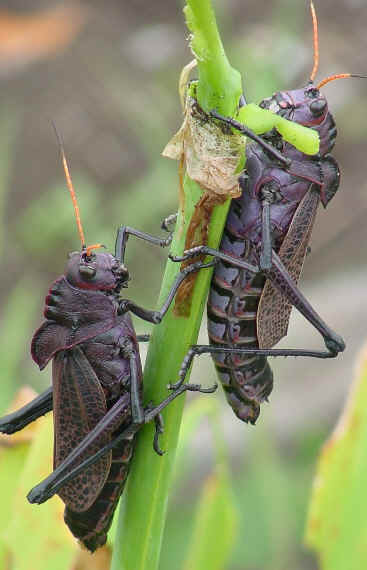
The most commonly held view of John’s diet, based on our text in Mark, is that he ate locusts, a migratory form of the grasshopper of the family Acrididae, still commonly consumed by desert peoples in Arabia. Others have suggested the word translated “locusts” refers to the beans of the carob tree, commonly called “St. John’s bread.” However, the Greek word translated “locusts,” (akris/ακρις) seems to clearly refer to a species of grasshopper. The problem is such eating of “flesh,” even if that of an insect, seems to contradict the sources that emphasize his ascetic vegetarian ideal. Paul, for example, refers to members of the Jesus movement who abstain from eating meat and drinking wine (Roman 14:1-4). We also have traditions that James, the brother of Jesus, practiced a strictly vegetarian lifestyle, which was also common among the Jewish Christian community that became known as the “Ebionites,” see my post here. Somehow “locusts” seem out of place.
A possible solution to this confusion about John’s desert diet is found in the fragments we have of the lost “Gospel of the Ebionites,” as quoted by the 4th-century Christian writer Epiphanius (Panarion 30.13.4-5), who hated the group but fortunately, nonetheless, can’t resist quoting them–thus preserving some precious material. The Greek word for locusts (akris/ἀκρίδες) is very similar to the Greek word for “honey cake” (enkris/έγκρίς) that is used for the “manna” that the Israelites ate in the desert in the days of Moses. According to this ancient text was not locusts but these cakes cooked in olive oil. If this is the case then John would have eaten a cake of some type, made from a desert plant, similar to the “manna” that the ancient Israelites ate in the desert in the days of Moses. This “bread from heaven” is described as “like coriander seed, white, and the taste of it was like wafers made with honey” (Exodus 16:31; Numbers 11:8). This kind of “pancake” baked in oil, and sweetened with honey, would then reflect and emulate the ideal holiness of the desert wanderings of Israel when the people had to look to God alone for “daily bread.”
The spirit of Elizabeth Rosemond Taylor, has been awoken. She was Hollywood Royalty. Liz almost married a Bond author. She despised homophiles. I suggested a Senior play James Bond, who is a role model of my generation who is getting ready to leave the planet. Consider Monty Woolley. My Bond, and I, will protect Gay folks from the hateful homophile, Franklyn Graham, and his Clones.
I should have stopped my research and written my first book when I learned I had a daughter. To be published would have given me the upper hand and insulated me from the pretenders who backed Tom Snyder – who were jealous of me!
This beautiful hardbound book is signed by the author. ‘Realm of the Ring Lords’ brings together for the very first time in one arena the mysteries of the legendary quests for the Ring and the Grail. From Arthurian romance to the world of J. R. R. Tolkien, these stories are enveloped within the magical lore of Elphame – however the myths are based on no mere fantasy, but on an engaging and continual history of real characters and events.
Time-honoured tales of fairies, elves and dragons have long carried a particular fascination which lingers in our collective psyche – a familiar but historical…
Goel (Hebrew: גואל, romanized: goʾel}redeemer), in the Hebrew Bible and rabbinic Judaism, is a person who, as the nearest relative of someone, is charged with the duty of restoring that person’s rights and avenging wrongs done to him or her. One duty of the goel was to redeem (purchase back) a relative who had been sold into slavery. Another was to avenge the death of a relative who had been wrongly killed; one carrying out this vengeance was known as the goel hadam, commonly translated to English as “avenger of blood.”[1]
The obligations of the goel include the duty to redeem the relative from slavery if the latter had been obliged to sell himself into slavery (Leviticus 25:48–49); to repurchase the property of a relative who had had to sell it because of poverty; to avenge the blood of his relative; to marry his brother’s widow to have a son for his brother, in the case that the brother had no son to pass on his name (Deuteronomy 25:5–6); and to receive the restitution if the injured relative had died (Numbers 5:8).
Jewish tradition has also attributed the blood avenger role in modern times to a prosecuting attorney, who pleads on behalf of the victim in the case against the criminal. Thus, he is responsible for bringing the offender to court, finding evidence against him, presenting the case, and collecting damages from the offender. His task is also to argue against any attempts to pardon the sinner. It is presumed that the court would be the party who would avenge the wrongful death via the imposition of the death penalty,[3] though Deuteronomy 13:9 suggests that the witness to an offence and afterward the whole of the people would carry out the penalty of death by stoning.[4]
The opening crawl reads: ‘San Francisco’s Chinatown 15 years ago (1917) had the largest Oriental population of any colony outside China. Its 40,000 yellow residents were divided into various political factions known as Tongs, each governed by a president and council. These various Tongs were almost constantly at war, so the office of “hatchet man” was one of special importance. The honorable title of “hatchet man” was passed from father to son by inheritance only, and it was he, with the aid of his sharp axe, who dispensed the justice of the great God Buddha…’
“…Our story opens following the death of Hop Li, member of the powerful Lem Sing Tong, and we see his funeral procession passing down DuPont Street”…
A huge dragon banner unfolds, declaring war. People panic: men sharpen hatchets; shops are shuttered. Wong Low Get is summoned from Sacramento to take revenge for Hop’s death. He is stunned when the council president, Nog Hong Fah, tells him that Sun Yat Ming, his friend since childhood, is the guilty party. Sun is surprised and pleased to see Wong. He has prepared for his own assassination: His will leaves everything to his old friend. He also asks Wong to raise his little daughter, Toya San, and marry her when she comes of age. Wong agrees—and then reveals that he is the Lem Sing Tong hatchet man. Wong swears before the Buddha that Toya will never know “the song of sorrow.” Sun calmly kneels and prays and forgives Wong’s “innocent hand its stroke of justice.”
Chinatown “today”.. “a far cry from what we have just seen. Gone are the warring Tongs—Gone are the queues and chop-sticks.” Wong, a prominent businessman, is wealthy and happy. Nog detests change, especially the way that women are being spoiled “by intelligence and freedom”. It is Toya’s birthday; it should be the day of her betrothal. Nog is appalled to learn that Wong will defy tradition and give her a choice.
Wong offers Toya his mother’s ring and declares his love. He is overjoyed when she replies “My father’s wish is also mine.” He kneels before the statue of Buddha, affirming his promise to bring her only happiness.
On the day of the wedding, the Bing Foo, an outlaw Tong based in Sacramento, declares war. Wong fears a nationwide conflict and the transformation of Tongs into gangsters. Nog hires bodyguards, and the handsome young gangster, Harry En Hai (Leslie Fenton) is assigned to Wong. Toya is a modern girl with a good education, and at first she gives Harry the brush off.
Wong and Toya are happy together, but threats and blackmail from Sacramento continue. Wong’s devoted clerk, Chung Ho, is killed, and Wong goes to Sacramento to meet with the Bing Foo. Only Big Jim Malone, the white gangster who started the war, refuses to cooperate. Wong eliminates him, and the war ends.
Meanwhile, Harry has seduced Toya. When Wong returns, he finds them embracing passionately. She steps between Harry and Wong, and recalls his promise to make her happy, always. Wong gives Toya and her happiness to Harry, making him swear, warning that if he breaks faith Buddha will find him. Because of this “unworthy act”, Wong is stricken from the Tong’s records everywhere. Shunned, he falls into poverty.
At last, Wong hears from Toya in a note, “written from a living death” in China, to tell him she loves only him. The government caught Harry selling opium, and deported both of them. Wong redeems his hatchets from pawn and heads across the Pacific to China, working as a stoker.
Toya is prisoner in an opium den/brothel, sold to Madame Si-Si by Harry. Harry sees Wong, but thinks he is a drug-induced hallucination. Toya faints when she sees him, but Wong has only love for her. He confronts Madame Si-Si and demands his wife, by ancient Chinese law and on the honor of a hatchet man. Madame SiSi scoffs; he proves it by hitting the eye of a dragon in a wall painting. Toya and Wong leave. He promises to return for Harry. On the other side of the partition, Madame Si Si shrieks at an unresponsive Harry while her servant removes the hatchet from the partition—and from Harry’s skull. Harry’s body falls, Cut to the statue of Buddha; Wong repeats his warning to Harry. “The great Lord Buddha will find you no matter where you are on the face of the Earth”.







 Rosamond Press
Leave a comment