

Capturing Beauty
A Autobiography
by
John Presco
ALL RIGHTS RESERVED
On July 11, 2024, I cleared my Janke kin of any wrong-doing when I found an article by Jim Clifford about the Irish Fenians who came to Belmont and Redwood City in trains a half mile long, pulled by four engine belnging to Southern Pacific Railroad. Here are my good intention when I contacted the Belmont Historic Society – that is now being invaded by my Rosamond kin. Elizabeth Rosemond Taylor – leads the way……Up Beautiful Mountain!
On this day, I make Belmont the un-official California City of Elizabeth Rosemond Taylor. I’m going to write Jenny Newson and see if she will help to make it official. How about a name change
Rosemond de la Belmont?
John Presco
The Fenians, the American branch of the Irish Republican Brotherhood, which operated from 1858 to 1924, are among those militant groups largely overlooked in American history. They certainly weren’t ignored in Canada, however; certain historians say the attack by Fenian soldiers, mainly Irish-American veterans of the U.S. Civil War, contributed to the drive for Canadian independence.fic
The San Mateo picnic in 1866 came a month after Fenians crossed into Canada at Niagara Falls on June 2 and met opposing forces at Ridgeway, today part of the town of Fort Erie, Ontario. The disciplined fire of the 1,500 or so Irish-Americans was too much for the raw Canadian militia, which retreated from the battlefield upon which nine troops were killed. The Irish-American fighters then went to Fort Erie and captured a small garrison whose officer in charge cut off his whiskers and fled in disguise, according to Canadian poet and historian Edgar McInnis.
reports say 15,000 people turned out for events in Redwood City and San Mateo, and a picnic in Belmont drew about 10,000. One newspaper story estimated the train carrying passengers to Belmont Park in 1868 was a half-mile long. Its account promoted the popular view of the Irish as brawlers, saying the train was “headed by three or four engines, puffing and blowing like so many thousand savage Fenians eager for the fray.” (The Fenian Brotherhood was an Irish-American group that agitated for Ireland’s independence from Britain.)
“To the credit of the Irish, they disappointed many who anticipated a disorderly riotous rabble,” the Gazette said of the San Mateo picnic. The paper noted there were only a few drunks, “considering the amount of liquor” involved. Just a handful of arrests and fistfights were reported at the event in Redwood City, which had a population of only 1,000 at the time.

When the Irish invaded the Peninsula—and Canada
By Jim Clifford
There’s a lot more to St. Patrick’s Day than green beer—usually imbibed by people who don’t know County Kerry from Marin. A new state law mandates one semester of ethnic studies for all California high school students who graduate starting in 2030. Such classes often focus on marginalized peoples, and it may help to remind high schoolers that most immigrants were considered “out groups” when they came the U.S.
The Irish were no different when they started arriving around 1820. In New York City, especially, newspapers carried employment ads with the acronym, “NINA”—”No Irish Need Apply.” Irish-American men and boys were routinely stereotyped as hooligans and drunks. As with derogatory images of other ethnic groups, the unflattering portrayal of 19th-century Irish-Americans has persisted, even appearing in a widely used U.S. history textbook first published in 1980.
But if it’s true that everyone is Irish on St. Patrick’s Day, then March 17 is a good place to start finding one’s roots. It may come as a surprise, but there was a time when the Bay Area’s Irish heritage was strong and thousands of immigrants from the Emerald Isle headed every year for celebratory picnics on the Peninsula.
The numbers are difficult to confirm, but various reports say 15,000 people turned out for events in Redwood City and San Mateo, and a picnic in Belmont drew about 10,000. One newspaper story estimated the train carrying passengers to Belmont Park in 1868 was a half-mile long. Its account promoted the popular view of the Irish as brawlers, saying the train was “headed by three or four engines, puffing and blowing like so many thousand savage Fenians eager for the fray.” (The Fenian Brotherhood was an Irish-American group that agitated for Ireland’s independence from Britain.)
The Redwood City picnic of 1870 was front-page news in the San Mateo County Gazette. The paper was a veteran in reporting on Irish-American gatherings, having covered the San Mateo event in 1866, the year the Fenians invaded Canada, which achieved its own independence from Great Britain 13 months later. In their quest for Irish freedom, the Fenians in 1881 also produced the first practical submarine in an attempt to end Britannia’s rule of the waves. The vessel, called the Fenian Ram, was tested but never used in battle.
Contemporary accounts of the Peninsula gatherings were a bit condescending, coming at a time when nativists warned of the presumed Irish three Rs of “Rum, Romanism and Rebellion.”
“To the credit of the Irish, they disappointed many who anticipated a disorderly riotous rabble,” the Gazette said of the San Mateo picnic. The paper noted there were only a few drunks, “considering the amount of liquor” involved. Just a handful of arrests and fistfights were reported at the event in Redwood City, which had a population of only 1,000 at the time.
A Neglected Revolutionary Organization
The Fenians, the American branch of the Irish Republican Brotherhood, which operated from 1858 to 1924, are among those militant groups largely overlooked in American history. They certainly weren’t ignored in Canada, however; certain historians say the attack by Fenian soldiers, mainly Irish-American veterans of the U.S. Civil War, contributed to the drive for Canadian independence.
The San Mateo picnic in 1866 came a month after Fenians crossed into Canada at Niagara Falls on June 2 and met opposing forces at Ridgeway, today part of the town of Fort Erie, Ontario. The disciplined fire of the 1,500 or so Irish-Americans was too much for the raw Canadian militia, which retreated from the battlefield upon which nine troops were killed. The Irish-American fighters then went to Fort Erie and captured a small garrison whose officer in charge cut off his whiskers and fled in disguise, according to Canadian poet and historian Edgar McInnis.
McInnis wrote in his book, “The Unguarded Frontier,” that the invaders became cut off when the United States sent a gunboat to prevent reinforcements. Most of the Fenians were arrested and released. The revolutionaries continued minor raids in Canada, the last in 1871. Why Canada? According to McInnis, the plan was to draw English troops out of Ireland and over to North America.
The Fenians also had a navy, or at least hoped to have one. They raised enough money to back Irish-born naval architect John Holland in his quest to build a submarine, which he accomplished in 1881 with the Fenian Ram. Even though the craft never saw action, Holland kept building submarines. His final design was sold to the United States and commissioned in 1900 as the USS Holland. The Fenian Ram still exists and can be viewed at the Paterson Museum in Paterson, New Jersey.
No Irish, No San Mateo County?
Some say San Mateo County owes its birth to the Irish. A stretch? Maybe not. Consider when the county was founded—1856, a year displayed prominently on the county seal. In San Francisco, 1856 is known for something else: It was the year of the Committee of Vigilance. Vigilantes, for short. It was a time when angry San Franciscans took the law into their own hands, hands that held guns and ropes—as in hanging.
To this day, historians debate if the main aim of the vigilantes was to crush crime or to rid San Francisco of a growing Democratic political machine run by Irish Catholics that was threatening the established power structure. “Anti-Catholic and anti-Irish feeling seethed through the Vigilantes,” wrote esteemed California historian Kevin Starr in his series, “Americans and the California Dream.” According to Starr, the Vigilante movements of both 1851 and 1856 were fueled by “anti-foreign reformism on the part of outraged businessmen.”
In 1856, the thinly settled Peninsula was part of San Francisco, whose population was approaching 60,000. Certain lawmakers thought making San Francisco both a city and a county would end jurisdictional disputes in the prosecution of so-called “toughs,” who were mostly Irish. For their own part, the “toughs,” a term used in histories written during the era, viewed the Peninsula as a promising place to enjoy pastimes that included prize fighting, gambling and drinking in saloons. State politicians in Sacramento agreed to San Francisco’s request, with the understanding that the new San Mateo County would be established.
It came to be in 1856, in an arrangement made to order for San Francisco’s criminal elements. The initial San Mateo County election to pick officials as well as the county seat was replete with stuffed ballot boxes and physical intimidation at the polls by thugs known in the day as “shoulder-strikers.” The California Supreme Court invalidated the results of the first election, in which Belmont was picked as the county seat. In the second election, the voters chose Redwood City.
The county emerged at a time when Peninsula residents, including many Irish-Americans, were trying to live off the land, mainly through farming, dairy production and logging, all ventures needed to feed and house the giant city to the north. Eventually, both Redwood City’s police chief and fire chief would have Irish names, but it was ordinary men and women who formed families that were often founded on strong religious beliefs and that helped write the area’s growing success story.
Their faith was so enduring that what they started more than a century ago is still a household name in Redwood City. The community’s Irish-Americans settled mainly east of El Camino Real, on the historically poorer side of town. Virtually all the pastors of their Catholic church, St. Mary’s, were also Irish.
Today, the church and school, now called Mount Carmel, are literally located—as the old saying goes about upward mobility—on the other side of the tracks. The desirable Mount Carmel neighborhood on Redwood City’s west side is beloved by real-estate agents and offers strong evidence of Irish-Americans’ ascent in the 20th and 21st centuries.
What’s in a Name?
Throughout much of the 1900s, sociologists referred to the mingling of various ethnic groups in America as the “melting pot.” Later, emphasizing the identities of separate peoples, others started calling it the “mosaic.” However it’s viewed, it’s on display every St. Patrick’s Day at St. Francis of Assisi Church in East Palo Alto, which hosts a dinner that recalls the area’s Irish heritage.
Father Larry Goode says the parish today contains a mix of cultures, including African-American, European-American, Hispanic and Tongan. Near the church, it’s impossible to miss the area’s Irish roots, especially in the street names. One of them is Kavanaugh Drive, which commemorates the family that donated the land for the church.
Menlo Park has several streets named for Irish people, according to local historian Bo Crane. Crane says the city was founded in the 1850s by Irish pioneers Denis Oliver (whose first name is also recorded as “Dennis”) and Daniel McGlynn, who both hailed from Menlough, an Irish village in County Galway. How did Menlough get shortened to Menlo? The best guess is that something got lost in translation.
There is also the matter of that other Menlo Park, the one in New Jersey that was the home of inventor Thomas Edison. According to a 1941 program marking the dedication of a fire station in the New Jersey town, that Menlo Park was named “for a village in the County of San Mateo” in California. A welcoming gate with ”Menlo Park” arched over the top was dedicated in the California “village” in 2019 on the library corner of Ravenswood Avenue and Alma Street. The ceremony, of course, was held on St. Patrick’s Day.
A few Menlo Park citizens have visited Galway, Menlo Park’s sister city, returning with stories about the ties between the two towns. Galway even boasts a Menlo Park Hotel, which features a restaurant named “Oliver and McGlynn.” It’s a good bet that a resident of Menlo Park—or anywhere else—can enjoy an invigorating pint there, and not only on March 17.
Come Home To Beautiful Mountain
Posted on February 22, 2021 by Royal Rosamond Press
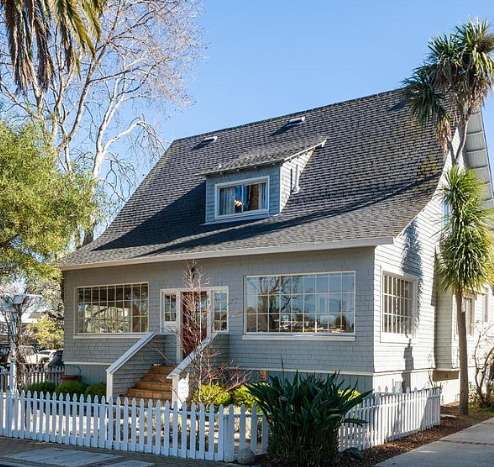


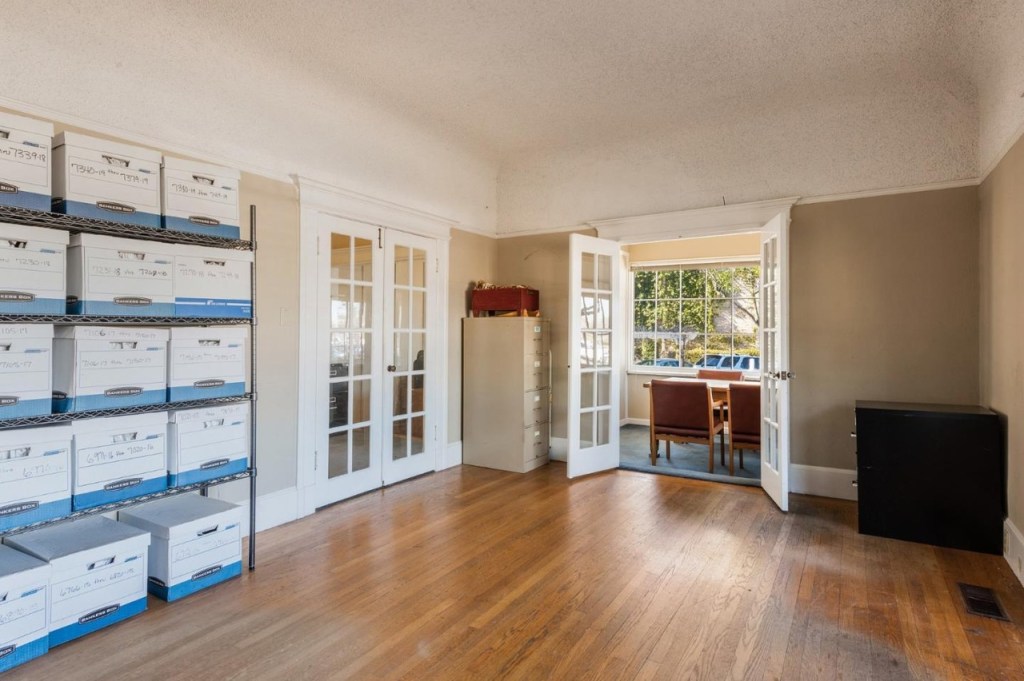
Last night as I was admiring my post of the history of Crockett, I went to Belmont California to see if they had any interesting homes for sale. Eureka! Is this the future home of Royal Rosamond Press? What was here before? I moved in the daughters of Christine Rosamond Benton. Why not Tyler, too? Our children can experience the miracle the Presco Children created growing up on San Sebastian Avenue in Oakland. Belmont – needs our history – in their Downtown! There is nothing there – there! The same goes for Crockett. If they only knew where the remains of William Janke ended up, after being dug up and evicted from his grave. Did William interact with the children gathered in the giant oak tree? I am going to do a painting of these little people dressed as Bohemians, posing before the Time Machine.
“What does the future have in store for us? Can we all get along?”
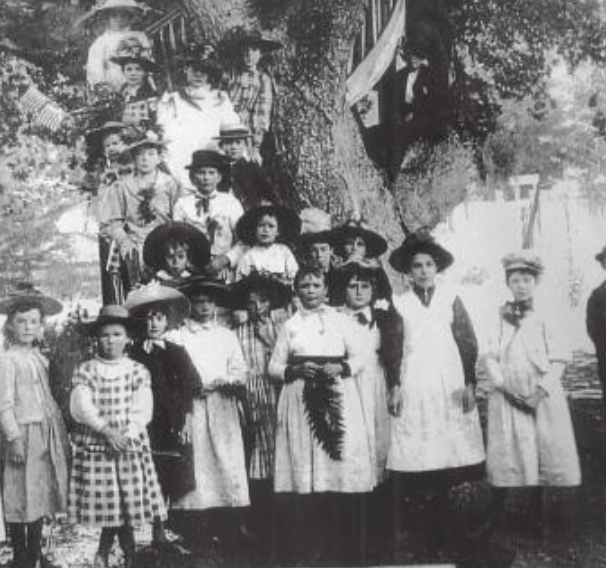


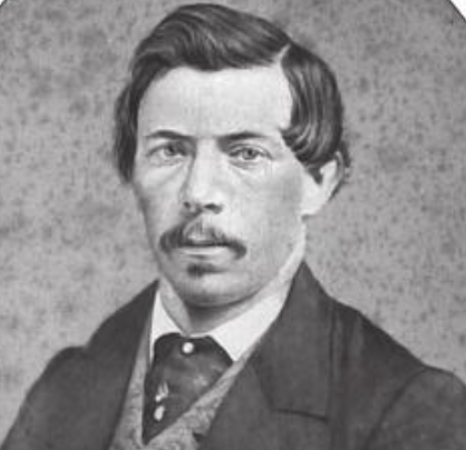

“You can’t put your family in one place – there will be trouble!”
“There will always be trouble!” says Victoria Rosamond Bond as she takes her contraption out of the closet, she determined to play it at the Orange Parade!
I just learned the Fenian Brotherhood had gathered in large numbers at the Janke German Theme Park, perhaps the first theme park in California. They did what the Irish are famous for, they drank some beers and got in some fights. This writer-historian calls our past “shady”. How perfect for kin of Ian Fleming, Jaspar John, and all the Gettys. Let’s not leave out Liz and Richard Burton. There will be talk as the citizens pass our home.
“They say Rosamond’s Daughter are mad. One is for the Orange Lodge, and the other is for the Finians Brotherhood. Then there is Heather. She and her mother follow the Tree Goddess. There’s some witchery going on here!”
“I always cross the street when I go by that house!”
“Hurry! We’re going to miss the start of the Irish Unity Parade!”
May I suggest Belmont reach out to the United Ireland folks and begin a cultural exchange. I am going to do some large paintings of these images, and may have Shannon and Drew help. They both heled Garth Benton with the Getty Villa murals.
I see us working on our family history in the sunroom where the conference table is. The Public will be encouraged to come by and watch us – from the outside. I will be working on our newspaper in the other half of the fishbowl we have been living in since Christine became famous.
John Presco
President: Royal Rosamond Press
Copyright 2021
901 Waltermire St, BELMONT, CA 94002 | MLS# ML81825373 | Redfin
Twin Pines Park’s shady past | Local News | smdailyjournal.com
Bennett Rosamond Grand Master of Orange Order
Posted on April 1, 2012 by Royal Rosamond Press
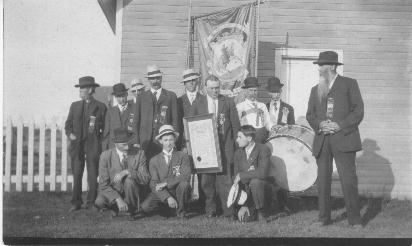
Above is a photograph of Bennett Rosamond the Grand Master of the Orange Order in Canada. Bennett is with members of Lodge 389 in Lanark, or, Almonte. The image on the banner is that of William of Orange who is carried in Orange Parades. That is Bennett on the far right, looking like Gandalf, or, a Levite Prophet.
According to the History of the Rosemond Family by Leland Rosemond, the Rosamond family were members of the Orange Order in Leitrim Ireland, and fled to Canada after a Rosamond son killed a Catholic lad who was invading the Rosamond home with a gang bent on doing my kindred harm.
Bennett may have been a Freemason as well – and an Oddfellow. There is a long history of the Rosamonds belonging to Guilds. They were members of the Swan Brethren.
My grandparents, Royal and Mary Magdalene Rosamond, begat my mother, Rosemary Rosamond, and her sisters, Lilian, Bonnie, and June Rice.
Fenian Brotherhood – Wikipedia


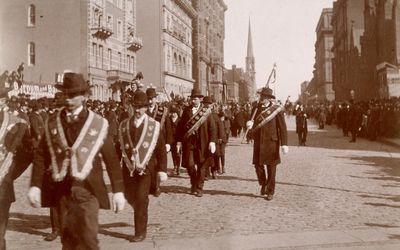
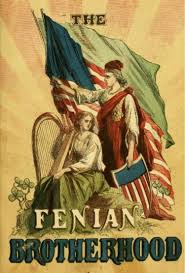
The Red Hand of Bond
Posted on September 5, 2018 by Royal Rosamond Press


James Bond Fans have gone over every Bong Thing with a fine-tooth comb, and, can not answer the riddle of the Red Hand of Ulster being in the Bond cote of arms.
John Presco 007
https://www.araltas.com/features/oneill/
https://en.m.wikipedia.org/wiki/File:Bond-coat-of-arms_(semi-fictional).svg
https://oneill.nd.edu/history/the-red-hand-of-oneill/
http://www.ronsattic.com/redhand.html
Red Hand of Ulster
From Wikipedia, the free encyclopedia
Jump to navigation Jump to search“Red Hand” redirects here. For other uses, see Red hand.


The Red Hand of Ulster, right and left hand versions
The Red Hand of Ulster (Irish: Lámh Dhearg Uladh) is an Irish symbol used in heraldry[1] to denote the Irish province of Ulster. It is an open hand coloured red, with the fingers pointing upwards, the thumb held parallel to the fingers, and the palm facing forward. It is usually shown as a right hand, but is sometimes a left hand, such as in the coats of arms of baronets.
From the Daily Journal archives
Twin Pines Park’s shady past
- By Jim Clifford
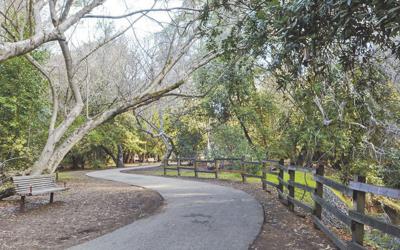
The Belmont City Council recently approved funding for a master plan to upgrade Twin Pines Park, a bucolic oasis where people can escape the push and pull of modern life by simply listening to the sound of a creek as it flows in the shade of towering trees. It is hard to believe this pastoral setting has a violent history that includes murder, rape and kidnapping.
The unsavory history took place a long time ago when the park was known as the Belmont Picnic Grounds as well as Belmont Park. The present park is a remnant of the original 12-acre, wildly popular venue that opened shortly after the train came to the Peninsula in the 1860s.
Belmont Park was the work of Carl Janke, who wanted to replicate a beer garden from his native Germany. The trains brought party goers from throughout the Bay Area to Belmont where they spent the day meandering through the woods or attending the many picnics hosted by immigrant groups and fraternal organizations, events that drew people by the thousands. Ships also brought park-bound passengers to the Belmont pier.
Today’s 10-acre Twin Pines Park is located on Ralston Avenue a few blocks west of El Camino Real in the same spot once occupied by the Belmont Picnic Grounds, according to the Belmont Historical Society. The society maintains a museum in Twin Pines, which is also home to popular summer concerts as well as picnickers.
Janke’s park featured a dance pavilion large enough to hold 300 dancers, a bandstand and, of course, a beer garden. Eventually, a jail cell was built under the bandstand to hold rowdy patrons, of which there were plenty.
Special trains carried passengers to the park for huge events, such as an 1868 picnic held by the Fenian Brotherhood, a group of Irish nationalists who wanted to free their native land from the English. The picnic drew 10,000 people, but such sizeable gatherings were not unusual for the times. Two years earlier, 15,000 turned out for a Fenian picnic in San Mateo. In 1870, 12,000 Fenians and their supporters converged on Redwood City, overwhelming a city of less than 2,000. The Irish group was not the only organization to hold massive picnics. In 1876, 8,000 people showed up at Belmont for an Odd Fellows picnic.
Victoria’s Orange Parade
Posted on April 19, 2018 by Royal Rosamond Press


Being part Dutch, and able to trace her lineage to William The Silent, got Victoria Bond an invite to march in the Orange Parade. But, when she insisted she play her ‘Contraption’, some of the most diplomatic folks of the Isles slithered up to her, and, as calm as can be, tried to talk her out of it.
“There will be trouble!”
“What kind of trouble? There’s always trouble. I’m not giving up my pipes – mon! That would be like me, asking you, to give up your nuts. Coo’mon! Drop em!”
Jon Presco
Copyright 2018
Return to the Getty Villa
Posted on December 31, 2017 by Royal Rosamond Press


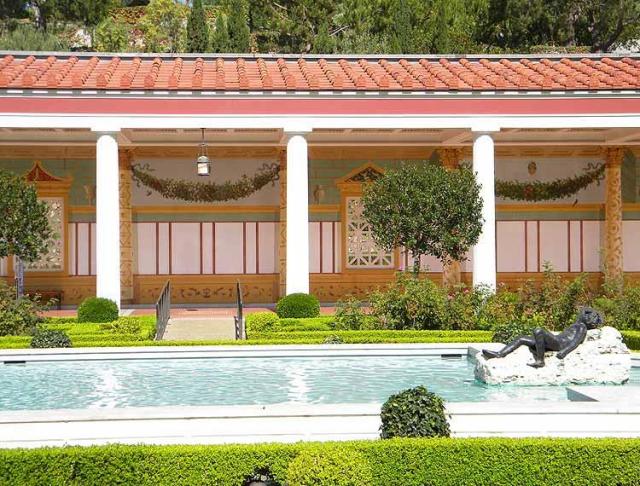
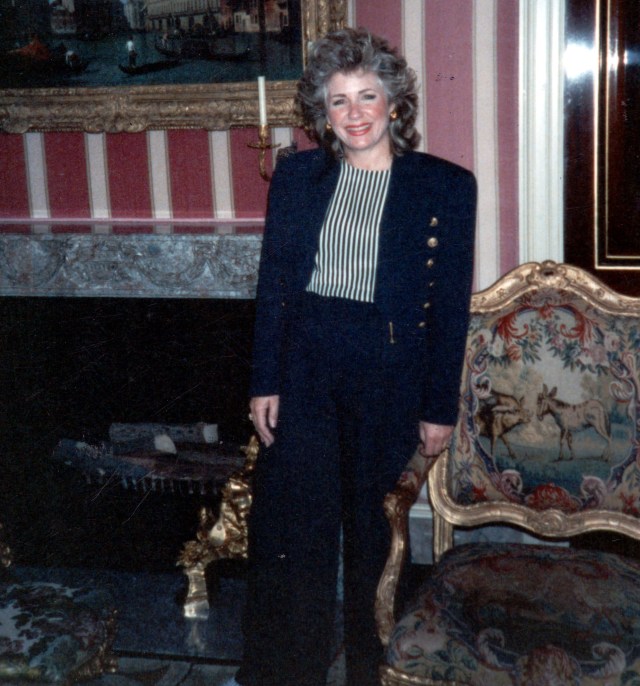
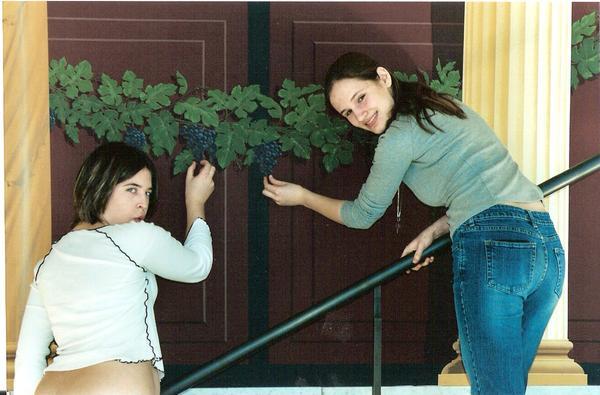
I have taken steps to be awarded several grants. A year from now, I hope to have my own room at the Getty Villa where I am allowed to roam freely admiring the art of my ex-brother-in-law, Garth Benton, and working on my paper and historic masterpiece………..
‘The Doomsday Prophecies of Wealthy Men’
I will be wearing the best headset money can buy with a endless soundtrack from the DaVinci Code, the Phantom of the Opera, and the best of Leonard Cohen. Young scholars will turn their heads as I pass them in halls.
“May the force be with you Professor Obi-Wan Kenobi!”
“Have you saved our planet yet, Obi-Wan?”
“He can’t hear you. He lives in his own world.”
I have also taken steps to receive a grant from the Paul Mellon foundation. Paul is in my rosy family tree via Elizabeth Rosemond Taylor, and Warner. I introduced the Pre-Raphaelites to Christine Rosamond Benton. We are ‘The Last Pre-Raphaelites’.
I just made an offer to be Drew Benton’s Mentor. I can show her how to be a scholar in a year. Above is her mother at the Getty Mansion in New York.
Jon Presco
Copyright 2017
Obi-Wan Kenobi played by Sir Alec Guinness
“The murals on the J. Paul Getty Museum’s garden walls have been seen by millions of visitors since the Malibu institution opened 20 years ago. But who knew that the artist who painted–and is now restoring–the realistic likenesses of columns, garlands and still-life arrangements is Garth Benton, a third cousin of Thomas Hart Benton? The 53-year-old artist never met his famous relative, an American regionalist painter who rejected modern abstraction and championed a muscular style of realism until his death in 1975. But the younger Benton was turned on to art at the age of 8 when he saw a book of his relative’s paintings, and he occasionally corresponded with the late artist, who spent much of his life in his home state of Missouri.”
 Rosamond Press
.svg)
Leave a comment