
The Detection Club meeting in 1932, when G. K. Chesterton was its President



James Bond In Hell
by
John Presco
Dorothy Leigh Sayers touched upon the investigation of the Priory de Sion and the idea that Jesus and Mary Magdalene had a daughter from which the Franks descend. Sayers translated The Divine Comedy by Dante Alighieri. Gabriele Pasquale Giuseppe Rossetti , the father of Dante Gabriel Rossetti, wrote commentaries on the Divine Comedy and founded a secret organization. Rossetti was a good fried of William Morris who influenced J. R. Tolkien, who read Sayer’s books, as did C.S. Lewis. Dan Brown made nearly a billion dollars on The DaVinci Code, a book and movie Dorothy would have blessed in many ways. Did she know the books of Ian Fleming. She married a Fleming. There is a good chance we are related – also! I began my Bond book after discovering we were kin. Broccoli nd Wilson are trying to raise James from the dead – after offing him. What I propose is a book, movie, series, about James Bond in Hell. Here he battles demons, as he did when alive.
I am convening a Trial By Peers to investigate whether or not I died – and went to heaven – which might be the Supreme No-no! Hell – yes! Heaven – no! ‘James Bond In Heaven’ would launch massive demonstrations from Christians avoiding going to hell, and preparing to meet Their Maker at the end of their lives. Apparently, I met my maker when I was twenty.
JP
“Sayers was a good friend of C. S. Lewis and several of the other Inklings. On some occasions, Sayers joined Lewis at meetings of the Socratic Club. Lewis said he read The Man Born to be King every Easter, but he claimed to be unable to appreciate detective stories. J. R. R. Tolkien, however, read some of the Wimsey novels but scorned the later ones, such as Gaudy Night.
The literary and academic themes in Sayers’ novels have appealed to a great many readers, but by no means to all. Poet W. H. Auden and philosopher Ludwig Wittgenstein were critics of her novels, for example.[13][14]
https://en.wikipedia.org/wiki/Gabriele_Rossetti
He also wrote commentaries on Dante Alighieri in which he attempted to show evidence of mysterious ancient conspiracies in his works.[2]
Gabriele Pasquale Giuseppe Rossetti (28 February 1783 – 24 April 1854) was an Italian nobleman, poet, constitutionalist, scholar, and founder of the secret society Carbonari.
Rossetti was born in Vasto in the Kingdom of Naples. He was Roman Catholic. His support for Italian revolutionary nationalism forced him into political exile in England in 1821.
https://en.wikipedia.org/wiki/Carbonari
The Carbonari (lit. ’charcoal burners‘) was an informal network of secret revolutionary societies active in Italy from about 1800 to 1831. The Italian Carbonari may have further influenced other revolutionary groups in France, Portugal, Spain, Brazil, Uruguay, the Ottoman Empire, and Russia.[1] Although their goals often had a patriotic and liberal basis, they lacked a clear immediate political agenda.[2]
We three were original hippies who took the Lord of the Rings to heart as we modified the modern world, made it over more to our liking, we oblivious to what normal folk were about. This is exactly what William Morris and the Pre-Raphaelite Brother and Sisterhood did. They – returned!
I discovered the Pre-Raphaelites in 1969 and let my hair grow long for the first time. I gave up drugs in 1967 and was looking for a spiritual format. I came under the spell of the Rossetti family who were friendly with Joaquin Miller. We Presco children knew Miller’s daughter as ‘The White Witch’ and we would call her for advice. Miller’s home ‘The Abbye’ was above our home in the Oakland Hills. Our kindred were friends of Miller, who was also a friend of Swineburn, who wrote ‘The Queen-Mother and Rosamund’ and ‘Rosamund Queen of Lombards. Tolkien was inspired by the Lombards.
Filed away in Rosamond’s probate is my plea to the executor to allow me to be my sister’s historian. I mention Miller and Rossetti. I saw myself in the role of Michael Rossetti who had his own publishing company. He published Miller and other famous poets. When I was twelve, my mother read evidence I might become a famous poet.
All my imput has been ruthlessly ignored, because petty un-creative minds have forced our families creative legacy down the tiny holes of their hidden agendas, into the mouths of worms and parasites, because these ignorant people sensed I and the real Art World, did not let them in the door – would never admit them into our circle, our ring of genius!
The poem begins on the night of Maundy Thursday on March 24 (or April 7), 1300, shortly before the dawn of Good Friday.[3][4] The narrator, Dante himself, is 35 years old, and thus “midway in the journey of our life” (Nel mezzo del cammin di nostra vita[5]) – half of the biblical lifespan of 70 (Psalm 89:10, Vulgate; Psalm 90:10, KJV). The poet finds himself lost in a dark wood (selva oscura[6]), astray from the “straight way” (diritta via,[7] also translatable as “right way”) of salvation. He sets out to climb directly up a small mountain, but his way is blocked by three beasts he cannot evade: a lonza[8] (usually rendered as “leopard” or “leopon“),[9] a leone[10] (lion), and a lupa[11] (she-wolf). The three beasts, taken from Jeremiah 5:6, are thought to symbolize the three kinds of sin that bring the unrepentant soul into one of the three major divisions of Hell. According to John Ciardi, these are incontinence (the she-wolf); violence and bestiality (the lion); and fraud and malice (the leopard);[12] Dorothy L. Sayers assigns the leopard to incontinence and the she-wolf to fraud/malice.[13] It is now dawn of Good Friday, April 8, with the sun rising in Aries. The beasts drive him back despairing into the darkness of error, a “lower place” (basso loco[14]) where the sun is silent (l sol tace[15]). However, Dante is rescued by a figure who announces that he was born sub Iulio[16] (i.e., in the time of Julius Caesar) and lived under Augustus: it is the shade of the Roman poet Virgil, author of the Aeneid, a Latin epic.
https://en.wikipedia.org/wiki/Inferno_(Dante)
https://en.wikipedia.org/wiki/The_Man_Born_to_Be_King
https://en.wikipedia.org/wiki/Dante_Alighieri
Dante Alighieri
https://en.wikipedia.org/wiki/Salian_Franks
Dante was instrumental in establishing the literature of Italy, and is considered to be among the country’s national poets and the Western world’s greatest literary icons.[11] His depictions of Hell, Purgatory, and Heaven provided inspiration for the larger body of Western art and literature.[12][13] He influenced English writers such as Geoffrey Chaucer, John Milton, and Alfred Tennyson, among many others. In addition, the first use of the interlocking three-line rhyme scheme, or the terza rima, is attributed to him. He is described as the “father” of the Italian language,[14] and in Italy he is often referred to as il Sommo Poeta (“the Supreme Poet”). Dante, Petrarch, and Boccaccio are also called the tre corone (“three crowns”) of Italian literature.
Helen “Nell” Mary, née Leigh
Life and career[edit]
Early years[edit]
Sayers was born on 13 June 1893 at the Old Choir House in Brewer Street, Oxford; she was the only child of the Rev Henry Sayers and his wife Helen “Nell” Mary, née Leigh.[3] Henry Sayers, born at Tittleshall, Norfolk, was the son of the Rev Robert Sayers, from County Tipperary, Ireland.[4][5] At the time of Sayers’s birth her father was headmaster of Christ Church Cathedral School and chaplain of Christ Church, one of the colleges of the University of Oxford.[5] Her mother, born in Shirley, Hampshire, was a daughter of a solicitor descended from landed gentry on the Isle of Wight.[6] Sayers was proud of the Leigh connection and later considered calling herself “D. Leigh Sayers” in professional matters, before settling for “Dorothy L. Sayers”—insisting on the inclusion of the middle initial.[7]
she, like many of the Leigh family—including her great-uncle Percival Leigh, a contributor to the humorous magazine Punch—was outgoing and gregarious and she missed the stimulation of Oxford society.[9]
Percival Leigh (3 November 1813 – 24 October 1889), was an English satirist and comic writer, known as one of the founding contributors to the magazine Punch, where he was deputy to the editor, Mark Lemon. He collaborated with cartoonists including John Leech and Richard Doyle and was the last survivor of the original Punch contributors.
https://www.genealogieonline.nl/en/family-tree-davidson-and-gee/P4159.php
https://www.wikitree.com/wiki/Leigh-1192
https://www.wikitree.com/wiki/Leigh-1403
Frederick Leigh
Born before 18 Feb 1818 in St Faith’s, Winchester, Hampshire, England
Son of Leonard Leigh and Eliza (Unknown) Leigh
Brother of Percival Leigh, Robert Leigh and Leonora Leigh
Husband of Sarah (Bearham) Leigh — married 17 Mar 1845 in Saint Bartholomew Hyde, Winchester, Hampshire, England

Father of Leonora Leigh, Amy (Leigh) Shrimpton, Helen Mary (Leigh) Sayers and Henry Devenish Leigh M. A.
Died 1886 after age 67 in Southampton, Hampshire, England
The task that preoccupied Sayers from the 1940s to the end of her life was her translation of Dante Alighieri‘s Divine Comedy. She said she began it after reading the original Italian version in an air-raid shelter during bombing raids.[n 12] She saw parallels between the writing and the state of the world during the war.[102]
I saw the whole lay-out of Hell as something actual and contemporary; something that one can see by looking into one’s self, or into the pages of tomorrow’s newspaper. I saw it, that is, as a judgment of fact, unaffected by its period, unaffected by its literary or dogmatic origins and I recognised at the same moment that the judgment was true.[103]
She thought Dante was “simply the most incomparable story-teller who ever set pen to paper”,[104] and in addition to the parallels of the world during war, she believed that her society suffered from a lack of faith, declining morality, dishonesty, exploitation, disharmony and other similar problems, and believed that Dante shared the same view of his own.[104] Once she began to read, she found herself unable to stop:
Thanks a lot for the detective mags. I had, before they arrived, been reading a detective story by Dorothy Sayers, and it was so bl… foul that it depressed me. Then when I opened one of your mags it was like getting out of a stuffy room into the fresh air. And, talking of detective fiction, I’d like you to make an enquiry for me when once you’ve got nothing better to do. A couple of years ago I read with great pleasure a detective story called Rendezvous With Fear by a man Norbert Davis. I enjoyed it so much that I gave it not only to Smythies but also to Moore to read and both shared my high opinion of it.
https://en.wikipedia.org/wiki/Dorothy_L._Sayers
In the same year Sayers married a divorcé, Captain Oswald Arthur (known as “Mac”) Fleming, a well-known journalist.[37][n 1] Her son was given the latter’s surname but was not brought to live with Sayers and her husband. The marriage, happy at first, grew more difficult as Fleming’s health declined, but the couple stayed together until his death of a stroke in 1950, when he was 68.[4][54][n 7]
https://en.wikipedia.org/wiki/Detection_Club
In addition to meeting for dinners and helping each other with technical aspects in their individual writings, the members of the club agreed to adhere to Knox’s Commandments in their writing to give the reader a fair chance at guessing the guilty party. These fair-play “rules” were summarised by one of the members, Ronald Knox, in an introduction to an anthology of detective stories. They were never intended as more than guidelines, and not all the members took them seriously. The first American member (though then living in the UK) was John Dickson Carr, elected in 1936.
The club continues to exist, although the fair-play rules have been considerably relaxed.
https://www.newworldencyclopedia.org/entry/Dorothy_L._Sayers
Sayers considered her translation of Dante‘s Divina Commedia to be her best work. The badly-titled Hell appeared in 1949, as one of the recently introduced series of Penguin Classics. Purgatory followed in 1955. Unfinished at her death, the third volume (Paradise) was completed by Barbara Reynolds in 1962.
Sayers was a good friend of C. S. Lewis and several of the other Inklings. On some occasions, Sayers joined Lewis at meetings of the Socratic Club. Lewis said he read The Man Born to be King every Easter, but he claimed to be unable to appreciate detective stories. J. R. R. Tolkien, however, read some of the Wimsey novels but scorned the later ones, such as Gaudy Night.
The literary and academic themes in Sayers’ novels have appealed to a great many readers, but by no means to all. Poet W. H. Auden and philosopher Ludwig Wittgenstein were critics of her novels, for example.[13][14]
https://en.wikipedia.org/wiki/The_Da_Vinci_Code_(film)
The film, like the book, was considered controversial. It was met with especially harsh criticism by the Catholic Church for the accusation that it is behind a two-thousand-year-old cover-up concerning what the Holy Grail really is and the concept that Jesus Christ and Mary Magdalene were married, producing a daughter, as well as its treatment of the organizations Priory of Sion and Opus Dei. Many members urged the laity to boycott the film. In the book, Dan Brown states that the Priory of Sion and “all descriptions of artwork, architecture, documents and secret rituals in this novel are accurate.”
The film grossed US$224 million in its worldwide opening weekend and a total of US$760 million worldwide, becoming the second-highest-grossing film of 2006, as well as Howard’s highest-grossing film to date. However, the film received generally negative reviews from critics. It was followed by two sequels, Angels & Demons (2009) and Inferno (2016).
. It was theatrically released on 30 September 2021 in the United Kingdom and on 8 October 2021 in the United States. The film received positive reviews and grossed over $774 million worldwide, making it the fourth-highest-grossing film of 2021 and the third-highest grossing Bond film. In addition, it earned sRonald Knoxeveral other box-office record achievements, including becoming the third-highest-grossing film of all time in the UK.
Dinner At Dante Rossetti’s
Posted on February 27, 2020 by Royal Rosamond Press


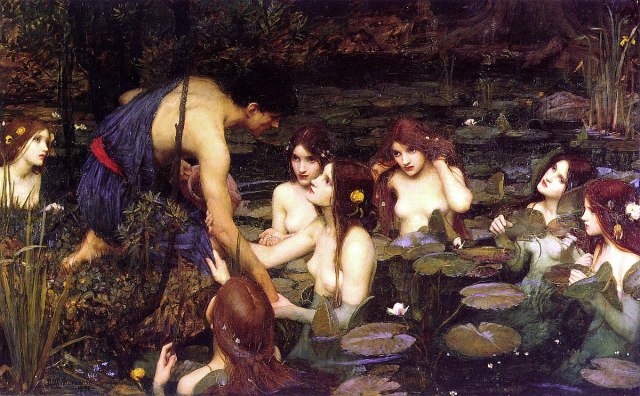
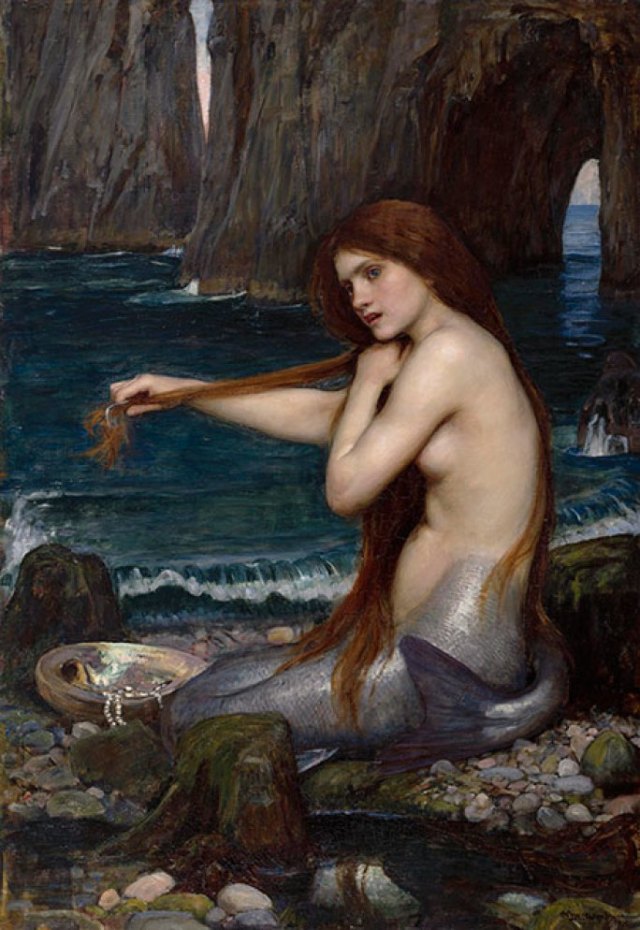
I am heir to the literary kingdoms of Tolkien, Fleming, and London. When I searched the internet for a replacement muse of Rena Easton, I gasped when I saw the three photographs of Lara Roozemond. If she was born in another time, and she came upon them, The Pre-Raphaelite Brotherhood would have fought bloody battles over her. Would Joaquin Miller join the fray?
There is a debate over the source of the name Rosamond. Some say it means “rose mouth”. Lara’s lips are like rose blossoms.
John Presco
Dinner at Rossetti’s
by Joaquin Miller
________________________________________
There is no thing that hath not worth;
There is no evil anywhere;
There is no ill on all this earth,
If man seeks not to see it there.
September 28. I cannot forget that dinner with Dante Gabriel Rossetti, just before leaving London, nor can I hope to recall its shining and enduring glory. I am a better, larger man, because of it. And how nearly our feet are set on the same way. It was as if we were all crossing the plains, and I for a day’s journey and a night’s encampment fell in with and conversed with the captains of the march.
But one may not gave names and dates and details over there as here. The home is entirely a castle. The secrets of the board and fireside are sacred. And then these honest toilers and worshippers of the beautiful are shy, so shy and modest. But I like this decent English way of keeping your name down and out of sight till the coffin-lid hides your blushes–so modest these Pre-Raphaelites are that I should be in disgrace forever if I dared set down any living man’s name.
But here are a few of the pearls picked up, as they were tossed about the table at intervals and sandwiched in between tales of love and lighter thoughts and things.
All London, or rather all the brain of London, the literary brain, was there. And the brain of all the world, I think, was in London. These giants of thought, champions of the beautiful earth, passed the secrets of all time and all lands before me like a mighty panorama. All night sol We dined so late that we missed breakfast. If I could remember and write down truly and exactly what these men said, I would have the best and the greatest book that ever was written, I have been trying a week in vain, I have written down and scratched out and revised till I have lost the soul of it, it seems to me; no individuality to it; only like my own stuff. If I only had set their words down on the next day instead of attempting to remember their thoughts! Alas! the sheaves have been tossed and beaten about over sea and land for days and days, till the golden grain is gone, and here is but the straw and chaff.
The master sat silent for the most part; there was a little man away down at the other end, conspicuously modest. There was a cynical fat man, and a lean philanthropist all sorts and sizes, but all lovers of the beautiful of earth. Here is what one, a painter, a ruddy-faced and a rollicking gentleman, remarked merrily to me as he poured out a glass of red wine at the beginning of the dinner:
“When travelling in the mountains of Italy, I observed that the pretty peasant women made the wine by putting grapes m a great tub, and then, getting into this tub, barefooted, on top of the grapes, treading them out with their brown, bare feet. At first I did not like to drink this wine. I did not think it was clean. But I afterward watched these pretty brown women” and here all leaned to listen, at the mention of pretty brown women– I watched these pretty brown women at their work in the primitive winepress, and I noticed that they always washed their feet after they got done treading out the wine.”
All laughed at this, and the red-faced painter was so delighted that he poured out and swallowed another full glass. The master sighed as he sat at the head of the table rolling a bit of bread between thumb and finger, and said, sitting close to me: “I am an Italian who has neven seen Italy. Belle Italia!…”
By and by he quietly said that silence was the noblest attitude in all things; that the greatest poets refused to write, and that all great artists in all lines were above the folly of expression. A voice from far down the table echoed this sentiment by saying:”Heard melodies are sweet; but unheard melodies are sweeter.” “Written poems are delicious; but unwritten poems are divine,” cried the triumphant cynic. “What is poetry?” cries a neighbor. “All true, pure life is poetry,” answers one. “But the inspiration of poetry?” “The art of poetry is in books. The inspiration of poetry in nature.” To this all agreed.
Then the master very quietly spoke: “And yet do not despise the books of man. All religions, said the Chinese philosophers, are good. The only difference is, some religions are better than others, and the apparent merit of each depends largely upon a mans capacity for understanding it. This is true of .poetry. All poetry is good. I never read a poem in my life that did not have some merit, and teach some sweet lesson. The fault in reading the poems of man, as well as reading the poetry of nature, lies largely at the door of the reader. Now, what do you call poetry?” and he turned his great Italian eyes tenderly to where I sat at his side.
To me a poem must be a picture,” I answered.
Proud I was when a great poet then said: “And it must be a picture–if a good poem so simple that you can understand it at a glance, eh? And see it and remember it as you would see and remember a sunset, eh?” “Aye,” answered the master, “I also demand that it shall be lofty in sentiment and sublime in expression. The only rule I have for measuring the merits of a written poem, is by the height of it. Why not be able to measure its altitude as you measure one of your sublime peaks of America?”
He looked at me as he spoke of America, and I was encouraged to answer:”Yes, I do not want to remember the words. But I do want it to remain with me a picture and become a part of my life. Take this one verse from Mr. Longfellow:
“And the night shall be filled with music,
And the cares that infest the day
Shall fold their tents like the Arabs,
And as silently steal away.’”
“Good!” cried the fat cynic, who, I am sure, had never heard the couplet before, it was so sweet to him; “Good! There is a picture that will depart from no impressible clay. The silent night, the far sweet melody falling on the weary mind, the tawny picturesque Arabs stealing away m the darkness, the perfect peace, the stillness and the rest. It appeals to all the Ishmaelite in our natures, and all the time we see the tents gathered up and the silent children of the desert gliding away in the gloaming.”
A transplanted American, away down at the other end by a little man among bottles, said: “The poem of Evangeline is a succession of pictures. I never read Evangeline but once.” “It is a waste of time to look twice at a sunset,” said Rossetti, sotto voce, and the end man went on: “But i believe I can see every picture in that poem as distinctly as if I had been the unhappy Arcadian; for here the author has called in ail the elements that go to make up a perfect poem.”
“When the great epic of this new, solid Saxon tongue comes to be written,” said one who sat near and was dear to the master’s heart, “it will embrace all that this embraces: new and unnamed lands; ships on the sea; the still deep waters hidden away in a deep and voiceless continent; the fresh and fragrant wilderness; the curling smoke of the camp-fire; action, movement, journeys; the presence–the inspiring presence of woman; the ennobl- ing sentiment of love, devotion, and devotion to the death; faith, hope and charity,- and all in the open air.”
“Yes,” said the master thoughtfully, ‘no great poem has ever been or ever will be fitted in a parlor, or even fashioned from a city. There is not room for it there.”
“Hear! hear! you might as well try to grow a California pine in the shell of a peanut,” cried I. Some laughed, some applauded, all looked curiously at me. Of course, I did not say it that well, yet I did say it far better, I mean I did not use the words carefully, but I had the advantage of action and sympathy.
Then the master said, after a bit of reflection: “Homer’s Ulysses, out of which have grown books enough to cover the earth, owes its immortality to all this, and its out-door exercise. Yet it is a bloody book a bad book, in many respects–full of revenge, treachery, avarice and wrong. And old Ulysses himself seems to have been the most colossal liar on record. But for all this, the constant change of scene, the moving ships and the roar of waters, the rush of battle and the anger of the gods, the divine valor of the hero, and, above all, and over all, like a broad, white-bosomed moon through the broken clouds, the splendid life of that one woman; the shining faith, the constancy, the truth and purity of Penelope–all these make a series of pictures that pass before us like a panorama, and we will not leave off reading till we have seen them all happy together again, and been assured that the faith and constancy of that woman has had it reward. And we love him, even if he does lie!”
How all at that board leaned and listened. Yet let me again and again humbly confess to you that I do him such injustice to try thus to quote from memory. After a while he said: “Take the picture of the old, blind, slobber-mouthed dog, that has been driven forth by the wooers to die. For twenty years he has not heard the voice of his master. The master now comes, in the guise of a beggar. The dog knows his voice, struggles to rise from the ground, staggers toward him, licks his hand, falls, and dies at his feet.”
Such was the soul, heart, gentleness of this greatest man that I ever saw walking in the fields of art….
The Rose of the World Garden
Posted on August 18, 2011 by Royal Rosamond Press

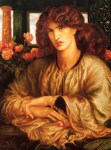

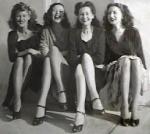
Shortly after Christine Rosamond’s overnight success, she gave full credit for her meteoric rise in the Art World. She told me I took the time to show her what I thought was good art in books I constantly took out from the library. After my near-death experience, I began to look for a spiritual vehicle for my artistic gifts, and found the Pre-Raphaelites, the Rossetti family in particular. I then had a vision that perhaps I and my three siblings could be another Rossetti family?
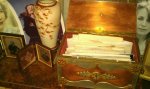
Art is forever a work in progress, as is our spiritual contact in the world. When Christine died there was an attempt to finalize this progress, and cash in. However, no one could author Rosamond’s Genesis, tell the world how she came to be one of the most printed artists in history. When I went to repair my relationship with my surviving sister, after one enters he home, there sit our mother’s jewelry box with the rose atop it. Within were Rosemary’s Treasures, her children, along with their laurels. There was much proof of how gifted I was, but, there was no evidence of Christine’s artistic destiny.
There are lies, like flies caught in the web, that give false testimony to the gifts Rosamond owned at an early age. These are the thorns that prevent one from grasping the Rose of the World, the greater design. Christine Rosamond would become her own model.
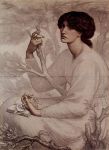
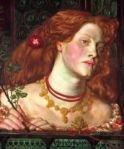
Above is a painting of Fair Rosamund, by Dante Gabriel Rossetti, whos father translated the Divine Comedy, that was a inspiration for the Rose of the World Prophecy.
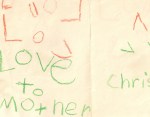
In Rosemary’s box was a card that Christine made for her mother who was born Rosemary Rosamond, the daughter of Mary Magdalene Rosamond. Here is the Genesis, the Signature Rose, that tells a Never Ending Tale.
Jon Presco
Copyright 2011
The Germ of Goblin Market
Posted on February 26, 2022 by Royal Rosamond Press
Juanita Miller brought the Pre-Raphaelites to Oakland, the City I was born in during a shower of stars.
John Presco
What I discovered was a pamphlet announcing Joaquin Miller Day. A musical drama was performed at the Woodminster Amphitheater on September 24, 1944. There was going to be the planting of memorial redwood trees around the equestrian statue of Joaquin Miller. On stage was a replica of the studio and garden used by Dante Gabriel Rossetti and Holman Hunt. The Poet, Christina Rossetti was played by Jeanne Jardin. Elizabeth Siddal Hunt’s model and muse is played by Helen Kraum. Carmencita Sanchez and her Mexican dancers, performed. In Scene Two we have the Bonaparte and Queen Victoria.
https://en.wikipedia.org/wiki/The_Germ_(periodical)
Menacing Beauty – Pre-Raphaelite Sisterhood (preraphaelitesisterhood.com)
Pre-Raphaelite Reflections – Page 2 – A blog devoted to the PRB (wordpress.com)
“TO THE ROSSETTIS”
Posted on April 3, 2014 by Royal Rosamond Press


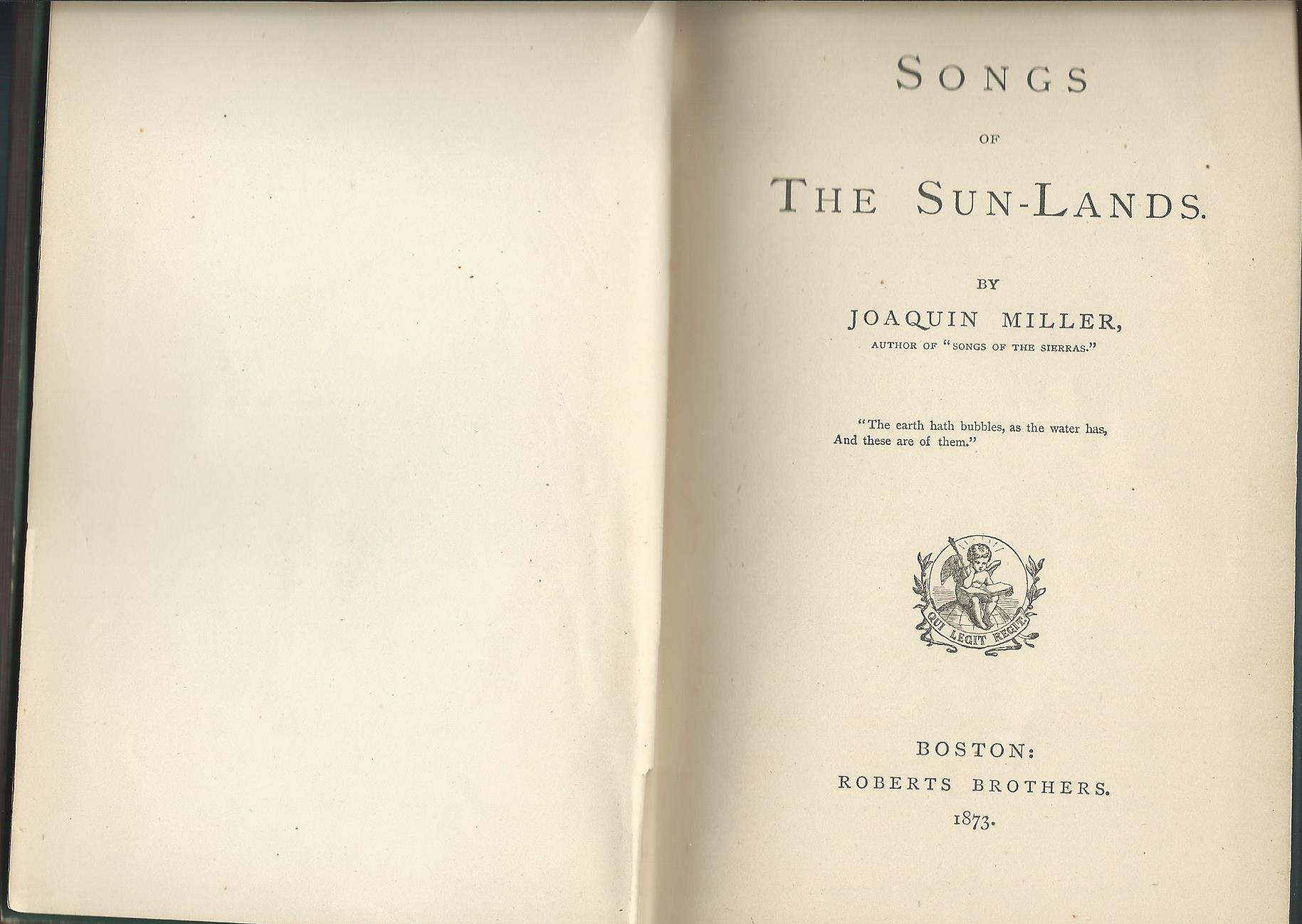


Yesterday I received in the mail a book I ordered on E-Bay. I quickly scanned it to see if their were any illustrations or photographs. Then, I found it, what amounts to my personal Holy Grail. Joaquin Miller dedicated his book of poems ‘Songs of The Sun-Land’ to the Rossetti family that includes Gariel, Michael, and, Christine. Gabriel was a artist and poet, Michael, a publisher, and Christine, a poet.
“TO THE ROSSETTIS”
There is controversy over this dedication. Michael is against it. He is critical of Miller’s poems that takes the reader to the Holy Land. Joaquin is describing a personal relationship with the Savior that reminds me of how Bohemians and Hippies would view Jesus, he a Nature Boy of sorts.
Gabriel, who had Joaquin over to his house for dinner, where he met several members of the Pre-Raphaelite Brotherhood seems to address his brother’s objections in a letter, and gives a tentative go ahead. He talks about Miller sending him a photograph of himself and bids him to say a word or two at the bottom of it, that does not exist. This photo may be the famous one taken by Charles Lutwidge Dodgson, who is better known as Lewis Carrol the author of ‘Alice in Wonderland’. If Joaquin had glued this portrait to a piece of paper, then we might have seen it on the dedication page.
What is going on here is extremely profound. Miller has exported his vision and lifestyle to the England, where he wrote Song of the Sierras, and now he is importing to America a cultural brand that contains Grail and Arthurian subject matter that was at the epicenter of the work of the Pre-Raphaelite Brotherhood.
The Rossettis may not have been too happy with Miller attaching himself to their star because the British are very protective of their culture. I wish I could say the same thing about the University of Oregon that is about to tear down homes that were once in the city limits of Fairmount, the city founded by Joaquin’s brother, George Miller.
The homes the Miller brothers lived in are registered and protected as Monuments. There is a Joaquin Miller State Park near Florence that was founded by George who also promoted the Winnemucca to the Sea Highway. There needs to be a Monument for George. I suggest the homes on Columbia Terrace be spared, and this city block declared a National Monument. I have suggested these homes be used to house homeless Vets going to college, but now I see a Free College on this site due to the student loan crisis.
This college will teach alternatives to prospective students of the UofO, such as having parents of students purchase a home in Eugene. In many cases a mortgage is cheaper than rent. Teaching your children how to get a job rather then attend college, will produce more home ownership that the UofO who promises jobs – that don’t exist!
The Miller Brothers were born on a farm near Coburg. They went into the world and achieved much. They are a cultural icon too Oregon and California. On page ten of the prelude, we read;
“By unnamed rivers of the Oregon north’
That roll dark-heaved into turbulent hills,
I have made my home….The Wild heart thrills
With memories fierce, and world storms forth.”
I once read that many college students didn’t know there was a Oregon, and if they did, they didn’t know where it is. The Rossettis more than likely read these words. Did they go to a globe to see where Joaquin and George live?
How many students at the UofO know who the Miller brothers were, and the Brotherhood.
Jon Presco
Copyright 2014
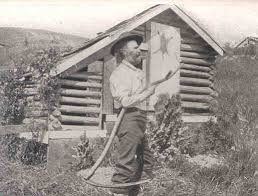
“When Joaquin Miller left DC, most sources agree that he gave his cabin to a friend, who in turn gave it to the Sierra Club. Then in 1913 the cabin was carefully disassembled at the urging of the California State Association and moved to its current location in Rock Creek Park, near the intersection of Beach Drive and Military Road, where it is now the property of the National Park Service. By and by, another Miller found inspiration in the cabin. From 1931 through the 1950’s, Pherne Miller, Joaquin’s niece, leased the cabin from the Parks Department, and there she gave art classes and sold soft drinks and candy.”


http://www.art.com/gallery/id–a82953-c23946/charles-lutwidge-dodgson-photography-prints.htm
Dante Gabriel Rossetti (/ˈdænti ˈɡeɪbriəl rəˈzɛti/;[1] 12 May 1828 – 9 April 1882) was an English poet, illustrator, painter and translator. He founded the Pre-Raphaelite Brotherhood in 1848 with William Holman Hunt and John Everett Millais, and was later to be the main inspiration for a second generation of artists and writers influenced by the movement, most notably William Morris and Edward Burne-Jones. His work also influenced the European Symbolists and was a major precursor of the Aesthetic movement.
William Morris and Joaquin Miller
Posted on August 1, 2018by Royal Rosamond Press

Joaquin Miller had dinner with the Pre-Raphaelites and was my grandmother’s friend. This history is being compiled for the grant I am applying for. The history of the Pre-Raphaelites has not been discarded, thus, Kehinde Wiley has no right to claim it and hand it out to NOBODIES who don’t deserve it! I don’t give a rat’s ass what the color of their skin is, and how badly they were oppressed. Let them work for their bragging rights. Just because Wyley thinks he has immortalized these non-artists, does not give them any titles. I will see to that.
Miller built a monument to my kin, John Fremont, the first Presidential Candidate for the Abolitionist Republican Party, and the first to emancipate slaves, forcing Lincoln’s hand.
Honoring The Visions of George Miller
Posted on May 30, 2016by Royal Rosamond Press


I will be going out to Coburg today to plant another flower at the grave of George Miller, the brother of Joaquin Miller, a honorary member of the Bohemian Club that was a place for Bay Area Journalists to gather and compare notes. If Miller lived in the Bay Area, then he too would be a honorary member.
http://www.findagrave.com/cgi-bin/fg.cgi?page=gr&GRid=29810634
Elizabeth Maude “Lischen” or “Lizzie” Cogswell married George Miller. Lizzie was the foremost literary woman in Oregon. On Feb. 6, 1897, Idaho Cogswell, married Feb. 6, 1897, Ira L. Campbell, who was editor, publisher and co-owner (with his brother John) of the Daily Eugene Guard newspaper. The Campbell Center is named after Ira.
The Wedding of John Cogswell to Mary Frances Gay, was the first recorded in Lane County where I registered my newspaper, Royal Rosamond Press. Idaho Campbell was a charter member of the Fortnightly Club that raised funds for the first Eugene Library.
George Melvin Miller was a frequent visitor to ‘The Hights’ his brothers visionary utopia where gathered famous artists and writers in the hills above my great grandfather’s farm. The Miller brothers promoted Arts and Literature, as well as Civic Celebrations. Joaquin’s contact with the Pre-Raphaelites in England, lent credence to the notion that George and Joaquin were Oregon’s Cultural Shamans, verses, he-men with big saw cutting down trees.
A year ago I received in the mail a book I ordered on E-Bay. I quickly scanned it to see if their were any illustrations or photographs. Then, I found it, what amounts to my personal Holy Grail. Joaquin Miller dedicated his book of poems ‘Songs of The Sun-Land’ to the Rossetti family that includes Gabriel, Michael, and, Christine. Gabriel was a artist and poet, Michael, a publisher, and Christine, a poet.
“TO THE ROSSETTIS”
Gabriel, who had Joaquin over to his house for dinner, where he met several members of the Pre-Raphaelite Brotherhood. Miller sends Michael a photograph of himself, and is sent a photo. This photo may be the famous one taken by Charles Lutwidge Dodgson, who is better known as Lewis Carrol the author of ‘Alice in Wonderland’. If Joaquin had glued this portrait to a piece of paper, then we might have seen it on the dedication page.
What is going on here is extremely profound. Miller has exported his vision and lifestyle to the England, where he wrote Song of the Sierras, and now he is importing to America a cultural brand that contains Grail and Arthurian subject matter that was at the epicenter of the work of the Pre-Raphaelite Brotherhood.
Lewis Carrol posed two children as Fair Rosamond and Queen Eleanore. I associate Fairmount with Rosamond. Johnnny Depp is starring in another Alice in Wonderland movie. Eugene can celebrate our Land of Make Believe, our White Rabbit made famous by the Jefferson Airplane. I stood before the Mayor of Eugene and suggested a Newspaper Museum at Kesey Square wherein is a model of Miller’s Fantastic Flying Machine. We could build a parade around this contraptions, a world contest that would bring creative people to our Fair City. Children would love this! They too would be in costume for the White Rabbit Run!
Here is what amounts to MY FANTASTIC MOVIE shot in Eugene. What an Amazing Journey is has been!
https://en.wikipedia.org/wiki/Bohemian_Club


Juanita Miller ‘The White Witch’
Posted on December 6, 2014by Royal Rosamond Press




Joaquin Miller, William Morris & Me
Posted on August 5, 2013by Royal Rosamond Press


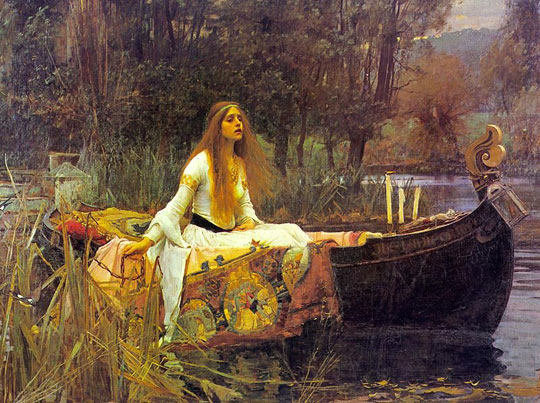

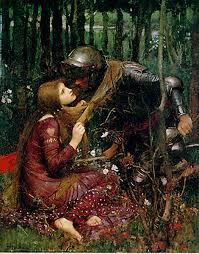


Christine Rosamond Benton and I were drawn into Tolkien’s Trilogy. The artist known as ‘Rosamond’ could not put these books down, nr could I. This caused our mutual friend, Keith Purvis, a British subject, to comment;
“She doesn’t know these books are real.”
We three were original hippies who took the Lord of the Rings to heart as we modified the modern world, made it over more to our liking, we oblivious to what normal folk were about. This is exactly what William Morris and the Pre-Raphaelite Brother and Sisterhood did. They – returned!
I discovered the Pre-Raphaelites in 1969 and let my hair grow long for the first time. I gave up drugs in 1967 and was looking for a spiritual format. I came under the spell of the Rossetti family who were friendly with Joaquin Miller. We Presco children knew Miller’s daughter as ‘The White Witch’ and we would call her for advice. Miller’s home ‘The Abbye’ was above our home in the Oakland Hills. Our kindred were friends of Miller, who was also a friend of Swineburn, who wrote ‘The Queen-Mother and Rosamund’ and ‘Rosamund Queen of Lombards. Tolkien was inspired by the Lombards.
Filed away in Rosamond’s probate is my plea to the executor to allow me to be my sister’s historian. I mention Miller and Rossetti. I saw myself in the role of Michael Rossetti who had his own publishing company. He published Miller and other famous poets. When I was twelve, my mother read evidence I might become a famous poet.
All my imput has been ruthlessly ignored, because petty un-creative minds have forced our families creative legacy down the tiny holes of their hidden agendas, into the mouths of worms and parasites, because these ignorant people sensed I and the real Art World, did not let them in the door – would never admit them into our circle, our ring of genius!
Jon Presco
Copyright 2011
William Morris had a major influence on J. R. R. Tolkien. As John Garth points out, unlike most authors traumatized by the experience of World War I, Tolkien did not “discard the old ways of writing, the classicism or medievalism championed by Lord Tennyson and William Morris. In his hands these traditions were reinvigorated so that they remain powerfully alive for readers today” (40). His love of Morris, in particular, goes back to his undergraduate days when he turned from studying the Greek and Latin classics to the the northern traditions — the language and literature of the Scandinavian and Germanic past. According Garth,
William Morris, from the late 1870s on, decided to “remedy” the defects of the real historical record by producing specific works of “pseudo-history,” fully-fleshed stories that he could present as “re-discovered” manuscripts of ancient tribal lore. So eager were the Germanic speakers of 19th century Europe to know more about their ancestors, that sometimes even academically trained scholars would be fooled by the books Morris wrote, and asked him for his sources, and wanted to read the original saga manuscripts themselves. To which requests Morris replied “Doesn’t the fool realize, that it’s a romance, a work of fiction — that it’s all lies!” (from May Morris, daughter of W. Morris recollections).
JRRT, a generation later than Morris, got in on the tail end of this nationalistic/ romantic period, and became as fully enmeshed in its allures as Morris. Tolkien went on to “sub-create” his own “pseudo-histories,” manufacturing his versions of the source myths that would allow a richer understanding of the Nordic tradition, especially the Anglo-Saxon phenomena of England. Between them, as much by accident as firm intent, Morris and Tolkien established an entire genre of pseudo-history that has, by now in the 21st century, become one of the most popular fields of literature.
“These two men knew either much (Morris) or most (Tolkien) of all that was known about these [northern] people and their lives. They used that wealth of knowledge to create ‘dreamed realities’ (Morris) or an ‘imaginary history’ (Tolkien) about what it might have been like to live in those days. While what they wrote wasn’t necessarily true in a strict sense, both knew enough about the past and were talented enough as writers that what they wrote created a strong sense that they described what might have been.” ( Michael W. Perry, More to William Morris, p. 7, 2003)
So, the question then becomes, for Tolkien readers, how does Morris stand up to JRRT? Is it worth the money to buy Morris’s books? Will I get the same, or at least a very similar thrill from reading them as I get when running through the pages of LotR and The Hobbit? Well, that’s what I am trying to decide in the next few installments of this topic. How do the works of the two authors compare, in what ways are they similar, in what ways do they differ?
http://tolkiensring.proboards.com/index.cgi?board=authors&action=display&thread=675
Joaquin Miller looked me up at Somerset House, and left with me
the remaining proofs of his forthcoming volume. He showed me the dedication, ‘To the Rossettis.’ I strongly recommended him to write direct to Gabriel as to the matter before anything further is done. I mentioned the dedication to Christina. She feels some hesitation in sanctioning it, not knowing what the book may contain. If she makes up her mind to object, she is to write to Miller. I looked through the proofs and noted down some remarks on them. They include a series of poems about Christ, named Olive Leaves, implying a sort of religious, or at least personal, enthusiasm, mixed up with a good deal that has more relation to a sense of the picturesque than of the devotional. These poems, though far from worthless from their own point of view, are very defective, and would, I think be highly obnoxious to many readers and Reviewers. I have suggested to Miller the expediency of omitting them altogether. – Christina, I find, has already read these particular poems, and to some considerable extent likes them, which is so far in their favour as affecting religious readers”
The wider world of Victorian London is present: Turgenev comes to dinner, Browning sends his new volumes, Swinburne arrives drunk, and the American poet and adventurer Joaquin Miller makes himself known to the Rossetti circle. Nine appendices include five devoted to Poems and one to the Fleshly School controversy.
Joaquin Miller Cabin is located in Washington, DC. The Hights, the Oakland home Miller built at the end of his life, is currently known as the Joaquin Miller House and is part of Joaquin Miller Park. He planted the surrounding trees and he personally built, on the eminence to the north, his own funeral pyre and monuments dedicated to Moses, General John C. Frémont, and the poets Robert Browning and Elizabeth Barrett Browning. The Japanese poet Yone Noguchi began his literary career while living in the cabin adjoining Millers’ during the latter half of the 1890s. The Hights was purchased by the city of Oakland in 1919 and can be found in Joaquin Miller Park.[42] It is now a designated California Historical Landmark.
Miller went to England, where he was celebrated as a frontier oddity. There, in May 1871, Miller published Songs of the Sierras, the book which finalized his nickname as the “Poet of the Sierras”.[22] It was well-received by the British press and members of the Pre-Raphaelite Brotherhood, particularly Dante Gabriel Rossetti and William Michael Rossetti.
While in England, he was one of the few Americans invited into the Savage Club along with Julian Hawthorne, son of Nathaniel Hawthorne. The younger Hawthorne referred to Miller as “a licensed libertine” but admitted him “charming, amiable, and harmless”.[
The Savage Club was formed to supply the want which Dr Samuel Johnson and his friends experienced when they founded the Literary Club. A little band of authors, journalists and artists felt the need of a place of reunion where, in their hours of leisure, they might gather together and enjoy each other’s society, apart from the publicity of that which was known in Johnson’s time as the coffee house, and equally apart from the chilling splendour of the modern club.
At present, there are 315 members. The club maintains a tradition of fortnightly dinners for members and their guests, always followed by entertainment. These dinners often feature a variety of famous performers from music hall to concert hall. Several times a year members invite ladies to share both the dinner and the entertainment — sometimes as performers. On these occasions guests always include widows of former Savages, who are known as Rosemaries (after rosemary, a symbol of remembrance).
Born in London, he was a son of immigrant Italian scholar Gabriele Rossetti, and the brother of Maria Francesca Rossetti, Dante Gabriel Rossetti and Christina Georgina Rossetti.
He was one of the seven founder members of the Pre-Raphaelite Brotherhood in 1848, and became the movement’s unofficial organizer and bibliographer. He edited the Brotherhood’s literary magazine The Germ which published four issues in 1850 and wrote the poetry reviews for it.
It was William Michael Rossetti who recorded the aims of the Pre-Raphaelite Brotherhood at their founding meeting in September 1848:
1. To have genuine ideas to express;
2. To study nature attentively, so as to know how to express them;
3. To sympathize with what is direct and serious and heartfelt in previous art, to the exclusion of what is conventional and self-parading and learned by rote;
4. And most indispensable of all, to produce thoroughly good pictures and statues.
Although Rossetti worked full time as a civil servant, he maintained a prolific output of criticism and biography across a range of interests from Algernon Swinburne to James McNeill Whistler. He edited the diaries of his maternal uncle John William Polidori (author of The Vampyre and physician to Lord Byron), a comprehensive biography of D. G. Rossetti, and edited the collected works of D. G. Rossetti and Christina Rossetti.
Rossetti edited the first British edition of the poetry of Walt Whitman, which was published in 1868; however, this edition was bowdlerized.[1] Anne Gilchrist, who became one of the first to write about Whitman, first read his poetry from Rossetti’s edition, and Rossetti helped initiate their correspondence.[2]
In 1874 he married Lucy Madox Brown, daughter of the painter Ford Madox Brown. They honeymooned in France and Italy. Their first child, Olivia Frances Madox, was born in September 1875, and her birth was celebrated in an ode of Swinburne.
William Michael Rosetti was a major contributor to the 1911 edition of the Encyclopædia Britannica; his contributions on artistic subjects were criticised by many reviewers at the time and since, as showing little evidence of having absorbed the mounting body of work by academic art historians, mostly writing in German.
 Rosamond Press

Leave a comment