
Noa Argamani.via Facebook
Here is a film about Noa who was taken hostage. I will analyze what I see. Concentrate on the belief the IDF knew what was happening, and was on their way. Having seen them in action, there was no need to panic, or run. How long were they hiding?
Take note of the unarmed men who came in after armed Hamas men eliminated all resistance. How did they find out about the attack? Did returning Hamas tell them Israel was wide open – and IDF was not responding? Is it possible IDF thought this was another false alarm?
John
“
“The key would be to move equipment into position over a period of weeks beforehand, and then put it into buildings or under tarps,” said Michael E. O’Hanlon, a senior fellow at the Brookings Institution. He noted that many of the vehicles could have been hidden in plain sight in parking lots or construction zones.
Still, “The idea of a bull dozer getting that close to the fence at all just boggles the mind,” Levitt said.”
In a photo sent to a friend at 7:46 a.m., about an hour after Hamas began its attack, Argamani, a data science engineering student, can be seen smiling and making a peace sign, reassuring worried friends.
may have been taken by another group of men who followed trained Hamas fighters out of the blockaded Palestinian enclave into Israel.
3 miles from the border with Gaza.
At 8:10 a.m., Argamani messaged a different friend, saying she was in a parking lot and “can’t get out.” Her friend warned her to “hide,” adding: “Let me know that everything is o.k.”
The last message he sent his friend was delivered at 10:19 a.m., thanking them for letting him know that authorities were either at the festival site or on the way.
https://www.nbcnews.com/news/world/noa-argamani-israel-hamas-hostages-nova-music-festival-rcna129792 ‘
Noa Argamani became the face of the Nova music festival hostages
More than two months after she was taken hostage, friends and family are growing more desperate to know her fate, and why she hasn’t been freed alongside dozens of others.
Dec. 19, 2023, 3:12 AM PST
By Raf Sanchez, Chantal Da Silva and Shira Pinson
BE’ER SHEVA, Israel — The video of her kidnapping has been seen around the world.
A hand outstretched, terror etched on her face, screaming as she is carried away on the back of a motorcycle, the roughly 10-second clip became an instant symbol of Israel’s hostage crisis.
But more than two months after Noa Argamani was abducted from the Supernova, or Nova, music festival during the Oct. 7 terrorist attack, she remains a captive in Gaza. Even as other young civilian women were released during a weeklong ceasefire in November, there has been no sign of Argamani.
NBC News has uncovered information indicating she may not have been kidnapped by Hamas, but was instead most likely abducted by a mob of Gazans that swept into Israel hours after the initial attack. That may explain why she was not released during the November cease-fire: Hamas may not be holding her, or even know where she is.
Argamani is among 14 female civilians who have yet to be released by their captors. More than two months after she was taken hostage, friends and family are growing more desperate to know her fate, and why she hasn’t been freed alongside about 100 others.
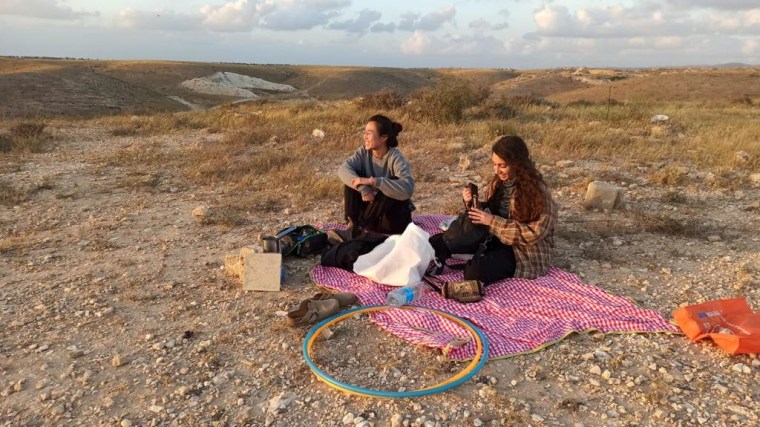
“When you see someone you love so much and a person that is so close to you in this situation, you just get crazy,” Amir Moadi, 29, a roommate and friend of Argamani’s, said in an interview. “Because there’s nothing you can do.”
While it’s known Hamas terrorists took hostages during the attack, who took Argamani is less clear, according to text messages, phone records, satellite images and human sources, as well as an NBC News analysis of the sun’s position during her abduction. The information indicates that she may not have been seized by Hamas militants at all, and instead may have been taken by another group of men who followed trained Hamas fighters out of the blockaded Palestinian enclave into Israel.
Moadi realized Argamani had been taken from the Nova music festival near Re’im when he saw the video that sent shockwaves around the world. He watched the footage of his close friend being driven away and reaching out toward her boyfriend, Avinatan Or, as their assailants marched him behind her. Israeli officials say that as many as 350 people were killed at the festival.
A second video posted to social media on Oct. 7 showed Argamani, who turned 26 in captivity, sitting on a sofa drinking from a water bottle. Two people with bare feet could be seen walking behind her. It gave some of her friends hope she was OK.
“It’s crazy to say, but … I was thankful that she’s not dead because I saw other videos and I saw what happened to other people,” Moadi said.
For Argamani’s loved ones, efforts to free her feel like a race against time because her mother, Liora, has terminal brain cancer, Moadi said. They are desperate to know why she wasn’t among those exchanged in an extended hostage-prisoner swap before talks between Israel and Hamas collapsed on Dec. 1.
‘Can’t get out’
As news of Hamas’ attack — in which 1,200 people were killed and 240 taken hostage, according to Israeli officials — spread throughout Israel early on Oct. 7, Argamani and Or’s loved ones began to worry for their safety. They knew they were around 3 miles from the border with Gaza.
A flurry of text messages reviewed by NBC News reveals the couple’s and their friends’ mounting panic.
In a photo sent to a friend at 7:46 a.m., about an hour after Hamas began its attack, Argamani, a data science engineering student, can be seen smiling and making a peace sign, reassuring worried friends. The photo was sent by another friend who had attended the festival — Ori Tchernichovsky, 29, who would later be killed.
At some point before his death, friends said Tchernichovsky’s phone history revealed he had a roughly 7-minute call with Argamani, but it is unclear what was said. Tchernichovsky’s friends learned about the call when his phone was returned to his family after he was found dead.
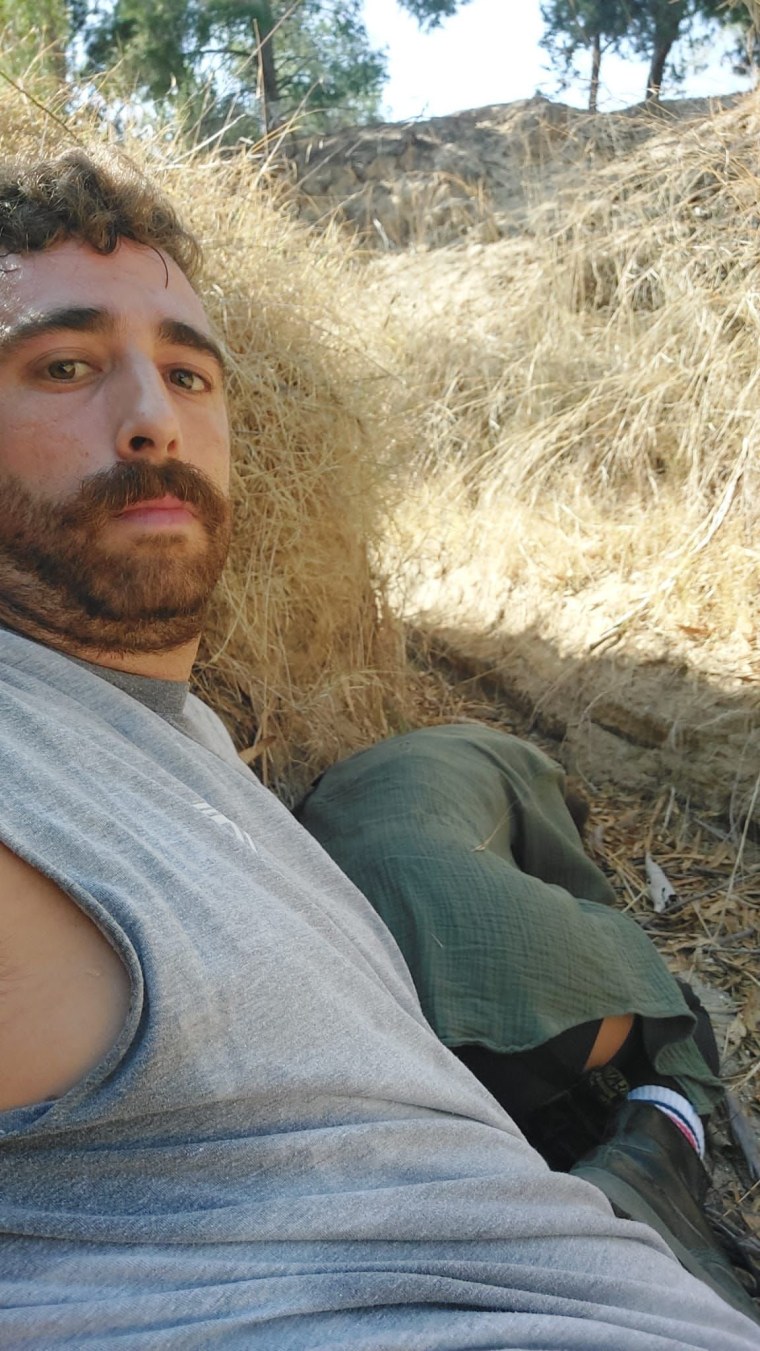
At 8:10 a.m., Argamani messaged a different friend, saying she was in a parking lot and “can’t get out.” Her friend warned her to “hide,” adding: “Let me know that everything is o.k.”
At 9:08 a.m., Argamani sent that friend a live location, saying she hoped “somebody will come and save us.”
Or, Argamani’s boyfriend, sent a selfie to another friend at 9:24 a.m., fear written on his face. Argamani lies huddled in the fetal position in front of him as they hide from their attackers. “It’s crazy here,” he messaged.
At 9:32 a.m., Or told his friend there were around 20 people looking for anyone hiding so they could “lynch them.” Later, he said the attackers were finding people and killing them one by one.
The last message he sent his friend was delivered at 10:19 a.m., thanking them for letting him know that authorities were either at the festival site or on the way.
The last message NBC News has seen sent by Argamani was delivered at 10:27 a.m., after a friend told her she heard others had been able to escape the festival site in a vehicle. “We don’t have a car,” Argamani said.
Or’s friend, Dolev Kikos, 27, said his messages were going through as of 10:43 a.m. But they appeared undelivered shortly after, suggesting Or’s phone was either dead or turned off.
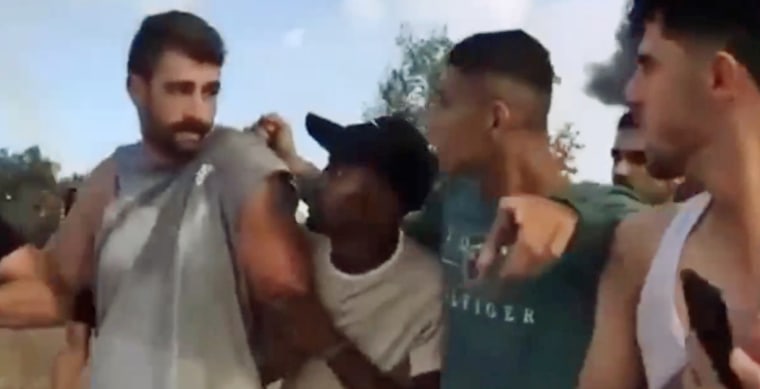
The analysis of the sun and shadows that appear in the video of the couple’s capture suggests that Or and Argamani were most likely kidnapped several hours into the attack and closer to midday than sunrise, when the attack began.
Holding out hope
Argamani’s friends said they felt hopeful last month when a deal to free hostages in Gaza amid a cease-fire was repeatedly extended. More than 100 people were released over seven days. But on Dec. 1, their hopes were shattered when the truce fell apart.
“She just slipped from the fingers,” Yan Gorjaltsan, a close friend of Argamani’s told NBC News.

Survivors of the Hamas attack on the Nova festival find healing at workshops
NOV. 20, 202301:14
“Every one of us imagined her back home,” Gorjaltsan, 27, told NBC News as he sat with a group of friends in one of Argamani’s favorite places in her hometown of Be’er Sheva — a sandy hill overlooking the Negev desert where she would often go alone to find peace or unwind.
“We saw her with us again,” he said.
The cease-fire also brought hope to Argamani’s mother and father, Yaacov Argamani, who were desperate to see their only child reunited with Liora, whose condition continues to deteriorate.
By the time the cease-fire fell apart, the number of hostages held in Gaza had fallen from 240 to less than 140. Of those, the majority are men who were never part of the hostage deal, as well as at least 19 women, 14 of whom are civilians.
Sponsored Stories
THE NEW YORK TIMESYour interests, covered by experts. Save now.
BESTSTORIESInternet’s Useless Yet Captivating Facts The World Needs to Know
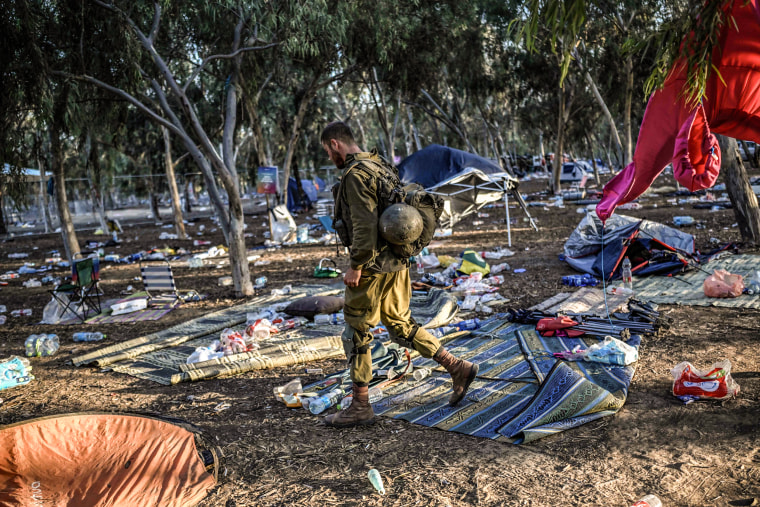
The U.S. and Israel have said it was Hamas’ refusal to release those women that led to the collapse of the cease-fire. Hamas has, in turn, blamed Israel, saying it refused “to accept all offers to release other detainees.”
NBC News asked Mark Regev, senior adviser to Prime Minister Benjamin Netanyahu, why Hamas may have reneged on the deal. He suggested one reason could have to do with the ages of some of the women who were expected to be released.
Military service is mandatory for most Israelis when they turn 18. “I think Hamas has a position, yes, that anyone who’s in the age, young, that they’re automatically soldiers even though they were clearly civilians when they were taken hostage,” Regev said.
State Department spokesperson Matthew Miller suggested a more bleak possibility on Dec. 4, days after the truce collapsed, saying Hamas doesn’t “want those women to be able to talk about what happened to them during their time in custody.
“Every day there’s more evidence of what Hamas did,” he said, referring to recent reports of mounting evidence of sexual violence and rape during the group’s Oct. 7 attack. “No one can have any illusions about who we’re dealing with.”
Hamas has denied accusations of sexual violence.
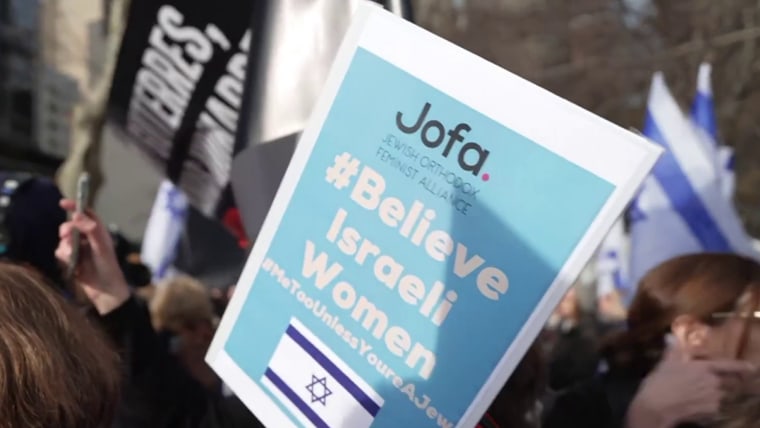
Sexual abuse committed by Hamas are ‘among the most egregious acts that can occur in wartime’
DEC. 5, 202305:38
A third possibility is that Hamas does not have Argamani in its captivity at all. NBC News gathered information indicating that she may have been taken by a group who crossed the border into Israel after Hamas stormed through.
Two Israeli military officials said that the first wave of the attack that morning on the festival appeared to have been carried out by members of the Nukhba Force, an elite Hamas commando unit. But as the hours passed, the sources said, other people, possibly including criminal elements, also entered the festival site.
One of the officials pointed out that none of the captors seen in the video of Argamani and Or’s kidnapping appear to be armed or wearing tactical vests, suggesting they are unlikely to be Nukhba members. At least one member of the group also appears to be young.

The analysis of the sun and shadow appearing in the images of the kidnapping also suggests it occurred in the late morning, hours after the Nukhba Force launched the attack.
A fourth possibility is one that Argamani’s friends and family don’t want to imagine.
Hamas has claimed throughout the war that hostages have been killed amid Israel’s offensive in Gaza.
On Friday, Israel announced it had mistakenly killed three Israeli hostages who were carrying a white flag, with at least one person shouting out in Hebrew.
Some of the hostages who have been released by Hamas have described hearing the sounds of heavy bombardment around them amid Israel’s offensive.
On Dec. 10, the Israeli government released a list of 20 hostages it said had died while being held captive by Hamas, including Shani Louk, a 23-year-old who attended the Supernova music festival.

In the days since, other names have been added to the list of those who have died in Gaza, including Alon Shamriz, Yotam Haim and Samer Talalka, who the IDF said were mistakenly killed by its own forces during their Gaza offensive.
With Argamani and Or absent from that list, their friends say they are still holding out hope for their safe return.
“This is very difficult,” Noa Stern, one of Aragamani’s friends, told NBC News. “Because you want to stay with hope.”
“But you don’t know anything.”
How Hamas breached Israel’s ‘Iron Wall’
By Samuel Granados,
Cate Brown and
October 10, 2023 at 5:00 a.m. EDT
Listen
3 min
Share
Comment2744Add to your saved stories
Save
The massive, complexattack on Israel on Saturday by militants from Gaza Strip stunned Israelis, who watched in horroras fighters easily bypassed one of the world’s most advanced security systems.
At least 900 people have been killed in Israel and more than 2,600 wounded. More than 100 people have been taken captive. Israel has pounded Gaza with airstrikes, killing at least 680 people, according to Palestinian authorities.
The“smart fence” that separates Israel from Gaza is equipped with cutting-edge technology, designed to detect any security breach. This is how the militants got through.
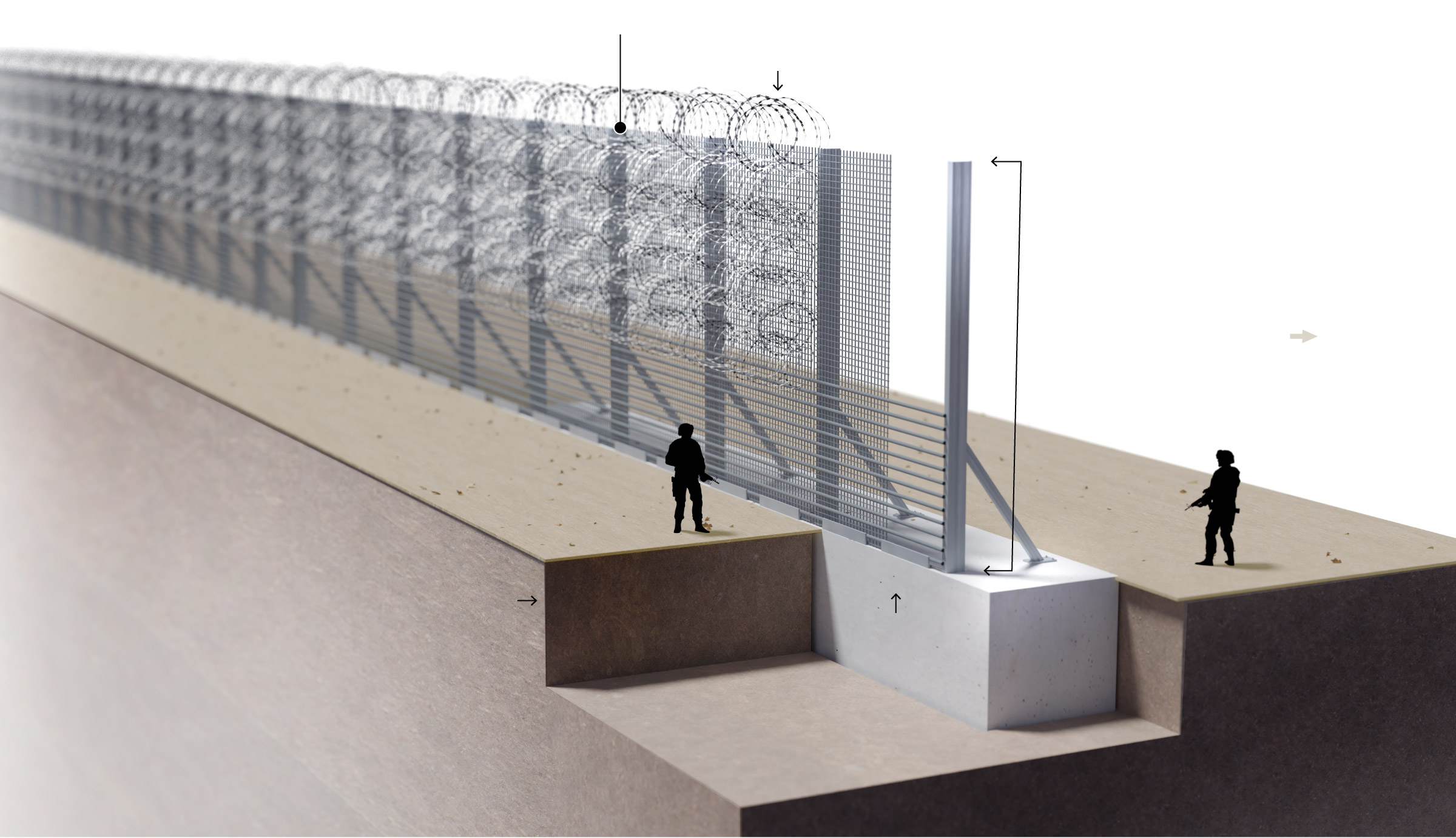
In 2021 Israel announced the completion of its “smart fence,” a 40-mile-long barricade along the Gaza Strip that included an underground concrete barrier.
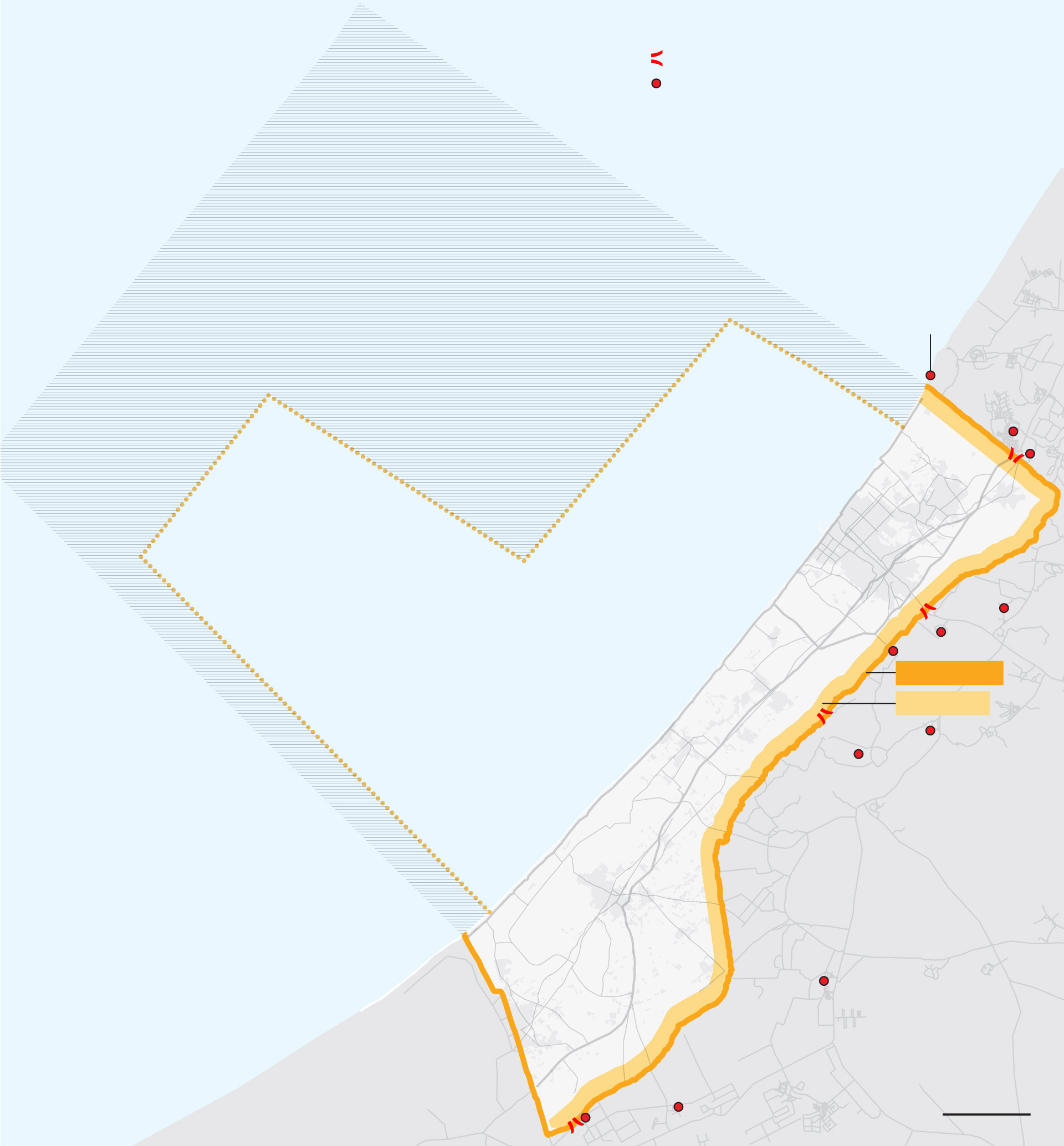
The project was publicly announced in 2016 after Hamas used underground tunnels to attack Israeli forces in the 2014 war. It required more than 140,000 tons of iron and steel, according to Reuters, and the installation of hundreds of cameras, radars and sensors. Access near the fence on the Gaza side was limited to farmers on foot. On the Israeli side, observation towers and sand dunes were put in place to monitor threats and slow intruders.
In 2021, then-Defense Minister Benny Gantz said the barrier placed an “iron wall” between Hamas and southern Israel.

But on Saturday, a surprise series of coordinated efforts enabled Hamas to get past the wall. The fence was breached at 29 points, according to the Israel Defense Forces. Though there wereIsraeli guard towers positioned every 500 feet along the perimeter of the wall at some points, the fighters appeared to encounter little resistance.
The border was minimally staffed, it soon became apparent,with much of Israel’s military diverted to focus on unrest in the West Bank.
“The most compelling parts of the system were the ones that provided indicators and warnings,” said Matthew Levitt, director of the counterterrorism program at the Washington Institute for Near East Policy. “But once you don’t see in advance that someone is massed at the fence, it’s still just a fence. A big fence, but just a fence.”
1.
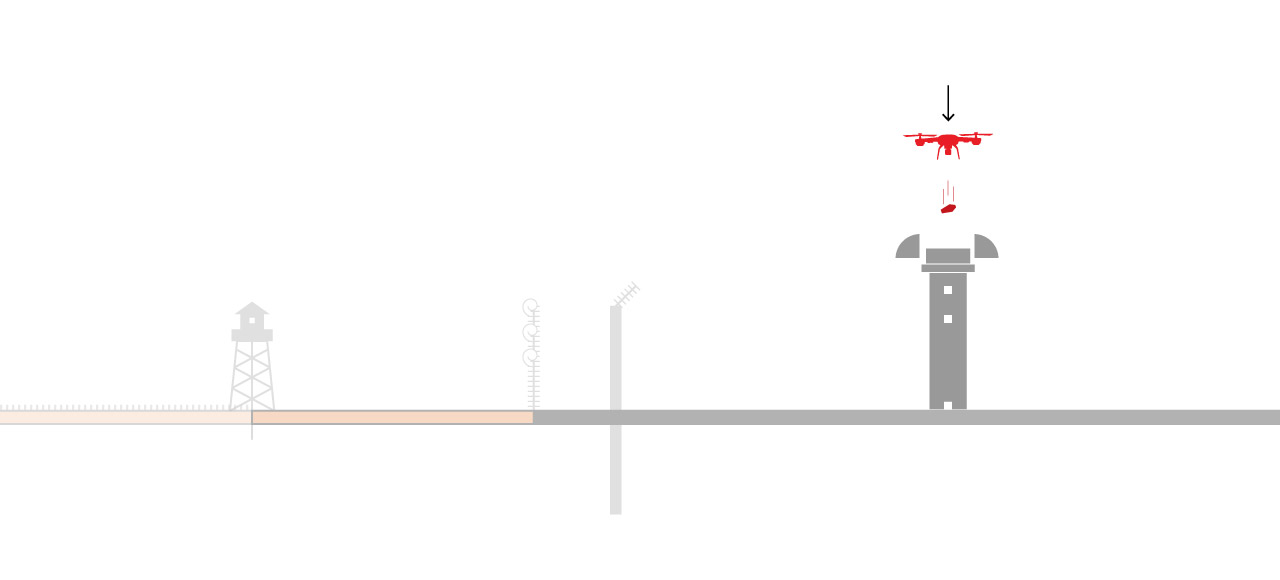
Drones dropped explosives
Using commercial drones, Hamas bombed Israeli observation towers, communications infrastructure and weapons systems along the border.
2.
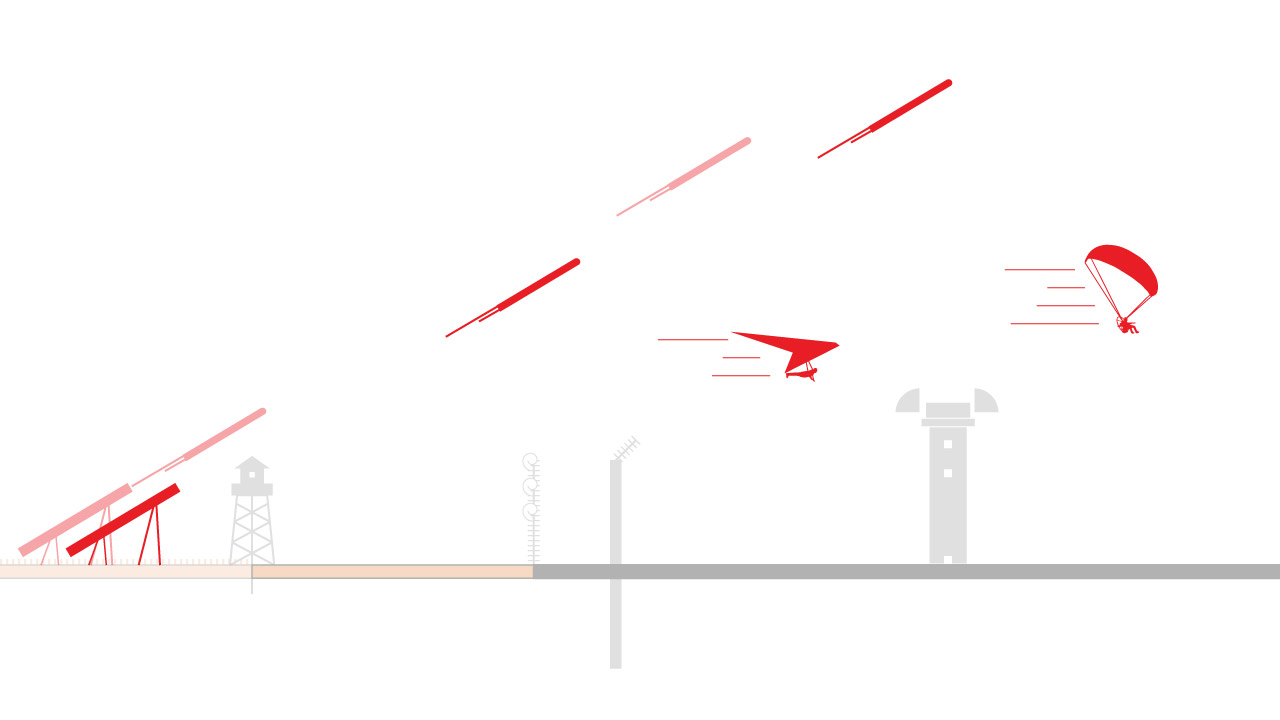
Coordinated rocket fire and man power
Israel said Hamas fired more than 3,000 rockets into the country, with some reaching as far as Tel Aviv and Jerusalem. Militants on fan-powered hang gliders flew across the border.
3.
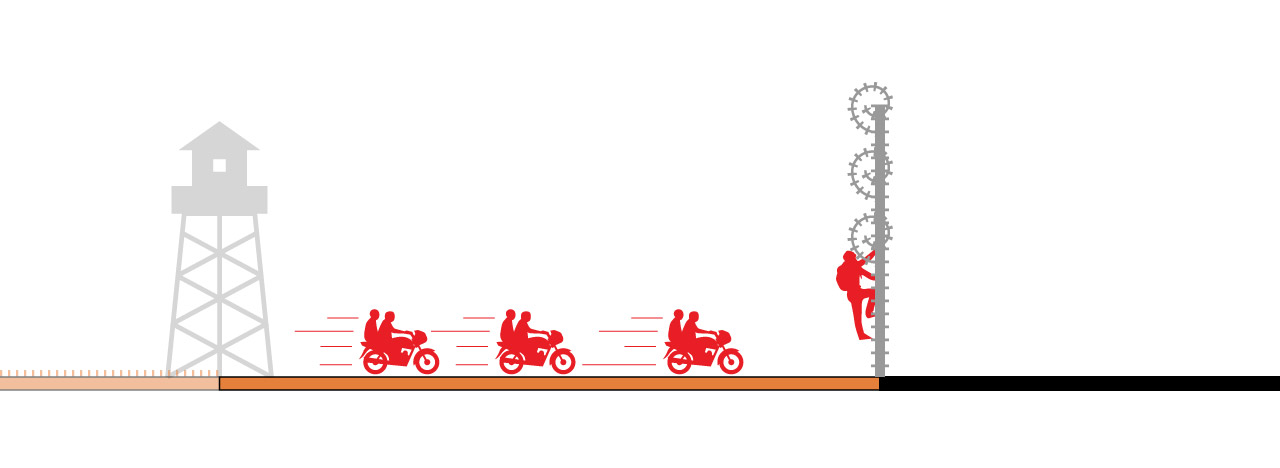
Explosives along the fence
Militants also used explosives to blow up sections of the barrier. Men on motorbikes drove through the gaps.
Fence
GAZA
ISRAEL
4.
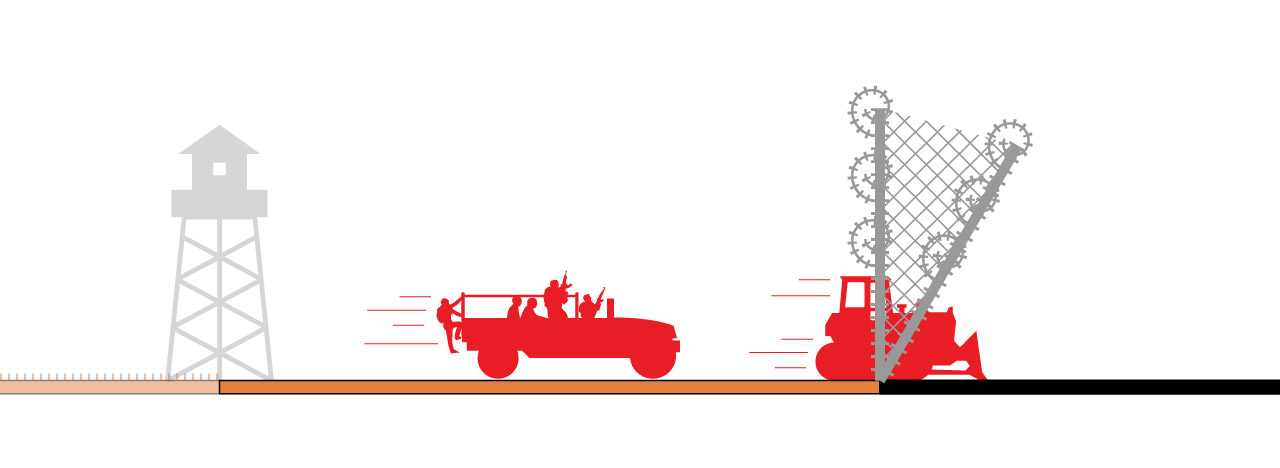
Widening the gap
Bulldozers did the rest, allowing enough space for larger vehicles to drive through.
Fence
GAZA
ISRAEL
Experts said the attack would have required weeks, at least, of preparation and subterfuge.
Share this articleShare
“The key would be to move equipment into position over a period of weeks beforehand, and then put it into buildings or under tarps,” said Michael E. O’Hanlon, a senior fellow at the Brookings Institution. He noted that many of the vehicles could have been hidden in plain sight in parking lots or construction zones.
Still, “The idea of a bull dozer getting that close to the fence at all just boggles the mind,” Levitt said.
Map data sourced from United Nations Office for the Coordination of Humanitarian Affairs.
 Rosamond Press
Leave a comment