Code of Jeanne (John) de Rougemont
Posted on February 13, 2020 by Royal Rosamond Press

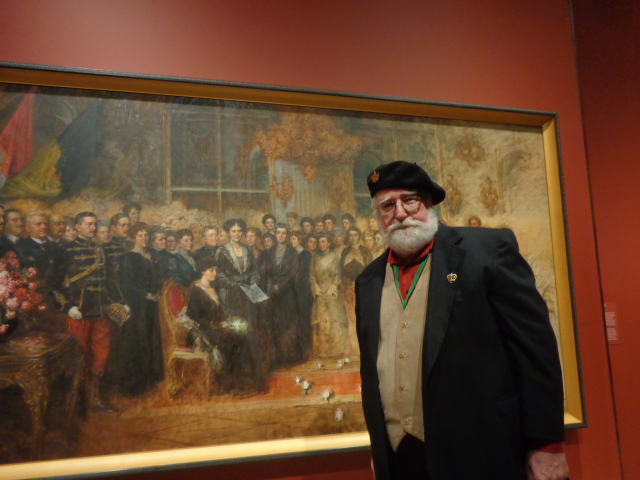
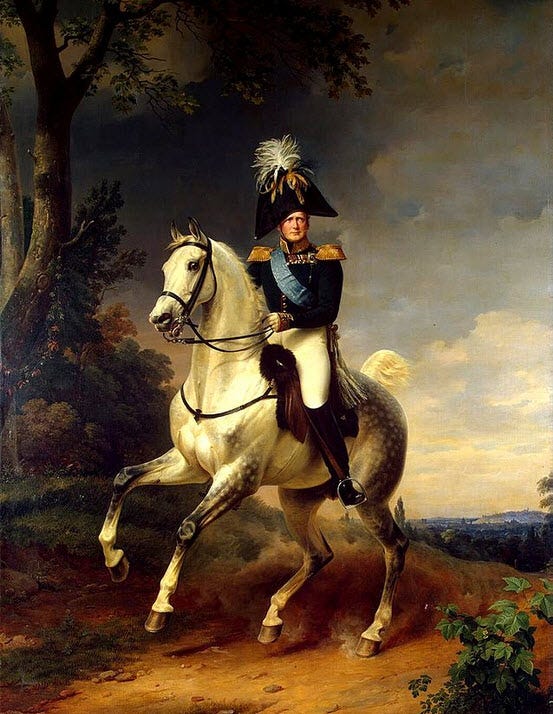
Tsar Alexander I of Russia

Marie Antoinette with her two eldest children, Marie-Thérèse Charlotte and the Dauphin Louis Joseph, in the gardens of the Petit Trianon (portrait by Adolf Ulrik Wertmüller, 1785)

Coronation of the Archduke Joseph as King of the Romans in the Imperial Cathedral of Saint Bartholomew in Frankfurt, 3 April 1764
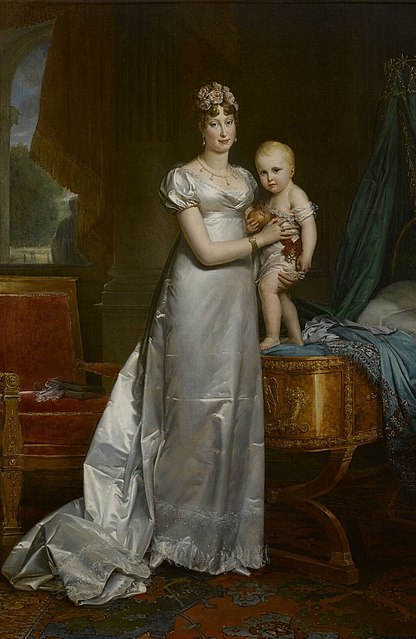
Last night I discovered Napoleon deliberately married a member of the Habsburg to make sure he had a legitimate, highly prized, heir to his throne. He married the cousin of Marie Antionette and she bore Napoleon 2. He was given the title ‘King of Rome. The Hapsburg owned the title ‘King of Romans. This is the greatest usurpation – of all time! There is not an ounce of royal blood in Napoleons veins, yet with the birth of his son – he is now related to many royal houses! How many men have held the title ‘King of Romans. Consider…..The Antichrist! Russians called Napoleon – The Antichrist!
Two days ago I discovered a Knight Templar in Virginia Hambley’s tree. Jacques de Maillé died a heroic death in the Holy Land where much death and atrocities are taking place. I met Virginia in 1998 while studying the book ‘Holy Blood, Holy Grail. The authors of this book sued Dan Brown. I was battling Ian Sinclair on a yahoo-group. He got me banned from a Templar group after posting on Jean Rougemont, the Queen Mother of all the Habsburgs – and my possible ancestor! Two years ago I discovered I am related to Karl Schwarzenberg who I sent an e-mail informing him of the Last Audience of the Hapsburg painting. He and Austria do not want this painting. I declared myself the heir to the Hapsburg Empire that fled to America. On this day, November 23, 2023, (Thanksgiving) I claim the Bonaparte-Habsburg linage – that also came to America. This is the greatest genealogical coup – known to man!
The opening scene of Napoleon depicts the beheading on Marie Antionette. The closing scene shows the Emperor of France, with his son. It is now clear to me, Napoleon saw the French Revolution – THROW AWAY their royalty – and the their connection to royal houses of other nations. This royalty was there for the taking – if you could raise a powerful and effective army. I declare that army..
The Imperial Army of the Antichrist
The de Maillé family – helped defeat the army of The Great Pretender!
On Thanksgiving Day I found an account of Prince Jerome’s tour of the United States, and his meeting of John Fremont in St. Louis. Prince Bonaparte was very interested in the account of Count Leonetta Cipriani going from St. Louis with a wagon train and a herd of cattle. It appears Cipriani prepared the way for the Prince, and his wife, Princess Clotilde of Savoy. Scroll down for the mazing encounter with Fremont, who brought guns with him from France when the Civil War broker out. Prince Jerome meets Lincoln and many American Generals. Is he a secret agent for Napoleon 3?
General Grant had it out for the Habsburgs in Mexico, and may have been aware of, or, an instigator of this idea..
“Historian James McPherson notes in Battle Cry of Freedom that Francis P. Blair, Sr., a former member of Andrew Jackson’s presidential administration, concocted a scheme to stop the American Civil War and unite Union and Confederate forces to overthrow the French from Mexico. Although intriguing, President Lincoln did not give the plan much thought and wished to win the war against the Confederacy first
John Presco ‘King of Romans’
Copyright 2023
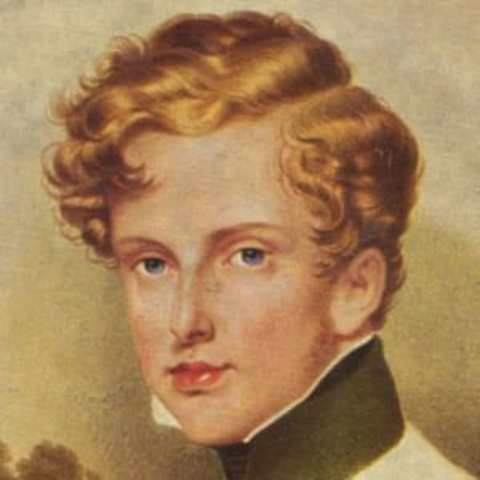
Napoleon II (Napoléon François Joseph Charles Bonaparte; 20 March 1811 – 22 July 1832) was the disputed Emperor of the French for a few weeks in 1815. The son of Emperor Napoleon I and Marie Louise of Austria, he had been Prince Imperial of France and King of Rome since birth. After the fall of his father, he lived the rest of his life in Vienna and was known in the Austrian court as Franz, Duke of Reichstadt for his adult life (from the German version of his second given name, along with a title he was granted by the Austrian emperor in 1818). He was posthumously given the nickname L’Aiglon (“the Eaglet”) after the popular Edmond Rostand play, L’Aiglon.
| Napoleon II | |
|---|---|
| King of Rome Duke of Reichstadt Prince of Parma | |
| Portrait by Leopold Bucher, 1832 | |
| Emperor of the French (more…) (disputed) | |
| Reign | 4 April – 2 May 181422 June – 7 July 1815 |
| Predecessor | Napoleon I |
| Successor | Napoleon III (1852; as Emperor) Louis XVIII (as King of France) |
| Regent | Joseph Fouché |
| Born | 20 March 1811 Tuileries Palace, Paris, French Empire |
| Died | 22 July 1832 (aged 21) Schönbrunn Palace, Vienna, Austrian Empire |
| Burial | Napoleon’s tomb, Les Invalides |
| NamesFrench: Napoléon François Charles Joseph Bonaparte | |
| House | Bonaparte |
| Father | Napoleon I, Emperor of the French |
| Mother | Marie Louise, Duchess of Parma |
| Religion | Roman Catholicism |
| Signature | |
When Napoleon I tried to abdicate on 4 April 1814, he said that his son would rule as emperor. However, the coalition victors refused to acknowledge his son as successor, and Napoleon I was forced to abdicate unconditionally some days later. Although Napoleon II never actually ruled France, he was briefly the titular Emperor of the French after the second fall of his father. He lived most of his life in Vienna and died of tuberculosis at the age of 21.
His cousin, Louis-Napoléon Bonaparte, founded the Second French Empire in 1852 and ruled as Emperor Napoleon III.
The war between Russia and France in 1812 was far more than a military conflict. At the core of this invasion by the French was a deep spiritual battle in which the Christian nation of Russia was under siege by the godless French led by the Emperor Napoleon Bonaparte. Because of many signs, there was widespread belief among the people in Russia that Napoleon was the antichrist, and a deep conviction that they were living in the last days. These events brought about a revival that swept throughout Russia, as the country sought help from God in the face of this existential threat.
https://en.wikipedia.org/wiki/King_of_the_Romans
Joseph II (German: Josef Benedikt Anton Michael Adam; English: Joseph Benedict Anthony Michael Adam; 13 March 1741 – 20 February 1790) was Holy Roman Emperor from 18 August 1765 and sole ruler of the Habsburg monarchy from 29 November 1780 until his death. He was the eldest son of Empress Maria Theresa and her husband, Emperor Francis I, and the brother of Marie Antoinette, Leopold II, Maria Carolina of Austria and Maria Amalia, Duchess of Parma. He was thus the first ruler in the Austrian dominions of the union of the Houses of Habsburg and Lorraine, styled Habsburg-Lorraine.
https://en.wikipedia.org/wiki/Antichrist
In verse 44, Daniel reveals this stone as the Kingdom of God. It will develop into a global kingdom of righteousness that will come immediately following the destruction of the Roman Empire. Daniel also says that God’s kingdom will come “in the days of these kings.”
What kings? The only king mentioned in Daniel 2 is King Nebuchadnezzar. Daniel, however, is referring to kings. These kings are represented by the ten toes of Nebuchadnezzar’s image. Read verses 42 and 43.
With Satan pulling out all stops, significant geopolitical shifting will occur. Europe will become the center of a comprehensive and intentional resurrection of the old Roman Empire. A one-world government will form, divided up into ten regions.
As the Antichrist conquers through deceptive peace, it is probable that other Western powers such as the United States, mortally weakened by the Rapture, will join this new world order.
PORTLAND, Ore. (KOIN) – Non-profit Free Speech For People sent a letter to the Oregon secretary of state on Tuesday calling for former President Donald Trump to be banned from the Oregon ballot after his involvement in the January 6 insurrection.
This challenge is the latest from Free Speech For People, which issued similar challenges in Michigan and Minnesota. The organization describes itself as a national non-partisan group that is focusing on holding insurrectionists accountable “for their role in the violent assault on American democracy.”
In their letter, Free Speech For People and Oregon Co-Counsel Jason Kafoury of Kafoury & McDougal and Daniel Meeks, argues that Trump should be disqualified from the primary and general election ballots under Section 3 of the 14th Amendment. The group is asking Secretary of State LaVonne Griffin-Valade for a temporary rule and later a declaratory ruling disqualifying Trump from the ballot.
The King of California
Posted on January 26, 2015 by Royal Rosamond Press
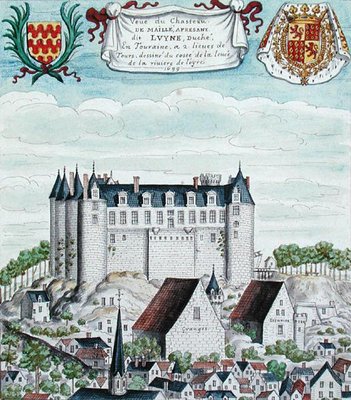
| View of the Chateau de Maille in the Tourraine |
Here
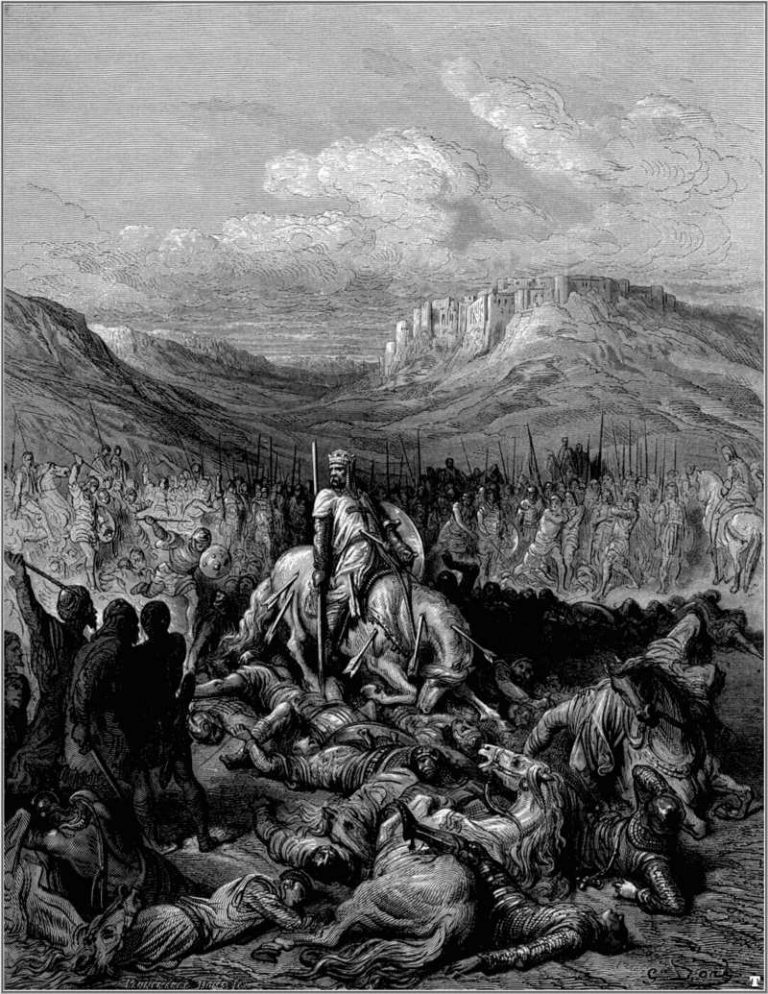
Heroic Death of Jacques de Maillé, a Knight of the Temple
FEBRUARY 14, 2019
Glorious death of Jacques de Maille Marshal of the temple by Gustave Dore.
The truce made with the king of Jerusalem was broken at the same time by both Christians and Mussulmans. Renaud de Chatillon continued his incursions upon the territories of the infidels, and only replied to the complaints of Saladin by new violations of treaties. A Mussulman army, which the sultan of Damascus had sent to the assistance of the count of Tripoli, advanced into the country of Galilee, whither five hundred knights of the Temple and St. John hastened to defend the Christian territory, and give battle to the Saracens. They were speedily overwhelmed by the numbers, and almost all perished on the field of battle. . . . Above all the rest, nothing could equal the heroic valor of Jacques de Maillé, a knight of the Temple. Mounted on a white horse, he remained alone in the field of battle, and fought on, surrounded by heaps of slain. Although hemmed in on all sides, he refused to surrender. The horse which he rode, worn out with fatigue and exhausted by wounds, sunk under him, and dragged him with him; but the intrepid knight arose, lance in hand, covered with blood and dust, and bristling with arrows, and rushed upon the ranks of the Mussulmans, astonished at his audacity; at length he fell, covered with wounds, but fighting to the last. The Saracens took him for St. George, whom the Christians believed they saw descend from heaven to join their battalions. After his death the Turkish soldiers, whom an historian calls the children of Babylon and Sodom, drew near with signs of respect to his body, slain by a thousand wounds; they wiped off the blood, they shared the rags of his clothes and the fragments of his arms, and, in their brutal excitement, evinced their admiration by actions that make modesty blush when speaking of them.
The grand master of the Templars, with two of his knights, were all that escaped from the carnage. This battle was fought on the 1st of May, 1187. In the season, says an ancient chronicle, in which flowers and roses are gathered in the fields, the Christians of Nazareth found nothing but the traces of slaughter and the mangled bodies of their brethren. They buried them in the church of St. Mary, repeating these prophetic words: “Daughters of Galilee, put on your garments of mourning; and you, daughters of Sion, weep over the ills that threaten the kings of Judah.”
:quality(70)/cloudfront-us-east-1.images.arcpublishing.com/baltimorebanner/6A5NSRNQ35C7DAVNII4IMG3ZCA.jpg)
After life’s fitful fever, French emperor Napoleon Bonaparte’s estranged family sleeps well in Baltimore.
So says the epitaph etched on Elizabeth Patterson Bonaparte’s tombstone in Green Mount Cemetery. The fever perhaps first flared when her notorious brother-in-law objected to her nuptials to Jérôme Bonaparte, Napoleon’s younger brother, on Christmas Eve in 1803. Though the marriage eventually ended in divorce, it ignited for Elizabeth what would become a decadeslong legal battle for diplomatic recognition and legitimacy for her son.
“Nature never intended me for obscurity,” the Baltimore Bonaparte once stated in a letter to her father.
Long before Baltimore’s other famous divorcée Wallis Simpson fell in love with a European ruler, Patterson’s love story did not sit well with her new family in France. Thursday’s anticipated release of the biopic “Napoleon,” directed by Ridley Scott and starring Joaquin Phoenix, has renewed interest in Elizabeth Patterson Bonaparte and her tussle with the French emperor.
General Grant and the Fight to Remove Emperor Maximilian from Mexico
Ulysses S Grant National Historic Site
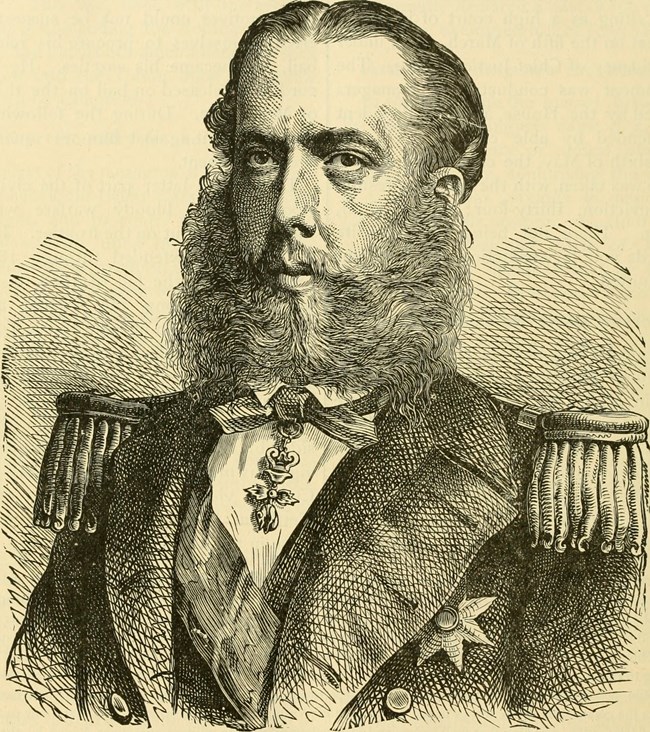
Ulysses S. Grant’s longstanding interest in Mexican affairs dated back to his service in the Mexican American War from 1846-48. During this time, Grant observed the culture and customs of Mexican society and admired its beautiful natural landscape while serving with the U.S. Army. During the American Civil War thirteen years later, Mexico found itself in a new fight for independence against France. After Confederate General Robert E. Lee surrendered his Army of Northern Virginia in April 1865, General Grant turned his focus to Mexican affairs.
In the decades following its independence from Spain in 1821, Mexico’s government faced a great deal of political instability and growing debts. These financial obligations became overwhelming, and the government stopped paying its debts to various European nations, including France, by the time the American Civil War broke out in 1861. French Emperor Napoleon III took advantage of the situation by attempting to create a French empire in Mexico. French troops mobilized for deployment to Mexico. During one French invasion on May 5, 1862, Mexican resistance fighters defeated the French at the Battle of Puebla, which is the inspiration for the popular Cinco de Mayo holiday in the United States. The French regrouped, however, and captured Mexico City. They installed an Austrian Hapsburg prince named Maximilian as Emperor of Mexico in 1864.
President Abraham Lincoln’s administration refused to recognize Maximilian and French meddling in Mexican affairs. Lincoln believed this move was a violation of the Monroe Doctrine, which warned European nations that the United States would not tolerate further meddling in Western Hemisphere countries. Conversely, the Confederacy welcomed Maximilian’s government as a possible ally in securing French recognition of the Confederacy. Although Maximilian’s presence in Mexico was unacceptable, President Lincoln had to walk a tight rope in his dealings with France.
Historian James McPherson notes in Battle Cry of Freedom that Francis P. Blair, Sr., a former member of Andrew Jackson’s presidential administration, concocted a scheme to stop the American Civil War and unite Union and Confederate forces to overthrow the French from Mexico. Although intriguing, President Lincoln did not give the plan much thought and wished to win the war against the Confederacy first. Meanwhile, Mexican resistance forces under Benito Juárez had more military successes. Maximilian needed conservative Mexican support to hold on to power, but alienated them by trying to compromise with political opponents by adopting some liberal policies. This didn’t endear him to the liberals because they viewed him as a puppet for the French.
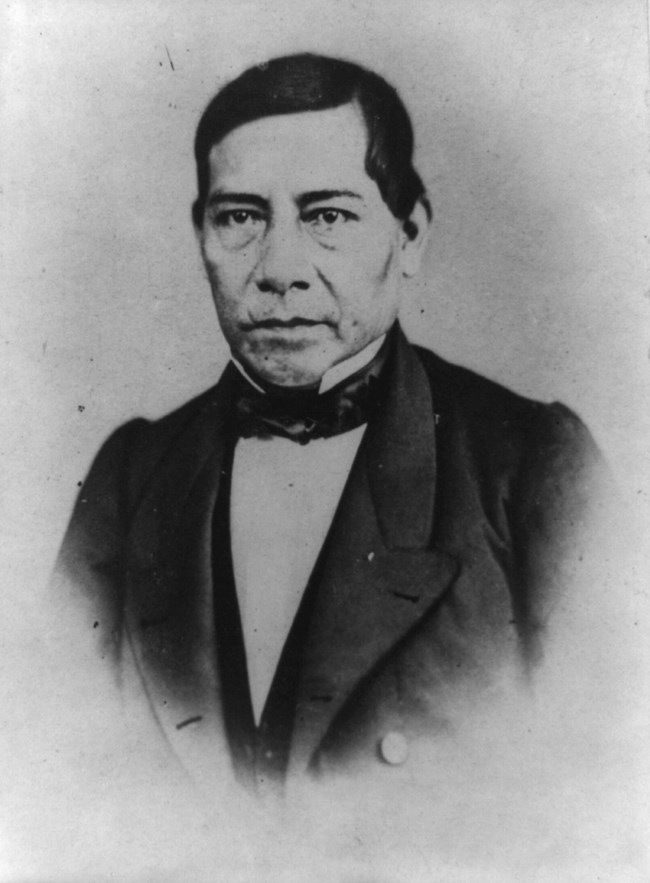
Ulysses S. Grant emerged as one of the most passionate enemies of Maximilian’s government after the American Civil War ended. In a letter to President Andrew Johnson that was written on June 19th 1865, Grant argued that “I regard the act of attempting to establish a Monarchical Government on this continent, in Mexico, by foreign [bayonets] as an act of hostility against the Government of the United States. If allowed to go on until such a government is established, I see nothing before us but a long, expensive and bloody war.” Grant then further explained his opposition to Maximilian’s government. For one, the French took advantage of the American Civil War to “overthrow Republican institutions” in Mexico. Second, the illicit trading in arms and materials of war between the Confederates and Maximilian’s government further prolonged the Civil War. “Rebels in Arms have been allowed to take refuge on Mexican soil protected by French [bayonets] . . . French soldiers have fired on our men from the South side of the [Rio Grande].”
Not everyone supported Grant’s use of the military in Mexico. Secretary of State William Seward favored diplomacy in dealing with the French. Grant had a willing ally in his subordinate, General Philip Sheridan. Grant dispatched Sheridan to Texas with around 50,000 troops to stop Confederate resistance in Texas, but his forces kept moving closer to the Rio Grande River. Grant even talked about sending liaisons from the U.S. Army to work with anti-imperialistic Mexican forces, while Sheridan talked about crossing the Rio Grande River to hasten Maximilian’s downfall. Ultimately a military battle between the U.S. and French forces in Mexico never happened. The intervention strained French resources and growing tensions with Germany drew France’s attention to events closer to home. Benito Juárez’s anti-imperialistic forces successfully defeated the French, who made a complete withdrawal from Mexico by 1867. Emperor Maximilian was also shot to death by Juárez’s forces that year. Although war with the French over Mexico never happened, Ulysses S. Grant backed up his convictions for self-determination for the people of Mexico.
Mexico during the French Intervention, 1862–1867
By the late 1850s, years of internal strife had left the young republic of Mexico fractured and deeply in debt to Europe. Seeing an opportunity to expand the French Empire in the New World, Napoleon III invaded Mexico in 1862. Ferdinand Maximilian Joseph, archduke of Austria, and his wife, Carlota, were installed as emperor and empress of Mexico in 1864.
During this time, the Commission scientifique du Mexique, established by Napoleon III to survey all aspects of the occupied country, produced numerous illustrations for scientific reports and travel narratives. In addition, souvenir images were created by and for foreign soldiers, and images of Mexico frequently appeared in the international illustrated press. Although the Second Mexican Empire was short-lived—the French army withdrew from Mexico in 1867, leaving Maximilian to face court-martial and execution—the legacy of image-making was continued by artists and photographers who remained in the country.
Symbols of Conquest
In 1863, following his successes during the siege of Puebla and other battles, François Achille Bazaine became commander of the French expeditionary force in Mexico. He is shown here on horseback wearing a flapped campaign hat and cape with his officers ranged behind him. He sits upon a jaguar pelt, once the symbol of Mexico’s Pre-Columbian rulers, alluding to France’s new role as master of Mexico.
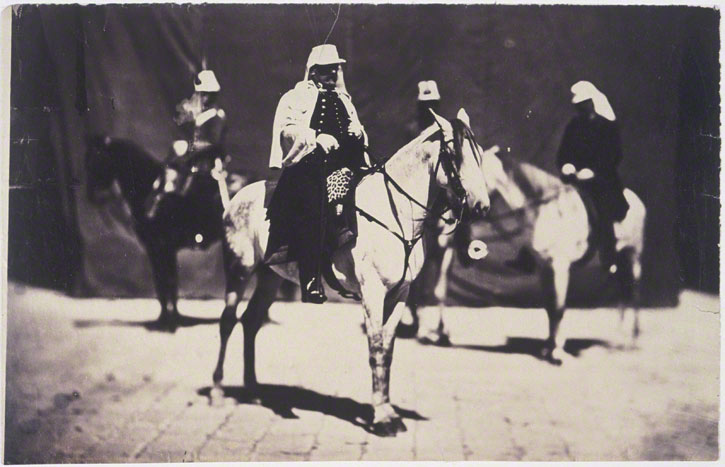
Portrait of Marshal Bazaine on Horseback, François Aubert (French, 1829–1906), 1860s. Albumen print. The Getty Research Institute, Views of Mexico during the French Intervention, 95.R.70.2
The Boban Calendar
The Commission scientifique du Mexique surveyed Mexican archaeological sites and studied French private collections, such as that assembled by Eugène Boban. The Commission’s reproduction of the Boban Calendar (ca. 1530), as this Aztec map and calendar are known, shows details that have since been lost due to deterioration of the manuscript.
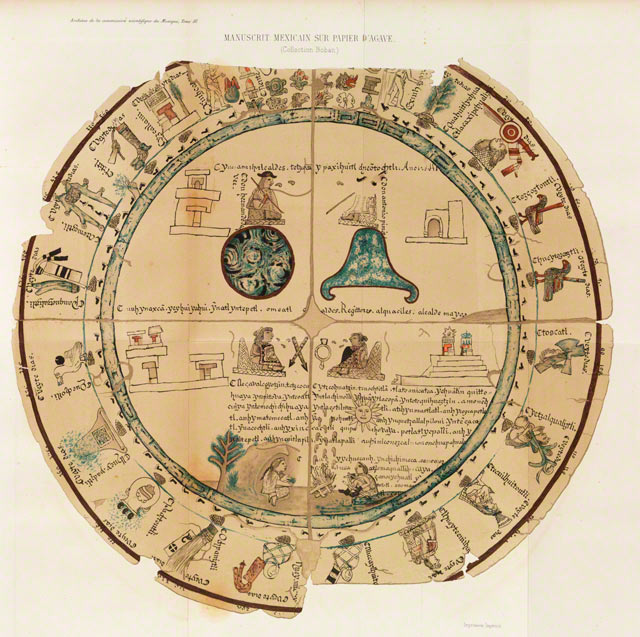
Boban Aztec Calendar Wheel by an anonymous artist. Color lithograph after original manuscript in Archives de la Commission scientifique du Mexique . . . (Paris, 1865–67), vol. 3, between pp. 120 and 121. The Getty Research Institute, 90-B38303
Hieroglyphs for the eighteen Aztec months ring the circular image, where Cortés sits on a woven throne above a blue circle representing the Lake of Mexico. Across from him sits Antonio Pimentel, the native ruler of Tetzcoco after the conquest and son of Cortés’s Indian ally, Ixtlilxochitl.
Banner image: Eastern Medicine, Einar de la Torre (Mexican, b. 1963) and Jamex de la Torre (Mexican, b. 1960), 2008. Blown glass and mixed media. Koplin Del Rio Gallery, Culver City
 Claude de MAILLÉ de LA TOUR-LANDRY
- Born in 1568
Parents
- François de MAILLÉ de LA TOUR-LANDRY, chevalier de l’Ordre du roi, baron de La Tour-Landry, seigneur de Bourmont (11e), comte de Châteauroux (1er, juin 1575), chambellan du Roi de France (8 janvier 1581), duc d’Alençon , born in 1540 – Châteauroux 36, deceased in 1598 aged 58 years old
Married February 3, 1564 (Monday), Guéméné sur Scorff 56, to - Diane de ROHAN, Dame de Gillebourg , Dame de Gilbourg , born about 1541 – Guéméné sur Scorff 56, deceased April 20, 1585 (Saturday) – Paris aged about 44 years old
Spouses, children, grandchildren and great-grandchildren
- Married to Jeanne DUGAS, born in 1573 with
- Jean Claude de MAILLÉ de LA TOUR-LANDRY 1593-1635 Married toMarie SALLÉ 1600-1686 with
 Antoinette de MAILLÉ de LA TOUR-LANDRY ca 1618-1698 Married about 1640, Nova Scotia, Canada, toAntoine BOURG 1609-1693 with :
- François BOURG 1644-1684
- Bernard BOURG 1649-1725
- Martin BOURG 1650
- Huguette BOURG 1657-1698
- René LANDRY 1619-1686 Married toPerrine BOURG with :
- René LANDRY 1634-1692
- Claude LANDRY ca 1663-1740
https://ancestors.familysearch.org/en/L5NK-J3C/jean-i-de-maill%C3%A9-de-la-tour-landry-1512-1563
When Jean I de MAILLÉ de La TOUR-LANDRY was born in 1512, in Châteauroux, Indre, Centre-Val de Loire, France, his father, Hardouin X de MAILLÉ, was 50 and his mother, Françoise de La TOUR-LANDRY, was 42. He married Anne CHABOT in 1538, in Châteauroux, Indre, Centre, France. They were the parents of at least 8 sons and 6 daughters. He died on 10 May 1563, in Charente, Poitou-Charentes, France, at the age of 51.
https://wappenwiki.org/index.php?title=House_of_Maill%C3%A9
https://wappenwiki.org/index.php/House_of_Maill%C3%A9
https://en.wikipedia.org/wiki/Ch%C3%A2teau_de_Bourmont
The family of La Tour-Landry and, later, the Maillé de La Tour-Landry, held the lands of Bourmont from the 14th century. Through an alliance in 1691 between Marie-Hélène de Maillé de La Tour-Landry (1670-1752) and Marie-Henry, Count of Ghaisne (1662-1710), it passed to the family of Ghaisne de Bourmont, who still own it.[2]
In 1771, the Château de Bourmont was the birthplace of Louis-Auguste-Victor, Count de Ghaisnes de Bourmont, architect of the French conquest of Algeria in 1830. The conquest led to him being appointed Maréchal de France (Marshal of France).[2]
In 1795, during the Chouannerie, vicomte de Scépaux established his headquarters there.[3]
Claire-Clémence de Maillé, Princesse de Condé
Claire was born on 25 February in 1628 to Urbain de Maillé, Marquis de Brézé, and Nicole du Plessis, sister of Cardinal Richelieu. The Brézés were an old noble family from Anjou and among their members was Diane de Poitiers, mistress of Henri II, who was married to Louis de Brézé.

The Marquis de Brézé was a Marshal of France, who had won plenty of glory on the battlefields, and a man of great renown. He married Nicole du Plessis in 1617 and their first child was born two years later. A son, Jean-Armand, who just like his papa won military glory. Jean-Armand was a brilliant commander and died, only twenty-seven years old, during battle.
Claire was their second born child and Cardinal de Richelieu took quite the interest in her, not just because she was his niece. Richelieu seems to have had quite the plans for her. As Claire was five years old, he arranged for her to marry a Prince du Sang. The chosen groom was Louis de Bourbon, at that time Duc d’Enghien and in direct line for the throne. Mademoiselle de Brézé, as Claire was called, was taken away from her family under the pretext of giving her a proper education and placed in the care of Madame Boutillier, the wife of the Superintendent of Finance.
As Mademoiselle de Brézé turned thirteen, she was wed in a swift to the Duc d’Enghien despite the loud protests of the groom. Louis was twenty years old and in love with a certain Mademoiselle du Vigean, Marthe Poussard. It was not his first love, he had a bit of a reputation as ladies-man and had already quite a few mistresses. Thus he protested, not wanting to marry a little girl, but it was in vain, for his father commanded him to marry Claire. The marriage was concluded at Milly-le-Meugon and celebrated at the Palais-Royal on February 11 in 1641.
Now styled Her Most Serene Highness Madame la Duchesse d’Enghien, she became a member of the Royal House of Bourbon… and liked her hubby not much more than he liked her. Nevertheless, duties were performed and their first child, Henri-Jules de Bourbon, was born in 1643. Another son, Louis de Bourbon, was born in 1652, but died the following year. Their third and last child, a daughter styled Mademoiselle de Bourbon, was born in 1657 and died not yet aged three.
The birth of Henri-Jules, did not bring the couple closer together… but the Fronde did. Louis succeeded to the title Prince de Condé upon the death of his father in 1646, becoming the First Prince of the Blood, and involved himself in the Fronde. As a result, he was disgraced and arrested in January 1650. Claire did everything in her power to help her husband and gathered his friends, leading them against Cardinal de Mazarin. The Prince did not get released until February 1651 and went into exile afterwards, Claire followed him with their son.
It was not until 1659, that Louis XIV allowed the Prince and Princesse de Condé to return to France. What little affection had grown between them, was long gone again by then. They settled at the Château de Chantilly, plagued by financial problems, but in fabulous company. The Prince invited all the great minds of France to visit him. Claire did not care too much for it.
She was homely, a little dull, very virtuous, gentle and pious. But, in 1671, she got herself involved in some strange affair. Two men, who were in her favour, got into an argument about it, during which Claire was slightly injured with a knife as she tried to intervene in the violent dispute. One of them, a man called Duval, was sentenced to the galleys, but died before he even reached the coast. Rumour had it that poison was the reason. The other, Jean-Louis de Rabutin, a distant cousin of Marquise de Sevigne, was forced into exile and settled in Transylvania, where he then became a man of brilliant military acumen.
Le Grand Condé took advantage of this strange affair and obtained the King’s permission to exile Claire by claiming she engaged in various affairs with various men over the last years. Louis XIV granted it and Claire was locked up by her hubby in Châteauroux. As Condé died in 1689, eighteen years later, his wife was still locked up, almost forgotten by everyone. The little hope Claire had to be released after the demise of her husband, who had abused her so, died as her own son, as cruel as his father, prolonged her exile indefinitely.
Claire remained locked up until the very day she died, on April 16 in 1694, and was buried at the chapel of the Château de Châteauroux.
Paneuropean Union and Virginia Hambley
Posted on October 8, 2013 by Royal Rosamond Press

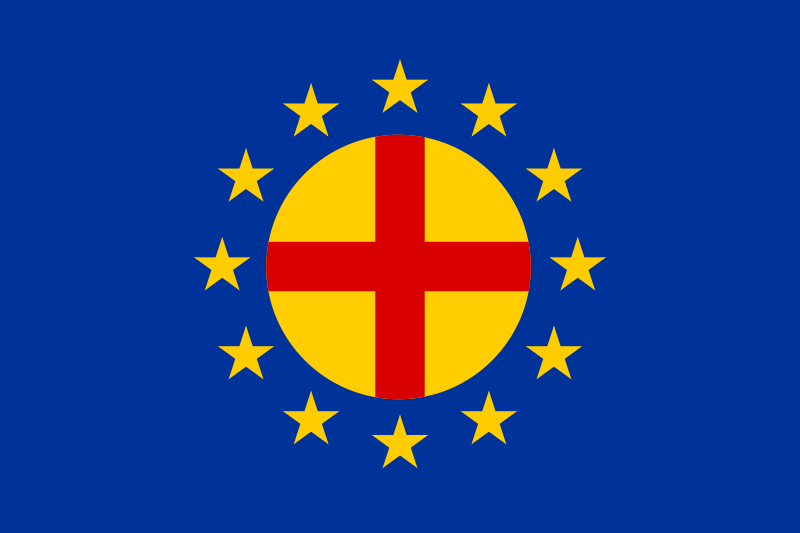

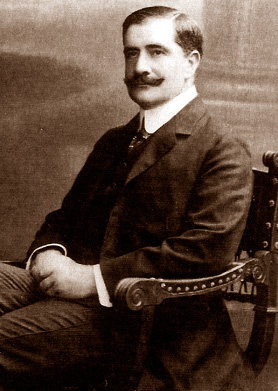
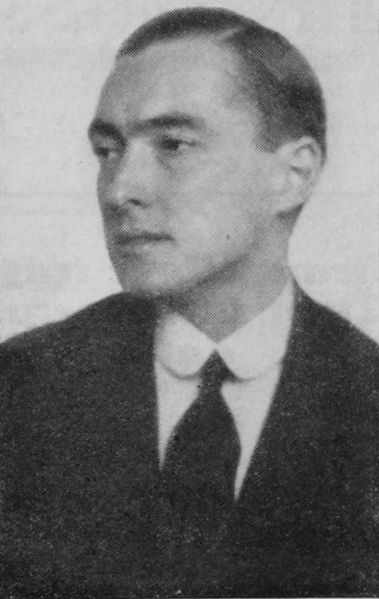
Virginia is kin to Count Richard Nikolaus von Coudenhove-Kalergi who gave birth to the European Union. Otto von Habsburg shared the dream of a Paneuropean Union that may be carried out in a bloodline that Virginia shares. The idea of a New France in America is not so farfetched now that the Republicans are on the brink of creating world chaos from which a new order will rise.
When one views the funeral march of Otto you see the flag of the Paneuropean Union followed by the flags of related families from many nations. Where did they get these uniforms? Were they, and the flags, at ready? This looks like a prearranged marriage. I believe Virginia and I represent the World Union in the West.
Jon Presco
Copyright 2013
Spring Roses of Nations
Posted on November 5, 2016by Royal Rosamond Press
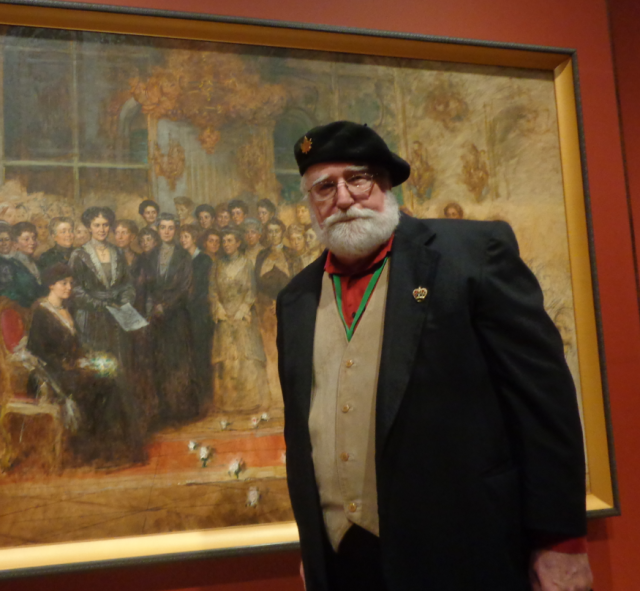
Did the Jacobites found a colony in Belmont California? I found a Jacobite-Savoy line to Empress Zita. It is my destiny to establish a Jacobite Kingdom in America, either in California or Oregon – that is threatened by followers of Traitor Trump, the evangelical Antichrist who want to grab part of Oregon in the Greater Idaho Insurrection. Stop the Anti-Democracy Traitors that took over John Fremont’s party he co-founded. John and Senator Thomas Hart Benton are my kin!
Because the Reformation has led to the anointment of King Trump, Dictator of America, I hereby deny Martin Luther, the anti-Semite, any religious legitimacy in our New Democracy-Kingdom. We will recognize Pope Adrien who established the Anti-Reformation with the help of my kin, Godeschalk Rosemondt, and Grand Master of the Swan Brethren.
On this day, I raise from the dead The Knights Templar of Rougemont who I have proven owned the Shroud of Turin. The Templars were Catholic – and not Protestants. I bid Catholic Templars to move to Eastern Oregon, and become Knights of Truth! Expand the Rightful Land! Down with the Orange Liar who betrayed is country and our Intelligence Community. Long live the Jacobites of the House of Stuart and Savoy! Long live……The White Rose!
I conclude that the white roses you see in the painting ‘The Last Audience of The Habsburgs’ represent the hidden Jacobite Royals of savoy. Again – I raise The Children of The Rose – from the dead!
John Presco
Grand Master of The Templar White Rose
Jacobites deny the validity of the usurpation of the throne first by the Prince and Princess of Orange (1688/9), next by the Princess Anne of Denmark (1701/2), and finally by the Elector Georg I of Hannover (1714) and his heirs to this day.
Marriage and issue[edit]
Margherita’s family announced her engagement to Robert, Archduke of Austria-Este on 20 October 1953.[1] They married on 28 December 1953 in Bourg-en-Bresse, Ain, France (civilly) and 29 December 1953 (religiously), in Royal Monastery of Brou.[2][3] He was the second son of former Emperor Charles I of Austria and Zita of Bourbon-Parma. Robert was 38, and Margherita was 23. As the royal couple arrived for the first ceremony, hundreds of Austrians and Italians stood outside the town hall where the marriage was held.[2] The wedding was also attended by former King Umberto II of Italy and Robert’s older brother Otto of Habsburg, the claimant to the Austrian throne.[2] At six feet tall, Margherita was, according to some witnesses, an impressive sight. She wore an ivory gown made out of satin with a long train hung from a diamond tiara.[3]
As President I Will Restore The French Territory
Posted on October 4, 2020 by Royal Rosamond Press
Here is my facebook group that is my homebase for my bid to be the write-in candidate for Republican President.
John ‘The Prophet’
King of Oregon and California
Posted on October 3, 2013by Royal Rosamond Press
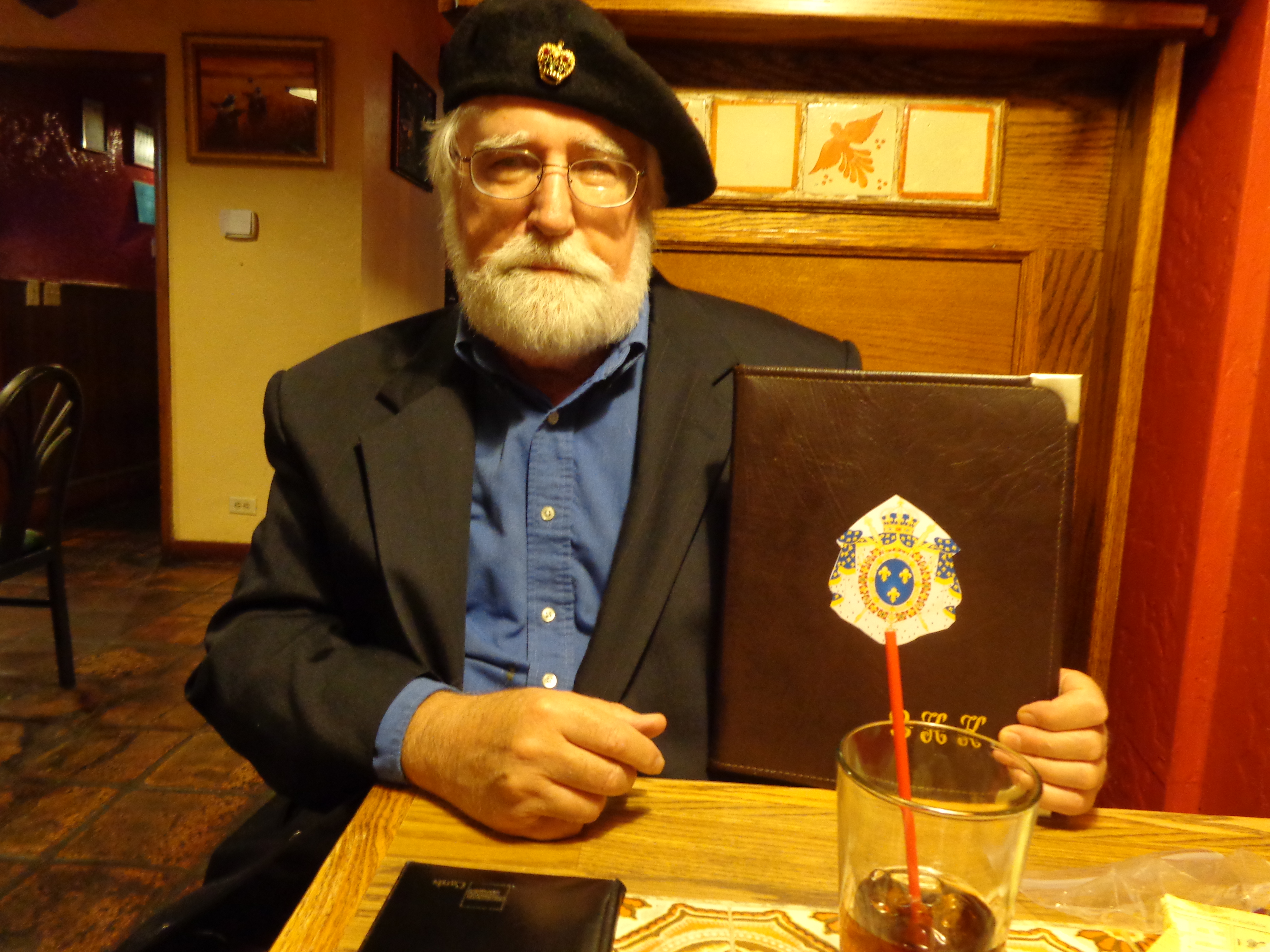



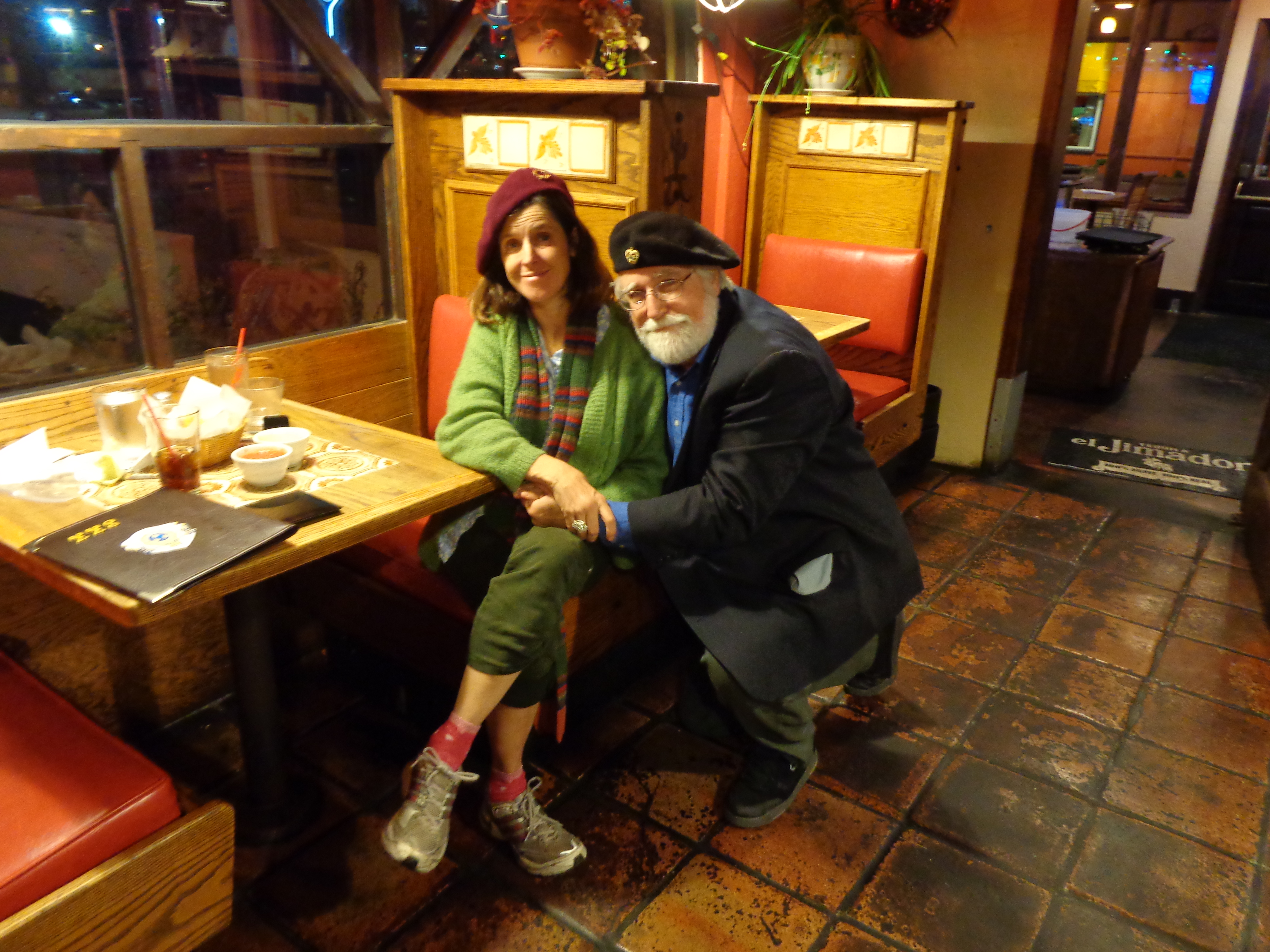
On October 1, 2013 on the day the Government of the United States ceased to exist due to the successful take-over of our Democracy by the Tea Party secessionists, I, John Presco, proposed to, Virginia Hambley de Bourmont, and she accepted.
With this proposal, I presented to my fiancé the Louisianans Territory as held by her illustrious French Ancestors.
Let it be known, that on this day, October 2, 2013, that I John Gregory Presco lay claim to the California and the Oregon Territory as it was known to my illustrious ancestors the Benton and Fremont family, who egregiously ignored the Constitution and the Economic Idealogy of Jeane-Baptise Say, who married into the de Bourmont Anjou family, who are this very day trying to restore the Monarchy of France. Good luck!
I believe the only chance the Orlean de Anjou claimants have, is to back the New Found Kingdoms in America that take in most of the land west of the Missouri River – that was illegally taken by the ideology of ‘Manifest Destiny’ as promoted by my kindred, Senator Thomas Hart Benton. Now that this democracy ceases to exist, I hereby make null and void the purchase of the Oregon Territory from Britain.
Let it be known, that I, the rightful King of California and Oregon, will return California to Mexico and the Mexican People, if they back my claim, and make my bride-to-be and her beloved kindred – the Titular and Dynastic Rulers of the New Kingdom of California-Mexico!
It is my desire to see my kindred merrily taking part in all festivities these great people are known for, with pomp, and royal flare that will be paid for by the Mexican people via a Royal Tax. This is a small price to pay for solving half of the immigration problem.
Sincerely
John Presco
Titular King of Oregon and California
P.S. also let it be known I am the Rightful Leader of the Republican Party – in exile!
https://rosamondpress.wordpress.com/2012/10/20/i-am-rightful-heir-to-republican-party/
https://rosamondpress.wordpress.com/2013/07/14/fremonts-radical-republicans/
https://rosamondpress.wordpress.com/2013/09/17/de-bourmont-anjou-legitimists/
https://rosamondpress.wordpress.com/2013/06/04/jessie-ann-benton-fremont/
During the reign of the third Bourbon king of Spain, Charles III (1759-88), the Bourbons introduced important reforms at home and in the colonies. To modernize Mexico, higher taxes and more direct military control seemed to be necessary; to effect these changes, the government reorganized the political structure of New Spain into twelve intendencias , each headed by an intendente under a single commandant general in Mexico City, who was independent of the viceroy and reported directly to the king.
The economic reforms were directed primarily at the mining and trade sectors. Miners were given fueros and were allowed to organize themselves into a guild. Commerce was liberalized by allowing most Spanish ports to trade with the colonies, thus destroying the old monopoly held by the merchants of the Spanish port of Cádiz.
The Bourbon reforms changed the character of New Spain by revising governmental and economic structures. The reforms also prompted renewed migration of Spaniards to the colonies to occupy newly created government and military positions. At the same time, commerce, both legal and illegal, was growing, and independent merchants were also welcomed. The new monied classes of miners and merchants were the real promoters of the successes of the reforms enacted by the Bourbons.
The Catholic Church mentions Blessed Joanna Maria de Maille, widow.

Joanna comes from a noble French family. She was born in 1331 at the castle of La Roche.
In 1347 she married a baron Robert de Silly.
Soon after the wedding, the couple made vows of chastity, and began their activities as servants of God.
In France, the plague epidemic prevailed, so they took care of and care for the sick and the poor.
During the Franco-British War, Baron de Silly was taken prisoner. The wealthy family managed to buy him out, thanks to which he returned to his wife. Unfortunately, shortly after his return, he died of hardships and exhaustion.
Joanna left the family estate and lived in Tours, in a modest apartment near the Franciscan monastery.
He led a life full of mortification, prayer and sacrifice.
In Tours, she worked as a nurse at a local hospital.
There were several miraculous healings in the hospital that are attributed to Joanna’s prayer.
Joanna died at the age of 82 on March 28, 1414. She was beatified in 1871 by Pope Pius IX.
Blessed Joanna is the patron of widows, exiles, victims of violence, people who lost their parents and people who have family problems.
MAILLÉ
Eldest ancestor Gauzbert Lord of Maillé lived in the first half of the 11th century. His descendant Hardouin X de Maillé, seigneur de Benais (1462-1524/25) married Françoise de La Tour-Landry. Their son Jean (1512-1563) combines the two surnames to Maillé de La Tour-Landry. His descendant Louis de Maillé de La Tour-Landry (+ 1674) was created Marquis de Gilbourg in 1649. Adn his great-grandson Charles-René de Maillé de La Tour-Landry (1732-1791) was created Duc de Maillé on 1-4-1784.
1a. William de Maillé de La Tour-Landry, Marquis de Maillé (*) 1996
1b. Kevin de Maillé de La Tour-Landry, Comte de Maillé * 2000
1c. Nolan de Maillé de La Tour-Landry, Vicomte de Maillé * 2013
II
2. Marie Gilles Geoffroy de Maillé de La Tour-Landry, 7.Duc de Maillé * Châteauneuf-sur-Cher 15-11-1972
x Châteauneuf-sur-Cher 24-7-1999
3. Nathalie Karine Françoise Brighenti * Bourges 31-12-1973
III
4. Stanislas de Maillé de La Tour-Landry, 6.Duc de Maillé * Boulogne-Billancourt 3-4-1946 + Saint-Doulchard 15-1-1996
x Lignières 23-9-1971
5. Martine Cognet (de La Brulerie) * La Châtre 9-3-1951
6. Bernard Roger Paul Brighenti * …
x …
7. Francette Nicole Simone Estève * …
IV
8. Marie Armand Gilles de Maillé de La Tour-Landry, 5.Duc de Maillé * Château de L’Orfraisière 2-9-1893 + Châteauneuf-sur-Cher 7-6-1972
x Parijs 16-6-1928
9. Anna Maria (Anka) Angela Dorothea Euphemia Gabriella Elisabeth Adela Prinses Radziwiłł * Balice 2-10-1907 + Meudon 1-6-1995
10. Robert Cognet (de La Brulerie) * …; Commerçant
x …
11. Jeannine Elie * Vars 13-7-1923 + Bourges 5-5-2012
12.
x
16. Marie Artus Hippolyte Jean de Maillé de La Tour-Landry, 4.Duc de Maillé * Parijs 7-1-1858 + Châteauneuf-sur-Cher 23-4-1926
x Parijs 23-1-1889
17. Marta Carlotta Consuelo Carmen de Wendel * Parijs 27-3-1870 + Châteauneuf-sur-Cher 24-10-1933
18. Wilhelm Janusz Heinrich Stanislaw Prins Radziwill * Berlijn 6-2-1880 + Malin 28-4-1920
x Parijs 28-4-1906
19. Dolores Konstancja Johanna Maria Prinses Radziwill * Parijs 26-6-1886 + Parijs 9-11-1966
20.
x
21.32. Jacquelin Armand Charles de Maillé de La Tour-Landry, 3.Duc de Maillé * 5-5-1815 + 4-3-1874
x Parijs 15-10-1845
33. Charlotte Eustachine Jeanne d’Osmond * Parijs 1-1-1827 + 13-11-1899
34. Adrien Charles Joseph Robert de Wendel * Souley 9-5-1847 + Hayange 26-8-1903
x Parijs 18-5-1863
35. Maria Antonia Elisabeth Carmen Consuelo Manuel de Gramedo * …
36. Friedrich Wilhelm Ferdinand Anton Vorst Radziwill 15.Hertog van Nieswiez * Teplitz 31-7-1833 + Berlijn 16-12-1904
x Sagan 3-10-1857
37. Marie Dorothée de Castellane * Parijs 19-2-1840 + Kleinitz 10-7-1915
38. Dominik Maria Ignatiusz Prins Radziwill * Poloneczka 12-8-1852 + Balice 28-12-1938
x Parijs 1-9-1881
39. María de los Dolores de Agramonte y Zayas-Zamudio * Barcelona 16-9-1854 + Ermenonville 13-9-1920
40.
63.
64. Charles François Armand de Maillé de La Tour-Landry, 2.Duc de Maillé * 10-1-1770 + 5-1-1837; Zn van Charles René de M. de La T.-L., 1.Duc de M., en Madeleine Angélique de Bréhan
xII ..-1-1801
65. Joséphine Le Bascle d’Argenteuil * 22-4-1787 + 10-9-1851; Dr van Jean Louis Marie Le B., Marquis d´A.,en Madeleine Barjot de Roncé
66. Rainulphe Marquis d’Osmond * 29-7-1788 + ..-10-1862; Zn van Eustache René Marquis d´O. en Eleanor Dillon
x 25-11-1817
67. Aimée Marie Caroillon des Tillières * … + 2-8-1853; Dr van Claude C. des T. en Mlle Magallon du Mirail
68. Alexis Charles de Wendel * Metz 13-12-1809 + Parijs 15-4-1870; Zn van François Charles de W. en Marie Françoise Joséphine de Fischer de Dicourt
x Souley 29-5-1843
69. Jeanne Henriette Marthe de Pechpeyrou Comminges de Guitaut * 10-1-1825 + 8-5-1908; Dr van Achille de P. C., Comte de G., en Pauline Adrienne de Meyronnet Châteauneuf
70. Don Ivan Eduardo Manuel, sed. 1850 Conde de Gramedo * Parijs 1813 + 11-1-1869
x 8-5-1847
71. Doña Tomasa Antonia Josefa Cayetana Carmen Maria del Consuelo de Acuña y de Witte * … + Nouzilly 3-12-1888; Dr van Don Manuel Lorenzo de A. y Fernández de Miranda, 7.Marqués de Escalona, en Maria Antonia de Witte
72. Friedrich Wilhelm Paul Nikolaus Vorst Radziwill 14.Hertog van Nieswiez * Berlijn 19-3-1797 + Berlijn 5-8-1870; Zn van Antoni Prins R.,13.Hertog van Nieswiez en 11.Hertog van Olyka, en Luise Prinses van Pruisen
xII Teplitz 4-6-1832
73. Mathilde Gräfin v. Clary u. Aldringen * Wenen 13-1-1806 + Berlijn 4-11-1896; Dr van Carl 3.Fürst v. C. u. A. en Luise Gräfin Chotek v. Chotkowa u. Wognin
74. Henri Charles Marquis de Castellane * Parijs 1814 + Saint-Patrice 16-10-1847; Zn van Boniface Comte de C. en Louise Cordélie Eucharie de Greffulhe
x Parijs 10-4-1839
75. Joséphine Pauline de Talleyrand-Périgord * Parijs 29-12-1820 + Saint-Patrice 12-10-1890; Dr van Edmond de T.-P., 2.Duc de Talleyrand, 2.Duca di Dino, en Dorothea Gräfin Biron Prinses van Koerland, 4.Herzogin v. Sagan
76. Konstanty Mikolaj Stanislaw Juliusz Franciszek Prins Radziwill, Graaf van Szydlowiec * Rome 5-4-1793 + Poloneczka 6-4-1869; Zn van Matthias Prins R., Graaf van S. en Elzbieta Gräfin Chodkiewicza
xIII Oswiciej ..-3-1840
77. Adele Karnicka * Ewersmujza 2-3-1811 + Wilno 3-1-1883; Dr van Mikolaj K. en Doroteja Szczyt-Niemirowicza
78. Francisco de Agramonte y Agüero * Puerto Principe …
x …
79. María de los Dolores Zayas-Zamudio y Hechevarria * Santiago de Cuba + …; Dr van
As the only legitimate son of Napoleon I, he was already constitutionally the Prince Imperial and heir apparent, but the Emperor also gave his son the style of King of Rome. Three years later, the First French Empire collapsed. Napoleon I saw his second wife and their son for the last time on 24 January 1814.[2] On 4 April 1814, he abdicated in favour of his three-year-old son after the Six Days’ Campaign and the Battle of Paris. The child became Emperor of the French under the regnal name of Napoleon II. However, on 6 April 1814, Napoleon I fully abdicated and renounced not only his own rights to the French throne, but also those of his descendants. The Treaty of Fontainebleau in 1814 gave the child the right to use the title of Prince of Parma, of Piacenza, and of Guastalla, and his mother was styled the Duchess of Parma, of Piacenza, and of Guastalla.
De Bourmont – Anjou Legitimists
Posted on September 17, 2013 by Royal Rosamond Press
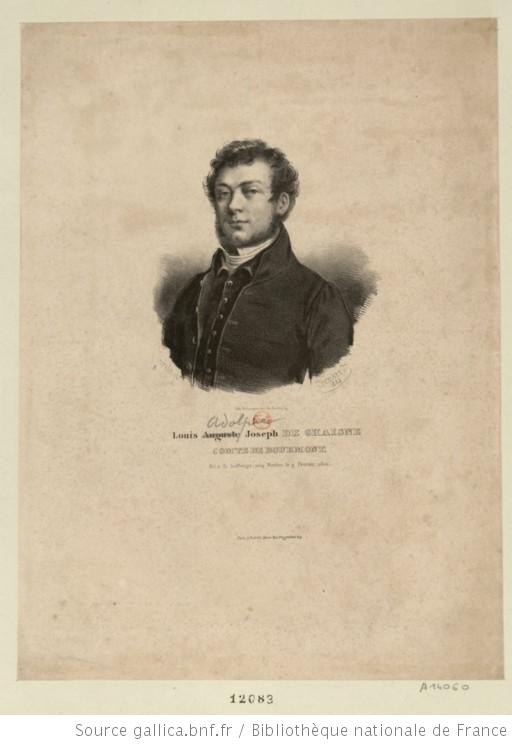


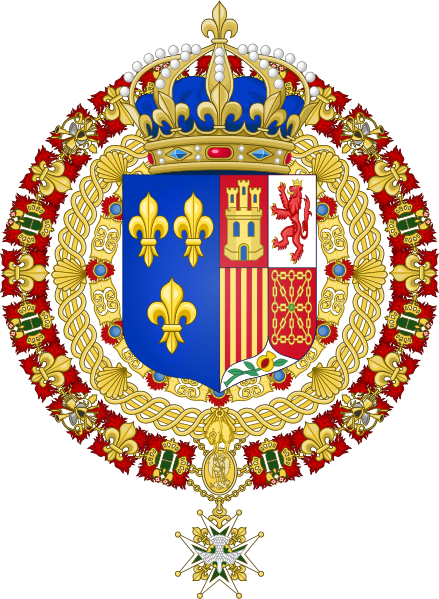

The de Bourmonts are Anjou Legitimists who are in contention with the Orléanists for throne of France when, and if, the French Monarchy returns. If this happens, then all the de Bourmonts, even in America, will be line for the French Throne. The question is, are Clark and Elizabeth’s children and grandchildren being watched, looked after?
This is the real Game of Thrones, and the real ‘Pan’s Labyrinth’. Is Virginia saying;
“Viva la France”?
Jon Presco
Drawing is of: Louis Auguste Joseph De Ghaisne Comte De Bourmont, Né à la Seilleraye, près Nantes, le 9 Février 1801
http://en.wikipedia.org/wiki/Legitimists
http://en.wikipedia.org/wiki/July_Revolution
French Prince Ready and Waiting for Monarchy to Return
Published December 19, 2008
Wall Street Journal
More than two centuries after the French cut off their king’s head, a pretender to France’s throne is planning a royal wedding.
Prince Jean d’Orléans, Duke of Vendôme, announced earlier this month that, at the age of 43, he will soon marry, with the hope of extending his royal line. His descendants would then be ready if the French monarchy — which was toppled by the bloody Revolution of 1789 — is ever brought back.
Prince Jean d’Orleans is undeterred by Louis XVI and Marie Antoinette’s untimely demise. He believes a monarch is just what France needs right now.
“Maybe one day the monarchy will be restored in France,” said Prince Jean as he strolled around the gardens of the Palais Royal in central Paris. “The prince can’t just sit back and wait. He must make his mark.”
Europe has many families descended from old monarchies. But most are happy just to enjoy the social status their backgrounds confer.
Prince Jean’s ambitions are unusual — and perhaps far-fetched. France restored the monarchy in the 19th century as many as four times, depending on definitions, but has since chosen to stay a republic. Alliance Royale, a group that wants to choose a king by referendum, got just 0.031% of the vote in the 2004 European elections.
“The idea of going back 200 years is unthinkable,” says Charles Napoléon, a politician descended from a brother of Napoléon Bonaparte.
Moreover, even if France decided it wanted its monarchy back, Prince Jean would have to battle a claim from a rival family — the Bourbons, who share a family name with the executed king, Louis XVI. Meanwhile, his own dynasty is struggling to end years of decline.
Prince Jean does his best to live like a king.
He has no official status and little public recognition, and he has to work for a living. He has been a financial consultant, and he now works full time promoting French heritage.
http://articles.latimes.com/2013/apr/08/local/la-me-sci-sn-talking-monkeys-20130408
“Victor de Bourmont is a member of one of the largest Angevin aristocratic families. He was born 1907 in Pontivy and died in March 1945 in Pomerania near Kolberg (Korlin). It comes down to many aristocratic families the region and Brittany, including de Cossé-Brissac, and Rohan. Many of his ancestors were under the former Regime, presidents or advisors of the Chamber of Auditors from Brittany and Normandy. Married in 1938, he left behind him, to his death four young children.”
Virginia’s grandmother is a Craven, and her grandfather is Joseph C M De Ghaisne De Bourmont.
“The term Angevin Empire is a modern term describing the collection of states once ruled by the Angevin Plantagenet dynasty.
The Plantagenets ruled over an area stretching from the Pyrenees to Ireland during the 12th and early 13th centuries, located north of the kingdoms of Navarre and Aragon. This “empire” extended over roughly half of medieval France, all of England, and some of Ireland.”
Angevin is Anjou. Rene de Anjou was the Duke of Bar. The Bourmonts appear to be kin to the Kings of Jerusalem and Godfrey de Boullon. Here is his genealogy that ends with the Habsburgs, and almost begins with them. Above is a phot of Bourmont Castle.
http://en.wikipedia.org/wiki/Dukes_of_Lorraine_family_tree
In the de Bourmont cote of arms we see a blue field with fish that represent the Dukes of Bar. Johanne de Ferrette and Rougemont has blood ties to the Duke’s of Bar. Virginia Hambley and I are related – if it is true that the name Rosamond comes from Rougemont in the Alsace, and I am kin to Johanne. The chances that Virginia is “of the blood” is very high. We talked about having children, I sensing she was “the one”. If my daughter had not come into my life, we would have been childless together. I disowned my daughter who called me “insane” because of my study.
Rene de Anjou, and members of the de Bar family, are considered by some to be Grand Masters of the Priory de Sion. Until I have better proof, I suspect we are looking at another legend that certain people who falsly claimed they were Sinclairs, have attachted themselves to. Below is Denis de Rougemont’s essay on a United Europe.
Jon Presco
Copyright 2013
http://en.wikipedia.org/wiki/Duchy_of_Bar
The rise to power of Louis-Philippe, following the revolution of 1830 which sees the establishment of a constitutional monarchy, will revive the ashes of the legitimist resistance in the West of the France and particularly in Mayenne. Supporters of the young Duke of Chambord (the legitimists named Henri V) organize themselves in anticipation of the outbreak of an insurrectional movement. In the campaigns, captains of parishes and division heads to toil to re-create the Organization of troops armed on the model of the chouanneries from 1799 and 1815. There among them to old figures chouannes as Pierre Gaullier, son of the famous “Grand Pierre”, or supporters aristocrats of the Bourbons as Arsène de Pignerolle, Mayor of Laval under the restoration. The clandestine landing in the Vendée of the duchesse de Berry, mother of the count of Chambord and legitimist resistance icon, will precipitate events. Order is given to the chouans take up arms in the night of 23 to 24 may 1832. But the royalist Committee in Paris, which is reluctant to provoke a new civil war, manages to convince Marshal Bourmont to disseminate an ordered that halts all military operations. Nevertheless, the South-Mayenne will be stirred up by fighting. On May 26, in the corridors of the castle of Chasnay to Grez-en-Bouère, a detachment of the 31st regiment of line, from Château-Gontier, collides with the custody of Clouet general who order the chouans of the right bank of the Loire. The latter manages to escape after a shootout that left 3 dead among government soldiers and 2 in chouans. Follows in the course of the month of June, a wave of arrests that will throw in jail individuals suspected of having participated in this uprising failed. Under the State of siege, ordained also because Republican riots which agitated the capital, war councils are established, but their installation does not occur smoothly. June 11, the judges of the Court of Laval refuse to divest itself of charges of chouans records. Nevertheless, despite this Act of protest, the death sentences, including that of journalist pamphleteer Karthik, are proclaimed. But these sentences will not be executed because the Court of cassation will a judgment invalidating the establishment of Councils of war as unconstitutional. Therefore, in the fall of 1832, the civil courts may begin to hear the trial of the insurgents. To remove these last to the condemnation of public opinion, the seats are generally held away from places of exaction of the chouans. Thus, in December 1832, it is 104 sarthois chouans who pass judgment in Orleans. The jury will be particularly clement to condemn only 7 individuals to imprisonment or deportation and by paying a large number of commoners from for most of the world agricultural or artisanal. The general amnesty proclaimed in 1837 will come to put an end to the judicial follow-up to this last chouannerie. Today, there is still much to learn about the uprising of 1832 and the consultation of judicial archives or the press of the time to go beyond the romantic myth born around the stories of the epic of the duchesse de Berry.
Château de Brézé is a small, dry-moated castle located in Brézé, near Saumur in the Loire Valley, France.
The château was transformed during the 16th and the 19th centuries. The current structure is Renaissance in style yet retains medieval elements including a drawbridge and a 12th-century trogloditic basement. Today, it is the residence of descendants of the ancient lords. The château is a listed ancient monument originally dating from 1060.[1]
A range of wines are produced at the château which has 30 hectares of vineyards.[2]
Purge of the Legitimists[edit source | editbeta]
In the meantime, the government expelled from the administration all of the Legitimist supporters who refused to pledge allegiance to the new regime, leading to the return to political affairs of most of the staff of the First Empire that had been expelled during the Second Restoration. This renewal of political and administrative staff was humorously illustrated by a vaudeville of Jean-François Bayard.[3] The Minister of the Interior, Guizot, renewed all the prefectoral administration and the mayors of large cities. The Minister of Justice, Dupont de l’Eure, assisted by his secretary general, Mérilhou, dismissed most of the public prosecutors. In the Army, the General de Bourmont, a follower of Charles X who was commanding the invasion of Algeria, was replaced by Bertrand Clauzel. Generals, ambassadors, plenipotentiary ministers and half of the Conseil d’État were replaced. In the Chamber of Deputies, a quarter of the seats (119) were submitted to a new election in October, leading to the defeat of the Legitimists.
The Kingdom of France (French: Royaume de France), commonly known as the July Monarchy (French: Monarchie de Juillet), was a liberal constitutional monarchy in France under Louis Philippe I starting with the July Revolution of 1830 (also known as the Three Glorious Days) and ending with the Revolution of 1848. It began with the overthrow of the conservative government of Charles X and the House of Bourbon. Louis Philippe, a member of the traditionally more liberal Orléans branch of the House of Bourbon, proclaimed himself Roi des Français (“King of the French”) rather than Roi de France (“King of France”), emphasizing the popular origins of his reign. The new regime’s ideal was explicated by Louis Philippe’s famous statement in January 1831: “We will attempt to remain in a juste milieu (the just middle), in an equal distance from the excesses of popular power and the abuses of royal power.”[1]
Legitimists are royalists in France who adhere to the rights of dynastic succession of the descendants of the elder branch of the Bourbon dynasty, which was overthrown in the 1830 July Revolution.[1] They reject the claim of the July Monarchy of 1830–1848, whose king was a member of the junior Orléans line of the Bourbon dynasty. Following the movement of Ultra-royalists during the Bourbon Restoration of 1814, legitimists came to form one of the three main right-wing factions in France, which was principally characterized by its counter-revolutionary views (they rejected the 1789 French Revolution, the Republic and everything that went with it; thus, they progressively became a far-right movement, close to traditionalist Catholics). The other two right-wing factions are, according to historian René Rémond, the Orléanists and the Bonapartists.
Legitimists hold that the king of France must be chosen according to the traditional rules of succession based in the Salic law. With the direct line of Charles X having become extinct in 1883 with the death of his grandson Henri, Count of Chambord, present-day legitimists also reject headship of the royal dynasty by members of the Orléans branch, arguing that members of the Spanish branch of the Bourbons descending from Philip V of Spain possess a more senior claim.
http://en.wikipedia.org/wiki/Legitimist
During the July Monarchy of 1830 to 1848, when the junior Orleanist branch held the throne, the Legitimists were politically marginalized, many withdrawing from active participation in political life. The situation was complicated before 1844 by debate as to who the legitimate king was: Charles X and his son Louis-Antoine the Dauphin had both abdicated during the 1830 Revolution in favor of Charles’s young grandson, Henri comte de Chambord. Until the deaths of Charles X and his son in 1836 and 1844, respectively, many Legitimists continued to recognize each of them in turn as the rightful king, ahead of Chambord.
Affected by sinistrisme, few conservatives explicitly called themselves right wing during the Third Republic: it became a term associated with the Counter-Revolution and anti-republican feelings, and by the 1900s (decade) was reserved for radical groups. Those Legitimists who had rallied to the Republic in 1893, after the comte de Chambord’s death ten years before, still called themselves Droite constitutionnelle or républicaine (Constitutional or Republican Right). But they changed their name in 1899, and entered the 1902 elections under the name Action libérale. By 1910, the only group which openly claimed descent from the right wing gathered only nostalgic royalists, and from 1924 on the term “right wing” practically vanished from the parliamentary right’s glossary.
By this time, the vast majority of legitimists had retired to their country chateaux and abandoned the political arena.[citation needed] Although the Action française remained an influential movement throughout the 1930s, its motivations for the restoration of monarchy were quite distinct from older Legitimists’ views, and Maurras’ instrumental use of Catholicism set them at odds. Thus, Legitimists participated little in the political events of the 1920s and 1930s, in particular in the 6 February 1934 riots organized by far right leagues. The royalist aristocrats clearly distinguished themselves from the new ultra right, influenced by the emerging movements of fascism and nazism. However, Legitimists joined Maurras in celebrating the fall of the Third Republic after the 1940 Battle of France as a “divine surprise”, and many of them entered Pétain’s Vichy administration as a golden opportunity to impose a reactionary program in occupied France[citation needed].
Legitimists under Vichy and after World War II (1940–Present)[edit source | editbeta]
Legitimists returned to prominence during Vichy France, according to historian René Rémond’s studies of the right-wing factions in France.[citation needed] Some would also support the OAS during the Algerian War (1954–62)[citation needed]. Marcel Lefebvre’s Society of St. Pius X, founded in 1970, especially in France, shares aspects with the legitimist movement, according to Rémond.
As of 2006, some remain strongly attached to the traditionalist wing of the Catholic Church and were particularly encouraged by the theological conservatism of the former Pope, Benedict XVI.[citation needed] Such Legitimists are strongly opposed to the proposed European Constitution and anything else perceived as threatening the independence of France. Among French Legitimists, there is diversity of opinion. Some tend to gather around Traditionalist Catholic places, such as the Saint-Nicolas-du-Chardonnet church in Paris, or around far-right parties such as Jean-Marie Le Pen’s Front National or de Villiers’ Mouvement pour la France. Many others are true democrats, wishing France could have a parliamentary monarchy like the ones of the United Kingdom or Spain. There are small but active Legitimist circles throughout France.[citation needed]
A remnant, known as the blancs d’Espagne (“Whites of Spain”), by repudiating Philip V’s renunciation of the French throne as ultra vires and contrary to the Fundamental French monarchical law, upheld the rights of the eldest branch of the Bourbons, represented as of 1883 by the Carlist pretender to the Spanish throne. This group was initially minuscule, but began to grow larger after World War II due both to the political leftism of the Orleanist Pretender, Henri, comte de Paris, and to the active efforts of the claimants of the elder line—Jaime, Duke of Segovia, the disinherited second son of Alfonso XIII of Spain, and his son, Alfonso, Duke of Anjou and Cádiz—to secure legitimist support, such that by the 1980s, the elder line had fully reclaimed for its supporters the political title of “Legitimists”. This means that the current legitimist claimant is the Spanish-born Louis-Alphonse de Bourbon (Luis-Alfonso de Borbón y Martínez Bordiú), styled duc d’Anjou, whom the French legitimists consider to be the de jure king of France under the name “Louis XX”. A 1987 attempt[2] by the Orleanist heir (and other Bourbons, none of the elder branch) to contest Louis-Alphonse’s use of the Anjou title[3] and to deny him use of the plain coat of arms of France was dismissed by the French courts in March 1989 for lack of jurisdiction (the courts did not address the merits of the claims). The duc d’Anjou, a French citizen through his paternal grandmother, is generally recognised as the senior legitimate representative of the House of Capet.
Dynastic arguments[edit source | editbeta]
This section possibly contains original research. Please improve it by verifying the claims made and adding inline citations. Statements consisting only of original research may be removed. (October 2011)
The Legitimist arguments on the succession to the French throne is based on the fundamental laws of the Ancien Régime which was formed in the early centuries of the Capetian monarchy.
According to these rules, the succession to the throne is hereditary, passing by primogeniture in combination with the Salic law (which excludes females and descendants who wish to claim the throne through the distaff line). The King must also be Catholic. Unlike the other requirements, which are fixed, this can be overcome by conversion.
Among the further tenets of the legitimist position are the following:
Continuity (or immediacy) of the Crown: upon the death of a monarch, his heir automatically and immediately becomes king, without the need of any formal act of investiture, and even if political circumstances would not allow him to actually take power.
Unavailability or (inalienability) of the crown: the crown is not the personal property of the king; therefore, nobody, not even the king himself, can alter the line of succession, through an act of abdication or renunciation, or by appointing an heir of his own choosing. This argument is crucial for the legitimists regarding the continuing validity of the rights of succession of the Spanish line of Philip V and his descendants. According to this view, Philip’s renunciation of his rights of succession in France in the Treaty of Utrecht of 1713 was null and void, and therefore his descendants still retain their claim to the French throne ahead of the Orléans line.
It has been a point of contention within the legitimist camp to what extent French nationality constitutes a precondition for royal succession. While adherents of the Spanish (Anjou) line argue that princes of foreign nationality can still succeed to the French crown,[4] others hold that French nationality of both the claimant and his ancestors is a requirement.[5][6]
Those Legitimists who did not accept the Orléanist line as the successors of Chambord argued that the renunciation of the French throne by Philip V of Spain, second grandson of Louis XIV, was invalid, and that in 1883 (when Chambord died childless) the throne had passed to Philip V’s male heirs. This line had also lost the Spanish throne in favor of the non-Salic heiress Isabella II, and were known as the Carlist pretenders in Spain. The French claim was reunited with that of the Isabelline Spanish line when the Carlist branch died out in 1936, though Alfonso XIII of Spain had by that time been dethroned by the Second Spanish Republic. The French and Spanish claims separated again at Alfonso’s death, as his eldest surviving son Infante Jaime renounced his claim to the Spanish throne due to physical disability and, some years later, asserted a claim to the French succession based on Legitimist principles. The present French Legitimist claimant is descended from Jaime, while the present King of Spain is descended from his younger brother, Don Juan.
Louis Alphonse of Bourbon, Duke of Anjou[1][2] (French: Louis Alphonse Gonzalve Victor Emmanuel Marc de Bourbon;[3][4][5] born 25 April 1974, Madrid) is a member of the Royal House of Bourbon, and one of the current pretenders to the defunct French throne as Louis XX. As the senior male heir of Hugh Capet,[6] being the senior descendant of King Louis XIV of France (ruled 1643–1715) through his grandson King Philip V of Spain, he is recognized as the “Head of the House of Bourbon” and rightful claimant to the French crown by the Legitimist faction of French royalists. Louis Alphonse is a great-grandson of King Alfonso XIII of Spain and first cousin once removed of King Juan Carlos I of Spain. Through his mother, he is also a great-grandson of Spain’s former dictator Francisco Franco[3] and is expected to succeed to the Dukedom of Franco held by his grandmother, Carmen Franco.
The title “Duke of Anjou” was the last French title held by Philip V of Spain prior to his accession. It had long merged with the French crown, last granted by Louis XV to his grandson Louis Stanislas. Legitimist pretenders use this style as a courtesy title.[7][8] According to Legitimist usage, dynasts who are French nationals are accorded the style Prince of the Blood (prince du sang).
http://en.wikipedia.org/wiki/Louis_Alphonse,_Duke_of_Anjou
Alfonso, Duke of Anjou, Duke of Cádiz, Grandee of Spain (Alfonso Jaime Marcelino Manuel Víctor María de Borbón y Dampierre, French citizen as Alphonse de Bourbon) (20 April 1936 – 30 January 1989) was a grandson of King Alfonso XIII of Spain and a Legitimist claimant to the defunct throne of France as Alphonse II.
In 1987, Prince Henri of Orléans, Count of Clermont, eldest son of Henri, Count of Paris, the then Orléanist claimant to the defunct throne of France, initiated a court action against Alfonso for his use of the title Duke of Anjou and the coat-of-arms France Moderne (three fleur-de-lis or); Henri asked the court to fine Alfonso 50,000 French francs for each future violation. In 1988, Prince Ferdinand, Duke of Castro and Prince Sixtus Henry of Bourbon-Parma joined Henri’s lawsuit in reference to the use of the title Duke of Anjou, but not in respect to the coat-of-arms. On 21 December 1988, the Tribunal de grand instance of Paris ruled that the lawsuit was inadmissible because the title’s legal existence could not be proven; that neither the plaintiff (Henri) nor the intervenors (Fernando and Sixtus) had established their claims to the title; and that Henri was not injured from the use of the plain arms of France by the Spanish branch of the Bourbon family.[10]
The Orléanists were a French right-wing/center-right party which arose out of the French Revolution. It governed France 1830-1848 in the “July Monarchy” of king Louis Philippe. It is generally seen as a transitional period dominated by the bourgeoisie and the conservative Orleanist doctrine in economic and foreign policies. The chief leaders included Prime Minister François Guizot. It went into exile during the reign of Emperor Napoleon III and collapsed with the establishment of the Third Republic in 1870.
It took its name from the Orléans branch of the House of Bourbon (descended from the youngest son of Louis XIII), who were its leaders. The faction comprised many liberals and intellectuals who wanted to restore the monarchy as a constitutional monarchy with limited powers for the king and most power in the hands of parliament. Orleanists were opposed by the more conservative Bourbon faction, who wanted the heirs of Louis XVI restored to the throne with great powers. Both Orleanists and Bourbons were opposed by republicans who wanted no king at all.
Henri d’Orléans, Count of Paris, Duke of France (Henri Philippe Pierre Marie d’Orléans; born on 14 June 1933), is a member of the former French ruling dynasty of the House of Bourbon, and one of the current pretenders to the defunct French crown as Henry VII. A descendant of King Louis-Philippe (ruled 1830–1848), he is the current head of the Orléans line of the Bourbon dynasty. As such he is recognized as the legitimate claimant to the throne by those French royalists who adhere to the succession of Louis-Philippe (“Orléanists”), as well as by the “Unionist” faction that rejects Louis-Philippe’s title but recognizes his grandson Philippe, Count of Paris (1838–1894), as the heir of the rival claimant Henry, Count of Chambord, the last direct agnatic descendant of King Louis XV. Henri of Orléans is a former military officer as well as an author and painter.
 Rosamond Press


Leave a comment