
“From Rosh Hashanah until Yom Kippur of the fiftieth year, slaves would not return home but would not work either. The fields would not return to their hereditary owners, but the owners would eat, drink and rejoice with their crowns upon their heads. Then, when Yom Kippur arrived, the slaves would return home and the fields would revert to their hereditary owners.”
It has become manifest that I am the Prophet of the Lutheran-Protestant Church.
In 2011 I found a book on the Sanhedrin. It said they did away with the Jubilee Laws fifty years before Jesus was born. I concluded it was Jesus’s mission to RESTORE the Jubilee, FREE SLAVES, and RETURN ancient lands – TO FAMILY LINES! This is why Jesus goes to his HOMETOWN and declarers he – with God’s Blessing – has restored the Jubilee! And, he produces thirty pieces of silver, and throws it on the ground!
“I am the Go-el of Ruth who married Boaz who promised this land would remain in her family – forever! I have PAID the price of Liberty. Now, pleases remove your property, your sheep, the beam of your house – from my land!”
This is when THE EVICTED rushed Jesus, took hold of him – and tried to throw him off the cliff! Here is the HISTORIC JESUS – that I found! It was my destiny. To find my great grandparents, evicted from their graves in Belmont, and more kin evicted from the Oddfellow’s graveyard in San Francisco, the City that William Ralston built.
On the Day of Atonement, I claim the property where Carl Janke and his wife – were buried. I believe Carl had an agreement, even a Deed, that allowed his remains to rest here – to perpetuity! I demand the City of Belmont – remove all structures built on the Janke Family property, and with dignified religious observances – restored to the ground God made for them.
After a day of repentance and reflection, it is customary to have a meal to “break the fast.” Families, congregants and friends gather to eat together at sundown, which signals the end of the holiday.
I restore The Jubilee. Today is Yom Kippur.
In my book I will reveal why John the Baptist and his priestly linage wanted the Jubilee restored, and why Jesus was – ritually crucified in order to restore- The Kingdom of David. As the embodiment of David, Jesus broke fast with his followers on the Mount of Olives – on the Day of Atonement!
John ‘The Nazarite’
EXRTA! At 3;33 P.M on Yom Kippur I found this article on my phone. It says there was a ongoing argument over what day Yom Kippur fell on. I figured this out in 2011 – at least! Paul had to know the history of this argument. Did her really have dead Jesus’ permission to gift Gentiles with the crux of the Judaic religion – mins the Judaic Calendar! I am a valid theologian – and then some!
John ‘The Essene’
“The Qumran group, who left behind the Dead Sea Scrolls and other artifacts, were probably Essenes, a smaller, mystical-oriented sect. Adler adds that the “wicked priest” was likely one of the Hasmonean priests or rulers, who arrived — possibly with soldiers — to admonish the desert worshipers because that group was observing the Day of Atonement on what was considered the wrong date.
“It seems, once the Torah became well-known — and ever since — people have argued how to observe it,” Adler says, thus leading to the existence of the different sects of the period. In this case, different opinions about exactly when a new lunar month began could lead to different groups celebrating holy days one or two days apart from each other.
Come Unto Me
Posted on June 28, 2022 by Royal Rosamond Press

What Happens During the Jubilee
Breaking the fast
After a day of repentance and reflection, it is customary to have a meal to “break the fast.” Families, congregants and friends gather to eat together at sundown, which signals the end of the holiday. In North America, the typical break fast cuisine stems from Jewish deli fare: Bagels, lox, schmears and all the fixings. And don’t forget the coffee cake or Jewish apple cake for dessert.
If you’re not Jewish, and you want to send your well wishes to people who do celebrate Yom Kippur, the typical greeting is, “Have an easy fast.” Or you can say, “Have a good fast.”
“And you shall consecrate the fiftieth year, and proclaim liberty
throughout all the land to all its inhabitants. It shall be a
Jubilee for you; and each of you shall return to his possession, and
each of you shall return to his family. . . . In this Year of
Jubilee, each of you shall return to his possession.” (Leviticus
25:10, 13).
During the Jubilee land sold outside the family returns to the
family it originally belonged to. Those who sold themselves into
indentured servitude gain their freedom and return home, in some
case to land that in the previous fifty years had passed out of the
ownership of their family to someone else.
Justice Found in the Torah
The Jubilee Found & Taught in the Torah
Verses from the Torah
The fiftieth year shall be a jubilee to you insofar as you may not sow, harvest crops growing of their own accord, or gather grapes from unpruned vines during that [year]. The jubilee shall thus be holy to you. You shall eat the crops from the field that (year]. In the jubilee year, every man shall return to his hereditary property. (Leviticus 25:11-13)
Furthermore the land must not be sold beyond reclaim, for the land is mine, you are but resident aliens under my authority. Therefore, throughout the land you hold, you must provide redemption for the land. (Leviticus, 25:1-24, esp vss. 10 and 23-24)
At the end of every seventh year you are to cancel the debts of those who owe you money, the Lord himself has declared the debt canceled. (Deuteronomy 15:1-2)
Every seventh year you shall practice remission of debts. This shall be the nature of the remission: every creditor shall remit the due that he claims from his neighbor (reíah) he shall not dun his relative or his neighbor, because this remission is for the Eternal. (Deuteronomy 15:1-18 esp. vss. 1-2 and 13-14)
You shall count seven Sabbatical years, that is, seven times seven years. The period of the seven Sabbatical cycles shall thus be 49 years. Then on the l0th day of the seventh month, you shall make a proclamation with the ram’s horn. This proclamation with the ram’s horn is thus to be made on Yom Kippur. You shall sanctify the fiftieth year, declaring emancipation in the land for all its inhabitants. This is your jubilee year, when each man shall return to his hereditary property and to his family. (Leviticus 25:8-10)
The Meaning of Jubilee
The Torah teaches us the laws of the jubilee, Yovel in Hebrew.
The Torah tells us that we must count seven Sabbatical years. The jubilee begins on the tenth day of the seventh month of the fiftieth year. The seventh month here is Tishrei and the tenth of Tishrei is Yom Kippur.
On Yom Kippur of the fiftieth year the shofar is sounded. This is an announcement that it is the jubilee, a year of liberty and emancipation. Anyone who has Hebrew slaves, whether male or female, must free them. Similarly, if anyone has bought a field, he must return the field to its hereditary owner.
In order to enhance commerce without violating prohibitions on interest the Rabbinic authorities innovated the heter iskah: setting up a partnership so that the lender would supply a sum to the borrower for a joint venture. This indicates the manner in which loans might be made in order that lenders have a joint interest in the success of borrowers.
The Jubilee year is like the Sabbatical year, when it is forbidden to plow, plant, harvest, or prune trees. All crops must be left as public property. Just as on Rosh Hashanah we must sound the shofar, the ram’s horn, we must do so on the jubilee. The shofar is sounded in exactly the same manner with the same blessings recited.
Initially, this is a commandment incumbent upon the court. After that, every Jew must sound the ram’s horn.
From Rosh Hashanah until Yom Kippur of the fiftieth year, slaves would not return home but would not work either. The fields would not return to their hereditary owners, but the owners would eat, drink and rejoice with their crowns upon their heads. Then, when Yom Kippur arrived, the slaves would return home and the fields would revert to their hereditary owners.
The jubilee in Hebrew is Yovel, which comes from the word hovel, meaning to transport. It is thus written, “Bring a gift to he who is to be freed.” (Psalms 76:12) It is called yovel because during this year each thing is “transported” to its owner and everything reverts to what it was in the beginning.
Others say that yovel denotes a shofar. It is thus written, “When the yovel blows the loud blast, they may climb the mountain.” (Exodus 19:13)
Obviously, the jubilee entails great mysteries that the human intellect cannot fathom. However, there is also a reason that we can understand. G-d wants to show His nation that He is the Master of the universe. G-d said, “To Me is the land.” (Leviticus 25:23) Therefore, in the end everything reverts to the owners whom G-d wants.
When a person sees this, he will refrain from stealing. He will not desire or reach out his hand for something that is not his. He knows that nothing will remain with him in the end; he will eventually have to return everything to its rightful owner. If a person takes something illegally from his friend, G-d will bring about a chain of events so that he will give it back. Therefore, a person has no gain stealing from others. The only thing that will remain from it is the sin.
The Sabbatical year and the jubilee also teach a person how he must direct his life. The seven years of the Sabbatical cycle allude to the seventy years that a person lives. A person sows and harvests for six years. In the seventh year he withdraws from his fields and leaves everything for the public.
Similarly, a person can spend the first 60 years of his life studying and working to earn a living, but in the “seventh year,” as he enters the seventh decade of his life, he should put aside his business and separate himself from the worldly. He should start concentrating on the World to Come. He should study Torah as much as possible and keep as many mitzvot and good deeds as he can.
During the seventh year a person abandons his fields, vineyards and all their fruit so that other people will be able to eat of them. Similarly, a person must leave all his goods and property to others so that they can enjoy them.
When a person goes to the World to Come it is as the Sabbath. Neither gold nor silver will accompany him, only the mitzvot and good deeds that he has done in this world.
The jubilee has a similar teaching. Among the seventy years allotted to man, the first ten do not count. A person is still immature and does not understand what life is all about. Therefore, from his tenth until his sixtieth year a person has fifty years during which he functions in this world. These fifty years are alluded to in the fifty years of the jubilee cycle.
The Torah literally says, “You shall sanctify the fifty years…” This teaches that when a person reaches his sixtieth year and his fifty years of toil are over, he should strive to leave everything aside. He should try to forget all worldly matters and sanctify the fiftieth year. These are the years of the seventh decade. A person should think only of the future world.
The Torah says “emancipation” shall be declared. A person should emancipate his body of all worldly concepts. This is the time when “A man shall return to his hereditary property and to his family.” The soul is ready to go to its original abode under the Throne of Glory. It has no more time for the temporal life. Therefore, a person should prepare his needs for the future life so that his soul will find repose.
Sound the Shofar
Posted on September 21, 2011 by Royal Rosamond Press






Why arn’t these demonstrations in Israel for Social Justice, being shown on American television?
After being offered several crowns and kingdoms in the wilderness by Satan, Jesus comes unto the Children of God to restore the kingdom God gave unto them. The chief priests tried to kill him after he quoted from Isaiah 61.1-2. Why? Did John the Baptist also call for the restoration of the Jubilee? Is this why they took his head, and not for some dame doing a dance for it? Did not Elijah raise a man from the dead, and was not John the second coming of Elijah?
In October of 2005 I made you a promise – in writing! Let it be!
Jon the Nazarite
“Your sorrow will soon turn to Joy.”
In Luke 4.18-19 we read of the beginning of Jesus’ ministry in a Synagogue in Nazareth. He stands up to be recognized, the attendant hands him the Torah roll, specifically the roll of Isaiah, to read, and he seeks a particular, Messianic passage, Isaiah 61.1-2, Luke 4.18-19).
‘The spirit of the Lord God is upon me, because God has anointed me to preach good news to the meek, he has sent me to bind up the broken of heart, to proclaim liberty to captives and to those who are prisoners, freedom, to proclaim the Jubilee year of the Lord and the day of God’s vengeance’.
The terms that Jesus was using in his discourse were those associated with Sabbatical Years, and with the Jubilee Year that was observed every fiftieth year. In this year all the debts of the poor were absolved, and slaves set free. Jubilee Years were not being celebrated by the Jews in the 1st century, yet the ordinary seven-year sabbatical cycle was very much in evidence among the Jews and Samaritans. The last time the Jubilee was celebrated was in 121 BCE.
I suspect Jesus was calling for the reinstatement of the Jubilee Year and thus the severe questioning from the Jews as to his authority to call for the freeing of slaves, the forgiveness of all debts by the poor who became slaves to fellow Jews in order to pay a debt, and, the non-payment of taxes during the Jubilee Year, which would get him in trouble with the Romans and the wealthy Sanhedrin who approved of Roman rule because it created a upper class, the very thing the Jubilee Year was designed to prevent from being permently established. The wealthy Jews who saw loss of revenue, and the return of lands to the poor tenants, tried to murder Jesus, who I suspect has produced Revelations, proclaiming himself the Alpha and Omega, the first and last days when God will have his vengeance and Judgement. The Jubilee Year began on the Day of Atonement.
Here is the proof that Jesus was preaching Orthodoxy
Jon the Nazarite
The Year of Jubilee:
Restoring the Jubilee With Debt Rebellion
Posted on July 11, 2023 by Royal Rosamond Press

Sweden is now a member of NATO.
“Kevin Brook cites that the Jewish kings of Adiabene were regularly involved in policy and military affairs. In 61 CE, Monobazus II, the king who Izates meant to succeed him, sent troops to Armenia to try to thwart an invasion of Adiabene. Two years later, he was in attendance at a peace settlement between Parthia and Rome. During the war of Judea against the Roman Empire (66-70 CE), the Adiabenian royal family supported the Judean side.34
According to Paul E. Kahle, there were many Jews in the city of Arbela even after the establishment of bishops and the spread of Christianity in Adiabene.35
,“Paul devoted himself fully to the word, testifying to the Jews that Jesus was the Christ. 6 When they opposed and slandered him, he shook the dust from his clothes in protest and said to them, “You are responsible for your own fates! I’m innocent! From now on I’ll go to the Gentiles!” 7 He left the synagogue and went next door to the home of Titius Justus, a Gentile God-worshipper.“
Get lost! Good riddance!
John
This is a historic moment for Sweden, which has spent the past year fighting hard to get accepted into Nato.
The Nordic country previously embraced wartime neutrality for more than 200 years, but applied for membership last May as part of efforts to improve security and stability in northern Europe, following Russia’s invasion of Ukraine.
However, until late on Monday night, Turkey had been blocking Sweden’s application.
Turkey argued Sweden was giving refuge to Kurdish militants, and needed to do more to crack down on rebel groups like the Kurdistan Workers’ Party (PKK), which it considers a terrorist organisation. The EU and US have also designated the PKK as a terrorist group.
Like any of Nato’s 31 member countries, Turkey has the power to block new nations from joining the group.
The outcome of crunch talks with President Recep Tayyip Erdogan is being seen as a major win for Sweden’s right-wing Prime Minister Ulf Kristersson.
The Jews Must Rebuild Temple
Posted on October 5, 2022 by Royal Rosamond Press

According to Christian Nationalists, who turned my families Republican Party into the temple of their cult of fake forgiveness, the Jews MUST rebuild the temple before Jesus returns! It is not going to happen – and most Evangelical leaders know it. This is why they tried to take over the White House and our Nation’s Capitol. This is why they are Insurrectionists employing the Supreme court. They swore verbal, and written contracts with the Citizens of this Democracy. Put up, or – shut up!
Tim LaHaye, a close cult ally of Ginni Thomas, says a global war must occur, along with the coming of the Anti-Christ, before Jesus returns and save believers – only! Clarence Thomas has to know about this Lunatic Plan – that involves Trump – who Ginni might see as……The Anti-Christ? Ten of millions of evangelicals wanted to SEE RESULTS, see BIG THINGS HAPPEN so they will not lose faith come Sunday. This is why the Thomas couple repealed Woe vs. Wade.
Get out! Get out of the Republican Party founded by John Fremont. Form your own party – of the Fake End Time Temple! Devils!
John ‘The Nazarite’
Many Evangelical Christians believe that New Testament prophecies associated with the Jewish Temple, such as Matthew 24–25 and 2 Thessalonians 2:1–12, were not completely fulfilled during the Roman destruction of Jerusalem in AD 70 (a belief of full preterism) and that these prophecies refer to a future temple. This view is a core part of dispensationalism, an interpretative framework of the Bible that stresses biblical literalism and asserts that the Jews remain God’s chosen people. According to dispensationalist theologians, such as Hal Lindsey and Tim LaHaye, the Third Temple will be rebuilt when the Antichrist, often identified as the political leader of a trans-national alliance similar to the European Union or the United Nations, secures a peace treaty between the modern nation of Israel and its neighbors following a global war. The Antichrist later uses the temple as a venue for proclaiming himself as God and the long-awaited Messiah, demanding worship from humanity.
Nazarite Lamp of Helena
Posted on March 28, 2016 by Royal Rosamond Press


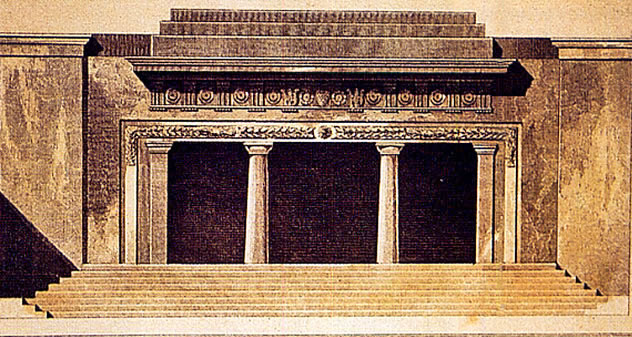
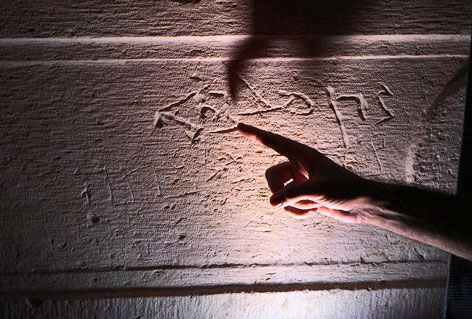
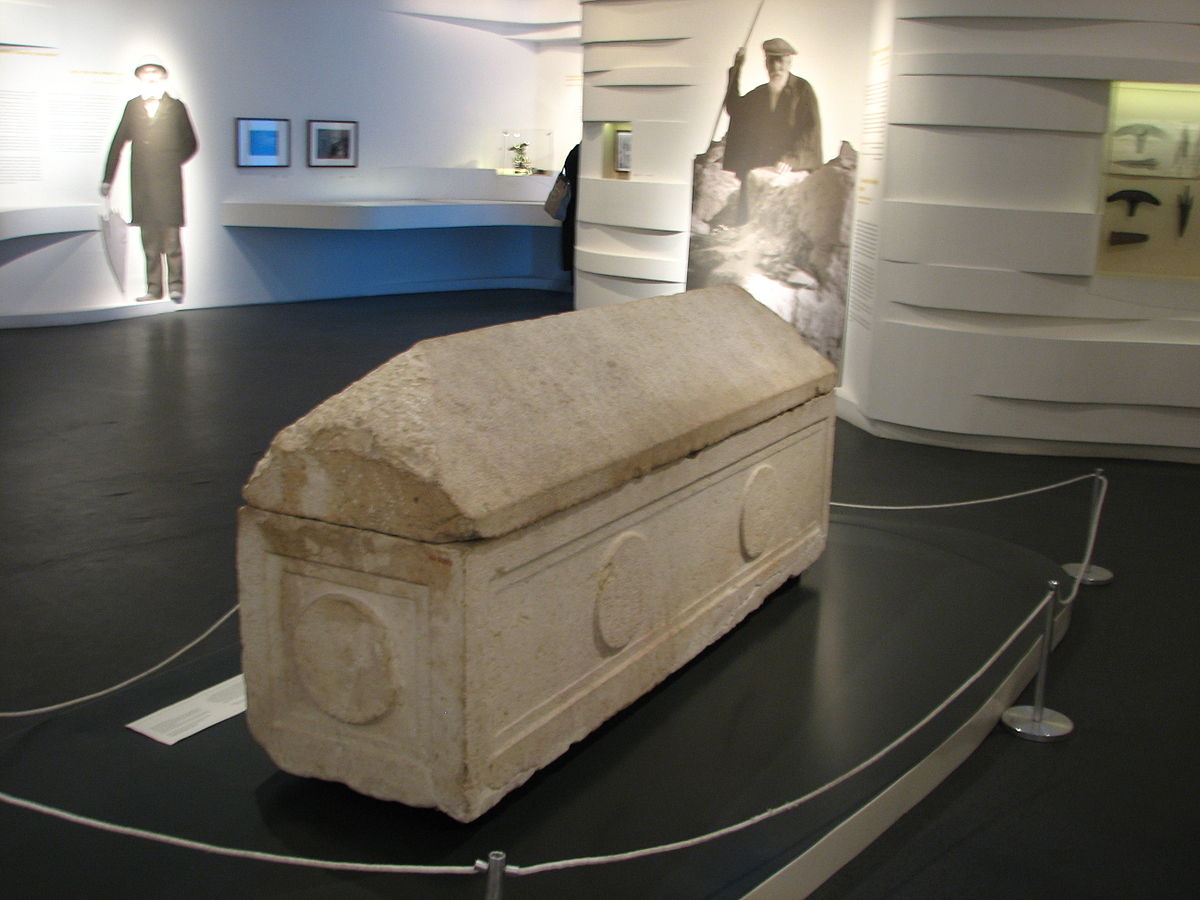


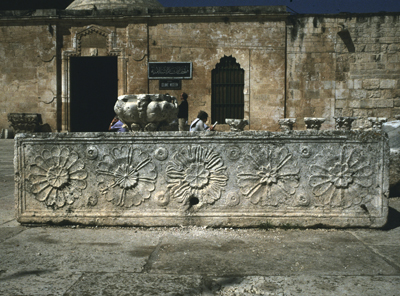


“What interests me in these sarcophagi is their decorations. They all display rosettes, resembling flowers. These motifs are well known from the Temple Mount Excavations, where many such fragments were found.”
The golden lamp that Queen Helena gifted to the temple is being constructed in hope that it will hang at the entrance of the new Temple in Jerusalem. I believe this lamp represents the Shekinah that I have installed on Santa Rosa Island for safe keeping. No one will enter the new temple unless they are cleansed in water by me, or, the one that comes after me.
Jon
‘The Nazarite’

“Simon held the upper city, and the great walls as far as Cedron, and as much of the old wall as bent from Siloam to the east, and which went down to the palace of Monobazus, who was king of the Adiabeni, beyond Euphrates; he also held the fountain, and the Acra, which was no other than the lower city; he also held all that reached to the palace of queen Helena, the mother of Monobazus; but John held the temple, and the parts thereto adjoining, for a great way, as also Ophla, and the valley called “Valley of Cedron;”
Years ago I suggested Nazarite Queen Helena of Abiabene was the Sleeping Beauty Princess, Rosamond. Her sarcophagus lies at rest under the pyramid of the Louvre, the place where Dan Brown’s Fairytale suggests Mary Magdalene, the wife of Jesus is interred. There is not name in the whole internet like that of my grandmother, Mary Magdalene Rosamond, whose granddaughter married a Benton. Jessie Benton and her husband, John Fremont, had Hungarian ex-patriots in their bodyguard, that fought against the Confederated slave masters of the new Roman empire whose false evangelical prophets have taken over Fremont’s party in order to take from the poor, the widow, and the elderly in order to give to the Imperial Billionaires of America.
The Roman swine who pretend to be wolves captured the beuatiful Menorah that Queen Helena gave as a gift to the Jewish people. My story ‘Capturing Beauty’ will bring the Light of God – home! I will overcome the world!
Johanne Wolferose
Judaism in Adiabene survived the death of Izates and Helena. History indicates that the Jewish religion continued to play a part in the kingdom of Adiabene; non-royal Adiabenians converted. “The names of the Adiabenite [sic] Jews Jacob Hadyaba and Zuga (Zuwa) of Hadyab,”33 indicate a non-Hebrew origin and possible conversion to Judaism.
Mindful of the events which in her view were of a positive nature, Helena journeyed with her retinue to Jerusalem and the Great Temple to worship and offer thank-offerings while the throne in Arbela had been safeguarded. Queen Helena offered items of blessing including a special addition to the Kodesh, or Inner Sanctuary of the Great Temple:
The doorway of the Kodesh was 10 cubits wide and 20 cubits high. Over the doorway was a carving of a golden menorah donated by Queen Helena, a convert to Judaism. The morning service could not begin before sunrise. The Temple was surrounded by high walls, and it was not possible to see the rising sun, so priest had to be sent outside to see if it was time for the service to begin. After Queen Helena donated the Menorah, it was no longer necessary to send a priest outside the Temple. As the sun rose in the east it shone against the menorah and the reflected light was cast into the Azarah. The priests then knew that the morning service could begin.18
Kevin Brook cites that the Jewish kings of Adiabene were regularly involved in policy and military affairs. In 61 CE, Monobazus II, the king who Izates meant to succeed him, sent troops to Armenia to try to thwart an invasion of Adiabene. Two years later, he was in attendance at a peace settlement between Parthia and Rome. During the war of Judea against the Roman Empire (66-70 CE), the Adiabenian royal family supported the Judean side.34
According to Paul E. Kahle, there were many Jews in the city of Arbela even after the establishment of bishops and the spread of Christianity in Adiabene.35
Book V, Chapter VI, Section 1 (Entire)
The Vast Slaughters Occurring Within The City
1. Now the warlike men that were in the city, and the multitude of the seditious that were with Simon, were ten thousand, besides the Idumeans. Those ten thousand had fifty commanders, over whom this Simon was supreme. The Idumeans that paid him homage were five thousand, and had eight commanders, among whom those of the greatest fame were Jacob, the son of Sosas, and Simon, the son of Cathlas. John, who had seized upon the temple, had six thousand armed men, under twenty commanders; the zealots also that had come over to him, and left off their opposition, were two thousand four hundred, and had the same commander they had formerly, Eleazar, together with Simon, the son of Arinus. Now, while these factions fought one against another, the people were their prey of both sides, as we have said already; and that part of the people who would not join with them in their wicked practices, were plundered by both factions. Simon held the upper city, and the great walls as far as Cedron, and as much of the old wall as bent from Siloam to the east, and which went down to the palace of Monobazus, who was king of the Adiabeni, beyond Euphrates; he also held the fountain, and the Acra, which was no other than the lower city; he also held all that reached to the palace of queen Helena, the mother of Monobazus; but John held the temple, and the parts thereto adjoining, for a great way, as also Ophla, and the valley called “Valley of Cedron;” and when the parts that were interposed between their possessions were burnt by them, they left a space wherein they might fight with each other; for this internal sedition did not cease, even when the Romans were encamped near their very walls. But although they had grown wiser at the first onset the Romans made upon them, this lasted but for a while; for they returned to their former madness, and separated one from another, and fought it out, and did everything that the besiegers could desire them to do; for they never suffered anything that was worse from the Romans than they made each other suffer ; nor was there any misery endured by the city after these men’s actions that could be esteemed new. But it was most of all unhappy before it was overthrown, while those that took it did it a greater kindness; for I venture to affirm, that the sedition destroyed the city, and the Romans destroyed the sedition, which it was a much harder thing to do that to destroy the walls; so that we may justly ascribe our misfortunes to our own people , and the just vengeance taken on them by the Romans; as to which matter let every one determine by the actions on both sides.
News of the discovery of human bones, and from a Jewish queen moreover, inflamed the Jewish community in Jerusalem. The community petitioned prominent figures in Europe and lobbied the Ottoman authorities. De Saulcy was forced to suspend his excavation, but not before managing to send the sarcophagus and his other findings to France. Since then the queen’s coffin has languished, largely unseen, in the basement of the Louvre in Paris
News of the discovery of human bones, and from a Jewish queen moreover, inflamed the Jewish community in Jerusalem. The community petitioned prominent figures such as Moses Montefiore and the Rothschild family, and lobbied the Ottoman authorities. De Saulcy was forced to suspend his excavation, but not before managing to send the sarcophagus and other findings to France. Since then the queen’s coffin has been in the Louvre in Paris. According to Maoz Lin, the museum displayed it for a while and then put it in storage. It was brought out again in 1982, for an exhibition marking the centenary of de Saulcy’s death, after which it went back into storage.
The main problems were the technical arrangements for transferring the sarcophagus. At the demand of the Jewish community in France, two rabbis came to make sure there were no human bones remaining inside.”
The Israel Museum’s director, James Snyder, and the French ambassador, Bigot, were also involved in the negotiations. Without their intervention, Maoz Lin notes, the royal coffin might never have left Paris. Snyder says that the French ambassador aided in the operation enthusiastically, and both Choukroun and Bigot stress the good will their country displayed in the matter.
“We have been working on this matter for a very long time, and we are very glad that the sarcophagus is back in Israel,” says Bigot. “The president of the Louvre is an old friend of Israel’s and he wanted to grant the request. A lot of details had to be worked out, to make sure that the casket is transferred safely, and more. So we are delighted that its transfer ended successfully.”
On the Tuesday before Sukkot, a few hours after the ceremony in honor of the burial box’s return to Jerusalem, Snyder entered the room where it is on display to the public, as part of the exhibition “Breaking Ground: Pioneers of Biblical Archaeology.”
“I saw a young family there, visiting the exhibition,” he says. “I realized that they did not understand what this object was, so I explained it to them. The return of the sarcophagus to Jerusalem makes me very happy. If the supposition is correct and it is really the sarcophagus of Queen Helena, the idea that we can look at a coffin in which a queen from the first century C.E. was buried – a woman who converted and who contributed a great deal to the people of Jerusalem – is very exciting. It opens a door to a piece of history that you would have no chance of knowing otherwise.”
“Her son [Izates] having gone to war, Helena made a vow that if he should return safe, she would become a Nazirite for the space of seven years. She fulfilled her vow, and at the end of seven years went to Judah. The Hillelites told her that she must observe her vow anew, and she therefore lived as a Nazirite for seven more years. At the end of the second seven years she became ritually impure, and she had to repeat her Naziriteship, thus being a Nazarite for twenty-one years. Judah bar Ilai, however, said she was a Nazirite for fourteen years only.”[8] “Rabbi Judah said: ‘The sukkah [erected for the Feast of Tabernacles] of Queen Helena in Lydda was higher than twenty ells. The rabbis used to go in and out and make no remark about it’.”[9]
What interests me in these sarcophagi is their decorations. They all display rosettes, resembling flowers. These motifs are well known from the Temple Mount Excavations, where many such fragments were found. None of these fragments were large enough to inform us reliably as to the style of Temple Mount decoration. In order to make reconstruction drawings, we had to turn to the funerary monuments and sarcophagi of the Second Temple period which reflected the architecture on the mount itself.
The variation in motifs was amazing. For instance none of the rosettes on the sarcophagi and tomb friezes was the same as the next. The sarcophagus of this Mesopotamian queen with its arrangements of rosettes resembling a frieze is invaluable as an indication of the splendour and beautiful architecture of Herod’s Temple and the buildings of the Temple Mount.
Nearly 3,000 km [2,000 miles] from Judea, east of the Tigris River, lies the ancient land of Adiabene — nowadays more or less Iraqi Kurdistan (upper middle of map). In Helena’s time, during the early first century CE, Adiabene was a client kingdom of the Parthians. According to the Jewish historian, Josephus,** it was also where the remains of Noah’s ark were still visible and could be shown to anyone who was interested in such things.
http://judithweingarten.blogspot.com/2010/10/queen-helena-returns-to-jerusalem.html
Queen Helena lived happily with her husband, Monobaz, in Adiabene. Occasionally, Jewish merchants used to visit Adiabene on business. Through them Helena became acquainted with, and interested in, the Jewish religion. As time went on, she became so deeply attracted by the high moral standard of Judaism that she engaged a teacher for herself to learn all she could about it.
The royal house of Adiabene helped the Jewish state in many ways. Many a time they sent large sums of money to Jerusalem, either to provide for the needs of the Beit Hamikdash or to help the poor. Once, a very serious famine ravished the Jewish land, and soon there was no money left to buy food from other countries. Queen Helena and her son used a large portion of their own state treasury to buy grain in Alexandria and dried fruits in Cyprus, and have all this lifesaving food shipped to Jerusalem.
When Monobaz was criticized by some of his advisers for squandering his money on the poor, both in his own country and in the Jewish state, he replied:
“My ancestors amassed treasures in this world, while I gather treasures for the world to come. My ancestors placed their treasures in chambers, and had to guard them against thieves; my treasures are far from the reach of any greedy hand, and will be safe forever. My ancestors’ treasures did not produce any fruits, but mine continue to bring more and more fruit.”
Such was the piety and charitableness of Queen Helena and her sons.
In the Mishnah we are told of many gifts which Queen Helena and her son gave to the Beit Hamikdash, for which they are remembered for all time. For instance, she had a golden candelabra placed above the entrance to the Beit Hamikdash, which not only had its own light, but early in the morning it reflected the sun’s first rays. Thus, when the priests wanted to know whether it was already time to say the Shema in the morning, they had only to look at Queen Helena’s candelabra.
Another gift of Queen Helena was a tablet of gold, on which she had a certain portion of the Torah inscribed, which was of special interest to women. In addition, King Monobaz and his mother donated golden handles to be attached to all vessels used in the Beit Hamikdash on Yom Kippur.
Once, on a visit to Jerusalem, Queen Helena built a beautiful mausoleum where she and her sons were to be buried after their death. Its door had an ingenious mechanism that opened it once a year at a certain hour and closed itself again, to stay closed for another twelve months. Even now, parts of this beautiful tomb, called the Tombs of the Kings, are still left.
Before her death, Queen Helena traveled to Jerusalem to spend there the last years of her life in prayer and good deeds. According to tradition, she lived as a nezirah (nazirite) for fourteen years, to keep a vow she had made for her son and for herself.
 Rosamond Press
Leave a comment