


Wooden Ships
by
John Presco
Copyright 2023
Christine Wandel told me her lover, Peter Shapiro, played for the Charlatans, the first SF band to use psychedelics on a regular basis, and promote legal LSD as part of their Rock and Roll Mystique. Peter Shapiro told me Mike Wilhelm led the way, and was a great guitarist. Christine did not like Mike.
“He was a scroungy little guy!”
“Why did you say that?”
“I think he kept coming on to me, knowing I was with Peter.”
Christine wanted me after coming into my room and watch me work on a very cosmic and magical sea-scape. We had just moved into the Victorian on 13th. She was still with Peter, but now was with Keith after recognizing him as the young Brit she met while going to Mills College. I was put on the back burner. Everywhere Peter played, Christine went with.
Tim Scully gave me as many canvases, brushes, and oil colors I wanted. Mr. B intriduced us at Berkeley Art supplu that Tim co-owned.
“Give Greg whatever he wants!”
Christine travel all over Europe with Mr. B.. A report highly suggested my grandfathers put cocaine in their sasperella. Where did this drug come from? Was it promoted as a miracle cure for depression, and the blues? Did Doctor William Stuttmeister own a Doctor’s license to legally procure the main ingredient for The Janke Magic Elixir. Will was a very successful dentist. Was cocaine used to ease the pain of tooth extractions? Tall ships ferried folks from SF to the Janke Theme Park in Belmont. Did any of these ships sail from Columbia? There was a magical carousel and tree platforms where children gathered to view the magic all around them. Fraternities brought their own bands that played on the dance floore that encircled a large Oak. Carl Janke had erected portable house in San Francicso that he brought around the Cape, and thus he too desrves the title ‘The Man Who Built San Francisco.
Keith Purvis and I were hooked up to Tim Scully’s first bio-feedback machine by Tim, after he gave us a sample of the new and improved batch. We met members of the Brotherhood of Eternal Love, a.k.a The Hippie Mafia. Last week, the first person graduated form the new psilocybin therapy AA fonder Bill W. took LSD to save himself from dying of alcoholism. My generation had become convinced Russia would start a war – to end all wars. I believe the Barbihiemer phenonium is a next generation Hippie Doctor Movement. We want to be well by turning and facing THE TRUTH rather than buring our head in the sand. We want – A NEW WORLD!
It is my goal to marry my fiancés at Ralston Hall in Belmont.
To be continued.
“Helped by the Brotherhood of Eternal Love, Orange Sunshine spread around the country, to Europe, India and even to American troops in Vietnam, and become part of the vernacular of the day.”
https://en.wikipedia.org/wiki/Wooden_Ships
“Wooden Ships” was written at the height of the Vietnam War, a time of great tension between the United States and the Soviet Union, nuclear-armed rivals in the Cold War. It has been likened to Tom Lehrer‘s “We Will All Go Together When We Go” and Barry McGuire‘s “Eve of Destruction,” in that it describes the consequences of an apocalyptic nuclear war.[2] According to the liner notes, the writers “imagined ourselves as the few survivors, escaping on a boat to create a new civilization.”[4] This represents one of Kantner’s recurring themes, to which he would return again in the 1970 concept album Blows Against the Empire.[5]
Horror grips us as we watch you dieAll we can do is echo your anguished criesStare as all human feelings dieWe are leaving you don’t need us
It is also described in an (unsung) prelude, included in the lyric sheet:Black sails knifing through the pitchblende nightAway from the radioactive landmass madnessFrom the silver-suited people searching outUncontaminated food and shelter on the shoresNo glowing metal on our ship of woodOnly free happy crazy people naked in the universe[2]
Oregon’s new psilocybin therapy program went live in January, but it’s taken months to train new facilitators. So people are only now beginning to take hallucinogenic mushrooms under the system.
One of the first was James Carroccio, a retired small business owner. He doesn’t actually live in Oregon. He traveled here from Arizona in his RV. But he used to live in Bend and has kept a close eye on Oregon’s new system in the hope of getting help.
When he was 14, Carroccio found his father in bed, dead from a heart attack. His mother was out of the picture, so suddenly, he was alone.
“I lost everything,” he said. “My world was out of control, and I had to get control of things around me.”
Carroccio developed what he thinks are obsessive-compulsive disorder and post-traumatic stress disorder. By middle age, he spent hours obsessively cleaning the windows, baseboards and floors, even though he could afford to have a housekeeper visit regularly.
“The lines were erratic on the carpet,” he said. “I would get the carpet out and vacuum a very consistent pattern into the carpet.”
His compulsive behavior impacted many aspects of his life, in positive and negative ways; he says he over-regimented the lives of his children. He also thinks his tendency to keep an immaculate job site pleased clients.

Over 30 years, Carroccio estimates he went through a dozen therapists. It was of limited help.
“The therapist always gave me a quick feel-good. But the pattern and the behavior never changed” he said. “With the hope of psilocybin, I was looking for a complete change.”
Don Sweeney
August 16, 2023·1 min read
Photos taken on the Oregon coast show a wonderland of glowing tides, wheeling stars and a falling meteor.
“Magical scenes from a fairy tale,” photographer Jay Shah called them in an email interview with McClatchy News.
One photo shows bioluminescent tides around Arch Rock in southern Oregon with stars wheeling in the night sky, captured by a long exposure, Shah said.
Another shows the glowing tides, a shipwreck, the Milky Way and a falling meteor from the Perseid shower at Fort Stevens State Park, he said.
“The magical bioluminescence sparkled all around our boots!” Shah said. Both photos and other photographs are on his Instagram page at @shutterbug_shah.
https://ca.style.yahoo.com/see-magical-bioluminescent-tides-coincide-185241697.html
Happy Birthday Tim Scully!!!
Robert “Tim” Scully born August 27, 1944
In heyday of LSD, secret Windsor lab produced millions of Orange Sunshine pills
Inside the Windsor Historical Society museum there are collections of fine art, archaeological artifacts, tools and household gadgets, thousands of items on shelves, in hutches and behind glass, some dating back nearly four centuries.
Two recently added items at the Hembree House – discretely placed posters in the two bathrooms – provide a hint, however, to a time in Windsor’s past that is neither well known locally nor widely publicized.
In the late 1960s, a small group of hippie zealots worked feverishly in an old Windsor farmhouse to produce an especially pure form of LSD, on a mission to turn on the world.
Little was known about the clandestine lab because it was never busted. Authorities only found out about it several years after it was dismantled.
That hidden chapter of history had its start in late 1968 when the lab was set up in Windsor. Within a few months it produced roughly 3 pounds of LSD, or enough to make 4.5 million hits of “Orange Sunshine,” a nickname for the orange-colored, barrel-shaped pill that produced an especially powerful psychedelic trip.
It would become one of the iconic drugs of the late 1960s, proclaimed the finest acid in the land by Timothy Leary, the former Harvard instructor who famously advised people to “turn on, tune in, drop out.”
It was the year after the “Summer of Love” when thousands of flower children flocked to San Francisco to get high and groove in The Haight, espousing peace, love and Utopian ways. Some would come north to Sonoma County for back-to-the land communal living.
Among those who discovered Sonoma County was Tim Scully, a wonky East Bay kid and a physics major who’d dropped out of UC Berkeley. He and his associates chose Windsor to make LSD, which they saw as God’s gift to humanity because of the ecstatic, consciousness-raising experience they had with the drug.
They chose a secluded Windsor farmhouse screened by trees, on 2 acres off Wilson Lane, now Mitchell Lane, to the west of Baldocchi Way. It was demolished more than 30 years ago to make way for Vintage Green subdivision homes.
“They invented Orange Sunshine, right here in Windsor,” said Windsor Historical Society President Steve Lehmann. “To me it’s history. I’m surprised we don’t have people doing some kind of pilgrimage here.”
“Sunshine Makers” come to Windsor
When Scully took LSD for the first time in April 1965 he felt at one with God and all living things.
Later that year he began hanging out with the San Francisco-based Grateful Dead, helping as sound engineer for the rock band along with Owsley “Bear” Stanley, already dubbed “The King of LSD” for the purity of his product.
The late Stanley, then 30, took the 21-year-old Scully as his apprentice beginning in mid-1966 at a lab in the basement of a rented house in Point Richmond. Stanley, his girlfriend and Scully cranked out 300,000 doses of “White Lightning” LSD. With the approaching 50th anniversary of the Summer of Love, the mayor of Richmond is trying to pinpoint the location and put up a commemorative plaque.
But in October 1966, LSD became illegal in California, and Stanley and Scully moved to Denver to set up a new lab.
The following year, Scully was introduced to Nick Sand, another underground chemist, and they collaborated in San Francisco to produce STP, a new psychedelic which was not yet illegal. Sand, another LSD proselytizer, had been introduced to LSD at Millbrook, an upstate New York farm and experimental community frequented by Leary.
By late 1967, Stanley was busted in connection with a tableting LSD lab in Orinda and Scully moved the Denver lab to another house.
But that was discovered in mid-1968 by authorities, when a water pump broke and police were called to the house while Scully was in Europe looking for precursor chemicals to make LSD.
Sand agreed to finance a new lab if Scully would teach him the Owsley Stanley manufacturing process.
Scully did on the condition that any LSD made be distributed through the Brotherhood of Eternal Love, rather than the Hells Angels. The former was described by some as a hippie mafia, a group of California surfers who evolved into a worldwide drug distribution network. The latter were notorious for gratuitous violence.
By late December, Sand through an intermediary, purchased the farmhouse in Windsor where he and Scully set up the large-scale LSD lab.
The real estate agent was told the buyer was a physics professor who wanted to set up a photography darkroom in the old farmhouse. The money came from proceeds of sales of psychedelics from Sand’s STP lab.
Scully and his partner were in a hurry to make as much LSD as they could, because they believed the raw material would become unavailable. The drug is manufactured from lysergic acid, which is produced by the ergot fungus that grows on rye and other grains but can also be synthesized in a lab. The LSD made in Windsor came from one pound of lysergic acid that was made in Italy, but purchased in London.
Like an early version of “Breaking Bad,” a utility room of the Windsor house harbored a lab equipped with flasks, funnels and glass tubes, along with materials ranging from solvents to dry ice, nitrogen gas and – depending on what stage of the chemical process – ultraviolet or yellow bug lights.
There were vacuum pumps running to provide a steady puttering background sound. “The lab was next door to the kitchen where the glassware was scrupulously washed and cleaned,” Scully said.
“We would work until we dropped, sleep for a few hours and get up and at it again,” Sand recalled of the Windsor lab production in the 2015 documentary film “The Sunshine Makers.”
Turning on the world
Scully and Sand wanted people to have the same insight and intense experience of oneness and empathy they had while tripping. Scully “couldn’t imagine how hatred, cruelty and destruction could continue to exist in the world, if everyone were to share this experience.”
“We agreed we couldn’t just turn on the United States,” he said. “We had to turn on the whole world. Otherwise it would be like unilateral disarmament.”
Helped by the Brotherhood of Eternal Love, Orange Sunshine spread around the country, to Europe, India and even to American troops in Vietnam, and become part of the vernacular of the day.
While the crystalline LSD was made in Windsor, it was apportioned into tablets mostly in a house in Novato, using a triturate machine that stamped out several million doses.
Scully figured they needed to produce 440 pounds – about 720 million doses of LSD – roughly enough to provide a single dose for everyone in the world willing to try it.
But the law caught up with both men.
A recently minted pilot, Scully was arrested at the Napa Airport in May 1969 on charges stemming from the previous lab in Denver.
Sand, he said, immediately shut down the Windsor lab and remodeled and sanitized the room where it had been.
“Sand and Scully were apparently running this lab in Windsor and they did a good job of keeping it from us. We didn’t find the lab,” retired narcotics officer Patrick Clark said in the 2015 documentary “The Sunshine Makers.”
But federal grand jury indictments and the testimony of Billy Hitchcock, the wealthy owner of Millbrook and a friend of theirs who had visited the Windsor lab, helped convict Scully, Sand and others.
In 1974, Scully was sentenced to 20 years in prison for LSD manufacturing and distribution, and Sand got 15 years. Both went to McNeil Island Federal Penitentiary in Washington state and were even cellmates.
Scully was released on an appeal bond partway through his prison term, and had his sentence cut in half, enabling him to be paroled after 3 ½ years.
He had earned his Ph.D. in psychology in prison and in 1979, was named Washington State Jaycees Outstanding Young Man of the Year. He was nominated based on his development of a computer device that enabled a person he knew with severe cerebral palsy to communicate using her knee movements that produced words on a TV screen.
While Scully said he knew by 1970 that he never wanted anything to do with manufacturing drugs, Sand was unrepentant.
While out on appeal, he bolted and spent the next 20 years evading authorities and living under various aliases. He spent time in India at Guru Rajneesh’s ashram. When finally arrested in Canada in 1996, Sand had more than $500,000 in cash and gold and approximately 430,000 doses of LSD, according to newspaper accounts.
Sand went back to prison before being released in 2000. He died April 24 at his home in Lagunitas from apparent heart problems.
Busy in the woods
Scully, 72, now lives in Mendocino County in the backwoods community of Albion on a ridge near the Pacific Ocean. He said he long ago gave up any criminal activity.
Before his conviction and prison time, he founded his own electronics company and still repairs old instruments and computers in his one-bedroom house, cluttered with thousands of books, file cabinets, computer monitors and buckets of firewood for his wood stove.
His longtime partner, Alice Einhorn, lives on the 4-acre property, in a nearby house.
During a recent interview at his home, the gray-bearded Scully, wearing a slight smile, Panama hat, corduroy jeans and a blue hoodie sweatshirt, answered questions with the meticulous detail that hints at his slight Asperger’s syndrome, a compulsive condition manifesting itself in inflexible routines, or pursuit of specific, narrow areas of interest.
In Scully’s case, it was the way he ate the same type of spaghetti and butter dinner every night for decades, until health problems forced him to change.
For the past 20 years he’s been gathering the history of underground LSD manufacturing and has a large database linking chronologies, court records and PDFs of people, labs and locations. He says it will be useful for historians and university libraries. He is also working on a memoir.
After LSD, Scully became interested in making brain wave biofeedback instruments. In a two-page spread in 1970, Life magazine referenced his company, Aquarius Electronics, in an articled entitled “turning on with Alpha waves.”
When it was apparent his drug record would prevent him from teaching, he started working as a consultant to a software computer corporation, joining a techie world where LSD use is not necessarily seen as an automatic disqualifier. Late Apple CEO Steve Jobs, for example, admitted using it.
Scully was hired as a full-time software developer for Marin-based Autodesk Inc. before retiring a dozen years ago and now relies on income from some long-term tenants on his property.
Looking back, Scully has a more balanced view than he once did of both the good and the bad that LSD unleashed.
For some it offered an intensely spiritual experience and especially influenced music and art. But it also induces paranoia, and can trigger, or worsen underlying psychiatric disorders. At its height of popularity in the late 1960s and early 1970s, thousands of freaked-out kids on “bad trips” were picked up annually by police.
“The majority of the people who took LSD had pretty good experiences,” Scully said. “Certainly a few had serious trouble and quite a few ended up in emergency rooms, because they were frightened. Most were fine the next day, but some had long-term issues.”
Although LSD carried a message of peace and love for him and many others, Scully came to realize over the years that it was “more of an amplifier than a message carrier.” Looking back, he says it was a mistake to make it widely available, “to scatter it to the four winds, so young people who were too young to have fully formed personalities were getting it.
“I have some regret,” he said. “We didn’t succeed in saving the world, obviously. Look at who’s in the White House now.”
But there is that quirky historic link to Windsor, a town that went from a dusty farm crossroads dubbed “Poor Man’s Flat” to a family-friendly bedroom community.
The History Society’s Lehmann first found about the LSD connection reading a passing reference on page 266 of an obscure book entitled “Hippie.”
He said the museum has to tread a fine line to avoid sounding like it’s promoting a drug, especially considering that fourth-graders visit the museum on school trips.
Lehmann finds the characters involved with the Windsor lab fascinating, “but not everyone smiles when you talk about LSD.”
Still, he noted, the museum doesn’t shy away from talking about the area’s illegal booze production during Prohibition.
“We’re joking about putting up a plaque at the park, across the street from where the farmhouse was,” he said. “I’m wondering if Windsor is ready for such a plaque.”
Editor’s note: The article has been updated with the correct name of Owsley “Bear” Stanley and to reflect that Scully studied physics at UC Berkeley but did not obtain a degree there. The location of the LSD lab inside the Windsor home as well as the tableting process in Novato has also been clarified.
Former House Speaker Nancy Pelosi (D-Calif.) recounted her top concert experiences in a new interview with The Los Angeles Times.
In the column, Pelosi discussed the transition from being Speaker and the minority leader in the House to now just serving as a member of Congress.
“You have to remember that for 20 years, either as speaker or [minority] leader, I was responsible for everything that happened on the floor … in terms of what happened with the Democrats … and I didn’t even realize that it was a burden until it was gone and I was like, ‘Oh, my God. What a relief,’” she said.
“I still, obviously, take an interest in the legislation,” Pelosi continued. “And I still raise
money for the Democrats.”
She recounted attending a Dead & Company concert in San Francisco, the home of the former band the Grateful Dead. The House had just passed the defense spending bill on that Friday, giving the former Speaker plenty of time to make it home for the show, she told the newspaper.
She told the lead singer, Bob Weir, that he should wear a hat and socks for the concert if he was cold while she was visiting the band backstage. Weir ended up wearing a hat, and Pelosi ended up being gifted the set list, the newspaper reported.
Pelosi was hesitant to name her top favorite show, but reminisced a time when she saw Bob Dylan perform in Argentina as part of the Rolling Stones’s “Bridges to Babylon” tour. She said she brought former Rep. Nita Lowey (D-N.Y.) to the show.
She also recalled being introduced at a Barbra Streisand concert and explained on how music could unify people.
“In that audience … they’re not there because they’re Democrats,” she said. “You’ve got a very mixed group of people. And it just completely drove home the point … which is that [music] is a unifier. People forget their differences, they don’t even think of it. They laugh together, cry together, are inspired together, find common ground together and I do think that’s our hope.” TAGS BOB DYLAN NANCY PELOSI NANCY PELOSI
Love and The Marbles
Posted on July 30, 2015 by Royal Rosamond Press
Peter Shapiro and I lived together in two Victorians in the Bay Area. We lived on 13th. Street near downtown Oakland, and a home in East Oakland where I did a painting of Rena Easton in 1971. When my friend, Bryan Maclean, of ‘Love’ died in 1998, I lamented the loss of the three artists God put in this world to accompany me and my gifts. Bryan and I had been the resident artist at University High is West Los Angeles in 1963 – 1964. Marilyn Reed and I created a Beatnik scene, and I drew her at a tea house we found on Sawtell. This became the New Balladeer where Bryan played with his friend, David Crosby. Bryan was also good friends of a Venice Beat named, Sky, who was murdered by my second girlfriend’s father who belonged to the Purple Gang. Bryan dated my sister, who in 1972 became the world famous artist ‘Rosamond’.



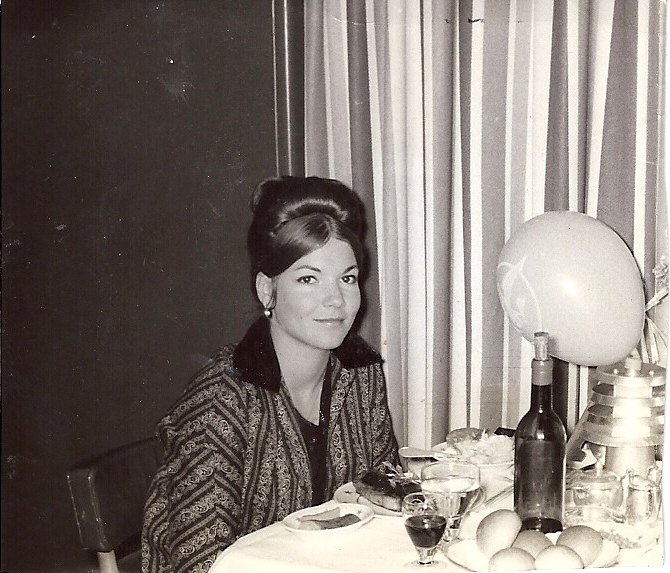
Marilyn is still a good friend of Jazz great, Les McCann. After we broke up she went with Jeff Pasternak to France on a ocean liner. Here she is having dinner with Jeff onboard. Jeff founded a rock group ‘The Mustard Greens’ that played at the Whiskey A Go-Go, where he met ‘The Doors’ that he tried to get in his father’s movie.
“Bryan started playing guitar in 1963/64. He got a job at the Balladeer before it changed its name to the Troubadour Club, playing back-up blues guitar. It was here he met the pre Byrds Jet Set while dating Jackie De Shannon and he became ‘fast friends’ with David Crosby. He moved away from home and by early 1965 he became road manager for the Byrds on their first Californian tour with the Rolling Stones.”
Bryan was a roadie for the Byrds when he was seventeen. We were both on the brink of dropping out of high school that we had outgrown. Bryan told me he was going to got on tour with the Byrds in Europe, but because he was underage, then did not take him. Bryan went to live with the Beat Artist, Vito Paulekas
In 1966 I went with my friend Nancy Van Brasch to see ‘Love’ at the Filmore. Instead of inviting us back stage, he came out into the audience to see me. He was fucked-up, and embarrassed when I noticed. He had dabbled in heroin in Venice where he hung with the Beats. I would read he had a freak-out and broke a big window.
Nancy and I lived in a famous commune in SF, and she dated Stanley Augustus Owsely. Christine Rosamond came to live with us, and she went on a date with Nick Sands. I later got to know members of ‘The Brotherhood of Eternal Love’ who bought me art supplies. I was the Artist in Residence when I lived with ‘The Loading Zone’.
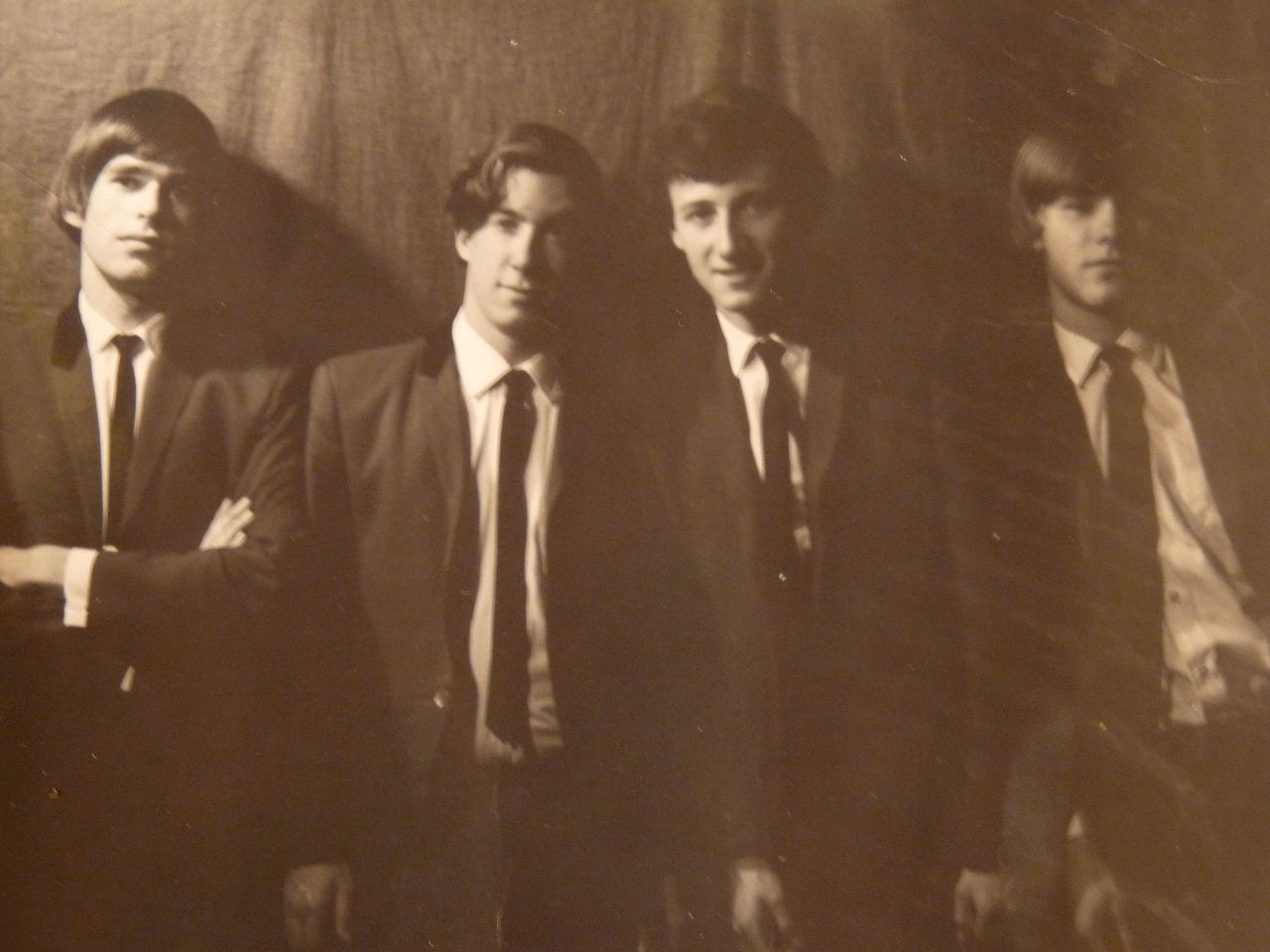
Peter Shapiro, was the founder of the Acid Rock Group ‘The Marbles’ who played at ‘The Tribute to Doctor Strange’ the Longshoreman’s Hall in 1965. A thousand original hippies were there. That is Peter on a bridge in Venice California with Keith Purvis, Tim O’Connor and his girlfriend, and myself. Tim was in love with Christine, who was Keith’s lover, who was Christine Wandel’s lover, who was Peter’s lover, and whom became my lover in 1967. Christine is currently the lover of the New York Artist, Stefan Eins, the founded of Fashion Modem that resembles the Berkeley Experimental Arts Foundation, who are The Open Theatre that presented the Loading Zone and Big Brother and the Holding Company.
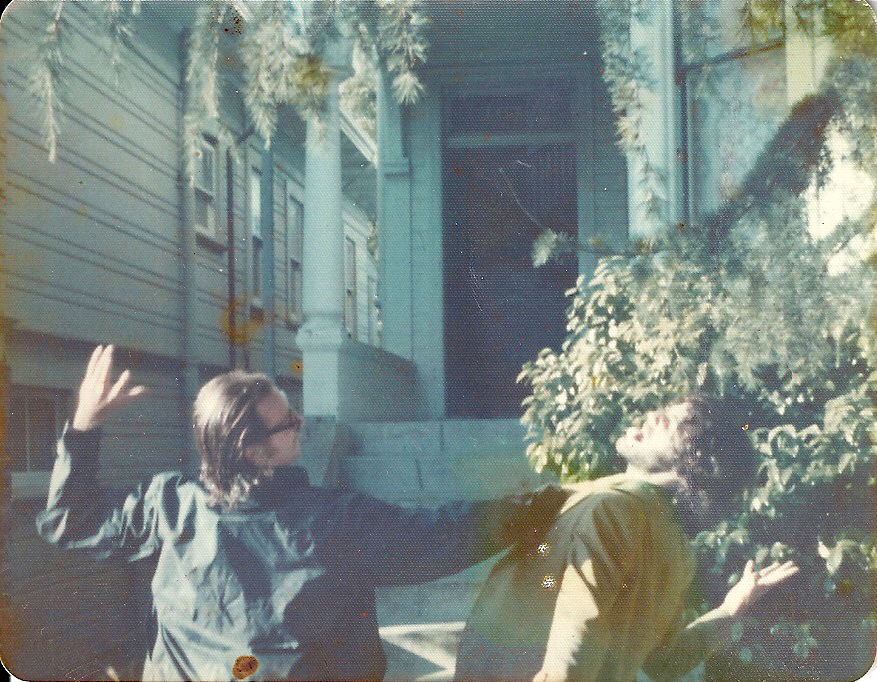


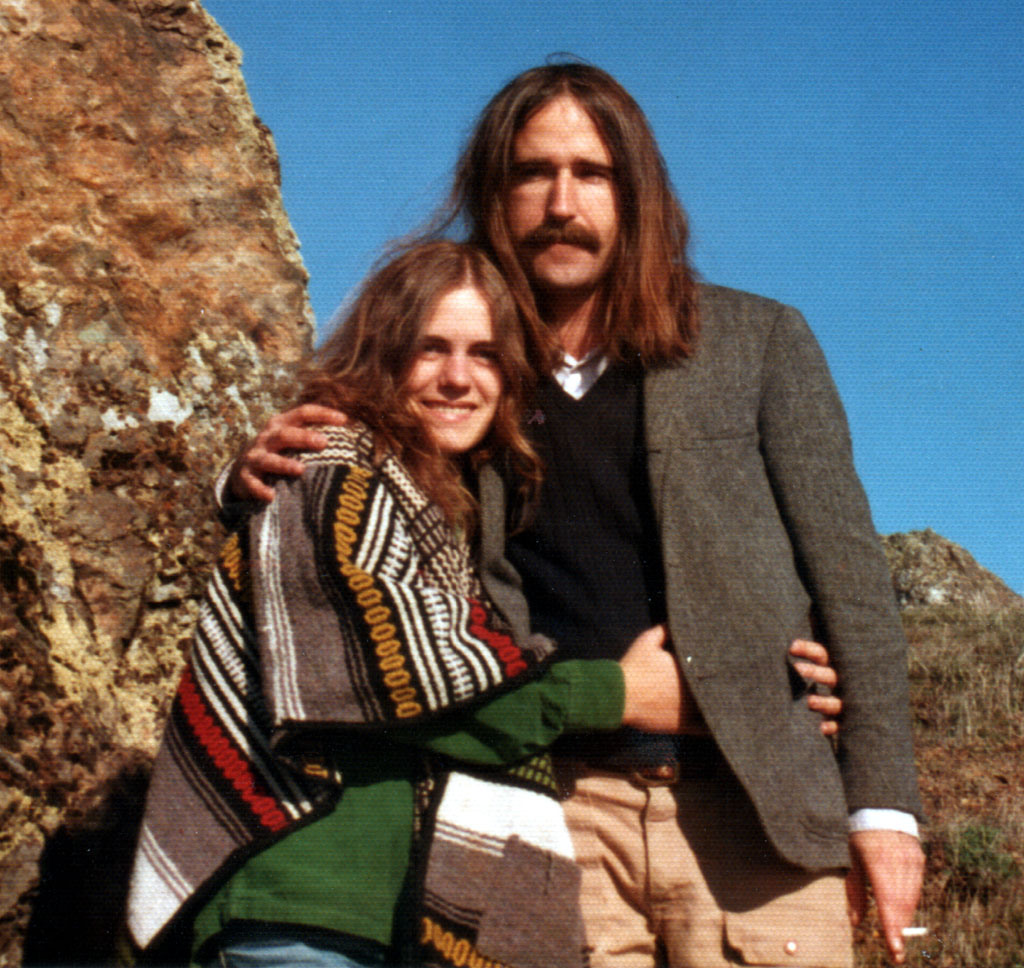
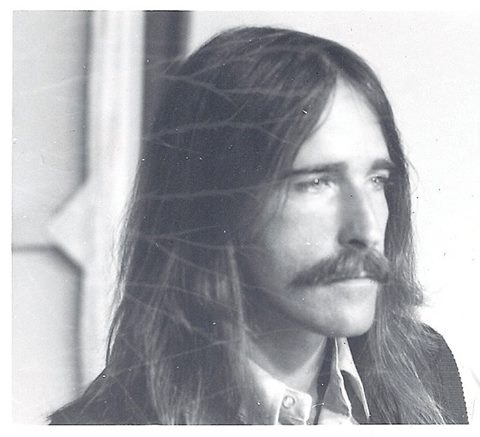
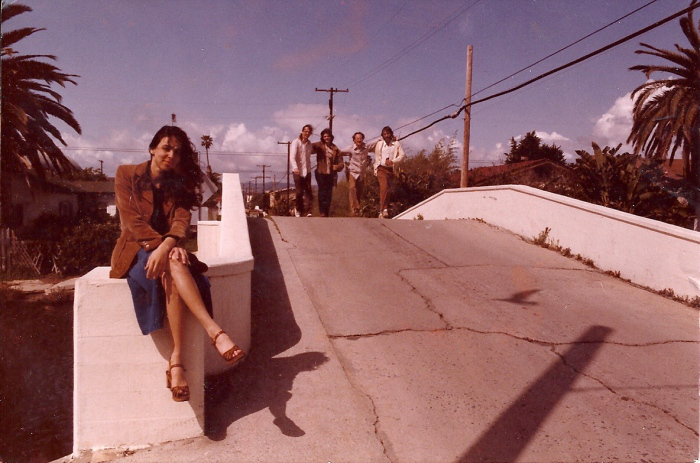
Keith was the lover of Berry Zorthian, the daughter of the artist, Jirayr Zorthian, who was titled ‘The Last Bohemian’. He was influenced by the artist Thomas Hart Benton, whose cousin, Garth Benton, married my late sister, the world-famous artist known as Rosamond. Christine Rosamond Benton lived in the ‘Idles Hands’ commune in San Francisco along with the Zorthian Sisters, and Nancy Hamren, a good friend of the Kesey family. Betty Williams-Zorntian paid the rent. That is Betty playing the guitar to her children. In 1965, when I was eighteen, I dropped acid at Betty’s home in Pasadena, and the Zorthian Ramch.
Here is the testimonial of Alessandra Hart who co-founded BEAF:
“A small group of our friends decided to create the Berkeley Experimental Arts Foundation and we rented a space on College Avenue in Berkeley which we made into a theater, calling it Open Theater & Gallery. Pop Art was just coming in, Andy Warhol was experimenting with it on the East Coast. We opened with a pop art exhibit and a theater piece my husband, Roland Jacopetti, wrote.”
The Loading Zone played at the event these artists and filmmakers put on at the Open Theatre. Here is the missing link between artists and Psychedelic Music that was an intended to be a sideshow to a multimedia happening aimed at expanding your mind, with, or without LSD. We are talking about ART, that would soon be pushed aside, put on the back-burner while The People got it, that they were Art Pieces, living sculptures on a new and very fluid stage. The Muse was everywhere, and in, everyone. No one wanted to look at art anymore and grove on the artist, his or her………..TRIP! Five hundred people were now living galleries with ten million paintings flashing inside their minds every second. There were light shows put on by The Family Dog whose member, Luria Castell, was the first manager of the Zone.
Christine Wandel has become the Muse of Stefan Eins. Christine, Marilyn, Peter, Jeff, and myself all read ‘Autobiography of a Yogi’. Marilyn, Jeff, and myself, lived in the Whiteaker Neighborhood, who block party is two days away. I had a studio and gallery on Blair in 1987.
Jon Presco
Copyright 2015
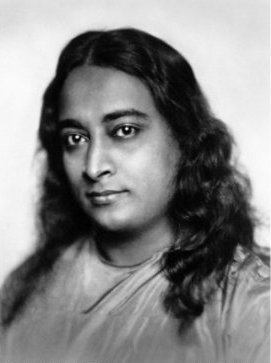
https://en.wikipedia.org/wiki/Paramahansa_Yogananda
http://berkeleyfolk.blogspot.com/2009/09/2976-college-avenue-open-theater.html
The Open Theater, at 2976 College, was a venue for “Happenings” that would now be called Performance Art. The directors were a Berkeley Drama School dropout named Ben Jacopetti and his wife Rain. Among their innovations were a light show that featured significant (if arty) nudity. When the performers auditioned for Tom “Big Daddy” Donahue’s psychedelic nightclub Mother’s on Broadway (home of Carol Doda and numerous topless clubs), Donahue rejected the show for having too much nudity.
The Open Theater seemed to be only open for a year or 18 months, but it was an important part of the scene, as the Open Theater was a big part of the Bay Area underground prior to the Fillmore. Berkeley comedy duo The Congress of Wonders got their start as part of the Happenings and Gary “Chicken” Hirsch (later in Country Joe and The Fish) sometimes played in the house jazz group. George Hunter and Alton Kelly artwork graced the lobbies. Thus the fact that Big Brother’s first public show (on January 15, 1966) was a benefit for the Open Theater seems only fitting. Charles Perry in his book Haight Ashbury – A History (Vantage 1985) has a brief but excellent history of the Open Theater.
http://berkeleyfolk.blogspot.com/2009/09/open-theater-2976-college-berkeley-ca.html
The Open Theater in Berkeley is most famous for debuting Big Brother and The Holding Company, and for being one of the incubators of the Trips Festival, which we have covered elsewhere. Indeed, another blogger discovered a listing in the Oakland Tribune Theater section that listed one of (if not the) first advertisements for “Psychedelic Music” at the Open Theater. Following the lead of this blogger, I reviewed the Theater Sections of The Oakland Tribune for 1965 and 1966, and managed to piece together the brief, but interesting history of the organization. I apologize in advance for any serious Theater scholars who have stumbled across this, as my focus is more on the musical side of the venture.
The Oakland Tribune first mentions the Open Theater on July 21, 1965. Founders Ben and Rain Jacopetti had formed a group called the Berkeley Experimental Arts Foundation “for the presentation and study of new art forms and trends”. After opening on September 30, 1965, the Open Theater began presenting shows every weekend, and sometimes on weekdays as well. The first listing above (under the heading Little Theaters, from the Sunday, November 7, 1965 Tribune) was typical of their Fall 1965 offerings. There was new theater on Fridays and Saturdays, and on Sunday they had “Sunday Meeting,” a spontaneous meeting. Sometimes music was advertised, as presented by either Ian Underwood or The Jazz Mice, Underwood’s trio.
It was the Sunday Happenings that seemed to be one of the precursors to The Trips Festival. According to Charles Perry’s 1984 book Haight Ashbury: A History, there was apparently multi-media performances, with lights and nudity (too much nudity for San Francisco’s Broadway), music by Underwood and others, an Art Gallery featuring contemporary art, and so on. The bass player for the Jazz Mice was artist Tom Glass, known also as Ned Lamont, and a painting of a huge comic book-style painting of his graced the lobby.
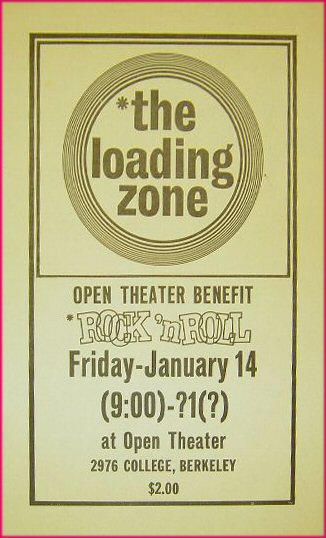
In January, the open theater begins to shift somewhat more towards music. The second (split-up) entry is from the Sunday, January 9, 1966 edition of Oakland Tribune. The Sunday night happening is followed by an apparently musical performance by Day Wellington and The Poor Losers. The next weekend is January 14 and 15, when The Loading Zone and Big Brother make their debuts, in evenings of “rock and roll and theatrical improvisation”.
The weekend of January 21-22-23 was the Trips Festival, in which the Open Theater participated. They surely contributed some multi-media, and Ian Underwood’s Jazz Mice played the first night. On the Saturday night (January 22), Underwood and others presented an avant garde musical performance. The last day of the Trips Festival, however, the Open Theater has its Sunday Meeting as usual, although perhaps some of the regular participants may have been a little worse for wear.
The last clipping is from the Sunday January 23 edition of the Tribune, noting the Happening, and also upcoming musical events. They are
Thursday January 27, 1966
Ramon Charles McDarmaid and Don Buchla, Movies by Bruce Baille
Don Buchla had constructed the Thunder Machine for Ken Kesey’s Pranksters, a sort of electronic percussion device.
Friday, January 28, 1966
Performances by Congress of Wonders and Ned’s Mob, introducing new material.
Congress of Wonders were a comedy trio, also regulars at the Open Theater, who did hip comedy and performance art (they later released a few albums). Ned’s Mob are unknown to me.
Saturday, January 29, 1966
Rock and Roll dance featuring The Loading Zone
This would have been The Loading Zone’s third performance, to our knowledge, the first two having been two weeks earlier at the Open Theater (Jan 14) and then at the Trips Festival (either Jan 21 or 22). The Loading Zone was based in Oakland.
The Open Theater continued to present performances through early March. They presented a John Cage piece on February 4 and 5 (reviewed by the Tribune) and a few other shows. Ian Underwood was now mentioned as the Musical Director, and per the March 12, 1966 Tribune it appears that Ben and Rain Jacopetti had left, and the Open Theater was under new management. However, by the end of March the Open Theater had closed. Ian Underwood said the Theater group was looking for a different space, but it was not to be.
https://en.wikipedia.org/wiki/Fashion_Moda
Fashion Moda was founded in 1978 by Stefan Eins. He was soon joined by artist Joe Lewis and William Scott, a young teenager from the neighborhood as co-directors.[1] Defining itself as a concept, Fashion Moda quickly became a strong voice in the New York art world during the late 1970s and the 1980s.[2] Fashion Moda crossed boundaries and mixed metaphors. It helped redefine the function of art in a post-modernist society. Fashion Moda spotlighted such artists as David Wojnarowicz, Keith Haring, Jane Dickson, Stefan Roloff, Jenny Holzer, Mark Kostabi, Kenny Scharf, Carson Grant, Joe Lewis, Thom Corn, John Ahearn, Lisa Kahane, Christy Rupp, John Fekner, Don Leicht, Jacek Tylicki, Stefan Eins himself and graffiti artists like Richard Hambleton, Koor, Daze, Crash, Spank, and many others. In addition to highlighting new talent, Fashion Moda was a major force in establishing new venues. In 1980, Fashion Moda collaborated with the downtown progressive artists organization Colab (Collaborative Projects Inc.) on “The Times Square Show” (June 1980), and Now Gallery which introduced uptown graffiti-related art to downtown art and punk scenes.



The Legendary Longshoreman’s Hall “Dr. Strange” Dance of October 1965
Until Jack’s arrival, the Airplane had confined their performances almost exclusively to the Matrix, with one exception. The club had been designed with them in mind, they were able to fill the room to capacity each time they played (which wasn’t that difficult as the legal limit was under 300–more often than not there would be twice as many bodies crammed inside), and they liked the place. The band was able to rehearse there during the week without having to set up and take down its equipment each time. Being the house band was ideal for them.
But as the Airplane’s reputation spread, there was more of a demand for their services and, like any new band, they needed all the work they could get. The most pivotal of the first outside gigs was undoubtedly the one that took place October 16th at Longshoreman’s Hall, at San Francisco’s Fisherman’s Wharf, dubbed by its comic-book-loving promoters “A Tribute to Dr. Strange.” Also featuring the Charlatans, the Marbles and the Great Society, the event was presented by a four-person collective calling itself the Family Dog, who took their name in honor of Harmon’s recently deceased pooch and lived together in a communal house on Pine Street. It was billed as a Rock ‘n’ Roll Dance and Concert.
 Rosamond Press
Leave a comment