On October 10, 2015, God and Jesus bid me to seize the Republican Party, co-founded by my kindred, John Fremont.
John ‘The Prophet’
I Seize The Republican Party
Posted on December 10, 2015 by Royal Rosamond Press

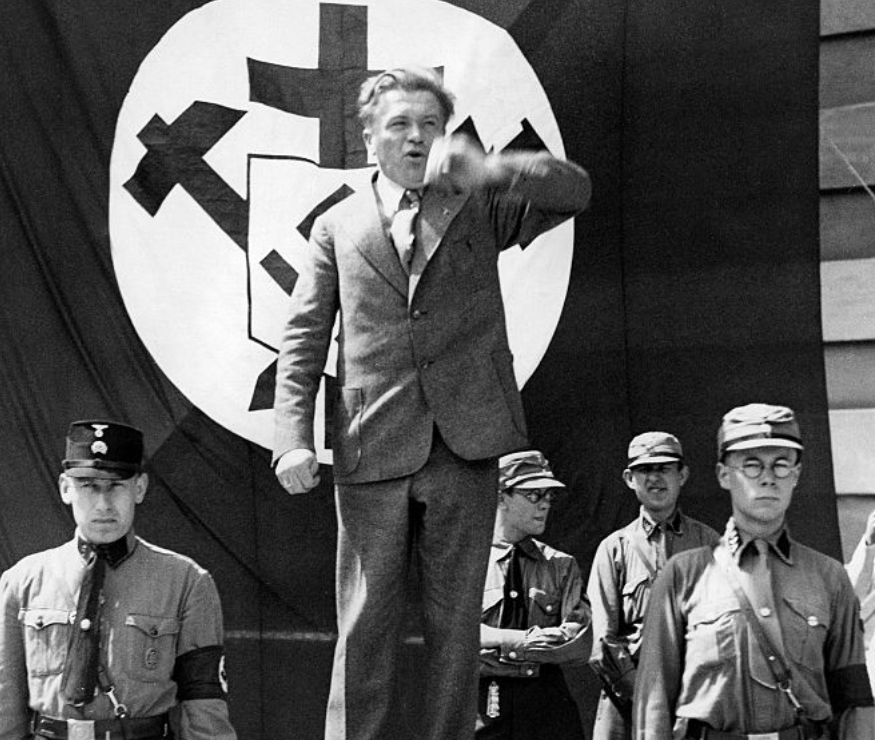
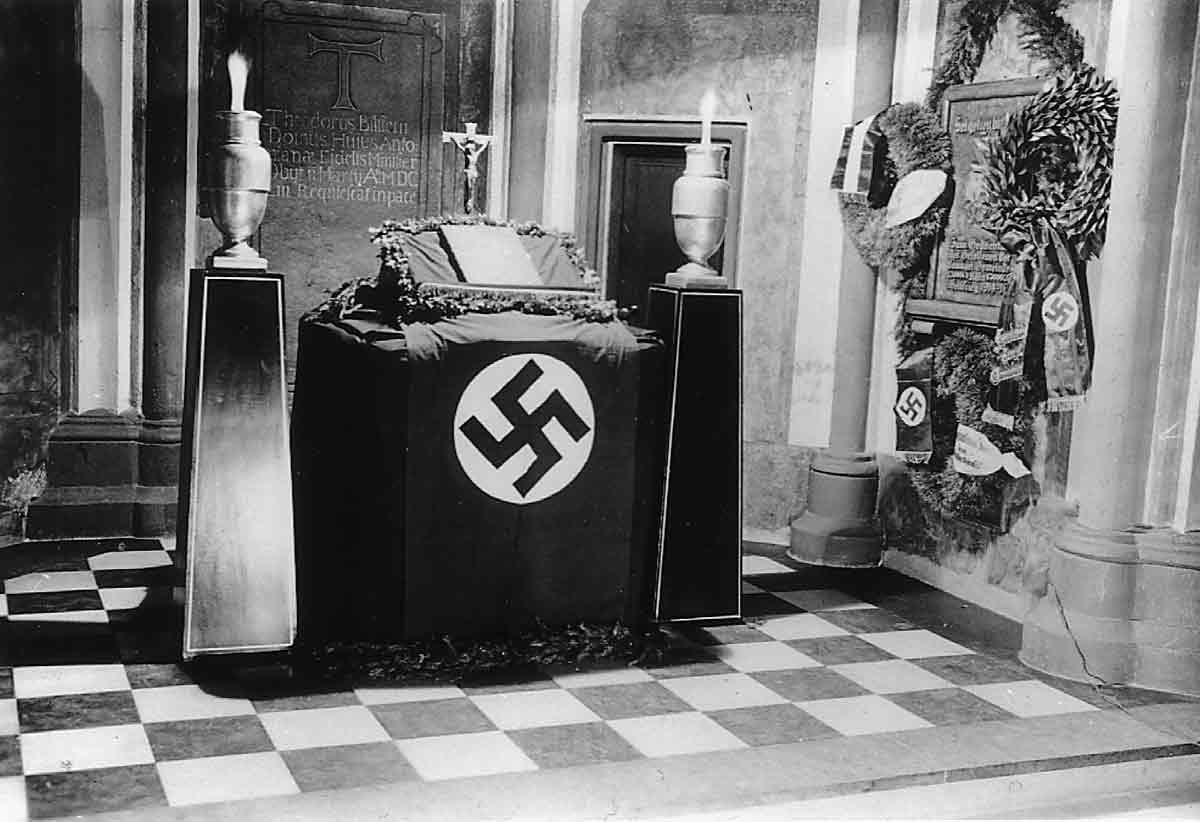
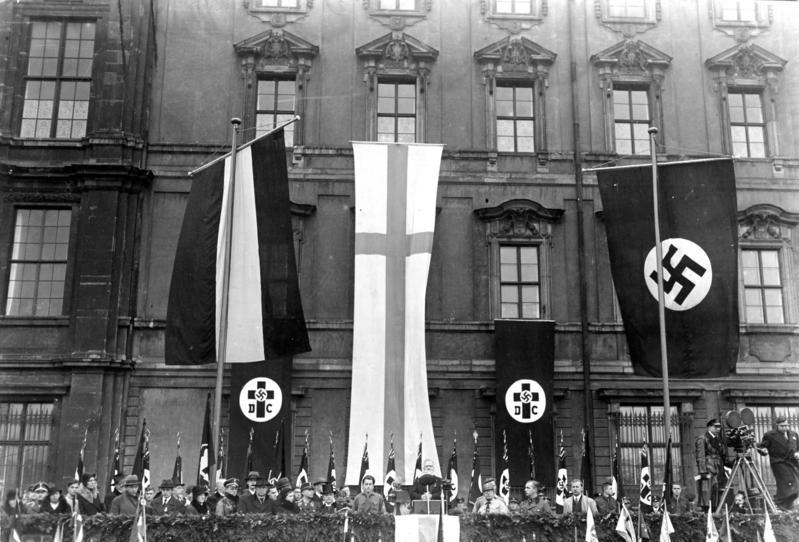
Die große Feier des Luthertages im Lustgarten in Berlin!
Bischof Hossenfelder hält die Ansprache auf der Rampe des Berliner Schlosses im Lustgarten.
19.11.1933
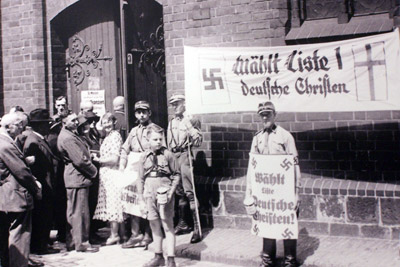
On this day, I seize the Republican Party in the name of my kindred who founded it. For the reason no Republican has condemned Donald Trump, declared him a Traitor to his country in time of war – and placed him under citizen’s arrest – I am compelled to take action. Trump has declared a crusade against Islam using the podium my kindred’s party provided him. He is playing into the hands of ISIS and has become its No.1 recruiter. Below is my prophetic post of 7/16.
Donald Trump, I place you under citizen’s arrest. Get out of my party! Sarah Palin, I ban you from the Republican party, and place you under citizen’s arrest! Franklin Graham should be deported for supporting Trump’s ban.
http://www.people.com/article/sarah-palin-publicly-supports-donald-trump-muslim-ban
Jon Presco
Wieneke, Von Trump, and Schicklgruber
http://www.cnn.com/2015/12/09/opinions/bergen-is-trump-fascist/
Friedrich Wieneke may be my kindred. He helped form the Deutsche Christen, a new Protestant brand of the Nazi cosmology that is almost secular Fascism without Jesus. Meanwhile, in the Land of the Free, my Wieneke kin are tending to children stricken with Polio who could be seen by some as parasites on society.
Amid an outcry over Donald Trump’s proposed ban on Muslims entering the country, prominent evangelist Franklin Graham has come out in support of the Republican presidential candidate’s plan, saying that he has been advocating a similar stance for months.
“For some time I have been saying that Muslim immigration into the United States should be stopped until we can properly vet them or until the war with Islam is over,” Graham wrote on Facebook on Wednesday. “Donald J. Trump has been criticized by some for saying something similar. The new Speaker of the House Paul Ryan said yesterday that he disagrees — saying that ‘such views are not what this party stands for and more importantly it’s not what this country stands for.’
“Politicians in Washington seem to be totally disconnected with reality.”
https://rosamondpress.com/2014/02/05/23076/
Donald Von Trump’s campaign is attracting evangelicals because he offers a Final Solution on illegal aliens. I believe the Nazi ideals have taken root in America. Von Trump is stealing the Christian fire. This could have been said by Trump:
“the de-emphasis of the Old Testament in Protestant theology, and the removal of parts deemed “too Jewish”
Things too Mexican will be removed.
That is Friedrich standing on a table with Christian flag with hammer and sword. He looks like a young Donald Trump – with a healthy head of hair – and a fresh arrogant mouth. Uncanny! Is Trump the long awaited Anti-Christ? The Nazi on the left looks like Hans Laden in the movie ‘Inglorious Bastards’. These priggish bastards look like they would have no problem hanging you with piano wire.
Hollywood would be hard pressed to recreate such a chilling scene. Friedrich looks a lot like my old nemesis, Helmut Schickelgruber, who went out of his way to tell me he spells his mother’s maiden name with an “el” lest I think he is kin to Hitler. I had to cut off his calls because he would scream and rage if I tried to get a word in edgewise. His discourse on the Origins of the White Race can last an hour or two. I am taking a big risk in revealing this information lest my brother get a hold of it.
“The Jews believe that their Messiah has yet to come, though either not knowing or outrightly rejecting that God had already sent His Son”
Jews have complained about the Fate of the Jews in the evangelical cosmology of the Rapture and Tribulation invented in Ireland in 1840 by John Darby. My friend, Edwin Corbin, is kin to the founders of the Plymouth Brethren who influenced Darby. ISIS also has an End Time scenario where Jesus comes and saves them.
Dr. Wieneke invents a Warrior Jesus who promotes the Aryan Race – after he has been de-Judified. The edict is, the Jews failed to recognize Jesus was their Messiah, and thus God ‘The Father’ rejected the Jews – and adopted the Gentiles as His Chosen Children. I have proven this rejection is a lie – because some Jews did recognize Jesus as their Messiah! How many, does not matter. There exist no democracy and vote! How did Gentiles recognize a Jew as their Messiah – and how many in Jesus’ lifetime?
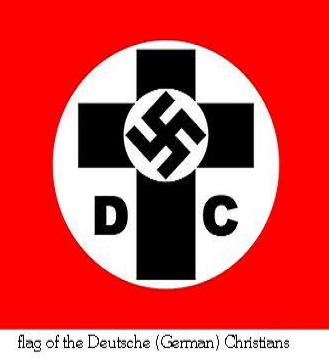
The Deutsche Christen used the American Negro in forming their Aryan Warrior Church, the same way the Evangelical Ne0-Confederate Racist in the Red States employed blacks, especially the President of the United States who is depicted as a Black Hitler. The end result is extreme violence against Jews, Gypsies, the Mentally Challenged, Freethinkers, Jehovah’s Witness, and many other peoples and groups who might be ruled a threat to Nazis who embraced Wieneke’s Killer Superior Jesus, who has a parallel today in the Killer Mohammad – that is murdering children, and raping and enslaving young girls in Iraq and Syria. ISIS has employed the same vision as Dr. Wieneke in recruiting Europeans. Good Muslims are not speaking out and condemning ISIS. We are now getting a good idea why Good German’s did not condemn the Nazis – who appear to be arm and arm with Jesus! The Deutsche Christen leaders have rubberstamped the cross with a swastika!
Paul invented the first de-Judify system when he went after the Judaizers who I contend were the survivors of the first church known as ‘The Way’. Paul Romanized the first church of the Jews because it was an Abolitionist Movement. In finding the Deutsche Christen, I have cut down a noble pine deep in the Black Forest, where upon I can hang my stars, my theories and conclusions that people close to me have called “Mad!
The Long Night of my isolation, has come t0 an end! There is no grafting of Gentiles to God’s Olive Tree as some Christians describe. Dr. Wieneke was hard pressed to conduct a transference of the Judaic religion over to the Feurher ‘The Dictator’ – for his own personal use. Voting is abolished in Germany. Hitler stands next to Jesus on the national platform. Wieneke had to do some serious weeding, as Paul did when he imprisoned women and children, then tortured them in order to get them to denounce their Lord.
Paul raises himself up to stand next to Jesus, and then he put Caesar in between to create the Trinity of Evil. Surely the One God of the Jews took into consideration the Twelve Disciples were Jews, before he decided to make Roman Pigs His Chosen Children. When I read the Bible for the first time at fifty, I could not buy the lie that ‘The Twelve’ failed to convert fellow Jews who had no problem KNOWING what passages in the Torah Jesus was referring to. Paul is forced to declare Mosaic Law does not matter anymore, after he is continually tripped up by the Judaizers who follow after him in order to destroy him and his false teaching. I suspect Paul was given an army to go after the Judaizers. Paul has been compared to ISIS.
https://en.wikipedia.org/wiki/Judaizers
Donald Trump promises to do some serious weeding, along our border with Mexico, and within our borders. This weeding is becoming America’s new religion, and is spreading like wildfire. Trump and his professional handlers have studied the thirty million evangelicals who make up the base of the Republican party, and are using a Game Plan on them. Our Founding Fathers thought they took precautions to make sure this kind of – shit – did not happen in this Democracy.
What is not being discussed in the secular forum is that Von Trump ‘The Rich’ is creating a schism between the Protestant and Catholic church. Most of the Mexican people are of the Catholic Faith, therefore, Pope Francis does not see a border existing between his people, who are poor. If Caesar Trump believes he will make jobs for white folks by sending them into the fields to harvest God’s Bounty – in place of the Mexican People – he is beyond delusional, and is the embodiment of Goebbels.
Jon Presco
http://www.nowtheendbegins.com/pages/rapture/the-great-tribulation.htm
“See what Paul is telling us? That we Gentiles (non-Jews) have been ‘grafted in’ to the Olive Tree that is Israel and the Jews, and as such we should not be “boasting’ but we should have respect and fear. Because it is a special privledge to be grafted into the family of God, and Paul promised that the Day is coming when the Jews will once again recover from their ‘blindness’ and see for themselves that Yeshua is indeed the Promised Messiah, and this is what will happen to them –
A Jew is a person born of descent from the twelve tribes of Israel who believes in Jehovah God, the God of Abraham, Isaac, and Jacob. The Jews believe that their Messiah has yet to come, though either not knowing or outrightly rejecting that God had already sent His Son Jesus Christ to be their Messiah. In the Left Behind books, the Jews in Israel were led to believe that Nicolae Carpathia was that coming Messiah, only to find out with his desecration of the Temple in “Desecration” that he was a deceiver. However, prior to the start of the Tribulation, there were 144,000 Jews that were sealed by God for the purpose of evangelizing to the nations that Jesus is the Messiah. Eventually the Jews came to the knowledge that Jesus is the Messiah and put their faith in Him before His second coming.
https://en.wikipedia.org/wiki/German_Christians
Friederich (Fred) TRUMP was born on 14 Mar 1869 in Kallstadt, Pfalz, Germany.6 He immigrated in 1885 to United States from Hamburg aboard the ship “Eider” and became a U.S. citizen in 1892 in Seattle, Washington.6 He died of influenza on 30 Mar 1918 in New York City, New York.6
- Before the birth of Adolf Hitler the family surname had many variations that were often used almost interchangeably. Some of the common variances were Hitler, Hiedler, Hüttler, Hytler, and Hittler. Alois Schicklgruber (Adolf’s father) changed his name on 7 January 1877 to “Hitler”, which was the only form of the last name that Adolf used.[2]
https://en.wikipedia.org/wiki/Hitler_family
The Deutsche Christen (English: German Christians) were a pressure group and movement within German Protestantism aligned towards the antisemitic and Führerprinzip ideological principles of Nazism with the goal to align German Protestantism as a whole towards those principles. Their advocacy of these principles led to a schism within 23 of the initially 28 regional church bodies (Landeskirchen) in Germany and the attendant foundation of the Confessing Church.[1]
Judaizers is a term for Christians who insist that Christians must follow the Old Covenant laws . This term is most widely known from its single use in the Greek New Testament (Galatians 2:14)[1] where Paul publicly challenges Peter for compelling gentile converts to Early Christianity to “judaize”,[2] also known as the Incident at Antioch.
This term also includes groups who claim the necessity of continued obedience to the Law of Moses found in the first five books of the Christian Old Testament,[3] although this is sometimes disputed by members of these groups, notably the Seventh-day Adventist Church, because the term Judaizers is typically used as a pejorative.
Most Christians believe that much of the Old Covenant has been superseded, while some modern Protestants believe it has been completely abrogated and replaced with the Law of Christ. Thus, “one who has Judaized”, refers to a Christian who has accepted the necessity of adhering to the Mosaic Laws or to specific laws that are believed to be superseded, such as circumcision, Sabbath observance, or observation of the Passover. The ongoing Christian debate over Judaizing began in the lifetime of the apostles, notably at the Council of Jerusalem and the Incident at Antioch, and parallels the ongoing debate about Paul the Apostle and Judaism, Protestant views of the Ten Commandments, and Christian ethics.
http://servosdemariaamordedeus.blogspot.com/2010/01/fotos-nazistas.html
The Imperial Period[edit]
During the period of the German Empire, before the Weimar Republic, the Protestant churches (Landeskirchen) in Germany were divided along state and provincial borders. Each state or provincial church was supported by and affiliated with the regnal house—if it was Protestant—of its particular region; the crown provided financial and institutional support for its church. Church and state were therefore, to a large extent, combined on a regional basis.[2] Monarchies of Roman Catholic dynasties also organised church bodies territorially defined by their state borders. The same was true for the three republican German states within the pre-1918 Empire. In Alsace-Lorraine the Napoleonic system of établissements publics du culte for the Calvinist, Jewish, Lutheran and Roman Catholic congregations and umbrellas remained in effect.
Weimar[edit]
With the end of World War I and the resulting political and social turmoil, the regional churches lost their secular rulers. With revolutionary fervor in the air, the conservative church leaders had to contend with socialists who favored disestablishment.
After considerable political maneuvering, state churches were abolished (in name) under Weimar, but the anti-disestablishmentarians prevailed in substance: churches remained public corporations and retained their subsidies from government. Religious instruction in the schools continued, as did the theological faculties in the universities. The rights formerly held by the princes in the German Empire simply devolved to church councils.
Accordingly, in this initial period of the Weimar Republic, the Protestant Church in Germany now operated as a federation of 28 regional (or provincial) churches. The federation operated officially through the representative German Evangelical Church Confederation (Deutscher Evangelischer Kirchenbund (DEKB)); the League was itself established in 1922 by the rather loose annual convention called Church General Assembly (Kirchentag), which was composed of the members of the various regional churches. The League was governed and administered by a 36-member Executive Committee (Kirchenausschuss) which was responsible for ongoing governance between the annual conventions of the Kirchentag.
Save for the organizational matters under the jurisdiction of the national League, the regionial churches remained independent in other matters, including theology, and the federal system allowed for a great deal of regional autonomy.[3]
The Deutsche Christen[edit]

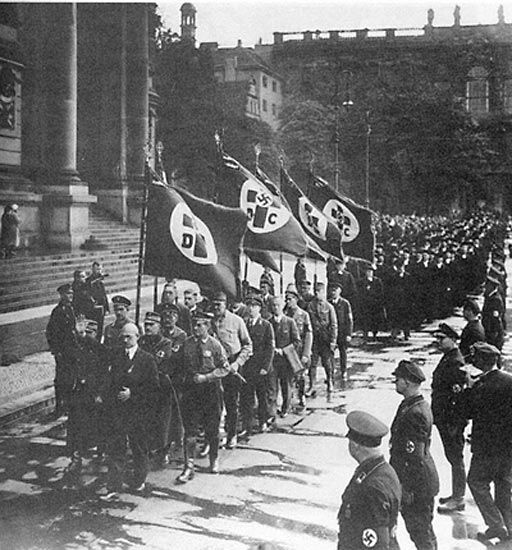
German Christians celebrating Luther-Day in Berlin in 1933, speech by bishop Hossenfelder
Ideology[edit]
The Deutsche Christen were, for the most part, a “group of fanatically Nazi Protestants.”[4] They began as an interest group and eventually came to represent one of the schismatic factions of German Protestanism.[4]
Their movement was sustained and encouraged by factors such as:
- the 400th anniversary (in 1917) of Martin Luther‘s posting of the Ninety-Five Theses in 1517, an event which served to endorse German nationalism, to emphasize that Germany had a preferred place in the Protestant tradition, and to legitimize antisemitism. This was reinforced by the Luther Renaissance Movement of Professor Emmanuel Hirsch.[5]
- the revival of völkisch traditions
- the de-emphasis of the Old Testament in Protestant theology, and the removal of parts deemed “too Jewish”
- the respect for temporal (secular) authority, which had been emphasized by Luther. The movement used scriptural support (Romans 13)[6] to justify this position.
The Deutsche Christen were sympathetic to the Nazi regime’s goal of “co-ordinating” (see Gleichschaltung) the individual Protestant churches into a single and uniform Reich church, consistent with the Volk ethos and the Führerprinzip.
Formation[edit]
The Deutsche Christen were organized as a Kirchenpartei (church party, i.e. a nominating group) in 1931 to help win elections of presbyteries and synods (i.e. legislating church assemblies) in the Evangelical Church of the old-Prussian Union, the largest of the independent Landeskirchen.[4] They were led by Ludwig Müller, a rather incompetent “old fighter” who had no particular leadership skills or qualifications, except having been a longtime faithful Nazi. The group achieved no particular notoriety before the Nazi assumption of political power in January 1933. In the Prussian church elections of November 1932, Deutsche Christen won one-third of the vote.[7]
Hitler was appointed Chancellor on 30 January 1933 and the process of Gleichschaltung was in its full sway in the first few months of the regime. In late April 1933 the leadership of the 1922-founded German Evangelical Church Confederation, in the spirit of the new regime, agreed to write a new constitution for a brand new, unitary “national” church, which would be called the German Evangelical Church (Deutsche Evangelische Kirche or DEK). The new and unified national DEK would completely replace and supersede the old federated church with its representative league.
This church reorganization had been a goal of the Deutsche Christen for some time, as such a centralization would enhance the coordination of Church and State, as a part of the overall Nazi process of Gleichschaltung. The Deutsche Christen agitated for Müller to be elected as the new Church’s bishop (Reichsbischof).
The Bishopric[edit]
Unfortunately for the Nazis, Müller had poor political skills, little political support within the Church and no real qualifications for the job, other than his commitment to Nazism and a desire to exercise power. When the federation council met in May 1933 to approve the new constitution, it elected Friedrich von Bodelschwingh as Reichsbischof of the new Protestant Reich Church by a wide margin, largely on the advice and support of the church leadership.[8]
Needless to say, Hitler was infuriated with the rejection of his candidate, and things began to change. By June 1933 the Deutsche Christen had gained leadership of some Landeskirchen within the DEK and were, of course, supported by Nazi propaganda in their efforts to reverse the humiliating loss to Bodelschwingh.[9][10] After a series of Nazi-directed political maneuvers, Bodelschwingh resigned and Müller was appointed as the new Reichsbischof in July 1933.[11]
The Aryan Paragraph[edit]
Further pro-Nazi developments followed the elevation of Müller to the DEK bishopric: in late summer the old-Prussian general synod (led by Müller) adopted the Aryan Paragraph, effectively defrocking clergy of Jewish descent and even clergy married to non-Aryans.[12]
With their Gleichschaltungspolitik and their attempts to incorporate the Aryan Paragraph into the church constitution so as to exclude Jewish Christians, the Deutsche Christen entered into a Kirchenkampf with other evangelical Christians. Their opponents founded the Confessing Church in 1934,[13] which condemned the Deutsche Christen as heretics and claimed to be the true German Protestant Church.
Impact of Deutsche Christen[edit]
The Nazis found the Deutsche Christen group useful during the initial consolidation of power, but removed most of its leaders from their posts shortly afterwards; Reichsbishop Müller continued until 1945, but his power was effectively removed in favor of a government agency as a result of his obvious incompetence.
The Deutsche Christen were supportive of the Nazi ideas about race. They issued public statements that Christians in Germany with Jewish ancestors “remain Christians in a New Testament sense, but are not German Christians.” Also they supported the call from the Nazi party platform for a “positive Christianity” that does not stress human sinfulness. Some went so far as to call for removal of the “Jewish” Old Testament from the Bible. Their symbol was a traditional Christian cross with a swastika in the middle and the group’s German initials “D” and “C”. It was claimed and remembered, as a “fact”, that the Jews had killed Christ, thus appealing to and actively encouraging existing anti-Semitic sentiment among Christians in Germany.
Precursors[edit]
19th century[edit]
The forerunner of the Deutsche Christen ideology came from certain Protestant groups of the German Empire. These groups sought a return to perceived völkisch, nationalistic and racist ideas within traditional Christianity, and looked to turn Christianity in Germany into a reformed intrinsic folk-religion (German: arteigene Volksreligion). They found their model in the Berlin Hofprediger Adolf Stoecker, who was politically active and tried to position the Christian working-classes and lower-middle-classes against what he perceived as Jewish “Überfremdung“.
The Bayreuther Blätter devoted its June, 1892, issue to a memorial of Paul Lagarde and it emphatically recommended his work to its readers. Ludwig Schemann, one of the most prolific of Bayreuth Germanics and racists, and later the author of a full-length biography of Lagarde, summarized his life and work and concluded that “for the comprehension of Lagarde’s whole being one must above all remember that he always considered himself the prophet and guide of his people — which of course he actually was.” For Schemann his legacy consisted largely of his struggle against the Jews: “Not since the days of Schopenhauer and Wagner is the German thinker so mightily opposed this alien people, which desecrates our holy possessions, poisons our people, and seeks to rest our property from us so as to completely trample on us, as Lagarde has” It was this image of Lagarde, the anti-Semitic prophet of a purified and heroic Germany, which the political Wagnerites and the Bayreuther Blätter and kept alive. Houston Stewart Chamberlain, Wagner’s son-in-law and intellectual disciple, wrote: “For us, the Deutsche Schriften have for a long time belonged to our most precious books, and we consider Lagarde’s unabashed exposure of the inferiority of Semitic religious instincts and the pernicious effects on Christianity as an achievement that deserves our admiration and gratitude.” — Houston Stewart Chamberlain, Die Grundlagen des neunzehnten Jahrunderts, 5th ed. München 1904, p.lxii. [14]
In 1896 Arthur Bonus advocated a “Germanization of Christianity”. Max Bewer alleged in his 1907 book Der deutsche Christus (The German Christ), Jesus stemmed from German soldiers in the Roman garrison in Galilee and his preaching showed the influence of “German blood”. He concluded that the Germans were the best Christians among all peoples, only prevented from the full flowering of their spiritual faculties by the materialistic Jews. Julius Bode, however, concluded that the Christianisation of the Germans was the imposition of an “un-German” religious understanding, and that Germanic feeling remained alien to it and so should remain exempt from it.[15]
20th century[edit]
On the 400th anniversary of the Protestant Reformation, in 1917, the Flensburg pastor Friedrich Andersen, the writer Adolf Bartels and Hans Paul Freiherr von Wolzogen presented 95 Thesen[16] on which a “German Christianity on a Protestant basis” should be founded. It stated :
| “ | The newer racial research has finally opened our eyes to the pernicious effects of the blood mixture between Germanic and un-German peoples and urges us, with all our forces, to strive to keep our Volkstum pure and closed. Religion is the inner strength and finest flower in the intellectual life of a people, but it can only strongly affect expression in popular culture … a deep connection between Christianity and Germanness can only be achieved when it is released from this unnatural connection, wherever it stands nakedly approached by the Jewish religion. | ” |
For the authors of the Thesen, the “angry thunder-god” Jehovah was the same as the “Father” and “[Holy] Ghost”, that Christ preached and that the Germans would have guessed. Childlike confidence in God and selfless love was, to them, the essence of the Germanic “people’s-soul” in contrast to Jewish “menial fear of God” and “materialistic morality.” Church was not an “institution for the dissemination of Judaism”, and they felt religious and confirmation materials should no longer teach the Old Testament and the Ten Commandments, nor even the New Testament, which they held to be of Jewish influence that had to be “cleaned” so that the child Jesus could be used as a model for “self sacrifice” and “male heroism”.
In 1921 Andersen wrote Der deutsche Heiland (The German Saviour), in which he opposed Jewish migration as an apocalyptic decision:
| “ | Who will win, the six-cornered star or the Cross? — The question is, for now, not yet evident. The Jew goes on his way purposefully, in any case … his deadly hatred will defeat his opponent. When the Christian Good Friday is celebrated, it should at least not weigh in his dreams; … otherwise there could come a whole lot of terrible Golgothas, where Jews across the whole world dance their jubilee songs on the grave of Christianity as heirs of a murdering people, singing to the Jahu they destroyed. | ” |
Against the “contamination by Jewish ideas”, mainly from the Old Testament, the Churches and Germany should (he argued) be “mutually benefits and supports”, and then Christianity would win back its status as “a religion of the Volk and of the struggle” and “the great exploiter of humanity, the evil enemy of our Volk [would] finally be destroyed”.
In the same year, 1921, the Protestant-dominated and völkisch-oriented League for German Churches (German: Bund für deutsche Kirche) was founded in Berlin. Andersen, pastor Ernst Bublitz and teacher Kurd Joachim Niedlich brought out the twice-monthly The German Church (German: Die Deutsche Kirche) magazine, which in 12,000 articles advanced the Bund’s ideas. Jesus should be a “tragic-Nordic figure” against the Old Testament’s “religious idea”, with the Old Testament replaced by a “German myth”. Each biblical story was to be “measured under German feelings, so that German Christianity escapes from Semitic influence as Beelzebub did before the Cross.”
In 1925 groups such as the Bund united with ten völkisch, Germanophile and anti-Semitic organizations to form the German Christian Working Group (German: deutschchristliche Arbeitsgemeinschaft). The Christian-Spirit Religious Society (German: Geistchristliche Religionsgesellschaft), founded in 1927 in Nuremberg by Artur Dinter, saw more effect in the churches, striving for the ‘de-Judification’ (German: Entjudung) and the building of a non-denominational People’s Church (German: Volkskirche).
The proposed abolition of the Old Testament was in part fiercely opposed among Christian German nationalists, seeing it as a racist attack on the foundations of their faith from inside and outside. The theologian Johannes Schneider, a member of the German National People’s Party (German: Deutschnationale Volkspartei or DNVP) (a party fairly close to the political aims of the NSDAP), wrote in 1925:
| “ | Whoever cheapens the Old Testament will soon also lose the New. | ” |
In 1927 the Protestant Church League (German: Deutscher Evangelischer Kirchenbund) reacted to the growing radicalization of German Christian groups with a Churches Day in Königsberg, aiming to clarify Christianity’s relation to “Fatherland”, “Nation”, “Volkstum“, “Blood” and “Race”. Many local church-officers tried to delineate, such as with regards to racism, but this only served to show how deeply it had intruded into their thinking. Paul Althaus, for example, wrote:
| “ | Volkstum is a spiritual reality … certainly there will never be a Volkstum without the precondition of, for example, the blood unit. But once a Volkstum is begotten, it may exist as a spiritual reality … even foreign blood may be lent [in]to it. How great the significance of blood might be in intellectual history, but the rule is, even if one is born into a Volkstum, the spirit and not the blood. | ” |
On this basis, the radical German-Christians ideas were hardly slowed down. In 1928 they gathered in Thuringia to found the Thuringian German Christians’ Church Movement (German: Thüringer Kirchenbewegung Deutsche Christen), seeking contact with the Nazi party and naming their newsletter “Letters to German Christians” (German: Briefe an Deutsche Christen).
Pagan and Anti-Christian Trends[edit]
Alfred Rosenberg‘s book The Myth of the Twentieth Century (German: Der Mythus des 20. Jahrhunderts) resonated in these circles and gave them renewed impetus. His polemic against all “un-German” and “root-stock” elements in Christianity was directed against the Christianity and the denominational organisations of the time. Marxism and Catholic Internationalism were attacked as two facets of the Jewish spirit, and Rosenberg stated the need for a new national religion to complete the Reformation.
The Associated German Religious Movement (German: Arbeitsgemeinschaft Deutsche Glaubensbewegung), founded in Eisenach at the end of 1933, was also an attempt to create a national religion outside and against the churches. It combined six earlier Nordic-völkisch oriented groups and a further five groups were represented by individual members. Jakob Wilhelm Hauer became the group’s “leader and representative” by acclamation, and other members included the philosopher Ernst Bergmann (1881–1945), the racial ideologue Hans F. K. Günther, the writer Ernst Graf zu Reventlow, the historian Herman Wirth, Ludwig Fahrenkrog and Lothar Stengel-von Rutkowski.[17]
Attempts to “de-Judify” the Bible[edit]
Some churches remained led by German Christians until 1945. In 1939 with the approval of 75% of the German Protestant churches the Eisenacher “Institute for Research and the Elimination of Jewish influence on German Church Life” was founded, led by Walter Grundmann. One of its main tasks was to compile a “People’s Testament” (German: Volkstestament) in the sense of what Alfred Rosenberg called a “Fifth Gospel”, to announce the myth of the “Aryan Jesus”. It became clear in 1994 that the Testament’s poetic text was written by the famous ballad-poet and proprietor of the Eugen-Diederichs-Verlag, Lulu von Strauß und Torney. Despite broad church support for it (even many Confessing Christians advocated such an approach, in the hope that the disaffiliation of 1937 to 1940 could be curbed), the first edition of the text did not meet with the expected enthusiastic response.
After-effects[edit]
After 1945, the remaining German Christian currents formed smaller communities and circles distanced from the newly formed umbrella of the independent church bodies Evangelical Church in Germany. German Christian-related parties sought to influence the historiography of the Kirchenkampf in the so-called “church-historical working group”, but they had little effect from then on in theology and politics. Other former members of the German Christians moved into the numerically insignificant religious communities known as the Free People’s Christian Church (German: Freie Christliche Volkskirche) and the People’s Movement of Free Church Christians (German: Volkskirchenbewegung Freie Christen) after 1945.

 Rosamond Press
Leave a comment