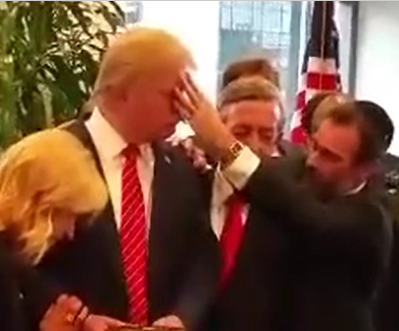
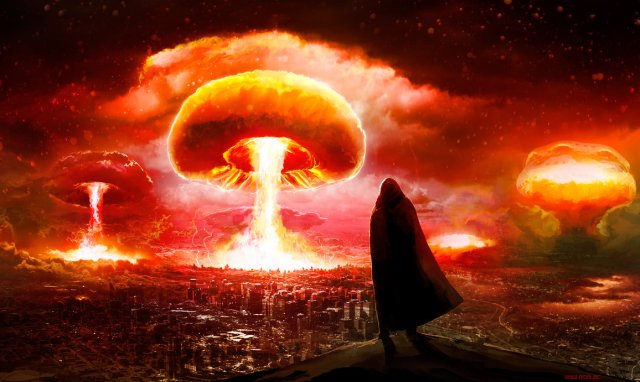
Trump is bent on restoring the kingdom of David so the Jews will rebuild the temple, and Jesus will come and set up his KINGDOM for a thousand years. This does not include our Democracy, that has to go.
John 007
It is true that evangelicals have often noted that their support for Trump is based in their conviction that God can use the unlikeliest of men to enact his will. But how did conservative American Christians become invested in such a fine point of Middle East policy as whether the U.S. Embassy is in Tel Aviv or Jerusalem?
For many of President Trump’s evangelical supporters this is a key step in the progression of events leading to the second coming of Jesus. There’s an interesting story as to how that came to be.
Ushering in the kingdom of God
The nation of Israel and the role of the city of Jerusalem are central in the “end-times” theology – a form of what is known as “pre-millennialism” – embraced by many American conservative Protestants.
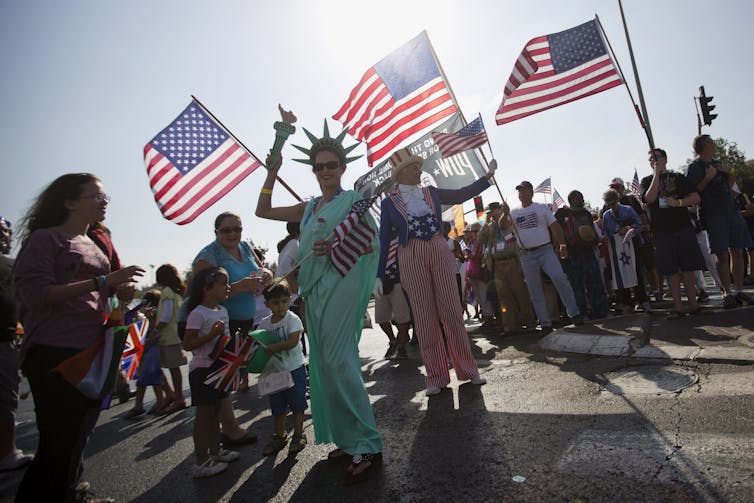
While this theology is often thought of as a “literal” reading of the Bible, it’s actually a reasonably new interpretation that dates to the 19th century and relates to the work of Bible teacher John Nelson Darby.
According to Darby, for this to happen the Jewish people must have control of Jerusalem and build a third Jewish temple on the site where the first and second temples – destroyed centuries ago by the Babylonians and Romans – once were. In Darby’s view this was a necessary precursor to the rapture, when believers would be “taken up” by Christ to escape the worst of the seven-year-period of suffering and turmoil on Earth: the Great Tribulation. This is to be followed by the cosmic battle between good and evil called Armageddon at which Satan will be defeated and Christ will establish his earthly kingdom. All of this became eminently more possible when the modern state of Israel was established in the 1940s.
In a closed-door meeting with evangelical leaders Monday night, President Donald Trump repeated his debunked claim that he had gotten “rid of” a law forbidding churches and charitable organizations from endorsing political candidates, according to recorded excerpts reviewed by NBC News.
In fact, the law remains on the books, after efforts to kill it in Congress last year failed.
But Trump cited this alleged accomplishment as one in a series of gains he has made for his conservative Christian supporters, as he warned, “You’re one election away from losing everything that you’ve got,” and said their opponents were “violent people” who would overturn these gains “violently.”
Trump addressed the law and the upcoming midterms in private remarks Monday during a dinner with evangelical supporters at the White House after the press had left.
At stake in the November midterms, Trump told the audience, are all the gains he has made for conservative Christians.
“The level of hatred, the level of anger is unbelievable,” he said. “Part of it is because of some of the things I’ve done for you and for me and for my family, but I’ve done them. … This Nov. 6 election is very much a referendum on not only me, it’s a referendum on your religion, it’s a referendum on free speech and the First Amendment.”
If the GOP loses, he said, “they will overturn everything that we’ve done and they’ll do it quickly and violently, and violently. There’s violence. When you look at Antifa and you look at some of these groups — these are violent people.”

Trump courts evangelicals by taking credit for Johnson Amendment
Aug.29.201805:29
The law that Trump says he got rid of is the so-called Johnson Amendment, a provision inserted into law in 1954 by then-senator and future President Lyndon Johnson of Texas, who was miffed that a conservative nonprofit group was helping his opponent.
The law says churches and charities “are absolutely prohibited from directly or indirectly participating in, or intervening in, any political campaign on behalf of (or in opposition to) any candidate for elective public office.”
“Now one of the things I’m most proud of is getting rid of the Johnson Amendment,” the president said. “That was a disaster for you.”
The president doesn’t have the power to repeal a law — only Congress can do that. The Supreme Court can also rule a law unconstitutional, but that has not happened in this case.
In May 2017, Trump signed an executive order that purported to ease enforcement of the Johnson Amendment. But experts — and the American Civil Liberties Union, which opposes repeal of the provision — say the Trump order was basically toothless.
“It does almost nothing,” Gregory Magarian, a constitutional law professor at Washington University Law School.
Politifact, the nonpartisan fact-checking organization, rated Trump’s claim that he had gotten rid of the Johnson Amendment “mostly false” when he first made it publicly in July 2017.
As I watched Donald Trump announce that the United States would recognize Jerusalem as Israel’s capital and move our embassy to that city, I could only think of one thing: my high school youth group Bible study.

The law forbids religious organizations and other charities from formally endorsing candidates if they want to retain their federal tax exemption.
Trump’s executive order instructs the Treasury Department not to “take any adverse action against any individual, house of worship, or other religious organization on the basis that such individual or organization speaks or has spoken about moral or political issues from a religious perspective, where speech of similar character has, consistent with law, not ordinarily been treated as participation or intervention in a political campaign on behalf of (or in opposition to) a candidate for public office … ”

In other words, religious organizations can express their religious views, as they always could — but still cannot formally participate in political campaigns.

As he travels to preach at small country churches across Alabama, former State Baptist Convention President John Killian hears a lot of talk about President Donald Trump.
“I see overwhelming support,” Killian said.
Many Southern Baptists – who number more than a million in Alabama – tend to like Trump and believe he’s God’s man for the job. Exit polls in 2016 showed that about 80 percent of white evangelical Christians voted for Trump.
That support is still solid, said Killian, a former pastor and now director of Baptist missions for Fayette County.
But why? Trump is twice divorced, and his attorney claimed to have paid adult film star Stormy Daniels to keep quiet about having an affair with Trump. He’s been caught on tape speaking in foul-mouthed terms about women. His character flaws could have derailed almost any other politician trying to court the religious right.
“Everybody knows if Barack Obama had done one of these things, he would have been skewered by these folks as unfit for office,” said church historian Bill Leonard.
But major evangelical leaders such as Franklin Graham and Jerry Falwell Jr. defend Trump and see him as an ally in the culture wars.
“Issues matter more than a person’s personal life,” Killian said. “The two issues that come up are pro-life – appointment of judges (who oppose abortion), and support for Israel.”
King Cyrus and King David
In defending Trump, religious supporters cite a recurring theme in the Bible that God uses flawed leaders.
In the Book of Ezra, Persian King Cyrus the Great issued a decree to liberate the Jews after the Babylonian captivity and rebuild the temple in Jerusalem. “King Cyrus was a friend to the people of God, but he was a heathen king,” Killian said.
Alabama Pastor John Kilpatrick, whose call for prayer to stop the spirit of witchcraft attacking Trump went viral on social media last week, compares Trump to King David, who committed adultery with Bathsheba and had her husband killed.

“David committed adultery and had a man killed,” Kilpatrick said in his sermon on Aug. 26 at Church of His Presence in Daphne. “God left him as king of Israel.”
God is using Trump for his own purposes, Kilpatrick said. Evangelical supporters of Trump hope he will appoint U.S. Supreme Court justices who may overturn the 1973 Roe v. Wade decision that legalized abortion.
“He has defended the womb,” Kilpatrick said. “The president has taken a stand for life. Second, the president has taken up for Israel and has declared Jerusalem the capital of Israel. Third, he has chosen Supreme Court justices – that’s going to turn this nation around. Those three things are why the spirit of Jezebel hates him and wants him out. We may be on the verge of the greatest revival this world has ever seen.”
A street fighter
The very soul of America is on the line, Kilpatrick said.
“If we are where I think we are spiritually, we need a street fighter in the White House,” said Kilpatrick, who said in an interview with AL.com that he voted for Trump in 2016.
“There’s much at stake,” Kilpatrick said. “A lot of people are concerned about America right now.”
Kilpatrick is not vouching for Trump’s faith. “I don’t believe Trump is a man of God,” he said. But he believes the 2016 election was miraculous. “I have to believe it was the Holy Spirit that turned it,” Kilpatrick said. “If the Lord put him in an office, the Lord will sustain him in an office. You better be careful that you don’t lay a hand on him.”
That’s a reference to Psalm 105:15, “Touch not my anointed ones; do my prophets no harm.”
Kilpatrick quotes 1 Timothy 2:2, which calls on believers to pray for “kings, and for all that are in authority,” as a reason to pray for Trump.
“That doesn’t mean I’m a Trump fan,” said Kilpatrick, whose congregation is affiliated with the Assemblies of God denomination. “I love him, and I pray for him because he’s our president. What God has raised up, you don’t want to oppose. Do I believe he’s an adulterer? I do. Do I believe he’s had these affairs? I do. Do I think he’s a liar? I do. If God raised him up, my job is to pray for that man. That’s what we’re going to do.”
Framing a Christian nation
On the campaign trail, Trump often trumpeted support for framing the United States as a Christian nation, staking out an issue that resonates with the same people who supported Judge Roy Moore’s refusal to take down his hand-made plaque of the Ten Commandments in his Etowah County courtroom, and later his refusal as chief justice to remove a 2.6-ton monument of the commandments he had installed in the state judicial building. Many evangelical Christians also yearn for the return of Christian prayer to public schools. It was banned in a 1963 U.S. Supreme Court decision.
In 2016 at the Family Research Council Values Voter Summit, Trump sounded that theme. “A Trump administration, our Christian heritage will be cherished, protected, defended, like you’ve never seen before. Believe me. I believe it. And you believe it. And you know it. You know it.”
Southern Baptist Convention President J.D. Greear this week defended his decision to attend a meeting of ministers with President Donald Trump on Monday night. Greear said he was not one of the more than 100 ministers who signed a Bible for Trump, with the inscription, “History will record the greatness that you have brought for generations.”

TV Evangelist Paula White read the inscription and said, “We pray this prayer. If you all agree with that, say Amen,” according to a transcript of the event.
White, senior pastor of New Destiny Christian Center in Apopka, Fla., serves as chair of the Evangelical Advisory Board for Trump.
Many of the evangelical supporters of Trump are preachers of the prosperity gospel, who promote the idea that God shows His blessings by making them wealthy. Trump is wealthy, and for them, that’s a sign of God’s blessing, Leonard said.
“God used him to bless with them with tax cuts,” Leonard said.
Immigration, faith demographics
There are broader issues at play, too, with Trump’s stand on Muslim immigration echoing past religious right alarms against non-Protestant immigrants changing the nation’s faith demographics.
“Trump is, at best, racially insensitive, if not racist,” said Leonard, a former religion professor at Samford University and retired divinity dean at Wake Forest University.
But many evangelicals like his style, Leonard said.
“Fundamentalists vest great power in the authoritarian leader who brooks no disagreement,” Leonard said. “They have an appreciation for Trump as an authoritarian figure.”
Baptists traditionally supported the separation of church and state, but shifted with the rise of the Moral Majority in 1979 and the election of President Ronald Reagan in 1980. Despite being divorced, Reagan was the choice of evangelicals over Jimmy Carter, a born-again believer and Baptist Sunday school teacher who did not agree with the religious right on many issues. “Jimmy Carter is a brother in the Lord, but I didn’t like him as a president,” Killian said.
Evangelicals have abandoned separation of church and state in recent decades as they’ve seen an opportunity for government to prop them up, Leonard said.
“Their response to Trump as a person who is going to restore Christianity to its proper place is an indication how their approach to Christian conversion has failed,” Leonard said. “It is no longer reaching the multitudes as they thought it would. As their evangelistic influence wanes, they go looking to government to support their presence and authority in the country. They want the government to save them.”
‘100 Years From Now’
Trump has been willing to give lip service to their symbolic issues, perhaps on the advice of evangelical leaders who know how to get out their vote.
“They want the return of Protestant privilege in American culture,” Leonard said. “The loss of Protestant privilege, and the reality of religious plurality, is driving them crazy.”
There’s a price to be paid for political pandering by preachers, Leonard said.
“One of the stark realities of this support for Trump is that the moral high ground that this group of people has claimed about human behavior and Christian morality has been radically compromised by their failure to hold Donald Trump to the same standard they held the rest of us to,” Leonard said. “Their moral high ground has been compromised beyond measure.”


Trump said to the religious leaders at the White House: “Now you’re not silenced anymore. It’s gone and there’s no penalty anymore and if you like somebody or if you don’t like somebody you can go out and say, ‘This man is going to be great for evangelicals, or for Christianity or for another religion. This person is somebody that I like and I’m going to talk about it on Sunday.”
In practice, there has been nothing stopping anyone from doing that. The Johnson Amendment doesn’t prohibit individual speech, and it has rarely been enforced.
More than 2,000 mainly evangelical Christian clergy have deliberately violated the law since 2008 as a form of protest against it, but only one has been audited by the IRS, and none punished, according to the Alliance Defending Freedom, a pro-religious group.
A provision to overturn the amendment was included in last year’s tax cut bill, but it was ultimately removed for procedural reasons.
Trump “doesn’t have the legal authority to overturn the Johnson Amendment,” Magarian said.
“You would think,” Magarian added, “that the conservative religious leaders would get impatient at the continued repetition of that claim” that Trump has repealed it.
In the beginning of his private remarks to the evangelical leaders, Trump cited a comment he said was made by Robert Jeffress, a Southern Baptist leader who is one of his religious allies
“I had the great Robert Jeffress back there. Hello, Robert. Who said about me: He may not be the perfect human being, but he is the greatest leader for Christianity,” Trump said to applause and laughter.
He added: “Hopefully I’ve proven that to be a fact in terms of the second part. Not the first part.”
Later, Trump raised an issue that has become fodder for late night comedy shows.
“Little thing — Merry Christmas. You couldn’t say Merry Christmas,” Trump said. “I’m telling you — when I started running I used to talk about it and I hate to mention it in August, but I used to talk about it. They don’t say Merry Christmas anymore.”
 Rosamond Press
Leave a comment