
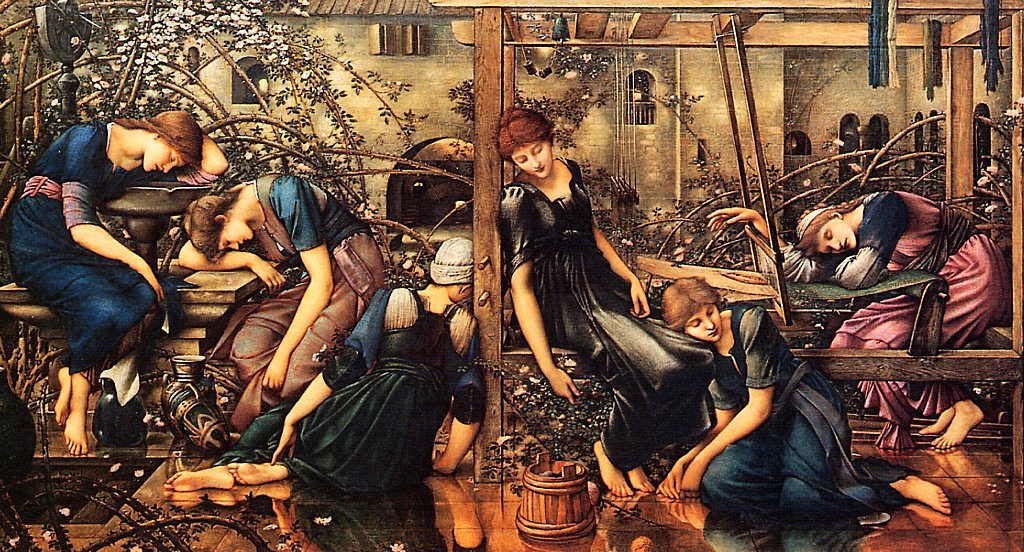
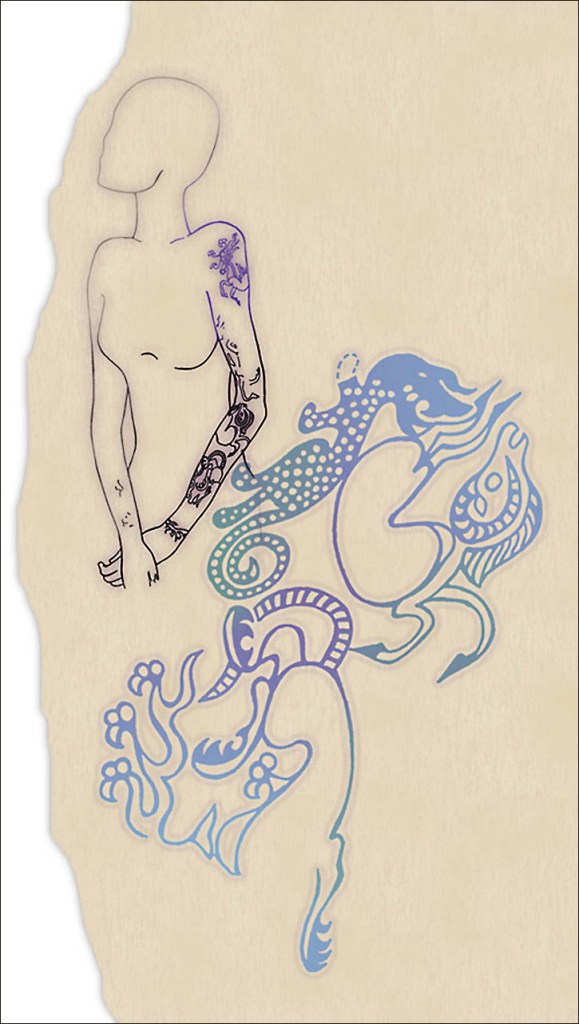
In my book ‘Where Art Thou’ I conclude the forbidden plant in Eden was the woad from which tattoos were made in order to heal the peoples that came out of Egypt and encountered the One God. Paradise had to be a place on the Nile. The Jewish Scribes wrote their Egyptian roots out of the Torah that was written by a woman I title ‘Sleeping Beauty’. She was the family genealogist. Her people were living inside her memory. Because the Chinese used the woad to heal people, I conclude the people that came out with Moses were Scythians.
Jon Presco
Copyright 2017
https://en.wikipedia.org/wiki/Scythians

https://en.wikipedia.org/wiki/Isatis_tinctoria
Woad has been used in traditional Chinese medicine for centuries. The first archaeological finds of woad seeds date to the Neolithic. The seeds have been found in the French cave of l’Audoste, Bouches-du-Rhône, France. Impressions of the seeds of Färberwaid (Isatis tinctoria L.) or German indigo, of the plant family Brassicaceae, have been found on pottery in the Iron Age settlement of the Heuneburg, Germany. Seed and pod fragments have also been found in Iron Age pit at Dragonby, South Humberside, United Kingdom.[4] The Hallstatt burials of the Hochdorf Chieftain’s Grave and Hohmichele contained textiles dyed with woad dye.

The Hunt of the Unicorn tapestry, dyed with weld (yellow), madder (red), and woad (blue).

Woad merchant Jean de Bernuy’s 16th-century mansion in Toulouse

Woad merchant Pierre Assézat’s 16th-century mansion in Toulouse
Melo and Rondão write that woad was known “as far back as the time of the ancient Egyptians, who used it to dye the cloth wrappings applied for the mummies.”[5] Skelton informs us that one of the early dyes discovered by the ancient Egyptians was “blue woad (Isatis tinctoria).”[6] Lucas writes, “What has been assumed to have been Indian Indigo on ancient Egyptian fabrics may have been woad.”[7] Hall states that the ancient Egyptians created their blue dye “by using indigotin, otherwise known as woad.”[8]
Julius Caesar reported (in De Bello Gallico) that the Britanni used to colour their bodies blue with vitrum, a word that roughly translates to “glass”, but has also been translated as “woad”.[9][10] Carr suggests the translation of: “dye themselves with glazes” or “‘infect themselves (or ‘work into themselves’) with glass’”.[11] The latter could refer to using glass in the tattooing process or to scarification. It has also been claimed that Caesar was referring to some form of copper- or iron.
Hi List members,
I hate to do this, but I have to take a break for a few weeks (maybe
more). Things have come up that will take my total concentration and
as much energy as I can muster. (If you believe in the power of
prayer, our family could use them right about now).
I am really disappointed that I won’t be able to keep up with you
here. You’re hitting on so many interesting things and I have read
through the past couple days’ messages having lots to contribute if
only I had the time.
One thing I wanted to do before heading out… the ogham alphabet now
that Barb has posted this – sparked a moment of recognition with me.
I thought I had seen it on a mummy. Please check out this book if
you can: _The Man in the Ice_ by Konrad Spindler. It’s the story
about the discovery (just in 1991) of an almost perfectly preserved
mummy (preserved from the ice) of a 5,000 year old body. There
are “tatoos” on his body, including a cross-like tatoo on his inner
knee.
Something strikes me as odd just now and I don’t know if it’s true or
not, but when the mummy was discovered, some folks asked why he had
no hair. It was as though he had been shorn. The author of the book
explains that no hair ever survives on animals – human or otherwise –
when mummified in this way. A study of some tufts of hair that they
found at the site caused the researchers to conclude this man had
dark brown, almost black, wavy hair – originally more than 9
centimeters long, worn loose, not plaited or in any knot. He wore a
beard. (Sounds like the descriptions of Moses that I have heard)
But clothing and tools made of woven grass (looking quite a lot like
a priestly robe, if you ask me) HAS survived.
Anyway, I think you may find the book fascinating. He carried tools
with him, specifically chosen because of their properties for certain
uses. One of the things he carried was an ember bag. Another was
fire starting equipment (pyrite, flint and a “true tinder” fungus).
Tools were made from specifically chosen TREES and SHRUBS. Some have
speculated that this man’s job (found in the Alps on between Germany,
Austria and Italy) was one or more of the following: an outlaw, a
shaman or priest, prospector for metal ores, travelling on business,
a hunter, a farmer, a shepherd. Some have speculated that he must
have been a rich farmer, his equipment was extensive, especially the
copper axe he carried. There is a huge number of axes and daggers
depicted on the picture stones.
The authors do not think he was a priest, but was religious due to
the tatoos, but they, say, the tatoos were theraputic means of
relieving his – arthritis. He also had a hereditary “split” between
his two front teeth.
(I note that copper also relieves arthritis symptoms)
The authors do not think this was any person of nobility because he
wore no gold. That was something else I wanted to talk about, but
will have no more time. But I wonder if all the priestly/kings of
the bloodline necessarily wore gold. Qu’ran prohibits MEN from
wearing gold and Muhammad himself did not wear it. I doubt then that
gold had anything to do with his ability to prophecy.
Take care all. Hopefully, I can check in once in a while.
Karen
 Rosamond Press
Leave a comment