


Cowan’s portrait of Donald Trump, with the repainted hand, hangs inside the bar of the Mar-A-Lago club in Palm Beach.
Last night, I came upon Denis de Rougemont’s book ‘The Myths of Love’ written in 1963. I was shocked to see that Denis had written a chapter on ‘Lolita’ that was written in 1955. Rougemont is a founding father of the European Union that is under attack by Steve Bannon and Breitbart. Rougemont fled to America so he would not be murdered by Hitler. He befriended famous artists who had fled to New York also. Rougemont dedicated his life to restoring what the Nazis destroyed, and, put forth ideas that would create a Eruope without wars due to nationalism. Trumps people took the White House by setting afire American Nationalism. We will have the Devil to pay.
“Love Declared resumes the argument with greater sophistication. To the myth of Tristan, De Rougemont adds the myth of Don Juan, interpreted as Tristan’s after-image. In novels by Nabokov, Musil, and Pasternak he exposes the secret workings of Tristan in the twentieth century; in Kierkegaard, Nietzsche, Gide he detects varying responses to the “dialectic” between Don Juan and Tristan; throughout he suggests a “mythanalysis” that penetrates to “symbols governing our emotive life.”
This is the cultural connection to the New World I have prayed for. I might be the only Rougemont Scholar in the United States. I was married to Thomas Pynchon’s ex-wife. Tom was inspired by Nabokov who taught at Cornell. Pynchon Scholars have been wondering if Tom and his friend, Richard Farina, sat in on Nabokov’s class. Richard married Mimi Baez. This is The Love Generation. Consider my Love Dance, and the movie, La La Land, that is in truth Ya! Ya! Land. Bob Dylan is here, also, as are Fictional Russians, one named Sebastian. Did Dylan go visit Woody Guthrie while he was renting from Fred Trump? These singers are American Troubadours who were inspired by Tristan and Isolde.
In 1963 I hitched across America in winter – with my guitar. Seven days later, I am living in the Village.
Rougemont was the most famous Anti-Russian Communist scholar, ever! He was the founder of…………
The Congress for Cultural Freedom (CCF) was an anti-communist advocacy group founded in 1950. At its height, the CCF was active in thirty-five countries. In 1966 it was revealed that the United States Central Intelligence Agency was instrumental in the establishment and funding of the group.[1]
Historian Frances Stonor Saunders writes (1999): “Whether they liked it or not, whether they knew it or not, there were few writers, poets, artists, historians, scientists, or critics in postwar Europe whose names were not in some way linked to this covert enterprise.”[2] A different slant on the origins and work of the Congress is offered by Peter Coleman in his Liberal Conspiracy (1989) where he talks about a struggle for the mind “of Postwar Europe” and the world at large.[3]
https://en.wikipedia.org/wiki/Congress_for_Cultural_Freedom
My ex had a very high I.Q. It did wonder if she was recruited by the CIA. Folks wonder if Pynchon was CIA, and thus there is a reason he stays out of the public eye. Did Putin know Rougemont’s work? Was he assigned to Denis? Right now, Rachel Maddow is laying down a credible Red Scare. Where is the John Birch Society when you need them? They were behind Donald, and, hooked him up with the Evangelicals, who worship Howard Roarke, the hero of ‘Fountainhead’, written by Ayn Rand, a Russian! Is Jeff Sessions a secret member of the John Birch Society?
Howard resembles Fred Koch, who founded the JBS. John is Trump’s middle name. Is it possible, that Putin and the JBS have formed a secret bond, because they have the same goals, and want to oppress and render powerless the same people? Are Putin and the JBS getting rid of the Neo-Conservative born of Denis de Rougemont? Why would evangelical leaders and their flocks vote for a Pussy Grabber? Because, he is better than a black president, a woman president, who let Mexicans come across our border. Has Putin won of the JBS? Making America Great Again, is a JBS theme, and brand. Look at that portrait of John Trump! Is he the hidden Grand Prince of the John Birch Society, the White Christ his father wanted to be? It feels we have been hijacked back to the late 50’s and 60’s.
Fred Trump went on to “jumpstart” the campaign of arch-racist Barry Goldwater, where they also got backing from the John Birch Society. With influence from Roy Cohn, Goldwater went on to develop what was later called the “Southern Strategy,” which plays on Southern racism using “dog whistle” terms to signal to the base. Cohn went on to become Trump’s “mentor,” and helped him to countersue a group that was suing him for discrimination against African Americans in his business. Cohn eventually introduced him to Roger Stone, a man who has walked the line between the right-wing of the GOP and Libertarian Party and openly racialist, nativist, and white nationalist movements.
Putin had to be spying on the JBS, and seeing it was a covert cult, it was vulnerable. Members could be blackmailed, especially if they had become subversive. Is this what Putin has on Donald? Are there tapes of his desire to overthrow our democracy with the help of the JBS? This Immigration Ban looks like payback to the JBS, who would love to see The JBS Wall come true. The wall that Reagan wanted torn down, is going to be rebuilt at our border. The enemy is at the gate!
“In the aftermath, McCarthy would drink himself into a death spiral, and some of the leadership of the NAM, including leader James O Welch, moved on to spearhead the John Birch Society, which amassed a sizable constituency of fascists, masking their anti-Semitism in cryptic anti-communist conspiracy theories. In the words of Chip Berlet and Matthew Lyons’s impeccable book, Right Wing Populism in America, “it was at the NAM, during the height of the Red Menace hysteria, that Welch honed his Americanist philosophy.” In 1964, the Birchers threw most of their influence behind Barry Goldwater, whose campaign was jumpstarted by a German émigré turned New York real estate entrepreneur named Fred Trump.”
In 1958, Koch became a founding member of the John Birch Society, an American political advocacy group that opposes communist infiltration and supports limited government.[13][22][30] Koch held John Birch Society chapter meetings in the basement of his family’s home in Wichita, Kansas.[27]:49[31]
http://www.hcn.org/articles/donald-trumps-cabinet-choices-reflect-koch-influence
Many of Trump’s picks have ties to Koch Industries and Koch Enterprises, which are corporations founded by Charles and David Koch that own a variety of manufacturing, energy, technology and distribution companies. Koch Industries executives and lobbyists have also given to Democrats, too, including the Clintons – though not nearly as much as Republicans.
http://www.alternet.org/election-2016/trump-clears-path-return-john-birch-society
http://www.alternet.org/comments/election-2016/trump-clears-path-return-john-birch-society
https://en.wikipedia.org/wiki/Irving_Kristol
“Two of Pynchon’s Cornell friends, his future girlfriend Tharaldsen and her then-husband, David Seidler, had moved to Seattle and encouraged Pynchon to join them. Tharaldsen says Pynchon arrived “depressed—very down.” She worked for Boeing, and hooked him up with a job writing technical copy for their in-house guide, Bomarc Service News.
What finally smoked him out was Richard Fariña’s wedding to Mimi Baez, sister of the famous folk singer. In August, Pynchon took a bus up the California coast to serve as his friend’s best man. Remembering the visit soon after, Fariña portrayed Pynchon with his head buried in Scientific American before eventually “coming to life with the tacos.” Pynchon later wrote to Mimi that Fariña teased him about his “anti-photograph Thing … what’s the matter, you afraid people are going to stick pins; pour aqua regia? So how could I tell him yeah, yeah right, you got it.”
Denis was a world-class scholar and was titled ‘The Prince of European Culture’. He is a difficult read. Minds like his, are of the past. Who can fathom half the things he says? Who bothers! A brave new world of tweeters and texters want things to be presented to the them in simple black&white terms. One would think it is easy to locate like-minded people in cyber-space, but it is not. This is because most people do not know anything. Very few have read a book. Feelers are sent out, over and over again. Just when you think you have lined your comrades up in a row, one turns on you.
http://inherent-vice.pynchonwiki.com/wiki/index.php?title=Pynchon’s_California_Trilogy_and_the_CIA
http://paxonbothhouses.blogspot.com/2015/12/donald-trump-and-denise-de-rougemont.html
Presdient Obama thought he had something in common with Presdient Trump, until five days ago, when he accused our first black President of a felony, he tweeting he was a sick, bad guy that needs to be investigated by Congress. A thousand world leaders – are in shock! “Is nothing sacred?”.
Denis has authored books on sacred unrequieted love. Not only is European Culture, and Tradtions under attack, but, American Culture is all but ruined, now that the Conservatives are in power wielding their agenda, that most American chose to ignore. Instead, they are bid to focus on, and once a week renew……… their Love for Jesus, and do harm to anyone who gets between the Sinful Servant and the Virginal Master.
“Lock him up! Whip him! Crucify him – and her!”
When I composed an open letter to our new president, and asked him to appoint me The Whit House Artist, and when I wanted to do The First Lady’s Portrait, several friends became alarmed. They thought I had been brainwashed, and gone over to the enemy. They were reinforcing several conspiracy theories they nurture, and, had thrown me to the dogs in their need to own SIMPLE ANSWERS, arrived at – WITH NO EFFORT!
What I was saying, is, that even though THE PEOPLE put the most destructive monster that ever walked the earth, in the White House, one must follow protocol, one must behave in civilized manner, one must aspire to the highest set of standards, or, it all come tumbling down
Two days ago, Trump emerged from the White House Bunker he made, and standing next to a portrait of Hillary Clinton, he was puzzled. Why hadn’t the children rushed him, grabbed him, and given Uncle Donald a big, grateful, hug. He has to beckon them, even looke perturbed with them, because His Self-image is going badly – somemore! I was reminded of that footage of Hitler patting the young boys he armed to stand up to very engraged Russian troops who will rape their mothers, and thousands of German women and teenagers.
Trump Towers is going down! What The Trumpire did not take into account after he insulted Europeans, NATO, and the European Union, is, that many of Europe’s most wealthy and traditional families, hate and fear this monster that reminds them of what Hitler did to – their Europe! These families will not be staying in any Trump Tower, or playing on at Trump golf course. They are not buy trump clothes and steaks. The Trump BRAND is dead, and may lose 66 million dollars while Donald is besieged, all alone, in the White House. Melania will not leave her tower, and thus is furfilling the Lai of Yonnec that resembles ‘Lolita’ and what Rougemont had to say about Humbert Humbert.
Donald putting his daughter on a pedestal, and promoting her line of clothing, tampers with the taboo against incest. Ivanka is Donald’s ‘Unrequitted Love’ that he admits he would have intercourse with, if she was not his daughter. Thus, she is his primary Love Object that Melania is well aware of. Take away the façade of MAKING MONEY together, then, you have shades of ‘Tobacco Road’ and incest amongst the very poor.
“When he was well stricken in years this lord took to himself a wife, that he might have children to come after him in his goodly heritage. Since she was young and gay, he shut her fast within 142 his tower, that he might the easier keep her to himself.”
https://en.wikipedia.org/wiki/Breton_lai


“Average ratings on Yelp and Google for the president’s 29 hotels, golf courses, and other properties in the US have fallen 40% since he took office to about 3.7 stars out of 5, according to a new study by Signpost, a firm that helps businesses manage customer ratings and reviews.
The relationship with Artist’s and Europe’s Aritstocracy, is the foundation of Western Culture. Above is a photo of Laure de Rougemont who married Marc de Beauvau-Craon, and thus it is possible Virginia Hambley and I are kindred. This poor translation appears to say the Rougemonts descend from a “modest line” and descends from Maria Theresa von Habsburg of Austria, paired with the Duchy of Lorraine. Laure is the President of Sotheby’s.
“With an exceptional network of contacts in the beautiful world, occasionally hunting with the family Thurn und Taxis in Germany and frequenting the mythical collector Antenor Patino ”
I suspect Bannon staged this Adoration de la Tour in front of Hillary who is pointing to a book that says “It takes a village”. Getting over on a woman, gave Steve the thrill of a lifetime. Steve and Don Juan wanted to rub it in. They wanted twenty children to come embrace him, the little ones wrapping their arms around his thigh. They did not see the boys doing this, as much as the little girls.
The screens were set in place by devious yes men, who had some knowledge of propaganda. Here is Don Juan ‘The Phantom of the Opera’ making his great entry. The Don has to prove he is a man of great passion. His passion has made him rich and powerful. Paint Obama as a Nubian Slave, peeking around the screen that keeps prying eyes at bay. Note TRUMP’S HAND covering the crotch of the woman who dare run against him! No woman, or no negro, should ever hold the office of President of the United States of America – unless – she is his daughter!
By Trump resisting THE TEMPTATION of Ivanka, (who carries his middle name) Donald believes he is a very religious and spiritual man. That hand-size came up in the primary, is a continuance of the mind-game Trump played with Cowan. Now, repaired, Don Juan poses like Jesus on the cross, his divine hand at ready….to receive his village of idiots, ignorant, know-nothing lunatics and racists, the very kind of parasites that goose-stepped across Europe, and shat in the castle toilets, before they wiped their ass on the classics, then these grunts hauled off priceless works of art, off to the Monster’s cave.
“For Ivanka! I do it all for my beautiful daughter!”
Ivanka is what greets all brave Errant Knight of Money as they travel all over the world closing the Art of the Deal. To sleep with the married daughter of the Father-Husband, resembles Courtly Love, but for the truth most involved – are ignorant and crass! Not one of them have any class, including the Conservative Tea Party Whores who will do anything for AN IDEA that has grown stale and lifeless while waiting in the wing, waiting for a brilliant black man to finish his last term.
So, who is really behind that veil, that curtain?………..a million French men and women, who want Obama to be the President of the United States? Why? He has been faithful to his loving wife, and she to him. This idea must carry on, must survive, or, Lai of Guinevere and Lancelot, does not work. Camelot will die – and stay dead!
Did any of my friends think I had copped out by my offer to be his Art Consultant and, render his wife’s portrait? I will turn around The Trumpire for a five million dollar fee – after Steve Bannon is sent to Devil’s Island.
BUY LOLITA WEAR
DRIVE A LOLITAMOBILE
STAY AT THE LOLITA HOTEL
GO SEE ‘THE TRUMPIRE STRIKES BACK’ AT A TRUMP THEATER NEAR YOU
Jon Presco
Copyright 2017
V. concludes that, after a long-running romantic relationship with Clare Bishop, Sebastian’s final years were addled by a love affair with another woman—a Russian whom he presumably met at a hotel in Blauberg, where Sebastian spent time recuperating from heart ailments in June 1929. V. leaves for Blauberg, where, with the help of a private detective, he acquires a list of the names of four women who were staying at the hotel during the same time period as Sebastian: Mademoiselle Lidya Bohemsky, of Paris; Madame de Rechnoy, also of Paris; Helene Grinstein, of Berlin; and Helene von Graun, who, despite her German name, spoke Russian and also lived in Paris.
https://en.wikipedia.org/wiki/The_Real_Life_of_Sebastian_Knight
14Pynchon’s title alludes directly to Nabokov’s narrator in Sebastian‑ Knight. That initial stands for many things, however. Just as V.’s true identity in Sebastian Knight remains obscure — a mystery emphasized by Nabokov’s linguistic play with the letter — so the referent for “V.” in Pynchon’s novel seems to change each time it appears. Like Nabokov before him, Pynchon evokes both its labial sound (his characters’ names are filled with f’s as well as v’s) and its visual appearance, which he repeats and inverts in capital N’s, M’s, and W’s
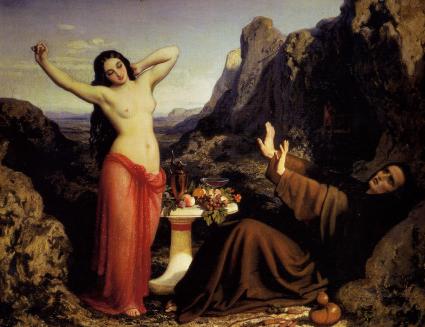
The opposition of sexuality to spirituality is an anomaly of Judeo-
Christian-Islamic religion not found in many other cultures and
spiritual orientations. (The Temptation of Saint Hilarion,
D. L. Papety, 1843. Wallace Collection, London)
Here is how Trump abused the artist that did his portrait.
“Every time I’d see him at Mar-a-Lago, he’d ask, ‘when are you going to finish the hand?’” he said. “It’s hard explaining (it all) to Donald.”
According to Cowan, Trump seemed to think that the artist’s insistence that the painting was complete was some sort of ongoing negotiation tactic.
“I (originally) got about $24,000,” said Cowan, who calls that a bargain. “He always tried to bargain and I don’t like that at all.”
http://money.cnn.com/2017/03/08/news/trump-tower-security-costs/
https://en.wikipedia.org/wiki/Unrequited_love
https://www.metahistory.org/GRAIL/SacredLoveLight.php
In days of yore there lived in Britain a rich man, old and full of years, who was lord of the town and realm of Chepstow. this town is builded on the banks of the Douglas, and is renowned by reason of many ancient sorrows which have there befallen. When he was well stricken in years this lord took to himself a wife, that he might have children to come after him in his goodly heritage. The damsel, who was bestowed on this wealthy lord, came of an honourable house, and was kind and courteous, and passing fair. She was beloved by all because of her beauty, and none was more sweetly spoken of from Chepstow to Lincoln, yea, or from there to Ireland. Great was their sin who married the maiden to this agèd man. Since she was young and gay, he shut her fast within 142 his tower, that he might the easier keep her to himself. He set in charge of the damsel his elder sister, a widow, to hold her more surely in ward. These two ladies dwelt alone in the tower, together with their women, in a chamber by themselves. There the damsel might have speech of none, except at the bidding of the ancient dame. More than seven years passed in this fashion. The lady had no children for her solace, and she never went forth from the castle to greet her kinsfolk and her friends. Her husband’s jealousy was such that when she sought her bed, no chamberlain or usher was permitted in her chamber to light the candles. The lady became passing heavy. She spent her days in sighs and tears. Her loveliness began to fail, for she gave no thought to her person. Indeed at times she hated the very shadow of that beauty which had spoiled all her life.
Love Declared: Essays on the Myths of Love
It is now twenty-five years since the first edition of Love in the Western World appeared. Most of the essays in Dramatic Personages precede it; the ones in Love Declared are quite recent. Taken together, the three books make a representative triptych of De Rougemont’s achievement. Literary figures interest De Rougemont less for their ideas than for the inner tensions revealed by the way in which they express ideas. In these tensions he hopes to find the identity of a person. This is the author as neither thinker nor particular individual, but somehow the two determining one another. Dramatic Personages consists of readable but minor essays on Goethe, Kierkegaard, Kafka, Luther, Calvin, Gide, and T. E. Lawrence. In each man De Rougemont seeks the “incarnation of a thought in a life or of a vocation in an individual.”
In Love in the Western World the approach remains constant, but its scope is tremendously enlarged. Contrasting pagan Eros with Christian Agape, De Rougemont assigns them to conflicting patterns of life in the West. For him Eros is adulterous passion, subversive to marriage as well as orthodoxy, in love with love itself rather than the beloved, seeking an infinite joy that transcends human forms, and so forever suicidal, sad, unsatisfied. By Agape he means Christian love between human beings as well as man and God. In this relationship lovers do not try to merge with one another, as Eros would require, but rather sustain each other’s separateness. While Eros is a love of death, Agape establishes a living communion. The concept of Agape originates with the New Testament. Eros, De Rougemont traces to the medieval legend of Tristan and Iseult, which he relates to Christian heresies deriving from Manichaeanism. According to De Rougemont, all history since the twelfth century has been a struggle between the passional, self-destructive “myth of Tristan” and the redemptive possibilities of orthodox Christianity.
Love Declared resumes the argument with greater sophistication. To the myth of Tristan, De Rougemont adds the myth of Don Juan, interpreted as Tristan’s after-image. In novels by Nabokov, Musil, and Pasternak he exposes the secret workings of Tristan in the twentieth century; in Kierkegaard, Nietzsche, Gide he detects varying responses to the “dialectic” between Don Juan and Tristan; throughout he suggests a “mythanalysis” that penetrates to “symbols governing our emotive life.”
I propose a mythanalysis, which can be applied not only to persons but to the characters of art, and to certain formulations of life; the immediate objective of such a method being to elucidate the motives of our choices and their too frequently unconscious implications, spiritual as well as social.
The book ends with a comparison of Eastern and Western ideas about the self which enables De Rougemont to reaffirm his commitment to Christian Agape.
What are we to say of this triptych? Its design so simple, its panorama so vast, its religious conviction so powerful, will it not strike us as deep and meaningful? Possibly so. And yet, is it…
https://rosamondpress.com/2013/09/01/vladimir-nabokov-pynchon-connection/
https://rosamondpress.com/2012/04/08/thomas-pynchons-lover-and-lolita/
https://rosamondpress.com/2016/03/04/oakland-tommy/
12As an aspiring young writer, Pynchon must have been especially fascinated by The Real Life of Sebastian Knight. It is a masterpiece of narrative complexity; a technical tour de force, its author’s first novel in English; a detailed account of a writer’s development; and a thorough evocation of the literary life — from writer’s block, romantic inspiration, and the revision process to agents, editors, and reviewers. Although we do not know when Pynchon read it, textual evidence indicates that he did so before he wrote his own novel. V. first took shape as a short story, “Under the Rose,” that Pynchon wrote at Cornell in 1959 and later expanded into the novel’s third chapter. Pynchon characterizes the story as a case of “literary theft,” although he cites only Baedeker’s 1899 guide to Egypt and Buchan’s and Oppenheim’s espionage fiction as sources (Introduction xxvii-xxviii). Certainly the most Nabokovian elements in the novel are not present in the story. But by the time Pynchon completed V. in 1963, he had obviously read Sebastian Knight.
II.
13V. resembles Nabokov’s novel in plot, character, narration, and style.3 To describe Sebastian Knight’s influence on V., however, I want to invoke the V‑shaped paradigm. Pynchon’s novel is organized around the letter V’s eerie proliferation. It has two major storylines: first, the picaresque adventures of Benny Profane, hapless schlemihl and human yo-yo, as he careens around America and Europe in the 1950s; second, the sinister appearances of a woman named “V.” at pivotal moments in European history. Connecting these plots is Benny’s friend Stencil, who is obsessed with V. and who narrates the chapters in which she appears. In tracing Sebastian Knight’s influence on Pynchon’s novel, I will focus on the letter V, the lady V., and Stencil’s role as obsessed, dissociated, unreliable narrator.
14Pynchon’s title alludes directly to Nabokov’s narrator in Sebastian‑ Knight. That initial stands for many things, however. Just as V.’s true identity in Sebastian Knight remains obscure — a mystery emphasized by Nabokov’s linguistic play with the letter — so the referent for “V.” in Pynchon’s novel seems to change each time it appears. Like Nabokov before him, Pynchon evokes both its labial sound (his characters’ names are filled with f’s as well as v’s) and its visual appearance, which he repeats and inverts in capital N’s, M’s, and W’s (Stimpson 82). Chapter 3, for example, opens with several analogies for the letter’s shape: “As spread thighs are to the libertine, flights of migratory birds to the ornithologist, the working part of his tool bit to the production machinist, so was the letter V to young Stencil” (50). (Those migratory birds even echo Sebastian Knight’s “V-shaped flight of migrating cranes” [139]). The letter also appears in words like “venery,” “virgin,” and “veil”; in the Roman numeral V; in allusions to the Virgin Mary and Botticelli’s “Birth of Venus”; in references to such places as “Vheissu,” “Venezuela,” “Vesuvius,” “Valletta,” “the Vatican,” and a club called “The V-Note”; and in names of characters like “Varkumian” and “Vogelsang.”
15The letter recurs, in particular, in various avatars of V. herself: Victoria Wren, Veronica Manganese, Vera Meroving, and simply V. This elusive femme fatale evokes a similar figure in Sebastian Knight: Madame Lecerf, also known as Nina Toorovetz and Nina Rechnoy, who pretends to be Helene von Graun and resembles Sebastian’s mother Virginia. Just as Nabokov’s narrator learns of Nina’s existence when he finds her letters among his brother’s papers after his death, so young Stencil discovers a cryptic reference to V. in his father’s journals after his death: “There is more behind and inside V. than any of us had suspected. Not who, but what: what is she” (43). Like Nabokov’s narrator, Stencil sets off on this mysterious woman’s trail so as to elucidate his relative’s death and give meaning to his own life. Like Nabokov’s narrator, too, he becomes utterly obsessed with her. Pynchon further emphasizes the œdipal nature of this search, since Stencil believes that V. was his father’s lover. Whereas Nabokov considers the bond between half-brothers, Pynchon is concerned with father-son relationships and “apostolic succession” — a preoccupation that suggests his sense of himself as Nabokov’s literary heir (52).
16Despite these V’s and femmes fatales, it is Stencil’s role that shows Sebastian Knight’s influence most clearly. Like Nabokov’s narrator, he is a self-styled detective, “a professional spy without any employer” (51). Although V. investigates literary biography, and Stencil history, their approaches are identical. Stencil, too, depends on what Nabokov’s narrator calls “inner knowledge” of his quarry (33). He too has great expectations for the “grand Gothic pile of inferences” that he is “hard at work creating” (209). Just as V. believes that Sebastian’s life and art will reveal to him the very meaning of existence, the “absolute solution” (180), so Stencil plans to decode “the century’s master cabal” (210). Like V., moreover, Stencil becomes so fixated on the object of his search that he loses his own identity. Practicing a “forcible dislocation of personality,” he refers to himself, even in casual conversations, “in the third person” (51). If he has any identity, he muses at one point, it is “He Who Looks for V.” (210).
In 1929 Koch’s partner Lewis Winkler’s former employer, Universal Oil Products (now UOP LLC), sued Winkler-Koch for patent infringement. Also that year, nearly three years before the patent case went to trial, Winkler-Koch signed contracts to build petroleum distillation plants in the Soviet Union, which did not recognize intellectual property rights.[12]
This extended litigation effectively put Winkler-Koch out of business in the U.S. for several years. “Unable to succeed at home, Koch found work in the Soviet Union”.[13] Between 1929 and 1932 Winkler-Koch “trained Bolshevik engineers[14] and helped Stalin’s regime set up fifteen modern oil refineries” in the Soviet Union. “Over time, however, Stalin brutally purged several of Koch’s Soviet colleagues. Koch was deeply affected by the experience, and regretted his collaboration.”[13] The company also built installations in countries throughout Europe, the Middle East and Asia.[1] According to New Yorker writer Jane Mayer, Koch partnered with William Rhodes Davis to build the third-largest oil refinery serving the Third Reich, a project which was personally approved by Adolf Hitler.[15] Koch President and COO David L. Robertson acknowledged that Winkler-Koch provided the cracking unit for the 1934 Hamburg refinery, but said that it was but one of many “iconic” American companies doing business in Germany at the time.[16]
In 1928, Koch traveled to the Soviet Union to build oil refineries, but he came to despise communism and Joseph Stalin‘s regime.[6][25] Koch self-published a 39-page, anti-communist pamphlet “A Business Man Looks at Communism” relating his experiences in the Soviet Union and warning of the threat of Communist take-over.[26][27]:46 Koch wrote that one of the “Potential Methods of Communist Take-over in U.S.A. by Internal Subversion” was “Infiltration of high offices of government and political parties until the President of the U.S. is a Communist…Even the Vice Presidency would do as it could be easily arranged for the President to commit suicide.”[22][27]:46[28]:12 Koch wrote that “socialism is the precursor to communism.”[26][28]:27 Koch wrote that he found the Soviet Union to be “a land of hunger, misery, and terror”.[11][28]:5 Koch wrote that he toured the countryside and received what he wrote was a “liberal education in Communist techniques and methods.”[11][28]:5 Koch grew persuaded that the Soviet threat needed to be countered in America.[11]
According to Daniel Schulman, writing in Sons of Wichita: How the Koch Brothers Became America’s Most Powerful and Private Dynasty, upon his return to the United States, Koch “saw evidence for communist infiltration everywhere” and the pamphlet was “a forceful, though deeply paranoid polemic intended to jar Americans from their apathy.”[27]:41,46 According to his son, Charles, “Many of the Soviet engineers he worked with were longtime Bolsheviks who had helped bring on the revolution.” It deeply bothered Fred Koch that so many of those so committed to the Communist cause were later purged.[11] According to his son, David, his father “was a very conservative Republican and was not a fan of big government,”[11] and was paranoid about communism.[22] David told author Brian Doherty his father “was constantly speaking to us children about what was wrong with government and government policy. It’s something I grew up with – a fundamental point of view that big government was bad, and impositions of government controls on our lives and economic fortunes was not good.”[29]:407
 Laure de Rougemont married Marc de Beauvau-Craon, and thus it is possible Virginia Hambley and I are kindred. This poor translation appears to say the Rougemonts descend from a “modest line” and descends from Maria Theresa von Habsburg of Austria, paired with the Duchy of Lorraine.
“It is 29 years that Laure de Rougemont, a descendant of a “modest” line, in the words of his brother, married Marc de Beauvau-Craon. This last, twenty years her senior, bears the name of an illustrious family descendant of Maria Theresa of Austria, paired with the Duchy of Lorraine.”
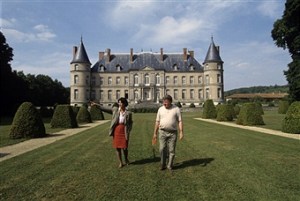
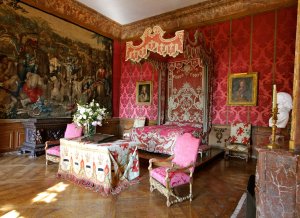
The Rosamond name has been traced to Rougemont in the Alsace that was ruled by the Habsburgs. Above are photos of Craon castle.
http://en.wikipedia.org/wiki/Ch%C3%A2teau_d’Harou%C3%A9
Laure de Rougemont Beauvau-Craon President of Sothebys is the brother of the famous artist, Gue de Rougemont who descends from the famous artist, Louis-François, baron Lejeune. We are looking at the most cultured family in France.
What is truly exciting, Virginia may be related to Yolande de Aragon Duchess de Anjou who may have employed Jean of Arc in saving the House of Anjou.
Jon Presco
https://rosamondpress.wordpress.com/2013/09/26/guy-de-rougemont-of-the-academy-of-fine-arts/
https://rosamondpress.wordpress.com/2013/09/18/de-bourmont-and-the-ordre-du-croissant/
http://www.thestylesaloniste.com/2010/07/la-vie-de-chateau-elegance-and.html
Haroué, in northeastern France near Nancy, has been in the Beauvau-Craon family since it was completed in 1732. The current proprietor, Princess Minnie de Beauvau-Craon, is a direct descendant of Prince Marc de Beauvau-Craon who in 1720 commissioned the architect Germain Boffrand to build it in the remote countryside near the Moselle and Meurthe rivers.
https://www.firstthings.com/web-exclusives/2011/02/the-myth-of-romantic-love
https://www.scribd.com/document/119112386/Denis-de-Rougemont-Myth-Love
https://www.jstor.org/stable/pdf/24457118.pdf?seq=1#page_scan_tab_contents
Love in the Western World” by Denis de Rougemont

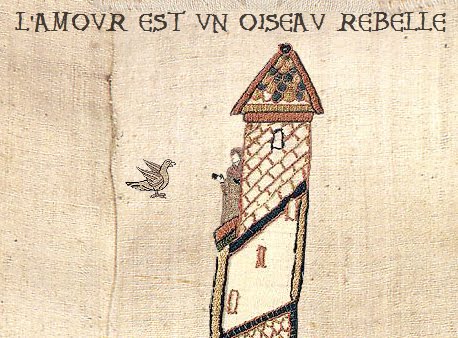

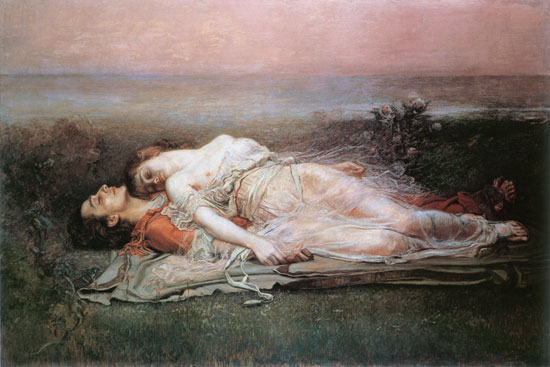

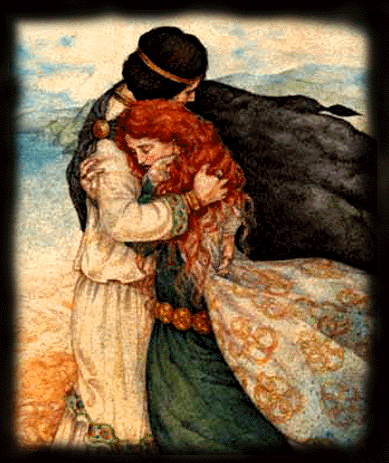
 “De Rougemont introduces the “Tristan Myth” in the first book of Love in the Western World, a work that focuses upon the intellectual and cultural development of love and its function as a myth in the West.”
Long ago I read that King Henry de Anjou of England built rooms at Woodstock that were connected by a man-made stream in which the occupants of enjoining rooms floated sticks upon which were written a message. This morning I discovered what is going on. The sticks were of the hazel tree. This is a ritual based upon several stories written by Marie of France that entails the legend of Tristan and Iseult who are at the core of Denis de Rougemont’s ‘Love in the Western World’.
In Marie’s ‘Yonec’ I believe I have found the source of the Sleeping Beauty’ story. Here again is Rena in her tower.
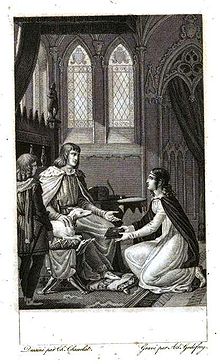
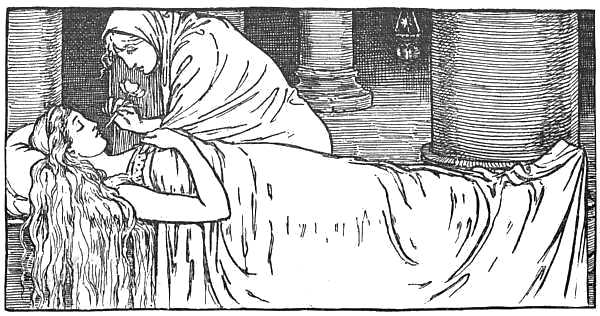
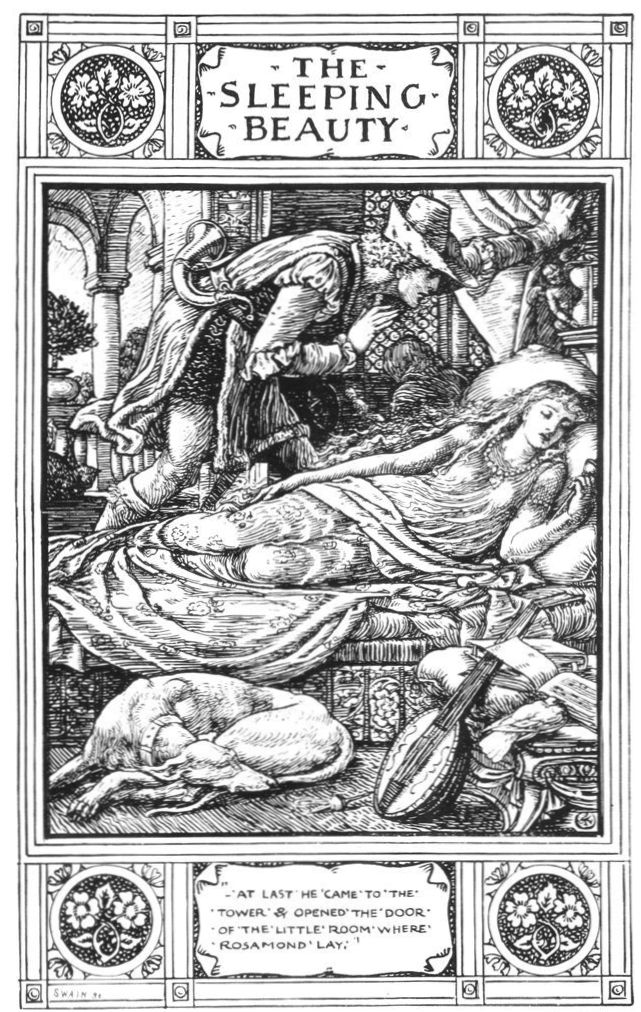
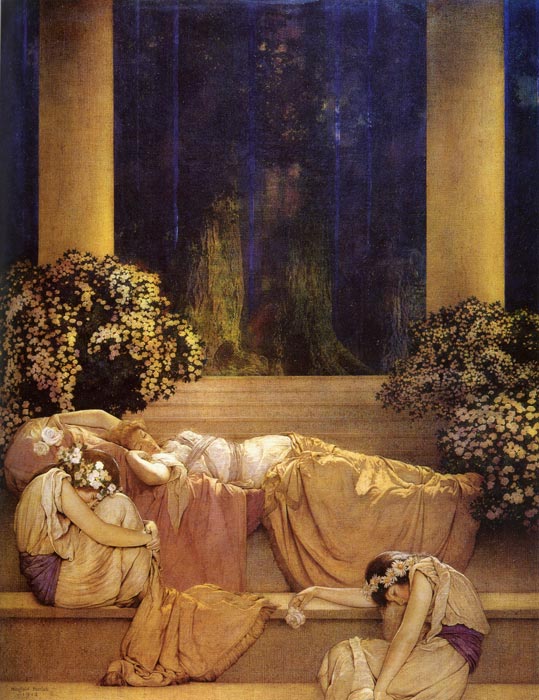 Above is an illustration from ‘Eliduc and Guilliadun’ by Marie of France. ‘Guildeluec Reviving Guilliadun’, may be the inspiration of Grimm’s ‘Sleeping Beauty’ who he named Rosamond. This led me to suspect that Marie of France is Joan Clifford, who was the paramour of King Henry de Anjou, Fair Rosamond.
For the last two days I have been searching the web for any connection between Marie of France, Fair Rosamond, and sleeping Beauty. In ‘Eliduc and Guilliadun’ there is a sleeping maiden who is revived by a red flower retrieved from the mouth of a weasel who found it in a deep forest. This is a resurrection from a death-like sleep, a coma, via a red flower that represents the blood of Christ.
In Marie’s ‘The Lay Of Yonec’ there is a beauty captured in a tower visited by a prince who changes into a hawk. The jealous husband puts barbs of steel around the window, that like the thorns of a rose, mortally wound the hawk-prince. Beauty follows the drops of her lovers red blood into a maze, a bower, replicating the legend of Fair Rosamond who was found in a labyrinth by a jealous queen via a red thread. Marie was a Arthurian Author who was influenced by Wace whose Roman de Rou is a Grail Legend.
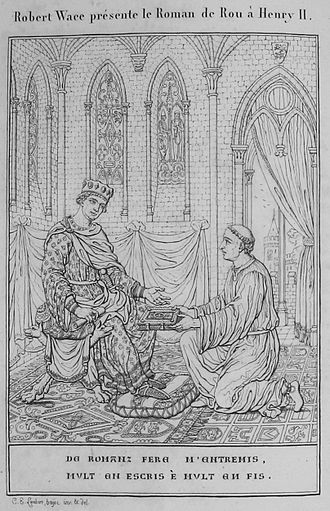
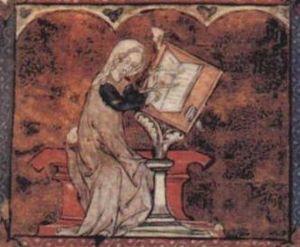
Above we see Marie and Wace presenting their Grail Manuscripts to King Henry de Anjou.
Jon Presco
Copyright 2013
https://rosamondpress.wordpress.com/2013/09/19/the-house-of-beauvau/
“Suddenly it ran out of the chapel into the forest grass. There it picked a deep red flower with its teeth, then carried it quickly back and placed it in the mouth of the weasel the servant had killed. Instantly the animal came back to life. The wife had watched all this, and how she cried out to the servant.
“Catch it! Throw, boy! Don’t let it escape!”
He hurled his stick and hit the weasel. The blossom fell from between its teeth. Eliduc’s wife went and picked it up, then returned and placed the exquisite red flower in Guilliadun’s mouth. For a second or two nothing happened, but then the girl stirred, sighed, and opened her eyes (10).
“Good lord,” she murmured, “how long I’ve slept!”
http://www.gutenberg.org/files/37348/37348-h/37348-h.htm#ELIDUC_AND_GUILLIADUN
There the damsel might have speech of none, except at the bidding of the ancient dame. More than seven years passed in this fashion. The lady had no children for her solace, and she never went forth from the castle to greet her kinsfolk and her friends.
Her loveliness began to fail, for she gave no thought to her person. Indeed at times she hated the very shadow of that beauty which had spoiled all her life.
Straightway he contrived a cunning gin for the slaying of this bird. He caused four blades of steel to be fashioned, with 148 point and edge sharper than the keenest razor. These he fastened firmly together, and set them securely within that window, by which the tercel would come to his lady.
Tenderly she called him to her side. Without any long tarrying the bird came flying at her will. He flew in at the open window, and was entangled amongst the blades of steel. One blade pierced his body so deeply, that the red blood gushed from the wound. When the falcon knew that his hurt was to death, he forced himself to pass the barrier, and coming before his lady fell upon her bed, so that the sheets were dabbled with his blood.
When the lady made her perilous leap she was clad only in her shift. Dressed in this fashion she set herself to follow the knight by the drops of blood which dripped from his wound. She went along the road that he had gone before, till she lighted on a little lodge. This lodge had but one door, and it was stained with blood.
But when the lady entered in the third chamber she saw a stately bed, that well she knew to be her friend’s. This bed was of inwrought gold, and was spread with silken cloths beyond price. The furniture was worth the ransom of a city, and waxen torches in sconces of silver lighted the chamber, burning night and day.
In the Roman de Brut by Wace, Brutus of Troy falls asleep before a statue of the goddess Diana in her abandoned temple and has a dream of the island he is destined to settle. This land is Britian.
Guildeluec stooped to pick up the fallen blossom. For a moment she hesitated, for her love for the knight was very great. Then she bent forward, and laid the stem of the flower between the rosy lips of the entranced Guilliadun. Immediately there were signs of life. The girl stirred, a blush came into her cheeks, and her lips parted. When her eyes opened, Guildeluec sighed and said, “Truly, never was there seen so fair a creature.”
Guildeluec soon explained to the awakened princess where she was, and received her fervent thanks for delivery from so strange a spell. With many tears, Guilliadun confessed to her unknown friend her love for the knight Eliduc, and the way she had followed him from her father’s court. Guildeluec heard her[315] [316]tale in silence, and when it was at an end, led her away from the hermitage to the palace, where the queen took the princess under her charge, and in the evening presented her with much pomp to the members of her court. When Eliduc saw Guilliadun alive and well, richly clad and lovelier than before, his heart rejoiced, but he turned away from her. Then came forward Guildeluec, who, with the queen’s permission, released him from his pledge to her, and gave him back his ring, saying she had determined to retire to a convent and devote her days to holy works.
On the grounds of Blenhiem Palace there is a temple for the goddess Diana where Winston Churchill proposed to his wife. This temple looks like the one that was built for Princess Diana Spencer who is kin to the Churchills and Dukes of Marlborough. It was on these grounds that King Henry built a Troy-town for Fair Rosamond, who descends from Rollo. Henry claimed he descends from Brutus of Troy. The Sleeping Beauty Princess was named ‘Rosamond’. Princess Diana was named ‘England’s Rose’. There is a rose in the middle of the Round Table that Wace introduced to the Arthurian Legends. Wace brought the sword he called ‘Excalibur’.
Above is a print of Wace delivering ‘The Roman de Rou’ to King Henry. As promised, here is the Grail Line of the Norse. The name Rosamond will forever be associated with the Holy Grail. I will forever be known as a Grail Author and Grail Scholar. I have immortalized my family. I have connected Princess Diana to the Grail Legends. One day, one, or both of her sons, will be the King of England.
Long live the king!
John Presco
Copyright 2013
Both Henry II and his wife, Eleanor of Aquitaine, were descended from Rollo. Henry via Rollo’s son, and successor, William ‘Longsword’. Eleanor via Rollo’s daughter, Gerloc (who married Duke William III of Aquitaine, and was called Adela).
https://rosamondpress.wordpress.com/2013/01/07/rosamond-and-the-earls-of-orkney/
His later work, the Roman de Rou, was, according to Wace, commissioned by King Henry II of England. A large part of the Roman de Rou is devoted to William the Conqueror and the Norman Conquest. Wace’s reference to oral tradition within his own family suggests that his account of the preparations for the Conquest and of the Battle of Hastings may have been reliant not only on documentary evidence but also on eyewitness testimony from close relations—though no eyewitnesses would have been still alive when he began work on the text. The Roman de Rou also includes a mention of the appearance of Halley’s Comet. The relative lack of popularity of the Roman de Rou may reflect the loss of interest in the history of the Duchy of Normandy following the incorporation of continental Normandy into the kingdom of France in 1204.
The Trojans land on a deserted island and discover an abandoned temple to Diana. After performing the appropriate ritual, Brutus falls asleep in front of the goddess’s statue and is given a vision of the land where he is destined to settle, an island in the western ocean inhabited only by a few giants.
“Yea, Rosamond, fair Rosamond,
Her name was called so,
To whom dame Elinor our Queene
Was known a deadly foe,
The King therefore for her defence
Against the furious Queene
At Woodstocke builded such a Bower
The like was never seen.
“Most curiously that Bower was built
Of stone and timber strong.
An hundered and fifty dores
Did to this Bower belong,
And they so cunningly contriv’d
With turnings round about
That none but with a clew of thread
Could enter in or out.”
http://en.wikipedia.org/wiki/Blenheim_Palace
From Old-World Love Stories from the Lays of Marie de France & other Mediæval Romances & Legends, translated from the French by Eugene Mason, Illustrated and Decorated by Reginald L. Knowles; J. M. Dent & Sons Ltd.; 1913; pp. 141-154.
~~~~~~~~~~~
[blank]
[141]
The Lay Of Yonec
SINCE I have commenced I would not leave any of these Lays untold. The stories that I know I would tell you forthwith. My hope is now to rehearse to you the story of Yonec, the son of Eudemarec, his mother’s first born child.
In days of yore there lived in Britain a rich man, old and full of years, who was lord of the town and realm of Chepstow. this town is builded on the banks of the Douglas, and is renowned by reason of many ancient sorrows which have there befallen. When he was well stricken in years this lord took to himself a wife, that he might have children to come after him in his goodly heritage. The damsel, who was bestowed on this wealthy lord, came of an honourable house, and was kind and courteous, and passing fair. She was beloved by all because of her beauty, and none was more sweetly spoken of from Chepstow to Lincoln, yea, or from there to Ireland. Great was their sin who married the maiden to this agèd man. Since she was young and gay, he shut her fast within 142 his tower, that he might the easier keep her to himself. He set in charge of the damsel his elder sister, a widow, to hold her more surely in ward. These two ladies dwelt alone in the tower, together with their women, in a chamber by themselves. There the damsel might have speech of none, except at the bidding of the ancient dame. More than seven years passed in this fashion. The lady had no children for her solace, and she never went forth from the castle to greet her kinsfolk and her friends. Her husband’s jealousy was such that when she sought her bed, no chamberlain or usher was permitted in her chamber to light the candles. The lady became passing heavy. She spent her days in sighs and tears. Her loveliness began to fail, for she gave no thought to her person. Indeed at times she hated the very shadow of that beauty which had spoiled all her life.
Now when April had come with the gladness of the birds, this lord rose early on a day to take his pleasure in the woods. He bade his sister to rise from her bed to make the doors fast behind him. She did his will, and going apart, commended to read the psalter that she carried in her hand. The lady awoke, and shamed the brightness of the sun with her tears. She saw that the old woman was gone forth from the chamber, so she made her complaint without fear of being overheard.
“Alas,” said she, “in an ill hour was I born. My lot is hard to be shut in this tower, never to go out till I am carried to my grave. Of whom is this jealous lord fearful that he holds me so fast in prison? Great is a man’s folly always to have it in mind that 143 he may be deceived. I cannot go to church, nor hearken to the service of God. If I might talk to folk, or have a little pleasure in my life, I should show the more tenderness to my husband, as is my wish. Very greatly are my parents and my kin to blame for giving me to this jealous old man, and making us one flesh. I cannot even look to become a widow, for he will never die. In place of the waters of baptism, certainly he was plunged I the flood of the Styx. His nerves are like iron, and his veins quick with blood as those of a young man. Often have I heard that in years gone by things chanced to the sad, which brought their sorrows to an end. A knight would meet with a maiden, fresh and fair to his desire. Damsels took to themselves lovers, discreet and brave, and were blamed of none. Moreover since these ladies were not seen of any, except their friends, who was there to count them blameworthy! Perchance I deceive myself, and in spite of all the tales, such adventures happened to none. Ah, if only the mighty God would but shape the world to my wish!”
When the lady had made her plaint, as you have known, the shadow of a great bird darkened the narrow window, so that she marvelled what it might mean. This falcon flew straightway into the chamber jessed and hooded from the glove, and came where the dame was seated. Whilst the lady yet wondered upon him, the tercel became a young and comely knight before her eyes. The lady marvelled exceedingly at this sorcery. Her blood turned to water within her, and because of her dread she hid her face in her hands. By reason of his courtesy 144 the knight first sought to persuade her to put away her fears.
“Lady,” said he, “be not so fearful. To you this hawk shall be as gentle as a dove. If you will listen to my words I will strive to make plain what may now be dark. I have come in this shape to your tower that I may pray you of your tenderness to make of me your friend. I have loved you for long, and in my heart have esteemed your love above anything in the world. Save for you I have never desired wife or maid, and I shall find no other woman desirable, until I die. I should have sought you before, but I might not come, nor even leave my own realm, till you called me in your need. Lady, in charity, take me as your friend.”
The lady took heart and courage whilst she hearkened to these words. Presently she uncovered her face, and made answer. She said that perchance she would be willing to give him again his hope, if only she had assurance of his faith in God. This she said because of her fear, but in her heart she loved him already by reason of his great beauty. Never in her life had she beheld so goodly a youth, nor a knight more fair.
“Lady,” he replied, “you ask rightly. For nothing that man can give would I have you doubt my faith and affiance. I believe truly in God, the Maker of all, who redeemed us from the woe brought on us by our father Adam, in the eating of that bitter fruit. This God is and was and ever shall be the life and light of us poor sinful men. If you still give no credence to my word, ask for your chaplain; tell him that since you are sick you greatly desire to hear the 145 Service appointed by God to heal the sinner of his wound. I will take your semblance, and receive the Body of the Lord. You will thus be certified of my faith, and never have reason to mistrust me more.”
When the sister of that ancient lord returned from her prayers to the chamber, she found that the lady was awake. She told her that since it was time to get her from bed, she would make ready her vesture. The lady made answer that she was sick, and begged her to warn the chaplain, for greatly she feared that she might die. The agèd dame replied,
“You must endure as best you may, for my lord has gone to the woods, and none will enter in the tower, save me.”
Right distressed was the lady to hear these words. She called a woman’s wiles to her aid, and made seeming to swoon upon her bed. This was seen by the sister of her lord, and much she was dismayed. She set wide the doors of the chamber, and summoned the priest. The chaplain came as quickly as he was able, carrying with him the Lord’s Body. The knight received the Gift, and drank of the Wine of that chalice; then the priest went his way, and the old woman made fast the door behind him.
The knight and the lady were greatly at their ease; a comelier and a blither pair were never seen. They had much to tell one to the other, but the hours passed till it was time for the knight to go again to his own realm. He prayed the dame to give him leave to depart, and she sweetly granted his prayer, yet so only that he promised to return often to her side.
“Lady,” he made answer, “so you please to 146 require me at any hour, you may be sure that I shall hasten at your pleasure. But I beg you to observe such measure in the matter, that none may do us wrong. This old woman will spy upon us night and day, and if she observes our friendship, will certainly show it to her lord. Should this evil come upon us, for both it means separation, and for me, most surely, death.”
The knight returned to his realm, leaving behind him the happiest lady in the land. On the morrow she rose sound and well, and went lightly through the week. She took such heed to her person, that her former beauty came to her again. The tower that she was wont to hate as her prison, became to her now as a pleasant lodging, that she would not leave for any abode and garden on earth. There she could see her friend at will, when once her lord had gone forth from the chamber. Early and late, at morn and eve, the lovers met together. God grant her joy was long, against the evil day that came.
The husband of the lady presently took notice of the change in his wife’s fashion and person. He was troubled in his soul, and misdoubting his sister, took her apart to reason with her on a day. He told her of his wonder that his dame arrayed her so sweetly, and inquired what this should mean. The crone answered that she knew no more than he, “for we have very little speech one with another.” She sees neither kin nor friend; but, now, she seems quite content to remain alone in her chamber.”
The husband made reply,
“Doubtless she is content, and well content. But by my faith, we must do all we may to discover the 147 cause. Hearken to me. Some morning when I have risen from bed, and you have shut the doors upon me, make pretence to go froth, and let her think herself alone. You must hide yourself in a privy place, where you can both hear and see. We shall then learn the secret of this new found joy.”
Having devised this snare the twain went their ways. Alas, for those who were innocent of their counsel, and whose feet would soon be tangled in the net.
Three days after, this husband pretended to go forth from his house. He told his wife that the King had bidden him by letters to his Court, but that he should return speedily. He went from the chamber, making fast the door. His sister arose from her bed, and hid behind her curtains, where she might see and hear what so greedily she desired to know. The lady could not sleep, so fervently she wished for her friend. The knight came to her call, but he might not tarry, nor cherish her more than one single hour. Great was the joy between them, both in word and tenderness, till he could no longer stay. All this the crone saw with her eyes, and stored in her heart. She watched the fashion in which he came, and the guise in which he went. But she was altogether fearful and amazed that so goodly a knight should wear the semblance of a hawk. When the husband returned to his house — for he was near at hand — his sister told him that of which she was the witness, and of the truth concerning the knight. Right heavy was he and wrathful. Straightway he contrived a cunning gin for the slaying of this bird. He caused four blades of steel to be fashioned, with 148 point and edge sharper than the keenest razor. These he fastened firmly together, and set them securely within that window, by which the tercel would come to his lady. Ah, God, that a knight so fair might not see nor hear of this wrong, and that there should be none to show him of such treason.
On the morrow the husband arose very early, at daybreak, saying that he should hunt within the wood. His sister made the doors fast behind him, and returned to her bed to sleep, because it was yet but dawn. The lady lay awake, considering of the knight whom she loved so loyally. Tenderly she called him to her side. Without any long tarrying the bird came flying at her will. He flew in at the open window, and was entangled amongst the blades of steel. One blade pierced his body so deeply, that the red blood gushed from the wound. When the falcon knew that his hurt was to death, he forced himself to pass the barrier, and coming before his lady fell upon her bed, so that the sheets were dabbled with his blood. The lady looked upon her friend and his wound, and was altogether anguished and distraught.
“Sweet friend,” said the knight, “it is for you that my life is lost. Did I not speak truly that if our loves were known, very surely I should be slain?”
On hearing these words the lady’s head fell upon the pillow, and for a space she lay as she were dead. The knight cherished her sweetly. He prayed her not to sorrow overmuch, since she should bear a son who would be her exceeding comfort. His name should be called Yonec. He would prove a valiant knight, and would avenge both her and him by slaying 149 their enemy. The knight could stay no longer, for he was bleeding to death from his hurt. In great dolour of mind and body he flew from the chamber. The lady pursued the bird with many shrill cries. In her desire to follow him she sprang forth from the window. Marvellous it was that she was not killed outright, for the window was fully twenty feet from the ground. When the lady made her perilous leap she was clad only in her shift. Dressed in this fashion she set herself to follow the knight by the drops of blood which dripped from his wound. She went along the road that he had gone before, till she lighted on a little lodge. This lodge had but one door, and it was stained with blood. By the marks on the lintel she knew that Eudemarec had refreshed him in the hut, but she could not tell whether he was yet within. The damsel entered in the lodge, but all was dark, and since she might not find him, she came forth, and pursued her way. She went so far that at the last the lady came to a very fair meadow. She followed the track of blood across this meadow, till she saw a city near at hand. This fair city was altogether shut in with high walls. There was no house, nor hall, nor tower, but shone bright as silver, so rich were the folk who dwelt therein. Before the town lay a still water. To the right spread a leafy wood, and on the left hand, near by the keep, ran a clear river. By this broad stream the ships drew to their anchorage, for there were above three hundred lying in the haven. The lady entered in the city by the postern gate. The gouts of freshly fallen blood led her through the streets to the castle. None challenged her entrance to the city; none asked 150 of her business in the streets; she passed neither man nor woman upon her way. Spots of red blood lay on the staircase of the palace. The lady entered and found herself within a low ceiled room, where a knight was sleeping on a pallet. She looked upon his face and passed beyond. She came within a larger room, empty, save for one lonely couch, and for the knight who slept thereon. But when the lady entered in the third chamber she saw a stately bed, that well she knew to be her friend’s. This bed was of inwrought gold, and was spread with silken cloths beyond price. The furniture was worth the ransom of a city, and waxen torches in sconces of silver lighted the chamber, burning night and day. Swiftly as the lady had come she knew again her friend, directly she saw him with her eyes. She hastened to the bed, and incontinently swooned for grief. The knight clasped her in his arms, bewailing his wretched lot, but when she came to her mind, he comforted her as sweetly as he might.
“Fair friend, for God’s love I pray you get from hence as quickly as you are able. My time will end before the day, and my household, in their wrath, may do you a mischief if you are found in the castle. They are persuaded that by reason of your love I have come to my death. Fair friend, I am right heavy and sorrowful because of you.”
The Lady made answer,
“Friend, the best thing that can befall me is that we shall die together. How may I return to my husband? If he finds me again he will certainly slay me with the sword.”
The knight consoled her as he could. He bestowed 151 a ring upon his friend, teaching her that so long as she wore the gift, her husband would think of none of these things, nor care for her person, nor seek to revenge him for his wrongs. Then he took his sword and rendered it to the lady, conjuring her by their love great, never to give it to the hand of any, till their son should be counted a brave and worthy knight. When that time was come she and her lord would go — together with the son — to a feast. They would lodge in an Abbey, where should be seen a very fair tomb. There her son must be told of this death; there he must be girt with this sword. In that place shall be rehearsed the tale of his birth, and his father, and all this bitter wrong. And then shall be seen what he will do.
When the knight had shown his friend all that was in his heart, he gave her a bliaut, passing rich, that she might clothe her body, and get her from the palace. She went her way, according to his command, bearing with her the ring, and the sword that was her most precious treasure. She had not gone half a mile beyond the gate of the city when she heard the clash of bells, and the cries of men who lamented the death of their lord. Her grief was such that she fell four separate times upon the road, and four times she came out from her swoon. She bent her steps to the lodge where her friend had refreshed him, and rested for awhile. Passing beyond she came at last to her own land, and returned to her husband’s tower. There, for many a day, she dwelt in peace, since — as Eudemarec foretold — her lord gave no thought to her outgoings, nor wished to avenge him, neither spied upon her any more.
152
In due time the lady was delivered of a son, whom she named Yonec. Very sweetly nurtured was the lad. In all the realm there was not his like for beauty and generosity, nor one more skilled with the spear. When he was of a fitting age the King dubbed him knight. Hearken now, what chanced to them all, the self-same year.
It was the custom of that country to keep the feast of St. Aaron with great pomp at Caerleon, and many another town besides. The husband rode with his friends to observe the festival, as was his wont. Together with him went his wife and her son, richly apparelled. As the roads were not known of the company, and they feared to lose their way, they took with them a certain youth to lead them in the straight path. The varlet brought them to a town; in all the world was none so fair. Within this city was a mighty Abbey, filled with monks in their holy habit. The varlet craved a lodging for the night, and the pilgrims were welcomed gladly of the monks, who gave them meat and drink near by the Abbot’s table. On the morrow, after Mass, they would have gone their way, but the Abbot prayed them to tarry for a little, since he would show them his chapter house and dormitory, and all the offices of the Abbey. As the Abbot had sheltered them so courteously, the husband did according to his wish.
Immediately that the dinner had come to an end, the pilgrims rose from table, and visited the offices of the Abbey. Coming to the chapter house they entered therein, and found a fair tomb, exceeding great, covered with a silken cloth, banded with orfreys of gold. Twenty torches of wax stood around this 153 rich tomb, at the head, the foot, and the sides. The candlesticks were of fine gold, and the censer swung in that chantry was fashioned from an amethyst. When the pilgrims saw the great reverence vouchsafed to this tomb, they inquired of the guardians as to whom it should belong, and of the lord who lay therein. The monks commenced to weep, and told with tears, that in that place was laid the body of the best, the bravest, and the fairest knight who ever was, or ever should be born. “In his life he was King of this realm, and never was there so worshipful a lord. He was slain at Caerwent for the love of a lady of those parts. Since then the country is without a King. Many a day have we waited for the son of these luckless lovers to come to our land, even as our lord commanded us to do.”
When the lady heard these words she cried to her son with a loud voice before them all.
“Fair son,” said she, “you have heard why God has brought us to this place. It is your father who lies dead within this tomb. Foully was he slain by this ancient Judas at your side.”
With these words she plucked out the sword, and tendered him the glaive that she had guarded for so long a season. As swiftly as she might she told the tale of how Eudemarec came to have speech with his friend in the guise of a hawk; how the bird was betrayed to his death by the jealousy of her lord; and of Yonec the falcon’s son. At the end she fell senseless across the tomb, neither did she speak any further word until the soul had gone from her body. When the son saw that his mother lay dead upon her lover’s grave, he raised his father’s sword and smote the 154 head of that ancient traitor from his shoulders. In that hour he avenged his father’s death, and with the same blow gave quittance for the wrongs of his mother. As soon as these tidings were published abroad, the folk of that city came together, and setting the body of that fair lady within a coffin, sealed it fast, and due rite and worship placed it beside the body of her friend. May God grant them pardon and peace. As to Yonec, their son, the people acclaimed him for their lord. as he departed from the church.
Those who knew the truth of this piteous adventure, after many days shaped it to a Lay,that all men might learn the plaint and the dolour that these two friends suffered by reason of their love.
http://www.elfinspell.com/MasonFrontispiece.html
“What are we doing? MY lord, it’s the girl you’ve brought aboard who’s going to drown us all. We’ll never reach land. You have a proper wife at home. But now you want another woman. It’s against God and the law. Against all decency and religion. So let’s throw her in the sea, and save our skins.”
Eliduc hears what the man cries, and nearly goes beserk.
“You son of a whore, you fiend, you rat — shut your mouth! If she goes into the sea, I’ll make you pay for it!”
He held Guilliadun in his arms, gave her what comfort he could. She was seasick, and riven by what she’d just heard: that her lover had a wife at home. She fainted and fell to the deck, deathly pale; and stayed like that, without breath or sign of consciousness. Eliduc knew she was only there because of him, and sincerely thought she was dead. He was in agony. He stood up and rushed at the sailor and struck him down with an oar. The man collapsed to the deck and Eliduc kicked the body over he side, where the waves took it away. As soon as he had done that, he went to the helm. There he steered and held the ship so well that they came to the harbor and land. When they were safely in, he cast anchor and had the gangway let down. Still Guilliadun lay unconscious, her only appearance that of death. Eliduc wept without stop — if he had had his way, he would have been dead with her. He asked his companions their advice, where he could carry her. He refused toleave her side until she was buried with every honor and full ritual, and laid to rest in holy ground. She was a king’s daughter, it was her due. But his men were at a loss and could suggest nothing. Eliduc began to think for himself. His own house was not far from the sea, not a day’s ride away. There was a forest around it, some thirty miles across. A saintly hermit had lived there for forty years and had a chapel. Eliduc had often spoken with him.
I’ll take her there, Eliduc said to himself, I’ll bury her in his chapel. Then bestow land and found an abbey or monastery. Nuns or canons, who can pray for her every day, may God have mercy on her soul.
He had horses brought and ordered everyone to mount, then made them promise they would neer betray him. He carried Guilliadun’s body in front of him, on his own horse. They took the most direct road and soon entered the forest. At last they came to the chapel, and called and knocked. But no voice answered and the door stayed closed. Eliduc made one of his men climb and open it. They found a fresh tomb: the prue and saintly hermit had died that previous week. They stood there sad and dismayed. The men wanted to prepare the grave in which Eliduc must leave Guilliadun forever, but he made them withdraw outside the chapel.
“This isn’t right. I need advice first from the experts on how I can glorify this place with an abbey or a convent. For now we’ll lay Guilliadun before the altar and leave her in God’s care.”
He had bedding brought and they quickly made a resting place for the girl; then laid her there, and left her for dead. But when Eliduc came to leave the chapel, he thought he would die of pain. He kissed her eyes, her face.
“Darling heart, may it please God I’ll never bear arms again or live in the outer world. I damn the day you ever saw me. Dear gentle thing, why did you come with me? Not even a queen could have loved me more trustingly. More deeply. My heart breaks for you. On the day I bury you, I’ll enter a monastery. Then come here evrey day and weep all my desolation out on your tomb.”
Abruptly then he turned from the girl’s body and closed the chapel door.
He had sent a messenger on ahead to tell his wife he was coming, but tired and worn. Full of happiness at the news, she dressed to meet him, and welcomed him back affectionately. But she had little joy of it. Eliduc gave her not a single kind word. No one dared ask why. he stayed like that for a couple of days — each early morning, having heard mass, he took the road to the forest and the chapel where Guilliadun lay . . . still unconscious, without breathing, no sign of life. Yet something greatly puzzled him: she had hardly lost color, her skin stayed pink and white, only very faintly pale. In profound despair, Eliduc wept and prayed for her soul. Then having done that, he returned home.
The following day, when he came out of the church after mass, there was a spy — a young servant his wife had promised horses and arms to if he could follow at a distance and see which way his master went. The lad did as she ordered. He rides into the forest after Eliduc without being seen. He watched well, saw how Eliduc went into the chapel, and heard the state he was in. As soon as Eliduc came out, the servant went home and told his mistress everything — all the sounds of anguish her husband had made inside the chapel. From being resentful, she now felt touched.
“We’ll go there as soon as possible and search the place. Your master must be off soon to court, to confer with the king. The hermit died some time ago. I know Eliduc was very fond of him, but that wouldn’t make him behave like this. Not show such grief.”
Thus for the time being she left the mystery.
That very same afternoon Eliduc set off to speak with the king of Brittany. His wife took the servant with her and he led her to the hermitage chapel. As soon as she went in she saw the bed and the girl lying on it, as fresh as a first rose. She pulled back the covering and revealed the slender body, the slim arms, the white hands with their long and delicately smooth-skinned fingers. She knew the truth at once — why Eliduc had his tragic face. She called the servant forward and showed him the miserable corpse.
“Do you see this girl? She’s as lovely as a jewel. She’s my husband’s mistress. That’s why he’s so miserable. Somehow it doesn’t shock me. So pretty . . . to have died so young. I feel only pity for her. And I still love him. It’s a tragedy for us all.”
She began to cry, in sympathy for Guilliadun. But as she sat by the deathbed with tears in her eyes a weasel darts out from beneath the altar. The servant struck it with a stick to stop it running over the corpse. He killed it, then threw the small body into themiddle of the chancel floor. It had not been there long when its mate appeared and saw where it lay. The living animal ran around the dead one’s head and touched it several times with a foot. But when this failed, it seemed distressed. Suddenly it ran out of the chapel into the forest grass. There it picked a deep red flower with its teeth, then carried it quickly back and placed it in the mouth of the weasel the servant had killed. Instantly the animal came back to life. The wife had watched all this, and how she cried out to the servant.
“Catch it! Throw, boy! Don’t let it escape!”
He hurled his stick and hit the weasel. The blossom fell from between its teeth. Eliduc’s wife went and picked it up, then returned and placed the exquisite red flower in Guilliadun’s mouth. For a second or two nothing happened, but then the girl stirred, sighed, and opened her eyes (10).
“Good lord,” she murmured, “how long I’ve slept!”
When the wife heard her speak, she thanked heaven. Then she asked Guilliadun who she was.
“My lady, I’m British born, the daughter of a king there. I fell hopelessly in love with a knight, a brave mercenary called Eliduc. He eloped with me. But he was wicked, he deceived me. He had a wife all the time. He never told me, never gave me the least hint. When I heard the truth, I fainted with the agony of it. Now he’s brutally left me helpless here in a foreign country. He tricked me, I don’t know what will become of me. Women are mad to trust in men.”
“My dear,” said the lady, “he’s been quite inconsolable. I can assure you of that. He thinks you’re dead, he’s been mad with grief. He’s come here to look at you every day. But obviously you’ve always been unconscious. I’m his real wife, adn I’m deeply sorry for him. He was so unhappy . . . I wanted to find out where he was disappearing to, so I had him followed, and that’s how I found you. And now I’m glad you’re alive after all. I’m going to take you away with me. And give you back to him. I’ll tell the world he’s not to blame for anything. Then I shall take the veil.”
She spoke so comfortingly that Guilliadun went home with her. The wife made the servant get ready and sent him after Eliduc. He rode hard and soon came up with him. The lad greeted Eliduc respectfully, then tells him the whole story. Eliduc leaps on a horse, without waiting for his friends. That same night he was home, and found Guilliadun restored to life. He gently thanks his wife, he’s in his seventh heaven, he’s never known such happiness. He can’t stop kissing Guilliadun; and she keeps kissing him shyly back. They can’t hide their joy at being reunited. When Eliduc’s wife saw how things stood, she told her husband her plans. She asked his formal permission for a separation, she wished to become a nun and serve God. He must give her some of his land and she would found an abbey on it. And then he must marry the girl he loved so much, since it was neither decent nor proper, besides being against the law, to live with two wives. Eliduc did not try to argue with her; he’ll do exactly as she wants and give her the land.
In the same woodlands near the castle that held the hermitage chapel he had a church built, and all the other offices of a nunnery. Then he settled a great deal of property and other possessions on it. When everything was ready, his wife took the veil, along with thirty other nuns. Thus she established order and her new way of life.
Of Marie’s work that has come down to us we have The Fables, already mentioned, dedicated to Count William, surnamed Longsword, and son of Henry the Second and Fair Rosamond;[11] The Lays, dedicated to the king, Henry the Second, and doubtless read by Fair Rosamond in her retreat at Woodstock; and The Purgatory of St. Patrick, translated from the Latin at the request of an anonymous benefactor.
http://www.gutenberg.org/files/31843/31843-h/31843-h.htm
http://www.elfinspell.com/MasonYonec.html
https://rosamondpress.wordpress.com/2013/04/17/roman-de-rou-holy-grail/
The Harley 978 manuscript also includes a 56-line prologue in which Marie describes the impetus for her composition of the lais. In the prologue, Marie writes that she was inspired by the example of the ancient Greeks and Romans to create something that would be both entertaining and morally instructive. She also states her desire to preserve for posterity the tales that she has heard. Two of Marie’s lais – “Lanval,” a very popular work that was adapted several times over the years (including the Middle English Sir Launfal), and “Chevrefoil” (“The Honeysuckle”), a short composition about Tristan and Iseult – mention King Arthur and his Knights of the Round Table. Marie’s lais were precursors to later works on the subject, and Marie was probably a contemporary of Chrétien de Troyes, another writer of Arthurian tales.
In the tale, Sir Launfal is propelled from wealth and status – the steward at King Arthur’s court – to being a pauper and a social outcast. He is not even invited to a feast in his home town of Caerleon in South Wales when the king visits, although Arthur knows nothing of this. Out in the forest alone, he meets with two damsels who take him to their mistress, the daughter of the King of Faerie. She gives him untold wealth and a magic bag in which money can always be found, on the condition that he becomes her lover. She will visit him whenever he wants and nobody will see her or hear her. But he must tell nobody about her, or her love will vanish at that instant.
The story of a powerful (fairy) woman who takes a lover on condition that he obey a particular prohibition is common in medieval poetry: the French lais of Desiré, Graelant, and Guingamor, and Chrétien de Troyes’s romance Yvain, the Knight of the Lion, all share similar plot elements. The presence of a Land of Faerie, or an Otherworld, betrays the story’s Celtic roots. A final court scene may be intended by Chestre as criticism of the contemporary legal and judicial framework in late-fourteenth century England.[4] The equation of money with worth in the tale may satirize a late-fourteenth century bourgeois mentality.[1]
“Chevrefoil” is a Breton lai by the medieval poet Marie de France. The eleventh poem in the collection called The Lais of Marie de France, its subject is an episode from the romance of Tristan and Iseult. The title means “honeysuckle,” a symbol of love in the poem. “Chevrefoil” consists of 118 lines and survives in two manuscripts, Harley 978 or MS H, which contains all the Lais, and in Bibliothèque Nationale, nouv. acq. fr. 1104, or MS S.[1]
The lai begins with a statement that others have sung it previously, and that the author has seen it in written form.[2] The story tells of the love between the knight Tristan and his uncle’s wife Iseult, which, according to Marie, was so pure that it eventually caused their deaths on the same day. Tristan has been exiled from Cornwall by his uncle Mark for his adulterous transgressions, and is forced to return to his homeland in South Wales. After pining away for a year, Tristan hears news that Mark is planning a great feast for Pentecost at Tintagel, and Iseult will be present. On the day the king’s court sets out, Tristan takes to the woods, where he cuts a hazel branch into an appropriate signal and carves his name into it. Marie says Iseult will be on the lookout for such a sign, since Tristan has contacted her in a similar manner in the past. Immediately recognizing the branch as Tristan’s, Iseult asks her party to stop and rest, and goes out in the woods with only her faithful servant Brangaine. The lovers spend their time together, and Iseult tells Tristan how he can win back his uncle’s favor. When it comes time to leave, the lovers weep, and Tristan returns to Wales to wait for his uncle’s word.
Lines 68 through 78 compare Tristan and Iseult’s love to the intertwining of the honeysuckle with the hazel; the two plants grow so entwined that both will die if they are separated. Marie says the original author of the lai was none other than Tristan, an accomplished bard who put his thoughts into a song at Iseult’s request. According to Marie, “Chevrefoil” is the French name for the poem; it is called “Gotelef” (Goatleaf) in English.[3]
Allusions and significance[edit source | edit]
Similar episodes to that recounted in “Chevrefoil” appear in longer Tristan poems; it is feasible that Marie drew her material from a longer source.[4] Though there are several allusions to the greater Tristan and Iseult cycle, such as Tintagel and the character Brangaine, Marie is unique in placing Tristan’s homeland in South Wales, rather than Cornwall or the fictitious Lyonesse. A testament to Marie’s popularity appears in Gerbert’s Continuation to Chrétien de Troyes’s unfinished romance Perceval, the Story of the Grail, which contains an episode in which a disguised Tristan plays the lay of “Chevrefoil” to his unsuspecting lover at a tournament.[5]
“Chevrefoil” is one of Marie’s several lais concerning an adulterous love. It is also one of several which deal with the sexual frustration suffered by a young woman who has been married to an older man.[6] Like other lais, prominence is given to the analysis of the characters’ emotions and to the contrast between the ideals of love and the needs of reality.[7] It has been speculated that Marie arranged her poems as they appear in MS H in order to pair a short, tragic poem with a longer one on the power of love and the importance of fidelity. If this is true, “Chevrefoil” may be paired with “Eliduc,” the final poem in the collection.[8]
One of the most discussed features of the lai is the hazel branch Tristan leaves for Iseult. The poet indicates that Tristan carves his name on the branch; it is unclear if he also leaves a fuller message. In any case Iseult interprets it correctly. Glyn Burgess suggests the branch is merely a signal Tristan has already told Iseult about in an earlier message; the poet indicates that Iseult would be on the lookout for the branch, “for this had all happened before”.[9] Others have read the poem as indicating that Tristan has left a longer message, perhaps lines 77-78, or the entirety of lines 61-78.[10] In such a case the message may have been transcribed in notches on the branch, perhaps in the ogham alphabet, or in a fashion similar to the tally stick.[10]
Like the other Lais, “Chevrefoil” was adapted into other languages. It was translated as “Geitarlauf” in the Old Norse version of Marie’s Lais known as Strengleikar, perhaps written by Brother Robert.[11]
http://www.webpages.uidaho.edu/eng257jp/ELIDUC.htm
http://en.wikipedia.org/wiki/Henry_II_of_England
http://www.geni.com/people/Rosamond-de-Clifford-Royal-Mistress-of-Henry-II/6000000005598859830

 Rosamond Press
Leave a reply to Royal Rosamond Press Cancel reply